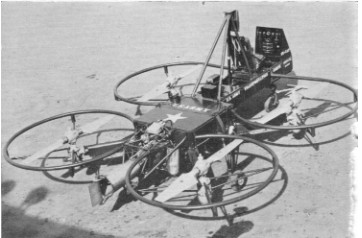
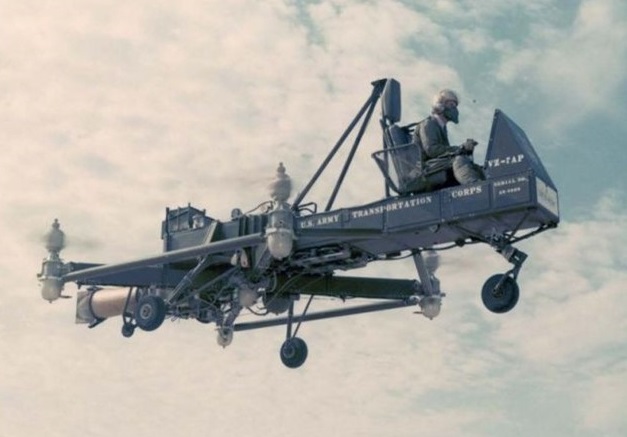
Soon after the U.S. Army ordered two VZ 7 aerial jeep research prototypes from the Aero¬physics Development Corporation, the company was absorbed by Curtiss Wright Corporation and became its Santa Barbara Division. The VZ 7 was originally designed as a ducted ¬fan type, like the VZ 6 and VZ 8, but it flew only with unshrouded rotors, of which it had four. This arrangement simplified the control system, since differential pitch on the rotors gave both pitch and roll control. For yaw control, a small rudder operated in the exhaust of the Turbomeca Artouste IIB shaft drive turbine. The VZ-7 was essentially consisting a rectangular central airframe to which four vertically-mounted propellers were attached in a square pattern. The central fuselage carried the pilot’s seat, flight controls, fuel and lubricant tanks, and a single 425shp Turbomeca Artouste IIB shaft turbine engine.
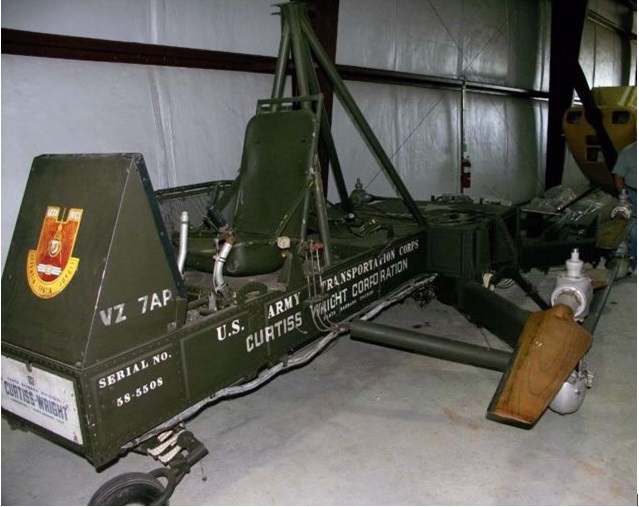
Curtiss-Wright’s Santa Barbara Division (formerly the Aerophysics Development Corporation) was awarded an Army contract in 1957 for the development and initial flight testing of two prototype aircraft. Two VZ 7s (58 5508 and 58 5509) were ordered by the Army but only the first was completed and delivered to the Army in mid-1958. It flew successfully during 1959 and 1960 and served its purpose of providing general information on this type of vehicle. The craft was capable of hovering and forward flight and proved relatively stable and easy to operate but was consistently incapable of meeting the altitude and speed requirements specified by the Army. The VZ-7 was withdrawn from service and returned to the manufacturer in mid-1960.
One of them still exists in storage at the United States Army Aviation Museum collection.
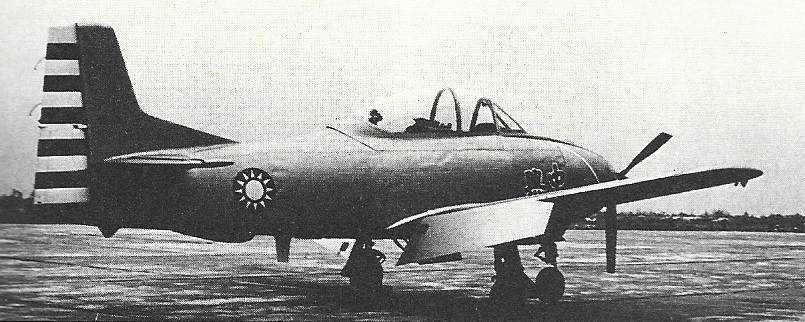
The Aero Industry Development Center of the Chinese Nationalist air force in Taiwan flew the XT-CH-1B prototype (63-3002) of the T-CH-1 Chung Hsing turboprop-powered basic trainer of indigenous design on 27 November 1974; this was a more advanced version of the XT-CH-1A prototype which had flown in November 1973.
A six seat high wing aircraft first flown in July 1994. Offered with 300-400 hp engine options, or (as the Turbine Stallion) with a P&W or Walter turboprop of around 500 shp.
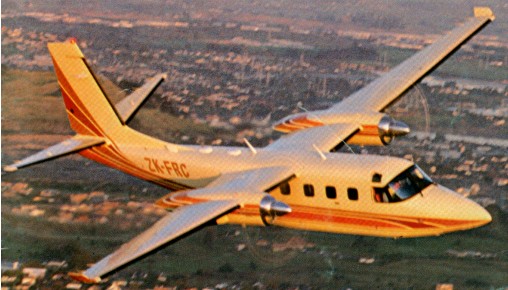
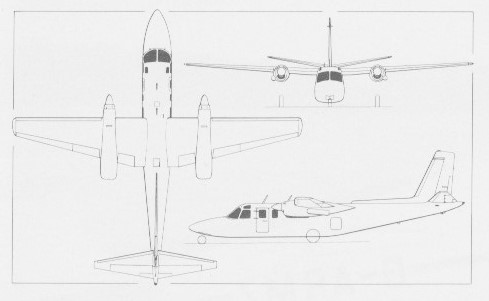
In 1980, an increase in turboprop sales led by the Jetprop 980 and Jetprop 840. The former carries up to eight persons and is powered by Garrett TPE-3331-10-501K turboprops. It is characterized by a 309 knot cruise, a 3,176-pound useful load, 5.2 psi pressurization, and enough fuel for a mission-efficient range of 2,040 run with reserves. The 840, powered by twin Garrett TPE-331-5-254K turboprops, boasts speeds up to 290 knots and a maximum range of 1,780 nm with reserves. Rockwell-developed high-technology sound control permits an easy conversation level in the cabins of both aircraft. Standard and custom cabin appointments permit the owner to outfit the interiors with hideaway tables, beverage servers, reclining chairs, telephones, and stereo systems. The numerical designations of the 840/980 denote maximum potential horsepower per side before derating to a common 700 shaft horsepower each. Both airplanes have Garrett TPE 331s: 10 on the 980 and 5 on the 840. The 980’s greater potential power translates into better climb above 10,000 feet, extra speed and a superior single engine ceiling. Fuel on the 690B was housed in 22 bladders holding 380 gallons, but the 840/980’s Garretts are fed by a more uniform system. Capacity has gone up to 420 USG, and the wings are wet outboard of the nacelles. Bladders (10 of them) remain in the inboard sections. The new layout cuts refuelling time by two thirds, but at the cost of numerous inspection panels for access to the wet bays. The void left by removal of the fuselage tank on the 840/980 has allowed the baggage volume to be almost doubled to 75 cubic feet. Absolute ceiling of the 980 is 39,900. The Commander 840 cruises at 267 knots at 31,000 ft. Maximum takeoff weight for the 290B, 840 and 980 is 10,325 pounds, but empty equipped weights for the new ones are down, by 295 pounds on the 840 (6,545 lb) and 255 on the 980 (6,585 lb). Rate of climb has changed little. On both engines, both new airplanes produce 2,840 fpm at sea level; with one dead at 5,000 feet, 900 fpm. Single engine ceiling, however, has risen on the 980 to 26,000 feet compared with 19,600 for the 690B and 20,400 for the 840.
AE-840 Engines: 2 x Garrett TPE-331-5-524K, 718 shp Props: Dowty Rotol 3-blade, 106-in Seats: 7/9 Length: 43 ft Height: 15 ft Wingspan: 52.1 ft Wing area: 279 sq.ft Wing aspect ratio: 9.8 Maximum ramp weight: 10,375 lbs Maximum takeoff weight: 10,375 lbs Standard empty weight: 6635 lbs Maximum useful load: 3740 lbs Zero-fuel weight: 8463 lbs Maximum landing weight: 9675 lbs Wing loading: 37 lbs/sq.ft Power loading: 7.2 lbs/hp Maximum usable fuel: 2848 lbs / 420 USG Rate of climb sea level: 2,840 fpm Certificated ceiling: 31,000 ft Max pressurisation differential: 5.2 psi 8000 ft cabin alt @: 23,900 ft Maximum single-engine rate of climb: 1003 fpm @ 115 kts SE ROC 5,000 ft: 900 fpm Single-engine climb gradient: 523 ft/nm Single-engine ceiling: 21,050 ft Maximum speed: 290 kts Normal cruise @ 31,000ft: 269 kts Fuel flow @ normal cruise: 378 pph Endurance at normal cruise: 7 hrs Max range with res: 1,780 nm Stalling speed clean: 77 kts Stalling speed gear/flaps down: 75 kts Turbulent-air penetration speed: 180 kts Baggage volume: 75 cubic feet Takeoff distance (50ft): 1,830 ft Landing distance (50ft): 2,050ft
AE-980 Engines: 2 x Garrett TPE-331-10-501K, 733 shp Props: Dowty Rotol 3-blade, 106-in Seats: 7/9 Length: 43 ft Height: 15 ft Wingspan: 52.1 ft Wing area: 279 sq.ft Wing aspect ratio: 9.8 Maximum ramp weight: 10,375 lbs Maximum takeoff weight: 10,325 lbs Standard empty weight: 6733 lbs Maximum useful load: 3642 lbs Zero-fuel weight: 8463 lbs Maximum landing weight: 9675 lbs Wing loading: 37 lbs/sq.ft Power loading: 7 lbs/hp Maximum usable fuel: 3176 lbs / 420 USG Best rate of climb: 2777fpm Certificated ceiling: 31,000 ft Absolute ceiling: 39,900 ft Max pressurisation differential: 5.2 psi 8000 ft cabin alt @: 23,900 ft Maximum single-engine rate of climb: 982 fpm @ 115 kts Single-engine climb gradient: 512 ft/nm Single-engine ceiling: 24,850 ft Maximum speed: 309 kts Normal cruise @ 31,000ft: 295 kts Fuel flow @ normal cruise: 444 pph Endurance at normal cruise: 6.6 hrs Stalling speed clean: 77 kts Stalling speed gear/flaps down: 75 kts Turbulent-air penetration speed: 180 kts Takeoff distance (50ft): 1,830 ft Landing distance (50ft): 2,150 ft Baggage volume: 75 cu.ft
Commander 980 Engines: 2 x Garrett TPE 331 10, 980 shp Props: Dowty Rotol 3 blade, 106 in. dia TBO: 3, 000 hrs Length: 43 ft Height: 15 ft Wingspan: 52 ft Wing area: 280 sq. ft Max ramp wt: 10,375 lbs Max takeoff wt: 10,325 lb Std empty wt: 6,298 lb Max useful load: 4,027 lb Max landing wt: 9,675 lb Wing loading: 36.96 lb/sq.ft Power loading: 7.22 lb/hp Max usable fuel: 420 USG/2,814 lb Max rate of climb, sea level: 2,840 fpm Max rate of climb, 8,000 ft: 2,710 fpm Max operating altitude: 31,000 ft Single engine rate of climb, sea level: 1,010 fpm Single engine climb gradient, sea level: 578 ft/nm Single engine service ceiling: 26,000 ft Max speed: 315 kts Cruise, max cruise power at 31,000 ft: 300 kts Fuel flow at max cruise power: 492 pph Endurance at max cruise power, no res: 5.7 hrs Stalling speed, clean: 77 kts Stalling speed, flaps down: 75 kts Turbulent air penetration speed: 184 kt
Design changes within the 1000 enabled greater interior space without changing the exterior fuselage dimensions. Cabin length was increased 2.9 feet and the cabin floor lowered nearly four inches to give a cabin height of 4.8 feet. A heavier structure was required all round to take the higher differential and the bottom exterior fuselage skins, replacing the floor of the former pressure vessel, were strengthened. Two aspects highlighted by the changes are the requirement to keep the rails extending the passenger steps clean and the now curved rear pressure bulkhead. The cleanliness of the rails prevents any damage to the seals and resultant loss of cabin pressure. In the 1000 the rear pressure bulkhead is curved, with the rearmost point being almost 3 feet further aft; the additional area accommodating the flushing toilet, small (100 lb maximum) baggage area and refreshment centre.
695A / 1000 Engines: 2 x AiResearch TPE 331-10-501K, 820 SHP. MTOW: 11,200 lb Press diff: 6.7 psi. Max SL alt: 15,900 ft
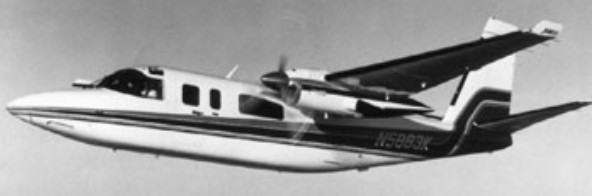
The Turbo Commander first appeared in 1965 as a pressurized version of the Grand Commander. Power was supplied by twin 605-shp AiResearch turboprop engines, each driving a three-blade constant-speed reversible-pitch propeller. This model became known as the Turbo Hawk and was built until 1971 when it was replaced by the Turbo Commander 681B, another pressurized version similar to the Shrike Commander, with 717-shp powerplants. The 690 Turbo Commander first flew on 3 March 1969. The North American Rock¬well Turbo Commander 690 was certificated at a gross weight of 10,250lb/4,650kg, in 1972, a payload improvement of 340lb, 155kg. Announcing the increase, the manufacturer stated that the 690, fully equipped, can carry seven people and full fuel tanks giving a range of 1,790 statute miles.
Turbo Commander 681B
In 1964 Aero Commander offered to fit oversize panoramic cabin windows to their Grand Commander at an extra cost of $6000.
The Turbo Commander cabin can be pressurized to 5.2 psi and the operational ceiling is 31,000 feet. Interior temperature is controlled by a high-volume climate system, and heated windshields provide maximum visibility in all weather conditions. The Turbo Commander is also certified for flight into known-icing conditions, and all deicing equipment is standard. While the 690A is just minutes slower that most business jets on a 900- to 1,000-mile business trip, fuel consumption is about 50% less.
The combination of reversible props, tough landing gear, high-wing, and 14-inch prop clearance are custom-tailored for short, rough landing strips. Engines that are flat-rated from 840 shp, to a nominal 700 shp help the 690A climb directly to the best cruise altitude without lengthy step climbing.
Aero Commander 681B N9004N
The 690B was offered in the Executive I and Executive II models. Many features that are usually considered optional are standard equipment in the Executive I, including avionics and cabin accommodations. The Executive II was for owners who wanted to select their own avionics and interior appointments.
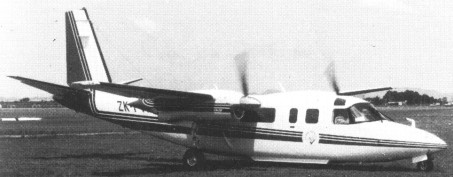
After hit¬ting a high of 50 airplanes in 1974, produc¬tion waned, and production was reduced by 1978. Rockwell offered the Shrike in an Esquire version. It was a deluxe model that fea¬tured opulent interiors. The only options in an Esquire II are Rajay turbocharging and air conditioning. Complete deicing, a super plush interior, prop synchro¬nizer, everything from the radar in the nose to the DeVore Tel Tail lighting of the vertical fin is standard equipment. Price, 1978: $329,500.
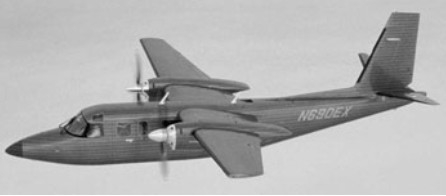
690EX
Turbo Hawk Engine: 2 x AiResearch turboprop 605-shp Gross weight: 9,400 lb Prop: 3-blade constant-speed reversible-pitch Empty weight: 5,783 lb Fuel capacity: 286-337 USG Top speed: 290 mph Cruise speed: 280 mph Stall speed: 94 mph Initial climb rate: 2,025 fpm Ceiling: 25,000 ft Range: 1,094 sm Takeoff dist (50ft): 1,975 ft Landing dist (50ft): 1,200 ft Seats: 8-10
681B Engines: 2 x AiResearch TPE 331-43BL 605-shp Wingspan: 44 ft 0.75 in / 13.43 m Length: 42 ft 11.74 in / 13.10 m Empty weight: 5,647 lb / 2561 kg MTOW: 9,400 lb / 4265 kg Fuel capacity: 286-337USG Top speed: 290 mph Max cruise speed: 278 mph / 241 kt / 447 kph Stall speed: 94 mph Initial climb rate: 2,007 fpm / 612 m/min Service ceiling: 25,600 ft 7800 m Range std fuel 21,000ft/6400m 221kt/254mph/409kph: 1,062 sm / 922 nm / 1709 km Range max fuel 21,000ft/6400m 221kt/254mph/409kph: 1,315 sm / 1141 nm / 2116 km Takeoff dist (50′): 2,016 ft Landing distance (50′): 1,200 ft Seats: 8-9 Baggage capacity: 500 lb / 227 kg
690A Engines: 2 x Garrett, 700shp TBO: 3000hr Max cruise: 285mph Econ cruise: 250mph Stall: 77mph Fuel cap: 2573lb Service ceiling: 33,000ft SE service ceiling: 19,700ft ROC: 2849fpm SE ROC: 893fpm Min field length: 1666ft Payload with full fuel: 1252lb Max range: 1767sm Pressurisation diff: 5.2psi High speed range: 1234sm Max payload: 1573lb Range max payload: 748sm Seats: 9. Gross wt: 10,300lb Equipped empty wt: 6475lb Useful load: 3285lb
690B Engines: 2 x Garrett/AiResearch TPE 331 5 251K, 700 shp. TBO: 3,000 hrs Props: constant speed, three blade, reversible. Length: 44 ft. 4 in Height: 14 ft 11 in Wingspan: 46 ft 8 in Wing area: 266 sq ft Wing loading: 38.82 lb/sq.ft Power loading: 7.37 lb/shp Empty wt: 6,840 lb Max TO weight: 10,250 lb Useful load: 3,535 lb Payload with full fuel: 962 lb Max ramp wt: 10,375 lb Usable fuel cap: 384 USG/2,573 lb Max landing wt: 9,675 lb Max rate of climb: 2,821 fpm. SE ROC: 878 fpm. Operational ceiling: 31,000 ft SE service ceiling: 19,600 ft Stalling speed, clean: 82 kts SE climb gradient 115 kts (Vy): 460 fpm Max cruise at 18,000 ft: 286 kts Duration at max cruise: 4.37 hrs Stalling speed, full flaps: 77 kt Long range cruise 31,000 ft: 250 kts. Top speed: 30 mph Duration at long range cruise: 6.55 hrs. Pressurization differential: 5.2 psi 10,000 ft. cabin at: 27,000 ft Seats: 7-10 Takeoff distance (50ft): 1,666 ft Landing distance (50ft): 2,084 ft
Shrike Engine: 2 x Lycoming IO-540-E1B5, 290 hp. Seats: 7 Wing loading: 26.47 lb/sq.ft Pwr loading: 11.63 lb/hp Gross wt: 6750 lb Empty wt: 6735 lb Equipped useful load: 1769 lb Payload max fuel: 854 lb Range max fuel/cruise: 671nm/3.8hr Ceiling: 19,400 ft Range max fuel /range: 813nm/5.1hr 55% cruise: 161 kt Vmc: 65 kt Stall: 59-68 kt 1.3 Vso: 77 kt ROC: 1340 fpm SE ROC: 266 fpm @ 94 kt SE ceiling: 6,500 ft Min field length: 1915 ft Fuel cap: 915 lb
Esquire II Engines: 2 x Lycoming IO 540 E1B5, 290 hp Propeller: three blade, constant speed, 80 in. dia. TBO: 1,400 hrs Length: 36 ft. 10 in Height: 14 ft. 6 in Wingspan: 49 ft. 6 in Wing area: 255 sq.ft Wing loading: 26.47 lb/sq.ft Power loading: 11.63 lb/hp Seats: 6 Empty weight: 5,136 lb Useful load: 1,614 lb Payload with full fuel: 628 lb Gross weight: 6,750 lb Usable fuel capacity: 156 USG/936 lb Maximum speed: 187 kts Service ceiling: 19,400 ft Maximum rate of climb: 1,340 fpm Single engine ROC: 266 fpm SE service ceiling: 6,500 ft Duration at max cruise: 4.8 hrs Stalling speed, clean: 68 kt Stalling speed, full flaps: 59 kt SE climb gradient at 93 knots (Vy): 171 ft/nm. Max cruise, 75% power at 9,000 ft: 176 kts
690 Turbo Commander Engines: 2 x 700hp TPE-331-5-251K
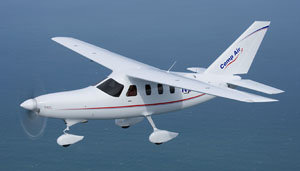
Offering an 8+2 standup cabin, with an enclosed lav, the Comp Air 12 will cruise at 310 knots, and can fly from just about anywhere to anywhere in the United States, non-stop. Constructed as an all carbon composite, single-engine, turboprop aircraft.
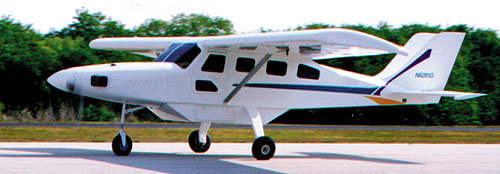
The aircraft is a kit set, amphibious floatplane constructed from composite materials and powered by a Walter tur¬bine. Aerocomp claim that the aircraft can take off in only 250 feet (in 3-4 sec¬onds) with a full fuel load and five peo¬ple on board, climb at 2,000 ft/min and cruise at 160 knots (TAS). One of the air-craft’s more distinguishing features is its twin vertical stabilisers. This aircraft can seat 8 adults, with room left over for baggage with inside cabin dimensions of 13 feet x 5 feet (9 feet available aft of the front seats). Powered by the 657 shp Walter M601D turboprop, it cruises between 175 and 200 mph TAS (depending on loading, altitude, power setting, etc). The Comp Air 10 features modern all-composite construction, and is available in tricycle, tailwheel, or float configuration. Numerous options are available to custom-tailor this airplane to your own specifications.
Engine: Walter M601D, 657 hp TBO: 1500 hr Wingspan: 36 ft 6 in /11.4m Length: 31 ft / 9.6m Height: 8 ft 8 in Wing area: 242 sq.ft. Wing loading: 21.6 lb/sq.ft. Pwr loading: 7.9-9.1 lb/hp. MAUW: 5200-6000 lb Empty wt: 2750-3150 lb Useful load: 2450-3000 lb Payload full fuel: 1300-2000 lb Useable fuel: 120-180 USG Undercarriage: Nose or tail Wheel track: 110 in Wheel size: 8.00×6 Seats: 8 Cabin doors: 3 Cabin width: 60 in Cabin height: 53 in Baggage cap: 300 lb Prop: Avia CS. FR. 65% cruise: 175 mph 75% cruise: 192 mph Range 65% cruise no res: 795 sm Range 75% cruise no res: 672 sm Fuel burn 65%:33 USG/hr Fuel burn 75%:38 USG/hr Endurance (30min res): 3.7 hr Stall clean: 51-61 kts Stall flaps: 46-54 kts ROC: 800-2000 fpm TO Ground roll: 250-500 ft Landing ground roll: 700 ft


 All Aero