Turboprop
Cycle: Continuous
Cooling: Air
Reduction: Mechanical gear
Reduction Ratio: 17.12-1
Weight: 45 kg
Max pwr: 75 hp
Price 1998: 15,500 DM
Turboprop
Aerotec Aircraft
1998:
Lenska 97
CZ-76314 Stipa
Czech Republic
Turbine engine builder
Aerospatiale TB.30 Epsilon / Omega

In September 1978 details were given of the Aerospatiale TB-30 piston-engined trainer, designed as a basic light trainer, in collaboration with the Armee de l’Air in response to rising costs before starting jet training. Features include a metal airframe with a life in the military training role of not less than 10,000 hours, a cockpit resembling that of a jet combat aircraft, and equipment for full basic flying training, including aerobatic, instrument, night, formation, navigation, combat manoeuvres and VFR/IFR navigation.
Aerospatiale TB.30 Epsilon Article
The first of two prototypes flew on 22 December 1977, but delays were caused by redesign of the wingtips, lowering the tail-plane and adding a ventral fin to cure high speed pitch and yaw instability.
Deliveries beginning in 1982 from SOCATA, the Aerospatiale subsidiary at Tarbes for the Armee de l’Air, the first of 150 aircraft to the French Air Force was accepted in July 1983.
An armed export version of the Epsilon, featuring structural reinforcement, a gunsight, and four under-wing hardpoints to carry up to 300kg of stores, flew in February 1983.
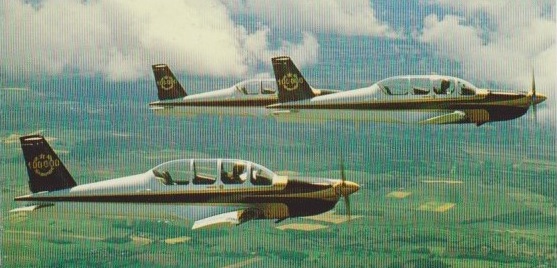
Assembled by OGMA for the Forca Aerea Portuguesa, 18 of the piston-engined Epsilon were ordered by Portugal in October 1987. The Togolaise Air Force operated three Epsilons for dual training/light attack use, with four underwing pylons for a total of 661 lb (300 kg) of stores. Powerplant is a 300 hp (224 kw) Lycoming AEIO-540-L1B5D.
On November 9, 1985, an Epsilon flew powered by a TP-319 turboprop. The aircraft was being used as a testbed for the engine, which has been developed by Turbomeca from the TM-319 turboshaft.
On 30 April 1989 SOCATA flew the first example of its turboprop-powered Omega trainer.
Omega is the outcome of re-engining the Epsilon using a 360 shp (269 kW) Turbomeca TP319-1A2. To familiarise students with future jet aircraft, engine power and propeller settings are controlled through a single lever and there is a 31 per cent increase in fuel capacity, allowing Omega to fly two full training missions without refuelling. The airframe has been strengthened to cope with the higher acrobatic weight.
Epsilon
Engine: 1 x Lycoming AEIO-540-L1B5D, 300 hp (224 kW)
Epsilon
Engine: 1 x Avco Lycoming AEIO-540-K, 225 kW
Span: 7.9 m / 25 ft 11 in
Length: 7.6 m / 24 ft 11 in
Height: 2.7 m / 8 ft 10 in
Wing area: 9 sq.m / 96.88 sq ft
Empty wt: 932 kg
MTOW: 1250 kg
Max. speed: 355 km/h / 221 mph
Ceiling: 6100 m / 20000 ft
Initial ROC: 565 m / min
Ceiling: 7000 m
T/O run (to 15m): 640 m
Ldg run (from 15m): 440 m
Fuel internal: 210 lt.
Range/Endurance: 1250 km / 3.75 hr
Combat radius: 465 km.
Omega
Engine: 1 x Turbomeca TP319-1A2, 360 shp (269 kW)
Aero Spacelines 377MGT Mini Guppy Turbo / Guppy-101
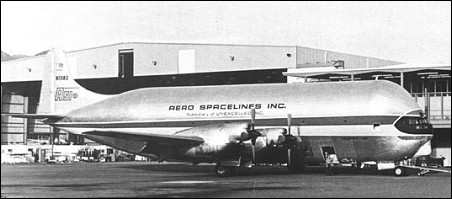
Aero Spacelines developed the turboprop conversion on the 377MGT first, then used the same conversion on the more successful Super Guppys.
The 1970 Guppy-101 was from a rebuilt from Boeing Stratocruiser with four 4900hp Allison 501-D22C turboprops. It was the first with the opening nose section.
The 377MGT Mini Guppy Turbine, first flew on March 13, 1970, but was involved in an accident at Edwards Air Force Base on May 12, 1970. With the crash of the 377MGT and the shrinking budgets, Aero Spacelines found itself no customers for the 377MGT.
Guppy-101
Engine: 4 x Allison 501-D22C turboprops, 3510kW
Take-Off Weight: 81500 kg / 179678 lb
Empty Weight: 41270 kg / 90985 lb
Payload: 28500kg / 62832 lb
Wingspan: 47.6 m / 156 ft 2 in
Length: 41.3 m / 135 ft 6 in
Aero Spacelines 377SG Super Guppy / Guppy-201
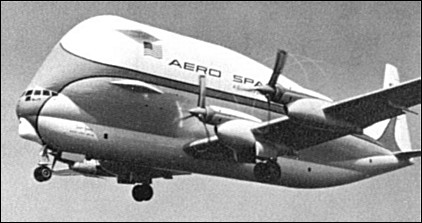
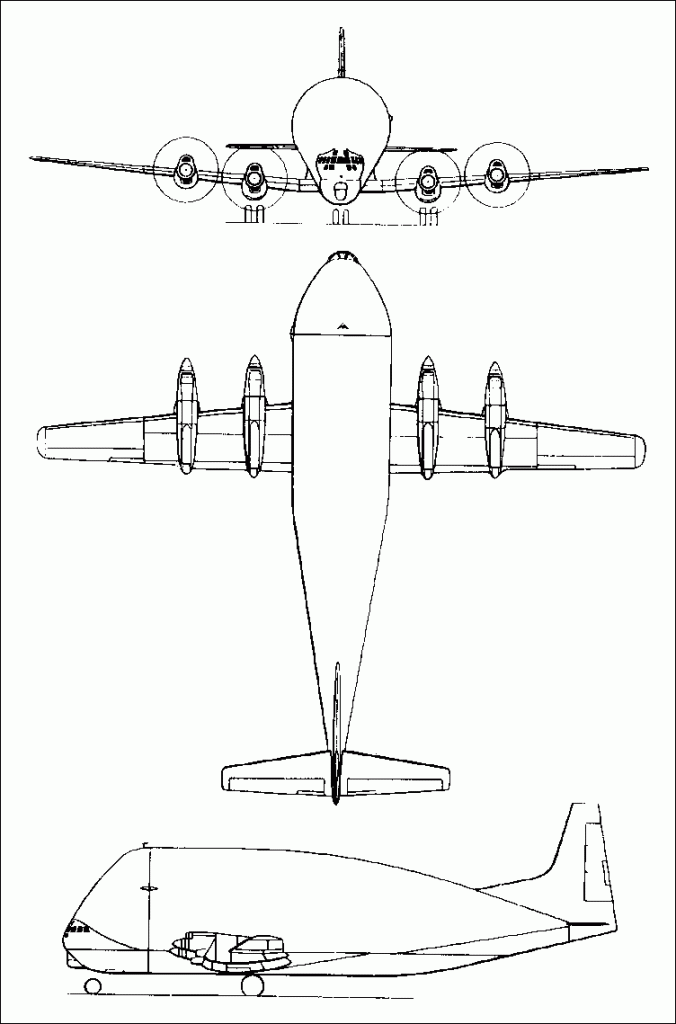
Following the B-377PG Pregnant Guppy was the larger B-377SG Super Guppy of 1965. Ex-USAF YC-97J was modified by adding wing root plug, stretching fuselage 30’10”, and adding huge new upper fuselage lobe with interior radius of 25′. Nose of fuselage pivoted to allow cargo loading. This featured an outsize fuselage with a cargo compartment measuring 33.17m in length, 7.62m in width, and 7.77m in height, and an increased wing span and four 5220kW turboprop engines.
The sole Guppy-201 built, N1038V, first flew on 31 August 1965.
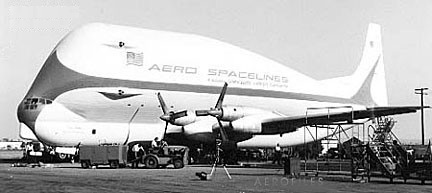
The only aircraft able to carry the third stage of a Saturn V launch vehicle, and the Lunar Module adapter, this Super Guppy was also used in the American space programme.
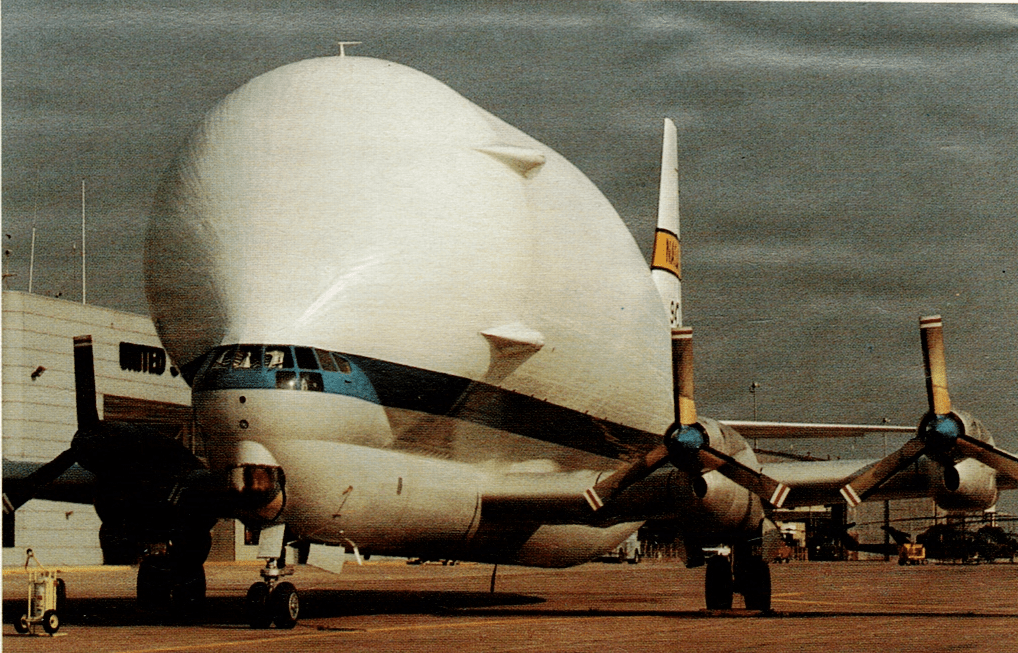
Displayed at Pima County Air Museum, Tucson AZ.
377SG “Super Guppy”
Engine: 4 x Pratt-Whitney T-34P7 turboprops, 4500kW
Take-Off Weight: 79400 kg / 175048 lb
Empty Weight: 47600 kg / 104941 lb
Payload: 18500 kg / 40786 lb
Wingspan: 47.7 m / 156 ft 6 in
Length: 43.1 m / 141 ft 5 in
Height: 11.7 m / 38 ft 5 in
Max. Speed: 480 km/h / 298 mph
Ceiling: 6000 m / 19700 ft
Crew: 3-4
Aero Spacelines 377GT Guppy 201

The Guppy 201 utilizes the lower fuselage, wings, tail unit and cockpit of a Boeing 377/C 97, with portions of the lower fuselage of several aircraft being joined to provide a larger cabin with interior diameter of 25′. Upper fuselage lobe added to stretched C-97 fuselage, plus parts from Airbus, Concorde, DC-10, and TriStar; engines from retired Lockheed Electras.
Although this Super Guppy is very close in dimensions to the original Super Guppy, the shape of the fuselage has a smoother flow and engine nacelles are completely different.

The first 377SGT Super Guppy Turbine flew on August 24, 1970. After success with the first of the 377SGTs, Aero Spacelines built a second 377SGT and it flew exactly two years later on August 24, 1972.
Aero Spacelines originally planned to build and operate the MGT and SGT aircraft but after the company got into serious financial trouble a decision was made to sell the SGT to Airbus Industrie.
Two were built by Aero Spacelines in early 1970s, N211AS and N212AS, and sold to Airbus Industrie/Aérospatiale to haul components of A300Bs and Concordes.
Two were built in early 1980s for Airbus by UTA Industries in France. Retired by Airbus in early ’90s; reportedly three went to European museums, and the last one was bought by NASA.

The Super Guppy Turbine (NASA’s B377SGT), super-sized cargo plane flown since 1980 was acquired by NASA in 1997. Its home base, was the Ellington Field, near the Johnson Space Center in Lancaster, California.

Guppy 201
Engines: 4 x Allison 501-D22C, 3663kW / 4912shp
Take-Off Weight: 77111 kg / 170002 lb
Empty Weight: 45359 kg / 100000 lb
Payload: 25000kg / 55116 lb
Wingspan: 47.63 m / 156 ft 3 in
Length: 43.84 m / 143 ft 10 in
Height: 14.78 m / 48 ft 6 in
Wing Area: 182.51 sq.m / 1964.52 sq.ft
Max. Speed: 460 km/h / 286 mph
Cruise Speed: 407 km/h / 253 mph
Ceiling: 7620 m / 25000 ft
Range W/Max.Payload: 813 km / 505 miles
Aeroric Dingo
Aeroric Science and Production Enterprise has developed the Dingo passenger (up to nine seats) or cargo amphibious lightplane of unusual design, featuring an air cushion landing system which enables it to land on any surface; has twin-boom tail unit and single turboprop engine with pusher propeller. Mock-up displayed 1992, and prototype displayed in 1995 in incomplete form but not flown by 1998.
Aeroprogress T-720
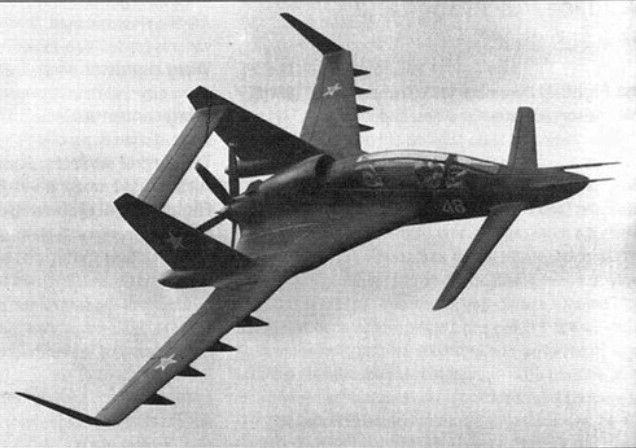
The Aeroprogress T-720 was a projected lightweight two-seat combat aircraft with 8 underwing pylons and an under fuselage gun-pod.
Engine: 1 x RKBM TVD-1500 turboprop, 1300 shp / 970 kW
Prop: 6 blade
MTOW: 9920 lb / 4500 kg
Max speed: 405 kt / 466 mph / 750 kph
Range: 756 nm / 870 miles / 1400 km
Aeroprogress T-440 Mercury
A twin engined turboprop business aircraft.
Aeroprogress in the USA offers the T-440 Mercury.
Aeroprogress T-101 Gratch
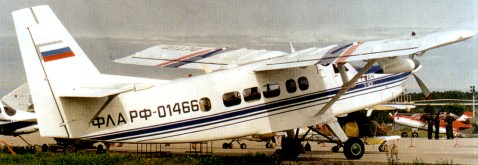
The prototype Gratch (Rook) was first flown in December 1994 but no certification work had begun by 2001.
Aeroprogress in the USA offers the T-101 Gratch 10-seat civil/military STOL transport (first flown 1994).
Engine: 1 x TVD-10B Turboprop
Pax cap: 9 + 400 kg / 880 lb
 All Aero