Over the years several efforts were made to improve the An-2 and several turbine engined versions have appeared.
ASTC (Antonov Aeronautical Scientific and Technical Complex) was the first to launch a turbine-powered variant. Design studies started in 1972 and in 1979 a photo was released of a modified An-2 (CCCP-30576) fitted with a 960 hp Glushenko TVD-10B turbine engine. Designated An-3, it was followed by a second test aircraft, now with a more powerful 1,430 hp Glushenko GTD-20. The upgraded variant was planned for production in several versions, but in the end no production aircraft were built.
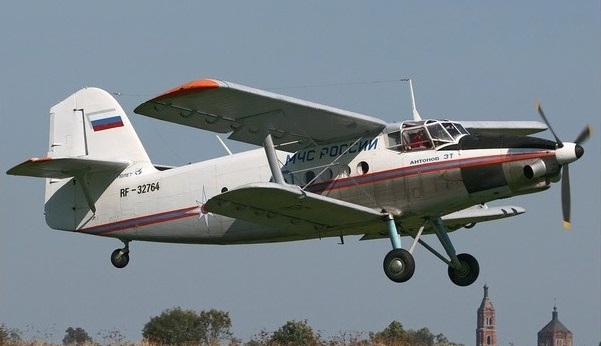
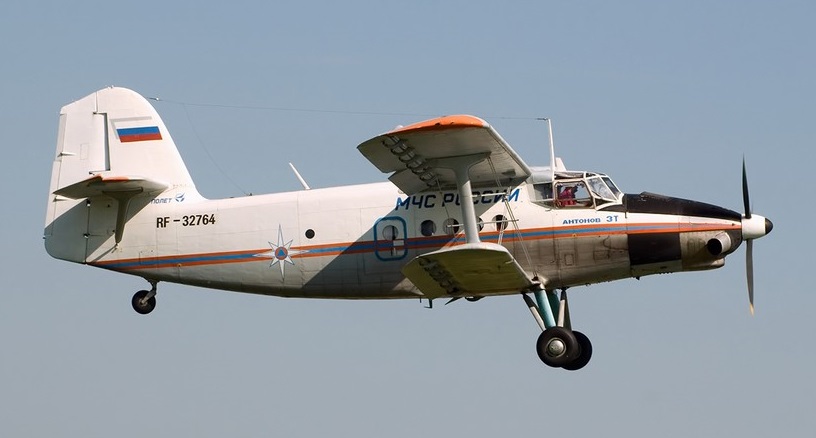
The An-3T was more or less a revival of the An-3 and was developed by Omsk-based Polyot State Aerospace Enterprises, reportedly in co-operation with ASTC. The first An-3T made its maiden flight on February 10, 1998, powered by a 1,375 hp Omsk (Glushenko) TVD-20M turbine. The An-3T had several changes compared to the original An-3 such as the larger An-2M vertical tail, a extra partition between the cockpit and cabin, and was mainly intended for transport work, rather than as ag-plane. No new An-3Ts were built, but the twenty or so that were completed were modified from An-2 airframes which had sufficient structural life left. Plans for production of the An-3T in Poland were abandoned.
An-3T
The An-3-300 designation was reported for a 2012 joint-venture of Tyumen Plant no.26 (Russia) and engine manufacturer Motor Sich (Ukraine) for a Motor Sich MS-14 turbine engine powered version. The joint-venture fell through and instead the Antonov Company developed the An-2-100 which had a 1,500 hp MS-14 engine. A prototype first flew on July 10, 2013 and the upgrade was mainly aimed at the many An-2s that were still in operation in countries such as Belarus, Uzbekistan, Kazakhstan, Russia etc.
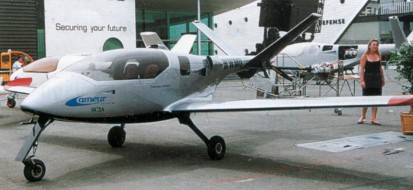
There was a range of four models based on the same body structure, the ultralight, the two- and four-seat versions, and the Altajet. The aircraft has a composite structure with retractable undercarriage and was built as a joint venture with Ameur and Slicom. The SC2A is a rear mounted turboprop.
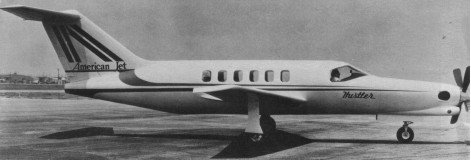
Unveiled at American Jet Industries plant in Van Nuys, California, in October, 1975, the seven place Hustler 400 turboprop/ turbojet has been modified since announcement was made. A major change was the redesign of the tail to a “T” tail configuration, and other changes include an increase of 52 inches in the wing span and installation of double slotted Fowler flaps on the supercritical wing. Sixteen inches have also been added to the fuselage. An 850 shp United Aircraft of Canada turboprop PT6A 41 in the nose provides power for the Hustler while the Teledyne turbojet engine will be used for standby’ power in the event of an engine failure. According to American Jet’s data the standby engine will enable the aircraft to maintain an airspeed of 170 mph at 13,500 feet with the nose turboprop engine feathered. A top speed of 380 mph for the Hustler is predicted with a maximum range of 2970 miles. Three prototypes were under construction at the American Jet California facility; two were to be used for flight testing and the third for ground structural testing. The Hustler faces some serious hurdles; for instance, no certificated jet engine of the size required by the design existed. Only various engines used for APUs, missiles or drones. If, on the other hand, a “single engine” classification were sought, the jet engine being viewed merely as a JATO unit, then the Hustler would face the challenge of making the FAA’s 70 mph landing speed requirement with a wing loading of at least 36 pounds per square foot. The Hustler was powered by a Pratt & Whitney PT6A-41 turboprop in the nose and a standby turbojet in the tail and made its first flight on January 12, 1978. Gulfstream American decided to replace the 850 shaft horsepower Pratt & Whitney PT6 turboprop engine in the nose of the Hustler with a 900 shp Garrett TPE331. The Pratt & Whitney JT15D remains Gulfstream’s choice for the Hustler’s rear mounted turbofan. Maximum takeoff weight was been increased to 10,000 from 9,500. Flight testing of the Gulfstream American Hustler 500 began late in January 1981 at Van Nuys, California, and continued at Mojave. This second Hustler prototype was powered by a 900 shp Garrett AiResearch TPE 331 10 501 turboprop in the nose and a 2,200 lb st (1000 kgp) Pratt & Whitney JT15D 1 turbofan in the tail.
Hustler 400 A Engine: Pratt&Whitney PT6A-41, 838 shp & Teledyne turbojet Length: 37.795 ft / 11.52 m Height: 10.761 ft / 3.28 m Wing span: 32.644 ft / 9.95 m Wing area: 185.141 sq.ft / 17.2 sq.m Max take off weight: 7497.0 lb / 3400.0 kg Weight empty: 3999.9 lb / 1814.0 kg Cruising speed: 343 kts / 636 kph Wing load: 40.59 lb/sq.ft / 198.0 kg/sq.m Range: 1303 nm / 2414 km Crew: 1 Payload: 6 Pax
Hustler 500 Engine: 1 x Garrett AiResearch TPE 331 10 501, 900 shp turboprop & 1 x Pratt & Whitney JT15D 1 turbofan 2,200 lb st (1000 kgp)
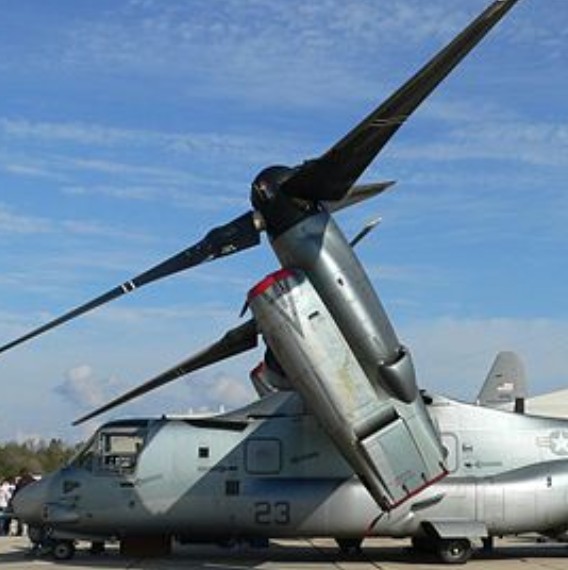
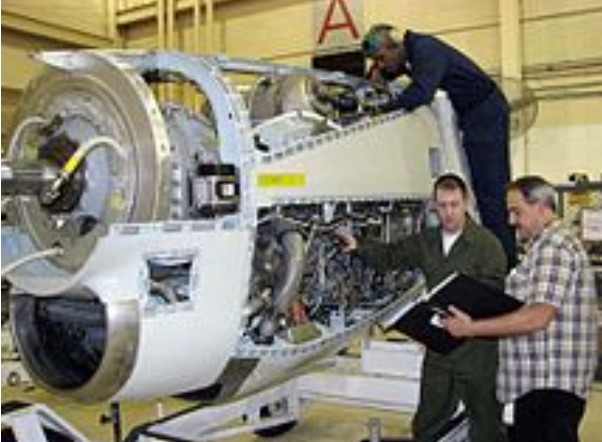
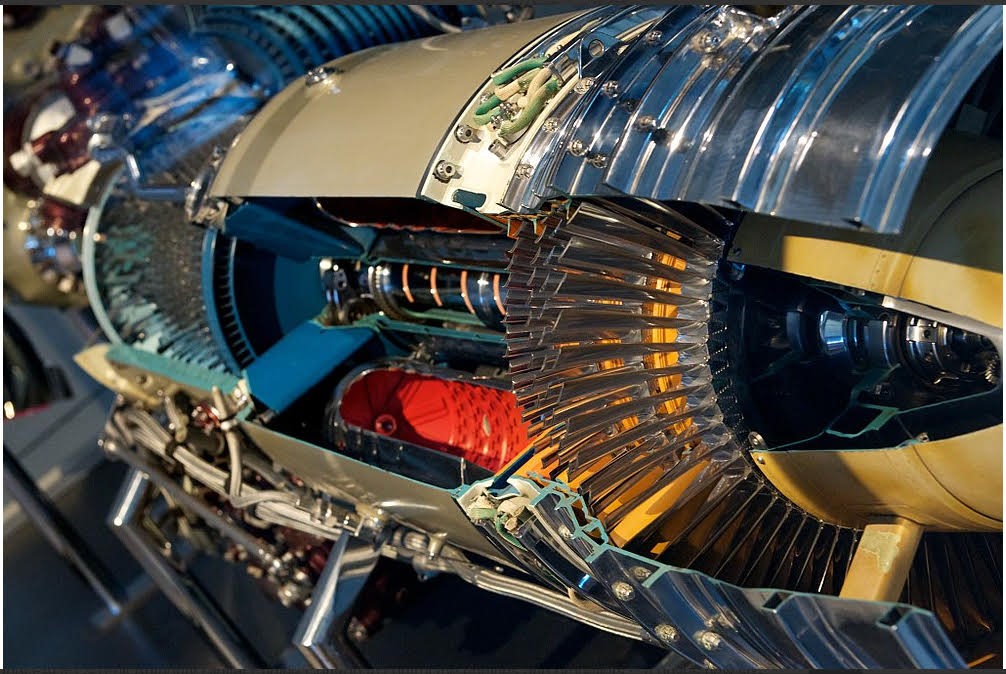
The Rolls-Royce T406 (company designation AE 1107C-Liberty) is a turboshaft engine which powers the Bell-Boeing V-22 Osprey tiltrotor. The engine delivers 6,000 shp (4,470 kW) and shares a common core with the AE 3007 and AE 2100 series of engines.
The V-22’s T406 powerplants are housed in wing-tip tilting nacelles, allowing the distinctive flight characteristics of the V-22. For take off and landing the nacelles are directed vertically (90° to fuselage), while for forward flight they are rotated parallel to fuselage.
In April 2012, the DoD ordered 70 AE 1107C engines for the Osprey, with options for up to 268 engines.
Applications V-22 Osprey
Specifications: T406 Type: Turboshaft Length: 78.1 in (1,980 mm) Diameter: 34.2 in (890 mm) Dry weight: 971 lb (440 kg) Compressor: 14-stage high pressure axial compressor Turbine: 2-stage high pressure and 2-stage power turbine Maximum power output: 6,150 shp (4,586 kW) Overall pressure ratio: 16.7:1 Power-to-weight ratio: 6.33 shp/lb (10.4 kW/kg)
The Allison T56 is a single shaft, modular design military turboprop with a 14 stage axial flow compressor driven by a four stage turbine. It was originally developed by the Allison Engine Company for the Lockheed C-130 transportentering production in 1954 but was produced under Rolls-Royce which acquired Allison in 1995. The commercial version is designated 501-D. With an unusually long and numerous production run, over 18,000 engines have been produced since 1954, logging over 200 million flying hours.
The engine evolved from Allison’s previous T38 series. It was first flown in the nose of a B-17 test-bed aircraft in 1954. Originally fitted to the Lockheed C-130 Hercules, the T56 was also installed on the P-3 and E-2/C-2 aircraft, as well as civilian airliners such as the Lockheed Electra and Convair 580. A shipboard version, the 501K engine, is used to generate electrical power for all U.S. Navy cruisers and destroyers currently in commission.
More than 18,000 have been built.
Allison T56
In the Lockheed Martin C-130J Super Hercules which first flew in 1996, the T56 is replaced by the Rolls-Royce AE 2100, which uses dual FADECs (Full Authority Digital Engine Control) to control the engines and propellers. It drives new six-bladed scimitar propellers from Dowty Rotol.
Variants:
501-D13 (Series I) Lockheed L-188 Electra and Convair CV-580 (Replacing P & W R-2800) starting December 1957
501-D13A (Series I) Similar to -D13
501-D13D (Series I) Similar to -D13
501-D13H (Series I) Similar to -D13
501-D22 (Series II) Lockheed L-100 Hercules
501-D36A (Series II) (non-type certified)
501-D22A (Series III)
501-D22C (Series III) similar to -D22A
501-D22G (Series III) similar to -D22A
501-M62 Company designation for the T701-AD-700 Turbo-shaft engine to power the Boeing-Vertol XCH-62 Heavy-lift helicopter.
T56-A-7 (Series I)
T56-A-8 (Series I)
T56-A-9 (Series I)
T56-A-9D (Series I) Lockheed C-130A Hercules Starting December 1956 and on all Grumman E-2A Hawkeyes from 1960
T56-A-9E (Series I) Similar to -A-9D
T56-A-10W (Series I) with water injection
T56-A-7A (Series II) Lockheed C-130B Hercules Starting May 1959
T56-A-7B (Series II) Similar to -A-7A
T56-A-10WA (Series II)
T56-A-14 (Series III) Lockheed/Kawasaki P-3/EP-3/WP-3/AP-3/CP-140 Aurora from August 1962
T56-A-15 (Series III) Lockheed C-130H Hercules from June 1974
T56-A-16 (Series III)
T56-A-425 (Series III) Grumman C-2A Greyhound from June 1974
T56-A-14+ (Series III.V) Fuel efficiency and reliability upgrade
T56-A-15+ (Series III.V)
T56-A-16+ (Series III.V)
T56-A-425+ (Series III.V) Northrop Grumman E-2 Hawkeye from August 2011
T56-A-427 (Series IV) Northrop Grumman E-2 Hawkeye upgrades from 1972
T56-A-427A (Series IV) similar to the -A-427
T701-AD-700 (501-M62) Turbo-shaft engine for the Boeing-Vertol XCH-62 Heavy-lift helicopter.
Applications: Lockheed Martin C-130 Hercules Lockheed P-3 Orion Northrop Grumman E-2 Hawkeye Grumman C-2A Greyhound Convair 580 and Convair 5800 Lockheed L100 Hercules Lockheed L-188 Electra Lockheed R7V-2 Constellation – Done for testing the model 501D for use on the L-188 Electra. Was nicknamed “Elation” during testing. Aero Spacelines Super Guppy
Specifications:
T56 Series IV Type: Turboprop Length: 146.1 in (3,711 mm) Diameter: 27 in (690 mm) Dry weight: 1,940 lb (880 kg) Compressor: 14 stage axial flow Combustors: 6 cylindrical flow-through Turbine: 4 stage Fuel type: JP8 2412 pounds per hour Maximum power output: 4,350 shp (3,915 kW) limited to 4,100 Turbine inlet temperature: 860°C Power-to-weight ratio: 2.75:1 (shp/lb)
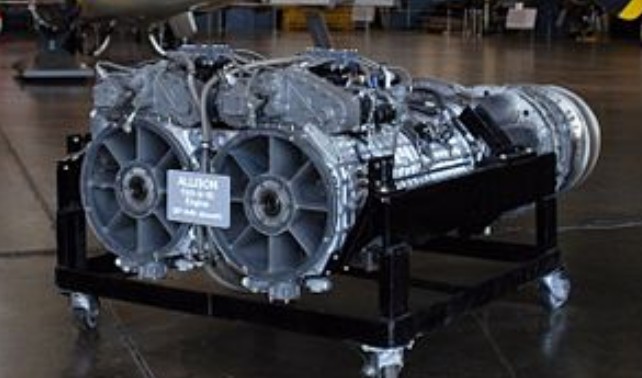
The Allison T40, company designation Allison Model 500, was an early American turboprop engine composed of two Allison T38 power sections driving a contra-rotating propeller via a common gearbox.
The T40 concept originated at Allison in 1944, where design studies were carried out on a 4,000 shp (2,983 kW) turboprop engine. Taking advantage of this effort, the US Navy awarded Allison a contract for the design and development of a 4,100 shp (3,057 kW) turboprop engine. The resulting T40 combined two Allison T38-A-1 power sections side-by-side with a common reduction gearbox powering a contra-rotating propeller. Similar in layout to the Armstrong Siddeley Double Mamba, the T40 differed in that each engine drove both the forward and the rear propellers, unlike the Double Mamba, where each Mamba power section drove either the front or the rear propeller separately. The T38-A-1 power sections each contained 17-stage compressors giving a pressure ratio of 6.3:1, eight combustion chambers, and four-stage turbines. A combining reduction gearbox was driven via extension shafts from the power sections. Each transmission shaft incorporated a clutch to allow the power sections to be run independently.
Accessories included a Master Control Unit, mounted above the compressors; and an air driven starter on the gearbox. The compound reduction gear had an overall reduction ratio of 15.75:1 and incorporated an airscrew brake to prevent windmilling when the engine was stopped. Anti-icing for the air intakes was supplied by compressor bleed air. The contra-rotating propeller consisted of two 14 ft (4.3 m) three-bladed Aeroproducts propellers fitted to concentric shafts.
Testing of the XT40 began on 4 June 1948, revealing some major vibration problems from the reduction gearbox due to mis-matched noise frequencies caused by poorly designed gear teeth. The de-coupling system, designed to disconnect a power section in the event of failure worked successfully. During a run in a test cell one power section developed a major oil leak and an attempt to shut it down failed because the engine carried on running on the leaking oil. After many attempts to shut it down the offending power section could only be shut down by destroying the compressor with buckets of nuts and bolts thrown down the intake, proving the de-coupling system.
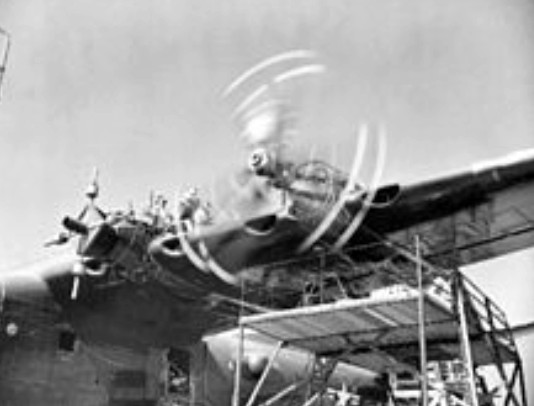
First flight test of the T40 was in the Convair XP5Y flying boat on 18 April 1950 fitted with four T40-A-4 developing 5,250 shp (3,915 kW). Service use of the T40 revealed problems with integrity of the propellers and gearboxes with at least one instance each of a propeller breaking free and a gearbox separation. One unusual problem was discovered during ground running of the Republic XF-84H Thunderscreech turboprop powered fighter; the special transonic 3-bladed single propeller set up harmonics that proved to be harmful to humans within a certain distance from the aircraft.
T40 engines on the XP5Y-1 prototype in 1950
The major problems of the T40 were its fragile gearbox, and the propeller control system which used 25 vacuum tubes, and was far from reliable. As the individual power plants were clutched into the gearbox, it was intended in most instances that the aircraft could cruise on one half of the engine and only engage the second power-section when there was need. In practice the system did not work well. Failure to recognize that one of the T38s had failed, and its compressor was devouring power produced by the other section, led to the loss of the first prototype Douglas XA2D-1 and its pilot on 14 December 1950.
The first aircraft to fly with the T40 was the Convair XP5Y-1 patrol aircraft prototype. As flying boat patrol aircraft became redundant, the US Navy changed the role of the aircraft from Anti-Submarine Warfare to Transport. Modifications to the XP5Y-1 (such as provision of air conditioning and pressurisation) produced the Convair R3Y Tradewind, which was to become the only aircraft using the T40 to actually enter service. These large four-engined flying boats served primarily between NAS Alameda and Hawaii during the mid-1950s, (replacing the Martin Mars flying boats). There were numerous problems with the T40s. One resulted in near disaster in 1956, when an R3Y managed to land with a runaway engine, resulting in a collision with a seawall. This event gave the US Navy one more reason to ground the R3Y, which it did soon after.
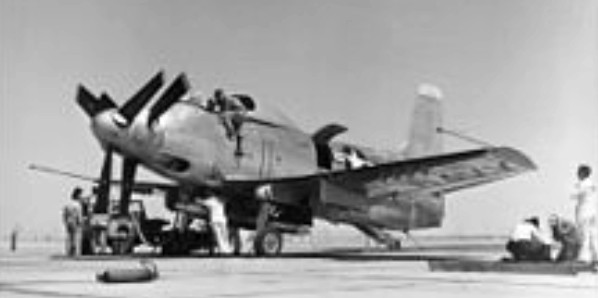
The only other aircraft to be produced in any quantity to be powered by the T40 was the Douglas A2D-1 Skyshark. Of the sixteen examples built, the twelve used for evaluation suffered similar problems to the R3Y. Propeller control problems and gearbox failures were among the more common problems.
Second Douglas A2D being prepared for its first flight in April 1952.
The T40 was also fitted to the North American A2J-1 Super Savage but the poor performance of the aircraft and continuing difficulties with the engines forced cancellation in favour of the Douglas A3D Skywarrior.
The most notable successes of the T40 were in the field of vertical take-off aircraft, being used to power three different types, the Convair XFY-1 Pogo, Lockheed XFV-1 and the Hiller X-18 tilt-wing research aircraft. Fitted with the more powerful 7,100shp YT40-A-6 the XFV-1 flew the first full flight from vertical take-off to horizontal flight and back to vertical flight for landing, of a fixed wing aircraft, in November 1954. Continuing concerns over propellers and the poor payload and performance precluded further development.
Some flying was carried out with the Hiller X-18 but most research was carried out with the aircraft attached firmly to a force measuring platform, that could be raised hydraulically, to gather data on ground cushion effects.
Limited flying was carried out by the two Republic XF-84H Thunderscreech turboprop fighter aircraft, but the continuing difficulties with the T40 engine, supersonic propeller, not to mention performance completely overshadowed by contemporary rivals led to cancellation of production plans.
Applications:
Douglas A2D Skyshark (1 × XT40-A-2) North American A2J Super Savage (2 × XT40-A-6) Convair P5Y (4 × XT40-A-5) Convair R3Y Tradewind (4 × XT40-A-10) Hiller X-18 (2 × T40-A-4) Lockheed XFV (1 × YT40-A-14) Convair XFY (1 × YT40-A-14) Republic XF-84H Thunderscreech (1 × XT40-A-1 driving a single three-bladed transonic propeller)
Specifications:
XT40 Type: Turboprop Length: 13 ft 11 in (4,240 mm) Diameter: 3 ft 3 in (990 mm) Dry weight: 2,500 lb (1,100 kg) Compressor: 17-stage axial flow (2 of) Combustors: 8 can-type per power-section Turbine: 4-stage axial flow (2 of) Fuel type: Kerosene based jet fuel Oil system: pressure spray scavenged Maximum power output: 4,000 shp Overall pressure ratio: 6.3:1 Specific fuel consumption: 0.6
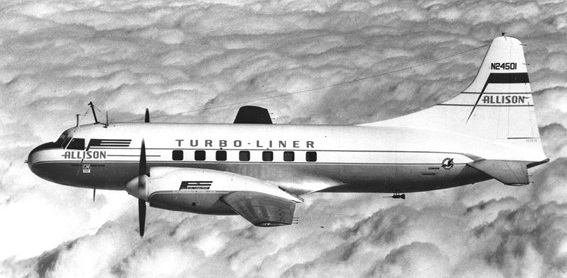
The Allison T38 (company Model 501) was an early large turboprop engine developed by Allison Engine Company during the late 1940s. Starting with a 19-stage axial compressor, eight can type combustion chambers, a 4-stage turbine driving the compressor and the extension shaft to the reduction gearbox, and initially rated at 2,000 shp (1,491.40 kW), the T38 first ran in 1947 and flew in the nose of a Boeing B-17 Flying Fortress test-bed on 19 April 1949, rated at 2,250 shp (1,677.82 kW). Problems with gearbox vibration and combustion were dealt with during the test programme and were mirrored by problems in the T40 programme. The engines fitted to the Convair CV-240-21 Turboliner were rated to 2,750shp.
Convair CV-240-21 Turboliner, December 1952 (Courtesy Pat Ford)
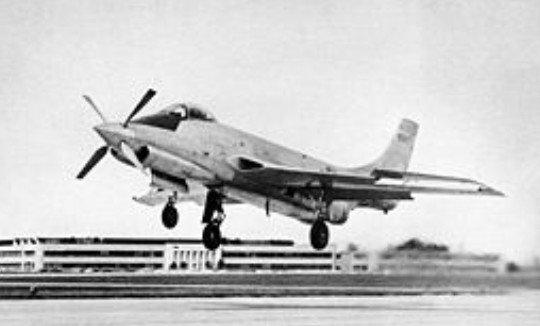
Although the only aircraft slated to receive the T38 as a production engine, the Convair T-29E, was cancelled, the T38 did power a converted Convair CV-240 (the CV-240-21 Turboliner, a project that would be abandoned due to engine problems), and was fitted in the nose of the McDonnell XF-88B to drive experimental supersonic propellers. Further development of the T38 provided the power sections for the Allison T40 as well as forming the basis for the Allison T56/Model 501 and the projected Allison T39.
Derivatives:
T39 A projected 9,000 shp (6,711.30 kW) development of the T38 which was cancelled before hardware had been produced.
T40 A 4,100 shp (3,057.37 kW) turboprop derivative composed of two T38s driving a common gearbox.
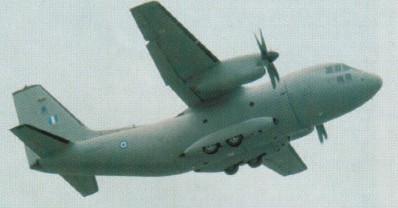
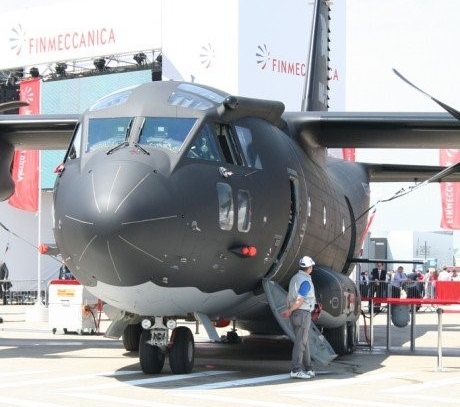
The C 27 J is a joint-venture of Alenia and Lockheed Martin based on the FIAT G222 transport, but with engines and avionics redesigned and made common with the Lockheed C-130J Hercules. The maiden flight of the prototype (I-CERX) took place from Turin, Italy, on September 25, 1999, and lasted 1 hr 32 min. Crewed by Alenia test pilots the prototype reached 15,000 ft. The first and second C-27 were converted G.222 aircraft, the third was the first new build.
MC-27J is a multimission transport aircraft jointly produced and marketed by Alenia Aermacchi and ATK. It is an armed, roll on/roll off (RO/RO) aircraft based on the C-27J Spartan. Alenia unveiled a new version of the C-27J Spartan battlefield air-lifter, the MC-27J, at the Farnborough International Air Show in July 2012.
The C-27J base platform is slightly modified, while the airlift capabilities of C-27J are retained. The new aircraft is incorporated with pallet-based systems for additional mission-specific capabilities.
The MC-27J can be configured to conduct troop / cargo transport, paratroops / material air-drop, medical evacuation (MEDVAC) and VIP / passenger transport. The gun barrel on the aircraft can be removed to allow reconfigurations for other missions. The aircraft also integrates a fire protection system and an ice protection system.
The two-pilot glass cockpit of the MC-27J is equipped with off-the-shelf avionics and is fully compatible with night vision imaging systems. The avionics suite integrates colour multipurpose displays, multifunction control and display units, optional head-up display units, digital auto-pilot, GPS/INS, identification friend or foe (IFF) transponder, recording systems, terrain awareness warning system (TAWS) and traffic alert and collision avoidance system (TCAS).
The onboard PaWS (palletized weapon system) provides combat capabilities for the MC-27J aircraft. The PaWS is specifically designed for the ATK GAU-23 30mm cannon and other precision guided light munitions. The system minimises collateral damages. The palletised system can be loaded / unloaded through the rear ramp of aircraft. It can be installed in the aircraft within four hours.
MC-27J gunship
The GAU-23 Bushmaster 30mm cannon mounted on the PaWS RO/RO pallet is a chain gun that incorporates features of the M242 and Mk44 25mm cannons. The gun can fire 30mm x 173mm, PGU-13, PGU-15, and PGU-46 ammunition at a rate of 200 rounds a minute. The ammunition is fed into the gun through a dual feed system.
The palletised system also accommodates a reconfigurable mission suite incorporating sensors, communications and mission management system. The aircraft is equipped with electro-optical / infrared targeting sensors, and command, control and communications equipment.
The MC-27J serves as an independent command and control centre interfaced with the ground command network. The aircraft is also equipped to provide signal intelligence (SIGINT) intelligence surveillance and reconnaissance (ISR) capabilities. The target identification systems and weapons systems aboard the aircraft support ground missions.
The MC-27J is powered by two Rolls-Royce AE2100D2A turboprop engines. Each engine, generating 4,637shp power, drives two Dowty six-blade, all-composite propellers. Two full authority digital electronic control units control the engines and propellers.
The onboard electricity is supplied by three generators. The auxiliary power unit (APU) allows the engines to be restarted in flight during emergency conditions.
The fuel system includes four wing tanks and two dedicated fuel feed systems. The aircraft can be optionally fitted with an air-to-air refuelling probe for performing aerial refuelling.
Alenia C 27 J Spartan Engine : 2 x Allison AE 2100 D3, 4142 shp Length : 74.475 ft / 22.7 m Height : 32.152 ft / 9.8 m Wingspan : 94.16 ft / 28.7 m Wing area : 882.648 sq.ft / 82.0 sq.m Max take off weight : 66150.0 lb / 30000.0 kg Weight empty : 36382.5 lb / 16500.0 kg Max. speed : 305 kt / 565 km/h Cruising speed : 270 kt / 500 km/h Initial climb rate : 1968.5 ft/min / 10.0 m/s Service ceiling : 26247 ft / 8000 m Cruising altitude : 19685 ft / 6000 m Wing load : 75.03 lb/sq.ft / 366.0 kg/sq.m Maximum range : 2484 nm / 4600 km Range : 1350 nm / 2500 km Range (max. weight) : 540 nm / 1000 km Crew : 2 Payload : 53 pax (max 10.000kg)
MC-27J Engines: 2 x Rolls-Royce AE2100D2A turboprop, 4,637shp Propellers: Dowty six-blade, all-composite Length: 22.7m Wing span: 28.7m Height: 9.6m Maximum take-off weight: 30,500kg Maximum altitude: 30,000ft Cruising speed: 583km/h Maximum speed: 602km/h Maximum range: 1,852km Ferry range: 5,926km
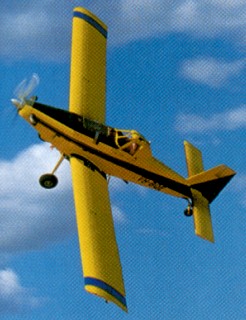
The Air Tractor AT-802 was designed primarily for the air tanker role. It was the first single engined fire fighter (as the AT-802F) to be designed from the ground up and with a similar hopper capacity to the twin engined Grumman S2F’s used by the Californian Division of Forestry.
The AT-802 is, in appearance, an enlarged AT-503. The length is 3l feet and the wingspan is 58 feet. The 800 gallon hopper also incorporates computer controlled hopper doors to drop the load of retardant as required. The first dual cockpit AT-802, N802LS, was flown on 30 October 1990, and was fitted with a P&W PT6A-67R of 1424 hp. By the time the aircraft was ready for production, it was certified for the installation of a PT6A-4SR or -6SB, both of 1173 hp. A single seat version, the AT-802A, N 1558W, flew on 6 July 1992, fitted with a -6SB turbine. The empty weight for the single seater is 6200 lbs and they both have an operating weight of 16000 lbs. The introduction of Hoerner wingtips increased the span to 59.2 ft and a 2 in extencion of the engine mount was incorporated to ease the C of G limit on the two seaters.
Croatia ordered three AT-802A Fire Boss amphibians, the first delivered to Zadar-Zemunik in March 2007.
Croatian AT-802A Fire Boss
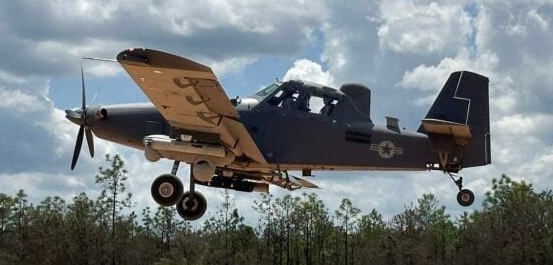
The U.S. Air Force’s newest light attack and reconnaissance aircraft, the OA-1K Skyraider II, was undergoing developmental testing in July 2025 at Eglin Air Force Base as part of its path toward operational service within Air Force Special Operations Command (AFSOC).
OA-1K Skyraider II
According to the Air Force, the aircraft is being evaluated by the 96th Test Wing in partnership with U.S. Special Operations Command to verify its airworthiness and validate manufacturer L3Harris’ performance claims. The effort also includes mission-effectiveness assessments to determine how well the aircraft performs in austere and remote environments, where AFSOC personnel often operate. The OA-1K Skyraider II is designed as a cost-effective, crewed aircraft capable of supporting special operations forces in geographically isolated regions. It is equipped for mission sets that include close air support, precision strike, and armed intelligence, surveillance, and reconnaissance (ISR). The platform is based on the rugged AT-802 airframe and has been adapted for military use with integrated sensors and weapons systems. One of the Skyraider II’s most distinctive features is its tailwheel landing gear—a configuration not seen on an active-duty U.S. Air Force aircraft in over 50 years. This unusual design element required the test team to develop new evaluation methods tailored to the aircraft’s landing characteristics. “There was quite a bit that went into this, from making sure we were compliant on the regulatory side, to ensuring we had the proper operations support for the Skyraider II,” said Maj. Stephen Wakefield of the 96th Test Wing. Due to the unique configuration, Air Force pilots received additional training using the Skyraider II’s civilian counterpart, the AT-802, to gain proficiency with tailwheel aircraft handling. The Air Force says this type of training was essential to safely operate the aircraft during its early evaluation phase. Maj. Jacob Marsh, a test pilot with the 96th TW, said flying the OA-1K has been both demanding and rewarding. “Flying the OA-1K has been a rewarding experience and certainly something that has required me to bring my skills to work every day,” Marsh said. “The fun of flying it is just a perk of the job.” Marsh, who previously flew un-augmented UH-1N helicopters at the United States Naval Test Pilot School, noted the coordination required in the OA-1K shares similarities with rotary-wing operations, particularly at lower airspeeds. The test campaign has so far included evaluations of human factors, handling qualities, and austere landing capabilities. Future trials will involve weapons release and sensor performance tests. The manufacturer, L3Harris, states the aircraft can fly at 245 miles per hour at 10,000 feet and has a range of 1,500 miles at an altitude of 8,000 feet. The Skyraider II is being positioned as a rugged, flexible platform that can operate from unprepared runways and support combat operations where more complex and expensive aircraft may be unavailable or unsustainable. This matches AFSOC’s need for adaptable aircraft in environments where logistics are limited and risk is high. While the Skyraider II is not intended to replace high-performance fighters or dedicated ISR platforms, it offers commanders a versatile tool to support missions ranging from overwatch and target identification to rapid strike against time-sensitive threats—all while operating from forward locations with minimal infrastructure.
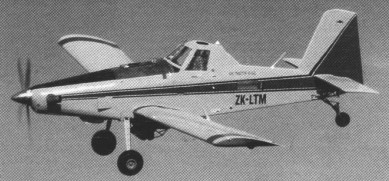
The first Air Tractor AT-602 aircraft had its maiden flight in 1995, deliveries beginning with N6084K in January 1996. The 602 shares many of the components of the larger AT-802A (including the fin and rudder).
AT-602 Engine: PT6A-60AG or -45R, 1050 shp Prop: five-blade Wing span: 56 ft Length: 32 ft 6 in Wing area: 336 sq.ft Empty weight: 5,600 lb Operating weight: 12,500 lb Hopper cap: 630 US gallon

 All Aero