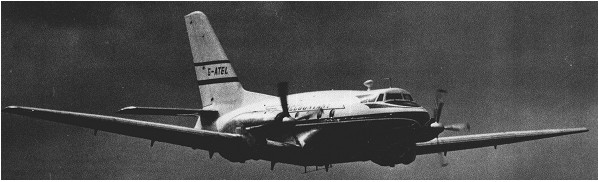
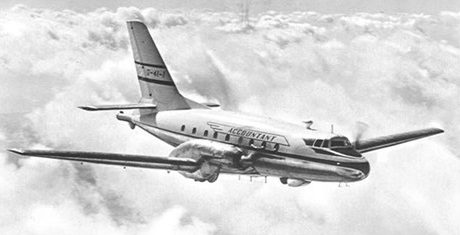
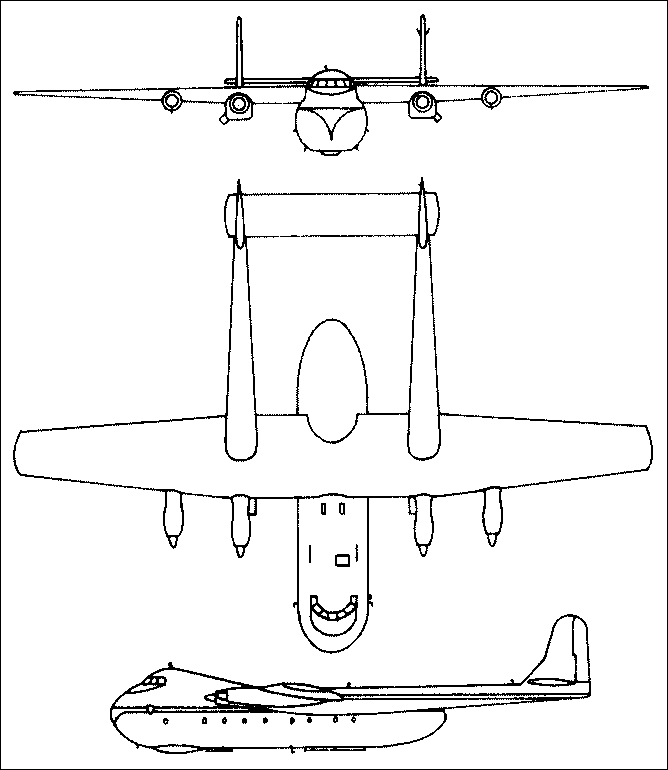
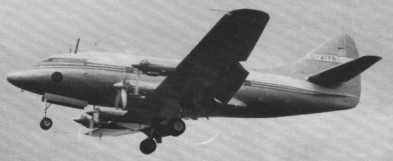
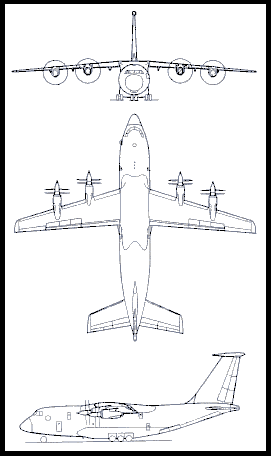
Designed as a 28-seater, 60ft long, with a wingspan of 82 ft, and powered by two Dart RDa6 Mk 510 turboprops, each of 1780 hp. Nobody knows why it was called the Accountant – but the Accountant paid for it out of Air Charter’s cash flow. The Accountant design was partly based on the use of a segmented tensioned skin production method. The problem with the tension skin was that, in order to keep the metal evenly stressed, the curves of the fuselage had to come to a long, pointed end, which strictly limited the freight capacity of the aircraft. By the time it was built, the Accountant’s rear end was largely taken up with struts to support a large separate tail-section, while the upper half of the flight deck was stuck on the front. First flown on 9 July 1957, the press was invited in July 1957 to first flight of the prototype, which The Aeroplane described as a “plump silver partridge”. The plane performed well enough, but Laker had already decided against the tension-skin construction, and plans were drawn for a conventional fuselage. Unhappily, he could find no-one to go into partnership with him to build it. The Accountant was flown at the 1957 Farnborough Air Show, but there were already two rivals in the air: the Handley Page Herald, and the Fokker Friendship. The programmes was cancelled in January 1958, by which time the prototype had completed over 200 hrs. The engines and equipment were removed and the aircraft left in open storage. Its optimum cruising altitude, powered by two Rolls Royce Dart 510 (R.Da.6) turboprops, would have been 30,000 ft. With S.B.A.C. reserves the Accountant would have carried a passenger pay¬load of 8,363 lb for 400 nautical miles, or 6,135 lb. for 1,000 n.m. and 2,422 lb. for 2,000 n.m. At a mean weight of 20,000 lb. in I.S.A. conditions the Accountant’s top cruising speed (13,600 r.p.m.) was expected to be 250 knots (290 m.p.h.).
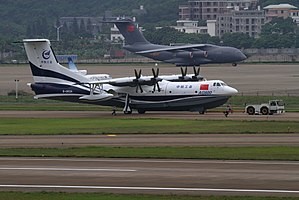
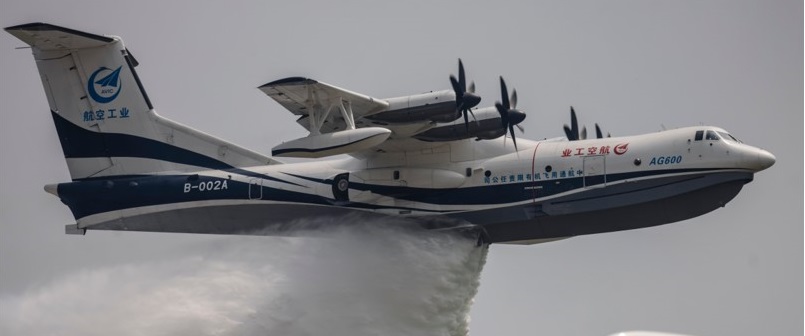
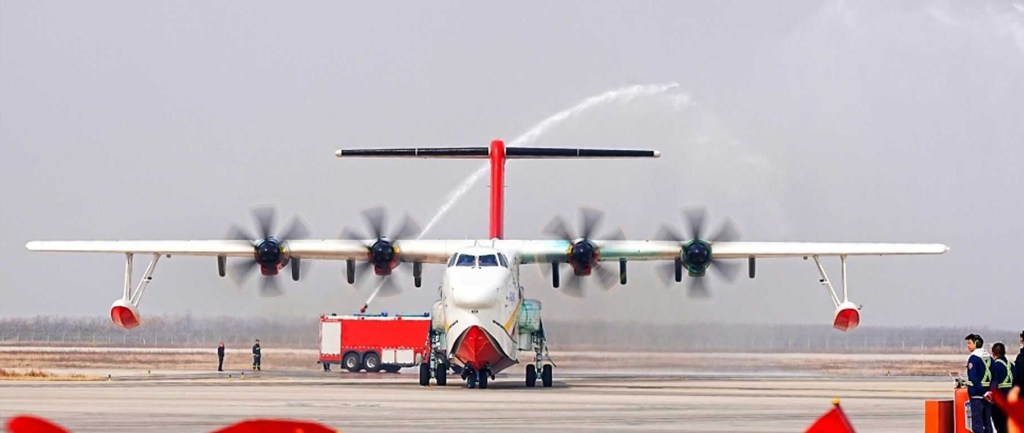
The AVIC AG600, code named Kunlong (鲲龙), also known as TA-600, is one of China’s three “big plane projects” approved by the State Council of China in 2009, along with the Xi’an Y-20 and C919. It is intended for both civil and military roles. In civil use, as an aerial firefighter it will be capable of dropping 12 tonnes of water, while in search and rescue operations it will accommodate up to 50 passengers. It is also intended to meet China’s strategic defence needs in the South China Sea area.
It was designed by the Aviation Industry Corporation of China (AVIC). The aircraft was developed by a group of 70 aircraft component manufacturers and research teams in association with more than 150 institutes across 20 provinces and municipalities in China. Over the years, its silhouette has been slowly revised by way of modified float supports, a more blended, better-contoured cockpit roofline, and a “T-style” tail unit (as opposed to the split vertical tail fins of the SH-5). On the whole, the aircraft has continued use of flying boat basics – high, shoulder-mounted wings, two engines installed at each wing, and a boat-like hull for water landings. The hold will also support seating for up to 50 passengers. The resulting aircraft has proven heavier than previously planned at approximately 107,000lb, up from the original 98,000lb. The added weight has altered the expected operational range, reduced from 3,200 miles to 3,100 miles. The AVIC AG600 is an amphibious aircraft having the hull of a flying boat for waterborne operations along with a wheeled retractable undercarriage for alighting on land. The prototype AG600, built by CAIGA, has a wingspan of 38.8 metres (127 ft) and is powered by four turboprop engines. The type of engine is WJ-6, a modified Chinese-made version of the Soviet Union’s Ivchenko AI-20 series. It is designed to have a maximum takeoff weight of 53.5 t (118,000 lb) and a maximum range of over 5,000 km (3,100 mi).
The aircraft is powered by four Chinese-made WJ-6 turboprop engines driving four six-bladed constant speed propellers. WJ-6 is a license-built copy of the Ivchenko AI-20 engine and generates a power output of 3,805kW (5,103hp).
The mid and forward fuselage sections of the aircraft were completed in December 2014 and March 2015 respectively. The horizontal and vertical tail was completed by January 2016. The prototype was rolled out on 23 July 2016 at the Zhuhai AVIC factory. Its maiden flight was made from the runway of Jinwan Civil Aviation Airport in Zhuhai, Guangdong on 24 December 2017, at 09:39 China Standard Time. 17 orders had been received from Chinese customers before the flight.
On March 2, 2025, China announced that the AG600, the country’s domestically developed large amphibious seaplane, has successfully completed its flight testing phase and is on the verge of receiving its type certificate from the Civil Aviation Administration of China (CAAC).
According to a statement from the Aviation Industry Corporation of China (AVIC), the state-owned aerospace giant overseeing the aircraft’s development, the AG600 prototype conducted its final flight test on the morning of Friday, March 1, 2025, at a civil aviation testing center in Pucheng, located in Shaanxi Province. This successful flight concludes a two-year testing program, which saw the aircraft complete a total of 2,014 flights spanning 3,560 hours.
The AG600 program was officially approved by the Chinese government in June 2009, with research and development kicking off later that year. The program saw the collaboration of tens of thousands of engineers and researchers from over 160 domestic institutes, enterprises, and universities. The first prototype of the AG600 was constructed in 2014 and completed in July 2016. After its debut flight in December 2017 at Zhuhai in Guangdong Province, the aircraft has undergone extensive testing across various regions of China.
The aircraft can take-off and land from 1,500m-long, 200m-wide and 2.5m-deep water. It has the capacity to collect 12t of water in 20 seconds and can carry up to 370t of water on a single tank of fuel. The AG600 can perform take-off and landing in severe weather conditions with a wave height of 2m. The maximum take-off weight of the aircraft is 53.5t on runways and 49t on water.
AG600 aircraft received two option orders at the 10th Airshow China held in Zhuhai in November 2014, bringing the total option orders to 17.
AG600 Engines: 4 × WJ-6 turboprops, 3,805 kW (5,103 hp) each Propellers: 6-bladed constant speed Wingspan: 38.8 m (127 ft 4 in) Length: 36.9 m (121 ft 1 in) Height: 12.1 m (39 ft 8 in) Max takeoff weight: 53,500 kg (117,947 lb) Maximum speed: 570 km/h (354 mph; 308 kn) Cruise: 500 kph Stall: 220 kph Range: 4,500 km (3,418 mi; 2,970 nmi) Service ceiling: 10,500 m (34,400 ft) Capacity: 50 passengers
Designed by Armstrong Whitworth later incorporated into Hawker Siddeley Group, the first prototype flew on January 8, 1959.
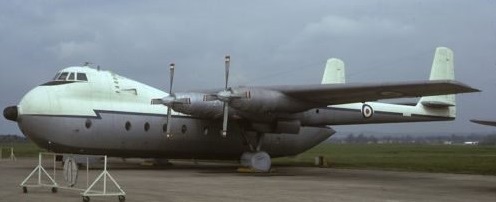
In order to shorten development time, Armstrong Whitworth put in hand a batch of ten of their Argosy Freighters, without waiting for firm orders. The second of these flew on 8 January 1959. Orders were received from Riddle Airlines and for a military version by RAF Transport Command.
The private venture Argosy completed flight trials during 1960. The first operators were to be Trans-Arabia Airlines and Riddle Airlines.
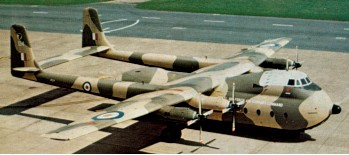
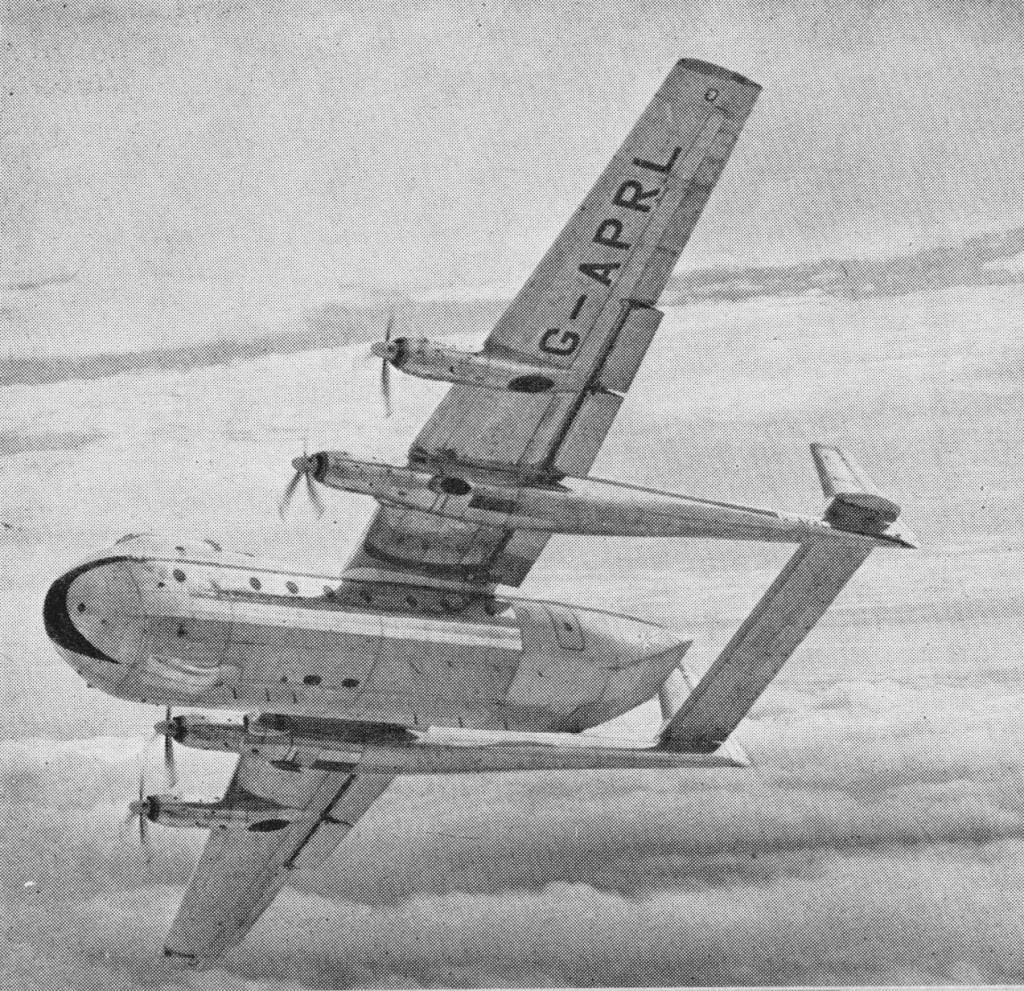
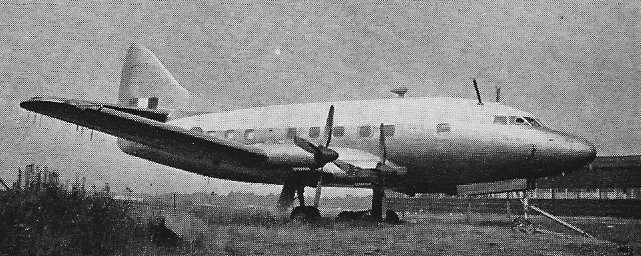
The series 100 led to the military Armstrong-Whitworth (later WhitworthGloster and Hawker-Siddeley) AW660 Argosy derived from the civil AW650, major design changes involving a “beaver tail” for air para-dropping, fixed nose doors, heavier and strengthened floor, Smith’s military flight system, Ekco weather radar-the scanner housing providing the characteristic bump on the nose and other internal equipment changes. Twenty aircraft (XN814-821, XN847-858) were ordered in January 1959 to replace the last of the Valettas, and a manufacturer’s prototype, G-APRL, was first flown on July 28, 1960, with some of the military modifications including the beaver tail doors. Follow-on production orders were placed for a further 36 aircraft (XP408-413, XP437-450, XR105-109, XR133-143), while the first RAF Argosy C1 (XN814) was flown for the first time on March 4, 1961. Together with the second aircraft it soon passed to the A&AEE at Boscombe Down for service trials prior to entry into service.
AW.660 prototype G-APRL
The variety of roles adopted by the Argosy are very wide-it can carry 54 fully-equipped paratroops (with two despatchers and one additional loadmaster); or two Ferret scout cars/ Land Rovers plus 20 troops in the air-transport role; or 64 passengers (with two air quartermasters); or 48 stretcher patients (with four attendants and two AQMs) for casevac. As a tactical support aircraft it can deliver nine x one ton containers or two medium-stressed platforms (12 0001b each). In the photographic role F-117B cameras can be installed, and for air-sea rescue Lindholme containers and flares are carried.
In the mid-1960s the first four operational squadrons (105, 114, 215 and 267) were active in the Far East, Gulf and European theatres.
RAF Argosy XP409
An early attempt to offset the problems of short range was tried with XN819 early in 1962 when in-flight refuelling equipment was fitted. However, after trials at the A&AEE Boscombe Down, it was decided not to proceed with the modification programme. In the internal-security fit in 1963 XN814 was modified to accommodate external bomb racks (for 14 bombs) on each side of the lower fuselage; the nose window was equipped as a bomb aimer’s position. After successful trials with the “Argi-bomber” the aircraft used in Aden and the Far East were given this modification. There is no evidence that they were operationally used in this offensive role. The C and E Mk.1 aircraft had higher gross weights and more powerful engines than the 222. Fifty six were used by the RAF. With the delivery to the RAF of the Hercules it was announced in 1968 that the Argosy would be withdrawn from tactical transport duties by 1970. However the fuel tank corrosion problems encountered by the Hercules and the subsequent withdrawal of aircraft for modification meant that this target date could not be reached. The 660 had the ‘Shackleton Wing’ and had ‘clam-shell’ doors at the rear of the fuselage to allow air-dropping of stores. Unlike the civil 650, the nose was fixed. The early versions of the civil AW 650 also had the ‘safe life’ Shackleton wing. It was main spar failure that curtailed the fatigue life of the AW 650/660 aircraft. However later versions known as AW 650 200 were manufactured with a ‘fail safe’ wing of much more modern structural philosophy. The series 200 can be recognised as it is fitted with large wing fences. The 222 model was designed to the specifications of British European Airways, and began service in 1965. The 200 Series featured a redesigned box-spar increasing the MAUW and fuel capacity. Only 17 civilian Argoseys were built.
Argosy series 100 Engines: 4 x Rolls-Royce Dart 526 turbo-prop, 1506kW Take-off weight: 39916 kg / 88000 lb Empty weight: 20865 kg / 46000 lb Max payload: 28,000 lbs. Wingspan: 35.05 m / 114 ft 12 in Length: 26.44 m / 86 ft 9 in Height: 8.23 m / 27 ft 0 in Wing area: 15.45 sq.m / 166.30 sq ft Cruise speed: 451 km/h / 280 mph Ceiling: 6100 m / 20000 ft Range: 3219 km / 2000 miles Crew: 2-3 Passengers: 84
AW650-222 Cruise: 240 kts. No built: 7. Max payload: 31,000 lbs. MAUW: 93,000 lbs. Max range: 1600 nm. Approach speed: 108 kts.
Hawker Siddeley / Armstrong Whitworth AW 650 Argosy C Heavy transport aircraft, United Kingdom, 1961 Length: 89.173 ft / 27.18 m Wingspan : 114.993 ft / 35.05 m Max take off weight : 103017.6 lb / 46720.0 kg Max. speed : 233 kts / 431 km/h Service ceiling : 20013 ft / 6100 m Range : 300 nm / 555 km Engine : 4 x RollsRoyce Dart RDa 8 Mk 101, 2680 shp Crew : 3+69
Argosy C1 Engines: 4 x Rolls-Royce Dart RDa8 Mk102 turboprops, 2210 shp (dry) or 2470 shp (with water-methanol injection). MAUW: 97 000 lb. Cruise: 220kt @ 10000-20000ft. Max payload / range: 24600 lb over 180 nm. Max range/payload: 1700nm with 3500 lb. Radius of action/payload: 750nm with 5000 lb.
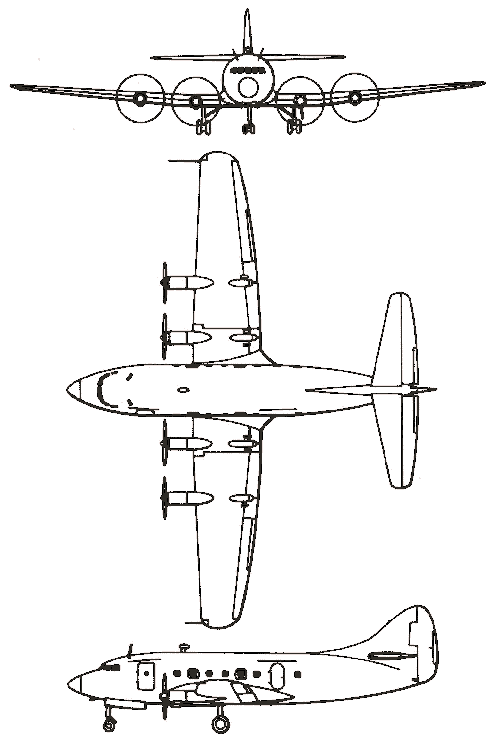
The Armstrong Whitworth AW.55 Apollo was designed as a competitor to the Vickers Viscount in response to the requirement outlined in the wartime Brabazon Committee’s Type II civil transport. It was a short- and medium-range airliner intended for operations in Europe. Specification C.16/46 to which the Apollo was designed, called for a turboprop-powered airliner to carry between 24 and 30 passengers over a range of 1609km at 483km/h.
The engine selected was the axial-flow Armstrong Siddeley Mamba centrifugal-flow turboprops but it was prone to teething problems. In the form first used on the Apollo, the engine should have developed 1010hp plus 139kg thrust, whereas it developed only 800hp.
Right from the beginning of the design, the AW.55 (first named Achilles and Avon before finally becoming Apollo) had a span of 28.04m, but length was increased from 19.66m to 20.73m and at the production stage to 21.79m, providing accommodation for between 26 and 31 passengers seated two-abreast on each side of a central aisle.
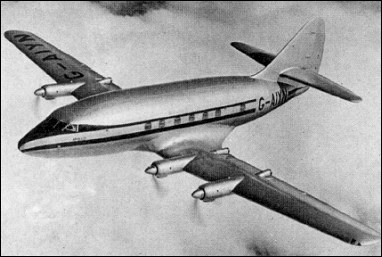
Construction began in 1948 of two flying prototypes and a fuselage for static testing. The first prototype was given the Ministry of Supply serial VX220, and made its initial flight on April 10, 1949, powered by four 1135shp A.S.Mamba A.S. Ma.1 turboprops. Control problems were remedied and the first prototype, re-registered G-AIYN, was available from October 30, 1950 for proving flights, starting with a successful flight to Paris on March 12, 1951.
In July 1951 the Mamba Mk 504 engines became available, but even these had severe limitations and problems and in June 1952 further development was halted.
The second prototype was completed with detail modifications and flew on 12 December 1952, powered by four 1475 hp Mamba A.S. Ma.3 turboprops, and both aircraft were used for a variety of experimental work for the Ministry of Supply, which had funded them. Both aircraft became structural-test airframes in December 1954.
2nd Prototype Engines: 4 x Mamba A.S. M3.3, 1475 hp Wingspan: 92 ft Wing area: 986 sq.ft Length: 71 ft 5.5 in Height: 26 ft Loaded weight: 47,000 lb Max cruise: 310 mph at 25,000 ft Range: 1130 mi at 280 mph at 25,000 ft w/payload 7500 lb
Engines: 4 x Armstrong Siddeley Mamba Mk 504 turboprops, 750kW Take-off weight: 20412 kg / 45001 lb Empty weight: 13791 kg / 30404 lb Payload: 3402 kg / 7500 lb Wingspan: 28.04 m / 91 ft 12 in Length: 21.79 m / 71 ft 6 in Height: 7.92 m / 25 ft 12 in Wing area: 91.6 sq.m / 985.97 sq ft Cruise speed: 444 km/h / 276 mph Range: 1513 km / 940 miles Crew: 3 Passengers: 31
The design started as an experimental pure-turbojet known as the ASX, which commenced testing in 1943. By this point other engine designs were already entering pre-production, and it seemed there was little need for the ASX in its existing form. The design was then modified into the turboprop layout with the addition of a second turbine stage, which was geared to the propeller and was named ASP at that stage.
Early flight-testing of the Python was carried out using the Lancaster B.1 (FE) TW911 and the Lincoln B.2 RE339/G, each aircraft having the two outboard Rolls-Royce Merlins replaced by Pythons. Lincoln B.2 RF403 also had two Pythons similarly installed and was used for high-altitude bombing trials at Woomera, South Australia, the Pythons being used to increase the height from which tests could be carried out. These trials were principally of the ballistic casings for the Blue Danube atomic weapon, there being at the time no other suitable aircraft available that could accommodate the large weapon casing measuring 62 inches diameter x 24 feet (7.3 m) in length, and carry it to the height required. Maximum release height and speed for the first eleven tests was 275 mph and 34,783 ft (10,602 m) with a bombing error of 61 ft.
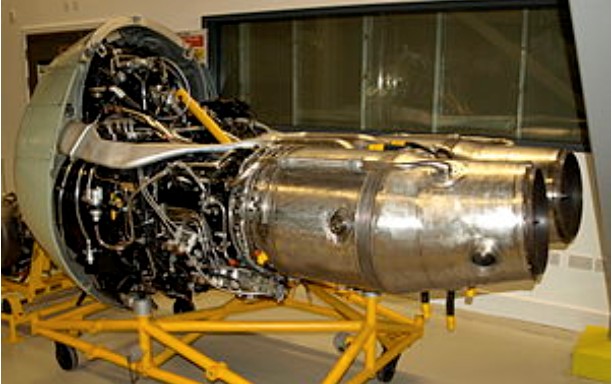
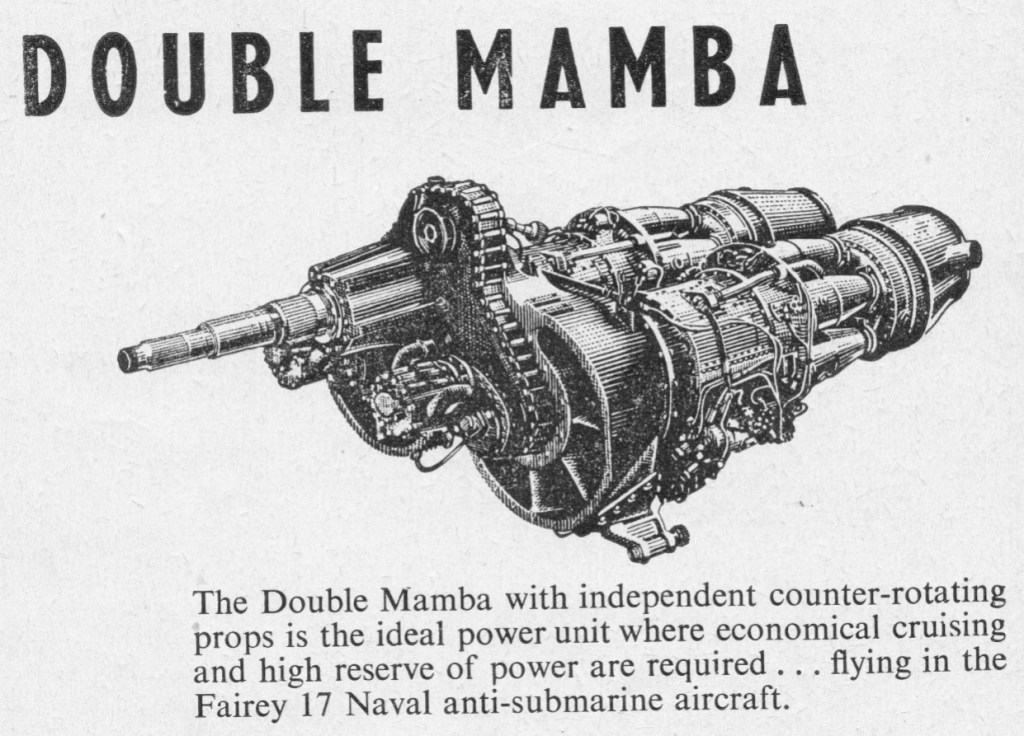
The Armstrong Siddeley Double Mamba was a turboprop engine design developed in the late 1940s of around 3,000–4,000 hp (2,500–3,000 kW). It was used mostly on the Fairey Gannet (First flight 29 September 1949) anti-submarine aircraft developed for the Fleet Air Arm of the Royal Navy.
The Double Mamba (rarely known as the Twin Mamba) was a development of the Armstrong Siddeley Mamba with two Mambas driving contra-rotating propellers through a combining gearbox. Engine starting was by cartridge, however, forced air restart was achieved in flight. One engine could be shut down in flight to conserve fuel.
Ministry of Supply designation system: AS = Armstrong Siddeley M = Mamba D = Double num = model
Variants and applications:
ASMD.1 Type: Turboprop engine Component engines: 2 x ASM.3 Maximum power output: 2950 eshp Aircraft fitted: Fairy Gannet A.S. Mk.1 Blackburn B88 (prototype)
ASMD.3 Type: Turboprop engine Component engines: 2 x ASM.5 Compressor: 10 stage axial (x2) Combustors: Six combustion chambers (x2) Length: 102.25 in (2,597 mm) Diameter: 52.8 in (1,341 mm) Dry weight: 2,170 lb (984 kg) Maximum power output: 2,960 eshp (2,207 kW) Overall pressure ratio: 5.35:1 Power-to-weight ratio: 1.36 eshp/lb Aircraft fitted: Fairy Gannet A.S. Mk.4
ASMD.4 Type: Turboprop engine Component engines: 2 x ASM.6 Maximum power output: 3875 eshp Aircraft fitted: Fairy Gannet AEW Mk.3
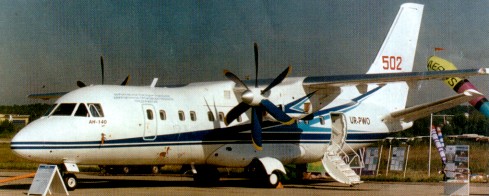
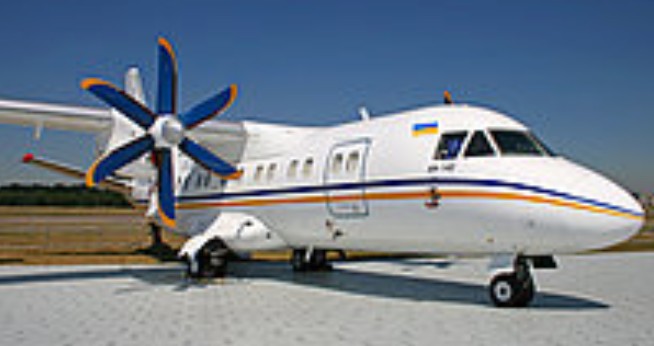
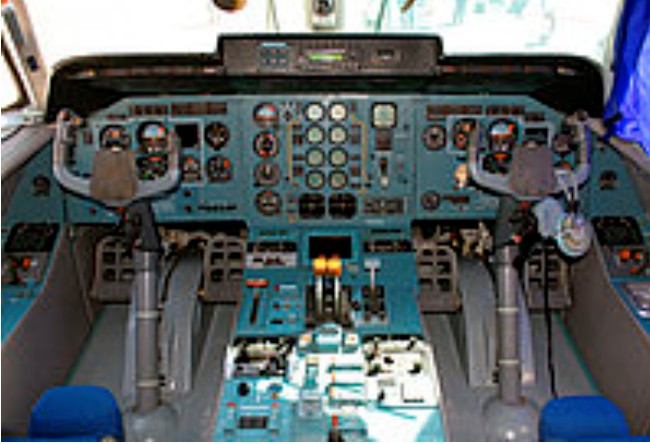
The An-140 (first flown September 1997) short-haul regional airliner was planned to supersede the An-24. An agreement for licence production by Iranian Aviation called ‘Iran-140’ was signed in 1993. The first aircraft, supplied as a kit, flew on 7 February 2001.
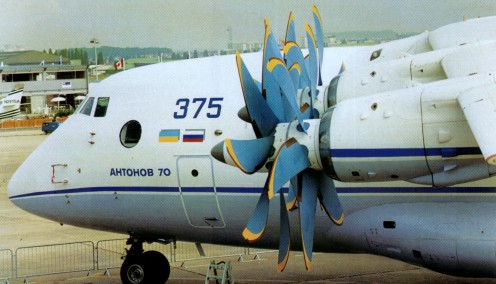
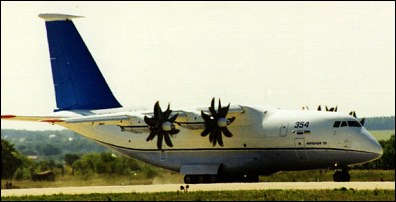
The development of the An-70 program began in 1975 but the collapse of the Soviet Union effectively stopped the funding of most major new programs. The An-70 has the high wing and tail loading ramp for a tactical freight aircraft and uses contra-rotating propfans. Each propfan has contra-rotating propellers; the front has eight composite blades, the rear just six.
A new propfan medium-size wide-body short take-off and landing transport aircraft intended to replace An-12, the first flight was achieved on December 16, 1994 but the first prototype crashed on 10 February 1995 after colliding with its An-72 chase plane. Construction of a second prototype was completed, which began flight testing at Gostomel airport in Ukraine on April 24, 1997.
Engine: 4 x D-27 propfans, 10300kW Take-off weight: 130000 kg / 286602 lb Wingspan: 44.06 m / 144 ft 7 in Length: 40.25 m / 132 ft 1 in Height: 16.1 m / 52 ft 10 in Cruise speed: 750-800 km/h / 466 – 497 mph Ceiling: 12000 m / 39350 ft Range: 7250 km / 4505 miles Range w/max.payload: 1350 km / 839 miles Maximum payload: 47 tons. Crew: 3-5


 All Aero