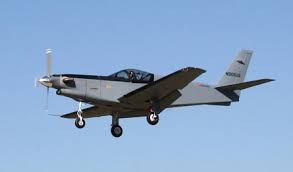
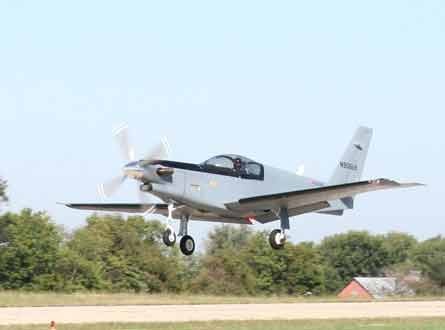
Start-up US Aircraft changed direction in its plans to develop a low-cost counter-insurgency aircraft for use in Afghanistan, Iraq and elsewhere. After funding design of the A-67 Dragon by US warbird restoration specialist Golden Aviation, it began working with Brazil’s Geometra on an aircraft based on a design by Josef Kovacs, former chief designer of Embraer’s EMB-312 Tucano trainer.
The original A-67 made its only flight in October 2006 in Missouri. The aircraft flew from Cassville, Missouri to Golden’s base at Monett Municipal Airport, ending with a landing gear collapse.
The Ohio-based company planed to base its A-67 on a scaled-up version of Kovacs’ K52, a general-aviation aircraft strongly resembling the Tucano, after testing a Brazilian-built prototype. US Aircraft planned to combine features from both designs, but where the original A-67 had side-by-side seating, the new design uses a tandem set-up.
Powered by a 1,250shp (930kW) Pratt & Whitney Canada PT6A-68 turboprop, the 4,620kg (10,200lb) gross-weight A-67 has an estimated maximum cruise speed of 381kt (706km/h) at 20,000ft (6,100m). Endurance will be 10h and external payload 1,620kg.
A subsidiary of US Technology, which produces the plastic media used for stripping paint from aircraft, US Aircraft was funding design work on the A-67, but sought private investors to complete development and begin production.
A-67 prototype Engine: 1 × Pratt & Whitney PT6A-67 turboprop, 1,250 shp (930kW) Prop: four-blade Wingspan: 38 ft (11.6 m) Wing area: 211 ft² (19.6 m²) Empty weight: 4,800 lb (2,200 kg) Max. takeoff weight: 10,200 lb (4,640 kg) Maximum speed: 371 knots (427 mph, 687 km/h) at 20,000 ft Range: 1,880 mi (3,008 km) Service ceiling: 35,000 ft (11,000 m) Rate of climb: 4,882 ft/min (1,488 m/min) Wing loading: 35.1 lb/sq ft Crew: 2
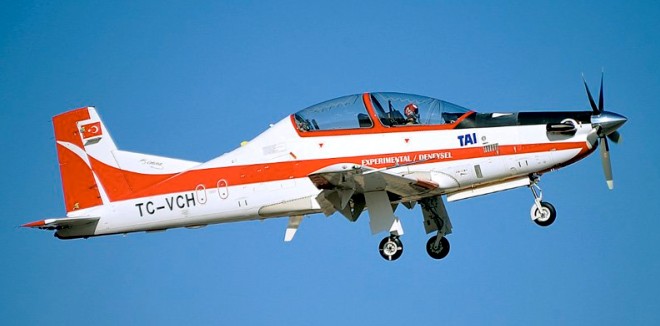
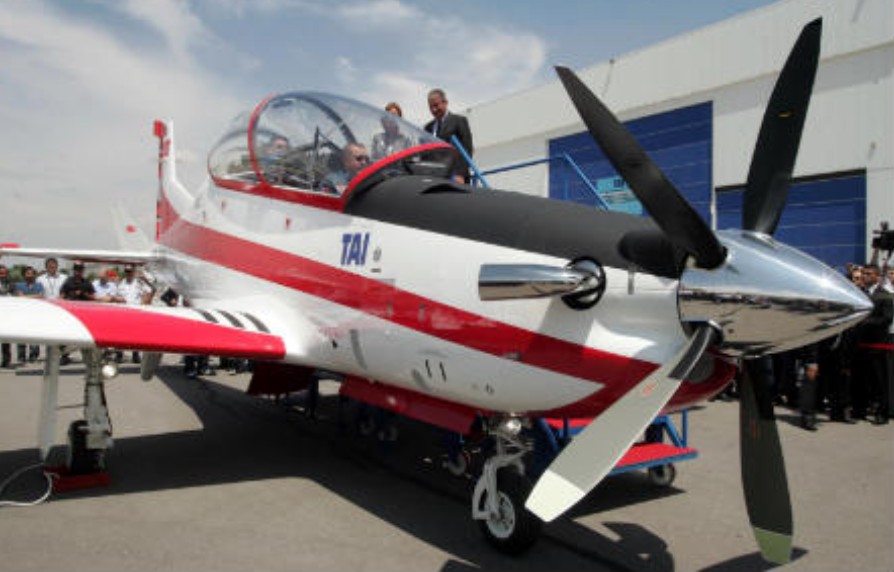
The TAI Hürkuş (Free Bird) is a tandem two-seat, low wing, single engine, turboprop aircraft developed by Turkish Aerospace Industries (TAI) as a new basic trainer and ground attack aircraft for the Turkish Armed Forces.
The aircraft is named after Vecihi Hürkuş, a Turkish aviation pioneer and the first Turkish airplane manufacturer.
The TAI Hürkuş Development Program started with an agreement signed between Turkish Undersecretariat for Defense Industries (Savunma Sanayii Müsteşarlığı (SSM)) and TAI in March 2006. Under the agreement the company was to design, manufacture and complete the civil certification the aircraft to European Aviation Safety Agency CS 23 standards.
HÜRKUŞ Within the framework of the program; two aircraft configurations were to be developed.
HÜRKUŞ-A: Basic version which is to be certified with EASA according to CS-23 requirements. HÜRKUŞ-B: Advanced version with integrated avionics (including HUD, MFDs, and Mission Computer).
By June 2012 the Hürkuş program had consumed one million man-hours with the work of 140 engineers. About a quarter of the Turkish engineers who have worked on Hürkuş are female, as well as two of the three project heads.
The Hürkuş was to be equipped for inverted, day and night flying as well as basic pilot training, instrument flying, navigation training, weapons and formation training. The aircraft has good visibility from both cockpits with a 50 degree down-view angle from the rear cockpit, cabin pressurization (nominal 4.16 psid), Martin-Baker Mk T-16 N 0/0 ejection seats, an on-board oxygen generation system (OBOGS), an Environmental Control System (Vapor Cycle Cooling), an anti-G system, high shock absorbing landing gear for training missions, and Hands On Throttle and Stick (HOTAS). Microtecnica of Turin, Italy was been selected to provide the aircraft’s environmental control system. The Hürkuş has been designed for a 35-year service life with a TAI designed wing airfoil.
The Hürkuş development program has been subject to delays. In 2007 it was forecast that the first prototype would fly in late-2009 with first delivery, upon completion of the certification process, forecast for 2011. On 27 June 2012, the Hürkuş was officially rolled out at a ceremony held at TAI’s Kazan premises. The forecast date for the first flight was then delayed until later in 2012 and actually occurred on 29 August 2013 when the aircraft flew from the Ankara Akıncı Air Base on a 33-minute flight. The first flight was performed with landing gear down and to a height of 9500 ft.
Stability and control checks in different flight configurations have been conducted in the following flight tests. Landing gear up-down tests, cockpit pressurized tests and system functions pre-checks have been performed. The aircraft has reached 12.500 ft height and 158 knots speed currently.
At an SSIK’s meeting, held on Sept. 26, 2013, in order to meet the 15 new-generation trainer aircraft requirement of TurAF, contract negotiations regarding the serial production of HÜRKUŞ was started with TAI. The negotiations regarding HÜRKUŞ-B contract was on the signing.
Two prototypes were built. Entering service in 2015, 15 were built.
Hürkuş Engine: 1 × Pratt & Whitney Canada PT6A-68T turboprop, 1,200 kW (1,600 shp) Propellers: 5-bladed Hartzell Propeller HC-B5MA-3 Wingspan: 9.96 m (32 ft 8 in) Length: 11.17 m (36 ft 8 in) Height: 3.70 m (12 ft 2 in) Maximum speed: 574 km/h (357 mph; 310 kn) Cruising speed: 463 km/h (288 mph; 250 kn) Stall speed: 143 km/h (89 mph; 77 kn) Range: 1,478 km (918 mi; 798 nmi) at 15000 ft (4572 m) Endurance: 4.25 hours at 15000 ft (4572 m) Service ceiling: 10,577 m (34,701 ft) Rate of climb: 22 m/s (4,300 ft/min) Total Take-Off Distance (@ sea level): 1605 ft (489 m) Total Landing Distance (@ sea level): 1945 ft (593 m) g limits: +7/-3.5 Hardpoints: 4 Seats: 2
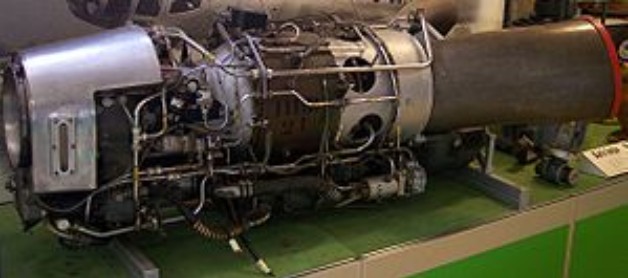
The Turbomeca Artouste is an early French turboshaft engine, first run in 1947. Originally conceived as an auxiliary power unit (APU), it was soon adapted to aircraft propulsion, and found a niche as a powerplant for turboshaft-driven helicopters in the 1950s.
Artoustes were licence-built by Bristol Siddeley in the UK, Hindustan Aeronautics Limited in India, and developed by Continental CAE in the USA as the Continental T51. Power is typically in the 300 kW (400 hp) range.
Continental T51 Licence production and development of the Artouste in the United States
Turbomeca Marcadau A turboprop variant, the Marcadau was a development of the Artouste II, producing 1300 kW (402 hp) through a 2.3:1 reduction gearbox.
Applications: Artouste – Aérospatiale Alouette II Aérospatiale Alouette III Aerospatiale Lama Aerotécnica AC-14 Atlas XH-1 Alpha IAR 316 IAR 317 Handley Page Victor – as APU Hawker Siddeley Trident – as APU Piasecki VZ-8 Airgeep Vickers VC10 – as APU SNCASO Farfadet
Marcadau – Morane-Saulnier Epervier
Specifications: Artouste IIC Type: Turboshaft Length: 1,440 mm (56.7 in) Diameter: 545 mm (21.5 in) – height, 390 mm (15.4 in) – width Dry weight: 115 kg (253.5 lb) – dry Compressor: Single stage centrifugal Combustors: Annular combustion chamber Turbine: Three stage turbine Fuel type: Aviation kerosene to AIR 3405 Oil system: Oil grade AIR 3512, pressure lubrication Maximum power output: 500 hp (372.85 kW) at 34,000 rpm for take-off Fuel consumption: 153 kg (337.3 lb)/hour at maximum continuous power Power-to-weight ratio: 3.24 kW/kg (1.972 hp/lb)
The Turbomeca Turmo is a French turboshaft engine developed for helicopter use. A descendant of Turbomeca’s pioneering Artouste design, later versions delivered around 1,200 kW (1,610 shp). A turboprop version was developed for use with the Breguet 941 transport aircraft.
Current versions are built in partnership with Rolls-Royce, and the engine is produced under license by the Chinese Changzhou Lan Xiang Machinery Works as the WZ-6 and Romanian Turbomecanica Bucharest as the Turmo IV-CA
Variants: Turmo IIIC A 894.84 kW (1,200 hp) turboshaft powering the Sud-Aviation Frelon prototypes.
Turmo IIIC2 Developed from the IIIC delivering 969.41 kW (1,300 hp) maximum output
Turmo IIIC3 Maximum rating 1,118.55 kW (1,500 hp) at 33,500 rpm for production Super Frelon helicopters
Turmo IIIC4
Turmo IIIC5
Turmo IIIC6
Turmo IIIC7
Turmo IIID Turboprop for the proposed Breguet Br 942 STOL transport, maximum rating 913.48 kW (1,225 hp).
Turmo VI Turboprop engine with two axial stages, one centrifugal compressor stage and two free power turbine stages, rated at 1,342.26 kW (1,800 hp) at 32,000 rpm.
WZ-6 Licence production at the Changzhou Lan Xiang Machinery Works in the Peoples Republic of China.
Applications: Turboshaft Aérospatiale Puma Aérospatiale Super Frelon Aérospatiale Super Puma Bölkow Bo 46 IAR 330 SNCASE SE.3200 Frelon
Turboprop Breguet 940 Breguet 941 Breguet 941S
Specifications:
Turmo IIIC7 Type: Two-shaft turboshaft Length: 182 cm (71.6 in) Diameter: 71.6 cm (28.2 in) Dry weight: 325 kg (716 lb) Compressor: Single-stage axial, single-stage centrifugal Combustors: Annular, reverse-flow Turbine: Two-stage compressor turbine, two-stage power turbine Maximum power output: 1,217 kW (1,632 shp) Overall pressure ratio: 5.9:1 Power-to-weight ratio: 3.74 kW/kg (2.28 shp/lb)
The Tupolev-Myasishchec Type 31 was believed to be an interim bomber design built only in pre-production quantities and used to test the turboprop power plants later employed by the type 40 Bear. The type 31 Barge originally employed diesel engines believed to be 4300 hp M-224, but these were later replaced by four turbines of about 4500 shp, plus 1200 lb residual thrust.
Est. Wingspan: 185 ft Length: 145 ft Height: 38 ft Loaded weight: 210,000 lb Max speed: 380 mph Cruise: 340 mph Max range: 7500 mi
In the mid-1960s, the Soviet Navy developed a requirement for a long-range anti-submarine and maritime patrol aircraft to supplement the IL-38 medium-range aircraft. With the Tu-95 and Tu-114 in operation, Tupolev was asked to prepare proposals.
Nikolai Bazenkov was appointed chief designer for the project, which was given the number 142. He took the basic Tu-95 design but omitted all the strategic equipment. The wing was redesigned with increased span, up from 50.05m to 51.10m, which allowed more fuel to be carried, and with increased camber. Much of the defensive weaponry was also removed. Then he added the electronic equipment needed for its new role.
Featuring lengthened forward fuselage and Mod II (Tu-142M) and successive Bear-F variants having redesigned nose with revised cockpit. Bear-J is SovNavAir VLF communications version. SovAir strike version (with fuselage lengthening omitted) is Bear-H. All are powered by four NK-12MV turboprops, 14,795 ehp.
The crew in all versions is accommo¬dated in nose and rear fuselage press¬urized cabins, as well as the pressu-rized but isolated rear turret, fitted to most versions. Most operational variants have an inflight refuelling probe on the nose, but even on internal fuel it is possible to fly missions lasting 26 hours.
The prototype Tu-142 made its first flight from Zhukovski in July 1968. After flight tests by the designers and the NIl VVS, the aircraft was put into production at Kuibyshev and later at Taganrog. It entered service with Naval Long Distance Aviation in 1972; it was then the world’s largest anti-submarine aircraft. It served as Bear-F alongside the smaller IL-38 but its long-range capability made it able to launch an attack on a submarine 5,000km from the aircraft’s base. With improvements in electronics, work began in 1973 on an improved version, the Tu-142M, and its first flight was made on 4 November 1975.
The -142M was fitted with electronic equipment capable of early detection of low-noise submarines, a new and more accurate INS navigation system and automated radio communications. Its surveillance system worked on a 360 degree arc, and was more capable than that of the IL-38 at detecting magnetic abnormalities. Data was transferred immediately by satellite link back to base. With a capability to patrol for seventeen hours, the aircraft was provided with bunks for crew rest. Its internal fuel load was seventy tonnes, and it was equipped for in-flight refuelling which could extend the patrol duration beyond the seventeen hours when needed.
The VMS based its Tu-142s, which were given the NATO codename ‘Bear F’, in the Northern and Pacific regions; some were also based in Cuba and Vietnam until 1990, when political developments prompted their return to Russia.
Production was running at ten a year until 1983, when output was split between Bear F and Bear H, with five of each being produced. Bear F was identified in 1973, and later aircraft have a MAD sensor at the top of the fin.
A new version of the long-range four-turboprop Bear, carrying the subsonic 3,000km range AS-is Kent cruise missile, entered service late in 1984, according to the Pentagon. The new Bear H carries at least four AS-b5s, two under each inboard wing section, and may carry more internally. According to US estimates, some 40 Bear Hs were in service by 1986.
Production continued at Taganrog until 1988 suspended by President Yeltsin as a unilateral arms limitation measure, with one aircraft per month being completed. Total production run at both factories was 225 aircraft, including eight delivered to the Indian Navy starting in the mid- 1980s and continuing until 1988.
The standard armament of the Tu-142 was two GSh-23 cannons mounted in the tail for defensive use. It could carry up to eight Kh-35 anti-shipping cruise missiles (NATO code AS-17) mounted on pylons under the wing, and internally, 450mm calibre anti-submarine torpedoes and/or 533mm calibre anti-shipping torpedoes. Depth charges could also be dropped. With a combat load of 11,340kg, its maximum range was 12,550km. Normal take-off weight was 170 tonnes, but 188 was possible with little difficulty.
Tu-142M3 Engines: 4 x NK-12MP, 15000hp Max take-off weight: 188000 kg / 414471 lb Empty weight: 80000 kg / 176371 lb Fuel capacity: 73,000 lt Wingspan: 51.10 m / 168 ft 8 in Length: 49.50 m / 162 ft 5 in Height: 12.12 m / 40 ft 9 in Wing area: 295 sq.m / 3175.35 sq ft Max. speed: 925 km/h / 575 mph Ceiling: 13500 m / 44300 ft Range: 12550 km / 7798 miles Endurance: 25 hr Crew: 10
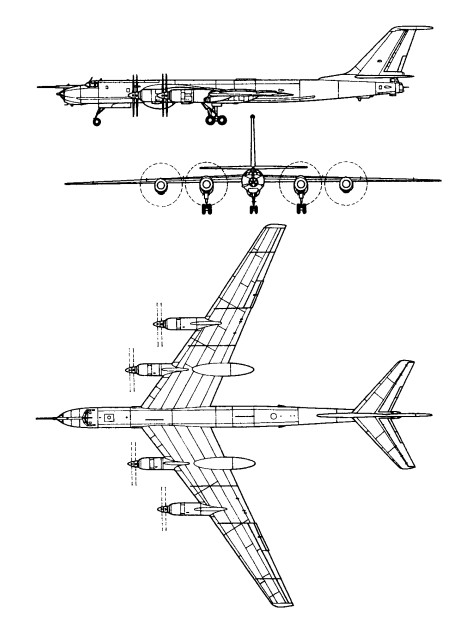
NATO code name ‘Moss’, about 10 surviving Tu-114s were retired and converted to Tu-126 ‘Moss’ configuration as airborne early warning platforms with a rotating radome pylon-mounted over the rear fuselage for the Soviet air force. The aircraft also has an inflight-refuelling probe and a number of blisters and fairings covering operational equipment. The former passenger cabin provides ample space for extensive communications, radar and signal processing equipment, and consoles for specialist operators.
First deployed in the mid-1960s, the Tu-126 carries a crew of 12. It is powered by four NK-I2MV turboprop engines and has a range of 7,700 miles at a cruise speed of 380-485 mph. The endurance at cruising speed for a 1,250-mile radius is six hours, which with flight refuelling can be extended to 17 hours.
Engines: 4 x NK-12MV, 15000hp Max take-off weight: 170000 kg / 374788 lb Wingspan: 51.20 m / 168 ft 0 in Length: 55.20 m / 181 ft 1 in Height: 16.05 m / 53 ft 8 in Wing area: 311.10 sq.m / 3348.65 sq ft Max. speed: 850 km/h / 528 mph Cruise speed: 650 km/h / 404 mph Ceiling: 13000 m / 42650 ft Range: 12550 km / 7798 miles Crew: 5 + 12 systems operators.
The Soviet government had planned for several years that the General Secretary of the Communist Party and Premier of the Soviet Union, Nikita Khrushchev, should address the United Nations General Assembly. As a matter of national prestige, he had to travel on a Soviet airliner.
When this matter first arose, in the mid-1950s, the Soviet Union had no medium- or long-range aircraft in commercial service. Although the Tu-104 was shortly to enter service, it was not considered suitable because of its relatively short range. The -114 was in the early stages of design, but whether it would be operational before the end of the decade was difficult to determine. The Soviet Union had, of course, the remarkable Tu-95, but the nation’s leader could not travel in a strategic bomber – or could he? Tupolev was called in.
Nikolai Bazenkov was diverted from other duties to prepare a passenger version of the Tu-95. Two aircraft were taken from the production line at Kuibyshev. No armaments were fitted, and all military equipment was removed. With the original airframe of the Tu-95, a passenger compartment was installed behind the wing spar; it consisted of a pressurised cabin with two sections, each of which could accommodate twenty passengers in VIP luxury. A kitchen, toilet and service room were also installed. A fitted stairs was installed so passengers could board and disembark without a need for special airport equipment.
Although the work began only in mid-1957, the Tu-116, which was sometimes called the Tu-114D, was airborne in November 1957. Usually, the ‘D’ suffix in an aircraft designation represented ‘Dalnii’ (long distance), but this time it stood for ‘Diplomaticheskii’ (diplomatic).
In April 1958, the prototype Tu-116, Air Force Number 7801, a number probably derived from its manufacturer’s block and line number, made a high-altitude, long-distance trial flight to demonstrate its ability for the task. Flying at levels between 10,000m and 12,200m, it flew non-stop from Moscow to Irkutsk and back to Moscow, covering 8,500km at an average speed of 800km/h. After landing, it was calculated still to have fuel for another 1,500 to 2,000km. The second aircraft was intended as a reserve in the event of a problem with the first, but neither were needed. Instead, Khrushchev flew to the New York headquarters of the United Nations Assembly in the prototype Tu-114.
Never intended for normal commercial service, the two Tu-116s were little used. Originally painted in military marks (7801 and 7802), one aircraft was later given the civilian registration SSSR-76462, and is now preserved in the Ulyanovsk Museum of Civil Aviation.
While the Tu-114 was derived from the military Tu-95, it was given a totally new fuselage. However, three Tu-116s were also built, and were designated Tu-114Bs by Aeroflot and retained the much narrower fuselage of its predecessor.
Engines: 4 x NK-12MV turboprops, 15000hp Max take-off weight: 121920 kg / 268789 lb Wingspan: 51.1 m / 168 ft 8 in Length: 47.5 m / 156 ft 10 in Wing area: 311.1 sq.m / 3348.65 sq ft Max. speed: 770 km/h / 478 mph Ceiling: 12000 m / 39350 ft Range: 10500 km / 6525 miles
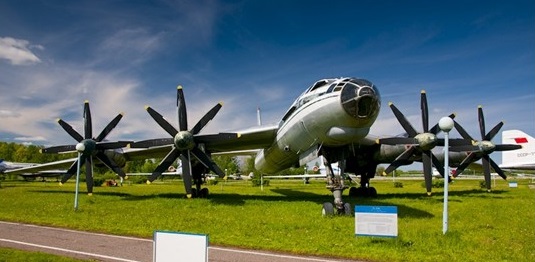
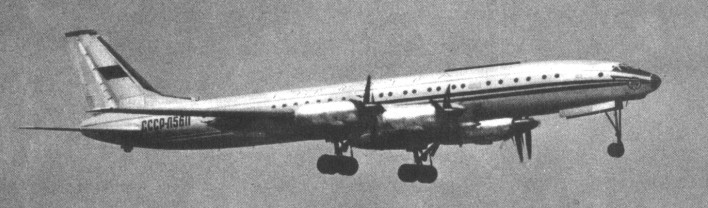
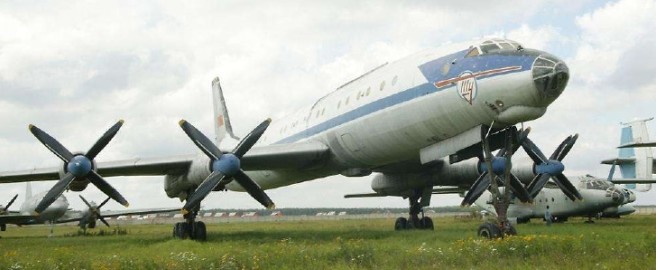
The Tu-114 flew for the first time on 3 October 1957 and remained the world’s largest and heaviest commercial aircraft until the introduction of the Boeing 747. The prototype Tu 114, named Rossiya (Russia) to celebrate the 40th anniversary of the 1917 Revolution, established a large number of speed, height and distance records with payloads of up to 66,216lb (30,035 kg). The first public appearance was at the 1959 Paris Airshow.
On April 9, 1960 Tu-114 set the world speed record with 25000kg payload on a 5000 km circuit at 877.212kph.
The production versions entered Aerofllot service since 1961. Seating 170 on internal services or 120 on intercontinental routes, the Tu-114 proved fast and reliable and operated Moscow-Havana, Moscow-Delhi, Moscow-Montreal and Moscow-Tokyo services until replaced by the four-jet Ilyushin Il-62 from 1967. Many speed-and-altitude-with-payload records set by the Tu-114 stood for many years. Its final retirement on international routes came in 1969, and the last domestic services were flown in 1973.
About 30 Tu-114s were built and about 10 surviving Tu-114s were retired and converted to Tu-126 ‘Moss’ configuration as airborne early warning platforms for the Soviet air force.
Engines: 4 x Kuznetsov NK 12MV turboprop, 14,795 eshp / 11033kW Props: 8 ft 41 in (5.60 m) diameter 8 blade contra rotating Wing span: 167 ft 8 in (51.10 m) Length: 177 ft 6 in (54.10m) Height: 15.5 m / 51 ft 10 in Wing area: 3,349 sq ft (311.1sq.m) Empty weight: 91000 kg / 200622 lb Gross weight: 376,990 lb (171,000 kg) Max cruising speed: 478 mph (770 km/h) at 29,500 ft (9,000m) Range: 3,850 miles (6,200km) with max payload of 66,140 lb (30,000 kg) Ceiling: 12000 m / 39350 ft Accommodation: Crew of 10 15 (Incl cabin staff) and 120 220 passengers









 All Aero