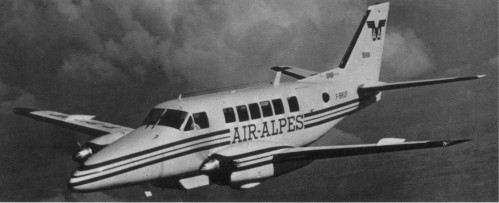
In production until 1978 the Beechcraft 99 Airliner was the first turbine-powered retractable landing gear aircraft to meet FAA approval for commuter air carrier service (regulations requiring a flight attendant for aircraft with 20 or more passengers). The test and development aircraft, which first flew in December 1965, was again a stretched fuselage Queen Air, initially with piston engines but was quickly upgraded to Pratt&Whitney PT6-A-27 turboprops. It was flown in July 1966, with type approval obtained in May 1968. With only capacity for two pilots and 15 passengers, it was less economical than the Twin Otter and required longer runways to operate from.
First delivered in 1968, the Model 99 was powered by twin 550-shp Pratt & Whitney turboprops driving reversible propellers. These enable the Beechcraft 99 to cruise at more than 250 mph and pull a gross load of 10,200 pounds or more. Introduced in 1969, the 99A Airliner housed 680-shp Pratt & Whitney free-shaft turbines flat rated at 550 shp. Except for the engines, the 99A is identical to the original 99.
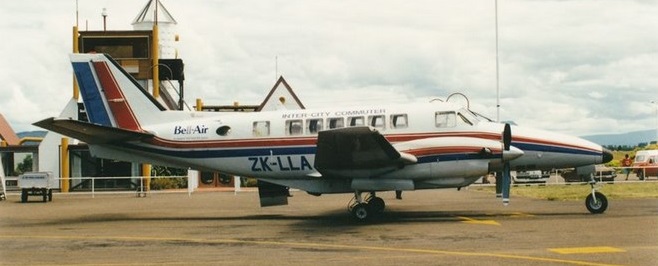
Beechcraft 99A ZK-LLA
The 99B, announced in 1972, featured engineering improvements for increased reliability, maintainability and passenger comfort. The ship has an air-conditioning unit as an option with its high pressure continuous-flow oxygen system. Also, an optional cargo door and cargo pod, installed beneath the fuselage, in¬creases its cargo capability. Seating can be varied to suit specific needs. After building only 164 Model 99 aircraft, Beech withdrew from this market in 1975. However, with the Air Deregulation Act of 1978 the upgraded Model 99 was brought back into production as the model C99 Airliner powered by the P&W PT-6A-36, with a further 75 of these C99s being built.
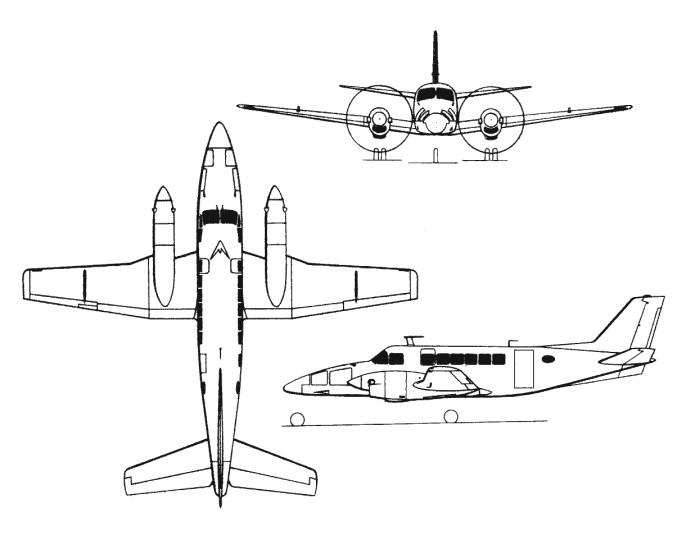
99 Engines: 2 x Pratt & Whitney (UACL) PT6A 20 turboprop, 550 shp. Props: 6 ft 7in (2.02 m) dia 3-blade. Wing span: 45 ft 10.5in. Length: 44 ft 6.75in (13.58m). Wing area: 279.7 sq ft (25.88 sq.m). Gross Wt. 10,400 lbs (4,717 kg). Empty Wt. 5675 lbs. Fuel capacity 374 USG. Max cruising speed: 254 mph (409 kph) at 10,000 ft (3,050 m). Range: 1,100 miles (1,770 km) with 1,800 lb (816 kg) payload. Crew: 2. Pax cap: 15. Stall 75 mph. Initial climb rate 1910 fpm. Ceiling 25,000 ft. Takeoff distance (50’) 3200 ft. Landing distance (50’) 2470 ft.
B99 Engine: 2 x P&WAC PT6A-27, 680 hp. Seats: 17. Wing loading: 38.97 lb/sq.ft. Pwr loading: 8.02 lb/hp. Gross wt: 10,995 lb. Empty wt: 5891 lb. Equipped useful load: 4784 lb. Payload max fuel: 2318 lb. Range max fuel/cruise: 749nm/3hr. Range max fuel /range: 1097nm/5.3hr. Ceiling: 26,313 ft. Max cruise: 245 kt. Max range cruise: 209 kt. Vmc: 85 kt. Stall: 75-91 kt. 1.3 Vso: 98 kt. ROC: 2070 fpm. SE ROC: 561 fpm @ 117 kt. SE ceiling: 13,000 ft. Min field length: 2800 ft. Fuel cap: 2466 lb. Takeoff distance (50’) 2480 ft. Landing distance (50’) 1810 ft.
BE-C99 Airliner First built: 1981. Engines: 2 x P&W PT6A-36, 715 shp. Props: Hartzell 3-blade, 93-in. Seats: 17. Length: 44.6 ft. Height: 14.4 ft. Wingspan: 45.9 ft. Wing area: 279.8 sq.ft. Wing aspect ratio: 7.5. Maximum ramp weight: 11,380 lbs. Maximum takeoff weight: 11,300 lbs. Standard empty weight: 6124 lbs. Maximum useful load: 5256 lbs. Maximum landing weight: 11,300 lbs. Wing loading: 40.4 lbs/sq.ft. Power loading: 7.9 lbs/hp. Maximum usable fuel: 2466 lbs. Best rate of climb: 2221 fpm Service ceiling: 28,080 ft. Maximum single-engine rate of climb: 539 fpm @ 119 kts. Single-engine climb gradient: 270 ft/nm. Single-engine ceiling: 14,360 ft. Maximum speed: 226 kts. Normal cruise @ 8,500 ft: 249 kts. Fuel flow @ normal cruise: 740 pph. Endurance at normal cruise: 2.8 hrs: Stalling speed clean: 94 kts. Stalling speed gear/flaps down: 83 kts. Turbulent-air penetration speed: 169 kts.
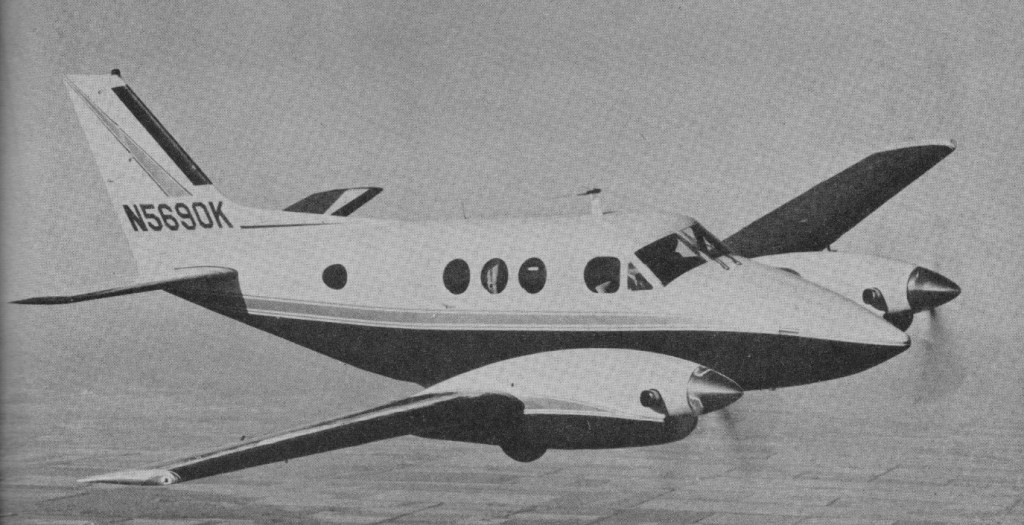
Beech had been working on the model 90 King Air since 1963 (then identified as the Beech Queen Air Model 65-80) utilising the 373kW P&W turboprop PT6 engines. This aircraft was basically a Queen Air fitted with turboprop engines and first flew in January 1964. It proved to be faster than the Twin Otter but still only provided seating for nine passengers. The Model 65-80 designation was confusing as there were Model 65 and Model 80 Queen Airs in production, so the aircraft became known temporarily as the Model 65-90T (T standing for turboprop). In due course, an even better job was made of clarifying the situation by renaming the turboprop-powered Queen Airs as King Airs. In effect, therefore, the Model 65-90T was the prototype for the Beech Model 90 King Air series, but more specifically became the prototype of the unpressurised military Kings Airs.
Announced with a basic price of $300,000, first deliveries were planned for the Fall of 1964. Following the first flight of the Model 65-90T, a civil equivalent was produced in parallel with a pressurised cabin, and the first production prototype of this aircraft, designated Model 90 King Air, flew for the first time on 20 January 1964.
The Pratt & Whitney PT6A-6, 550 shp King Air was fully pressurised.
The first overseas tour for Beech’s King Air started 4 September 1965 with a non-stop Gander, Newfoundland, to Paris flight, first for a plane in this category. Bob Oestreicher, Beech pilot, and Pierre Allain, of Neuchtel, Switzerland, landed at Toussus-Le-Noble Airport near Paris 9 hr 50 min after takeoff. Groundspeed for the 2600 mile trip was 264 mph at 17,000 ft. The only squawk was the clock lost 30 sec over the Atlantic.
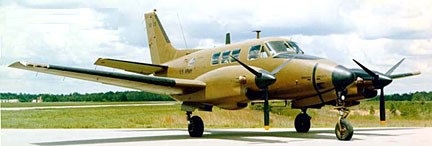
US Army testing of the Model 65-90T, under the military designation NU-8F, had shown the aircraft to be suitable for the military requirement, so an initial order for 48 aircraft, under the designation U-21A (TC 3A20), was placed. Beech distinguished its military King Airs from civil versions by identifying them as Model 65-A90-1, and began modification of the civil aircraft to provide a utility interior. This accommodates a crew of two and 10 troops, or six to eight command personnel, or three stretchers, and seating can be removed easily for the carriage of up to 1361kg of cargo.
Beech U-21A
Initial deliveries of production U-21As, which were given the name Ute, began on 16 May 1967, and subsequent contracts resulted in more than 160 being built. These included U-21As and RU-21A/RU-21D variants all with 410kW Pratt & Whitney PT6A-20 turboprops, and RU-21B/ RU-21C/RU-21E variants with 462kW PT6A-29s. The RU-21s were developed especially for operation in an electronic reconnaissance role in South-East Asia, sprouting a strange collection of aerials and sensors, and being equipped internally with related avionics’ systems, plus nav/com systems suitable for all-weather operations. RU-21Bs and RU-21Cs had Beech designations Model 65-A90-2 and Model 65-A90-3 respectively, and the designation U-21G applied to 17 aircraft for the USAF that were similar to the U-21A. Deliveries of the civil Model 90 King Air began in late 1964, this having cabin pressurisation, and accommodating a maximum of 10 persons, including the pilot. It was superseded in early 1966 by the King Air A90, which introduced the more powerful PT6A-20 engines.
The 90, A90 (first flying in 1966) and B90 are all powered by 500 shp.
The A90 was followed by a King Air B90 with detail improvements in 1970, the B90 was fitted with a 550-shp Pratt & Whitney engines.
In September 1970 by the King Air C90 which introduced a more advanced pressurisation and heating system for the cabin, still with 550-shp Pratt & Whitney engines. The C90 was in production in 1982, with a total close to 1,000 having been delivered by the end of the year. One of these, designated VC-6B, also serves with the USAF’s 1,254th SAM Squadron. The single VC-6A operated by the 89th Military Airlift Wing at Andrews AFB, Maryland, was placed in service in early 1966, and retired in 1985.
Since its introduction, the C90 has been the subject of steady improvement, the 1982 powerplant was the PT6A-21. Ten examples of the C90 serve with the Spanish air force and civil aviation school for instrument training and liaison.
The E90 became part of the lineup in 1972 and employed the 680-shp Pratt & Whitney PT6A-28 turboprop, flat-rated to 410kW. All have full-feathering, reversible propellers. Their pressurized, three-compartment interior can be maintained at sea level atniosphere pressure to flight levels as high as 10,500 feet. The E90 is virtually a more powerful version of the C90. This version remains in production in 1990.
An addition to the King Air line in June 1979 is the F90, a fuel-efficient version, thanks in part to the new Pratt & Whitney engines with improved turbine blades which extract more power from the engine, four blade propellers and full deicing equipment. At 300 mph true air speed it burns less than 70 gallons per hour. Slower-turning props also reduce interior noise levels. This combined the pressurised fuselage of the Model 90, with the wings and tail unit of the Models 100 King Air and 200 Super King Air respectively. The dual wheel gear are fitted with brake deice systems. The pressurization differential of 5.0 pounds/sq.in. provides a sea-level cabin at 11,000 feet. The F90 was powered by 750 shaft horsepower Pratt & Whitney PT6A 135 engines and sold for $954,500.
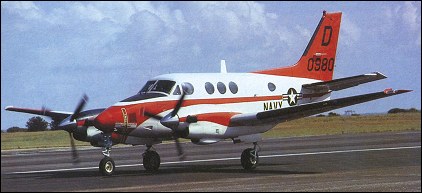
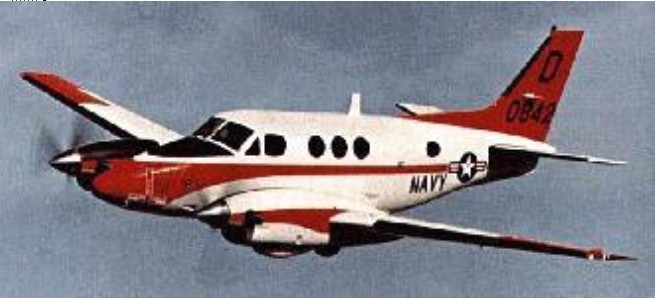
In 1976 the Naval Air Systems Command selected Beech win¬ner of an industry, competition for a three year pur¬chase of new multi engine training aircraft for Naval aviators. The Navy selected an aircraft that combined features of the C90 and E90, designated T 44A. The aircraft is powered by two 550 shp PT6A-34B turbo-prop engines. A total of 15 aircraft purchased by the Navy are to replace piston engine powered TS 2A and TS 2B trainers.
Students selecting the Specialized Undergraduate Pilot Training [SUPT] turboprop track attend T-44 training conducted by the U.S. Navy at Corpus Christi, Texas, and then go on to flying duties in turboprop aircraft. Training includes the Navy common maritime turboprop course followed by an Air Force top-off course. The top-off course consists of single aircraft and formation tactical low level airdrop procedures. Training takes approximately 26 weeks and includes 152 hours ground training, 30 hours in the flight simulator and 111 flying hours in the T-44. The T-44 is equipped with deicing and anti-icing systems augmented by instrumentation and navigation equipment which allows flight under instrument and icing conditions. The interior includes a seating arrangement for an instructor pilot (right seat), a student pilot (left seat), and a second student. Two additional passenger seats are included. A distinguishing feature of the aircraft is the avionics fault insertion capabilities afforded the instructor pilot from the right-seat armrest and the second student/observer audio control panel that allows the second student to monitor all radio communications.
T-44A Pegasus
The T-44A aircraft was procured as a commercial-derivative aircraft certified under an FAA Type Certificate. Throughout its life, the aircraft has been operated and commercially supported by the Navy using FAA processes, procedures and certifications. It continues to be maintained commercially at all levels of maintenance, and relies on COTS/NDI components and equipment to support airworthiness. Aircraft modification efforts are “turnkey” projects (procurement and installation) implemented as part of competitively awarded maintenance contracts. Where extensive integration efforts are required, the non-recurring engineering phase, including test and certification, is typically performed by Raytheon Aircraft Company under a sole-source engineering contract with the Navy.
The 3,000th example of the King Air family was delivered to a customer on 17 April 1981. While production of the F90 ended at 231 aircraft, the C90 continued in production, 1,415 of the low-tailplane variants having been delivered by early 1989.
The Swearingen Taurus was a modified Beech King Air 90 with two 700hp P&W PT6A-135 circa 1986.
B90 Engines two 500-shp Pratt & Whitney turboprops. Seats 6-10. Gross Wt. 9650 lbs. Empty Wt. 5685 lbs. Fuel capacity 384 USG. Cruise 260 mph. Stall 87 mph. Initial climb rate 1900 fpm. Ceiling 27,000 ft. Range 1480 sm. Takeoff distance (50’) 1420 ft. Landing distance (50’) 2300 ft.
C90 King Air First built: 1964. Engines: 2 x P&W PT6A-21, 550 shp. Props: Hartzell 3-blade, 93.4-in. Seats: 6/10. Length: 35.5 ft. Height: 14.3 ft. Wingspan: 50.3 ft. Wing area: 294 sq.ft. Wing aspect ratio: 8.6. Maximum ramp weight: 9705 lbs. Maximum takeoff weight: 9650 lbs. Standard empty weight: 5765 lbs. Maximum useful load: 3940 lbs. Maximum landing weight: 9168 lbs. Wing loading: 32.8 lbs/sq.ft. Power loading: 8.8 lbs/hp. Maximum usable fuel: 2573 lbs. Best rate of climb: 1955 fpm. Service ceiling: 28100 ft. Max pressurisation differential: 4.6 psi. 8000 ft cabin alt @: 21200 ft. Maximum single-engine rate of climb: 539 fpm @ 108 kts. Single-engine climb gradient: 299 ft/nm. Single-engine ceiling: 15050 ft. Maximum speed: 224 kts. Normal cruise @ 18,000ft: 218 kts. Max range cruise: 197 kt. Fuel flow @ normal cruise: 432 pph. Endurance at normal cruise: 5.4 hr Range max fuel/cruise: 881nm/4.0hr. Range max fuel /range: 1251nm/6.4hr. Stalling speed clean: 89 kts. Stalling speed gear/flaps down: 76 kts. 1.3 Vso: 99 kt. Turbulent-air penetration speed: 169 kts.
C90A Cruise: 247 kt. Seats: 10. Range 7 POB & res: 1100 nm
E90 Engine: 2 x P&WAC PT6A-28, 550 hp. TBO: 3500hr. Seats: 10. Wing loading: 34.4 lb/sq.ft. Pwr loading: 9.2 lb/hp. Gross wt: 10,160 lb. Empty wt: 5961 lb. Equipped useful load: 3949 lb. Payload max fuel: 773 lb. Range max fuel/cruise: 1004nm/4hr. Range max fuel /range: 1609nm/7.5hr. Ceiling: 27,620 ft. Max cruise: 248 kt. Max range cruise: 216 kt. Vmc: 86 kt. Stall: 77-86 kt. 1.3 Vso: 100 kt. ROC: 1870 fpm. SE ROC: 470 fpm @ 111 kt. SE ceiling: 14,390 ft. Min field length: 2110 ft. Takeoff distance (50’) 2024 ft. Landing distance (50’) 2110 ft. Fuel cap: 3176 lb / 474 USG. Cabin pressure: 4.6 psi.
F90 King Air First built: 1979. Engines: 2 x P&W PT6A-135, 750 shp / 559kW. Props: Hartzell 4-blade, 92-in. Seats: 6/10. Wingspan: 13.99 m / 45 ft 11 in Length: 12.13 m / 39 ft 10 in Height: 4.8 m / 15 ft 9 in Wing area: 25.98 sq.m / 279.65 sq ft Wing aspect ratio: 7.5. Maximum ramp weight: 11,030 lbs. Maximum takeoff weight: 10,950 lbs. Standard empty weight: 6549 lbs. Maximum useful load: 4481 lbs. Zero fuel wt: 9,600 lbs. Maximum landing weight: 10,950 lbs. Wing loading: 39.1 lbs/sq.ft. Power loading: 7.3 lbs/hp. Maximum usable fuel: 3149 lbs. Best rate of climb: 2380 fpm. Service ceiling: 29,802 ft. Max pressurisation differential: 5 psi. 8000 ft cabin alt @: 23,120 ft. Maximum single-engine rate of climb: 600 fpm @ 117 kts. Single-engine climb gradient: 309 ft/nm. Single-engine ceiling: 14,419 ft. Maximum speed: 267 kts. Normal cruise @ 22,000ft: 257 kts. Fuel flow @ normal cruise: 538 pph. Endurance at normal cruise: 5.3 hrs: Stalling speed clean: 94 kts. Stalling speed gear/flaps down: 77 kts. Turbulent-air penetration speed: 169 kts.
U-21A Ute 1967 Staff transport Engines: two 550hp P&W PT6A-20 Wingspan: 45′ 11 in Length: 35’6″ Useful load: 4220 lb Max speed: 265 mph Range: 1675 mi Seats: 10 No built: 140, 66-18000/18047, 67-18048/18076, -18078/18084, -18086, -18088, -18090/18092, -18094/18103, -18116/18118 4 for electronic warfare as RU-21A, 67-18112/18115 4 modified for electronic reconnaissance as EU-21A, 66-18000, -10803, -18007, 67-18058 2 for ground instruction as GU-21A, 66-18006, -18012 4 for special development tasks as JU-21A, 66-18008, 67-18063, -18065, -18069
RU-21B 1967 Special military applications No built: 3 67-18077, -18087, -18093
RU-21C 1967 Staff transport No built: 2 67-18085, -18089
RU-21D 1967 Modified cockpit No built: 18 67-18104/18111, -18119/18128, plus 18 U-21A conversions
JRU-21D No built: 1 unknown modification 67-18125
RU-21E 1971 Staff transport. No built: 15 70-15875/15890; with 3 modified RU-21D
U-21G 1971 Electronic countermeasures No built: 17 70-15891/15907
RU-21H 1971 Staff transport No built: 32
RU-21J 1972 Battlefield surveillance No built: 20 71-21058/21060 3 modified for a short time from C-12L, then reverted
T-44A Pegasus / H-90 Engines: 2 x P&W-Canada PT6A-34B, 550hp 61 built
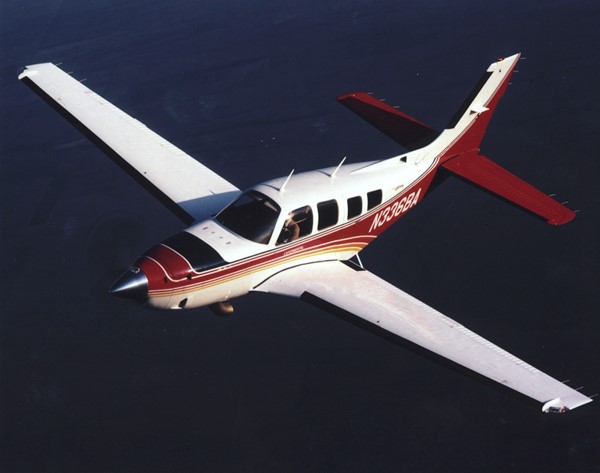
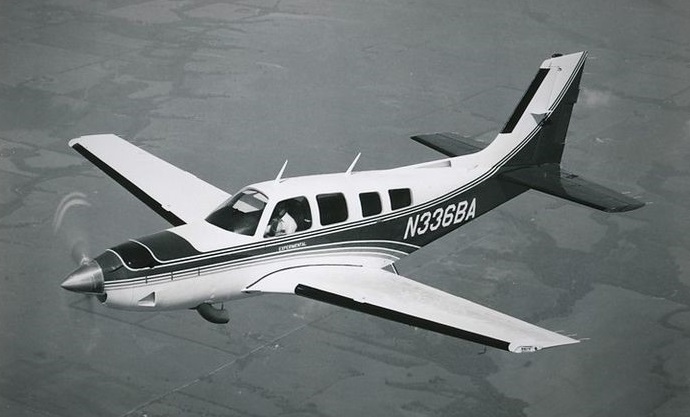
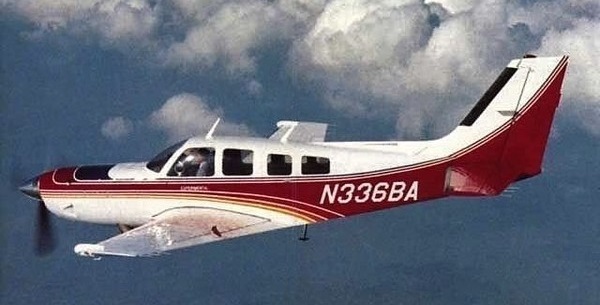
The Model 38P (Pressurized) (also known as the model PD.336) was created during 1981 by installing a Garrett AiResearch TPE-331-9 engine in the nose of a Beechcraft Baron 58P fuselage, which was mated to a Beechcraft B36TC Bonanza wing in place of the Baron’s wing with two engines. This resulted in a low-wing aircraft with six seats including the pilot’s.
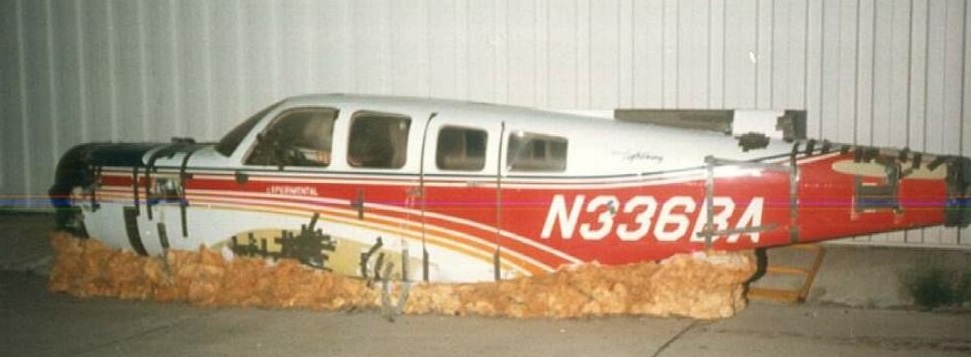
The aircraft, registered N336BA c/no EJ-1, flew for the first time on June 14, 1982, piloted by Lou Johansen. After 133 flights over almost 18 months the aircraft was temporarily grounded so that the TPE331 could be removed and a Pratt & Whitney Canada PT6A-40 engine fitted in its place.
A total of 133 flights were logged and the last flight of the Model 38P was made on 14 November 1983. The PD 336 prototype was also fitted with a 630shp UACL PT6A-40 powerplant and was flown by Lou Johansen on 9 March 1984. This aircraft logged 68 flights before the last flight was made on 8 August.
Beechcraft originally planned to put the Lightning into production but the economic downturn among general aviation manufacturers in the United States in the 1980s led to the project being shelved shortly after the first flight with PT6A power.
Three variants were expected to be offered to customers: the Model 38P powered by a PT6A-40, the Model 38P-1 powered by a PT6A-116 and the Model 38P-2 powered by a TPE-331-9. In spite of 75 letters of intent, Beech announced during the summer of 1984 that further development work on the Model 38P Lightning was being suspended because of poor market conditions and purchase deposits collected were returned.
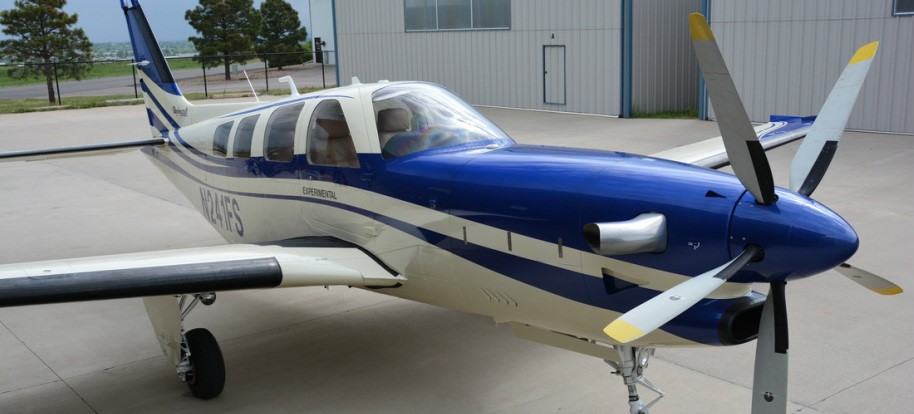
Advertised for sale in August 2019 was Lightning N241FS S.N.: RB-01, for $590,000.
Lightning N241FS
Lightning N241FS was reported as powered by a Walters Diemech 601 EXP Turboprop with an Avia Five Bladed, full feathering/reverse prop. This Lightning was manufactured and certified in 2006. Climb rates were 2,000 fpm which it can maintain into the flight levels. High speed cruise is 241 kts, thus the N number of N241FS (for “fast ship”). Normal cruise is 220-230 kts TAS depending on density altitude. Cruise fuel flows are 40-45 gph depending on altitude. A cruise prop setting of 1850 makes for a very quiet cabin. Useful load is 2500 lbs. With full fuel, you can put over 1300 lbs in the cabin. Useful Load: 2500 lbs. Takeoff and landing ground roll is typically 1000-1500′ depending on weight and density altitudes. This is a full feathering and reverse prop which saves on the brakes on short runways. It was currently flying and at last count, had a little over 150 hrs total time.
Model 38 P Engine: 1 × Pratt & Whitney Canada PT6A-40 turboprop, 550–650 shp (410–480 kW) Wingspan: 37 ft 10 in (11.53 m) Length: 29 ft 11 in (9.12 m) Height: 9 ft 2 in Wing area: 188.1 sq.ft Loaded weight: 5800 lb Max speed: 316 mph (509 km/h, 275 kn) Cruise 20,000ft: 279 mph Cruise 25,000ft: 238 mph Range normal: 1075 mi Rang eco: 1285 mi Service ceiling: 25,000 ft (7,600 m) Crew: 1 Capacity: 5 passengers
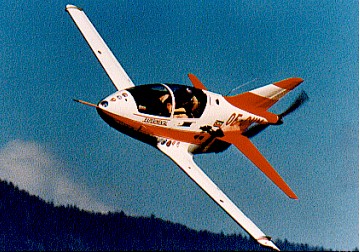
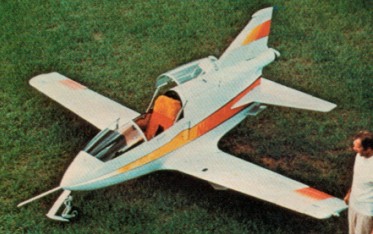
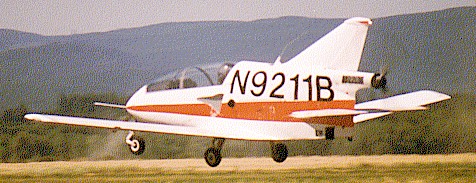
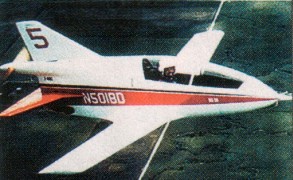
The BD-5 is a high performance single-place, low-wing, pusher-configuration sport plane. Design features include all-metal construction, mechanical retractable landing gear among the industry finest, detachable wings, and wrist action side stick control as in modern day fighter aircraft. Originally developed in the early 1970’s the aircraft was designed to day VFR requirements for use in sport and recreational flying, including limited aerobatic capability. Originally it was powered by a 40-hp Hirth snowmobile engine and was fitted with a wingspan of 14 feet. More recently the wingspan was stretched to 17 feet and the more powerful Xenoah three-cylinder two-stroke engine was installed. The pilot is seated under a transport canopy forward of the engine in a heated cockpit. The landing gear is fully retractable, and the entire fuselage/wing structure is constructed of light alloy materials.
Oshkosh 1973 was the year the BD.5 appeared and it provided a spectacular show in the hands of Les Bervan, Bede’s test pilot. It performed both in long and short winged versions and with a retracting gear. The jet powered BD-5J also made its first public appearance.
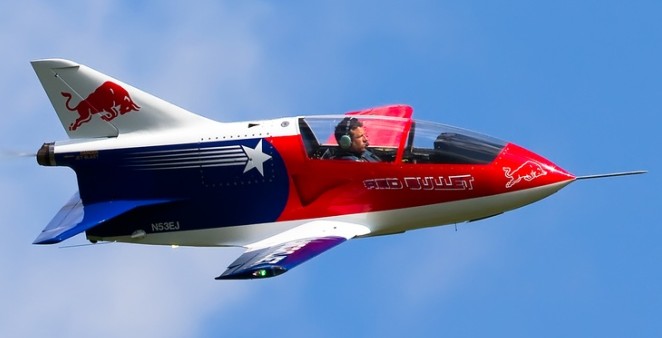
BD-5J
The BD 5J was powered by a 100 kg (202 lb) thrust Microturbo jet engine, spans 5.18 m (17 ft), and is fully aerobatic. After the collapse of Bede, the BD-5 became available as modified conversions such as the Alturair BD-5. BD-Micro Technologies, in late 1995, offered enhanced BD-5 kits. Enhanced BD-5 Kits are designed to be assembled in the shortest time with the least hassle. Components (Wings, Flaps, Ailerons, Vertical Stabilizer, Horizontal Stabilator, Rudder, Fuselage, Landing Gear, and Nose Gear Box) come predrilled on factory jigs. Machined, welded, and difficult to form parts are supplied. The .032” thickness wing skins with modified leading edge improves stall and slow flight control.
Flightline BD-5T Turboprop
The BD-5T Turboprop kit features everything except paint & avionics. With the standard components (Wings, Flaps, Ailerons, Vertical Stabilizer, Horizontal Stabilizers, Rudder, Fuselage and Landing Gear) pre-drilled on factory jigs, and machined, welded, and difficult to form parts are supplied. The BD-5T features a fuselage superstretch of 13.4 in and supplementary wingspar system, detachable wings and control system (20 minutes for assembly or removal), and detachable horizontal stabilizer. Power is from a Quantum H-95 turboshaft engine and Quantum III Propeller. The propeller is developed specifically for turbine engines, weighs 11 lbs including hub and 3 blades. The Quantum turboprop powerplant system (engine & propeller) was designed for the BD-5T. It is a constant speed, torque variable turboshaft engine based on Solar T-62 series components. Flightline Series® BD-5B kit features a complete airframe package- less engine, engine systems, paint & avionics. With the standard Wings, Flaps, Ailerons, Vertical Stabilizer, Horizontal Stabilizers, Rudder, Fuselage and Landing Gear) pre-drilled on factory jigs, and machined, welded, and difficult to form parts supplied, construction time is around 900-1000 hours. Assembled quickly and easily with common skills. Engines can be in the Hirth 2706, Xenoah range.
In 1992, Ed (“Skeeter”) and Richard Karnes started BD Micro Technologies Inc. (BMT), beginning a long journey to update the BD-5 with modern technology while using current building techniques. After many years of research and development, BMT has successfully incorporated many improved design features in an aircraft lineup called the “Flight Line Series” or “FLS” kits.
FLS safety advances include improved stall characteristics, increased pitch stability, reduced airframe fatigue, and modern technology integration focused on increasing systems reliability while reducing pilot workload. Lewis, who formed Lewis & Clark Performance LLC, collaborated with BMT to build the first complete FLS Microjet.
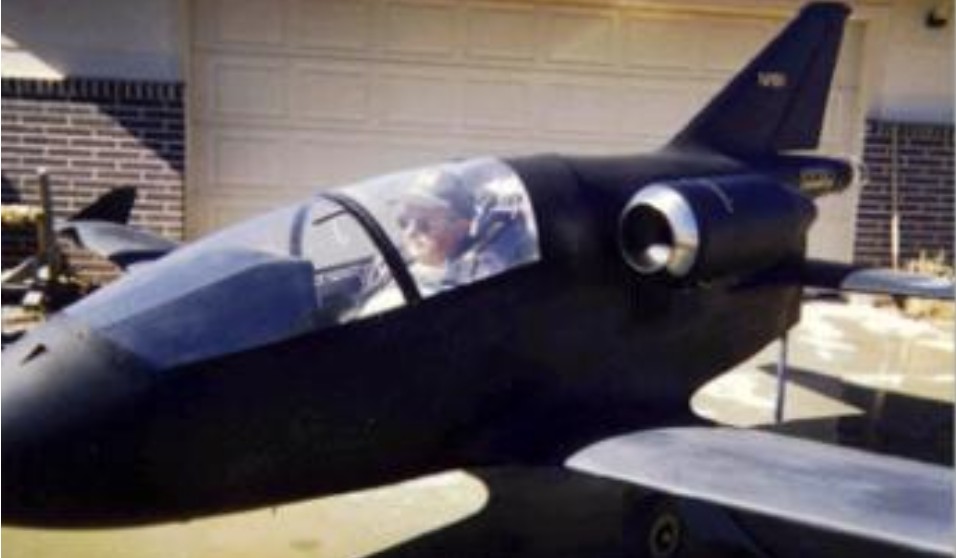
The Flightline Series BD-5J Microjet airframe kit features a complete airframe package requiring 600 to 800 hour construction time. Components (Wings, Flaps, Ailerons, Vertical Stabilizer, Horizontal Stabilizers, Rudder, Fuselage and Landing Gear) are pre-drilled on factory jigs and the fuselage preassembled to “On the Gear” stage. Machined, welded, and difficult to form parts are supplied. Parts are manufactured to aircraft industry standards. The Flightline Series BD-5J Microjet has FLS turbine structural airframe enhancements and a fuselage stretch, 5.2 in. (optional 13.5 in superstretch). The BD-5J has fuel quick disconnects, NACA jet engine intake scoops, Super Spar (supplementary wing spar system), Microjet disc brakes, a Hartwell canopy latch system, and a 5-point safety harness system. With adjustable seating and side stick control, the retractable landing gear cycles in one second. Detachable wings and control system takes 20 minutes for assembly or removal. The horizontal stabilizer is also detachable. The engine is also equipped with an attenuator designed to cut thrust.
BD-5J
Alturair produced a modification of the standard Bede BD-5 to accept an alternative engine.
William ‘Wild Bill’ Brooks Cornville (Arizona) BD-5J Trijet
Bill Brooks flew a BD-5B with a Solar T62, then modified it with 3 HJFS-100 55 Kp units (pod 2 and 1 in the fuselage) and a canard in the front. It is more than probable that he never flew in this configuration.
It was bought by Dave Dearing in 2004 who changed it to standard 5J (the wing is still that of a 5B). Engine side, Dave acquired a Christmas Penny NPT301.
EMG G8-2-130 powered BD-5
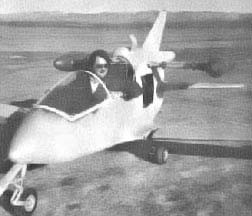
Leolan McRorey was the first owner of BD-5 to have equipped it with two Gluhareff EMG G8-2-130 pulse jets. These jets are mounted on a steel rod to each side of the rear fuselage. This configuration was chosen to create a separation between the motors and to avoid the propagation of sound waves.
The small size of the BD-5 managed to board 50 liters of propane in two tanks, a 20 and 30 liter.
Instead of installing a dual throttle, he decided to change the position of the two engines, close to the fuselage.
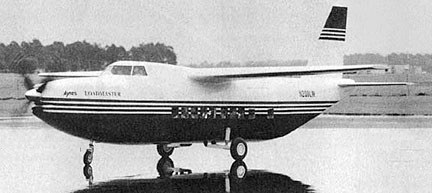
The 1996 LM200 Loadmaster was designed for Federal Express, featuring two turboshafts driving one five-bladed propeller through a combining gearbox. It was design-driven for need to carry four “demi” containers.
Engine: 2 x Allied Signal / Allison TWINPAC CTP 800-4T, 2367 shp Length: 68.996 ft / 21.03 m Height: 22.474 ft / 6.85 m Wingspan: 63.976 ft / 19.5 m Wing area: 453.487 sq.ft / 42.13 sq.m Max take off weight: 19002.7 lb / 8618.0 kg Weight empty: 9000.8 lb / 4082.0 kg Max. speed: 196 kts / 363 km/h Cruising speed: 165 kts / 306 km/h Initial climb rate: 1870.08 ft/min / 9.5 m/s Wing load: 42.03 lb/sq.ft / 205.0 kg/sq.m Maximum range: 1120 nm / 2075 km Range (max. weight): 651 nm / 1205 km Crew: 2 Payload: 19-34pax / max. 3400kg
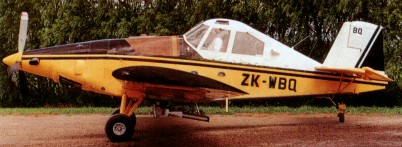
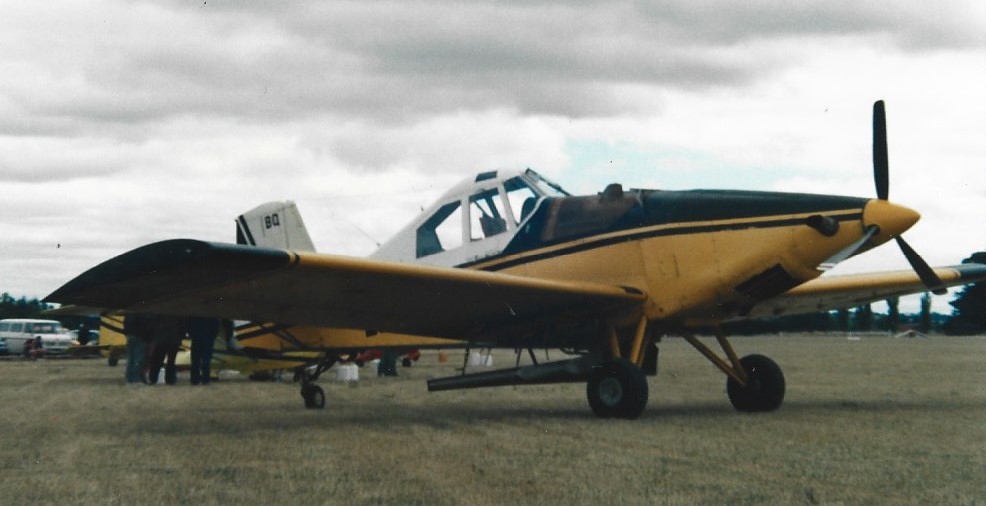
The S2R Series is a fixed undercarriage low-wing single-engine tailwheel configuration agricultural aircraft of all-metal construction with welded steel-tube fuselage. The hopper is located forward of the cockpit, and the aircraft is available in single or dual (tandem) cockpit configurations. The S-2R model was developed by Rockwell from the S-2D by widening the fuselage from 38” to 46” to accept a larger 400 US gallon hopper, to be able to carry a greater volume of low density materials used by Rice growers, and adding flaps.
Type Acceptance Certificate FAA Type Certificates A3SW and A4SW.
The S2R Series is a fixed undercarriage low-wing single-engine tailwheel configuration agricultural aircraft of all-metal construction with welded steel-tube fuselage. The hopper is located forward of the cockpit, and the aircraft is available in single or dual (tandem) cockpit configurations. The S-2R model was developed by Rockwell from the S-2D by widening the fuselage from 38” to 46” to accept a larger 400 US gallon hopper, to be able to carry a greater volume of low density materials used by Rice growers, and adding flaps.
Type Acceptance Certificate FAA Type Certificates A3SW and A4SW.
In 1977, the Ayres Corporation, of Albany, Georgia, purchased the Thrush Commander line and continued to build the S2R, with the same constructors serial sequence, finally ending at 2582R. Previously the type certificate had been held by Snow Aeronautical Company (up to February 18, 1970), North American Rockwell Corporation (up to April 3, 1973), and Rockwell International (up to November 28, 1977) .
A new sequence was started by Ayres with the 750 hp P & W PT6A-34AG with constructors numbers beginning with 6001, and incorporating one major change, the fitting of a 500 US gallon hopper. The 5000 sequence was used for the 100 or so 800 hp Wrights built by Rockwell. The Turbo Thrush S2R-T34 was then developed for Ayres by installation of a PT6A engine under STC, the first such turbine application for an agricultural aircraft. This was type certificated under A3SW in the Normal Category, but the manufacturer advises virtually none have been delivered in that category. All subsequent S2R derivatives (basically different turbine engine options) were only certificated in the Restricted Category under A4SW, including several using the TPE331 family (these were popular because overhauled engines were much less expensive than a new PT6A). Some engine and propeller options for the S2R-T34, and the Dual Cockpit trainer option originally approved by STC, are only approved in the Restricted Category.
Once Ayres had taken over, one of the new versions was named the Bull Thrush, powered with a 1200 hp Wright R-1820-97 and fitted with a 500 US gallon hopper. One of the new features was a Dual Cockpit variant, being denoted by a DC at the end of the constructor’s number. From this time Ayres were to start a whole new series of constructors num¬bers, prefixed by S2R, followed by engine model fitted and then a number, in most cases, starting at -001. As example, S2R-1340-… (600 hp), S2R-1820-… (1200 hp), S2R-RS3-… (PZL R83, 595 hp) and S2R-T34-… (750 hp).
The new turbine models incorporated a wing extension from a span of 44 feet, 5 inches to 47 feet, 6 inches with a wing area of 350 square feet. The wing extensions can also be fitted to the smaller round engined versions, as well as adding an all metal tailplane. The Ayres tail version being the same outline as the tube and fabric original, and another is being offered by Weatherley.
A further development by Ayres was the Model S2R-T65, which was fitted with a larger 500 US gallon hopper and 1300 shp PT6A-65 engine. This had an increased span wing but was initially approved at the original 6000 lb. gross weight. Later an improved wing with steel spar webs was tested and the S2RHG-T65 (High Gross) version was certificated with a MCTOW of 10,500 lb. Thrush also certificated a similar high gross S2RHG-T34 version with a 550 US gallon hopper and a MCTOW of 9500 lb. However Report ER-568 stated that performance was marginal and only a few were produced. Report ER-538 states that all aircraft manufactured by Thrush since 2003 have been produced to a common fuselage and wing configuration.
Since 1991, some of the T34 aircraft have had a PT6A-41AG of 850 hp fitted and, likewise, the T15 line has had one PT6A-27 of 680hp installed. Another version available is the T45, with its own c/n sequence fitted with a PT6A-45 of 1173hp
The Type Certificate went to Ayres Corporation up to November 26, 2001, then Quality Aerospace (up to July 9, 2003), and the Thrush Aircraft Inc.
In the eighties, the US Government required a long range sprayer for anti-narcotics work. Ayres developed the T34 model and fitted it with the PT6A-65A of 1376 hp, self-sealing fuel tanks, and armour plate around the pilots seat. Up until December 1990, eight had been built with the unusual T65-1X sequence. From October 1987, Dual Cockpit versions entered the production line, beginning with T65-001DC and all going to the US Government. The first to a civil operator was 011DC, going to Gwydir Air as VH-NFH in 1990. This was re-powered by a PT6A-65AG of 1230 hp turning a five blade prop. Not only is it quieter, the length has been increased to 34 feet and the hopper has been increased to hold 625 US gallons. In 1994, the T65s were back in production, with several being delivered to South Africa. In 1991 Ayres installed a Garrett TPE 331-6 (starting with c/ n G6-101) and up until 1994, twenty of these 750 hp versions have been delivered. Two more variants are offered, the G5 and G10, first appearing in 1993. Like the T15/34 range, they can be fitted with 400 or 500 gallon hoppers. The real advantage is the much cheaper Garrett engine. On 14 March 2000 Ayres received the type certificate for the all new Ayres 660 Turbo Thrush. The first three aircraft are fitted with the Pratt & Whitney PT6A-60AG turbine of 1050 hp, the fourth with the 1230 hp PT6A-65AG engine, which will be available as an option. With a work force of 62 in 2004, Thrush Aircraft principals Payne Hughes and Larry Bays have already built six new Thrush aircraft three model 660s and three model 550s, all sold to individual owners since acquiring the company in mid 2003. The new owners have made a substantial investment, not only in purchasing the Thrush line, but also in building renovations and new machine equipment. Thrush Aircraft has exclusively teamed with General Electric to produce the Thrush 510G powered by the GE H80 turbine engine. The H80 provides increased temperature margins to enhance hot-day takeoff performance and high-altitude cruise speeds. GE chose Thrush to launch this new engine. The top of the range model is the Thrush 660. This aircraft was developed by the Ayres Corporation as the S2R T660 at the end of last century and went into production in 2000. Only eight aircraft were built before Ayres closed it doors at its Albany, Georgia, plant. The aircraft was designed around a 660 US gallon hop¬per and this was the first time that the airframe had been completely reworked since the inception of the Rockwell S2R 600 in 1968. The standard main undercarriage was replaced with steel spring legs, the wings were modified and an unusual dorsal fin added to the tailplane with the idea of keeping the overall in¬flight height the same as other Thrush ag planes.
Thrush S2R-T
With the new aircraft, the name Thrush 660 remains the same, but with a new hopper design and a new gate box for spraying, 680 US Gallons is now standard capacity. In firebombing mode, this can be increased to 750 US gallons. The vacuum bag technology in the fibreglass construction allows for a more even wall thickness, saving about 100 Ibs of weight while creating a larger interior with the same external dimensions. The new hopper has also allowed changes in the hopper gates. The new 660 will have a longer, straight cowling, similar to the TPE331 G series, with a new, more streamlined nose bowl. The squat tailplane has been replaced with a completely new fin, which is six inches higher and thus has more surface area. Thrush Aircraft has addressed its wing spar problems head on. The 660 centre wing beam and spar configuration has been redesigned to make the outer wing panels lighter and incorporates stronger heat treated 4340 steel spar caps, as well as a 4340 cen¬tre beam. The extra strength of the heat treated 4340 steel spar caps allow for a reduction in the number of steel doublers and inboard steel webbing, which saves weight. The 660 wing has been static tested to 14,150 lbs. The Thrush 660 will be fitted with the PT6A 65 or the PT6A¬67. More performance enhancing features include the closing in of the rear portion of the fuselage, thus reducing air turbulence around the tail section. The medium size version is the Thrush 550. Once marketed as the Ayres 510, the 550 has inherited the new vacuum bag technology fibreglass hopper as with the 660. The aircraft’s capacity has been increased by 49 US gallons and the top of the hopper is wider and has been redesigned to give a straight line between the propeller and the cockpit windscreen. Along with the redesign of the hopper, better fairings have been installed on the lower fuselage. The Thrush 550 now incorporates a new 29,000 hour lower spar caps (made from 4340 heat treated steel and giving the same weight advantages as the 660), which can be retrofitted to exist¬ing Thrush aircraft eliminating all requisite ADs on existing S2Rs. For operators requiring extra fuel, new tanks can be provided outboard of the present fuel cells. The PT6A 34AG engine will be the main provider of power but the G 10 engine can also be fitted. However, the most notable change to the Thrush 550 is the fitting of steel spring undercarriage legs.
Thrush Aircraft has exclusively teamed with General Electric to produce the Thrush 510G powered by the GE H80 turbine engine. The H80 provides increased temperature margins to enhance hot-day takeoff performance and high-altitude cruise speeds. GE chose Thrush to launch this new engine.
The Thrush 550P has wide-stance spring landing gear capable of absorbing 8800 pounds on short, rough strips and optional spring steel landing gear can be added to increase weight for take off and landings. And it brings you a 29,000 hour Wing Spar Life and a 550 gallon clear-view hopper.
The Thrush 550P has wide-stance spring landing gear capable of absorbing 8800 pounds on short, rough strips and optional spring steel landing gear can be added to increase weight for take off and landings. It has a 29,000 hour Wing Spar Life and a 550 gallon clear-view hopper.
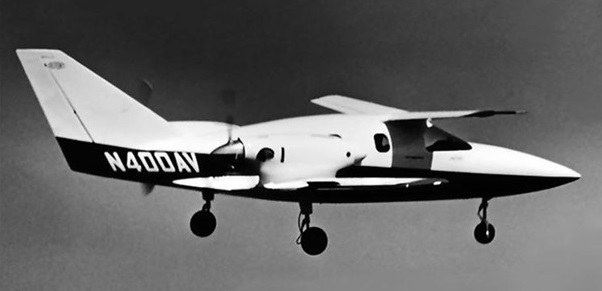
The Avtek 400 was the proof of concept aircraft of a six/nine-seat pusher turboprop-powered business aircraft, with a crew of one or two pilots. Designed by Leo J Windecker, it was the first US aircraft constructed throughout from DuPont ‘Kevlar’ advanced composite material, hence the ‘DUPONT’ logo on upper sides of the tailfin.
It featured over the wing pusher propellers, high mounted forward canard, bizarre wing shapes, all-Kevlar construction and lack of elevators.
First flown in the USA on 17 September 1984, the type never went into production, and the company went bankrupt in 1998.
The aircraft appeared in the ‘Airwolf’ TV series as the X-400, the plane used by the villain Lou Stappleford in the episode ‘Eagles’.”
400A Engines: 2 x 680hp P&W Canada PT6A-3L/R Wingspan: 35’0″ Length: 39’4″ Useful load: 2781 lb Max speed: 294 mph Stall: 96 mph Range: 2600 mi Ceiling: 41,000 Seats: 6-10
Beginning as an A. V. Roe project in 1958, the original Type 748 was planned as a 20-seat short/medium-range feeder airliner. When no interest was shown in the design, it was scaled up in size and the Hawker Siddeley Group, of which Avro was a component company, decided to put the aircraft into production.
The first flight of the prototype took place at Woodford on 24 June 1960. The first production aircraft, capable of seating a maximum of 48 passengers, was designated Avro 748 Series 1. It first flew on 31 August 1961, powered by two 1298kW Rolls-Royce Dart 514 turboprops.
This aircraft has a takeoff run of only 2,750 feet, for STOL performance it has a long-span wing, mounted low, with Fowler flaps driven by an electric actuator. The Rolls-Royce Dart turboprops, mounted with their jet pipes above the wings, are rated at about 2,280 hp, though some military versions have 3,200-hp Darts. Most civil versions of the HS 748 seat 40 to 58 passengers and some are equipped for freight or passenger/freight operations.
Redesignated HS.748 in 1963, later versions included the Series 2 and Series 2A (1967) civil transports; Andover CC.Mk 1 and CC.Mk 2 for the RAF, the CC.Mk 2 being two specially equipped examples for The Queen’s Flight; the Coastguarder variant was also developed, optimised for maritime patrol, flying in 1977.
Six Andovers were delivered to the RAF, two for Queen’s Flight, and four for special passenger service. Prince Phillip Duke of Edinburgh, after completing transition training, used Queen’s Andover CC Mk.2 during his tour of Mexico and Caribbean in October and November 1964.
Hawker Siddeley Andover C.1
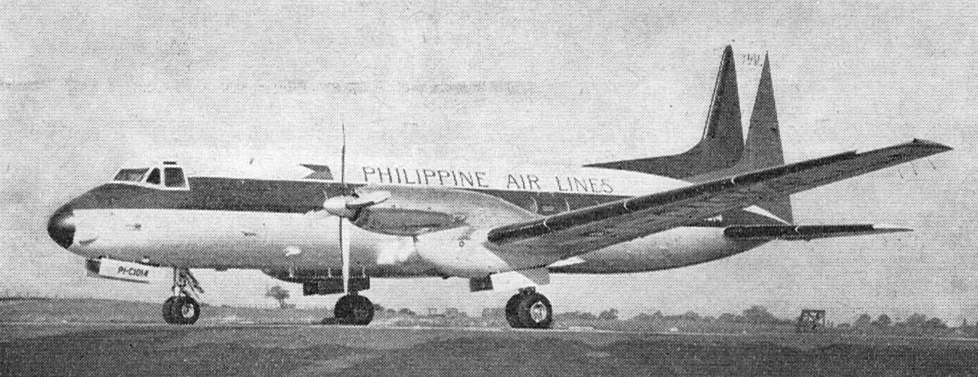
1st of six HS.748 for Philippine Air Lines, handed over at Woodford, 29 September 1967
The 748-2B incorporated a 2000 lb increase in payload, increased span, more powerful engines, and a number of cockpit refinements, flew in June 1979. A production version of the twin-turboprop transport is the Super 748. In its Military Transport form the 748 has a large rear freight door, strengthened floor, and optional military overload take-off and landing weights giving improved payload/range capabilities.
Andover NZ7626
Outwardly, the 748 is similar to the 780 Andover aircraft which differ mainly in having more powerful engines (and reverse pitch propellors), a rear loading ramp, and a kneeling undercarriage. Only 31 Andovers were built, along with six of the Andover CC.2 version of the civil 748. Although developed from the basic Hawker Siddeley 748 and retaining it’s exterior looks, with the exception of the revised tail and straight-in loading ramp, the Andover does have only 20 per cent commonality with the 748. The Andover’s “kneeling” undercarriage allows the aircraft’s fuselage to be lowered to allow easier loading and unloading. The STOL performance for a 42,000 lbs take off, the Andover requires 1,300 ft (to 50 ft), while 1,340 ft is needed for a short field landing (from 50 ft) at 40,000 lbs auw. Reverse-thrust propellors assists the short field performance. Production of all versions, including 79 assembled in India by Hindustan Aircraft from parts manufactured in both countries, totaled 380 aircraft.
HS748-2A Engines: 2 x Rolls-Royce Dart, 2280 shp. Wing span: 98 ft 6 in (15.24 m). Length: 67 ft 0 in (20.42 m). Height: 24 ft 10 in (3.51 m). Max TO wt: 44,495 lb (20182 kg). Max level speed: 278 mph (448 kph).
BAE 748-2B Engines: 2 x Rolls-Royce Dart 7 Mk.535-2, 1,835 shp. Props: Dowty-Rotol 4-blade, 144-in. Seats: 48/50. Length: 67 ft. Height: 24.8 ft. Wingspan: 102.5 ft. Wing area: 829 sq.ft. Wing aspect ratio: 12.7. Maximum ramp weight: 46,700 lbs. Maximum takeoff weight: 46,500 lbs. Standard empty weight: 26,650 lbs. Maximum useful load: 20,050 lbs. Maximum landing weight: 43,000 lbs. Wing loading: 56.1 lbs/sq.ft. Power loading: 12.7 lbs/hp. Maximum usable fuel: 11,200 lbs. Best rate of climb: 1470 fpm. Service ceiling: 25,000 ft. Max pressurisation differential: 5.5 psi. 8000 ft cabin alt @: 25,000 ft. Maximum single-engine rate of climb: 359 fpm. Single-engine ceiling: 10,700 ft. Maximum speed: 250 kts. Normal cruise @ 25,000ft: 230 kts. Fuel flow @ normal cruise: 1257 pph. Endurance at normal cruise: 8.4 hrs: Stalling speed clean: 95 kts. Stalling speed gear/flaps down: 71 kts. Turbulent-air penetration speed: 155 kts.
HS 748 series 2B Engines: 2 x Rolls-Royce Dart Mk 555, 1700kW Take-off weight: 23133 kg / 51000 lb Empty weight: 11644 kg / 25671 lb Wingspan: 31.23 m / 102 ft 6 in Length: 20.42 m / 66 ft 12 in Height: 7.57 m / 24 ft 10 in Wing area: 77.0 sq.m / 828.82 sq ft Cruise speed: 452 km/h / 281 mph Ceiling: 7620 m / 25000 ft Range w/max.payload: 1307 km / 812 miles Crew: 2-3 Passengers: 52
748 Military Engine: 2 x R-R Dart turboprop, 3400 kW. Span: 31.2 m. Length: 20.4 m. Wing area: 77 sq.m. Empty wt: 11,700 kg. MTOW: 23,100 kg. Payload: 5800 kg. Cruise speed: 455 kph. Initial ROC: 430 m / min. Ceiling: 7600 m. T/O run: 1082 m. Ldg run: 387 m. Fuel internal: 6550 lt. Range/payload: 1865 km with 5800 kg. Capacity: 60 pax.
748MF Andover C.1 Engines: 2 x RR Dart 12 Mk 201C, 3,000 shp. MTOW: 50,000 lbs. Fuel cap: 1,440 Imp gallons, + 860 gallons in an integral centre-wing tank. Range: 1,020 nm (1,800 nm with 860 Imp aux). Pax cap: 57 passengers (at 30” pitch). Cruise alt: 20,000 ft. Max speed: 302 mph @ 15,000 ft. Service ceiling: 23,800 ft. Maximum payload: 14,750 lbs. Take off distance mauw: 3810 ft. Landing ground roll max ldg wt (47,600 lbs): 2490 ft.
HS.780 C.1 Engines: 2 x Rolls-Royce Dart 12 Mk.201, 3425 shp. Max payload: 6270 kg.
Hawker Siddeley Andover C Mk 1 Engine: 2 x Rolls Royce Dart R.Da 12 Mk. 210 C, 2929 shp Length: 77.92 ft / 23.75 m Height: 30.085 ft / 9.17 m Wingspan: 98.261 ft / 29.95 m Max. speed: 262 kts / 485 km/h Service ceiling: 24016 ft / 7320 m Range: 1031 nm / 1909 km Crew: 3+44
748-2A Andover CC2 Engines: 2 x RR RDa7 Dart 152, 2280 shp. TBO: 1600 hr. Max cruise: 245 mph. Econ cruise: 243 mph. Stall: 82 mph. Fuel cap: 11628 lb. Fuel flow max cruise: 1850 pph. Fuel flow econ cruise: 1400 pph. Service ceiling: 23,000 ft. SE service ceiling: 13,000 ft. ROC: 1300 fpm. SE ROC: 750 fpm. Min balanced field length: 4050 ft. Payload with full fuel: 8790 lb. Max range: 1828 mile. High speed range: 1068 mile. Max payload: 16,773 lb. Range with max payload: 761 mile. Pressurisation differential: 5.5 lb. Seats: 47. Gross wt: 46,500 lb. Empty wt: 29,727 lb. Useful load: 16,773 lb.
The ATR72, a stretched development of the ATR42 (the fuselage had grown by 4.5 metres to provide space for up to 74 seats), was launched in January 1986 and first flew on 27 October 1988. Significant changes from the ATR-42 (apart from the fuselage stretch) include Pratt and Whitney Canada PW 124-B turbo props with roughly 20 percent more power than the PW 120 of the ATR-42, wingspan extended by 2.48 metres (although the whole of the wing outboard of the nacelles has been simplified and improved), and greater use of composites. French certification was achieved in September 1989, by which time five aircraft were flying. The first customer delivery, to KarAir in Finland, was made exactly a year after the first flight. By May 1995,152 ATR-72’s had been firmly ordered or delivered. Construction of the ATR-42 and ATR-72 is on a common assembly line at Toulouse. The ATR72 fuselage and tail is manufactured in Italy, the wings, undercarriage and engine cowlings in France, the engines in Canada, and propellors in the USA. The ATR72-212A designation being a marketing ploy and rating commonality of Mount Cook Airline for the ATR72-500. The 212A model being certified on 14 January 1997.
ATR72 Engines: 2 x Pratt & Whitney Canada PW 124/2 turboprops , 2,400 shp (1 790 kW). Wing span: 88 ft 9 in (27,05m).
ATR72-212A Engines: 2 x Pratt & Whitney Canada PW127F, 2750 shp. Props: 6 blade Hamilton Standard/Ratier-Figeac 568F composite. Length: 27.166 m. Wing span: 88 ft 9 in (27,05m). Height: 7.65 m. MTOW: 22,500 kg (49,603 lbs). MLW: 22,350 kg (49,273 lbs). Max zero fuel wt: 20,300 kg (44,753 lbs). Max payload: 7450 kg (16,424 lbs). Seats: 66. Range: 942 nm. TO field length: 1290m (4232 ft). Ldg field length: 1067 m (3500 ft). Max cruise: 278 kts. Operating ceiling: 25,000 ft.
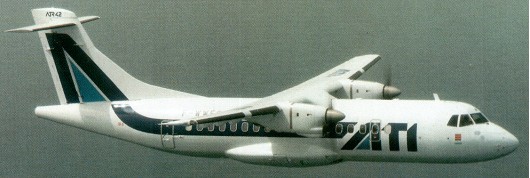
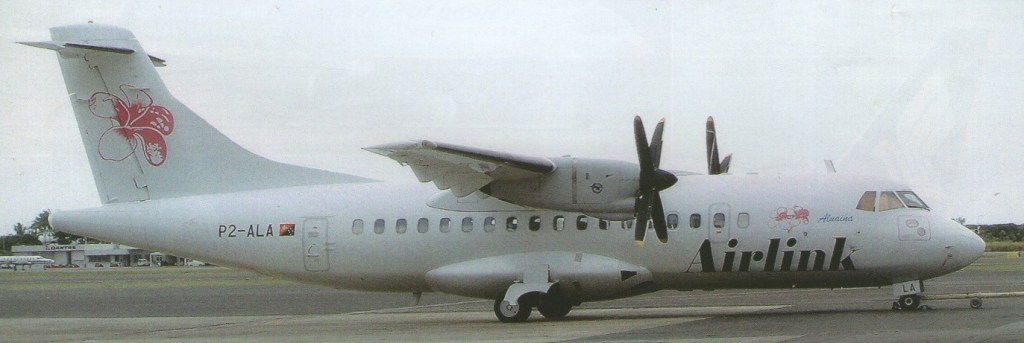
Both Aerospatiale in France, and Aeritalia in Italy, had developed proposals in the late 1970’s for twin turboprop 38/40 seat aircraft. Both companies were looking for partners to further develop the concepts and eventually, in July 1981, a joint venture consortium, ATR, was formed. The new project was designated the ATR 42, the 42 indicating the number of seats at 81 cm pitch. The initials ATR stand for Avion de Transport Regional/ Aereo daTransporto Regionale/ Regional Transport Aircraft. The type made its first flight in August 1984 and was certificated in September 1985. The launch customer was Air Littorial, a French regional opera¬tor, which began operating the type in the following December. The ATR 42 300 (the higher weight version) accommodates a maximum of 50 passengers, but a more typical layout is for 46 passengers. In addition to the generous overhead lockers, baggage compartments are provided both behind the flightdeck and in the rear fuselage. The aircraft is powered by two Pratt and Whitney Canada PW120s, flat rated at 1800shp and driving Hamilton Standard four bladed composite propellors. The ATR 42 structure makes extensive use of composites, particularly Keviar/Nomex sandwich for the wing and tail leading edges, wing and undercarriage fairings, and fuselage tail cone. Carbon/Nomex sandwich is used for the rudder, elevators, flaps, and engine nacelles, and carbon monolithic structure is used for the ailerons and outer wing panels. using experience gained with the Airbus, the flight deck is EFIS equipped. Subsequently the consortium has developed the ATR 72, a stretched version of the ATR 42 which uses the same wings and tail but uprated engines.
As at May 1995, 286 of these aircraft had been ordered or delivered. ATR42F freighter. The ATR42-500 first flew in September 1994.
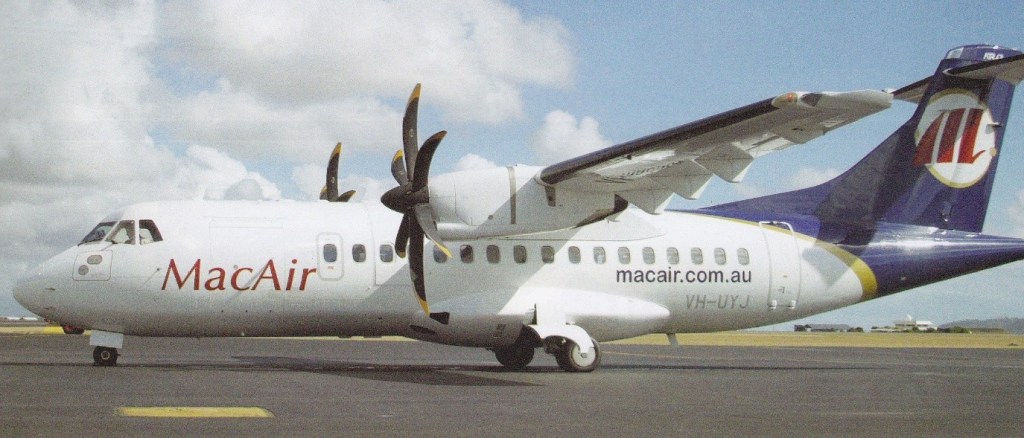
1998 ATR42-500 VH-UYJ
The ATR 42-600 pre-series aircraft (F-WWLY c/n 811) completed its maiden flight on 4 March 2010 from Toulouse Blagnac Airport in southern France. The two-hour flight included tests of the Pratt & Whitney PW127M turboprops, the balance of the propellers, the new avionics, hydraulic and electrical systems.
The ATR 42-600 will undertake a 75hour flight test campaign. Many of the systems are the same as used in the ATR 72-600, which began its 150-hour flight test programme in July 2009. To March 2010 ATR had orders for five 42-600s and 54 72-600s.
ATR-42R Engine: 2 x P&W PW 120 turboprop. Installed pwr: 2680 kW. Span: 24.6 m. Length: 22.7 m. Wing area: 54.5 sq.m. Height: 7.586m. Empty wt: 9937 kg. MTOW: 15,750 kg. Payload: 4530 kg. Cruise speed: 470 kph. Initial ROC: 490 m / min. Ceiling: 7650 m. T/O run (to 15m): 660 m. Ldg run (from 15m): 560 m. Fuel internal: 5700 lt. Range/payload: 2535 km with 4000 kg. Capacity: 44 pax.




 All Aero