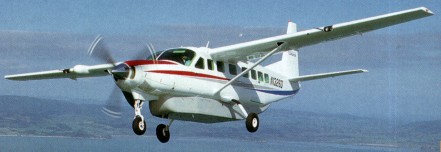
Cessna CE-208 Caravan / C-98

CE-208B Grand Caravan

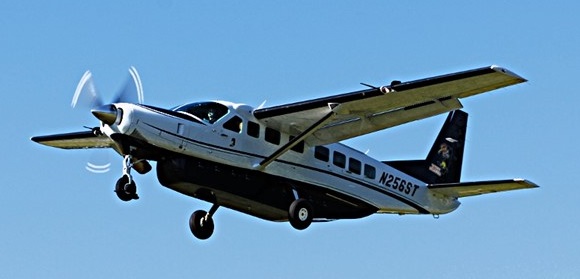
First flown on 9 December 1982, the Caravan I was Cessna’s first wholly new design for some years. The type was planned as the Model 208 to succeed the company’s earlier Models 180, 185, and 206 while also assuming the utility mantle of de Havilland Canada types such as the Beaver and Otter. The Caravan I is a thoroughly utilitarian design with a strut-braced wing in the high-set postion, a capacious fuselage accessed by large doors, and fixed tricycle landing gear with tall legs so that a ventral freight container can be fitted when required. The spring steel main undercarriage legs were designed to tear away without damaging the fuselage structure in an accident. The nosewheel fore-and-aft location is taken not on the airframe but by means of a drag link spring, attached near the fork to reduce bending loads in the strut. Steering to 15 degs either way is by linkage to the rudder pedals, and the wheel is free to castor to 56 degs either side. All fuel is carried inside the wings between the two spars for safety, and the tips and leading and trailing edges are made from lighter-gauge metal than the rest of the wing structure, which should thus remain intact in the event of minor damage. The wings are an aerofoil section the same as the Citation’s, and the flaps take up so much of the span that lateral control is helped by spoilers on the top surface acting in conjunction with the ailerons.

Cessna CE-208 Caravan Article

The first production aircraft rolled out in August 1984.
The 208 received FAA certification in October 1984 and the first deliveries in February 1985. Because of FAR Part 23 restrictions, American registered Caravans have no more than 10 seats in their 17 foot cabins. An increase in MAUW to 8000 lbs (from 7300) allows them to carry more than their basic empty weight of 3800 lbs and promising much useful load-carrying.
The higher gross weight Model 208A, ordered in December 1983 by the US small parcel airline Federal Express and called Cargomaster by them, is fitted with more comprehensive all-weather avionics and an underfuselage pannier, but has the fuselage windows deleted. Flight testing began on 3 March 1986, followed by certification and first delivery to Federal Express, who have ordered 210, in October the same year. By the end of 1989 more than 370 variants of the Model 208 had been delivered.
In 1984 the company launched development of a purely military model as the U-27A. This is externally identical with the Model 208A but is stressed for higher maximum take-off and landing weights in its role as a utility transport for troops and freight. The type can also be configured for the casualty evacuation and forward air control roles, while the 100-cu ft (2.83 cu.m) freight container can be replaced by a reconnaissance pod with optical and infra-red sensors as well as a data-link.
In 1985 Cessna released details of a quasi-military/special mission version of the Caravan I designated U-27A by the US Department of Defense and marketed as the Low Intensity Conflict Aircraft (LICA). Equipped with six hardpoints under the wing plus another on the fuselage centreline able to carry either a General Dynamics F-16 reconnaissance pod, or a cargo pannier, the LICA also has a electrically operated ‘roll up’ cargo door with slipstream deflector, openable in flight, and bubble windows for downward surveillance and observation. Cessna are also offering a similarly equipped version of the stretched Model 208B for special mission.
Following experience with the 208A, Federal Express ordered the Model 208B Super Cargomaster with the fuselage stretched by four feet / 1.22m, also built without windows and equipped with a pannier. The first Caravan Super Cargomaster flew on 3 March 1986.
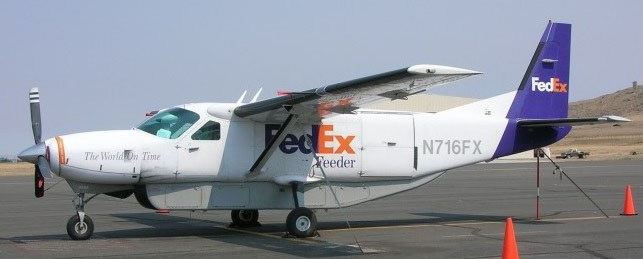
Cessna 208B Super Cargomaster

The Caravan family of aircraft consists of four distinct aircraft: the original Cessna Caravan, the Grand Caravan, the Super Cargomaster and the Caravan Amphibian. The original Caravan had its origins dating back to the early 80s and the Grand Caravan, like the Super Cargomaster, is essentially a stretched version of the original Cessna Caravan but powered by the A variant of the reliable Pratt and Whitney Canada PT6A-114 turboprop, which produces 675 shp (75 shp more than the standard version).
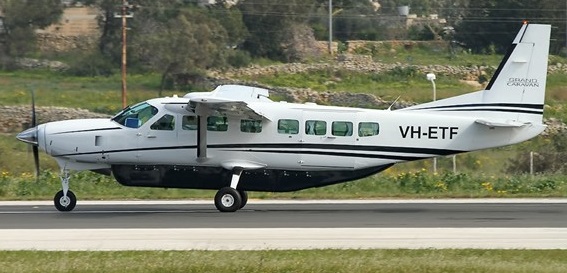
The Grand Caravan 208B first flew in 1990, some eight years after the Caravan I, and retains all of the conventional design aspects of the original: single-engine, high wing, unpressurised, with a fixed tricycle undercarriage. The PT6A-114A drives a three-blade McCauley propeller, which is governed to a constant speed of 1900 rpm and can be both feathered and reversed. While 1.2 m longer at 12.7 m, the Grand Caravan has room for up to fourteen (a pilot and thirteen passengers), the same as the Caravan I, and the fuselage itself is made up of a sheet metal bulkhead and a stringer and skin design. Although it narrows slightly towards the tail, the 5.1 m cabin is spacious and offers 9.6 cu.m of volume. This, combined with the more powerful turboprop, means that the Grand Caravan does have a higher useful load than the original. The wings on the Grand Caravan (which span 15.9 m) are conventional aerofoils, and both contain an integral fuel bay with a capacity totalling 1270 litres which feeds into a fuel reservoir before continuing to the turbine. The tail stands 4.5 m high and the control surfaces are again conventional: horn-balanced elevators and rudder. The flight control system is cables, bell cranks and push-pull rods, providing positive control and simple maintenance. The aircraft is steered by the nose wheel and the shock absorption for the main landing gear is provided by the tubular spring steel struts with an “intertube” connecting the two. Once at 10,000 ft, the Grand Caravan will cruise at 184 kts and, with a payload of just under 2,000 lbs and a reserve of 45 minutes, has a range of about 900 nm. Block time for such a flight would be around five hours. With 3,500 lbs on board, range drops to about 100 nm. It is these tasks where the Grand Caravan comes into its own; flying large loads to or from rough and short surfaces. At gross weight, landing requires just 745 ft, 1655 ft to clear a 50-ft obstacle, while a zero-wind take-off requires 1205 ft (2,210 ft to clear a 50 ft obstacle).
In 1997 the Caravan 675, which used the same engine as the Grand Caravan, was announced and deliveries started in May 1998.
The type was in service with military air arms in Brazil, Liberia, Thailand and with the Royal Canadian Mounted Police as amphibians.
Variations:
Soloy Corp Pathfinder

Gallery

CE-208
Engine: Pratt & Whitney PT6A-114, 600 shp.
Prop: Hartzell 3 blade 100-inch dia.
Wing span: 51ft 8in.
Length: 37ft 7in.
Height: 14ft 2in.
Cruise: 186 kt (214 mph).
MTOW: 6,700 lbs.
Seats: 14 pax.
Cabin width: 5ft 2in.
Cabin height: 4ft 3in.
Cabin vol: 337 cu. ft.
Payload: 3000 lbs.
Fuel cap: 330USG.

Cessna 208 Caravan I
Engine: 1 x Pratt & Whitney Canada PT6A-114 turboprop, 477kW
Take-off weight: 3629 kg / 8001 lb
Empty weight: 1752 kg / 3863 lb
Wingspan: 15.88 m / 52 ft 1 in
Length: 11.46 m / 37 ft 7 in
Height: 4.32 m / 14 ft 2 in
Wing area: 25.96 sq.m / 279.43 sq ft
Cruise speed: 341 km/h / 212 mph
Ceiling: 8410 m / 27600 ft
Range: 1797 km / 1117 miles

Cessna 208 B Caravan I
Engine: Pratt & Whitney Canada PT 6 A 114, 441 shp
Length: 37.73 ft / 11.5 m
Height: 14.108 ft / 4.0 m
Wingspan: 52.165 ft / 15.9 m
Wing area: 279.864 sq.ft / 26.0 sq.m
Max take off weight: 7336.0 lb / 3327.0 kg
Weight empty: 3801.4 lb / 1724.0 kg
Payload: 3534.6 lb / 1603.0 kg
Max. speed: 184 kts / 341 km/h
Landing speed: 60 kts / 111 km/h
Cruising speed: 175 kts / 325 km/h
Initial climb rate: 1200.79 ft/min / 6.10 m/s
Service ceiling: 26608 ft / 8110 m
Wing load: 26.24 lbs/sq.ft / 128.00 kg/sq.m
Range: 972 nm / 1800 km
Crew: 1
Payload: 9-14pax

2008 Cessna 208B Grand Caravan
Standard Price: US$1,990,000
Engine: Pratt & Whitney PT6A-114A, 675 shp
Prop: 2.7m
Length: 12.7m.
Wing span: 15.9m.
Height: 4.5m
Max ramp wt: 8785 lbs.
Gross Weight (lbs.): 8750
Empty Weight (lbs.): 5013
Useful Load (lbs.): 3772
Max ldg wt: 8500 lb
Fuel Capacity (gals./lbs.): 335/2245, 1270 lt
Payload, Full Standard Fuel (lbs.): 1548
Rate Of Climb, SL (fpm): 975
Max Operating Altitude (ft.): 23,700
Max Cruise Speed, 10,000 Ft. (kts.): 184
Max Range, 10,000 Ft. (nm): 917
Ldg roll: 745 ft
T/O run: 1205 ft
Ldg dist from 50 ft: 1655 ft
T/O dist to 50 ft: 2210 ft
Capacity: 450 cu.ft

U-27A Caravan I
Engine: one 600-shp (447-kW) Pratt & Whitney Canada PT6A-114 turboprop.
Maximum speed 203 mph (326 km/h) at optimum altitude
Initial climb rate 1050 ft (320 m) per minute
Service ceiling 30,000 ft (9,145 m)
Range 1,105 miles (1,778 km)
Empty wt: 3,850 lb (1,746 kg)
Maximum take-off 8,000 lb (3,629 kg)
Wing span 52 ft 1 in (15.88 m)
Length 37 ft 7 in (11.46 m)
Height 14 ft 2 in (4.32 m)
Wing area 279.4 sq ft (25.96 sq.m).
Payload: 14 passengers or 4,185 lb (1,898 kg) of freight.

Caravan 675
Engine: Pratt & Whitney PT6A-114A turboprop, 675 shp.

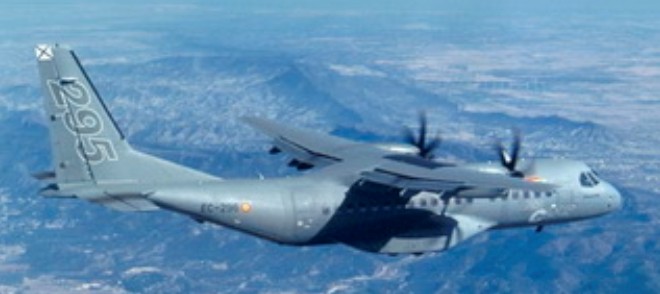
CASA CN-295 Persuader / Airbus C-295

Designed with the same operating criteria as the CASA CN-135, the C-295 has high commonality.
The CN-295 received FAA FAR-25 certification on 17 December 1999.

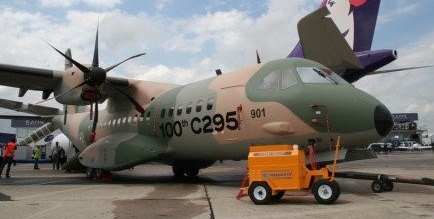
The 100th C-295, the first destined to the Royal Omani Air Force in static display, at the Paris Air Show.

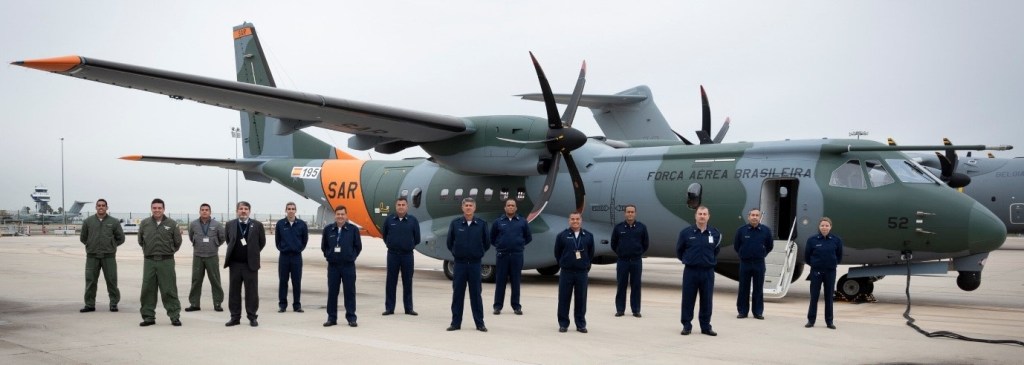
The Brazilian Air Force (FAB) received its third and final Airbus SC-105 Amazonas search and rescue (SAR) aircraft on December 9, 2020, during a handover ceremony at the company’s production facility in Seville, Spain.

Following the delivery, the aircraft – serial 6552 – departed Spain on December 11 for Campo Grande air base in Brazil’s Mato Grosso do Sul state. There it will be operated by the 2nd Squadron of the 10th Aviation Group (2°/10° GAv) ‘Pelicano (Pelican)’, alongside serials 6550 and 6551, which were delivered in August 2017 and October 2019, respectively. Locally designated the SC-105 Amazonas, this dedicated SAR platform is a variant of Airbus’ C-295MPA Persuader twin-turboprop maritime patrol aircraft.

Airbus SC-105 Amazonas 6552 in Seville, Spain, on December 9, 2020.

The first SC-105 entered service with Brazil in April 2009, when two SAR-equipped variants of the C-105 Amazonas tactical transport (based on the C-295M) operated as an interim solution for the FAB. In July 2014, Airbus announced that the South American nation had contracted it to produce and deliver three fully SAR-configured SC-105s to the air force.

The two interim examples are being reconverted into C-105 tactical transports. One has already reverted back to its original configuration and was redelivered to the FAB after SC-105, serial 6550, was handed over in 2017. The second will undergo the same process now that the third and final fully SAR-configured SC-105 has arrived in Brazil.

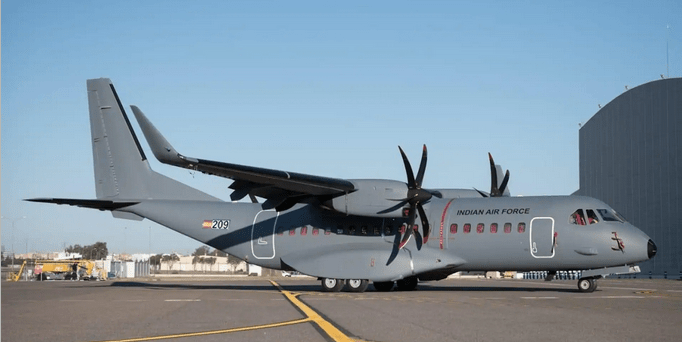
The Tata Aerospace Complex in Vododara, Gujarat, India was opened in 2024, dedicated to manufacturing C-295. Under the deal, 57 C-295 were to be supplied to the IAF, with 16 aircraft manufactured in Spain and the remaining 40 produced in India. The first Indian-assembled C-295 was expected September 2026.

Gallery

Ceiling: 30,000 ft
Range: 2850 nm
Payload: 9700 kg
Capacity: 78 troops.

CASA C-212 Aviocar / IPTN NC-212

C-212

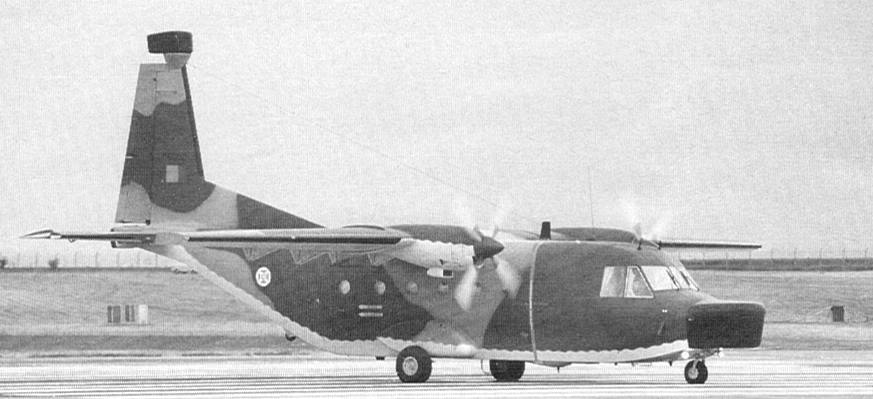
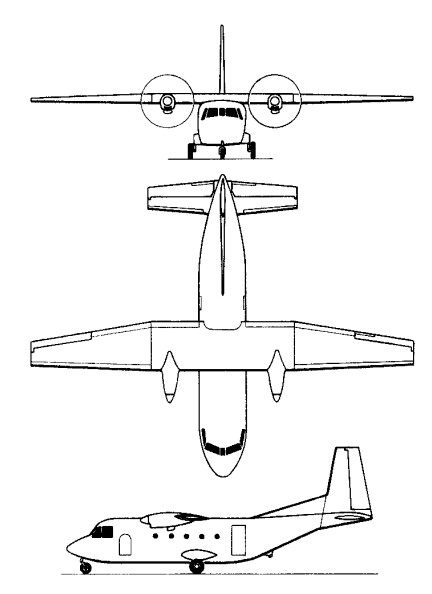
Design of the Aviocar originated to provide the Spanish Air Force with a general purpose transport and first flight was made on 26 March 1971. Active military roles include ASW and Maritime Patrol, with nose-mounted radar, specified role equipment and fuselage hardpoints for torpedoes, rockets or depth charges. Specially equipped ELINT/ECM versions of the Aviocar are used by Portuguese Air Force and others.

CASA C-212 Aviocar Article

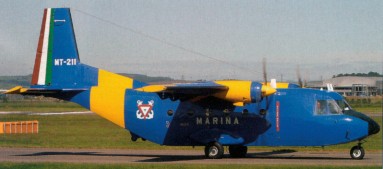
CASA 212ECM 502 Sqn Portuguese AF

Powered by two 776 hp AiResearch TPE331 251C turboprops driving four blade propellers, the C.212 has an unpressurized fuselage with full section rear doors for heavy freight or for paradropping. Able to operate from unimproved 2,000-foot strips, loads, with a flight crew of two, include 2000 kg (4410 lb) of cargo, 15 paratroops and jumpmaster, or 12 stretcher patients and three attendants or sitting casualties. Versions are available for navigational instruction, air survey and other special roles, and studies have been made of armament schemes which include stores pylons for guns, bombs or rockets under the fuselage and wings. The prototype flew on March 26, 1971, and by late 1976 well over 100 had been sold.
Since early 1987 the standard production version was the Series 300, which has an increased maximum take-off weight of 8,000kg (for the military variant), improved range and payload, and structural modifications including a redesigned nose and glassfibre wingtips. The military version can carry two 500 litre auxiliary fuel tanks on underwing hardpoints. The 26-seat commercial Series 300 flew in September 1984.
Several special-mission Aviocars are offered, including an Elint/ECM version and an ASW/maritime patrol model. The ASW/maritime patrol model is equipped with a nose-mounted 270Oscan APS-128 search radar for maritime patrol or a 3600 radar for ASW duties. Two underwing hardpoints are provided.
The Mexican Navy purchased nine Aviocars for maritime duties (plus another for VIP transport) without radar but retaining other maritime equipment.
The 212 was manufactured under licence by IPTN from 1976 as the NC-212.
By 1990 a total of 435 aircraft were built.

Engines two 908 shp Garrett-AiResearch turboprops
Seats 26.
Gross wt. 16,091 lb
Empty wt. 9,072 lb
Fuel capacity 555 USG
Top speed 242 mph
Initial climb rate 1,730 fpm
Ceiling 28,000 ft
Range 1,070 miles.
Takeoff distance (50 ft) 1,588 ft.
Landing distance (50 ft) 1,700 ft.

C-212-200
Engines: 2 x Garrett TPE331-10 turboprops, 671kW
Max Take-off weight: 7450 kg / 16425 lb
Loaded weight: 3915 kg / 8631 lb
Empty wt: 4115 kg.
Payload: 2770 kg.
Wingspan: 19 m / 62 ft 4 in
Length: 15.16 m / 49 ft 9 in
Height: 6.68 m / 21 ft 11 in
Wing area: 40 sq.m / 430.56 sq ft
Cruise speed: 385 km/h / 239 mph
Initial ROC: 455 m / min.
Ceiling: 8500+ m.
T/O run: 440 m.
Ldg run: 250 m.
Fuel internal: 2000 lt.
Range w/max.fuel: 1620 km / 1007 miles
Range w/max.payload: 760 km / 472 miles
Crew: 2
Passengers: 15-26

C.212-200 CC
First built: 1971.
Engines: 2 x Garrett TPE-331-501 C, 900 shp.
Props: Hartzell 4-blade, 110-in.
Seats: 28.
Length: 49.8 ft.
Height: 21.8 ft.
Wingspan: 62.3 ft.
Wing area: 430 sq.ft.
Wing aspect ratio: 9.
Maximum ramp weight: 16,537 lbs.
Maximum takeoff weight: 16,427 lbs.
Standard empty weight: 9700 lbs.
Maximum useful load: 6272 lbs.
Maximum landing weight: 16,207 lbs.
Wing loading: 38.2 lbs/sq.ft.
Power loading: 9.1 lbs/hp.
Maximum usable fuel: 3538 lbs.
Best rate of climb: 1735 fpm.
Service ceiling: 28,000 ft.
Maximum single-engine rate of climb: 345 fpm @ 112 kts.
Single-engine climb gradient: 182 ft/nm.
Single-engine ceiling: 11,500 ft.
Maximum speed: 200 kts.
Normal cruise @ 10,000ft: 192 kts.
Fuel flow @ normal cruise: 650 pph.
Endurance at normal cruise: 4.9 hrs:
Stalling speed clean: 84 kts.
Stalling speed gear/flaps down: 71 kts.
Turbulent-air penetration speed: 147 kts.

CASA C 212-300 Aviocar
Engine: 2 x AlliedSignal TPE 331 10R, 662 shp
Length: 53.15 ft / 16.2 m
Height: 20.669 ft / 6.3 m
Wingspan: 66.929 ft / 20.4 m
Wing area: 441.324 sqft / 41.0 sqm
Max take off weight: 16978.5 lb / 7700.0 kg
Weight empty: 10650.2 lb / 4830.0 kg
Max. weight carried: 6328.4 lb / 2870.0 kg
Max. speed: 200 kts / 370 km/h
Landing speed: 83 kts / 154 km/h
Cruising speed: 166 kts / 308 km/h
Initial climb rate: 1574.80 ft/min / 8.00 m/s
Service ceiling: 26083 ft / 7950 m
Wing load: 38.54 lb/sq.ft / 188.0 kg/sq.m
Range: 329 nm / 610 km
Crew: 2
Payload: 23-26 pax

Canadair CL-215 / CL-415

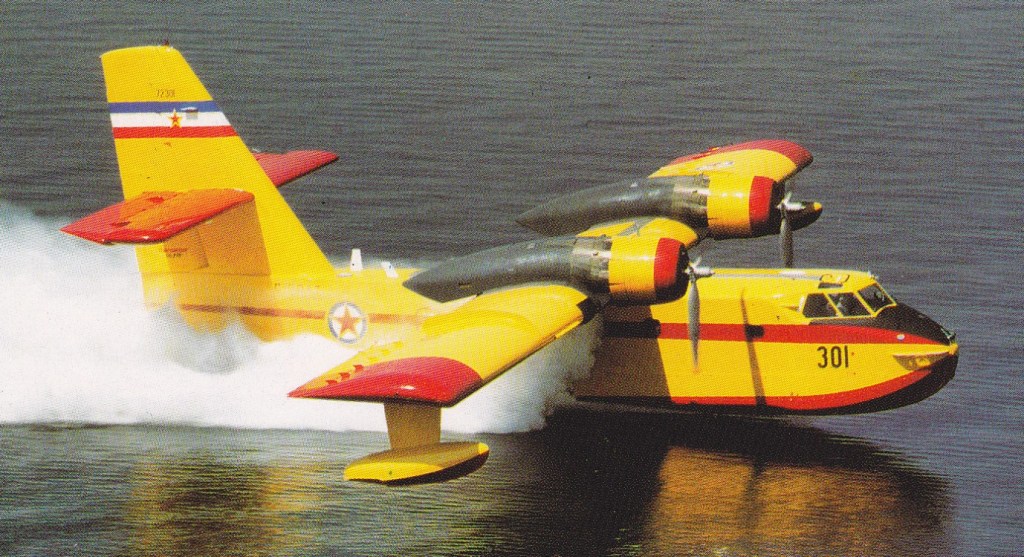
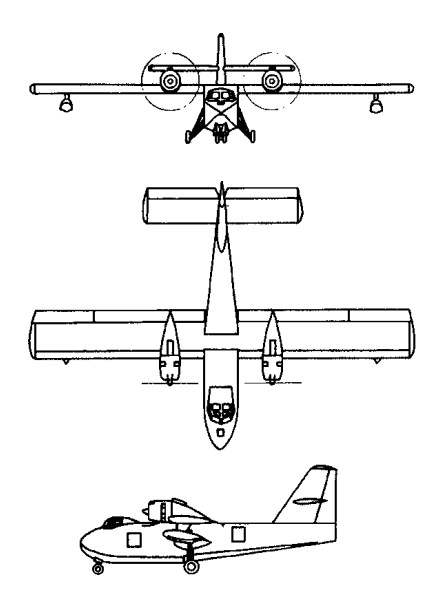
Designed principally for firefighting duties, the CL-215 twin-engined general-purpose amphibian also has military applications, including search and rescue and coastal patrol, Spain and Thailand use their CL-215s in both of these roles. The first prototype flew on October 23, 1967.

Canadair CL-215 Article

The CL-215’s two fuselage tanks hold 1412 USG / 5345 lt of water which can be scooped up in 10 seconds from a lake or sea surface, and can be dumped in one second.

Canadair offers a number of special military configurations, including flight inspection, maritime surveillance using an ALL AN/APS-128 search radar, electronic warfare support and training, cargo transport, and airborne early warning (AEW).

Production of the basic CL-215 was completed with delivery in 1990 of the 126th airframe, having been exported to France, Greece, Spain, Italy, Yugoslavia, Thailand and Venezuela.

CL-415T

In September 1986 Canadair announced the CL-215T turboprop development. Designed as a retrofit package for existing operators of the piston-engined aircraft and – if sufficient new orders were received – for full production, the CL-215T has two 2,380 shp (1 175 kW) PW123AF engines driving four-bladed propellers. As a water-bomber (its primary mission) the CL-215T will carry 6,132 litres (1,620 US gal).

The first CL-215T flew on 8 June 1989 powered by two 2380 shp / 1775 kW Pratt & Whitney Canada PW123AF turboprops, and could carry 1620 USG / 6132 lt of water.

CL-215T

Canadair CL-415 Operation 1996

CL-415

Gallery

CL-215
Engines: 2 x Pratt & Whitney R-2800-CA3, 1566kW, 2100hp
Wingspan: 28.6 m / 93 ft 10 in
Wing area: 100.33 sq.m / 1079.94 sq ft
Length: 19.82 m / 65 ft 0 in
Height: 8.92 m / 29 ft 3 in
Max Take-off weight: 17100-19731 kg / 37699 – 43500 lb
Empty weight: 12161 kg / 26811 lb
Max level speed: 172 mph (293 kph) at 10,000ft/3050m
Cruise speed: 291 km/h / 181 mph
Initial ROC: 1000 fpm / 305 mpm
Range: 2095 km / 1302 miles
Payload: 5453kg 12,000 lb of water, 3864 kg / 8518 lb freight, or 26 passengers

Canadair CL-84

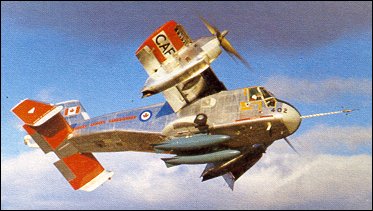
With a research and development period from 1958 to 1963 before the first prototype was constructed, the design incorporated a number of innovations including a large chord wing which was to be covered by the propeller slipstream, all engines, rotors, and the tail rotor which were connected together by intricate shafts and gear boxes, and a stability augmentation system for reduction of pilot workload in low-speed flight conditions. There was considerable scale model testing in Canadian wind tunnels to ensure the design.
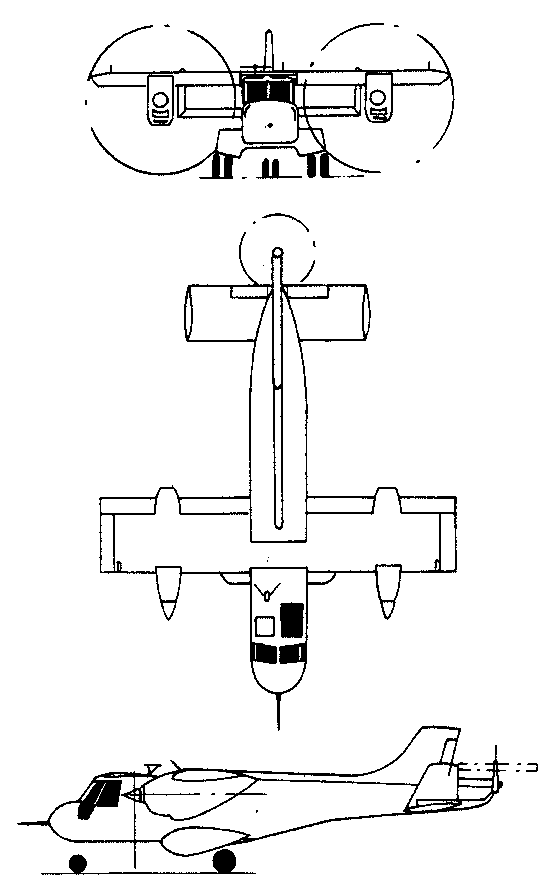
The CL-84 had a maximum height of 14 feet, seven inches, and a rotor tip-to-tip length of over 4.2m. The wings had a total area of 21.6sq.m with the trailing and leading edge flaps having of 4.7sq.m. The empty weight of the plane was 3380kg. In a maximum payload configuration, the plane could be loaded to 675kg for a pure VTOL mission, with 1620kg of payload available in a STOL or conventional mission.
The prototypes weighed about 3600kg, and the wings were 10m in length Mounted on the underside were a pair of Lycoming T53-LTCIK-4A turboprop engines with 4.3m-diameter propellers.
The horizontal tail was relatively low so that it was below the wing wake during cruising flight and always within the slipstream of the wing-tilt angle. The placement within the slipstream was to prevent abrupt changes in pitching moment as a function of wing-tilt angle.
Pitch control was provided by a pair of horizontally-mounted two-bladed propellers mounted on the rear of the aircraft. When in conventional flight, the props were stopped to minimize drag.
Roll control was maintained by differential thrust from the main engines while ailerons accomplished yaw control. A so-called mixing box brought all the control forces together to act as one as it linked the elevators, rudder, ailerons, and propeller blade angles together.
The first of four prototypes was built in two years, with the first vertical flight achieved in May 1965, followed by its first conventional flight seven months later.
The first total transition flight was accomplished on January 17, 1966, at the company’s Montreal facility. Transition was made from hover to forward flight and back. Flights were made in light snow with wind gusting to 25 miles per hour. The flight, with company pilot W.S.Longhurst at the controls, came seven months ahead of schedule.
The CL-84 was able to lift 2930kg of fuel and payload in a STOL take-off, or 1850kg of fuel and payload in a VTOL mode. It was found a 65km/h wind could double the VTOL payload capability.
An advantage of the CL-84 came from the pilot’s seat where it was piloted pretty much like a conventional aircraft. The pilot sat in the left seat, but dual controls were fitted. Even with its complex control mechanisms, the control stick and rudder pedals produced the desired control functions. A new flying technique wasn’t necessary. The pilot could fly the plane without knowing the wing angle.
Significant flying maneuvers were accomplished during the test program, including forward flight from hover (wing tilt 88 degrees) to 60km/h (wing tilt 48 degrees) and return to hover mode, demonstration of adequate control in winds gusting to 45km/h, rearward, sideward, and turning flight in and out of ground effect, and sustained flight with hands free of the controls.
By April 1966, the CL-84 began investigation into the high-speed regime followed undercarriage retraction tests, with speeds up to 370km/h in 60-degree banked turns being achieved. Other significant test accomplishments occurred during low-speed maneuvers. For example, the CL-84 easily completed 2G turns at only 165km/h, followed by 60m radius turns at 90km/h.
The plane also demonstrated exceptionally stable hovering flights, including hands free flight, and the CL-84 was hovered and landed vertically with the stability augmentation system not operating.
The first prototype was flown for two years by 16 pilots for a total of 145 flying hours. A number of military applications were tested, including dropping of external stores, mini-gun firing, simulated rescues from hover, use of a cargo sling, joint operations with a helicopter at seas, and hover downwash tests. A number of United States teams also evaluated the plane.
The first prototype was lost in a reliability test accident in September 1967, both pilots ejecting safely from the plane. The aircraft was flying at 980m at 280km/h in a forward velocity mode when the plane yawed to the left and quickly pitched downward. The investigation that followed identified the probable cause as a propeller failure. The plane was on its 306th test flight when the incident occurred.
The program continued with the construction of the three additional versions which incorporated a number of design changes from the original. Only two of them would actually fly. Two of the planes would be involved in non-fatal accidents due to mechanical problems.
The additional prototypes were built between February 1968 and February 1970. The testing of them would continue until 1974, over 20 years since the design work had started.
The CL-84 was demonstrated to the US Navy and the USS Guam also hosted a number of both STOL and VTOL flights from its deck. A flying demonstration took place off a hundred-square-foot pad at the Pentagon.
Neither the United States or the Canadian government showed enough interest to bring the program into production.
The second of the three prototypes produced is on permanent display at the National Aviation Museum of Canada in Ottawa. This particular plane made 196 flights with almost 170 flight hours. The plane was donated to the museum by Canadair in 1984.

Canadair CL-84
Engine: 2 x Lycoming LTC1K-4C turboshaft, 1119kW
Wingspan: 10.16m
Length: 14.41m
Height with wing in horizontal position: 4.34m
Height with a wing in 90deg position: 5.22m
Take-off weight vertical start: 5715kg
Take-off weight with a shortened run: 6577kg
Empty weight: 3827kg
Max speed: 517km/h
Cruising speed: 497km/h
Range: 547km

Canadair CL-44 / CC-106 Yukon

CL-44

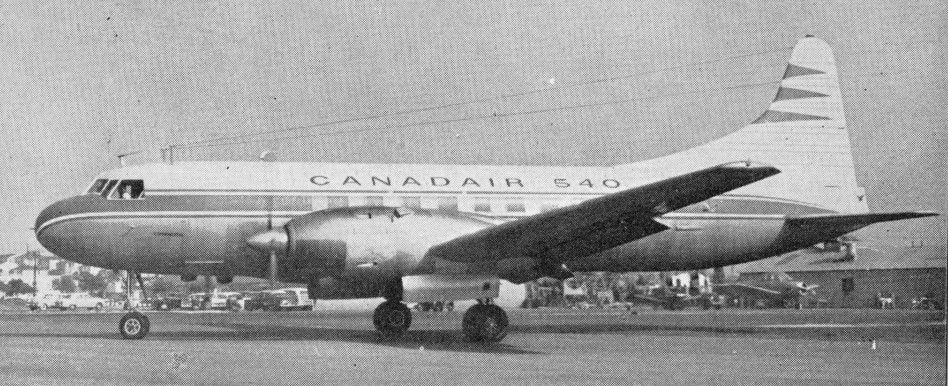
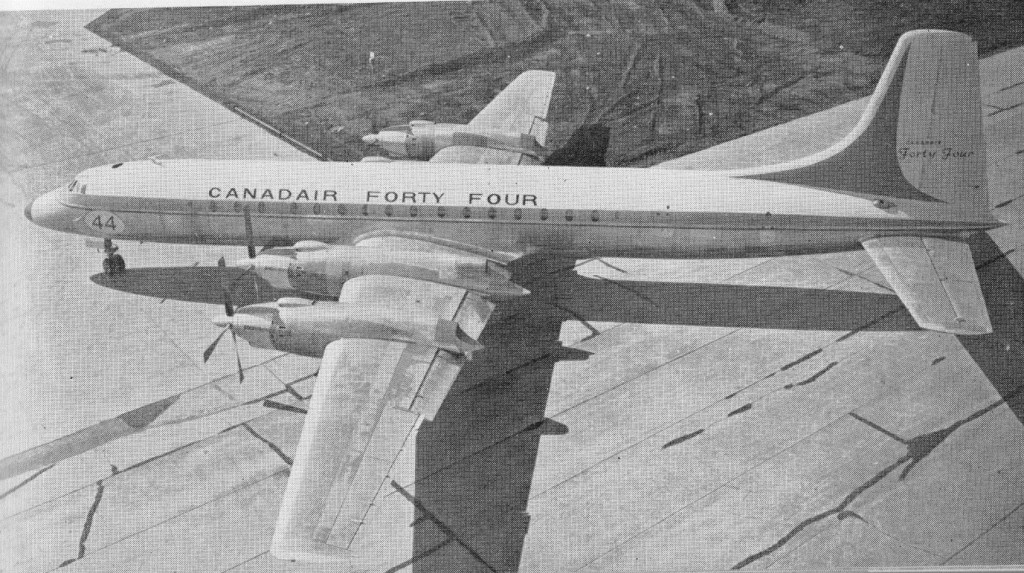
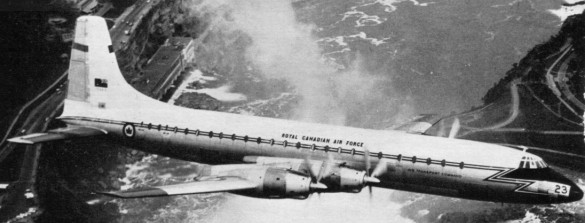
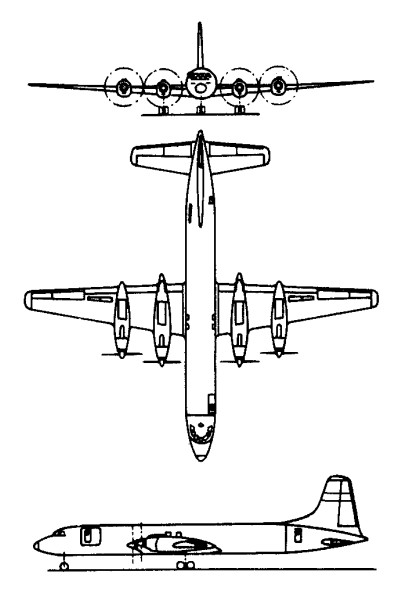
The RCAF was looking for replacements for it’s C-54GM North Star to provide personnel and logistics support for Canadian Forces in Europe. Canadair had already acquired a licence for the Bristol Britannia and announced in January 1957 plans for a fleet of long range transports based on the Britannia. Canadair received a contract for 8 aircraft, later increased to 12, designated CL-44-6 and CC-106 by the RCAF. The design used the modified Argus wings and controls. The fuselage was almost identical to the Britannia 300 with two cargo doors on the left-hand side. The cabin was pressurised to maintain a cabin altitude of 2.400m at 9.000m (30,000 ft). The Yukon could accommodate 134 passengers and a crew of nine and in the casualty evacuation role it could take 80 patients and a crew of 11. The RCAF had specified the CL-44 to be equipped with Bristol Orion engines but when the British Ministry of Supply dropped the Bristol Orion, the RCAF decided to use the Rolls Royce Tyne 11.

Canadair CL-44 Article

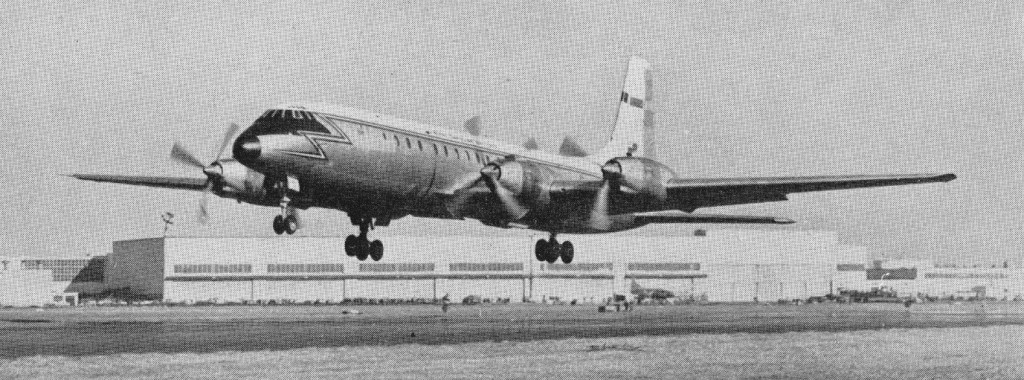
The roll out of the Yukon was a disaster all over. When the prototype was supposed to be pushed out of the hangar the tail was too high. The first plane took off 15 November 1959.

CL-44 No.1

During test flights all kind of problems where encountered from complete electrical failure to engines shaking loose and almost falling off. Rolls Royce had problems delivering engines resulting in “Yukon gliders” being parked outside Canadair as late as 1961.

Once in Service the Yukon proved very well and on December 1961 a Yukon set a world record for its class when it flew 10.860 Km (6.750mi) from Tokyo to Trenton, Ontario, in 17 hours three minutes at an average speed of 640 Km/h (400 mph). Later a Yukon even set a new record staying airborne for 23 hours and 51 minutes. These records stayed untouched until broken by the new 747SP in 1975. Eleven Yukons flew for 437 Transport Squadron. Two flew as VIP transports for 412 Squadron.

The RCAF needed an aircraft, which could operate as an in-flight refuelling tanker, and there was a chronic shortage of spares as the CL-44 had never gone into large-scale production. Consequently spare parts tended to be in short supply and relatively expensive. All Yukons were sold to South American and African operators since it could not be registered in Northern America or Europe since the Britannia windshields did not meet new security standards. The Yukons retired in March 1971 and were replaced by Boeing 707.

CC-106 Yukon

At a similar time as the Yukon contract came in Canadair announced its intentions to re-enter the civilian market with a slightly modified Yukon. The plane generated little interest with the passenger airlines, but cargo airlines found the cost projections made by Canadair compared with the high operating cost of Super constellations and DC-6B interesting.
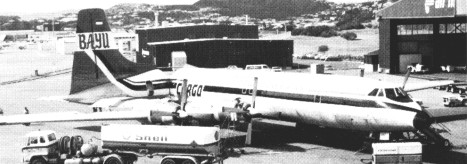
The Flying Tiger Line and Seaboard World Airlines pushed Canadair to develop a system to load and unload the 29.5 tons of cargo in 45 minutes enabling turn-around in less then 60 minutes. This became the “Swingtail”. After the initial eight Yukons, Canadair built the first civilian CL-44 with a swingtail, designated CL-44D4. The APU that the Yukon carried in the nose was removed to increase payload and Canadair built the plane without a launch customer. This Aircraft, serial #9, used as a demonstrator for many years, was built in 1960 but not sold to Loftleidir until 1965.
While the prototype was being built a problem arose as the FAA refused to certify the Britannia type windshields for its vision standards. The Convair CV880/990 windshields were compatible enough to be adopted into the flight deck structure. A requirement was set for structural fatigue testing. The CL-44 had to simulate 80,000 flight hours in a watertank to be certified for 40,000 hours.
The Flying Tiger Line ordered 12 aircraft and Seaboard World Airlines ordered 7 aircraft. Pakistan ordered five aircraft, but the Canadian government refused to issue an export permit for Pakistan for fear of offending India. Saudi Arabia withdrew their two aircraft after the Pakistan cancallation. Japan Cargo Airlines ordered three Aircraft but cancelled after Japan airlines opposed the purchase. BOAC appeared to be a certain client until their management changed and stopped the discussion. (BOAC Cargo later leased a D4 from Seaboard while waiting for their new Boeing 707).

First flight of CL-44D, November 1959

In 1960 the USAF Military Air Transport Service (MATS) was thinking of buying up to 232 D4’s. The United States wanted Canada to bolster its northern fighter defences and proposed a deal whereby the Canadian would buy 100 F-101 Voodoo fighters plus a possible participation in the maintenance of the Pinetree early warning radar line. The quantity of D4’s had dwindled to 37 when Ontario conservatives objected on the grounds that it would be politically unacceptable to award a major aircraft contract to Quebec after having cancelled the Ontario-built Avro Arrow. MATS quickly changed their minds and bought Boeing C-135.Canadair built a Total of 39 CL-44 aircraft. 12 CC-106 Yukon and 27 CL-44D4. Seaboard World Airlines bought seven aircraft and The Flying Tiger Line bought twelve. Later Slick Airways ordered four more. This left Canadair with the unsold prototype and three CL-44D4s already finished but not sold. Canadair knew that the Icelandic low fare carrier Loftleidir was searching for alternatives to replace their ageing fleet of DC6B. Loftleidir bought those with the condition that they would all be stretched to accommodate more passengers. An engineering office in the United States on behalf of Loftleidir carried out a study to stretch the CL-44. Canadair carried out the work and the first stretched D4 flew on November 8, 1965. Loftleidir had already taken the other three D4s into service but returned them one after another in order to be converted.

CL-44D4-2 EL-AMC

Another D4 was converted by Jack Conroy Aviation of California into a CL-44-0 “Guppy”. This aircraft had its upper fuselage removed and replaced by an enlarged section, which raised the cabin height by 1.5m.The forty-four proved to be a nightmare for mechanics. But it was an extremely profitable aircraft to run. At the time the fuel burn of a CL-44 was half compared to a Boeing 707.
After 40 years, out of the 39 built, 17 either crashed or were destroyed in operation. 19 aircraft have been cut up.
No CL-44 has been preserved.

Gallery

Cameron P-51

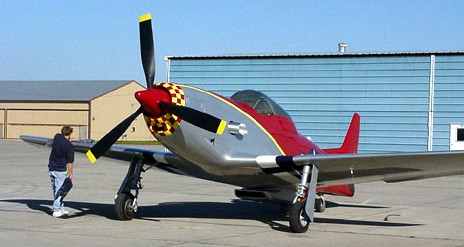
The P-51 is a full size Carbon Fiber Mustang manufactured by Cameron and Son’s Aircraft. This aircraft is available with a 1450 hp turbine, or can be fitted with a Rolls Merlin. It is capable of speeds in the mid 400mph range. There are three options on the canopy, the standard P-51D, a 9ft bubble, or a low profile racing canopy. Also available are standard P-51D wing tips. The cockpit features dual controls. The kit is built from 12 major components, making it the fewest part count aircraft of its kind.

Cruise: 420 mph
Stall: 87 mph
Range: 580 sm
Rate of climb: 4200 fpm
Takeoff dist: 1250 ft
Landing dist: 1750 ft
Engine: Allison, 1750 hp
HP range: 1150-3500 hp
Fuel capacity: 250 USG
Empty weight: 4500 lb
Gross weight: 6000 lb
Length: 36 ft
Wing span: 37 ft
Wing area: 233 sq.ft
Seats: 2
Landing gear: tailwheel

Britten-Norman BN2 Islander / Defender     

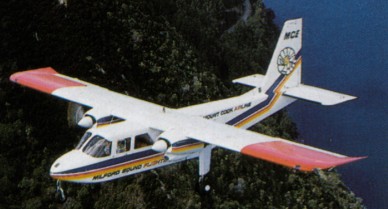
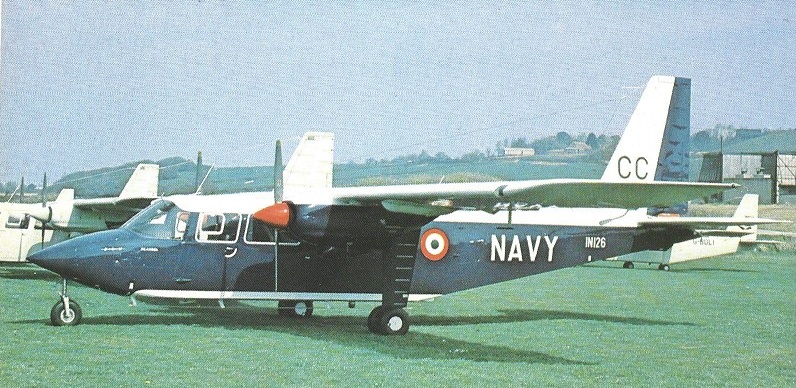
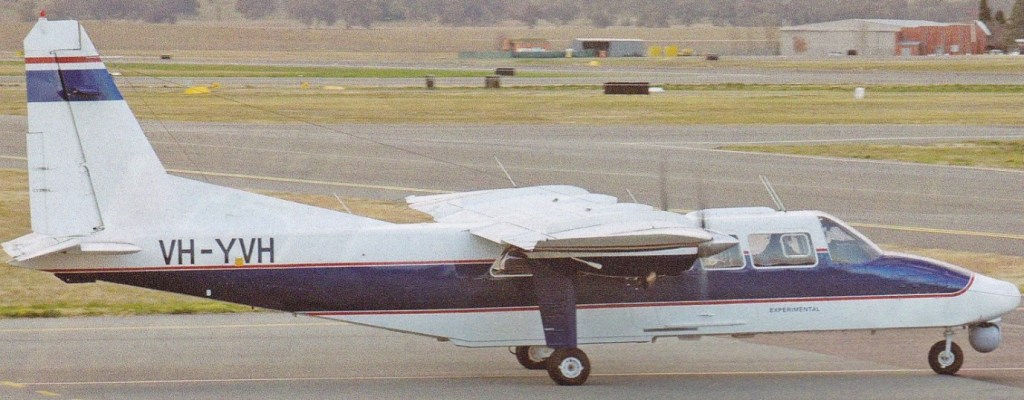
BN-2

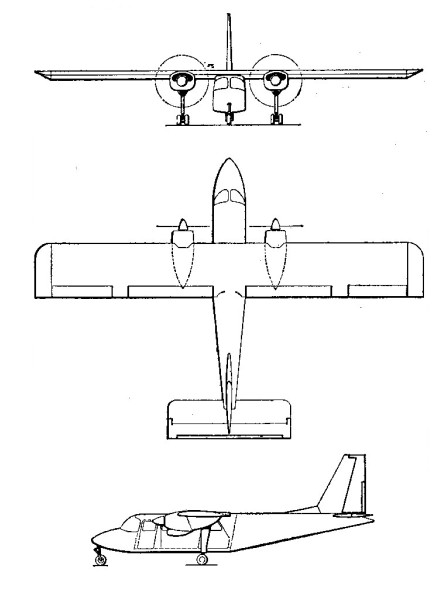
In 1962 the two partners, John Britten and Desmond Norman, decided to build a plane of their own. The essential factors were low cost, all-weather construction, twin engine reliability and a good payload. The design was of classic simplicity: a one-piece wing with no dihedral, Hoerner-type tips, slab-sided fuselage with seating for up to 10 passengers. The prototype was powered by two 210-hp Continental engines with a fixed tricycle undercarriage. Bench-type seats for two people eliminated the need for a central aisle and these were accessed by three doors, two port and one starboard, with the rear door being of extra width to allow ease of cargo loading. The Islander can also be operated as a freighter carrying more than a ton of cargo. Passenger baggage is stored in a large 30 cu.ft. bin behind the cabin with an access door on the port side. The first metal was cut in September 1964 and the aircraft was hand crafted on a “Dexion” jig. The prototype took to the air for its first flight of 70 minutes on 13 June 1965 with both John Britten and Desmond Norman at the controls. There were some shortcomings which an increase in wing span by 1.22 metres and more powerful Avco Lycoming 260-hp engines cured.

Britten-Norman BN2 Article

A choice of wings was offered, so the plane could be fitted with the standard 49-foot-span wings or extended 53-foot wings, using raked tips and auxiliary fuel tanks.
Delivery of the Islander began in August 1967, but the great number of orders from over 50 countries forced Britten-Norman to subcontract manufacture of a number of the mini-airliners to the British Hovercraft Corporation. Others were produced in Romania by IRMA which was then trucked to Bembridge for completion. Buyers were able to choose Lycoming engines: 260 or 300 hp. A Rajay turbocharging unit increased the Islander’s twin-engine ceiling to 26,000.

Britten-Norman BN2 Article

Britten Norman developed two other variants for demonstration at the 1976 Farnborough Show, the “Firefighter” and “Agricultural Islander”. While both designs proved themselves technically, no orders were forthcoming and the variants were shelved.
Arrangements were made with Rornaero in Bucharest, Romania, to produce the airframes. The engines, propellers, and undercarriage are trucked across Europe to where the aircraft are assembled under UK CAA supervision then, with basic instrumentation and a pilot’s seat fitted, the aircraft is flown in dull grey primer to Bembridge to be completed to customer’s requirements.
The BN-2 Super was developed by inserting a 33-inch plug in the fuselage of the production prototype, G-ATWU, allowing for an additional row of seats, however, the version was never put into production. To increase the Islander’s hot and high performance Lycoming IO-540K 300-hp fuel-injected engines were fitted. Another modification involved fitting wingtip tanks which increased the span to 53 feet while droop flaps and droop leading edges increased performance.
The first turbine powered Islander flew in April 1977. Designated the BN2A-41, it was powered by Lycoming LTP 101 turboprops and, although its performance was described as “sparkling”, it was overpowered and the fitting of the engines required major wing modifications. The project was discontinued.
In 1980 the production BN2T Turbine Islander took off with Allison 250 B17C engines. Wing fences were fitted to improve stall recovery and the prototype headed off for hot and high in Kenya and to Finland for cold weather trials.
Pilatus introduced a beefed up Islander, the BN2B, featuring a 300 pound increase in landing weight, including the BN-2B-20 and BN-2B-26.

In 1979 it was decided to diversify, looking at different roles as against taking people. Those sort of roles are fisheries protection, border patrol and parachuting etc. In 1978 they looked at putting a more sophisticated airborne radar into the aircraft, entering into a joint venture with Thorn EMI, using their Skymaster radar to increase the ground warning time from three or four minutes to 20 30 minutes. The name “Defender” came at that point, referring to an Islander with four wing mounted hardpoints. Stressed to take 750lbs on the inboard pair and 350lb outboard, the hardpoints designed to carry long range fuel tanks or military stores.

Available with 260 hp, turbo-charged 260 hp, or 300 hp engines, and optional 28 cu.ft. capacity nose extension.

Defender – For general military duties PBN developed the Defender from the basic piston-engined Islander utility aircraft and, with the introduction of the Allison 250-B17C powered Turbine Islander, a parallel turbine Defender was offered. The Defender is capable of a wide range of military roles including troop trans¬port, SAR, forward air control, electronic warfare, logistic support, and medevac.

Operationally launched by PBN on March 6, 1987, The AEW Defender is a low-cost AEW system offered in conjunction with Thorn-EMI’s Skymaster lightweight multi-mode pulse-Doppler track-while-scan radar. Acquisition and tracking of targets is auto¬matic, and air-to-air/air-to-ground datalinks, 1FF and navigation systems may be fully integrated with the radar’s display and control system. The Skymaster system can also be used to detect surface vessels during maritime reconnaissance missions. A large undernose radome houses the 360’-scan antenna. With appropriate computer software modifications, the AEW Defender/Skymaster combination is being offered as a solution to the British Army’s Astor requirement for an airborne battlefield surveillance radar. The British Army has bought Defender AL Mk 1s to replace Beavers.Another Defender has been flown with a Ferranti surveillance radar installed in connection with the Army’s earlier Corps Airborne Stand-Off Radar (Castor) requirement. The AEW Defender is based on the BN-2T Turbine Defender airframe.

The Maritime Defender is designed for coastal patrol, fishery and oil rig protection, and SAR durties. The Maritime Defender has Bendix RDR-1400 search radar in the nose, and four under-wing pylons to carry weapons, survival packs or other items. Either 6600 lb maximum all up weight piston engined or 7000 lb MAUW turbine powered, the aircraft comes with both Omega and short range sector scan radar.

The Defender was officially added to the ranks of the British Army on March 10th, 1989. Design is wholly utilitarian and is most characteristically defined by the high-mounted monoplane wings. Each wing maintains an Allison 250-B17F turboprop engine powering a three-bladed propeller. The cockpit compartment is held well forward in the squared off fuselage with slab sides and features a useful sloped nose for improved downward visibility. The undercarriage is a conventional tricycle arrangement and made up of two double-tired main landing gear legs and a single-tired nose landing gear leg – as a whole, the undercarriage is non-retractable. The empennage is dominated by a single large-area vertical tail fin clipped at the top and sporting some sweep along the leading edge. Horizontal tailplanes are affixed to the vertical fin tail. Typical accommodations are for two pilots and up to six passengers. Entry/exit is via side doors, two forward and two aft. Her gross weight is listed at 7,000lbs. Each wing can field four hardpoints for various munition options to include gun pods, rocket pods and bombs if need be or external fuel tanks for extended loitering times and operational range. Specialized reconnaissance and surveillance mounts are fitted with applicable tailored equipment, cameras and jamming pods as well as communications options. Airborne Early Warning (AEW) Defenders sport a hideous-looking nose radome that quickly identifies the type and its role.

In 2003, the UK military purchased three (some sources state four) Defenders to help with the deteriorating conditions in Iraq following the 2003 coalition invasion. These aircraft carried the designation of Defender 4S AL Mk 1 and sported underwing dispensers to protect against surface-to-air guided munitions. This model was furthered defined by the implementation of an electro-optical turret under the extreme end of the nose.

The Defender 4000 is a military version of the Defender series and first flight of this system was achieved in August of 1994. The Defender 4000 features a larger wing component similar to that of the Trislander and operates with increased weight tolerances. Her engines are more powerful than previous versions and has an enlarged nose section for the fitting of search radar. Top speed is a reported 225 miles per hour.

BN-2T-4S Defender 4000

By 1990, over 1,100 Islanders have been built with Lycoming piston engines or, in the BN-2T Turbine Islander, two 400 shp (298 kW) Allison 250-B17C turboprops.

In 1970, Britten-Norman introduced an enlarged version of the twin-engine Islander with a third engine mounted high on the tail in a tractor position. The three engines were 260-hp 0-540-E4C flat-sixes turning Hartzell two-blade constant-speed fully feathering propellers. Three versions of the Trislander are the BN-2A Mk 111-2 (a standard version with extended nose baggage compartment), the BN-2A Mk 111-3 (with an automatic feathering system for the props), and the BN-2A Mk 111-4 (with a rocket engine for additional thrust if an engine fails on takeoff).

Gallery

Britten Norman BN-2 Islander (1968)
Powerplant: two Lycoming O-540-E4B5, 260 bhp
Propellers: Hartzell constant-speed feathering two-blade 80 in diameter.
Wingspan, 49 ft
Length, 35 ft 71 in
Height, 13 ft 8 in
Gross wing area, 325 sq.ft
Max. usable floor area, 43.4 sq.ft
Max. usable cabin volume, 140 cu.ft
Max. cabin length, 160 in including flightdeck
Max. width, 43in
Max, height, 51 in.
Accommodation: max. high density seating 9 passengers and pilot at 30 in pitch
Basic operational weight, 3280 lb
Total fuel, 800 lb
Max. take-off, 5500 lb
Max. landing, 5500 lb
Max. payload (volume limited), 1920 lb
Max. zero fuel, 5200 lb
Power loading (max. take-off weight), 10.6 lb/hp
Wing loading (max. take-off weight), 16.95 lb/sq.ft
Wing loading (max. landing weight), 16.95 lb/ft
High-speed cruise, 138 kt. at 6500 ft
Long-range cruise, 132 kt. at 13,000 ft
Approach speed, 62 kt
Take-off field length, ISA at sea level, 1000 ft
Landing field length, ISA at sea level, 990 ft
Range with allowances, max. fuel, 1450 lb payload, 738 nm

BN2A-8
Engine: 2 x Lycoming O-540-E4C5, 260 hp.
Seats: 10.
Wing loading: 19.6 lb/sq.ft.
Pwr loading: 12.7 lb/hp.
Gross wt: 6200 lb.
Empty wt: 3400 lb.
Equipped useful load: 2449 lb.
Payload max fuel: 1633 lb.
Range max fuel 75% pwr: 564nm/4hr.
Range max fuel 55% pwr: 625nm/5.3hr.
Service ceiling: 13,000 ft.
75% cruise: 139 kt.
55% cruise: 119 kt.
Vmc: 39 kt.
Stall: 44-50 kt.
1.3 Vso: 57 kt.
ROC: 950 fpm.
SE ROC: 170 fpm @ 65 kt.
SE service ceiling; 4450 ft.
Min field length: 1160 ft.
Fuel cap: 816 lb.

BN2A-9
Engine: 2 x Lycoming O-540-E4C5, 260 hp.
Seats: 10.
Wing loading: 20.3 lb/sq.ft.
Pwr loading: 12.12 lb/hp.
Gross wt: 6,300 lb.
Empty wt: 3250 lb.
Equipped useful load: 2699 lb.
Payload max fuel: 1523 lb.
Range max fuel/75% pwr: 856nm/6.1hr.
Range max fuel / 55% pwr: 934nm/7.9hr.
Ceiling: 13,000 ft.
75% cruise: 139 kt.
55% cruise: 119 kt.
Vmc: 39 kt.
Stall: 44-50 kt. 1.3
Vso: 57 kt.
ROC: 950 fpm.
SE ROC: 170 fpm @ 65 kt.
SE ceiling: 4450 ft.
Min field length: 1160 ft.
Fuel cap: 1176 lb.

BN-2A-20
Engine: 2 x Lycoming IO-540-K1B5, 300 hp.
Seats: 10.
Wing loading: 19.6 lb/sq.ft.
Pwr loading: 11 lb/hp.
Gross wt: 6560 lb.
Empty wt: 3640 lb.
Equipped useful load: 2569 lb.
Payload max fuel: 1753 lb.
Range max fuel
75% pwr: 534nm/3.6hr.
Range max fuel 55% pwr: 609nm/4.7hr.
Service ceiling: 18,000 ft.
75% cruise: 147 kt.
55% cruise: 131 kt.
Vmc: 39 kt.
Stall: 44-50 kt.
1.3 Vso: 57 kt.
ROC: 1130 fpm @ 57 kt.
SE ROC: 225 fpm @ 75 kt.
SE service ceiling; 3,100 ft.
Min field length: 1100 ft.
Fuel cap: 816 lb.

BN-2A-21
Engine: 2 x Lycoming IO-540-K1B5, 300 hp.
Seats: 10.
Wing loading: 20.3 lb/sq.ft.
Pwr loading: 11 lb/hp.
Gross wt: 6600 lb.
Empty wt: 3695 lb.
Equipped useful load: 2554 lb.
Payload max fuel: 1378 lb.
Range max fuel
75% pwr: 799nm/5.4hr.
Range max fuel 55% pwr: 924nm/7.1hr.
Service ceiling: 18,000 ft.
75% cruise: 147 kt.
55% cruise: 131 kt.
Vmc: 39 kt.
Stall: 44-50 kt.
1.3 Vso: 57 kt.
ROC: 1130 fpm.
SE ROC: 225 fpm @ 75 kt.
SE service ceiling; 3,100 ft.
Min field length: 1100 ft.
Fuel cap: 1176 lb.

Britten-Norman BN-2A-21 Maritime Defender
Engines: 2 x Avco Lycoming IO-540-K1B5, 300 hp
Length: 36.319 ft / 11.07 m
Height: 12.402 ft / 3.78 m
Wingspan: 53 ft ft / 16.15 m
Wing area: 342.295 sq.ft / 31.8 sq.m
Max take off weight: 6593.0 lb / 2990.0 kg
Weight empty: 4013.1 lb / 1820.0 kg
Max. speed: 157 kts / 290 km/h
Cruising speed: 148 kts / 274 km/h
Service ceiling: 18045 ft / 5500 m
Endurance (2 x 56 Imp.Gal. drop tanks): 15 hr.

BN2B
First built: 1967.
Engine: 2 x Lycoming O-540-E4C5, 260 hp.
TBO: 2000 hrs.
Prop: Hartzell 2 blade, constant speed 80 in.
Seats: 10.
Length: 35.7 ft.
Height: 12.4 ft.
Wingspan: 49 ft.
Wing area: 325 sq.ft.
Wing aspect ratio: 7.4.
Max ramp wt: 6600 lbs.
Max take off wt: 6600 lbs.
Standard empty wt: 3612 lbs.
Max useful load: 2988 lbs.
Max landing wt: 6300 lbs.
Wing loading: 20.3 lbs/sq.ft.
Power loading: 11 lbs/hp.
Max useable fuel: 1176 lbs.
Climb rate: 1130 fpm @ 65 kts.
Climb gradient: 1043 ft/nm.
Rate of climb @ 8000 ft: 550 fpm.
Service ceiling; 18,000 ft.
SE rate of climb: 225 fpm @ 62 kts.
SE climb gradient: 218 f/nm.
SE ceiling: 7000 ft.
Max speed: 139 kts.
Cruise @ 65% power @ 8,000ft: 135 kts.
Fuel flow @ 65% power @ 8,000ft: 160 pph.
Endurance @ 65% power @ 8,000ft: 7.1 hr.
Stalling speed clean: 49 kts.
Stall speed gear/flaps down: 42 kts.
Turbulent air penetration speed: 107 kts.
Fixed undercarriage.
Wing load: 19.27 lb/sq.ft / 94.0 kg/sq.m
Maximum range: 1134 nm / 2100 km
Crew: 2+2
Payload: 8Pax / 1015kg

BN-2T
Engines: 2 x Allison 250-B17C

Turbine Defender
Engine: 2 x Allison 250 600 kW, 480 kW.
Span: 14.9 m.
Length: 10.9 m.
Wing area: 30.2 sq.m.
Empty wt: 1914 kg.
MTOW: 3175 kg.
Payload: 1270 kg.
Cruise speed: 285 kph.
Initial ROC: 320 m / min.
Ceiling: 7620 m.
T/O run: 225 m.
Ldg run: 228 m.
Fuel internal: 814 (+454) lt.
Range: 1350 km.
Capacity: 10 pax.

Britten-Norman BN2T-4S Defender 4000
Engines: 2 x Allison 250-B17F/1 turboprop, 400 shp
Props: 3 blade, 80 in.
Length: 35.86ft (10.93m)
Width: 48.98ft (14.93m)
Height: 13.78ft (4.20m)
Maximum Speed: 225mph (362kmh; 195kts)
Max cruise: 178 kts
ROC: 1210 fpm.
SE ROC: 223 fpm
Maximum Range: 437miles (703km)
External Fuel Tanks capacity: 2,500lbs
Accommodation: 2 + 6
Hardpoints: 4
Empty Weight: 4,998lbs (2,267kg)
Maximum Take-Off Weight: 8,499lbs (3,855kg)

AEW Defender
Engines: Allison turboprop, 375 shp.
Endurance: 6 hr.
Operating speed: 90-150 kts.

BAe ATP / Jetstream 61

A product of British Aerospace at its Manchester facilities, the ATP is the stretched and updated development of the HS 748 (formerly Avro, latterly BAe 748), production of which ceased in 1989.

BAe ATP / Jetstream 61 Article

Development of the BAe ATP / Jetstream 61 started in 1984 as a short-range, low-noise, fuel-efficient turboprop aircraft. The airframe of the Avro 748 was re-designed and lengthened 5.03 m (16.5 feet), the wing re-designed, and minor modifications were made to the nose and tail shapes. The six-blade Hamilton Standard composite propellers were driven by 1,978kW / 2,653shp Pratt & Whitney Canada PW126 engines. The British Aerospace Advanced Turboprop or ATP is a twin turboprop airliner for up to 72 passengers. Passenger accommodation totals 64 at 31-in (79-cm) seat pitch in a fuselage similar to that of the 748 but 16 ft 6 in (5,03 m) longer. Other changes included smaller and closer-pitched cabin win¬dows, a wider centre section for the wing (adapted from the Andover), new landing gear, a redesigned flight deck with EFIS instrumentation, and new electrical, hydraulic and environmental control (air conditioning) systems.
The ATP programme was launched in March 1984, and the prototype, G-MATP s/n 2001, was flown first on 6 August 1986. Certification was granted in March 1988 and the ATP entered airline service in May 1988 with British Midland Airways.

By the end of October 1990, 39 aircraft had been ordered with some 12 further options held, and 30 machines had been delivered to six airlines. Production in 1991 was running at about 12 aircraft a year, and depending on specification, the new cost is between $US112.5 and US$13.0 million.
In 1994, a modified version with Pratt & Whitney Canada PW127D engines was introduced under the name Jetstream 61. The BAe ATP and Jetstream 61 failed to attract significant orders. The ATP / J61 saw a limited production run. 63 ATPs and 1 Jetstream 61 were built. Production ended in 1998.
In 2001, the ATP Freighter project started, with 6 ATPs to be converted into cargo aircraft for West Air Sweden. The ATPF is capable of carrying eight LD3 containers or six LD4s when fitted with the Large Freight Door, or loading up to eight tonnes. The ATPF made it first flight on 10 July 2002. Since then, 12 ATPs were converted into ATPFs.

ATP
Engine: 2 x 2653hp Pratt & Whitney Canada PW126 turboprops
Take-off weight: 22930 kg / 50552 lb
Empty weight: 13595 kg / 29972 lb
Wingspan: 30.63 m / 100 ft 6 in
Length: 26.00 m / 85 ft 4 in
Height: 7.14 m / 23 ft 5 in
Wing area: 78.3 sq.m / 842.81 sq ft
Cruise speed: 496 km/h / 308 mph
Ceiling: 7600 m / 24950 ft
Range: 1825 km / 1134 miles
Passengers: 64

Jetstrem 61
Engines: 2 x 2,653 shp (1 978 kW) PW126D
MTOW: 52,200 lb (23,678 kg).
Pax cap: 60-70