A single-turboprop conversion of Cessna Super Skymaster flown 1969, with upward-opening aft fuselage.
Turboprop
Conroy CL-44-O Guppy
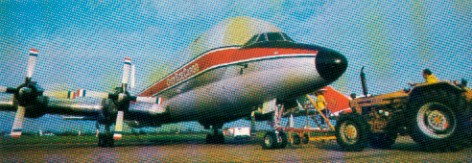
California-based Conroy Aircraft converted at least one CL-44 to an over sized ‘Guppy’.
Commuter Aircraft Corp CAC-100
A 60-seat four-turboprop CAC-100 airliner.
IAR IAR-828
Derived from the IAR-827, the IAR-828 agricultural aircraft of 1981. The first Rumanian turboprop aircraft.
Engine: PT-6 or M601
IAR IAR-825
IAR-825TP Triumf – Retaining the wing and landing gear of the IAR-823, the turboprop powered Triumf has a new fuselage with two seats in tandem, and a new swept fin. Two underwing hardpoints are provided. The IAR¬825TP first flew on June 12, 1982, and series production for the Romanian Air Force, using uprated 559kW Pratt & Whitney Canada PT¬6A-25C engines, was due to begin in 1986.
IAR-825TP Triumf
Engine: 1 x P&WAC PT6A, 560 kW.
Span: 10.3 m.
Length: 8.9 m.
Wing area: 15 sq.m
Empty wt: 1200 kg.
MTOW: 2300 kg.
Max speed: 470 kph.
Initial ROC: 960 m / min.
Ceiling: 9000 m.
T/O run (to 15m): 250 m.
Ldg run (from 15m): 300 m.
Fuel internal: 360 lt.
Range/Endurance: 1400 km / 3 hr.
Cirrus Designs ST50
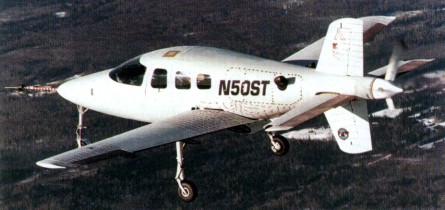
Contracted by Israviation to develop, design and build the “proof of concept” prototype of the turboprop ST50, the Cirrus ST50 engineering prototype first flew on December 7, 1994. The all new five seater is being developed by Cirrus Designs in the US and Israviation in Israel. Cirrus is responsible for the design while Israviation will manufacture the aircraft.
Engine: Pratt & Whitney PT6.
Seats: 5.
Cessna 408 SkyCourier

On November 28, 2017, Textron Aviation unveiled a new large utility turboprop designated as Model 408. The aircraft’s configuration was built to fit FedEx Express requirements. FedEx Express has signed on as the launch customer for up to one hundred aircraft, with an initial fleet order of fifty cargo aircraft and options for an additional fifty.
The SkyCourier is a twin-engine, high-wing, large utility turboprop built for high utilization operations. It will be offered in a 19-passenger version incorporating large round cabin windows for greater views and separate crew and passenger doors for smooth boarding, or in a cargo version which features a large cargo door and a flat floor cabin sized for three LD3 shipping containers and 6,000 pounds of maximum payload, with a maximum cruise speed of 200 knots and a maximum range of 900 nautical miles. Both versions will provide single-point pressure refueling to allow faster turnarounds.
The clean-sheet design of the SkyCourier will feature improved cabin flexibility and payload capability, excellent performance, and reduced operating costs compared to its rivals. The airframe is constructed from conventional aluminum materials and will be powered by two Pratt and Whitney Canada PT6A-65 turboprop engines with 1,100 horsepower of thrust each. The aircraft is also designed with fixed landing gear and Garmin G1000 avionics.
The Skycourier was expected to enter into service in 2020. In March 2018, initial tests in the wind tunnel were performed and accomplished. The maiden flight was initially set for 2019 and the design will be certified to FAR Part 23 standards.
In December 2019, assembly of the wing and fuselage was completed. In March 2020, initial ground testing was performed, including inspection on the fuel system, engines, avionics interfaces, and electrical systems.
Cessna’s new twin utility turboprop, the SkyCourier made its maiden flight from the company’s east campus Beech Field Airport on 17 May 2020.
The aircraft, piloted by Corey Eckhart, senior test pilot, and Aaron Tobias, chief test pilot, flew for more than two hours on its first flight. The sortie included tests on the aircraft’s performance, stability and control, environmental impact as well as its propulsion and avionics systems.
The prototype aircraft, along with five additional flight and ground test articles, testing programme was focusing on flight controls and aerodynamics.
Powered by two Pratt & Whitney Canada PT6A-65SC engines, it was to be offered in various configurations including a 2,700kg payload freighter, a nineteen seat passenger version or a mixed passenger/freight combination, all based on the common platform.

It was to feature the popular Garmin G1000 NXi avionics suite and have a maximum cruise speed of 200kt (TAS), with a maximum range of 900nm.
Both freighter and passenger variants will include single-point pressure refuelling as standard to enable faster turnarounds.
Cessna 408 Skycourier
Engines: 2x Pratt & Whitney Canada PT6A-65SC, 1100 hp
Max Cruise Speed: 200 kt / 370 kph
Range: 900 nm / 1,667 km
Service Ceiling: 25,000 ft
Take Off Distance: 1006 m / 3,300 ft
Cessna CE-441 Conquest
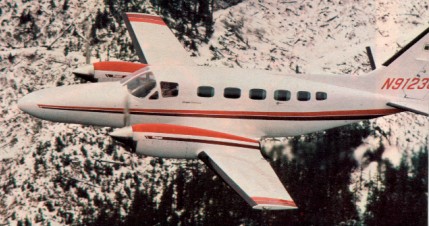
On 15 November 1974, Cessna announced the development of a new turboprop-powered pressurised executive transport designated Cessna Model 441. The prototype was flown for the first time on 26 August 1975 and by the time that initial deliveries began in September 1977 the type had been given the name Conquest and the basic airplane sold for US$850,000. The aircraft was certified on 19 August 1977, and powered by two Garrett TPE331 turboprop engines to provide the high-altitude/high-speed performance that Cessna required for this 11-seat transport.
The Model 441 Conquest incorporated the wing and landing gear of the Model 404 Titan, with the span increased by the use of wingtip extensions. The pressurised and air-conditioned cabin could accommodate up to 10 passengers, although a four-seat de luxe version was offered for executive use.
The Cessna 441 wings are of “failsafe” construction, meaning there is no life limit requiring either fail safe design or established fatigue life limits. The useful load of the 441 is 48 percent of its gross weight. The cabin is pressurized to 6.3 psi for a 10,000 foot cabin at 33,000 feet. The 441 will climb to 33,000 in 22 minutes. The wing is of bonded construction, with 30 percent chord Fowler type flaps utilized to lower the landing speed. Maximum cruise is 277 knots. VFR range with 10 and baggage will be 1,150 nm; it will be 1,830 nm with five and baggage. The airplane exceeded every performance standard set for it before the certification program began, including a 10 knot increase in maximum cruising speed at 33,000 feet, to 287 knots.
In early 1978, one of the first production aircraft being involved in a crash resulting in the Conquest being grounded by Cessna. Modification of the tail unit was carried out before the type was re-certificated, and aircraft that were already completed had to be modified with a new tailplane.
A 400 lb gross weight increase is possible for the Corsair when owners fit the later standard stronger wheels and change tyres from 8 to 10 ply. On completing these changes they now have a Conquest I and the original big brother becomes Conquest II.
In 1983 the Model 441 was redesignated and marketed as the Conquest II and by 1986 when production ceased, 353 examples had been sold.
Conquest – Engines: 2 x Garrett AiResearch TPE 331 8 401S/402S, 635.5 shp, 474kW
Props: Hartzell three blade, constant speed, full feathering, reversible, 90 in dia.
TBO: 3,000 hrs.
Length: 11.89 m / 39 ft 0 in
Height: 4.01 m / 13 ft 2 in
Wingspan: 15.04 m / 49 ft. 4 in.
Wing area: 23.56 sq.m / 253.60 sq ft
Wing loading: 38.8 lb/sq.ft.
Power loading: 7.88 lb/hp.
Seats: 9.
Empty wt: 5,929 lbs.
Useful load: 3,996 lbs.
Payload with full fuel: 813 lbs.
Max ramp wt: 9,925 lbs.
Max Take-off weight: 4468 kg / 9850 lb
Usable fuel cap: 475 USG/3,183 lb.
Max landing wt: 9,360 lbs.
Max zero fuel wt: 8,100 lbs.
Max allowable payload: 2,171 lbs.
Max ROC: 2,435 fpm.
SE ROC: 715 fpm.
SE climb gradient at 120 kt (Vyse): 358 ft. per nm.
Service ceiling: 37,000 ft.
Maximum operating altitude without oxygen for each occupant: 25,000 ft.
Maximum operating altitude with oxygen for each occupant: 33,000 ft.
SE service ceiling: 21,380 ft.
Max speed: 295 kts.
Max cruise, at 24,000 ft: 293 kts.
Max range cruise, at 33,000 ft: 257 kts.
Duration at max cruise: 5.68 hrs.
Duration at max range cruise: 9.4 hrs.
Max range: 2,196 nm / 4245 km / 2638 miles.
Stalling speed, clean: 89 kt.
Stalling speed, full flaps: 74 kts.
Pressurization differential: 6.3 psi.
10,000 ft. cabin at: 33,000ft.
Takeoff dist 50 ft obstacle: 2,465 ft.
Landing Dist 50 ft obstacle: 1,875 ft.
Seats: 11.
CE-441 Conquest
Engines: 2 x Garrett TPE-331-8-403S, 635 shp.
Props: McCauley 3-blade, 93-in.
Seats: 8.
Length: 34.7 ft.
Height: 12.8 ft.
Wingspan: 42.7 ft.
Wing area: 229 sq.ft.
Wing aspect ratio: 9.5.
Maximum ramp weight: 9925 lbs.
Maximum takeoff weight: 9850 lbs.
Standard empty weight: 5682 lbs.
Maximum useful load: 4243 lbs.
Zero-fuel weight: 8500 lbs.
Maximum landing weight: 9360 lbs.
Wing loading: 38.8 lbs/sq.ft.
Power loading: 7.8 lbs/hp.
Maximum usable fuel: 3183 lbs.
Best rate of climb: 2435 fpm.
Certificated ceiling: 35000 ft.
Max pressurisation differential: 6.3 psi.
8000 ft cabin alt @: 28500 ft.
Maximum single-engine rate of climb: 715 fpm @ 120 kts.
Single-engine climb gradient: 358 ft/nm.
Single-engine ceiling: 21380 ft.
Maximum speed: 295 kts.
Normal cruise @ 33,000ft: 287 kts.
Fuel flow @ normal cruise: 372 pph.
Endurance at normal cruise: 7.4 hrs:
Stalling speed clean: 90 kts.
Stalling speed gear/flaps down: 76 kts.
Turbulent-air penetration speed: 167 kts.
Cessna CE-425 Corsair I
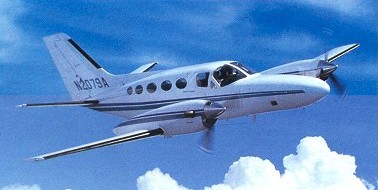
In November 1977 Cessna initiated the design of a new pressurised aircraft and the prototype flew for the first time on 12 September 1978. The aircraft combined the airframe of the Model 421 Golden Eagle with two Pratt & Whitney of Canada PT6A turboprop engines. Other features included the dihedral tailplane of the Model 404.
The new aircraft was introduced in 1980 as the Cessna Model 425 Corsair. Like the Model 421, the Corsair offered six/eight seats in varying. The Corsair was certified in mid-1980 and first deliveries made in November the same year.
Late in 1982 the aircraft was retrospectively designated and marketed as the Corsair I and 226 had been delivered when production terminated in 1986. The Garrett-engined Corsair II was built as the Model 441
A 400 lb gross weight increase is possible for the Corsair when owners fit the later standard stronger wheels and change tyres from 8 to 10 ply. On completing these changes they now have a Conquest I and the original big brother becomes Conquest II.
CE-425 Corsair
Engines: 2 x P&W PT6A-112, 450 shp, 335kW.
Props: McCauley 3-blade, 93-in.
Seats: 6/8.
Length: 10.93 m / 35 ft 10 in
Height: 3.84 m / 12 ft 7 in
Wingspan: 13.45 m / 44 ft 2 in
Wing area: 20.90 sq.m / 224.97 sq ft
Wing aspect ratio: 8.7.
Maximum ramp weight: 8275 lbs.
Maximum takeoff weight: 8200 lbs.
Standard empty weight: 4915 lbs.
Maximum useful load: 3360 lbs.
Zero-fuel weight: 6740 lbs.
Maximum landing weight: 8000 lbs.
Wing loading: 36.4 lbs/sq.ft.
Power loading: 9.1 lbs/hp.
Maximum usable fuel: 2452 lbs.
Best rate of climb: 2027 fpm.
Certificated ceiling: 30000 ft.
Max pressurisation differential: 5 psi.
8000 ft cabin alt @: 23500 ft.
Maximum single-engine rate of climb: 434 fpm @ 111 kts.
Single-engine climb gradient: 235 ft/nm.
Single-engine ceiling: 18500 ft.
Maximum speed: 264 kts.
Normal cruise @ 26,000ft: 257 kts.
Fuel flow @ normal cruise: 400 pph.
Endurance at normal cruise: 5.1 hrs:
Stalling speed clean: 88 kts.
Stalling speed gear/flaps down: 79 kts.
Turbulent-air penetration speed: 154 kts.
Cessna CE-406 Caravan II
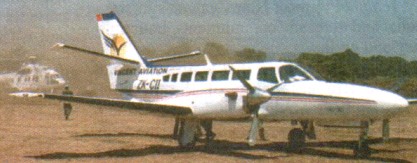
It was reported in July 1982 that with financial support from the French Government, Reims Aviation and Cessna were collaborating in the development of a new pressurised turboprop twin for utility and business use. A variant of the Cessna 400 series, it was known as the Reims-Cessna 406-5 and was to be powered by PT6A-112 engines derated to 500 shp each. Th gross weight was to be about 9260 lb / 4200 kg, of which 4410 lb / 2000 kg would be useful load, and the max range to be more than 1460 miles / 2350 km. The prototype was being built by Cessna, bu Reims Aviation was to be responsible for flight development and eventual production.
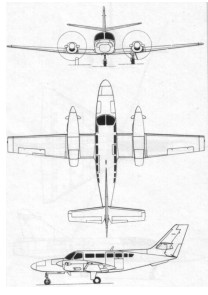
The Caravan II is a French-based design jointly developed by Cessna and the company’s European licensee, Reims Aviation. The twin-turboprop unpressurized aircraft uses Conquest II wings, a Titan-type fuselage with seating for up to 12 passengers and 500 shp (373 kW) Pratt & Whitney Canada PT6A-112s. As well as business use, the Caravan II is operated as a target tug by the French Army, as a freighter with side cargo door and as a coastal surveillance aircraft.
Engines: 2 x Pratt & Whitney Canada PT6A-112, 500 shp (373 kW).
Cruise: 235-240 kts.
Pax cap: 12.
 All Aero