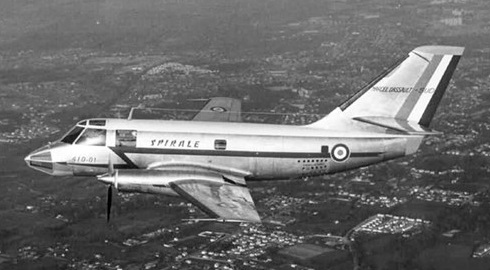
The Dassault M.D.410 Spirale was one of two nearly identical prototypes produced for the French Air Force – the M.D.410 Spirale and M.D.415 Communauté. The M.D.410 was to be the ground-attack variant of the M.D.415 which was a liaison and general duty aircraft (training, command liaison and ambulance), with the M.D.410’s windows removed and a glazed nose installed along with hardpoints and provisions for cannons.
MD.415 Communauté
Designed as a military communications and staff transport, the Dassault MD.415 Communauté made its first flight on 10 May 1959. Power was by two Turboméca Bastan turboprops.
Neither variant generated any interest and the project was abandoned.
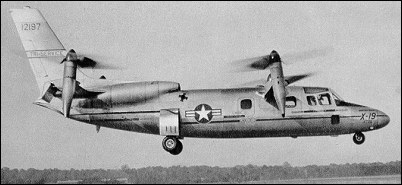
The Curtiss-Wright X-19 began as a commercial venture to develop a small, 4-passenger, executive VTOL aircraft that would have good high speed performance. Funded initially by Curtiss-Wright, it was designated the M-200. With solid test results from the X-100 confirming their theories regarding the potential for a practical application of radial lift, Curtiss-Wright pressed on with the design of the M-200. Design trade-off studies were performed which ultimately led to the X-19’s tandem wing configuration with a tilting propeller at each wing tip. The X-19 started with what Curtiss-Wright engineers felt was the optimal design for a propeller for a VTOL aircraft and then built the aircraft around it. The propellers had a very wide chord with a large amount of twist. This allowed them to maximize the amount of radial lift. At the start of the program, Curtiss-Wright funded the entire effort, with no interest in any government support. Two prototypes were being built when new management at Curtiss-Wright decided they no longer wanted to invest company research funds. They offered the two aircraft to the Tri-Service VTOL Program, a joint Air Force, Army, and Navy program office tasked with developing VTOL technologies for military needs. The Tri-Service Program also was developing the XC-142 and the X-22. Eighteen months later the Air Force agreed to buy the aircraft. When the Tri-Service Program bought the X-19s, the two prototypes already were 55 percent and 35 percent complete, with a substantial investment already having been made by Curtiss-Wright. The original X-19 design, as the M-200, was not built to any specific mission requirement. The goal was to fly as fast and far as possible and to be economically competitive with conventional executive transports that were becoming very popular in the 1960s. Analysis of the design showed that the M-200 could achieve a range of 1450km to 1850km with a maximum level speed of 740km/h at 4880m. It was to conform to FAA regulations, have all weather flying capability, low noise level, and be free of vibration. Conventional aircraft construction techniques and materials were used.
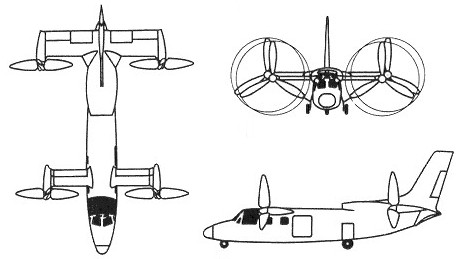
The X-19’s basic configuration was an all-metal, monocoque fuselage, with two shoulder-mounted tandem wings. A nacelle at each wing tip could rotate from pointing vertically for take off and landing to pointing horizontally for cruise. The wide, specially-designed propeller was mounted in front of each nacelle. Two turboshaft engines housed in the rear fuselage powered the four props. The fully hydraulic tricycle landing gear retracted completely into the fuselage. A large vertical tail was required because the props were located relatively close to the fuselage. Total height was just over 5m. The original fuselage was 12.5m long, but the cabin area was only 1.2m high, 1.4m wide, and 2.4m long. The passenger compartment was intended for four passengers, or 450kg of cargo. The cabin was pressurized to 4880m. All fuel was stored in the fuselage, aft of the passenger/cargo area. There were two 860 lt tanks and one 990 lt tank. The front wing had a 6.1m span with a narrow chord, while the rear wing had a 6.4m span with a greater chord. The rear wing had almost twice the area of the front wing. The wings had no incidence, dihedral, or sweepback. The front wing incorporated full span flaps, while the rear wing had inboard ailerons and outboard elevators, the ailerons being slightly larger than the elevators. The flaps on the front wing were directly coupled to the nacelle tilt angle, and the pilot could not control them independently. At hover, the flaps and elevators drooped to their full extension of 60 degrees to decrease the amount of wing area that was in the prop downwash. The location of the props on wing tips, however, resulted in the loss of 7 to 9 percent of lift due to wing interference. Curtiss-Wright intended originally to use four Wankel rotary engines rated at 580hp each. Curtiss-Wright eventually abandoned the Wankel in favor of two Lycoming T-55-5 turboshaft engines of 2200hp each (although some sources stated T-55-L-7 engines of 2650hp each). This more than doubled the total power, but retained the ability to operate with one engine failed, including performing vertical take-offs and landings. Switching from four engines to two also simplified the design by decreasing the engine interconnects, and changing to turboshaft engines eliminated the need for engine cooling. Power from the engines was distributed to the props by means of three-inch diameter drive shafts and seven gear boxes. The gear boxes consisted of one engine coupling box that coupled the two engines so that either could power the entire system, two T-boxes to transfer power from the fuselage shafts into the wing shafts, and four nacelle tilt gear boxes. The exhaust pipe from each engine joined in the fuselage so that only one pipe exited the rear of the aircraft. The 4m diameter props construction consisted of a steel shank, foam core, and fiberglass shell. The paddle-wheel shape allowed them to produce about 2.7kg of thrust per horsepower. Low prop noise was obtained because the maximum tip speed of 250m/s was well below sonic speed. The cockpit accommodated two pilots seated side by side. The aircraft could be flown from either seat, but the pilot-in-command seat was on the right, as in a helicopter. The cockpit resembled that of a conventional aircraft, with the cockpit visibility being very limited for a VTOL aircraft. The high instrument panel also restricted vision over the nose. Two one-foot square windows were located near the pilots’ feet, but were too small to be effective and later were modified into ram air inlets to provide additional cooling. Each pilot had a conventional stick, rudder pedal, and two throttles. Nose wheel steering was by means of a hand tiller controlled by the copilot. To minimize the clutter on the instrument panel, there was a single oil temperature gauge and single oil pressure gauge for all nine gear boxes. The pilot could select which component to monitor by rotating a 9-way selector switch to the desired component. To signal a problem, each gear box had a single warning light that indicated either high or low oil pressure, or the presence of metallic chips in the oil. If the light illuminated, the pilot had to rotate the 9-way switch to see the specific problem. When rotated to the vertical positions, the front nacelles rotated past vertical, to 97 degrees, meaning the thrust actually pointed slightly forward. The rear naceltes rotated only to 82 degrees with their thrust pointing slightly rearward. A tilt button on the control stick caused all nacelles to tilt together. Initially, the nacelle tilt rate was mechanized at 5 degrees per second. It was soon realized that this would have required a deceleration from 90km/h to hover in less than 5 seconds, resulting in 0.5g of longitudinal acceleration. This was too much, so the rate was reduced to 1 degree per second, resulting in a more reasonable 0.2g. Two independent hydraulic systems controlled the nacelle rotation and prop blade angles. If the automatic system failed, the pilot could rotate them manually using a hand crank. The crank required 570 turns to move the nacelles from end to end, and eventually was replaced with a motor. The Tri-Service Program required a few changes to convert the M-200 into the X-19. North American Aviation LW-2B ejection seats, which used a rocket catapult mechanism and ballistically deployed parachutes, were added. These seats could operate from zero altitude and zero airspeed up to 15250m and deploy fully within 0.5 second from seat firing. The seats ejected through the canopy. The fuselage was lengthened by 0.9m so that two more passenger seats could be added, bringing the total personnel load up to two pilots and six passengers. This increased the fuselage length to 13.5m. The cabin door was enlarged to 1.06m high and 1.17m long, and a rescue hoist was added. The resulting aircraft was a bit long for a six passenger aircraft, but this was attributed mostly to the engines and fuel tanks being located in the fuselage. The only difference between the two prototypes was that the second had better instrumentation and data recording, and also had a dummy refueling probe installed on the nose to evaluate probe and drogue in-flight refueling. Weight growth after adding the ejection seats and stretching the fuselage resulted in the useful load being reduced to 185kg. This allowed for only one pilot and fuel for 10 minutes of hovering. With two pilots, the hovering time was cut to 1 minute. However, there was still 270kg of unusable fuel because of the location of the fuel pumps inside the tanks. The pump position was changed to improve the amount of usable fuel. The X-19 was statically unstable in hover and in pitch and roll at low speed, mandating the addition of stability augmentation in both of these axes. Control by the augmentation system was limited to 30 percent of the pilots’ control authority, so the pilot could override it if necessary. No stability augmentation was needed for yaw. The system initially mechanized rate feedback, but initial testing showed this to be of little use to pilot. The system was changed to a rate plus integral of rate, which improved control for hover and low speed flight. The X-19 was test flown with the stability augmentation turned off. Although it was controllable by the pilot, the workload was unacceptable. All gear boxes were designed to absorb the power required to lift the aircraft at a maximum weight of 5540kg. Great difficulty was encountered in qualifying them, and very low life limits were established in order to conduct flight tests. The engine coupling gear box, which combined the power output of the two engines, was capable of absorbing 2,900 horsepower with both engines running, or 2500hp from only one engine. With each engine producing 2200hp (or 2650hp, depending on the reference), the gear box obviously could not absorb full power from both engines. In addition, it was limited to 50 hours of operation. Likewise, the nacelle gear boxes had estimated lives of 13-14 hours and were thus limited to 5 hours of operation. The problem was felt to be improper heat treating of the gears. Wind tunnel tests of the initial design indicated an unacceptably high amount of interference drag at the junctions of the wing/fuselage and wing/nacelle. Drag clean up measures were taken, and more wind tunnel tests were run to confirm the improvement. The rear wing had significant lift loss due to downwash from the front wing, but knowing this, it was compensated for in the basic design. Airframe structural tests revealed no major problems. Full scale static propeller tests were performed to evaluate and reduce download losses on the wing at hover. The intended design empty weight was 3600kg with a gross take-off weight of 5540kg. However, the empty weight grew to 4800kg and the gross take-off weight to 6160kg by the time the aircraft was built, thus reducing the useful load and placing greater stress on the gear boxes. Most of the weight growth came from the fuselage, wings, and power transmission system. It is safe to assume that Curtiss-Wright engineers started their fuselage and wing designs using standard practices for a conventionally configured aircraft, but stress analyses indicated weaknesses peculiar to the tandem design and prop locations. The fuselage had to be heftier than originally expected to handle the loads imposed by the landing gear location and the tandem wing configuration. The wings also had to be heftier than normal because during hover, all lift came from the props at the wing tips, rather than the lift being distributed along the wing as on a conventional aircraft. Also, the wings had to be very stiff so as not to transmit any propeller vibration. The shafting and gear boxes also proved to be heavier than predicted. Altitude was controlled during hover by the throttle, and precise control was difficult because of a lag of nearly one second in the engine response time. Varying the pitches of the four props controlled pitch and roll. A unique prop rotation scheme was used to maximize propeller torque for yaw control…the props on opposite corners turned in the same direction. A yawing moment resulted from the blade angle being increased on one corner and decreased on the opposite corner. The pilot didn’t control the blade angles directly, but used the rudder pedals for yaw and the stick for pitch and roll inputs. A mixer in the flight control system automatically controlled the actual commands to the individual props. To initiate a transition from hover to horizontal flight, the pilot pressed the tilt button on the stick to start the nacelles rotating, then added throttle to increase lift, accelerate, and maintain altitude or climb. As altitude and speed increased, the pilot continued to lower the nacelles until reaching 295km/h, at which time the transition was complete and the X-19 would fly like a conventional aircraft. Throughout the transition, the mixer continuously faded out prop control and faded in conventional control surface control as the airspeed increased. To reverse the transition, the process was reversed.
Roll out of the first prototype, tail number 62-12197, occurred on July 23, 1963. The flight test approach was to demonstrate hover, transition, and finally forward flight. Curtiss-Wright pilots would fly the initial flights, demonstrating hover and transition. After that, a Tri-Service test team would take over. The first flight was performed on November 20, 1963, at Curtiss-Wright’s facility at Caldwell, NJ. The X-19 lifted off for only a few seconds in hover before settling and collapsing a main gear because of side loads. Although the damage was minor, it was seven months until the X-19 flew again. The Air Force wanted to send the X-19 to Edwards AFB. Curtiss-Wright argued that supporting the test program at Edwards would be difficult, and that in an emergency, the X-19 would land vertically, making the long runway and large dry lake bed unnecessary and a waste of taxpayers’ money. The Air Force finally agreed that flights up through transition would be done at Caldwell, NJ, but the remainder of test flights would be performed at Edwards. Flight testing resumed on June 26, 1964. The X-19 made numerous hovers, most only a few seconds in duration. By August 7, it had flown on twelve different days and accumulated one hour and 37 minutes, accomplishing most of the objectives planned for its first eight hours of hover testing. The X-19 demonstrated spot turns, lateral translations at speeds up to 28km/h, rearward flight at 19km/h, forward flight at 37km/h, and 50 take-offs and landings. During these tests, the X-19 proved difficult to control, requiring excessive pilot workload. Various combinations of stick breakout and gradient forces were tried, but produced no improvement. However, the pilots were improving their skills at such a fast rate as they gained experience that it was difficult to determine if improved performance was from increased experience or the control system improvements. On the 21st flight, the stability augmentation system was turned on, which made hovering much easier. Flight speeds up to 160km/h were obtained with good flight characteristics up to this speed. On November 12, the X-19 experienced a full pitch hardover caused by the stability augmentation system. The pilot retained control because of the limited authority of the stability augmentation system and deactivated it. On the next day, they experienced a roll hardover. The cause of these incidents never was determined conclusively. On December 4, 1964, the X-19 suffered damage from loose cinders on the runway, which had just been resurfaced. Both engines and the leading edges on all four props were damaged. On January 31, 1965, one prop failed, which forced suspension of further testing for six months. While repairs were being made, it was decided that testing should be moved to the Federal Aviation Administration’s National Aviation Facilities Experimental Center (NAFEC) near Atlantic City, NJ. On July 31, 1965, the X-19 hovered for an air worthiness test after six months of down time, following which the props were removed and the aircraft was shipped to NAFEC. The X-19 was reassembled quickly and soon was flying again at NAFEC. Throughout August 1965, it made numerous high speed hovers going more and more into the transition. At this point, the Air Force test team joined the program. The Air Force test pilot quickly determined that the remaining control problems during hover were caused by excessive and uneven hysteresis in the control stick. Hysteresis is the tendency of the stick and control surfaces not to return to their original position when the pilot moves the stick then lets go (it is caused by friction between all the moving parts and stretching of control cables). Pitch hysteresis was found to be 4 to 8 percent of total displacement, and lateral hysteresis was 12 to 25 percent. Pilots had to make much bigger roll inputs than pitch inputs, resulting in poor control harmony and the pilot getting out of phase with the aircraft’s motions. This problem was corrected, and hovering became much easier. The first full transition was planned for August 25, 1965, on flight number 50. As the X-19 climbed and accelerated, the nacelles tilted as far as 65 degrees from vertical as the aircraft reached 150km/h at 400m. At this point, the temperature warning lights for left rear nacelle gear box and aft T-box illuminated. The pilots terminated the test and began a return to the airport. An immediate, emergency landing did not appear warranted, and the pilots planned a normal approach based on the recommendation from the ground support team. As they circled to line up with the preferred runway, a very high frequency vibration and a low frequency random shake began. Lateral control began to deteriorate. With the X-19 pointed toward a wooded area at low altitude and fearing that they would not clear the trees, the copilot jammed the throttles forward. As they climbed and accelerated, some control was regained and the vibrations smoothed out. At 120m, the left rear prop snapped off, and the X-19 rolled to the left and pitched up. This was followed promptly by the separation of the left front prop, then the two right props. The pilots bailed out inverted, their parachutes deploying fully within 2 seconds at an altitude of 70m. The aircraft crashed into a nearby swampy area and was totally destroyed. The pilots suffered only minor injuries, mostly cuts from ejecting through the canopy. The time from loss of props to ejection was only 2.5 seconds. The cause of the crash was attributed to the copilot’s applying full power. The drive system could not absorb the 4400hp being generated, resulting in the failure of the prop gear box. Total flight time for the flight was only seven minutes.
The crash itself did not end the X-19 program. The Air Force wanted to continue with testing the second prototype, which was nearing completion, but wanted to switch to a fixed price contract. Curtiss-Wright did not like that, because they would now take all financial risk. Their management also saw no future business in a commercial VTOL transport, even if the X-19 ultimately proved successful. They refused the Air Force’s offer. Unable to come to any agreement, the program ended in December 1965.
The X-19 completed 129.4 hours ground running time and flew a total of 3.85 hours. The second X-19 never flew and eventually was cut up for scrap.
Curtiss-Wright X-19A Engines: two 2,200-shp (1640-kW) Avco Lycoming T55-L-5 turboshafts Wingspan: 10.5m Length: 13.5m Height: 5.2m Wing area: 14.4 sq.m Take-off weight: 6200kg Empty weight: 4400kg Max speed: 720km/h Cruising speed: 650km/h Range with max fuel: 1200km Crew: 2 Passengers: 4 Payload capacity: 550kg
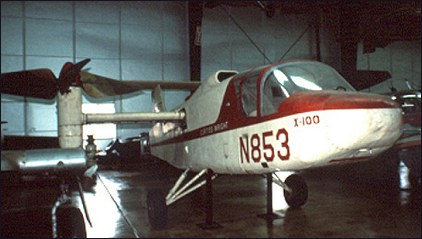
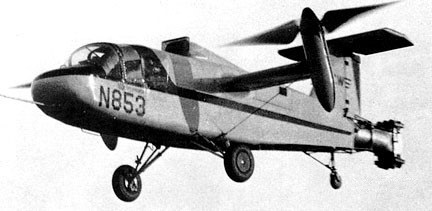
The Curtiss-Wright X-100 was a short-lived research program used to demonstrate the lift concept being developed for the Curtiss-Wright M-200 aircraft, which eventually became the X-19. The X-100 was to test the lift force concept and the gimbaled nacelles needed for a tilt prop configuration, and to test the glass fiber propellers needed to enable the use of radial lift. The X-100 was successful in that it verified the characteristics of the props, and produced data on noise, vibration, downwash, ground effect, stability, and control, and the piloting techniques needed to hover and transition a tilt prop VTOL. The airframe was all aluminum except for the aft half of the fuselage starting just aft of the cockpit, which was fabric covered. Design and fabrication was completed in just over a year, using concurrent design and construction. The design, fabrication, testing, and documentation of components occurred in a continuous and ongoing process. The X-100 was a high wing with T-tail and conventional landing gear. The fuselage was 8.6m long and consisted of welded tube construction. The shoulder mounted wing, with a span of 4.9m and an area of 2.1sq.m, had a wing loading of 560kg/sq.m. This was intentional so that the radial force produced by props could be demonstrated beyond any doubt. A three bladed, 3m diameter propeller was mounted on a gimbaled nacelle at each wing tip, and the two props rotated in opposite directions to balance yawing moments. Gross weight was 1580kg. The two-place cockpit had side by side seating. A rectangular engine intake was just behind the cockpit on the top of the fuselage. The T-tail, with an area of 2.1sq.m, was chosen to keep the stabilizer out of the props’ slipstream, giving the X-100 an overall height of 3.28m. To control pitch and yaw during hover, the engine exhaust was ducted out the rear of the fuselage and could be vectored up or down, and left or right by a device called a jetivator. This device was chosen for simplicity and to reduce weight. As a control effector, the jetivator could produce 63kg of pitch force and 18kg of yaw force. Roll control during hover was by differential control of the prop pitch. Altitude control was by means of the throttle. The X-100 originally had a rigid conventional landing gear. It eventually was replaced by tricycle gear to improve landing characteristics. The props were made of foamed plastic molded onto a metal shank and covered with a layer of urethane elastomer. Blades were wide and had a considerable amount of twist to maximize the amount of radial lift. The relatively low tip speed of 200m/s in hover minimized the amount of noise. The nacelles could rotate from pointing vertical to 12 degrees above horizontal. They rotated forward slowly at 2 degrees per second to allow the pilot to adjust power and attitude in order to prevent settling during the transition to cruise flight. They rotated back to vertical at 5 degrees per second. Curtiss-Wright’s program managers selected a Lycoming YT-53-L-1 turboshaft engine of either 650 or 825 horsepower. The U.S. Army, who had numerous YT-53-L-1 engines on hand, loaned two of them for the X-100 project. In exchange, Curtiss-Wright agreed to write a report on the engines’ performance. The fuselage had to be enlarged to accommodate the Lycoming engine. The design process started in February 1958. The first prop assembly was fabricated soon after and tested in NASA’s 12m x 24m wind tunnel starting in October 1958. It was run through the expected power operating range and at shaft angles from 0 to 90 degrees. These tests demonstrated that thrust in hover would be 10 percent below prediction (which was later confirmed in flight test), but there was enough excess thrust that the 10 percent loss was acceptable. Preliminary wind tunnel tests using models were performed at the Massachusetts Institute of Technology, then a powered model was run in the wind tunnel to determine stability and control characteristics. Tests using the actual aircraft eventually were run in NASA’s 12m x 24m wind tunnel. Reasonable correlation was achieved between wind tunnel tests and flight tests. Roll out of the completed X-100 was on December 22, 1958, at Curtiss-Wright’s Caldwell, NJ, facility, and the first engine run was performed on January 14, 1959. The first hover was made in a tether rig on April 20, 1959, to verify control power and feel. The first free hover test was performed on September 12, 1959, but extra weight was added to prevent the X-100 from getting out of ground effect. After three days of testing, hover flights of up to 20 minutes duration were made. The outflow velocities of air along the ground at various distances from the hovering X-100 proved to be similar to those of a helicopter of similar weight. Hover proved to be difficult as the pitch and yaw thrust provided by the jetivator was insufficient. Roll and yaw motions tended to couple together. The throttle was used to maintain height during hover, and lags in the engine response further compounded the problem. The X-100 also tended to weathervane into the wind during hover due to yaw moments produced by the wind hitting the props at an angle, which the jetivator’s yaw control could not counter adequately.
X-100 N853
Steady hovering was possible only up to about 4m, while the X-100 was in ground effect. If maximum power was applied on the ground, the X-100 would rise to about 7.6m, settle to within a few feet of the ground, then rise again and repeat several cycles of a slowly damped oscillation in height. The first transition from hover to forward flight was made on April 13, 1960. The transition itself was fairly simple. The pilot pressed a switch on top of the control stick to rotate the nacelles forward, then added power to prevent sinking. As the nacelles rotated, the X-100 picked up 30km/h of airspeed for each 10 degree of tilt. The conversion was done at 0.9 to 1.5m of altitude and very slowly to prevent settling to the ground. The nacelles were rotated down in 5 degree increments until a speed of 290km/h was achieved with the nacelle at a 15 degrees from horizontal. In general, low speed flight characteristics were unsatisfactory, especially in gusty air. The X-100 demonstrated a high pitch-up moment as forward speed increased, but directional stability, roll control, and longitudinal maneuvering were good in flight at 110km/h. At low altitude and up to 110km/h, the X-100 was notably free of mechanical vibration. Testing at altitude showed the aircraft to be buffet and stall free over a large range of angles of attack. STOL take-offs and landings were made with nacelle angle at 20 degrees from the vertical. Directional control was poor and was a problem during ground run. Smooth touch-downs also were difficult, much of the problem being caused by the landing gear being too stiff. There was considerable bouncing even at low touchdown speeds. The basic test program was completed on July 21, 1960. Test pilots from NASA visited Curtiss-Wright and flew the X-100 on August 12 and 13. This concluded test operations for the X-100 at the Caldwell, NJ, facility. With Curtiss-Wright satisfied that they had proven the radial lift concept, they turned the X-100 over to NASA. It was shipped to the Langley Research Center in October of 1960. It was used to study the effects of downwash on several types of ground surfaces, such as snow, grass, pavement, and packed dirt. NASA also studied problems associated with visibility in snow during hover and slow forward transition. This role was finished by October 1961.
The X-100 was test-flown until August 1965, when a gear case and prop failed. The pilots safely ejected and the ship crashed, but its technology was basis for X-200 and, ultimately, Bell-Boeing XV-22 Osprey.
Following the completion of tests at Langley, the X-100 was donated to the Smithsonian Institution. During its short career, the X-100 completed a total of 14 hours flying time and 220 hours of ground engine run time. It successfully proved the radial force concept, the feasibility of tilting nacelles, and low noise levels.
From 1949 the US Navy actively pursued a policy of VTOL research. The results were two prototypes, the Lockheed XFV-1 and the Convair XFY-1 Pogo. Both aircraft were of the ‘tail-sitter’ concept and powered by the 5500-shp (4101-kW) Allison T40-A-6 turboprop driving large contra-rotating propeller units. These provided more thrust than the weight of the aircraft, making possible VTOL operation.
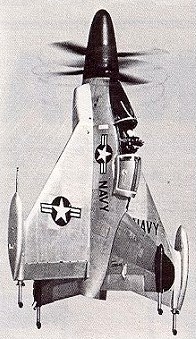
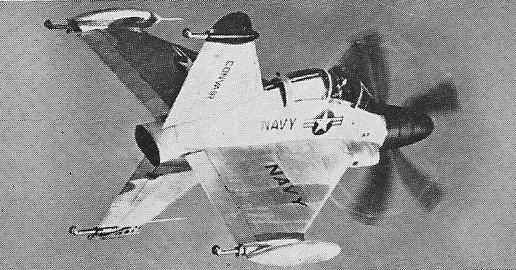
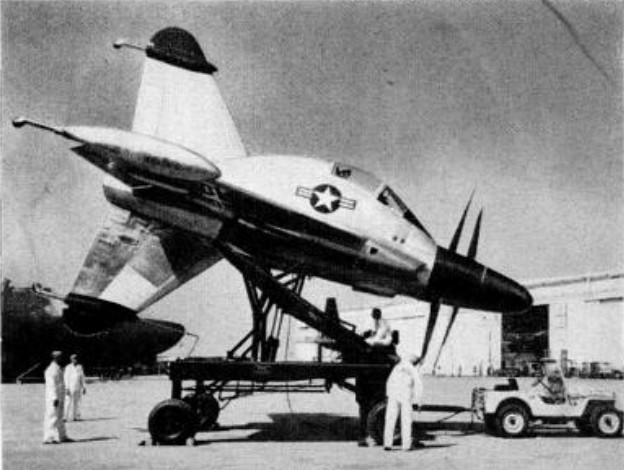
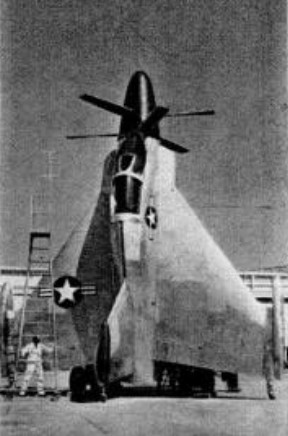
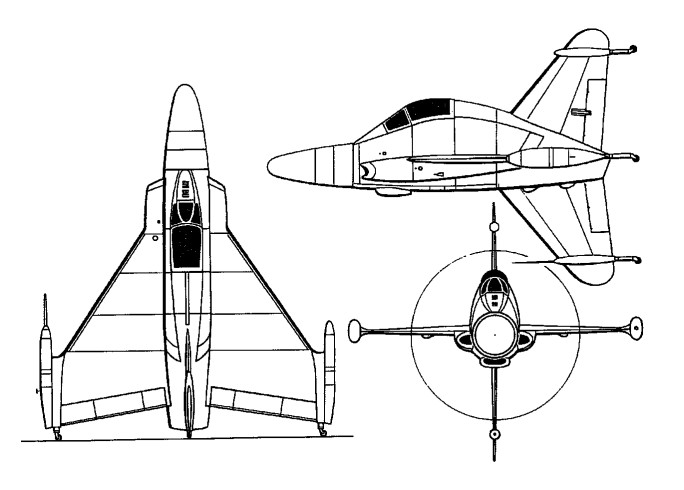
The XFY-1 was a swept delta design with large dorsal and ventral fins, all four surfaces of this cruciform arrangement carrying castoring wheels to support the aeroplane vertically on the ground. This arrangement of flying surfaces made it impossible to fit the XFY-1 with the same type of conventional landing gear as the XFV-1, so Convair received the only example of the T40 turboprop cleared for VTOL operation.
The pilot is seated in a gimbal-mounted seat which tilts forward 45 degrees when the aircraft is in the vertical position, returning to normal when horizontal flight is attained.
The Pogo made its first free VTOL flight on 1 August 1954 and in October made its first transition from free vertical to horizontal flight and back. The flight test programme was very successful in overall terms, but like that of the XFV-1 confirmed that exceptional piloting was necessary for such a tail-sitter type.
The aircraft had little castoring wheels on their fins on which they stood, towering nearly 12.2 m (40 ft) above the ground, and wingtip weapon pods.
The Pogo was equipped with a custom fitted clamshell ‘hangar’ which locked around tile aircraft and made it independent of airfield facilities so that it could be stationed anywhere.
Extensive tethered tests from a special rig were followed by a first vertical take-off and landing on 1 August 1954. Testing continued with a series of similar vertical flights before the first complete transition from vertical to horizontal flight and vice versa was accomplished on 2 November 1954. Although some 40 flight hours were accumulated by two prototypes of this experimental fighter, its development was abandoned. The aircraft did not get beyond preliminary testing.
Engine: 1 x Allison YT40-A-6 turboprop, 4362kW / 5500 shp Wingspan: 8.43 m / 27 ft 8 in Length: 10.66 m / 34 ft 12 in Height horizontal: 30 ft 9in Wing area: 32.98 sq.m / 354.99 sq ft Max take-off weight: 7371 kg / 16250 lb Empty weight: 5345 kg / 11784 lb Loaded weight: 10,000-11,000 lb Max. speed: 982 km/h / 610 mph Ceiling: 13320 m / 43700 ft Armament: 4 x 20mm cannon (proposed) or 46 x 70mm rockets
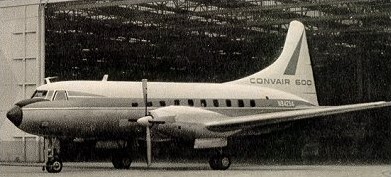
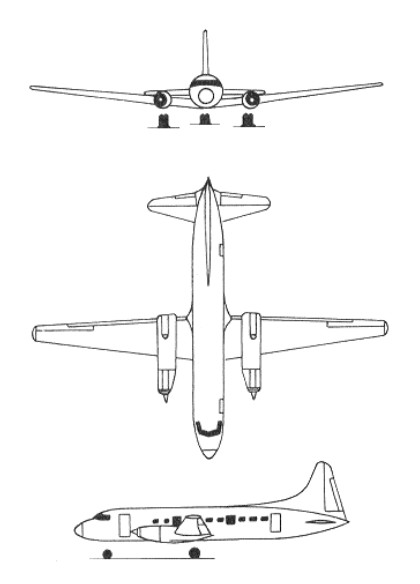
The prototype Convair 600 (a converted 240D) was powered by Rolls-Royce Dart R.Da 10 turboprops, and first flew on 12 May 1965.
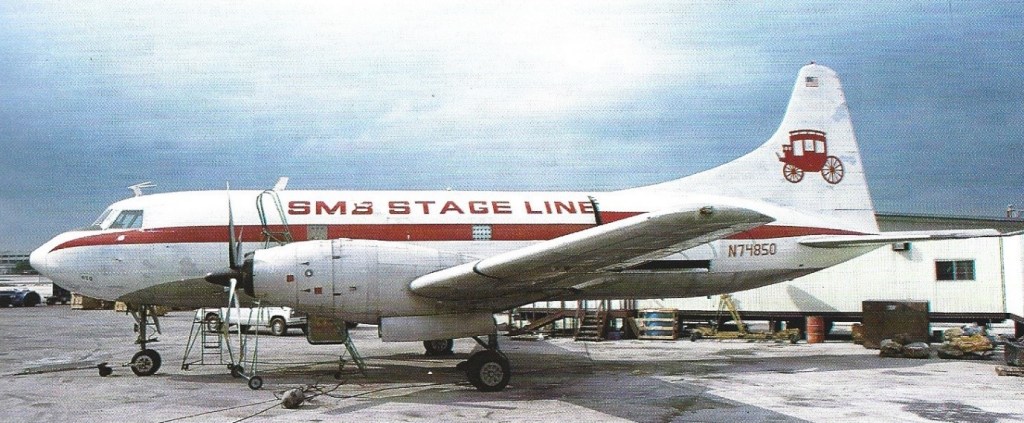
N74850 1948 Convair 240-0 converted to 600 with RR Dart 542-4
About 240 aircraft were modified from Convair 240 (Convair 600) and Convair 340 / Convair 440 (Convair 640) with the Rolls-Royce turbo-props installed.
Engines: Rolls Royce Dart 10 Mk 542 4 turboprops, 2,750 shp. Length: 74 ft 8 in. Wingspan: 91 ft 9 in. Speed: 309 mph. Ceiling: 24,600 ft. Range: 1,230 mls.
Convair 640 Engines: 2 x Rolls-Royce RDa. 10/1 Dart turbo-prop, 2256kW Max take-off weight: 25855 kg / 57001 lb Empty weight: 13733 kg / 30276 lb Wingspan: 32.11 m / 105 ft 4 in Length: 24.84 m / 81 ft 6 in Height: 8.59 m / 28 ft 2 in Wing area: 85.47 sq.m / 919.99 sq ft Cruise speed: 465 km/h / 289 mph Ceiling: 6000 m / 19700 ft Range w/max.fuel: 3138 km / 1950 miles Range w/max.payload: 1979 km / 1230 miles Crew: 2-3 Passengers: 49-56
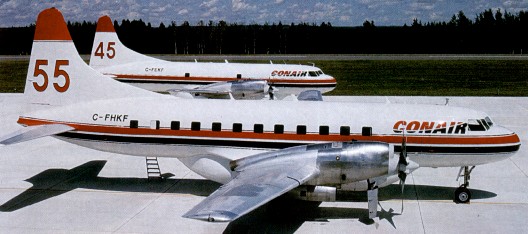
The Convair 580 is a turbine powered development of the Convair 340/440. Standard Pratt and Whitney R2800 piston engine (2,000hp) Convairs were converted to take a pair of Allison 501-D turboprop engines developing 2796kW (3750ehp) and driving four-bladed propellers. Development work was carried out by PacAero Engineering Corp, the extra power allowed a gross weight increase to 53,200 lb. for take off following some structural modification including an enlarged horizontal and vertical tailplane. The conversion line was opened at Pacific Airmotive Corp. Burbank, California, following certification in 1960. The last 580 was delivered in July 1969 after 170 aircraft had been converted. In all-passenger configuration it could carry 39 passengers.
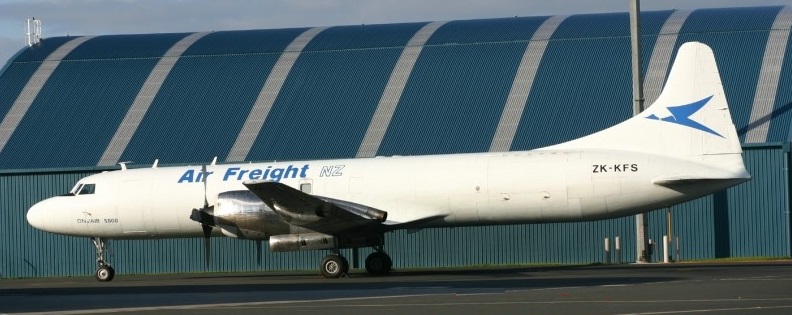
Kelowna Flightcraft R&D Ltd., Allison Gas Turbine and General Dynamics teamed to launch the Convair 5800 Program. The Convair Model 340, 440, and 580 Airplanes were converted with a fourteen foot, three inch stretch to provide increased capacity. The 5800 is powered by the Allison 501-D22G (Series III) Propjet Engine, de-rated to 4300 TSHP.
CV5800
The CV5800 featured a reconditioned airframe with a projected life in excess of 100,000 hours, modern, all new lightweight electrical wiring, all new flight control system cables, dual point underwing pressure refuelling, roller floor system, and passenger, cargo, or Combi models with approved Class E cabin.
All have Honeywell EFIS Flight Decks. The passenger model 5800 has 78 seats, and wide body interior with overhead bins. The cargo versions have a 120 inch cargo door and pallets and containers are compatible with DC-9 and B-727 aircraft. There is a 9-G Tie-down system.
CV5800 Engines: 2 x Allison 501-D22G Propellers: Hamilton Standard 54H60-164 Cruise speed: 325 mph Range with 21,000 lb payload: 750 statute miles Range with20,000 lb payload: 900 statute miles
Shortly after Reuben Fleet sold his interest in Consolidated Aircraft Corporation in March 1943 and the company was reorganised as Consolidated Vultee (Convair), the US Navy expressed interest in a new long-range multi-role flying-boat.
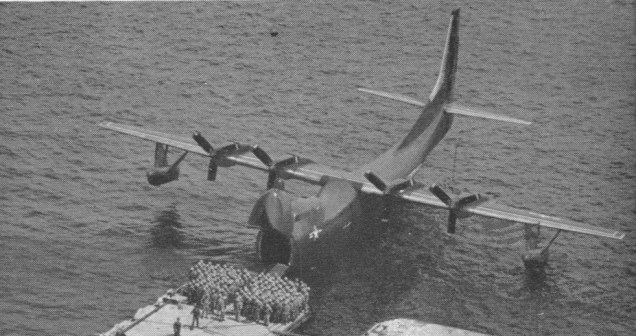
Convair’s proposal was for an aircraft powered by four turboprop engines, was the subject of a contract for two prototypes, awarded on 27 May 1946. Designated XP5Y-1, the new aircraft featured a slim fuselage for an aircraft of this class with a length-to-beam ratio of 10 to 1. it was powered by four Allison T40-A4 turboprops, each driving two contra-rotating, reversable propellers through a common gearbox. The type’s main role was anti-submarine warfare, and it was to have been fitted with advanced radar, ECM and MAD equipment in addition to carrying a heavy load of bombs, mines, rockets and torpedoes. The first aircraft was flown from San Diego on 18 April 1950, and in August the type set a turboprop endurance record of 8 hours 6 minutes. August was an eventful month for the XP5Y-1 as the US Navy decided to discontinue its development for maritime patrol, but to persevere with the basic design for use as a passenger and cargo aircraft.
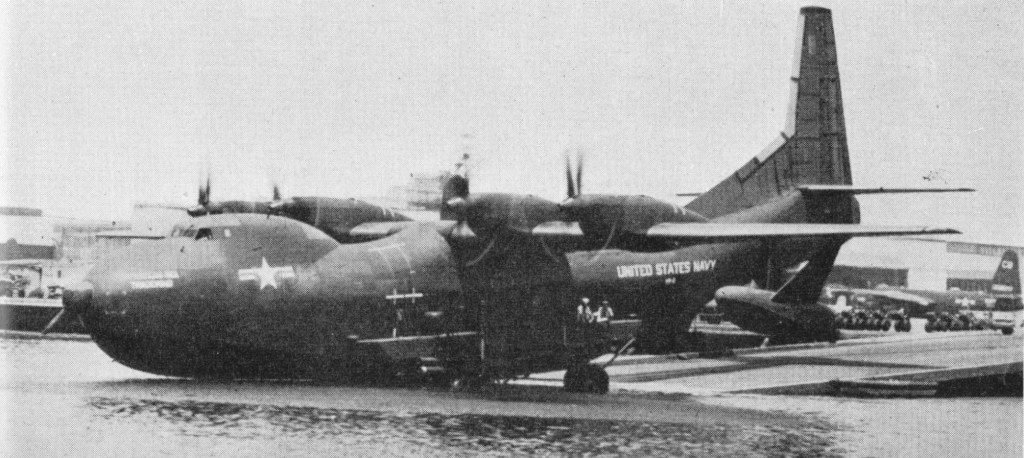
Convair R3Y-1 Tradewind
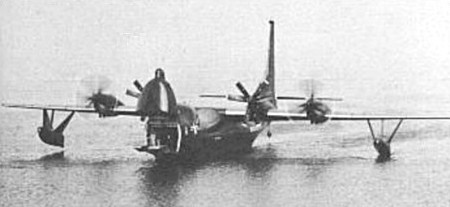
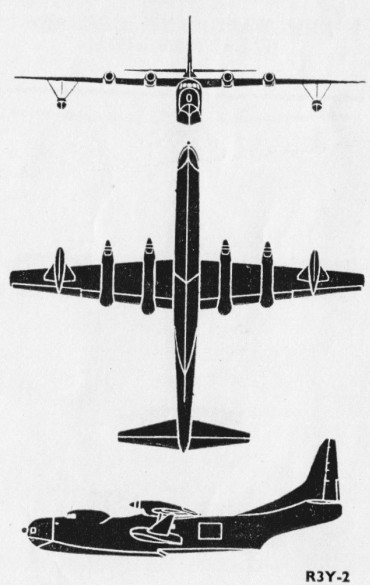
Work continued, despite the loss of an XP5Y-1 in a non-fatal crash off San Diego in 15 July 1953 and the first R3Y-1 Tradewind flew on 25 February 1954. Major changes included the deletion of all armament and of tailplane dihedral, the addition of a 3.05m wide port-side cargo hatch aft of the wing and the provision of redesigned engine nacelles to accept the improved T40-A-10 engines. Cabin sound-proofing and air-conditioning were installed and pressurised accommodation provided for up to 103 passengers or, in medevac configuration, for 72 stretcher cases and 12 attendants; cargo payload was 24.4 tonnes (24 tons). The R3Y-1 was a straight transport version, the R3Y-2 was the assault transport version with the hinged nose. It could also refuel jets in flight using two or four wing pods. The R3Y-2 had a nose loading door and integral hydraulic ramps. The opening door blocked the pilots’ forward view during beach operations. The R3Y-1 ‘s performance was demonstrated on 24 February 1955 when one of the five aircraft built flew coast-to-coast at an average speed of 649km/h on delivery to the Navy Test Center at Patuxent River, Maryland. Similarly, on 18 October a 6 hour 45 minute record flight at an average 579km/h was accomplished between Honolulu and NAS Alameda, California. US Navy transport squadron VR-2 received the first of its mixed fleet of R3Y-1 and R3Y-2 flying-boats on 31 March 1956, but financial considerations and continuing problems with the engine/propeller combination, culminating in two in-flight separations of propellers and gearbox from an engine (on 10 May 1957 and on 2 January 1958), led to a curtailment of Tradewind operations. Squadron strength was first cut to two R3Y-1s and two R3Y-2s and the unit was finally disbanded on 16 April 1958.
R3Y-2
R3Y Engines: 4 x Allison T40-A-10 turboprops, 4362kW, 5500 shp Max take-off weight: 74843-79379 kg / 165001 – 175002 lb Payload: 21750kg / 47951 lb Wingspan: 44.42 m / 145 ft 9 in Length: 42.57 m / 139 ft 8 in Height: 13.67 m / 44 ft 10 in Max. speed: 580 km/h / 360 mph Cruise speed: 480 km/h / 298 mph Range w/max.fuel: 6437 km / 4000 miles Crew: 5 Passenger Capacity: 80 or 24 ton.
R3Y-1 Engines: 4x 5,500 h.p. Allison T40-A-4 coupled turboprops. Wingspan: 145 ft Length: 142 ft. 6 in Loaded weight: 160,000 lb Max. speed: 392 mph Range: 4,500 miles at 300 mph Accommodation: 103 troops, 92 stretchers and 12 attendants or 24 tons of cargo.
The Continental CAE T51 was a small turboshaft engine produced by Continental Aviation and Engineering (CAE) under license from Turbomeca. A development of the Artouste, it was followed by three additional turboshaft engines, the T72, the T65, and the T67. However, none of these engines, including the T51, entered full production. CAE abandoned turboshaft development in 1967 after the XT67 lost to the Pratt & Whitney Canada PT6T (T400) to power the Bell UH-1N Twin Huey.
Variants and derivatives:
XT51-1 (Model 210) Based on the Artouste I; 280 shp.
XT51-3 (Model 220-2) Based on the Artouste II; 425 shp.
XT72 (Model 217-5) Based on the Turbomeca Astazou; 600 shp.
XT65 (Model 217-10) A scaled-down version of the Astazou; competed against the Allison T63 to power the Light Observation Helicopter; 305 shp.
XT67 (Model 217A) two engines driving a common gearbox; based on the Astazou X and T72; 1,540 shp.
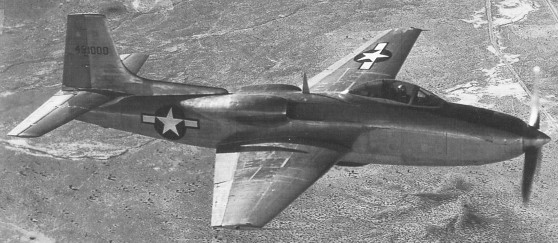
The Consolidated Vultee XP-81 (its newly-merged builder soon to be better known as Convair) was the first American aircraft powered by a turboprop engine. Ordered by the USAAF on 11 February 1944, the XP-81 was intended as a long-range escort fighter using compound power, with one 1230kW General Electric TG-100 turbo-prop and one 1701kg thrust Allison I-40 jet engine, eventually designated J33-A-5. When delays with the turboprop powerplant were encountered, the prototype XP-81 was flown on 11 February 1945 with a Packard V-1650-7 Merlin installed temporarily in the nose. The first flight with the intended turboprop engine followed on 21 December 1945 and the turboprop provided no advantage in performance over the Merlin. A second XP-81 flew in early 1946 to join the first machine in testing, but war’s end, the disappointing results with the TG-100, and the superiority of pure jet designs resulted in cancellation of an order for 13 YP-81 service-test aircraft. Both XF-81 airframes have survived derelict on a test range at Edwards AFB, California.
Wingspan: 15.39 m / 50 ft 6 in Length: 13.67 m / 44 ft 10 in Height: 4.27 m / 14 ft 0 in Wing area: 139.48 sq.m / 1501.35 sq ft Max take-off weight: 12700 kg / 27999 lb Empty weight: 5785 kg / 12754 lb Max. speed: 815 km/h / 506 mph Cruise speed: 442 km/h / 275 mph Ceiling: 10800 m / 35450 ft Range: 4000 km / 2486 miles Armament: 6 x 12.7mm guns or 6 x 20mm cannon planned, 1450kg underwing bombs




 All Aero