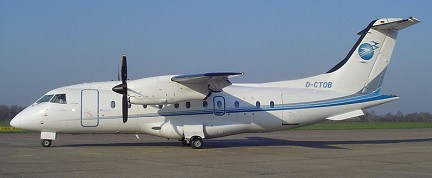
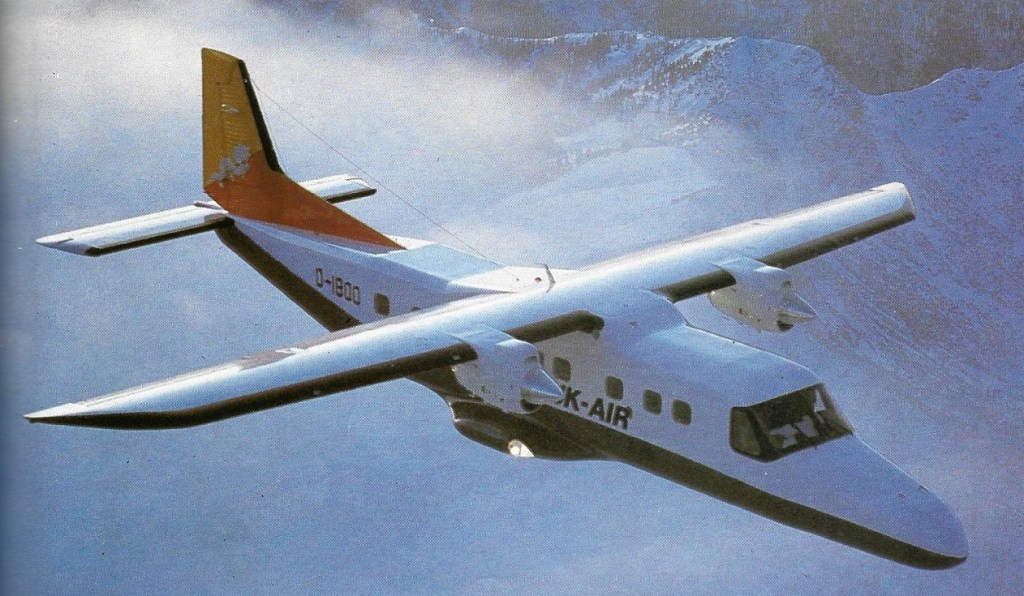
The Fairchild-Dornier 328 is 30-34 seat turboprop powered commuter airliner designed and engineered by Dornier in Oberpfaffenhofen, Germany. Development of the 328 started in 1985, after Dornier decided to redesign the fuselage of the Dornier 228. After Dornier’s market research had indicated a substantial market for regional airliners in the 30-seat class it was decided to develop the Dornier 328. Work began in December 1988, culminating in the first development aircraft’s rollout on 13 October 1991 and the first flight on 6 December 1991. The 328 was awarded EJAA certification on 15 October 1993.
First customer deliveries occurred on 21 October 1993, when the Dornier 328-110 s/n 3005 HB-AEE was handed over to the Swiss scheduled carrier Air Engiadina. The initial 328-100 was followed by the production standard 328-110 with redesigned aerodynamics and increased performance. Other models are the 328-120 with improved short field performance and the 328-130 with progressive rudder authority reduction with increasing airspeed.
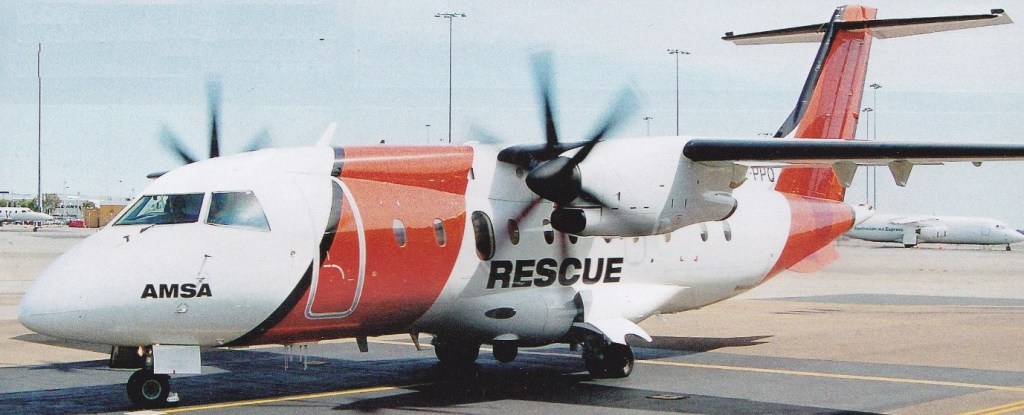
Dornier 328 VH-PPQ
Mid 1996 Fairchild Aerospace acquired 80% of Dornier to form Fairchild-Dornier. In 2002 Fairchild Dornier filed bankruptcy and the court appointed administrator determined that the company had to be sold in pieces. The US company AvCraft Aviation acquired the Fairchild-Dornier’s 328 program, including the 328 production line at Oberpfaffenhofen, Germany. Early 2005 AvCraft Aerospace GmbH, the German subsidiary of AvCraft Aviation was declared insolvent at a German court at Weilsheim. In December 2005, UK’s Corporate Jet Services Ltd purchased the former AvCraft Aerospace GmbH. On 2 January 2006, Corporate Jet Services Ltd created the German subsidiary ‘328 Support Services GmbH’, headquartered at Oberpfaffenhofen near Munich. It holds the type certificate of the Dornier 328 Jet and Turboprop aircraft plus the Dornier 428, and is carrying on the worldwide support of the aircraft. Part of the company’s strategy is to work towards returning to service the Dornier 328 aircraft which are currently parked in Europa and US.
Do.328Jet
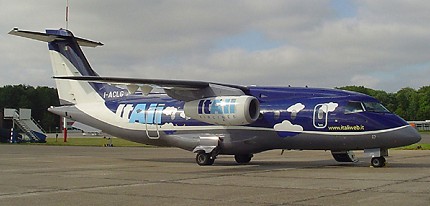
The Fairchild-Dornier 328JET is 32 seat commuter jet airliner. After Fairchild Aerospace had acquired the majority of Dornier in 1996, the new formed company Fairchild-Dornier started in 1997 with the development of the 328JET. The Fairchild-Dornier 328Jet was derived from the Dornier 328 turboprop featuring two Pratt & Whitney Canada PW306B turbofans instead of the turboprops. Next to the engines, only slight modifications to the landing gear and wings were required to convert the Dornier 328 into the 328JET model. FADEC Pratt & Whitneys were hung under the wings, the landing gear was strengthened and new Honeywell Primus 2000 EFIS panels were installed in the cockpit. The 328JET prototype D-BJET was converted from the second 328 turboprop airframe and was flown first on 20 January 1998. Deliveries of the 328JET started in 1999. The combined USA and German engineering team developed the new 428 model based on the 328JET, but the project was turned down in 2001 when Fairchild-Dornier ran into financial problems. In 2002 Fairchild Dornier filed bankruptcy and the court appointed administrator determined that the company had to be sold in pieces. The US company AvCraft Aviation acquired the Fairchild-Dornier’s 328 program, including the 328JET production line at Oberpfaffenhofen, Germany. Next to 18 ready-to-deliver aircraft, and five in the final assembly stage, the purchase included also the 428 intellectual properties. AvCraft/Fairchild-Dornier restarted in 2004 the production of the Fairchild Dornier 328JET. Early 2005 AvCraft Aerospace GmbH, the German subsidiary of AvCraft Aviation responsible for the 328JET program was declared insolvent at a German court at Weilsheim. In December 2005, UK’s Corporate Jet Services Ltd purchased the former AvCraft Aerospace GmbH. On 2 January 2006, Corporate Jet Services Ltd created the German subsidiary 328 Support Services GmbH, headquartered at Oberpfaffenhofen. It holds the type certificate of the Dornier 328 Jet and Turboprop aircraft plus the Dornier 428, and is carrying on the worldwide support of the aircraft. Part of the company’s strategy is to work towards returning to service the Dornier 328 aircraft which are currently parked in Europa and US.
Dornier 328 Jet UR-DAV
Two 328Jets were handed over to Skyways Airlines ofMilwaukee at San Antonio, Texas, on 9 August 1999. The first customer for the type. By then, orders and options had reached 162. Fairchild was developing the Envoy, a private jet variant of the 328JET, and the 528JET, a 55- to 63-seat stretch. A larger 728Jet was planned until the company declared bankruptcy in 2002.
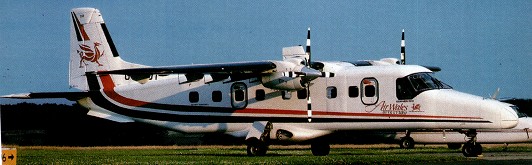
In June 1979 Dornier flight tested a new high-technology wing intended for the proposed Do 228 series of commuter airliners. Using a modified Skyservant fuselage fitted with the so-called TNT wing and powered by 533kW Garrett turboprop engines, the aircraft completed a 2 1/2-year test programme during which seven different types of propeller were evaluated. The first definitive Do 228-100, fitted with a new fuselage and tail plus the TNT wing, flew for the first time on 28 March 1981. German certification followed on 18 December the same year and the first production aircraft was delivered to the Norwegian commuter airline Norving early in 1982. The Do 228-100 prototype was lost in a fatal accident near Augsburg while undergoing tests for British certification in March 1982. About 35 Series 100s were built and customers included the German Alfred Wegener Institute which used three ‘Polar’ aircraft on research duties in Antarctica.
Development of a ‘stretched’ version followed, designated the Do 228-200. The Dornier 228-200 seats 19 passengers in single seats on either side of a central aisle in a rectangular fuselage of interior dimensions 1.35m x 1.55m and is intended for the wide range of capabilities but its forte is commuter operations into smaller and often semi-prepared airfields. The aerofoil, of Do A-5 supercritical section with maximum thickness at 50 per cent of chord, is tapered on the outer panels, with the triangular wingtips acting as winglets, but straight out to reduce drag. The glassfibre/Kevlar leading and trailing edges being attached to the primary structure by myriad screws. The smooth-surfaced wing structure is a box made up of four panels, with integral internal bracing for strength. Each is made from a 70mm thick block of aluminium, of which 95 per cent is milled away to a tolerance of 0.01mm, giving rise to a basic structure which is guaranteed for 50,000 flight hours and 62,500 landings. The two Garrett/ AiResearch TPE 331-5 engines, flat rated to 715 shp, will give full performance for take-off at either sea level at 33’C, or 8,000 feet field elevation at ISA. The Dornier 228-200 (the -100 model is 1.5m shorter and carries 15 passengers but is otherwise identical) has small single mainwheels with negative camber retracting into the underside of a sponson below the fuselage which, combined with the wing’s position right on top of the fuselage and the straight bottom surface of the long nose, gives it a hunch-back, droop-snooted look. Able to carry 19 passengers, the prototype made its first flight on 9 May 1981.
Do 228-200 prototype
Two versions of the Dornier 228 twin-turboprop regional transport have been developed to serve in the maritime surveillance role, with differing equipment fits. The Version A has a MEL Marec 2 radar as primary surveillance sensor, and wing hardpoints for supply or sensor packs. For inshore patrol and fishery protection, Version B has Ericsson/SSC side-looking airborne radar as main sensor and an optional forward-looking Bendix radar and other aids. Hindustan Aeronautics’ Kanpur Division was manufacturing some 150 twin-turboprop Dornier 228s, of which a substantial number are for the Indian armed forces. The first Indian-built aircraft flew in January 1986, and was delivered to the internal airline Vayadoot the following March. The Coast Guard service received its first aircraft in 1986 for maritime surveillance duties. These are fitted with an MEL Marec 2 search radar and other maritime equipment. Deliveries to the Air Force and Navy were suspended in May 1987, following a series of engine difficulties experienced by Indian civil operators. The Dornier 228 was in commercial service in both 15-seat -100 and 19-seat -200 form with more than 183 ordered by customers in some 27 countries by 1990. More than 50 airlines ordered the Series 200, including Air Caledonie, Air Moorea, Air Tahiti, Air Guadeloupe, Air Maldives and Aerotuy of Venezuela. Other customers include the governments of Germany, Nigeria, Saudi Arabia, India, Niger, Malawi, Bolivia and Japan.
Do228-100 Engine: 2 x Garrett TPE331-5-252D turbo-props. Installed pwr: 1060 kW. Span: 17 m. Length: 15 m. Wing area: 32 sq.m. Empty wt: 2980 kg. MTOW: 5700 kg. Payload: 2130 kg. Cruise speed: 430 kph. Initial ROC: 618 m / min. Ceiling: 9020 m. T/O run (to 15m): 565 m. Ldg run (from 15m): 600 m. Fuel internal: 2390 lt. Range/payload: 1343 km with max pax. Capacity: 15 pax.
Do228-200 Engine: 2 x Garrett TPE331-5-252D turbo-props, 715 shp / 578kW Wingspan: 16.97 m / 55 ft 8 in Length: 16.56 m / 54 ft 4 in Height: 4.86 m / 15 ft 11 in Wing area: 32 sq.m / 344.44 sq ft Max take-off weight: 5700 kg / 12566 lb Empty weight: 3086 kg / 6804 lb Max. speed: 428 km/h / 266 mph Cruise speed: 205 kts/365km/h true airspeed @65% / 10000ft Ceiling: 9020 m / 29600 ft Range w/max.payload: 1130 km / 702 miles Crew: 2 Pax cap: 19
Professor Claude Dornier started his first aircraft company in 1922 as the successor to the “Do” division of the Zeppelin Werke, GmbH. When aircraft manufacturing became forbidden in Germany after World War II, Dornier continued his design work in Spain. There he developed the Do 25, a general-purpose airplane that later evolved into the Do 27.
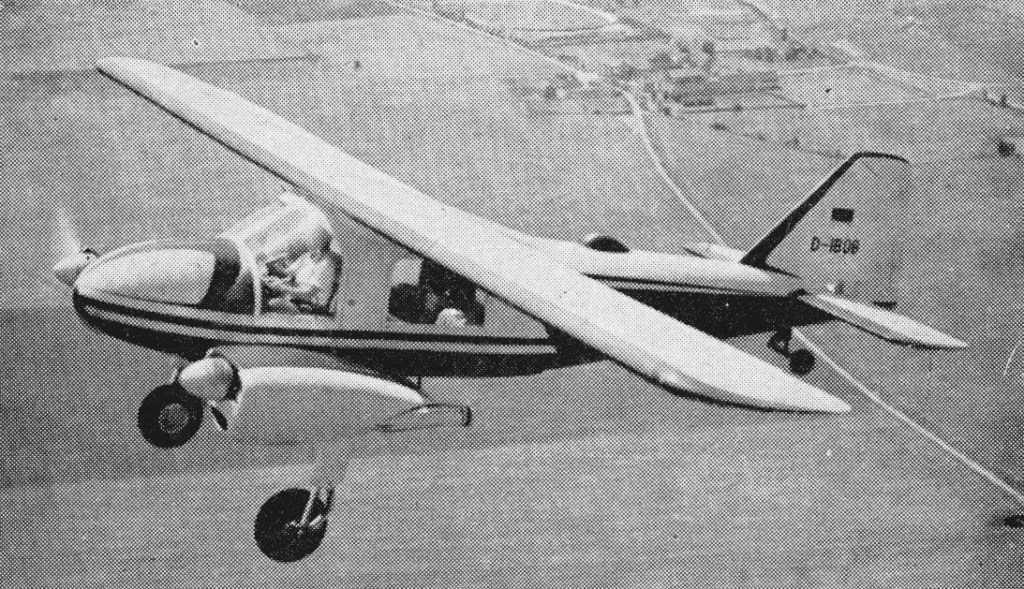
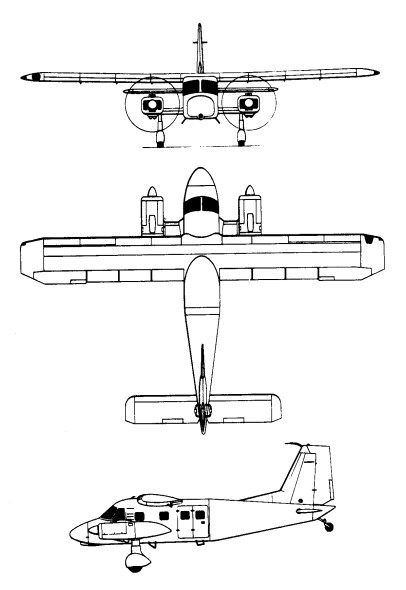
The Do 28 began as a simple twin-engined derivative of the Do 27, the basic structure being retained virtually unchanged. The prototype flew for the first time on 29 April 1959, with two 180 hp Lycoming O-360-A1A engines, and the second machine introduced 250 hp Lycoming O-540-A1D engines and an increase in wingspan and area. This version entered production as The Do 28A1 in 1960, eighty produced by mid-1963.
1960
The Do 28 was produced until 1971. The Skyservant’s twin Lycomings and landing gear are mounted on stub wings that protrude from the lower fuselage directly underneath the main wings.
The Do 28B, introduced in 1963, featured 25 modifications, including the redesign of the nose, an enlarged tailplane, and auxiliary tanks in the wingtips. Two versions were available; the Do 28B1 and Do 28B2. The B2 having turbocharged engines.
While the original Do 28 series had an advantage over the Do 27 by providing twin-engine safety and enhanced performance, it did not have any more internal space, the cabin dimensions being identical to those of its predecessor. Financial assistance provided by the German Ministry of Economics helped Dornier to develop the layout into a bulkier, higher-powered STOL transport which could carry up to 13 passengers and this redesigned version was designated Dornier Do 28D, later being named Skyservant. The redesign was so drastic that, apart from the layout and designation, the Do 28D bore little resemblance to the Do 28B. The prototype flew on 23 February 1966, receiving type approval a year later.
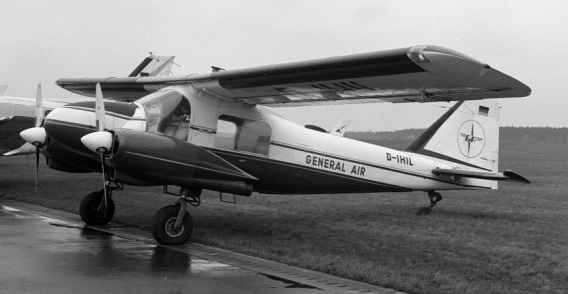
Dornier Do-28A-1 Skyservant D-IHIL (3002)
Developed as the Do 28D-1, the type won FAA certification on 19 April 1968 and military type approval in January 1970. Orders for 125 were placed for the German Luftwaffe and Bundesmarine, and other military deliveries have been made to Ethiopia, Morocco, Nigeria, Turkey and Zambia. More than 220 Skyservants are in operation world-wide. A Do 28D-1 set several class records for piston-engined business aircraft in 1972, including an altitude of 8624m with a 1000kg payload, as well as several time-to-height records. It was followed by the Do 28D-2, which introduced a number of refinements. In 1980, a Luftwaffe Do 28D-2 was re-engined with Avco Lycoming TIGO-540 turbocharged engines under a contract from the German Federal Ministry of Defence prior to upgrading that country’s military Skyservants; the new designation was Do 28D-2T.
Further development of the basic Do 28D design continued under a new designation: Do 128 Skyservant. Two basic designs were offered, the Do 128-2 and Do 128-6. Both 10-passenger models, the main difference was in powerplant, the Do 128-2 having two Avco Lycoming IGSO-540 piston engines and the Do 128-6 two 298kW Pratt & Whitney PT6A-110 turboprops. The latter had first been seen in prototype form as the Do 28D-5X, known then as the TurboSky and powered by two 447kW Avco Lycoming LTP 101-600-1A turboprops flat-rated to 298kW. The Do 128-6 had, in addition, a new fuel tank, reinforcements to the underwing engine supports and other modifications. Orders and options for 30 Do 128-6s from African customers were announced, the first going to Lesotho Airways. A variant of the Do 128-6 was also delivered to Cameroun for maritime patrol work, equipped with a 360 deg MEL Marec surveillance radar. Production ceased in the mid-1980s.
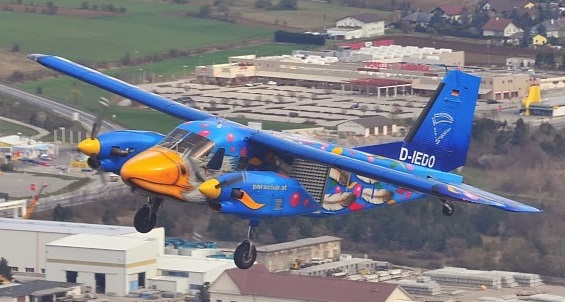
A Slovakian Do-28 G92 derivative of the Skyservant is fitted with two Walter M601-D2 turbine engines. It will haul 15 skydivers to altitude 4 times in one hour.
Dornier DO 28 D Skyservant Length : 37.402 ft / 11.4 m Height : 12.795 ft / 3.9 m Wingspan : 50.853 ft / 15.5 m Max take off weight : 8048.3 lb / 3650.0 kg Max. speed : 173 kt / 320 km/h Service ceiling : 24278 ft / 7400 m Range : 992 nm / 1837 km Engine : 2 x Lycoming IGSO-540-A1E, 375 hp Crew : 2+12
Do-28D-1 Engines two 380 hp Lycoming O-540. Gross wt. 8,470 lb Empty wt. 5,066 lb Top speed 202 mph. Cruise 170 mph. Stall 65 mph. Vmca: 42 kts. Initial climb rate 1,180 fpm. Range 1,255 minle. Ceiling 25,200 ft Takeoff distance (50′) 1,020 ft Landing distance (50′) 1,000 ft Seats 12-13.
Do 128-2 Engine: 2 x Avco Lycoming IGSO-540-A1E, 283kW Max take-off weight: 3842 kg / 8470 lb Empty weight: 2346 kg / 5172 lb Wingspan: 15.55 m / 51 ft 0 in Length: 11.41 m / 37 ft 5 in Height: 3.9 m / 12 ft 10 in Wing area: 29 sq.m / 312.15 sq ft Max. speed: 325 km/h / 202 mph Cruise speed: 211 km/h / 131 mph Ceiling: 7680 m / 25200 ft Range: 642 km / 399 miles
Do-128-6 Engine: 2 x P&WAC PT6A. Installed pwr: 600 kW. Span: 15.9 m. Length: 11.4 m. Wing area: 29 sq.m. Empty wt: 2540 kg. MTOW: 4350 kg. Payload: 1275 kg. Cruise speed: 340 kph. Initial ROC: 385 m / min. Ceiling: 8580 m. T/O run (to 15m): 555 m. Ldg run (from 15m): 435 m. Fuel internal: 895 (+475) lt. Range/payload: 1460 km with 805 kg. Capacity: 12 pax.
The Dongan WJ-5 is a Chinese single-shaft turboprop aero engine built by the Dongan Engine Manufacturing Company for the Xian Y-7 twin-engined transport.
Variants: WJ-5A Main production variant of 2162 ekW (2900 ehp)
WJ-5E Improved variant for the Xian Y-7-200 sometimes referred to as the WJ-5A-1G. Developed with the help of General Electric.
WZ-5 A turboshaft version of the WJ-5, which failed to progress beyond the prototype stage.
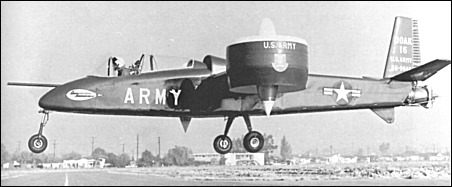
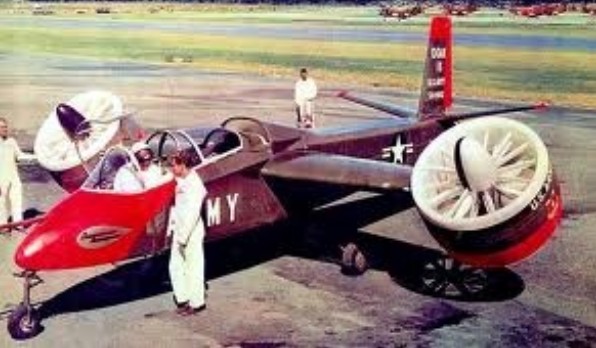
Company president, Edmond R. Doak, had experimented with ducted fan and various other air moving principles since 1935. He first proposed a VTOL aircraft using the tilt duct principle to the military as early as 1950. The Army issued the contract to Doak on April 10, 1956. The U.S. Army Transportation Research and Engineering Command purchased a single Doak 16. The Model 16 made its first flight in February 1958 and the single prototype was put through extensive pre-delivery flight testing and was not officially accepted by the Army until September 1959. Upon acceptance the craft, which had already been allocated the serial number 56-9642, was given the designation VZ-4.
Early 1958
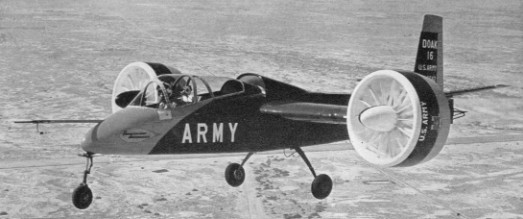
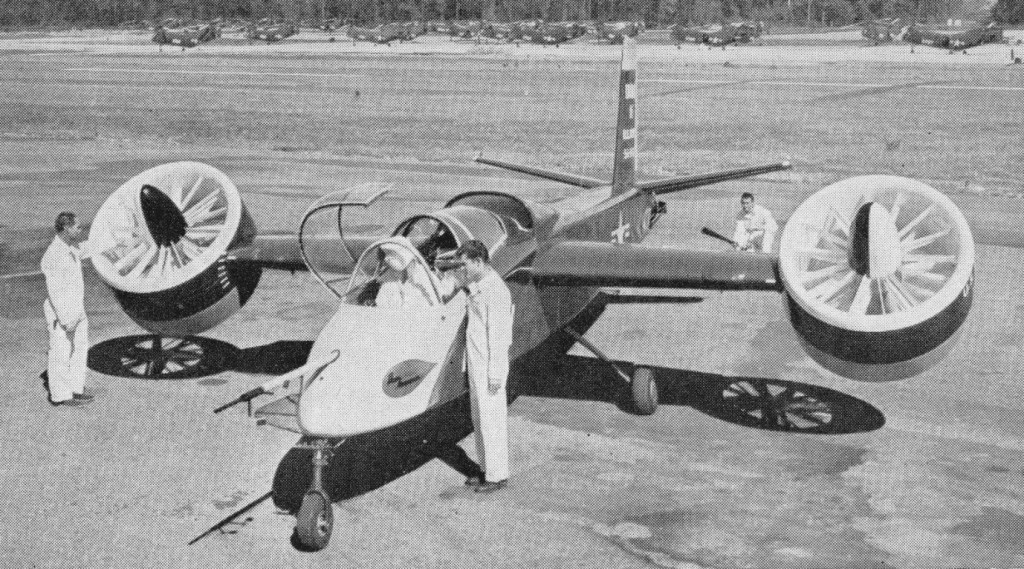
Doak Model 16 was the first VTOL aircraft to demonstrate the tilt duct concept. It was built by the Doak Aircraft Company of Torrance, CA. The fuselage was constructed of welded steel tubing covered by moulded fiberglass skin from the cockpit forward, while the wings and tail were metal-skinned. The aircraft was designed to accommodate a pilot and observer sitting in tandem, though as far as can be determined the observer’s seat was never actually installed in the prototype. With a mid-wing, conventional tail, and fixed tricycle landing gear, a single 1000shp Lycoming YT53-L-1 turbine mounted in the fuselage just aft of the cockpit drove two ducted-fan airscrews, one fixed within each rotating wingtip fan assembly. The fans were set in the vertical position for takeoff and landing, and were rotated into the horizontal plane for normal forward flight. Some additional directional stability was provided by routing the turbine exhaust through a set of hinged louvers mounted in the aircraft’s tail. The cantilever wing and tail unit were of all metal construction. To save development costs, Doak incorporated numerous off the shelf items in the design, such as the landing gear from a Cessna 182, seats from a F-51, duct actuators from T-33 electric flap motors, and the rudder mechanism from an earlier Doak aircraft.
The design empty weight was 900kg with a design gross vertical take-off weight of 1170kg. These grew to 1037kg and 1443kg during the life of the program. To keep weight down, the original specification called for the aircraft fuselage to remain uncovered. However, it subsequently was felt that this would severely limit being able to obtain any meaningful forward speed data, and that the added weight would allow for much more valuable data to be collected.
The wingtip-mounted ducts were five feet in diameter with a four foot inside diameter. Their construction was of aluminum alloy with a fiberglass leading edge section. Eight fixed pitch fiberglass fan blades turned at a maximum fan speed of 4800 rpm. Ahead of the fan in the forward part of the duct were fourteen fiberglass variable inlet guide vanes. The vane angle varied during hover to modulate the thrust produced by the duct, and thus to obtain roll control. The prop was set back two feet from the front of the duct to prevent airflow separation. Nine stainless steel stator blades located aft of the fan straightened the air flow as it exited the duct. The ducts rotated through 92 degrees, pointing horizontal for forward flight, and pivoting to 2 degrees aft of vertical during hover. The ducts rotated past vertical to compensate for the thrust from the jet exhaust. A switch on the control column initiated the duct rotation. To power the fans, drive shafts traveled through the wing quarter chord. Doak-designed flexible couplings compensated for misalignment and wing flexing.
A Lycoming T-53-L-1 turboshaft engine located in the fuselage just below the wing root provided power. It produced 825hp (some sources stated 840hp). A “T” box on the engine transmitted power to the ducts using a four-inch tubular aluminum shaft and two smaller steel shafts of 3.8cm each. Flight controls consisted of standard stick and rudder. An electrical and mechanical interlock system controlled all functions for both hovering and forward flight. There were no other cockpit controls. In hover, a cruciform shaped vane in the tail pipe at the rear of the fuselage controlled pitch and yaw by deflecting the engine exhaust. Rotating the inlet guide vanes in the ducts provided roll control by restricting airflow. As the ducts rotated from vertical to horizontal, a mechanical control system gradually phased out control of the inlet guide vanes and left them aligned with the duct airflow. There was no artificial damping or power boost. Doak looked down on any type of automatic stabilization system, feeling that the aircraft should be a satisfactory flying machine without any such equipment. Careful selection of the duct location allowed the fuselage to remain level throughout the transition. Ground testing began at Torrance Municipal Airport during February 1958. Tests consisted of 32 hours in a test stand, and 18 hours of tethered hovering and taxi tests. The first free hovering flight was performed on February 25 1958. Initial Doak testing at Torrance was completed in June 1958 and was followed by a complete tear down inspection. The aircraft then was transferred to Edwards AFB in October 1958. At Edwards, it performed 50 hours of tests, including transitions at altitudes as great as 1830m. James B. Reichert completed the first conversions in 1959. Following these tests, the Army accepted the Doak 16 in September 1959 and transferred it to NASA Langley for further tests. In 1961 Douglas Aircraft Co. purchased the design rights and test data on the VZ 4. Douglas liked the aircraft and had some ideas for improving it, primarily by installing a larger engine and making numerous structural improvements. They made an unsolicited proposal to the Army in 1961, but could not sell their ideas. The Doak 16 remained at NASA Langley until August of 1972. Eventually it was transferred to the U.S. Army Transportation Command Museum at Fort Eustis, VA, near Newport News, where it is on display.
VZ-4 Engine: 1 x Lycoming YT53, 625kW / 800 hp Wingspan: 7.77m Length: 9.75m Height: 3m Wing area: 8.73sq.m Empty weight: 900-1037 kg Max take-off weight: 1170-1443kg Max speed: 370km/h est. Rate of climb SL: 30m/s Hover ceiling: 1830m Endurance: 1 hr Range: 370km Crew: 2
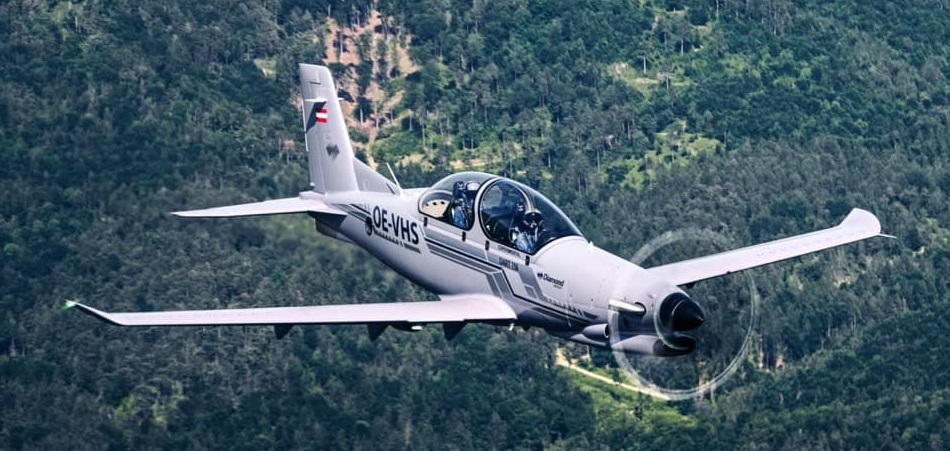
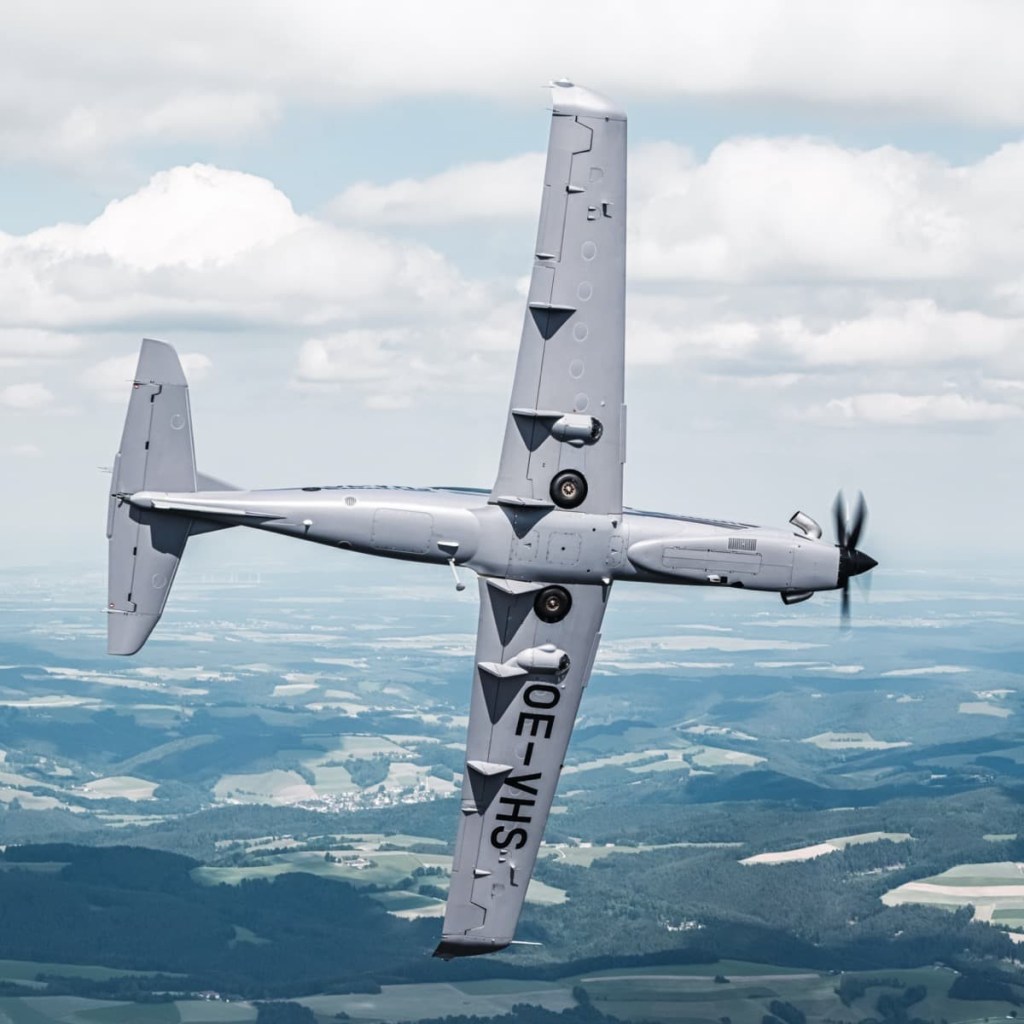
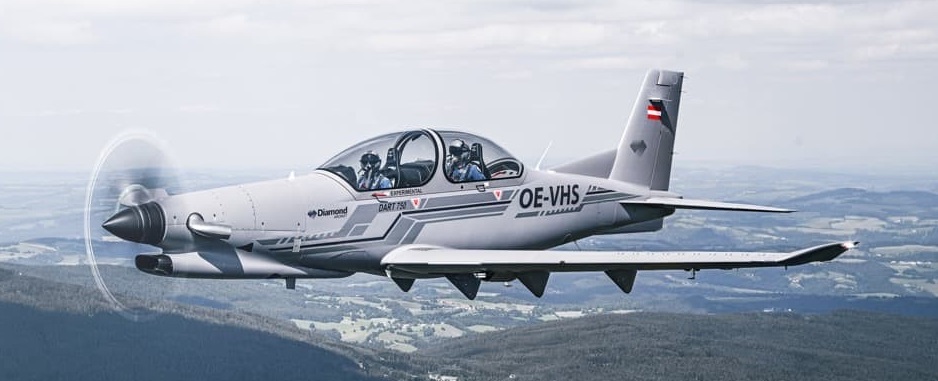
The DART-750 will be a certified all composite aerobatic turboprop trainer in tandem seat configuration, equipped with Garmin G3000 avionics and the 750 shp Pratt & Whitney Canada.PT6A-25C turboprop engine.
The first flight of Diamond Aircraft‘s DART-750 aerobatic trainer took place June 12, 2023, at the company’s headquarters in Wiener Neustadt in Austria.
Piloted by Diamond’s Head of Flight Test Sören Pedersen and Senior Test Pilot Niko Daroussis, the maiden flight lasted 30 minutes and covered all basic maneuvers, including performance and handling checks.
“The aircraft and all tested parameters did meet or exceed all expectations,” company officials said in a press release.
The aircraft was expected to be certified by EASA in 2024, with FAA certification soon after.
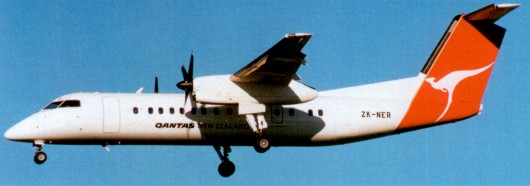
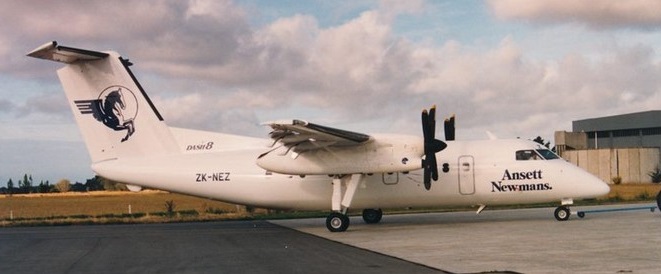
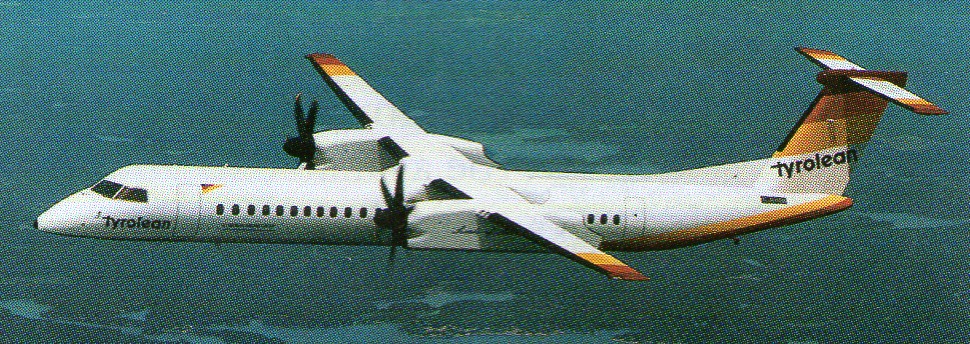
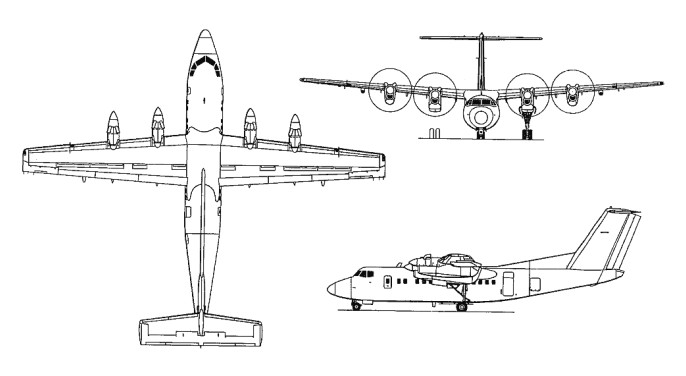
The Dash 8, of high wing monoplane configuration powered with two P&W 120s, was announced by de Havilland Canada in 1979 as a complement to the larger four engined STOL capable Dash 7. The company’s first transport not optimised for short take-off and landing. The go-ahead to cut metal was announced in September 1980 and the prototype Dash 8 series 100 rolled out in Downsview, Ontario, in April 1983.
The fuselage cargo-loading door is standard, and other features include a retractable tricycle landing gear with twin-wheel units, large-span T-tail, and a high-mounted wing carrying two fuel-efficient Pratt & Whitney PW120 advanced turboprop engines driving large-diameter slow-turning four-bladed propellers (originally the PT7A) ensuring very low noise levels. These engines also have safety features which ensure that if one fails the other automatically increases its output to 1492kW.
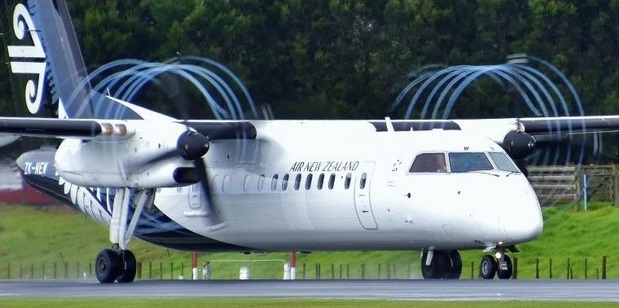
The prototype of the 36-seat Series 100 flew for the first time on 20 June 1983. Canadian certification followed on 28 September 1984. The first customer was to be norOntair of Canada on 23 October 1984. Orders for the initial 100 series production version had reached 230 by 1990. The -100A series followed in 1990. The -100A model had a revised interior with more headroom and enhanced PWI20A engines and in 1992 was offered with the more powerful PW121 engines. In 1992 the production switched to the Dash 8-200 and the first deliveries began in April 1995. The Dash 8-200 has PW123C engines, which gave the -200 series an increase in top speed of 30 knots over the 100 series. The -200B series has the PW123Bs for better ‘hot and high” performance. From April 1996 all Dash 8 aircraft delivered were fitted with a computer-controlled noise and vibration suppression system (NVS). To reflect this the name was changed to Dash 8Q (for “quiet”). In 1998 this was changed again to Dash 8-Q200 when the new interior was introduced. The Dash 8-Q200 holds 37 passengers. Boeing, within a month of purchasing DHC, signalled their commitment to the enterprise by announcing mid-1985 the development of a stretched 50/56 passenger Dash 8 Series 300 for a first flight on 15 May 1987 (modified Series 100 prototype). This became the -300 series and the first aircraft was an earlier prototype Dash 8 converted to the new length of 25.68 metres. It first flew on 15 May 1987. Canadian certification followed on 15 February 1989 and the first deliveries were to Time Air later on 27 February 1989, FAA type approval on 8 Tune 1989. The stretch for the series -300 was effected with a “plug,” forward and aft of the wing. of 3.43 metres. The wings also have a greater span of 27.43 metres over 25.91 metres. Other smaller changes were a larger toilet, a repositioned galley and a new galley door, an additional wardrobe, dual air conditioning packs and the option for an APU. Orders for the Srs 300 were in excess of 100 by 1990, deliveries starting in February 1989. The Dash 8-300 provides a very good single engine performance, being able to climb to 14,000 feet at maximum all up weight or descend to 16,000 feet on one engine. Further variants of the 300 series were offered with the first, the -300A, being in 1990 with increased higher gross weights, interior improvements and the standard PW123A engines. The -300B was introduced in 1992 with PW123B engines as standard. All Dash 8-300 aircraft built since April 1996 have also been fitted with NVS and throughout the ’90s Boeing Canada worked on variants for both military and civil applications. Two transport versions are in service with the Canadian Department of National Defence as CC 142s and four navigation trainers are on order as CT-142. The USAF has two on inventory as E¬9As for range control on the Gulf Missile Test range.
In 1986 de Havilland Canada, by then part of Bombardier, started development of a larger 50-seat regional airliner. 1998 the aircraft where renamed Dash 8Q-300s when the new interior was introduced. Six twin-turboprop Dash 8s ordered by the Canadian Armed Forces have long-range fuel tanks, rough-field landing gear, strengthened floors, and other equipment changes. Designated Dash 8Ms by DHC, four will be used as navigation trainers, while the other two will be allocated to transport duties in Europe, replacing Dash 7s. The 1987 commercial variant was the stretched 50-56-seat Series 300. The 37-seat Dash 8 Series 200 and 50-seat Series 300 turboprops were being produced at the rate of two per month in 1998. Launched in June 1995 as stretch of Series 300, the -Q400, can hold 70 passengers, equipped with a computer-controlled noise and vibration suppression system, indicated by the “Q” (standing for quiet) before the model/number designator. First flown on 31 January 1998, FAA FAR Pt 25 approval was received on 8 February 2000. First delivery was to SAS Commuter 20 January 2000, followed by service entry 7 February on the Copenhagen, Denmark, to Poznan, Poland route.
The low-noise Dash 8 Q became the standard version from 1996
By January 1991 the Dash 8 order book stood at 361 aircraft, comprising 251 Series 100s and 110 Series 300s, with around 230 delivered. A Q300 delivered to Air Nippon on 6 March 2001 was the 600th Dash 8.
Bombardier Dash 8-400
In June 2009 Bombardier sold the Q400 aircraft program to Longview, the company that owns Viking Air. A separate company called DeHavilland Aircraft of Canada was created to build and support the Q400.
In 2025 a used Q400 plane can be purchased for about $5 million and can be retrofitted for firefighting for an additional $5 million.
Variants:
CC-142: designation of two Series 100s bought by the Canadian. Department of National Defence but operated since March 1987 by the Canadian Forces at Lahr, Germany. Used as passenger/cargo transports, the aircraft are equipped with long-range fuel tanks, rough field landing gear,, high strength floors and a special-mission-related avionics fit.
CT-142: designation of four Series 100s, acquired by the Canadian DND, and operated as specially configured navigation trainers by the Canadian Forces. Otherwise equipped similarly to the CC-142, the trainers are distinguished by their extended noses.
Dash 8M-100: two specially-equipped Series 100s used by the Canadian Department of Transport to calibrate ILS, VOR and MLS systems at Canadian airports.
Dash 8M-300ASW Triton: designation of a proposed maritime patrol or anti-submarine warfare version of the Series 300 equipped with Harpoon or Exocet-type anti-shipping missiles mounted on lower side fuselage sponson hardpoints, and four underwing pylons, outboard of the engines, capable of carrying missiles, torpedoes, mines, sonobuoys or searchlights. With a full range of ASW sensors including FLIR, MAD and search radar operated by a six-man crew, maximum endurance is over 11 hours.
E-9A: designation of two standard Series 100 aircraft acquired by the US Air Force in 1985 as airborne platforms to perform telemetry and data link duties in connection with drone and missile testing at Tyndall AFB, Florida. Modified by the Sierra Research division of LTV, the E-9A carries a large fuselage fairing containing a steerable phased-array antenna, underfuselage search radar and special avionics. Both aircraft were delivered in 1988.
Dash 8 Series 100 Engines: 2 x Pratt & Whitney Canada PW120A turboprops, 1491kW Take-off weight: 15650 kg / 34503 lb Empty weight: 9979 kg / 22000 lb Wingspan: 25.91 m / 85 ft 0 in Length: 22.25 m / 73 ft 0 in Height: 7.49 m / 25 ft 7 in Wing area: 54.35 sq.m / 585.02 sq ft Cruise speed: 497 km/h / 309 mph Ceiling: 7620 m / 25000 ft Range w/max.payload: 2010 km / 1249 miles
Dash 8 Series 200 Engines: 2 x Pratt & Whitney Canada PW120A turboprops, 1491kW Take-off weight: 15650 kg / 34503 lb Empty weight: 9979 kg / 22000 lb Wingspan: 25.91 m / 85 ft 0 in Length: 22.25 m / 73 ft 0 in Height: 7.49 m / 25 ft 7 in Wing area: 54.35 sq.m / 585.02 sq ft Cruise speed: 497 km/h / 309 mph Ceiling: 7620 m / 25000 ft Range w/max.payload: 2010 km / 1249 miles
Dash 8 Series Q200 Engines: 2 x Pratt & Whitney Canada PW120A turboprops, 1491kW Take-off weight: 15650 kg / 34503 lb Empty weight: 9979 kg / 22000 lb Wingspan: 25.91 m / 85 ft 0 in Length: 22.25 m / 73 ft 0 in Height: 7.49 m / 25 ft 7 in Wing area: 54.35 sq.m / 585.02 sq ft Cruise speed: 497 km/h / 309 mph Ceiling: 7620 m / 25000 ft Range w/max.payload: 2010 km / 1249 miles
DHC 8 Dash 8-300 Length: 84.318 ft / 25.7 m Height: 24.606 ft / 7.5 m Wingspan: 89.895 ft / 27.4 m Wing area: 604.937 sqft / 56.2 sq.m Max take off weight: 41101.2 lb / 18640.0 kg Weight empty: 24696.0 lb / 11200.0 kg Max. weight carried: 16405.2 lb / 7440.0 kg Max. speed: 286 kts / 530 km/h Landing speed: 76 kts / 141 km/h Cruising speed: 270 kts / 500 km/h Initial climb rate: 1771.65 ft/min / 9.00 m/s Service ceiling: 25098 ft / 7650 m Wing load: 68.06 lb/sq.ft / 332.00 kg/sq.m Range: 891 nm / 1650 km Engine: 2 x Pratt & Whitney 123, 1751 shp Crew: 2 Payload: 50-56pax
Dash 8-300A Payload: 6272kg
Dash 8-311 Engines: 2 x Pratt & Whitney of Canada PW123 turboprops, 2,380-shp. Props: four bladed Hamilton Standard 14SF-23. Max cruise: 287 kts. Initial ROC: 1800 ft/ min. Empty wt: 11.657 kg. MTOW: 19,505 kg. Cruise 92%: 276 kts. Fuel flow @ 92%: 360 kg/hr each. Seats: 56.
de Havilland Canada, in response to a market survey, estimated interest in a large STOL aircraft with advanced STOL capability, so that higher standards of comfort, comparable with much larger aircraft, would be available to those airlines which operate from runways about 915m in length.
With backing from the Canadian government the, construction of two pre-production de Havilland Canada DHC-7 aircraft began in late 1972, and the first was flown on 27 March 1975 (C-GNBX X) at Downsview, Ontario. Certification was gained in 1977 and the Dash 7 proved not only to be very quiet, but could take off with full load in only 2,260 ft (689 m) and land in 1,950 ft (594 m).
Prototype DHC-7 C-GNBX c/n 001 in 1979
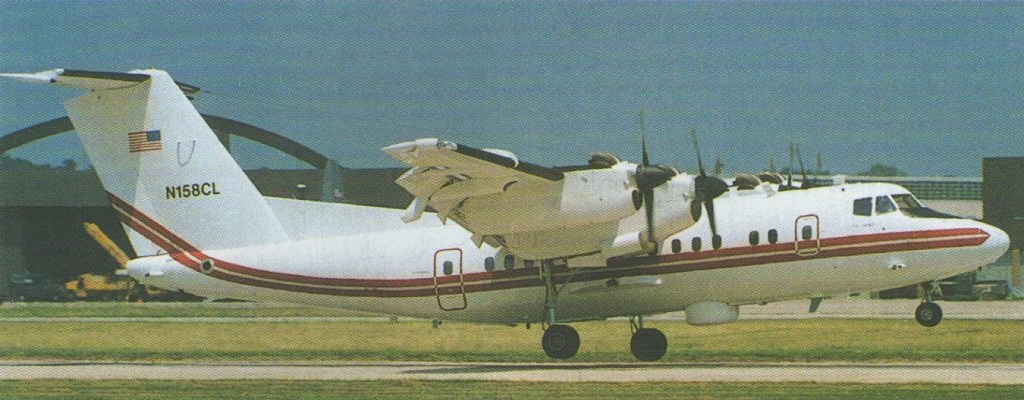
The DHC-7 has four large-diameter propellers turning slowly (and therefore quietly) in front of double-slotted trailing-edge flaps, and a T-tail keeps the tailplane well clear of the propeller wash. There are four spoilers in the upper surface of each wing. The inboard pair serve as spoilers or lift dumpers, the outboard pair as air spoilers which can also be operated differentially in conjunction with the ailerons to augment lateral control. The fuselage is of fail-safe construction to permit pressurisation, and the landing gear is of the retractable tricycle type, with twin wheels on each unit, Powered by four Pratt & Whitney Aircraft of Canada PT6A-50 turboprop engines, to reduce noise levels to a minimum, each drives a large-diameter 3.42m, Hamilton constant-speed full-feathering reversible-pitch four-blade propeller made from fiberglass. The props are slow-turning to reduce noise levels, so that the landing approach noise level on a three-degree glideslope is 92.4 EPNdB. Accommodation is provided for 50 passengers, with access to the main cabin via a single door, incorporating air-stairs, at the rear of the cabin on the port side. There are provisions for optional mixed passenger/cargo or all-cargo operations, and a large freight door can be installed at the forward end of the cabin on the port side. Up to five standard pallets can be carried by the Dash 7 in an all-cargo configuration. The flight crew of two is accommodated on a separate flight deck, and advanced avionics to enhance their efficiency include an autopilot/flight director system which incorporates flight and air data computers, and weather radar. The first operator to receive the Dash 7 was Rocky Mountain Airways, on 3 February 1978. The company offered a coastal reconnaissance model as the Dash 7R Ranger with Litton LASR-2 radar with its antenna in an underfuselage radome for 360x surveillance coverage, but in fact the only military sales have been three aircraft each to Canada and Venezuela. Two of the Canadian aircraft were designated CC-132 and used for communications from the base at Lahr in West Germany by No.412 Squadron, while the third is designated Dash 71R and used for ice reconnaissance by the Canadian Coast Guard in the Gulf of St Lawrence. The Venezuelan aircraft are transports with a secondary coastal reconnaissance.
When production finished in December 1988 113 had been delivered to 35 customers in 22 countries. Military use of the Dash 7 was restricted to two used as VIP/transports (designated CC-132) by the Canadian Armed Forces in Germany from August 1979 to April 1987, and a single aircraft delivered to the Venezuelan Navy in May 1982 used in the patrol and transport roles.
RC-7B N158CL
Variants: Dash 7 Series 100: standard passenger version seating 50 passengers. Dash 7 Series 101: all-cargo version of Series 100 able to accommodate five standard pallets. Dash 7 Series 150: developed passenger version introduced in 1978 with higher gross weight, increased fuel capacity and improved passenger amenities. Dash 7 Series 151: all-cargo version of Series 150. Dash 7 IR: single special ice reconnaissance version of the Series 150 built for the Canadian government. Equipped with SLAR and computers to track ice formations and flow patterns, the aircraft was delivered in May 1986 and is operated by Bradley Air Services for the Department of Environment.
DHC-7 Series 100 Engines: 4 x P & W Aircraft Canada PT6A-50 turboprop, 835kW Max take-off weight: 19958 kg / 44000 lb Empty weight: 12542 kg / 27651 lb Wingspan: 28.35 m / 93 ft 0 in Length: 24.58 m / 81 ft 8 in Height: 7.98 m / 26 ft 2 in Wing area: 79.89 sq.m / 859.93 sq ft Cruise speed: 436 km/h / 271 mph Ceiling: 6400 m / 21000 ft Range w/max.payload: 1279 km / 795 miles Crew: 2 Passengers: 48
DHC 7-102/103 Engines: 4 x P&W PT6A-50, 1120 shp. Props: Hamilton 4-blade, 135-in. Seats: 50. Length: 80.5 ft. Height: 26.2 ft. Wingspan: 93 ft. Wing area: 860 sq.ft. Wing aspect ratio: 10. Maximum ramp weight: 44,100 lbs. Maximum takeoff weight: 44,000 lbs. Standard empty weight: 27,044 lbs. Maximum useful load: 17,056 lbs. Zero-fuel weight: 39,000 lbs. Maximum landing weight: 42,000 lbs. Wing loading: 51.2 lbs/sq.ft. Power loading: 9.8 lbs/hp. Maximum usable fuel: 9925 lbs. Best rate of climb: 1200. Service ceiling: 22,800 ft. Max pressurisation differential: 4.7 psi. 8000 ft cabin alt @: 22,000 ft. Maximum engine out rate of climb: 700 fpm @ 124 kts. Engine out climb gradient: 338 ft/nm. Engine out ceiling: 14,800 ft. Maximum speed: 231 kts. Normal cruise @ 16,000ft: 225 kts. Fuel flow @ normal cruise: 1639 pph. Endurance at normal cruise: 5.5 hrs: Stalling speed clean: 100 kts. Stalling speed gear/flaps down: 66 kts. Turbulent-air penetration speed: 171 kts.
CC-132 Engines: four 1,120-shp (835-kW) Pratt & Whitney Canada PT6A-50 turboprops. Maximum speed 266 mph (428 km/h) at 8,000 ft (2,440 m) Service ceiling 21,000 ft (6,400 m) Range 1,347 miles (2,168 km) with a 6,500-lb (2,948-kg) payload. Empty weight: 27,650 lb (12,542 kg) Maximum take-off 44,000 lb (19,958 kg). Wing span 93 ft 0 in (29.35 m) Length 80 ft 7.75 in (24.58 m) Height 26 ft 2 in (7.98 m) Wing area 860.0 sq ft (79.89 sq.m) Payload: 50 passengers or 11,310 lb (5,130 kg) of freight.
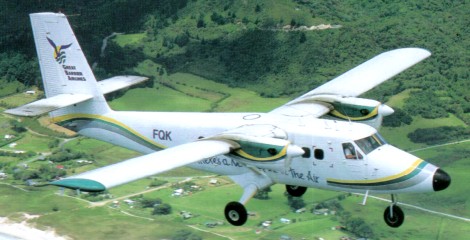
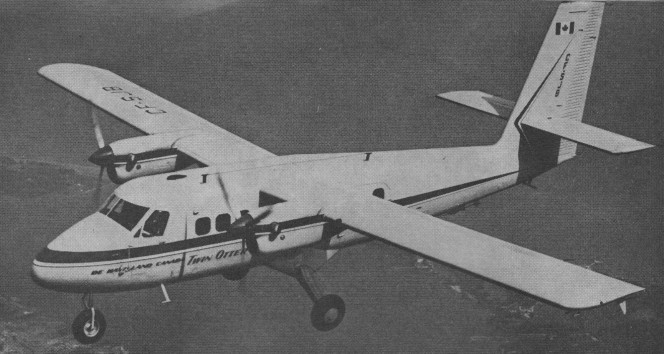
In 1964 de Havilland Canada announced that it was developing a twin-turboprop high-wing monoplane with STOL capability to provide accommodation for 13 to 18 passengers as the de Havilland Canada DHC-6 Twin Otter. Design of the aircraft’s wing includes double-slotted trailing-edge flaps and ailerons which can be drooped simultaneously with the flaps to enhance STOL performance. Fixed tricycle landing gear can have optional float or ski installations, as well as the standard wheels.
Jointly funded by the Canadian Department of Defence and de Havilland Canada, the first of an initial batch of five made its maiden flight on 19 May 1965. The first three aircraft were powered by two 432kW Pratt & Whitney Aircraft of Canada PT6A engines, but the fourth and subsequent examples of this first Twin Otter Series 100 production version had PT6A-20 engines of similar output.
Its design philosophy is directed towards operation from short semi-prepared runways for services in localities where air connections have not previously been practical, and its emphasis is on engineering simplicity and operational versatility. This is reflected by such features as urethane blocks as shock absorbers in the main undercarriage shoulders. Another selling point is the quickly convertible 384 cu.ft cabin from passengers to a maximum freight load of 4250 lb carried over 100 nm stage lengths with reserves.
The principal impact of the Twin Otter, and a feature which has already resulted in sales and options for about 30 aircraft, is probably its STOL performance to and from 50 ft of about 1000 ft. The CAR 3 distances are still only 1700 ft for take-off and 2160 ft for landing. At the start of its European tour at the Hanover Air Show, the Twin Otter demonstrator was able to join the Do27s and Porters ferrying passengers across the town to the small airstrip of the main industrial fair, and it was also able to get in and out of Heligoland’s 190m strip off the German coast.
The Twin Otter has full-span double-slotted flaps, with the outer sections also operating as ailerons, but has no exotic high lift devices. Its tricycle undercarriage has an electrically-driven hydraulic pump providing power for steering, toe brakes and flaps, with a nosewheel – tiller on the port control wheel. The Twin Otter cockpit has entry doors each side so that the crew can get in and out when the cabin is packed to capacity with freight.
The Twin Otter has roof-mounted engine controls, which increase available cockpit space and the PT6s can be left in the flight idle gate for taxying except for occasional aft movement into the Beta range, to prevent excess speed building up on the ground. Further aft movement of the power levers through the idle gate selects reverse pitch, which enables the Twin Otter to back out of restricted parking spaces.
There are two main power references-torque, in lb/sq.in, and turbine gas temperature, with respective limits of 42.5 and 750 deg C.
During take-off, it would be easy to over boost the engines by opening the power levers to their full extent, so if the outside air temperature is on the low side, the torque-meters have to be watched to avoid exceeding the limit. In hot weather the limiting factor becomes exhaust temperature.
After raising flap, the Twin Otter climbs at 110 kt on 41 lb/sq.in torque, with the airscrew rpm pulled back to 90 per cent and climbed at nearly 2 000 ft/min. Levelling out with power reduced to 33 lb/sq.in torque and 78 percent rpm (330 shp per engine) gives an indicated 140-145 kt., which trued out to 155-160 kt. for a fuel flow of 225 lb per hour per engine.
One of the most useful aspects of Twin Otter performance is the’large usable speed range between Vno Of 160 kt. and a flapdown stall with power of well below 40 kt. IAS, including a manoeuvre speed for bush flying of around 55 kt. with about 25 per cent power and full flap.
To eliminate large changes of trim with flap movement, the Twin Otter retains the same trim tab interconnection that was introduced in its single-engine predecessor. This ensures a comfortable limit to, the nose-up pitch accompanying flap retraction during an overshoot. Clean and power off, slight aileron snatch precedes pre-stall buffet, with some lateral hunting at 65 kt. which continues after the mild break-away at about 60 kt. IAS. With the full 40 degrees of flap extended, a gentle and straight stall break occurs at about 42 kt. IAS, power oft. Aerodynamic buffet gives about 8 kt. stall warning in all configurations
With 30 degrees (take-off) of flap extended, Vmc is 64 kt., and single-engine flight is completely uncomplicated. Feathering the port (critical) propeller from a 92 kt. climb resulted in light rudder loads, even before wind milling stopped, although the Twin Otter runs out of rudder trim at just below 85 kt, a long way before Vmc. There was no difficulty in showing a single engine en route climb of more than 300 ft/min.
Before landing, the nosewheel tiller has to be checked for centering, and then a spectacularly steep approach is achieved with full flap and just a trickle of power at only 65 kt. With restricted reverse pitch a 250 ft ground run is achieved.
The price, in basic form, in 1966 was (Canadian) $275000 approx. The PT6A-20 starts operational life with an overhaul period of 1200 hours.
Some 30 Twin Otters were due for completion by the end of 1966, and production was to continue at the rate of about six per month.
Delivered in July 1966, the first Twin Otter Series 100 entered service in 1966, and, following manufacture of 115 of that version, production switched to the Twin Otter Series 200. It differed by having increased baggage capacity in a lengthened fuselage nose and was certificated for operation at a higher gross weight. After 115 had been built the production Twin Otter Series 300 was introduced, this having more powerful 652 shp PT6A-27 engines which make possible an increase of almost 454kg in maximum take-off weight. Later production aircraft had a 20-seat commuter interior as standard and all floatplane versions, irrespective of series, retain the shorter fuselage nose of the original Series 100. Specialised equipment that has been developed to enhance the capabilities of these popular aircraft includes a ventral pod to carry 272kg of freight and an expendable fabric membrane tank holding 1818 litres of water for water-bombing fire-fighting operations. The 300S model features several improvements: high-capacity brakes, an antiskid system, wing spoilers, refined electrical and hydraulic systems, propeller automatic feather, and improved fire protection. In addition, six 300S enhanced STOL performance DHC-6-300s were built in the mid 1970s. Earlier models, the series 100 and 200, were fitted with 570 shp engines. Access to the two man cockpit is through a car-like door on each side or through the cabin. The standard “Commuter” version will accommodate 20 passengers, but optional arrangements are available. In 1982 DH Canada offered two specialised military versions designated Twin Otter Series 300M basic military transport (15 troops, 20 passengers or 2,270kg of cargo) or COIN version armed with cabin-mounted machine-guns and four underwing hardpoints, and the 300MR maritime reconnaissance version equipped with undernose Litton AN/APS-504 360 degree scan search radar, comprehensive avionics, an infrared linescanner, and a wing-mounted searchlight. Although a prototype 300MR was flown, the only buyer as Senegal with a single aircraft. The Twin Otter has seen wide use with air forces and government agencies. Military operators include Argentina, Canada, Chile, Ecuador, Ethiopia, France, Haiti, Jamaica, Nepal, Norway, Panama, Paraguay, Peru, the USA and Venezuela. When the last Twin Otter was delivered in December 1988 production had reached 844. Field Aviation Co of Mississauga, Ontario, developed an update package for the aircraft which has prompted a first contract by Wideroe Flyveselskap to modernise that airline’s fleet of nine aircraft. Principal differences are the four-bladed propellers on the two Pratt & Whitney Canada PT6A-27 turboprops and a brand new interior.
Viking announced the re-launch of the type and in 2010 ten Twin Otter 400s were in various stages of assembly at Calgary with production ramping up to build one-and-a-half aircraft every four weeks.
Viking Air completed a ten-minute maiden flight of the first new-build DHC-6 Series 400 Twin Otter on February 16, 2010. The aircraft (c/n 845) flew from the company’s assembly facility at Calgary in Alberta. It has been assigned the registration C-FMJO and is configured with a commuter cabin and was to be delivered to launch customer Zimex Aviation of Switzerland for use on oil and gas industry contracts throughout North Africa.
By 2016 the Twin Otter series 400 was in series production by Viking Air and a number were in service, including two operated by Loganair, Glasgow, Scotland.
Variants:
Twin Otter 300S: designation of six aircraft fitted with 11 seats, an improved high-capacity anti-skid braking system and wing spoilers, built for the 1973 experimental Air Transit service linking downtown STOL airports in Montreal and Ottawa.
Twin Otter Series 400: proposed development to meet US FAR 36 noise regulations. Not built.
UV-18A: two standard Series 300s delivered October 1976 onwards to the US Army Alaska National Guard, followed by four more in 1979 and 1982. Operating on wheels, floats or skis they are used for command, personnel or logistic flights within Alaska.
UV-18B: two standard Series 300s delivered to the US Air Force Academy in 1977 and used for sporting parachuting activities.
De Havilland Canada DHC 6 Twin Otter Engine: 2 x Pratt&Whitney Canada PT6A 20, 643 shp Wingspan: 65 ft (19.81 m) Length: 49.5 ft (15.1 m) Height: 18.6 ft (5.67 m) Wing area: 420 sq.ft (39.02 sq.m) Max take off weight: 11,000 lb (4990 kg) Weight empty: 5850 lb (2653 kg) Max. fuel: 2488 1b (1128 kg) Max. payload: 4250 lb (1928 kg) Max. speed: 239 kt / 442 km/h Max. cruise at 10,000 ft (3050 m): 158 kt (293 kph) Service ceiling: 25,500 ft (8354 m) Single-engine ceiling: 8500 ft (2590 m) Initial climb: 1550 ft/min (7.87 m/sec) Single-engine climb: 315 ft/min (1.59 m/sec) Cruising altitude: 10007 ft / 3050 m Wing loading: 25.01 lb/sq.ft / 122.0 kg/sq.m Range full fuel / 2420 lb (1105 kg) payload: 710 nm (1320 km) Range with max. payload: 100 nm (185 km) STO to 50 ft (15 m): 1090 ft (332 m) Short landing from 50 ft (15 m): 980 ft (298 m) CAR 3 distance take-off: 1700 ft (518 m) CAR 3 distance landing, 2 160 ft (658 m) Crew: 2+20
DHC-6 Twin Otter Engine: 2 x PT6A-27, 620 hp. Seats: 22. Wing loading: 29.8 lb/sq.ft. Pwr loading: 10.08 lb/hp. Gross wt: 12,500 lb. Empty wt: 7387 lb. Equipped useful load: 4944 lb. Payload max fuel: 1754 lb. Range max fuel/cruise: 763nm/4.1hr. Range max fuel / range: 895nm/6.1hr. Ceiling: 26,700 ft. Max cruise: 182 kt. Max range cruise: 148 kt. Vmc: 68 kt. Stall: 58-74 kt. 1.3 Vso: 75 kt. ROC: 1600 fpm. SE ROC: 340 fpm @ 80 kt. SE ceiling: 11,600 ft. Min field length: 1500 ft. Fuel cap: 2583/3190 lb.
DHC-6 Twin Otter Engines: 2 x Pratt & Whitney (UACL) PT6A 27 turboprop, 652 shp. Prop: 8 ft 6 in (2.59 m) dia 3 blade. Wing span: 65 ft 0 in (19.81m). Length: 51 ft 9 in (15.77 m). Wing area: 420 sq ft (39.02 sq.m). Gross weight: 12,500 lb (5,670 kg). Max cruising speed: 210 mph (338 kph) at 10,000 ft (3,050 m). Range: 745 miles (1,198 km) with 3250 lb (1474 kg) payload. Crew: 1 or 2 Accommodation: 20 passengers or equivalent freight load.
DHC 6-300 Engines: 2 x P&W PT6A-27, 620 shp / 486kW. Props: Hartzell 3-blade, 102-in. Seats: 20. Wingspan: 19.81 m / 65 ft 0 in Length: 15.77 m / 52 ft 9 in Height: 5.94 m / 20 ft 6 in Wing area: 39.02 sq.m / 420.01 sq ft Wing aspect ratio: 10.1. Maximum ramp weight: 12,508 lbs. Maximum takeoff weight: 5670 kg / 12,500 lbs. Standard empty weight: 6873 lbs. Maximum useful load: 5635 lbs. Zero-fuel weight: 12,300 lbs. Maximum landing weight: 12,300 lbs. Wing loading: 29.8 lbs/sq.ft. Power loading: 10.1 lbs/hp. Maximum usable fuel: 3190 lbs. Best rate of climb: 1600. Service ceiling: 8140 m / 26,700 ft. Maximum single-engine rate of climb: 340 fpm @ 79 kts. Single-engine climb gradient: 258 ft/nm. Single-engine ceiling: 11,600 ft. Maximum speed: 182 kts. Normal cruise @ 10,000ft: 182 kts. Fuel flow @ normal cruise: 664 pph. Endurance at normal cruise: 4.3 hrs: Stalling speed clean: 74 kts. Stalling speed gear/flaps down: 58 kts. Turbulent-air penetration speed: 136 kts.
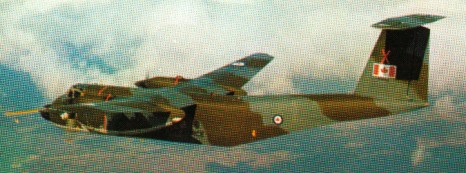
Developed from the DHC-4 Caribou, being an enlarged fuselage version of that aircraft, the de Havilland Canada DHC-5 Buffalo was known originally as the Caribou II.
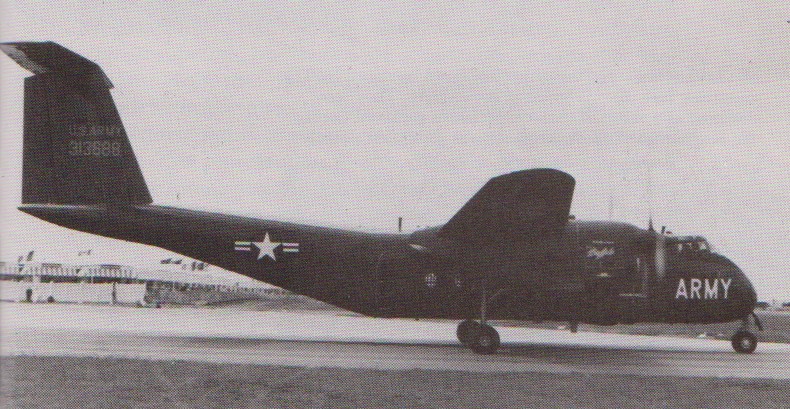
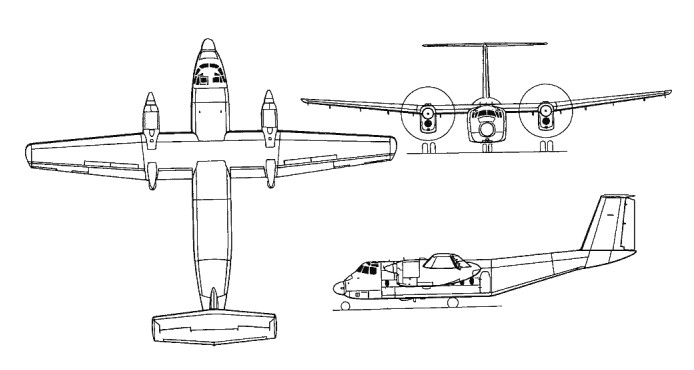
Four were ordered for evaluation by the US Army, their development cost shared by the US Army, together with the Canadian government and de Havilland Canada; the first of these transports made its maiden flight on 9 April 1964. To meet the requirements of the US Army for a transport, the DHC-5 can carry loads such as the Pershing missile, a 105-mm howitzer or 3/4-ton truck. The Buffalo can accommodate 41 troops, 35 paratroops, 24 stretchers, or up to 18,000 lb (8,164 kg) of freight (Including vehicles). No further orders resulted from US Army evaluation of the DHC-5 (designated originally YAC-2 by the US Army, and later C-8A), but the Canadian Armed Forces acquired 15 of the DHC-5A which it designated CC-115: six were converted subsequently for deployment in a maritime patrol role. Following delivery of 24 to the Brazilian air force and 16 to the Peruvian air force, the production line was closed down.
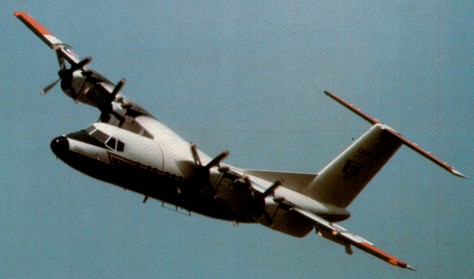
US Army DHC-5 Buffalo
In 1974 production of an improved DHC-5D Buffalo was initiated. This had more powerful engines which permitted operation at higher gross weights, and offered improved all-round performance. Production of the Buffalo ended in 1982, but the last of 122 aircraft built was not delivered until April 1985. DHC-5Ds were bought by the armed forces of Abu Dhabi (5), Cameroun (3), Chile (1), Ecuador (3), Egypt (10), Kenya (8), Mauritania (1), Mexico (3), Sudan (4), Tanzania (6), Togo (2), Zaire (3) and Zambia (7). With interest being shown by civil operators, DH Canada developed the DHC-5E Transporter, certificated in Canada in 1981. Generally similar to the military Buffalo, it could seat 44 passengers in a standard layout but with quick-change passenger/cargo and VIP/executive interior. Two were acquired by Ethiopian Airlines.
March 1979
The de Havilland Canada XC 8A research aircraft, modified by the addition of an air cushion landing system (ACLS) designed by Bell Aerospace, made its first flight on 31 March 1975. An air cushion beneath the aircraft was created by an inflated rubberized nylon trunk pierced with hundreds of vent holes, making it possible to take off from or land on virtually any surface, including water.
Variants: DHC-5B: designation of proposed version with General Electric CT64-P4C engines, not built. DHC-5C: designation of proposed version with Rolls-Royce Dart RDa.12 engines, not built. NASA/DITC XC-8A: designation of C-8A following conversion for use as an augmentor wing research aircraft; extensively modified, it has clipped wings, fixed landing gear, two Rolls-Royce Spey engines with vectored nozzles complementing the augmentor wings. XC-8A ACLS: redesignation of C-8A following conversion for use as an Air-Cushion Landing System research aircraft; instead of conventional landing gear it has an inflatable but perforated rubber air cushion which permits operation from and to almost any type of surface, including ice, rough airfields, soft soils, snow, swamps and water. NASA/Boeing QSRA: redesignation of C-8A following conversion for use as a Quiet Short-haul Research Aircraft; this aircraft has a new wing incorporating upper-surface blowing and boundary-layer control; engines are four Avco Lycoming F102 turbofans.
DHC-5D Engines: 2 x General Electric CT64-820-4 turboprop, 3,133 shp / 2336kW Max take-off weight: 22317 kg / 49201 lb Empty weight: 11412 kg / 25159 lb Wingspan: 29.26 m / 96 ft 0 in Length: 24.08 m / 79 ft 0 in Height: 8.76 m / 29 ft 9 in Wing area: 87.79 sq.m / 944.96 sq ft Wing loading: 52.07 lb/sq.ft / 254.00 kg/sq.m Cruise speed: 420 km/h / 261 mph Ceiling: 7620 m / 25000 ft Range w/max.fuel: 3280 km / 2038 miles Range w/max.payload: 416 km / 258 miles Payload: 41 Pax. / 8160kg Crew: 2-3 Passengers: 44
Gemini Engine: 2 x General Electric CT64 turboprop, 3,133shp. Installed pwr: 4680 kW. Span: 29.3 m. Length: 24.1 m. Wing area: 87.8 sq.m. Empty wt: 11,410 kg. MTOW: 22,320 kg. Payload: 8165 kg. Cruise speed: 420 kph. Initial ROC: 555 m / min. Ceiling: 7600 m. T/O run: 700 m. Ldg run: 260 m. Fuel internal: 7980 lt. Range/payload: 1112 km with 8165 kg. Capacity: 41 pax.
DHC-5 Buffalo CC-115 Engines: 2 x General Electric, 3055 shp. Wing span: 96 ft 0 in (29.266 m). Length: 79 ft 0 in (24.08 m). Height: 28 ft 8 in (8.73 m). Max TO wt: 49,200 lb (22316 kg). Max level speed: 261 mph ( 420 kph).










 All Aero