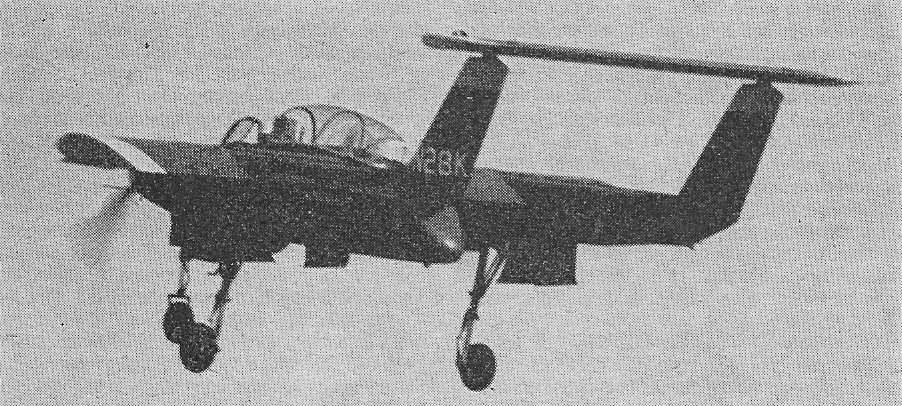
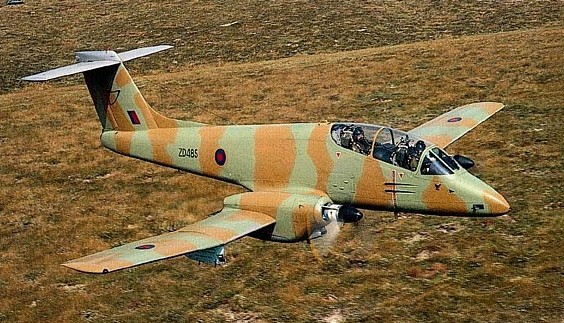
Designed for counter-Insurgency, the design and construction of the General Dynamics Charger took thirty-five weeks.
First flown on 25 November 1964, General Dynamics offered the Charger as an ‘off the shelf’ aircraft and claimed 100 could be delivered within 18 months. Orders of 500 would give an average price of $250,000.
General Aircraft Corporation announced plans in 1969 for a 36- seat STOL transport, the GAC-100, powered by four Pratt & Whitney PT6A-40 turboprop engines.
Skylander was a Desmond Norman’s last project. Intended for rough field work in remote areas, the rights for this twin PT6A turboprop have been bought by GECI of France for further development.
Skylander (provisional) Engines: Two 1100shp Pratt & Whitney Canada PT6A 65B turboprops. Span, 71 ft (21.6m). Length, 47ft 2in (14.38m). Height, 20ft 1 in (6.lm). Max take off weight, 18,5001b (8.4 tonnes). Max payload, 7,2751b (3.3 tonnes) Cruise speed, 230kt (426km/h). Range, 1,207nm (2,235km).
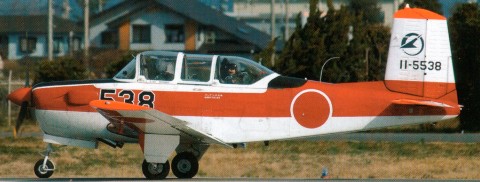
The original LM/KM series aircraft were four-seat developments of the Beech T-34A Mentor, the first flying in 1955, and large numbers were delivered to the JMSDF and JGSDF for liaison and training. A tandem two-seat derivative of the Beech T-34 with a Lycoming IGSO-480-AIA6 piston engine entered production in the mid¬1970s as the KM-2B for the JMSDF, and later as the T-3 for the JASDF. Fuji in Japan flew the prototype (JA3725) of the KM-2B two-seat primary trainer on 26 September 1974; this development of the earlier KM-2 combined the airframe and powerplant of that aircraft with the tandem-seat cockpit arrangement of the Beech T-34A Mentor.
Ten KM-2 were ordered for the JMSDF, for delivery by February 1963. Further contracts were to follow, to replace the 45 North American SNJs (Harvards) then in naval service. The prototype KM-2 received its certificate of airworthiness February 1961.
T-5
Fuji has tested a company owned four-seat KM-2 utility aircraft with an Allison 250-B17 turboprop, under the designation KM-2D.
The first KM-2D, flown on 28 June 1984, was a straight conversion of a company-owned piston KM-2 retaining the original four-seat cabin structure.
The JMSDF considered re-engining its fleet of tandem-seat KM-2B trainers, but has now elected to purchase new-build KM¬2Kais, with the first funded in 1986/87. These will be turboprop powered, and will retain the tandem seating of the KM-2B. Deliveries are scheduled for 1988, to begin replacement of the oldest KM-2Bs.
The Japanese Maritime Self-Defence Force took delivery of the definitive turbo-prop powered KM-2D prototype (first flown on 27 April 1988) in August 1988 which was to be tested by the service until March 1989. This prototype, a conversion of a MSDF KM-2B, embodied extensive cabin redesign.
KM 2 Engine: Lycoming IGSO-480 A1A6, 340 hp. Max speed: 227 mph (365 kph) at 16,400ft (5000 m) Cruise, 183 mph (295 kph) Initial climb, 1,560 fpm (7.92 m/sec) Service ceiling, 29,200ft (8900 m) Range, 765 mls (1235 km). Empty weight, 2387 lb (1083 kg) Loaded weight, 3,296 lb (1495 kg). Span, 32 ft 9.75 in (10 m) Length, 26 ft 0.75 in (7.95 m) Wing area, 177.6 sq.ft (16.49 sq.m).
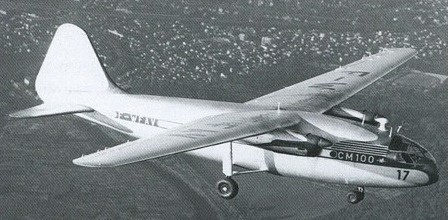
The Castel-Mauboussin CM.10 transport glider was built for French military forces, also the CM.100 powered version with two Renault engines. In the latter CM-101R Renault engines were augmented by two Turbomeca Pimene turbojets.
CM.10 — 1947 wooden assault glider, 35 troops, 26.96 m span, 2 prototypes CM.10: Fouga-built glider prototypes evaluated by Armée de terre, 1947 Prod. order for 25 (SNCAN-built) cancelled after crash of CM.10 n° 1 CM.100: 1949 powered vers., 2 x Snecma 12S (As 411), 1 built (F-WFAV) NB: study begun Nov 1944 for Armée but civil vers. envisioned by SGAC CM.101R: F-WFAV with added wingtip-mounted Turboméca Piméné turbojets CM.103R: [Project] military CM.101R variant, 2 x Turboméca Marbore turbojets
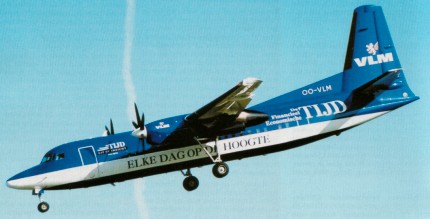
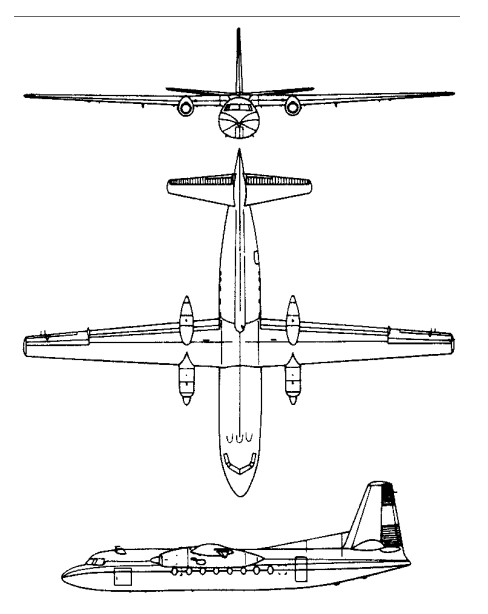
During celebrations held in November 1983 to mark the 25th anniversary of the F27 entering airline service, Fokker announced the launch of a 50-seat follow-on to be known as the Fokker 50. Based on the F27 airframe, but fitted with more fuel-efficient Canadian-built P&W 125B turboprops engines, 12 foot diameter, six-bladed DowtyRotol ‘quiet’ propellers, improved aerodynamics, a redesigned cockpit incorporating digital avionics CRT “glass” cockpit and a new cabin interior, the external differences include extra windows, twin-nosewheel landing gear and upturned wingtips. Much use is made of lighter composite materials, and F50 commonality with the F27 is only 20%.
Production is shared with Dassault, Fuji Heavy Industries, Deutsche Airbus, SABCA, Dowty Rotol and Pratt & Whitney Canada with final assembly, systems integration and flight test carried out by Fokker at Schiphol. The first two prototypes were conversions of F27 airframes, with the first (PH-OSO), flying on 28 December 1985 followed by (PH-OSI) on 30 April 1986. The first production aircraft (PH-DMO) flew on 13 February 1987 and first delivery made (to DLT), on 7 August 1987. By mid-1991 Fokker held firm orders from 18 customers for 132 Fokker 50s, and had delivered 116. The standard production variant was the 46/50-seat Fokker 50-100 and the 1998 build rate was 30 aircraft per year. Four maritime/surveillance versions of the PW124-powered Fokker 50 supersed the F.27 Maritime models. The Maritime Mk.2 is the standard unarmed maritime patrol version for coastal surveillance and SAR, while the Maritime Enforcer Mk.2 is similar but has provision for external stores to allow ASW/ASV missions to be flown. Both variants are fitted with a Litton APS-140(V) or APS-504(V)5 360o scan search radar. The Enforcer also has a sonobuoy processing system. Intended for border surveillance and stand-off reconnaissance, the Sentinel Mk.2 has a Motorola APS-135(V) slide-looking airborne radar (Slar) under the fuselage. Other systems include a Doppler moving target indicator, a Litton/Itek long-range oblique photography (Lorop) system, and an optional computerised intelligence gathering system. The Kingbird Mk.2 is an AEW version.
Rekkof Restart was formed with intention of restarting production of the Fokker 50 and 100, having bought tooling and rented the production factory in 1998.
Engines: 2 x Pratt & Whitney Canada PW125B turboprops, 1864kW Max take-off weight: 18990 kg / 41866 lb Empty weight: 12570 kg / 27712 lb Wingspan: 29.0 m / 95 ft 2 in Length: 25.2 m / 82 ft 8 in Height: 8.3 m / 27 ft 3 in Wing area: 70.0 sq.m / 753.47 sq ft Cruise speed: 522 km/h / 324 mph Ceiling: 7620 m / 25000 ft Range: 2630 km / 1634 miles Passengers: 46-58
Maritime Enforcer Mk.2 Engine: 2 x PW124 turboprop. Installed thrust: 3200 kW. Span: 29 m. Length: 23.56 m. Wing area: 70 sq.m. Empty wt: 14,100 kg. MTOW: 21,545 kg. Warload: 3930 kg. Max speed: 480 kph. Initial ROC: 390 m / min. Ceiling: 7620 m. T/O run: 1525 m. Ldg run: 560 m. Fuel internal: 9322 lt. Range: 6820 km. Endurance: 14.4 hr. Air refuel: No.
The company’s design study of 1950 was for a 32-seat transport to be powered by two Rolls-Royce Dart turboprop engines. Known as the P.275 project, it was enlarged slightly and modified to incorporate a circular-section pressurised fuselage by 1952, when Dutch government backing was sought for its construction and development.
The type was then designated Fokker F27, and the first of two prototypes made its maiden flight on 24 November 1955 from Schiphol, powered by two Dart 507 turboprops. At the controls was Fokker’s chief test pilot, Mr H.V.B. Burgerhout, for the 34 minute flight. The first prototype did not have a pressurised cabin. For its first trials the prototype F.27 was powered by Rolls Royce Dart Mk. 507 engines, and in March 1956 these were replaced by Dart Mk. 511 engines.
F-27 No.1
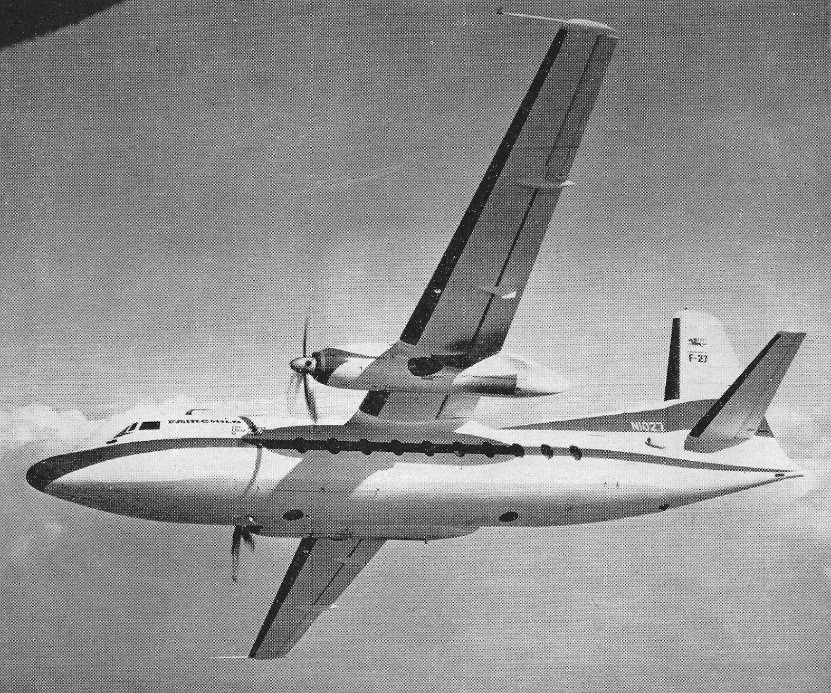
Two of the prototypes never flew at all, as they were used to investigate fatigue, wing loading and pressurisation problems (submerged in a water tank). Fokker installed a pneumatic system for the retractable undercarriage, because air is cheap, fast and non combustible. A high-wing monoplane, the F27 has a pressurised fuselage, retractable tricycle landing gear and accommodation for 28 passengers. The second prototype, with Dart Mk 511 engines and its fuselage lengthened by 0.91m to seat 32 passengers, was flown on 31 January 1957. Between the initial flights of these two prototypes, On April 26th 1956 it was announced that Fokker had concluded an agreement with the Fairchild Engine and Airplane Corporation for the manufacture and marketing of the F27 in North America, where it was known as the Fairchild F-27.
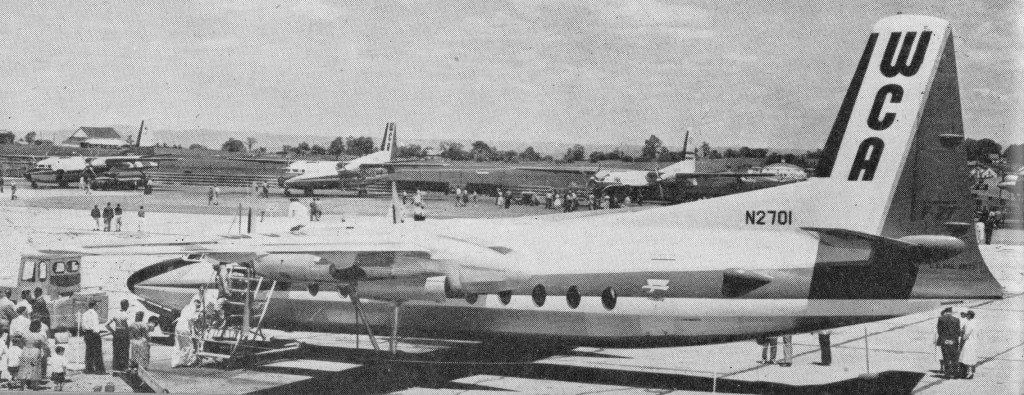
Fairchild F-27
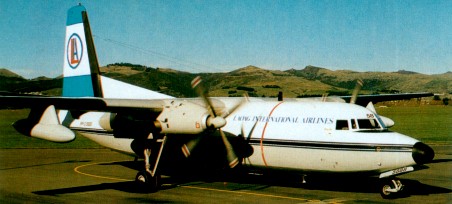
By April 1956 orders had come in for 30 aircraft. On March 23rd, 1958, the first production F.27 EI AKA for Aer Lingus, made its ¬maiden flight, to be followed on 12 April by the first American built F.27, for Pied¬mont Airlines. Fokker’s first F27 Friendship entered service with Aer Lingus in December 1958, but Fairchild had been a little quicker off the mark, its F-27 entering service with West Coast Airlines three months earlier. The American company had modified the interior layout to seat 40, increased the fuel capacity and made provision for weather radar in a lengthened nose; Fokker adopted similar improvements at a later date. The initial Dutch production version was designated F27 Mk 100 (Fairchild F-27), and was powered by two 1279kW Rolls-Royce Dart RDa.6 Mk 514-7 turboprops. A total of eighty-five Series 100 were built. It was followed by the similar F27 Mk 200 (Fairchild F-27A) with 1529kW Dart RDa.7 Mk 532-7 engines. Both airliners had standard accommodation for 40 passengers, but a high-density arrangement made it possible to seat 52. An executive version of the Mk 200 was available with the interior design to customer requirements. Subsequent versions include the F27 Mk 300 Combiplane (Fairchild F-27B), a passenger/cargo aircraft with Mk 100 powerplant, a reinforced cabin floor, cargo tie-down rings and a large cargo door forward of the wing on the port side. A similar Combiplane version of the Mk 200 had the designation F27 Mk 400, but no equivalent version was produced by Fairchild in America.
In 1964 the Sudanese air force ordered four F-27s for paratrooper and medical evacuation missions, incorporating upward-hinging cargo door forward and two sliding doors near the rear. They can carry 45 in canvas seats, 24 litters, or 13,000 lb of cargo. Nine F-27M Troopships were in service with the Netherlands air force.
In 1964 Fairchild was to start a production line again to produce 15 F-27s ordered by Ozark Airlines. Priced at $995,000 each, engines were to be Rolls Royce Dart 7s and the MTOW 42,000 lb.
The Mk.400M flew in April 1965. It can carry 6,000kg of cargo, 46 paratroops, or 24 stretchers and nine attendants. A number of civilian-standard F.27 Friendships, some with VIP inte¬riors, were sold to military operators. Formerly known as the Troopship, the Mk.400 military version was ordered for the Royal Thai Air Force. These aircraft, deliv¬ered in 1986 and early 1987, were multirole aircraft equipped for transport, target towing, and SAR duties. Fokker next developed a lengthened fuselage (by 1.50m) variant of the Mk 200. Designated F27 Mk 500, this failed to appeal initially to airline operators, but 15 were acquired by the French government for service with the nation’s Postale de Nuit. Friendship Mk 500s in service with airlines have standard accommodation for 52 passengers, with high-density seating for 60. Fairchild in America produced its own stretched variant, the FH-227. The FH-227 differed from the standard F27 by having a fuselage ‘stretch’ of 1.83m to provide accommodation for a maximum of 52 passengers, with increased baggage and cargo space, and by the installation of 1678kW Rolls-Royce Dart RDa.7 Mk 532-7 turboprop engines. The first of two FH-227 prototypes made its initial flight on 27 January 1966. Production of FH-227s and their variants had reached 79 when production ended. When the Fairchild Hiller FH.227 production line closed down more than 200 aircraft had been sold. Fairchild Stratos Corp. demon¬strated its F 27G variant in 1963, incorporating the refinements developed by Fairchild in the F 27F, and also has a large cargo door in the front fuselage, as used in the F 27B. It is intended for both military and civil use. The last production version was the F27 Mk 600, combining the Mk 200 fuselage without the reinforced cabin floor but with the cargo door of the Mk 300/400 Combiplanes. The F27 Mk 600 introduced an optional roller-track quick-change interior so that the type could be used for passenger/cargo services. Other versions included the F27 Mk 400M and F27 Mk 500M military aircraft, an F27 Mk 400M aerial-survey version and an F27 Maritime suitable for coastal patrol, fishery protection, and search and rescue. Late production aircraft had an updated flight deck and cabin interior. Manufacture was shared by Dassault-Breguet (France), MBB (Germany) and SABCA (Belgium). When production was terminated in 1986 in favour of the Fokker 50, the company had sold 581 F27s alongside 205 Fairchild-built F-27/FH-227 variants. In mid-1991 Fokker stated that around 450 F27s were still in service and that the highest-time aircraft had made some 80,000 flights. About 30 FH-227s of different marks remained in airline service in 1991. The Fokker F.27 Maritime prototype (PH FCX), a conversion from an ex airline F.27, was flown for the first time on 25 March 1976. This medium range maritime patrol aircraft was equipped for this role by the installation of adv¬anced avionics, including search radar and long range inertial navigation. Operated by a crew of up to six, the F.27 Maritime can carry fuel for an endurance of 10 to 12 hours or range of 3,107 miles (5000 km). A total of 17 of the Dart engined F.27 Maritimes was sold to seven customers. The four delivered to the Royal Thai Navy have a weapons capability, but are not equipped to full Enforcer standard.
F-27 Engines: 2 x Rolls-Royce Dart 7 535-7R, 1835 shp. Props: Dowty-Rotol 4-blade, 106-in. Seats: 56. Length: 82.3 ft. Height: 28.7 ft. Wingspan: 95.2 ft. Wing area: 754 sq.ft. Wing aspect ratio: 12.1. Maximum ramp weight: 45,200 lbs. Maximum takeoff weight: 45,000 lbs. Standard empty weight: 27,400 lbs. Maximum useful load: 17,800 lbs. Zero-fuel weight: 39,500 lbs. Maximum landing weight: 43,500 lbs. Wing loading: 59.7 lbs/sq.ft. Power loading: 12.3 lbs/hp. Maximum usable fuel: 9090 lbs. Best rate of climb: 1250 fpm. Certificated ceiling: 20,000 ft. Max pressurisation differential: 4.2 psi. 8000 ft cabin alt @: 20,000 ft. Maximum single-engine rate of climb: 413 fpm @ 150 kts. Single-engine climb gradient: 165 ft/nm. Single-engine ceiling: 9500 ft. Maximum speed: 259 kts. Normal cruise @ 20,000ft: 259 kts. Fuel flow @ normal cruise: 1542 pph. Endurance at normal cruise: 5.4 hrs: Stalling speed clean: 98 kts. Stalling speed gear/flaps down: 78 kts. Turbulent-air penetration speed: 183 kts.
Fokker F27 Mk 200 Engines: 2 x Rolls-Royce Dart Mk 536-7R turboprops, 1730kW Max take-off weight: 20410 kg / 44997 lb Loaded weight: 12148 kg / 26782 lb Wingspan: 29.0 m / 95 ft 2 in Length: 23.56 m / 77 ft 4 in Height: 8.5 m / 27 ft 11 in Wing area: 70.0 sq.m / 753.47 sq ft Cruise speed: 480 km/h / 298 mph Ceiling: 8990 m / 29500 ft Range: 1926 km / 1197 miles
F-27-400M Engine: 2 x R-R Dart turboprop. Installed pwr: 3590 kW. Span: 29 m. Length: 23.6 m. Wing area: 70 sq.m. Empty wt: 11,436 kg. MTOW: 21,545 kg. Payload: 6485 kg. Cruise speed: 430 kph. Initial ROC: 380 m / min. Ceiling: 7620 m. T/O run: 1020 m. Ldg run: 530 m. Fuel internal: 5900 kg (+1535 kg). Range/payload: 1300 km with 4765 kg. Capacity: 48 pax.
F27-500 Engines: 2 x RR Dart -7, 2050 shp. Seats: max 52. Wing span: 95 ft 2 in (29 m). Length: 82 ft 0.5 in (25.01 m). Height: 27 ft 11 in (8.5 m). Max TO wt: 43,500 lb (19,730 kg). Max level speed: 292 mph ( 470 kph).
F27 Mk 600 Seats: 44 plus crew Gross weight: 45,000 lbs Empty weight: 22,786 lbs Fuel capacity: 1,357–2,463 gal Engines: two 2,140 shp Rolls-Royce Dart turboprops Cruise speed: 298 mph Initial climb rate: 1,480 fpm Service ceiling: 29,500 ft Takeoff distance: 2,310 ft Landing distance: 3,290 ft.
In the mid 1960s the Argentine government issued a requirement to Fabrica Militar de Aviones (FMA), for a new combat aircraft suitable for the COIN, CAS and recce roles. Development of the FMA IA 58 Pucara ground-attack aircraft began in August 1966 and led to the flight of an unpowered aerodynamic test vehicle on 26 December 1967. The first powered prototype, by then known as the AX-2 Delfin, and with two 674kW Garrett TPE3311/U-303 turboprop engines installed, was flown for the first time on 20 August 1969. Subsequent prototypes were powered by Turbo-meca Astazou XVIG engines and fitted to all production aircraft.
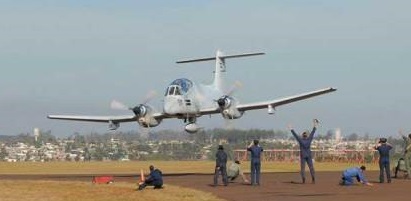
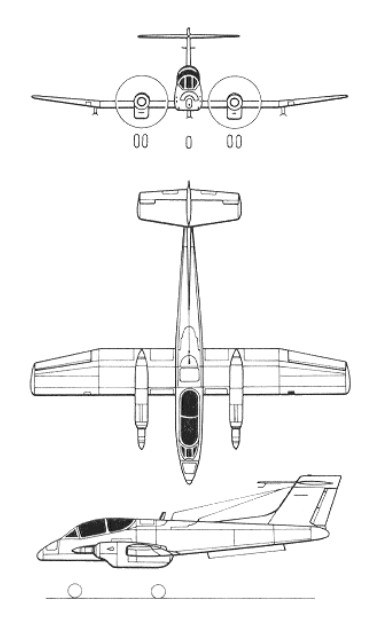
A cantilever low-wing monoplane of all-metal construction, the Pucara has a T-tail, a retractable tricycle landing gear, and accommodation for a pilot and copilot in tandem on Martin-Baker ejection seats beneath a large transparent canopy. It has narrow fuselage and tail section and a tandem seat cockpit with a steep sloping nose. Because of the steep nose the pilot has excellent forward visibility. Although heavily armed the weapons are unguided and visually aimed by the crew. The IA 58 only needs a minimum of ground support to operate, it is able to operate from unprepared rough terrains. More prototypes were produced and on 8 November 1974 the first of 60 IA 58A production aircraft for the Argentinian Air Force made its maiden flight. The initial production version, the IA 58A, flew for the first time on 8 November 1974 and first deliveries of 108 ordered for the Argentine air force began early in 1976 and continued until 1986. Six were also ordered for the air force of Uruguay. Forty improved IA 58B Pucara Bravos with advanced avionics and more powerful armament (30mm instead of 20mm cannon) were ordered for the Argentine air force in 1980 but were completed as IA 58As following the Falklands campaign. A single IA 66, a Pucara with more-powerful 746kW Garrett TPE331 engines, began its flight test programme in 1980 but did not proceed any further. Pucara production ended with a batch of 40 IA 58As built from 1986 onwards but no further sales were subsequently announced and they are believed to be in store as ‘white tails’.
Argentine IA58 Pucara
About 3 aircraft were captured by the United Kingdom during the Falkland War, they are now preserved by the RAF. First flown on December 30, 1985, the single-seat IA.58C is a developed version of the earlier IA.58A, in which the forward cockpit is replaced by a new nose section housing a 30mm Defa cannon with 270 rounds, in addition to the usual armament of two 20mm cannon and four 7.62mm machine-guns. The Astazou engines of the IA.58A are retained, but feature self-starters and modified exhausts to reduce their infrared signature. The IA.58C incorporates a complete avionics upgrade, including an Omega/VLF navigation system, Hud, IFF, and radar warning receiver, together with a Saab RGS-2 lead-computing sight for air-to-air or air-to-ground use. The IA 58A is also operated by Colombia, Sri Lanka and Uruguay but only in small numbers. In December 1989, Argentina delivered three Pucaras to Colombia on loan for use against drug manufacturers and smugglers.
IA.58A Engines: 2 x Turbomeca Astazou XVIG, 760kW / 988 shp Max take-off weight: 6800 kg / 14992 lb Empty weight: 4037 kg / 8900 lb Wingspan: 14.5 m / 47 ft 7 in Length: 14.3 m / 46 ft 11 in Height: 5.4 m / 17 ft 9 in Wing area: 30.3 sq.m / 326.15 sq ft Max. speed 3.000m (9,840 ft): Mach 0.48 / 500 km/h / 311 mph Cruise speed: 500 km/h / 311 mph Ceiling: 10000 m / 32800 ft Initial ROC: 1080 m / min. Range w/max.fuel: 3400 km / 2113 miles Combat radius hi-lo-hi: 350 km. T/O run: 300 m. Ldg run: 200 m. Fuel internal: 1280 lt. Air refuel: No. Warload: 1500 kg. Armament: two Hispano HS804 20mm cannons with 270 rounds per gun, four FN Browning 7.62mm guns with 900 rounds per gun; up tp 1500 kg (3,307 lb) of free fall load. Hard points: 3. Crew: 2
IA 66 Engines: 2 x 1,000-shp Garrett TPE331-11-601W turboprop Wingspan: 14.5 m / 47 ft 7 in Length: 14.3 m / 46 ft 11 in Height: 5.4 m / 17 ft 9 in Wing area: 30.3 sq.m / 326.15 sq ft Crew: 2

 All Aero