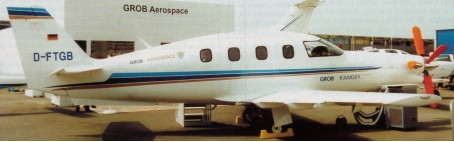
A seven seat business aircraft, considered a competitor for the TBM700, the Ranger maintains the German company’s tradition to produce composite carbon fibre. It has a big cabin for a single engined aircraft in this business market segment 16ft long, over 5ft wide and 4.7ft high and in addition to pressurisation, it has various internal options for a toilet, folding tables and power connections for laptops.
G160 Ranger – (provi¬sional) Powerplant: One 850shp Pratt & Whitney Canada PT6A-42A turboprop. Max cruise speed, 270kt (500km/h). Range with six people at 25,000ft with 30min reserves, 1,800nm (3,300km). Sea level take-off to 50ft (15m): 2,130ft (650m). Max take off wt: 7,275 lb (3,300kg). Max payload, 1,587 lb (720kg). Span, 42ft 8in (13m). Length, 37ft 8in (11.5m) Height: 11ft 3in (3.4m).
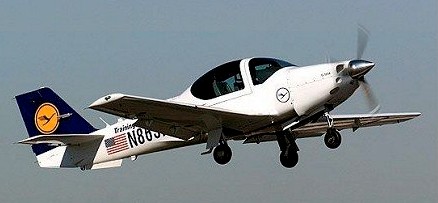
The 1999 Grob G 120A is a two seated training and aerobatic low-wing aircraft with a carbon composite airframe. It is based on the Grob G 115TA training aircraft and is specially designed for military and civil pilots training.
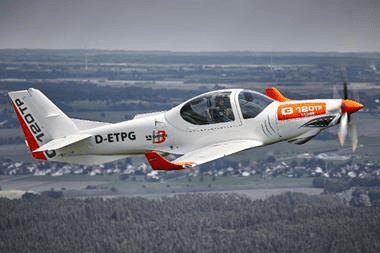
G120TP
In 2025 the Royal Canadian Air Force (RCAF) planned to operate 23 G120TPs under the designation CT-102B Astra II. To be based at CFB Moose Jaw in Saskatchewan, they will serve as a basic flight instruction platform, succeeding Canada’s Grob CT-120A (G120A) trainers.
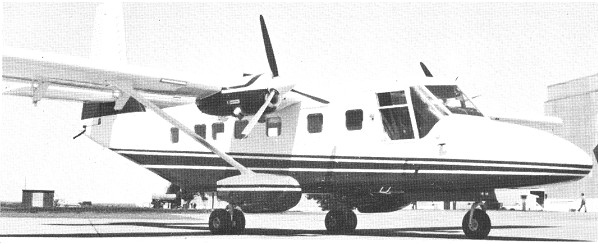
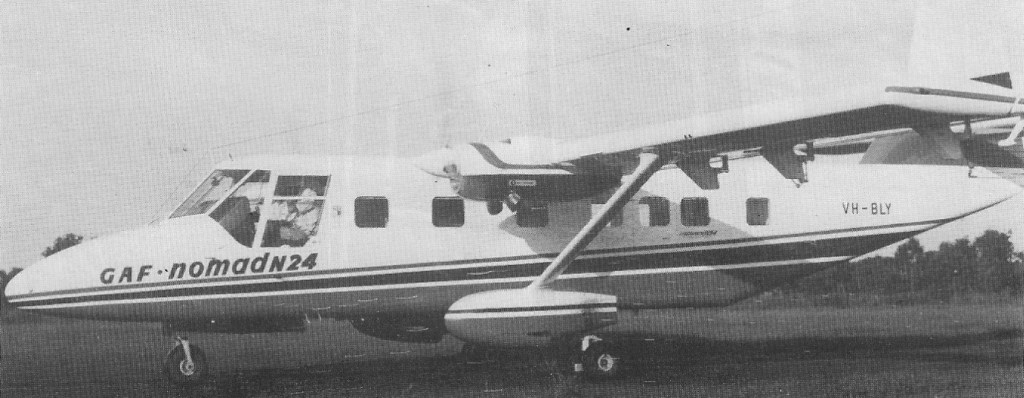
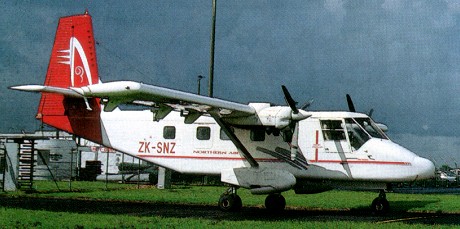
Originally designed in the 1960s as a STOL utility aircraft for both civil and military use. The first prototype flew in 1971. One hundred and seventy were sold by GAF / ASTA. Certification in accordance with the Australian Department of Transport air regulation 27 approves the use of N24A as an 18-place airliner in regular public transport as well as in normal operation. N24A is an improved version of the previous ‘stretched’ Nomad N24. It has increased passenger and load carrying capacity with an all-up-weight of 9400 pounds from the original 8500 pounds.
Production ceased in 1984 after safety concerns following a number of accidents and the loss of 54 lives. Boeing obtained the type certificate via its 1999 acquisition of Rockwell, which had previously acquired ASTA. Gippsland Aeronautics purchased the GAF N24 Nomad type certificate from Boeing Australia and planned to restart production.
N-24 Engine: 2 x Allison 250-B17B, 400 hp. Seats: 18. Wing loading: 27 lb/sq.ft. Pwr loading: 10.5 lb/hp. Gross wt: 8750 lb. Empty wt: 4844 lb. Equipped useful load: 3811 lb. Payload max fuel: 1451 lb. Range max fuel/75%: 964nm/5.7hr. Range max fuel /55%: 1071nm/7.7hr. Ceiling: 22,500 ft. Max cruise: 167 kt. Max range cruise: 140 kt. Vmc: 62 kt. Stall: 52-70 kt. 1.3 Vso: 68 kt. ROC: 1430 fpm. SE ROC: 280 fpm @ 87 kt. SE ceiling: 9000 ft. Min field length: 1100 ft. Fuel cap: 1770/2360 lb.
N24A Engines: 2 x Allison 250-B17C, 400 shp. Props: Hartzell 3-blade, 90-in. Seats: 17. Length: 47 ft. Height: 18.2 ft. Wingspan: 54.2 ft. Wing area: 320 sq.ft. Wing aspect ratio: 9.1. Maximum ramp weight: 9450 lbs. Maximum takeoff weight: 9400 lbs. Standard empty weight: 5480 lbs. Maximum useful load: 3970 lbs. Maximum landing weight: 9200 lbs. Wing loading: 20.9 lbs/sq.ft. Power loading: 12.2 lbs/hp. Maximum usable fuel: 1770 lbs. Best rate of climb: 1313 fpm. Service ceiling: 23,300 ft. Maximum single-engine rate of climb: 240 fpm @ 96 kts. Single-engine climb gradient: 113 ft/nm. Single-engine ceiling: 11,390 ft. Maximum speed: 173 kts. Normal cruise @ 8,000 ft: 169 kts. Fuel flow @ normal cruise: 335 pph. Endurance at normal cruise: 5.3 hrs: Stalling speed clean: 72 kts. Stalling speed gear/flaps down: 57 kts. Turbulent-air penetration speed: 134 kts. Takeoff distance (50ft) 1,710 ft Landing distance (50 ft) 1,380 ft
In 1965 design studies were started by GAF to find a follow-on production commitment. Interest expressed from commercial operators lead to a twin engined utility transport. Production commenced on the prototypes in January 1970 with flight testing beginning in 1971.
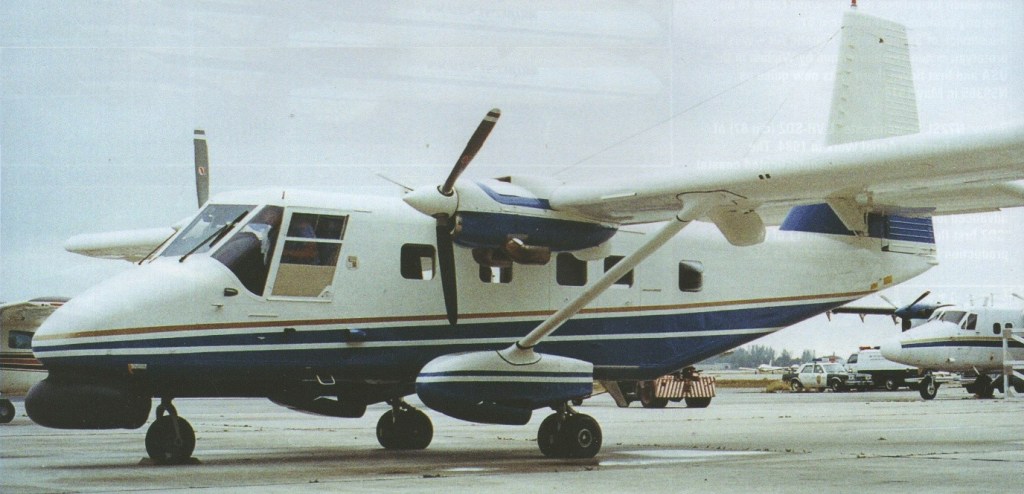
The final version, launched in May 1985, was the N22C, aimed at the commuter airline market and offering an increased all-up weight of 4,060kg. The N22C was a post-production variant with increased weights, strengthened undercarriage, improved tail structural design and other modifications. Most Nomads delivered from storage after production ended were to this standard and some earlier aircraft were modified.
Three military variants of the N22/N24 Nomad, the utility Missionmaster, the coastal surveillance Searchmaster B with 1200 scan Bendix radar, and the Searchmaster L with 3600 scan Litton radar, were built for five customers.
The Nomad is designed and built by the Government Aircraft Factories in Australia in two models. These are the short-takeoff-and-landing (STOL) Nomad N22B and the Nomad N24A commuter aircraft. Variations on the basic aircraft include the Mission Master, the Search Master for maritime surveillance work, and a photographic and mapping model. The aircraft have proven successful in many countries, often flying over rugged terrain in climates ranging from tropical to subarctic. Its STOL capability, originally developed for Australian military use, has made it ideal for operations in rugged areas such as the highlands of Papua, New Guinea. The N22B, capable of carrying up to 12 passengers, can take off in only 800 feet. The larger N24A is a later development of the basic aircraft capable of carrying more passengers and cargo.
The Nomad is characterized by simplicity of construction and systems, which contribute to its economy of operation. Its two Allison 250-B17C turboprops are rated at 420 shp, producing more than two horsepower per pound of engine weight. The B17C offers an improved single-engine high-altitude performance capability and a more rugged gearbox.
The Royal Thai Air Force received 20 N22B Missionmasters.
US Customs Service received 7 Searchmaster Ls from storage including VH-HTG cn160 becoming N6305U in December 1989
N22B Engines: 2 x Allison 250-B17, 416 shp. Props: Hartzell 3 blade reversible 7 ft 6 in. Fuel cap: 1030 lt. Wing span: 54.0 ft (16.46 m). Length: 41.2 ft (12.57 m). Height (tail section): 18.12 ft (5.52m). Main wheel track: 10.6 ft (3.23m). Wheel base: 12 ft (3.66 m). Propeller ground clearance: 4 ft (1.22m). Wing area: 324 sq.ft (30.2 sq.m). Wing loading at max. gross weight: 26.2 lbsft) 127.9 kg/ sq.m). Power loading at max. gross weight: 10.2 lbs eshp (4.64 kg eshp). (Excluding flight deck) – Cabin length: 17.5ft (5.34m). Cabin height: 5.13ft (1.57m). Cabin volume: 360 cu.ft (10.2 cu.m). Cabin door size: 4.06 ft x 4.33 ft (1.24 m x 1.32m). Baggage compartment volume (nose): 28 cu.ft ( 0.79 cu.m). Baggage compartment volume (rear): 30 cu.ft (0.85 cu.m). Take of pwr: 416 eshp (400shp). Maximum continuous: 400 eshp (385 shp). Maximum cruise: 380 eshp (366 shp). Normal internal fuel tanks (usable): 227 Imp gals (1030 lt, 268 U S gals). Maximum take-off: 8500 lbs (3856 kg). Maximum landing: 8500 lbs (3856 kg). Typical operating empty (including commercial interior and avionics): 4730 lbs (2146 kg). Max fuel capacity (usable): 1793 lbs (813.5 kg). Tyre size – Nosewheel: 35 p.s i. (241.1 KPa). Mainwheels (dual): 29 p s i. (199.8 KPa). All performance quoted at 8500 lbs (3856 kg) TO weight – STOL Ground roll: 600 ft (183 m). Distance over 50 ft: 1050 ft (320 m). FAR 23 Ground roll: 800 ft (244 m). Distance over 50 ft: 1360 ft (415 m). STOL Ground roll: 250 ft (76 m). Distance over 50 ft: 635 ft (194 m). FAR 23 (no reverse thrust) Ground roll: 655 ft (200 m). Distance over 50 ft: 1150 ft (351 m). Stalling Flaps retracted: 68 knots EAS. Flaps extended: 49 knots EAS. ROC take-off rating: 1440 fpm (439 m/min). ROC max. cruise rating: 1260 fpm (384 m/min). ROC Single engine wax. continuous: 220 fpm (67 m/min). Service ceiling: 22,500 ft (6858m). Single engine max continuous rating service ceiling: 10,000 ft (3050 m). Max. cruise speed — ISA, 5000 ft (1 525 m): 169 kt. Cruise speed 90% power ISA 5000 ft: 165 kt. Long range cruise speed 145 kts TAS: 50 NM wth 3300 lbs (1496kg) payload; 860nm wth 1617lb (733kg). Max cruise speed (168 knots TAS) range: 50nm wth 3280 lbs (1470 kg) payload; 730nm wth 1617 lbs (733 kg) payload.
N22C Nomad Engine: 2 x Allison 250. Installed pwr: 630 kW. Span: 16.5 m. Length: 12.6 m. Wing area: 30 sq.m. Empty wt: 2092 kg. MTOW: 4060 kg. Payload: 1630 kg. Vne: 200 kts. Cruise speed: 304 kph. Initial ROC: 445 m / min. Ceiling: 7620 m. T/O run (to 15m): 400 m. Ldg run (from 15m): 385 m. Fuel internal: 1018 (+335) lt. Range (std fuel): 1460 km. Capacity: 13 pax.
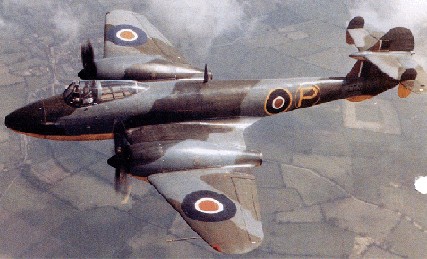
The Gloster Meteor was an important development platform for many jet related technologies including early engine design, this is highlighted by the fact that the eight Meteor F9/40’s were powered by no less than four entirely different engine designs with only two powered by the same engine (The W2/B 23’s of DG205 & DG208).
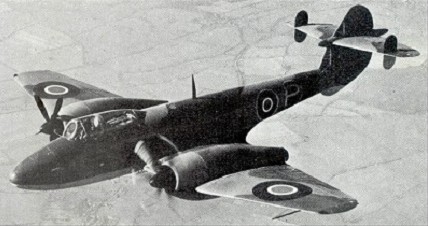
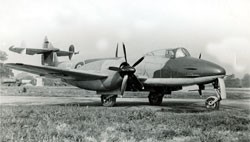
In many ways the Meteor contributed more at the end of their service life which is seen for the first time with F Mk I Meteor EE227.
Rolls-Royce began to develop the experimental Trent in May 1944, using as the basis of the engine the centrifugal-flow Derwent turbojet which was to power the F.3 and later marks of the Meteor.
EE227 was originally issued to 616 squadron but after just 80 hours was retired from service in favour of the improved Meteor F. Mk III. Initially sent to RAE Farnborough it soon moved to Rolls Royce at Hucknell in March 1945 where its Derwent Turbojets were exchanged for a pair of Rolls Royce RB50 turboprops.
Fitted with 7ft 11 inch Rotol propellors and reduction gear the combination produced 750 shp and 1,000 lbs of jet pipe thrust. Other modifications included a six inch undercarriage extension for better propellor clearance and ballast in place of its cannons. It first flew from Church Broughton on the 20th September 1945 with Eric Greenwood at the controls.
Initial trials showed that the aircraft was directionally unstable which was improved by the addition of small fins on the horizontal stabilizer fitted in May 1946. Later the propellors were reduced in size to 4ft 10.5 inches which had the effect of reducing shaft horsepower to 350 although jet thrust increased to 1,400 lbs. In April 1948 the aircraft spent time at Boscombe Down in simulated deck-landing trials. In total it accumulated 47 hours of flight time in a successful program which would lead to the Rolls Royce Dart turboprop. After having its engines removed in October 1948 it ended its days as a standard F Mk I in fire destruction tests at Farnborough.
Engines: 2 x Rolls-Royce R.B.50 Trent turboprops, 1305kW Wingspan: 13.12 m / 43 ft 1 in Length: 12.57 m / 41 ft 3 in Height: 3.96 m / 12 ft 12 in Wing area: 34.75 sq.m / 374.05 sq ft Crew: 1
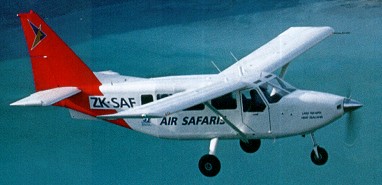
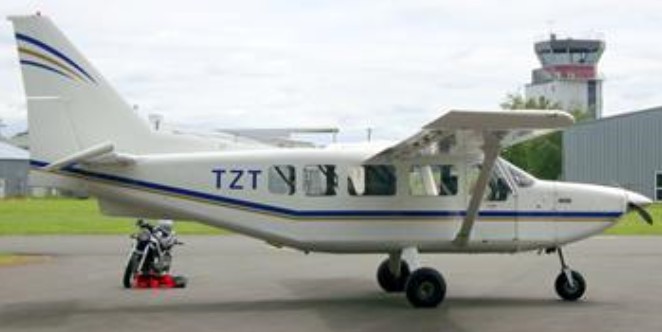
Designed by Peter Furlong to be between the Cessna Caravan and 206. Design work had begun in earnest in early 1994, with the first aircraft (VH-GAV and later re-registered as VH-PTR), powered by a 250 hp Textron Lycoming 0-540, making its maiden flight on 3 March 1995. On 7 February 1996, this air¬craft was destroyed during spinning trials. A second airframe was completed to a major component stage for static testing and a third, VH-ZGI, became the second flying prototype. The second prototype was first flown in August 1996 with a 300-hp Textron Lycoming IO-540K-lAS engine. Flight testing was completed by No-vember 1998 after a total of 350 hours had been collectively flown by the two aircraft. The basic simplicity of the aircraft’s non-turbo engine, automatic fuel management system, manual flaps, no cowl flaps, large cabin area with centre aisle, and useful centre of gravity range serve a utility role. It is of a strut braced high wing design, using the same wing as the GA 200, with a fixed undercarriage. It is of an all metal stressed skin construction which is fully corrosion protected. Up to eight passengers can be carried with entry gained by a large sliding door on the port side. The cabin floor has a quick release mechanism to permit rapid conversion between passenger and cargo roles or combi configuration.
The second prototype was re-registered VH-XGA in January 1999 and provisional type certification was achieved in early 1999, followed by full certification on 10 October 2000. The first production Airvan (004) was assembled in November 2000 and delivered to Air Fraser Island in Australia on 22 December 2000 as VH-RYT. The first export aircraft was 008, which was delivered to Maya Island Air in Belize, Central America, in late 2001 as V3-HGJ. Planned is a 2.4-metre-long, 18 cu.ft underbelly cargo pod that can carry 400 lbs (180 kg). The pod is able to be retrofitted.
In July 2005 the Airvan was awarded EASA European certification. Gippsland had delivered about 80 Airvans by the end of July including the last of 16 for the US Civil Air Patrol.
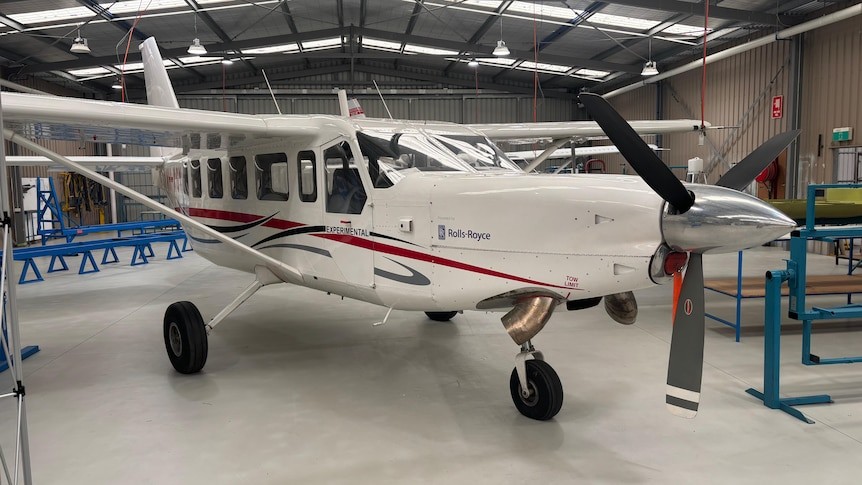
In August 2006 the 100th GA8 was handed over to Missionary Aviation Fellowship. Several engine variants were under evaluation. These include a 320-hp version of the Lycoming IO-580, a turbo-charged Lycoming TIO-540, a diesel version powered by the Thielert TAE 135 turbo diesel or the French SMA engine, and a turbine example powered by the Rolls-Royce Allison 250 BT7F. The consideration of a turbine-powered Airvan has meant a study into a stretched 10-seat turbine version, aimed at paramilitary and special mission applications. The Australian Civil Aviation Safety Authority (CASA) certified the GA8 Airvan for IFR flight. Certification work was also undertaken on an under belly cargo pod for the aircraft. The 18 cu ft pod will allow a total increase in weight lift of 180 kg and accommodate items up to 2.4 metres in length.
Mahindra agreed to pay about $40 million for a controlling stake in two small Australian aviation companies, Gippsland Aeronautics and Melbourne-based component maker Aerostaff Australia.
Mahindra Airvan 10
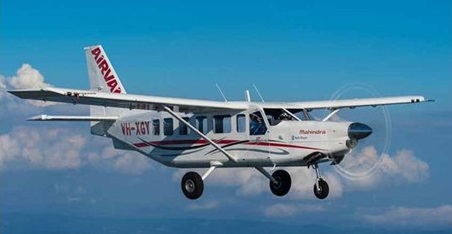
Developed by Mahindra Aerospace, the Airvan 10 10-seat single-engine turboprop received U.S. and Australian certification in 2017. With a price of around $1.7 million, it is targeted as a competitor to pricier turboprops, namely the Cessna Caravan and Quest Kodiak.
The Airvan 10 was planned to cost around $1.7 million and provide competition for turboprops like the Cessna Caravan and Quest Kodiak. The market introduction for the new turboprop was being supported by GippsAero, a Mahindra subsidiary in Australia and the original designer of the airplane.
GA-8 Airvan & Airvan 10
The Rolls-Royce M250-powered model, with a useful load of 2,300 pounds (1,400-pound full-fuel payload) and cruise speed of 145 ktas, is a follow-on to the piston-powered eight-seat Airvan 8, which Mahindra’s aircraft business unit in Australia produces. Certified in more than 42 countries, over 220 Airvan 8s were in service.
By 2025 more than 260 of the Airvans operating in 43 countries around the world.
The company employed up to 180 local people to send one GA8 Airvan out the factory door every two weeks in 2025.
The General Electric H80 is a turboprop aircraft engine produced by GE BGA Turboprops. The H80 is an updated derivative of the Walter M601. First run in 2009, FAA certification of the engine obtained at 13 March 2012. Russian type certificate received in October 2012 also approved by EASA, Brazilian Civil Aviation agency (ANAC) and the Argentine Administración Nacional de Aviación Civil.
The H80 will update the legacy M601 in several ways, including power and efficiency. The H80 will be a significant power upgrade over the M601, reaching 800 shaft horsepower (shp) rather than the 650 shp of the M601. Another important upgrade to the engine will be improving its hot day performance. That improvement is a major reason why the H80 was selected to power the Thrush Model 510 as a crop duster for Afghanistan.
Thrush Aircraft has exclusively teamed with General Electric to produce the Thrush 510G powered by the GE H80 turbine engine. The H80 provides increased temperature margins to enhance hot-day takeoff performance and high-altitude cruise speeds. GE chose Thrush to launch this new engine.
The GE H80 turboprop engine that powers the Thrush 510G was initially based upon the Walter M601 engine. The new H80 represents a complete rethink by GE Aviation that resulted in a free-turbine design that is lighter, more powerful, and more fuel efficient. In addition, the H80 has the ability to produce its full-rated 800 shp at high altitudes and field elevations, even on the hottest of days. Plus, the H80 requires no hot section inspection, and has a TBO of 3,600 hours.
The General Electric GE38 is a gas turbine developed by GE Aviation for turboprop and turboshaft applications. The GE27 was developed in the early 1980s under the “Modern Technology Demonstrator Engines” (MTDE) program sponsored by the United States Army Aviation Applied Technology Directorate. The GE27 was GE’s unsuccessful submission to power the Bell-Boeing V-22 Osprey. The CFE CFE738 is based on this engine.
In the late 1980s, GE used the GE27 as the basis for its GE38 commercial engine development. The GE38 became the T407 turboprop in partnership with Lycoming Engines for the Lockheed P-7, with a maximum takeoff power of 6,000 shp (4,475 kW). The P-7 program was canceled in 1990, as was the engine. The commercial version of the T407 was the GLC38, which was unsuccessfully offered for several turboprop airliners in the early 1990s.
The new GE38-1B is slated to power the new Sikorsky CH-53K Super Stallion three-engined helicopter for the US Marine Corps. It has a power rating of 7,500 shp. The GE38 completed its first round of ground testing in May 2010. Two test engines had completed over 1,000 hours of ground testing by November 2011. Five test engines were to be used in the 5,000-hour test program. GE is also hoped to offer the engine to power the US Navy’s Ship-to-Shore Connector Air-cushioned landing craft.
Variants and applications:
T407 Lockheed P-7
GE38-1B Sikorsky CH-53K
CPX38 Proposed turboprop engine variant
Specifications Type: Turboprop / Turboshaft Length: 57.5 inches (79.5 in with Torque Tube) Diameter: 27 in Dry weight: 1104.7 lb Compressor: 5+1 Axi-Centrifugal Compressor (5 Axial stages and 1 Centrifugal stage) Turbine: a 3-Stage Power Turbine, a 2-Stage-Single Crystal Cooled HP Turbine Oil system: synthetic Maximum power output: 7,500 shp Overall pressure ratio: 18.6:1 OPR Power-to-weight ratio: 6.8 shp/lb
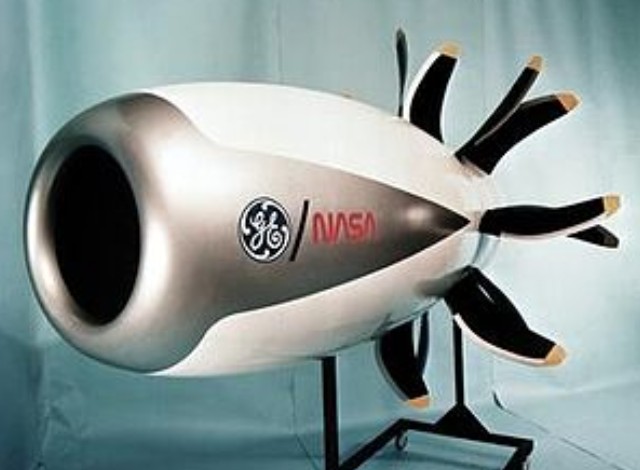
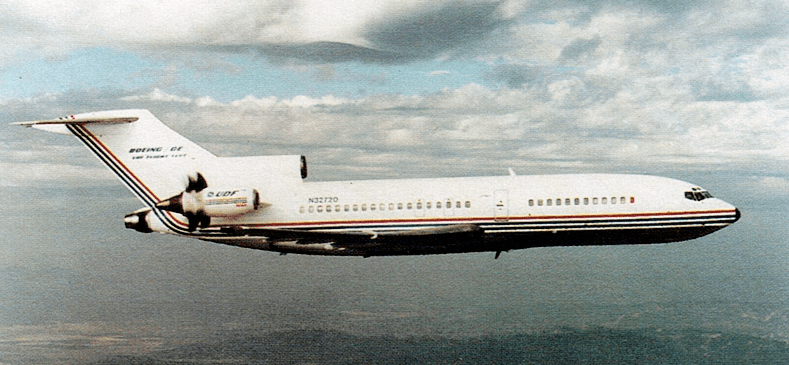
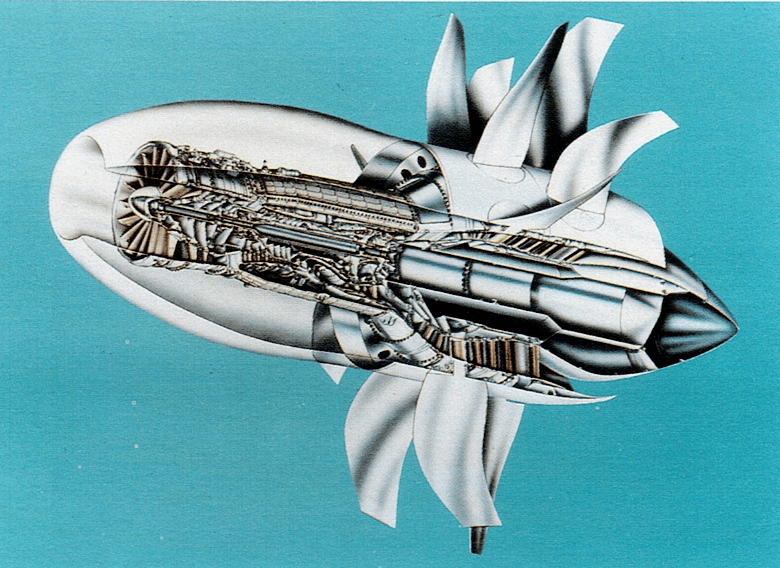
The General Electric GE36 was an experimental aircraft engine, a hybrid between a turbofan and a turboprop, known as an Unducted Fan (UDF) or propfan. The GE36 was developed by General Electric Aircraft Engines and first run in 1986.
A General Electric F404 military turbofan was used as the basis of the GE36. The F404 mixed exhaust stream discharged through a seven-stage low pressure (LP) turbine, where each stator ring was ‘unearthed’ and free to move in the opposite direction to that of the rotors. One set of open rotor, variable pitch, fan blades was connected to the LP turbine rotor system, while the other set was connected to the contra-rotating LP turbine stators. The scimitar shape of the fan rotor blades enabled high flight speeds (about Mach 0.75) to be obtained. GE used a low speed, (effectively) 14 stage, LP turbine, rather than a conventional high speed LP turbine and reduction gearbox, to drive the fan rotor blades.
Although the engine demonstrated an extremely low specific fuel consumption, cabin noise levels were a problem, even though the engines were mounted at the rear of the test aircraft.

 All Aero