Turboprop/turbofan derivatives of the HX-321.
Turboprop
Gulfstream G-159 Gulfstream I / C-4 / Grumman Gulfstream

Dubbed the Gulfstream I (GI), the turbo-prop aircraft was named after the Gulf Stream, the current that flows along the coast of Florida, which was a favored vacationing spot for Grumman executives. The Gulfstream I is a business transport designed to carry a crew of two with 10 to 14 passengers, which was introduced in 1958. Power is provided by twin Rolls-Royce Dart turboprop engines turning four-blade Rotol constant-speed propellers.
Gulfstream G-159 Gulfstream I / C-4 Article
The Gulfstream I first flew on 14 August 1958 and was the first United States twin-engine business aircraft to be certificated to cruise at 30,000 feet, and had a maximum speed of 350 mph at 25,000 feet and a range of 2,200 miles.
The Gulfstream continued in production in 1960, with about 40 ordered.

A later version received certification as a 24-passenger variation for feeder-line use. Two Gulfstream offspring were enlisted for military use: the VC-4A was a U.S. Coast Guard transport and the TC-4C was an “avionics classroom” for the U.S. Navy.
The aircraft, specifically for business travel, was a success in the business world, prompting Grumman to develop a jet-powered corporate aircraft called the Gulfstream II or GII.
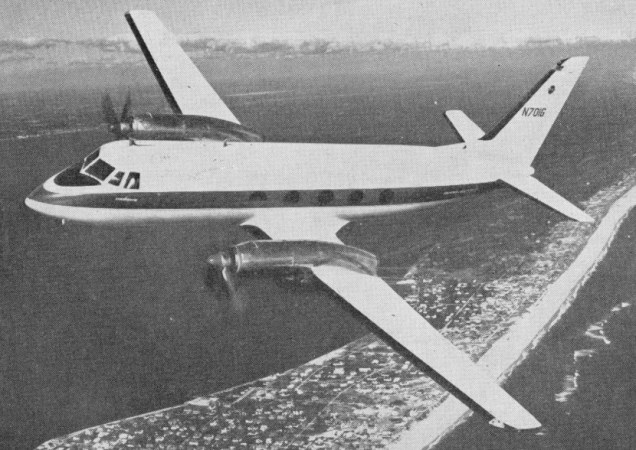
Seats 10-24.
Gross wt. 35,100 lb.
Empty wt. 21,900 lb.
Fuel capacity 1,550 USG.
Engines two 2,210 shp Rolls-Royce Darts.
Top speed 348 mph.
Cruise speed 288 mph.
Initial climb rate 1,900 fpm.
Approach speed 128 mph.
Range 2,540 miles.
Ceiling 33,600 ft.
Takeoff run 2,550 ft.
Landing roll 1,525 ft.
Gulfstream Commander 900
Gulfstream American Commander Divi¬sion announced it will build a lower-¬powered version of its large cabin 1000 model. The new airplane will be called the Commander 900. By moving the floor and the pressure bulkhead and by chang¬ing the windows, Gulfstream has been able to come up with a great deal more cabin space inside the old Commander fu¬selage.
First built in 1982.
AE-900
Engines: 2 x Garrett TPE-331-5-254K, 748 shp.
Props: Dowty Rotol 3-blade, 106-in.
Seats: 7/9.
Length: 42.9 ft.
Height: 14.9 ft.
Wingspan: 52.1 ft.
Wing area: 279 sq.ft.
Wing aspect ratio: 9.8.
Maximum ramp weight: 10,775 lbs.
Maximum takeoff weight: 10,700 lbs.
Standard empty weight: 7000 lbs.
Maximum useful load: 3775 lbs.
Zero-fuel weight: 9000 lbs.
Maximum landing weight: 10,550 lbs.
Wing loading: 38.3 lbs/sq.ft.
Power loading: 7.2 lbs/hp.
Maximum usable fuel: 2848 lbs.
Best rate of climb: 2779 fpm.
Service ceiling: 32,325 ft.
Max pressurisation differential: 6.7 psi.
8000 ft cabin alt @: 31,000 ft.
Maximum single-engine rate of climb: 924 fpm @ 112 kts.
Single-engine climb gradient: 480 ft/nm.
Single-engine ceiling: 18,140 ft.
Maximum speed: 289 kts.
Normal cruise @ 18,000ft: 286 kts.
Fuel flow @ normal cruise: 648 pph.
Endurance at normal cruise: 3.9 hrs:
Stalling speed clean: 79 kts.
Stalling speed gear/flaps down: 77 kts.
Turbulent-air penetration speed: 188 kts.
Grumman OV-1 Mohawk
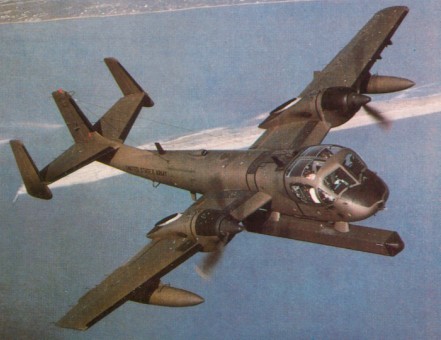
The first of 380 Grumman Mohawk battlefield surveillance aircraft made its first flight on April 14,1959 at Bethpage, New York.
Initial variants were reasonably unsophisticated but progressive modification efforts over the years have brought about a significant improvement in its sensor systems. The first production model to see service was the OV-1A, essentially intended to fulfil photographic reconnaissance duties by day or night, being fitted with cameras, flares and advanced navigation equipment.
The type entered service with the US Army in February 1961 and became a stalwart of the Vietnam conflict. Six JOV-1As with additional under-wing weapon stations to take an incredible arsenal, including Sidewinder heat-seeking missiles, were evaluated in South East Asia.
Grumman OV-1 Mohawk in Vietnam
It was succeeded by he OV-1B which was the first model to incorporate SLAR (Side-Looking Airborne Radar), this AN/APS-94 equipment being housed in a prominent pod carried externally under the lower starboard forward fuselage.
The next derivative was the OV-1C, which utilised the AN/AAS-24 infra-red sensor in place of the SLAR gear, while the final new-build member of the family was the OV-1D, basically a quick-change aircraft capable of operating with either infra-red or SLAR sensors. The standard OV-1D is equipped with infrared or radar sensors in addition to two panoramic cameras (horizontal and vertical) and one vertical/oblique camera, plus inertial navigation systems and full communication navigation packages. Deliveries of the OV-1D terminated in 1970, bringing total production to 375. Additional OV-1Ds were made available by the relatively simple conversion of most of the 100-plus OV-1Bs and OV-1Cs which remained.
A number of other derivatives appeared, including the RV-1D and the EV-1E, The former version is a conversion of the OV-1B specifically intended for Elint (electronic intelligence) duty, the dozen or so aircraft known to exist being fitted with a multiplicity of passive receivers, analysers and recorders to gather unknown or ‘hostile’ signals. The EV-1E, again a rebuilt OV-1B, is fitted with AN/ALQ-133 ‘Quick Look II’ surveillance radar, additional Elint equipment and electronic warfare pods. At least 16 conversions have been produced.
The latter type was also converted into the dedicated electronic intelligence gathering RV-1D. Israel received two OV-1Ds for use in the mid-1970s, with the designation EV-IE attributed to them. The only other export customer was Argentina, which still operates a small number of OV-IDs. Production ended in late 1970 after 265 were built and the US Army retired its Mohawks in 1996.
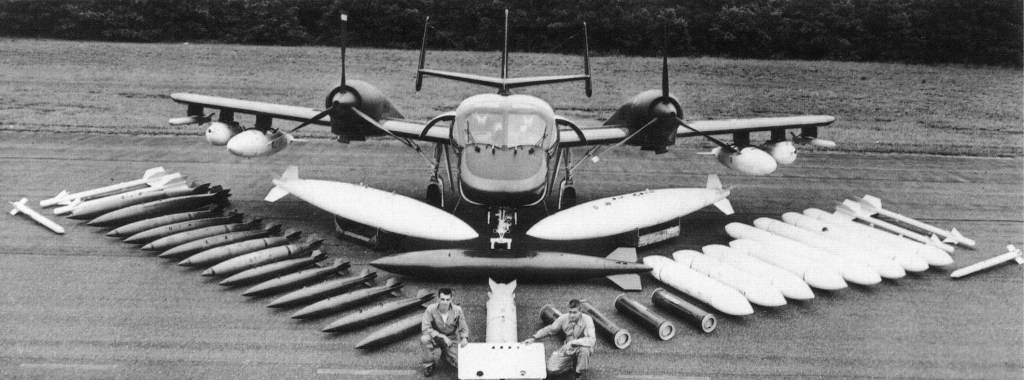
Israel’s air force has received two OV-1Ds, and continued updating effort should result in updated or converted OV-1Ds for various customers, including Pakistan and the US Army.
The JOV-1B was an armed version used in Vietnam. Israel operated two EV-1Es equipped for ELINT surveillance.
The Army maintained a Mohawk fleet at 110 OV-lDs and 28 RV-1D electronic-intelligence-gathering aircraft.
Engine: 2 x Lycoming T-53-L-7, 810kW
Max take-off weight: 5546-7365 kg / 12227 – 16237 lb
Empty weight: 4339 kg / 9566 lb
Wingspan: 12.8 m / 41 ft 12 in
Length: 12.5 m / 41 ft 0 in
Height: 3.9 m / 12 ft 10 in
Wing area: 30.7 sq.m / 330.45 sq ft
Max. speed: 558 km/h / 347 mph
Cruise speed: 345 km/h / 214 mph
Ceiling: 10700 m / 35100 ft
Range w/max.fuel: 2770 km / 1721 miles
Crew: 2
OV-1D
Engines: two Avco Lycoming T53L-701 turboprops, 1,400 hp (1044 kW)
Maximum speed 465 km/h (289 mph)
Range 1520 km (944 miles)
Empty weight 5467 kg (12,053 lb)
Maximum take-off 8214 kg (18,109 lb)
Wing span 14.63 m (48 ft 0 in)
Height 3.86 m (12 ft 8 in)
Wing area: 30.66 sq.m (330 sq ft)
Length (with SLAR) 13.69 m (44 ft 11 in).
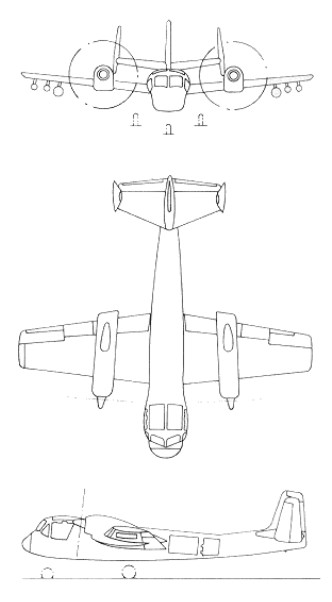
Grumman E-2 Hawkeye / W2F-1
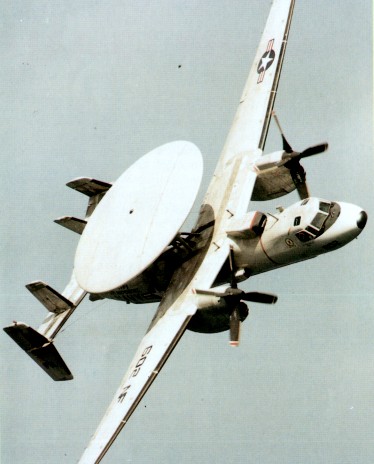
The first of three Hawkeye prototypes flew on October 21, 1960, the Hawkeye became the primary early warning component of the US Navy carrier air wings.
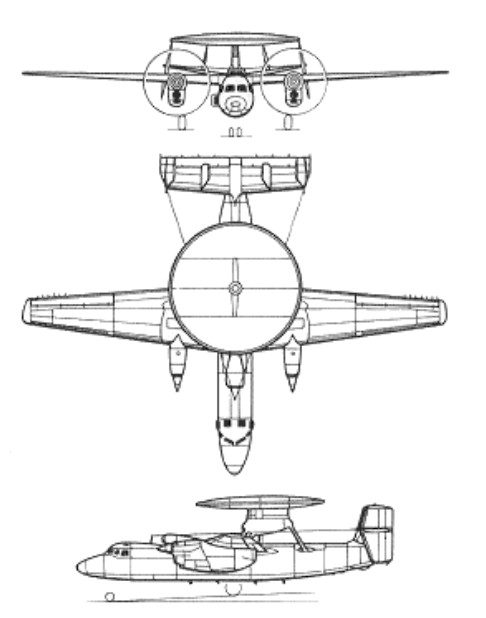
Delivery of the first member of the Hawkeye family, the E 2A (formerly known as the W2F-1) began on 19 January 1964 to the US Navy, entering service in 1965 as a replacement for the Grumman E 1B Tracer, an early warning derivative of the S 2 Tracker. The E 1B carried its radar aerial inside a fixed oval, aerofoil shaped radome, but the E 2 was the first AEW type to adopt the 7.32m diameter ‘rotodome’, with the antennae mounted rigidly inside a radome which itself rotates at 6 rpm in the case of the Hawkeye. Fifty nine E 2As were delivered to the US Navy, and the type quickly proved its worth off the coast of Vietnam. The Hawkeyes were sent out to patrol whenever there was a risk of the naval task force being attacked by enemy aircraft or ships; by extending the force’s detection range well beyond the normal horizon, even against low flying aircraft, the E 2As reduced the need for large numbers of intercepters to be kept on alert throughout the day and night.
In addition to their defensive role, the Hawkeyes were able to relay target information from the aircraft carriers to their distant attack formations. With the E 2A the US Navy began to appreciate the many advantages of a modern AEW aircraft, but the 1950s technology computer had to be physically modified every time the ATDS (Airborne Tactical Data System) needed new software. To overcome this problem the Hawkeyes were fitted with Litton L 304 general purpose digital computers, and several minor modifications were also made; the E 2As thus became E 2Bs, which flew for the first time in February 1969, all having been converted by 1971.
Grumman built 56 E-2As, later updated to E-2B, before introducing the E-2C. The first of the significantly more capable E-2C series flew in January 1971. By mid-1987 97 E-2Cs had been delivered to the US Navy, plus 21 to overseas customers.
Firm orders existed for a total of 47 aircraft, with procurement of 36 more by the end of 1985. Israel has four and in 1979 Japan released funds for the first four of an eventual total of about 15 for the JASDF. The Air Self-Defence Force accepted its first E-2C Hawkeye at Bethpage, Long Island, on 18 May 1982.
The E-2G has an advanced radar that is capable of detecting airborne targets anywhere in a three-million-cubic-mile surveillance envelope. It first entered service with the US Navy in November 1973 and went to sea on board USS Saratoga in late 1974. A training version is designated TE-2C.
By this time the first E 2Cs were flying, the prototype first flew in January 1971. Although virtually identical to its forebears externally, the E 2C is a very different under the skin. The improved APS 120 radar’ can detect and track aircraft over land as well as above the sea, and the APS 125 ARPS (Advanced Radar Processing System) is being incorporated in all E 2Cs to give long range detection of very small targets and automatic overland tracking. The APS 125 also incorporates a digital airborne moving target indicator (AMTI) in place of the E¬2B’s analogue unit. Communication equipment has been improved, and the E 2C has better hot day and single engine performance than its predecessors, and is four times as reliable.
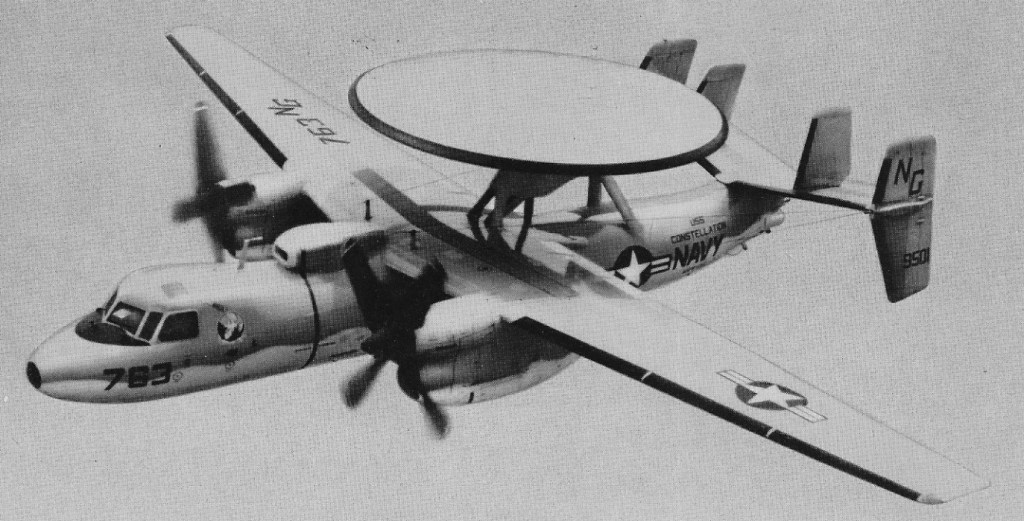
The E 2C entered service in 1974, its arrival more or less coinciding with the introduction of the US Navy’s new generation of carrier based aircraft: the F 14 Tomcat, S 3 Viking, EA 6B Prowler and A 6E Intruder.
The latest APS-138 surveil¬lance radar was introduced on the E-2C airborne early warning aircraft built in 1983, and will be retrofitted to earlier E-2Cs in place of the original APS-125. APS-138 has a low-¬side-lobe active-element-array antenna, an enhanced passive detection system with trian¬gulation and exotic emitter recognition, together with expanded computer memory allowing the simultaneous and automatic track¬ing of up to 600 targets. At an operating height of 9,150m (30,000ft), a Hawkeye can detect and assess any approaching aircraft over a range of 480km (260 nm) in all weathers.
From 1988 new E-2Cs will be fitted with uprated Allison T56-A-427 engines, and will receive the improved APS-139 radar system which can transmit on any one of ten UHF channels. General Electric is also developing an APS-145 radar for service in 1990 which will counteract the problem of overland clutter.
The Hawkeyes work closely with the Tomcats, orbiting on station between 110 km (68 miles) and 185 km (115 miles) from the carrier at heights of 4600 m to 9150 m (15000-¬30000 ft); a typical orbit begins at 7000 m (23 000 ft) and rises to 8500 m (28000 ft) as fuel is burnt off. At a height of 7600 m (24 930 ft) the radar has a horizon range of 375 km (235 miles) and can detect high flying aircraft out to 460 km (285 miles).
The radar can detect and track more than 200 targets simultaneously, supplying alti¬tude, range and velocity information. The crew of five includes three operators in the combat information centre, each of which has a main 25 cm (10 in) radar display and a 12.5 cm (5in) screen giving alphanumeric information. Targets detected by the AWG 9 long range fire control radar in the F 14 can be notified to an E 2C by data link; they are then correlated with the appropriate return on the Hawkeye’s own radar displays or are used to feed in new information, thus effec¬tively extending the range of the AEW cover-age. The intercepter may then be vectored automatically on to the rear of the target for a visual identification, or it can be manoeuvred into the optimum firing position. The US Navy claims that the use of an E 2C for airborne control can double the number of kills made by the intercepter force while substantially reducing losses of friendly air¬craft.
Hawkeyes can also control a carrier’s attack force, supplying navigation and turn¬ing instructions by data link.
Northrop Grumman undertakes production of E-2C Hawkeye in the Hawkeye 2000 form (first flown April 1998).
E-2A Hawkeye
E-2B Hawkeye
E-2C Hawkeye
Engine: 2 x Allison T56-A-425 turboprop, 4910 shp.
Installed thrust: 6800 kW.
Span: 24.6 m.
Length: 17.5 m.
Wing area: 699.66 sq.ft / 65 sq.m.
Height: 18.34 ft / 5.59 m
Empty wt: 17,265 kg.
MTOW: 23,560 kg.
Max speed: 600 kph.
Cruising speed: 269 kts / 498 kph
Service Ceiling: 30840 ft / 9400 m.
Initial climb rate: 2519.69 ft/min / 12.80 m/s
T/O run: 609 m.
Ldg run: 439 m.
Fuel internal: 7050 lt.
Range: 320 km.
Endurance: 4 hr on station.
Air refuel: Yes.
Crew: 5
Engines: 2 x turbo-prop Allison T-56 A-8, 2980kW
Max take-off weight: 22450 kg / 49494 lb
Empty weight: 16358 kg / 36063 lb
Wingspan: 24.6 m / 80 ft 9 in
Length: 17.2 m / 56 ft 5 in
Height: 5.6 m / 18 ft 4 in
Wing area: 65.0 sq.m / 699.65 sq ft
Max. speed: 600 km/h / 373 mph
Cruise speed: 500 km/h / 311 mph
Ceiling: 9660 m / 31700 ft
Range w/max.fuel: 3000 km / 1864 miles
Crew: 5
Grumman C-2 Greyhound
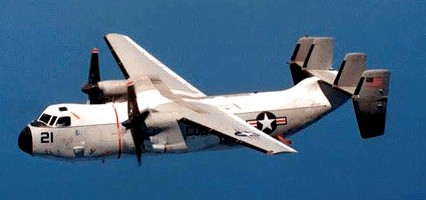
Derived from the E-2A Hawkeye, the first of two Greyhound prototypes flew on November 18, 1964.
19 were completed for the US Navy by the end of 1968, including the two prototypes converted from E-2A airframes. The C-2 shares wings and power plants with the E-2 Hawkeye, but has a widened fuselage with a rear loading ramp and replaced the piston-engined C-1 Trader in the COD role.
The original C-2A aircraft were overhauled to extend their operational life in 1973.
The C-2A was produced 1965-1968, followed by the C-2A(R) 1985-1989
58 were built at a unit cost of US$38.96 million
C-2As built after production was resumed in 1983 are based on the E-2C, and have the uprated engines and avionics of the latter. Production C-2As also have a new auxiliary power unit to reduce the need for ground support equipment at remote locations.
Grumman received a $678 million multi-year production contract for 39 additional C-2A twin-turboprop carrier on-board delivery (COD) aircraft from the US Navy in 1983. The first of these was delivered in 1985, and production was to run until 1989.
The C-2A was originally powered by two Allison T56-A-425 turboprop engines and four-bladed Hamilton-Sundstrand constant-speed propellers.
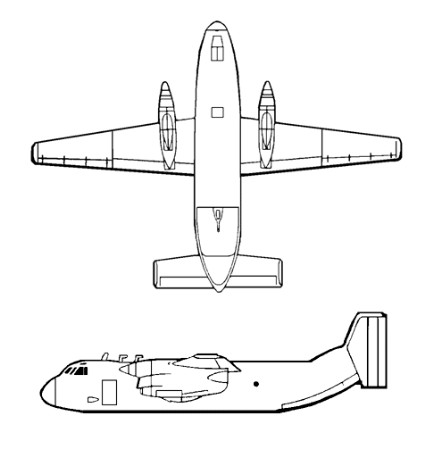
An undercarriage with main gears is fitted to each engine nacelle and at the fuselage’s forward-most portion, a nose wheel is fitted. The wing systems are foldable and twist down, and then fold towards the empennage, just outboard of each engine nacelle, thus improving the carrier storage. Fitted into streamlined nacelles, the engines are mounted under each wing.
Straight-in rear cargo loading and downloading are enabled by the inclusion of a large aft cargo ramp and door, and a powered winch in the design to allow for fast turnarounds. A cage system helps to tie down the cargo and restrain it from the arresting and loads during carrier operation.
Northrop Grumman has equipped the aircraft with modified fowler-type flaps, and hydraulically powered irreversible flight controls with an independent hydraulic backup system.
Ultra-high-frequency (UHF) radio navigation aids such as GPS, TACAN (tactical air navigation), dual VOR (VHF omni-directional range), UHF/DF (ultra-high-frequency / direction finder), LF/ADF (low-frequency / automatic direction finder) and weather radar; and communications equipment such as high frequency (HF) and very high frequency (VHF) were provided in the aircraft. The TCAS, TAWS and ARC-210 (airborne radio communication) radios were added later.
The C-2A has open-ramp flight capability which enables airdrop of personnel and cargo or other supplies from a carrier-launched aircraft. Ground power self-sufficiency in remote areas and an auxiliary power unit onboard for starting the engine give the C-2A high operational versatility.
The C-2A is also an approved special warfare asset. It can airdrop the inflatable combat rubber raiding craft of a SEAL (sea air land) platoon out of its ramp. It deploys the platoon after the release has been made, thus enabling the SEALs to operate in close proximity to enemy camps. The airdrop capability also enables the aircraft’s utility as a search and rescue (SAR) platform to airdrop life rafts and provisions.
In 1984, the Navy ordered 39 new C-2A aircraft to replace older airframes. Dubbed the Reprocured C-2A (C-2A(R)) due to the similarity to the original, the new aircraft has airframe improvements and better avionics. The older C-2As were phased out in 1987, and the last of the new models was delivered in 1990.
Powered by two Allison T56 turboprop engines, the C-2A can deliver up to 10,000 pounds (4,500 kg) of cargo, passengers or both. It can also carry litter patients in medical evacuation missions. A cage system or transport stand restrains cargo during carrier launch and landing. The large aft cargo ramp and door and a powered winch allow straight-in rear cargo loading and unloading for fast turnaround.
Its ability to airdrop supplies and personnel, fold its wings, and generate power for engine starting and other uses provide an operational versatility found in no other cargo aircraft.
The fact that this aircraft has four vertical stabilizers is due to aircraft carrier hangar deck height restrictions. Only three of these stabilizers have working rudders. For adequate directional control of an aircraft of this size, a single rudder would have been too tall. It also places the outboard rudder surfaces directly in line with the propeller wash, providing effective yaw control even as the plane’s airspeed approaches zero, as during takeoff and landing.
Between November 1985 and February 1987, VR-24 (the former Navy Transport Squadron) and its seven reprocured C-2As demonstrated the aircraft’s exceptional operational readiness. The squadron delivered 2,000,000 pounds (910 t) of cargo, 2,000,000 pounds (910 t) of mail and 14,000 passengers in the European and Mediterranean theatres. The C-2A(R) also served the carrier battle groups during Operations Desert Shield and Desert Storm, as well as during Operation Enduring Freedom.
Production of the modernised version began in 1985. Delivered in 1990, the aircraft’s modernisation process included several improvements in the airframe and avionic systems over those in the C-2A.
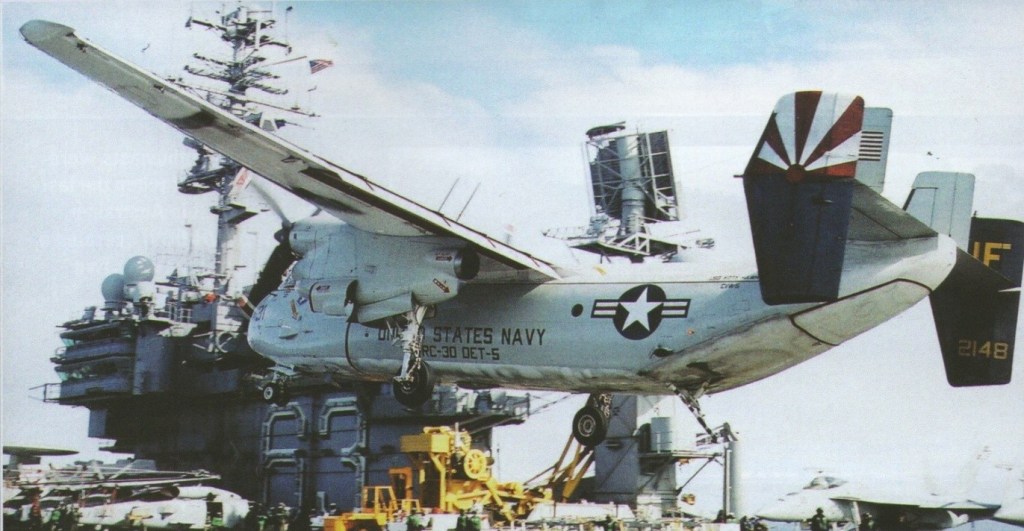
Northrop Grumman is currently working on the resupply of the upgraded C-2A version. In November 2008, the company also obtained a $37m contract for the maintenance, logistics and aviation administration services over five years for the C-2A fleet assigned to air test and evaluation squadron 20 (VX-20) at Patuxent River.
Greyhound service life extension programme (SLEP)
A service life extension programme (SLEP) is being carried out to improve the operating service life of the reprocured aircraft, achieving a viable and economically maintainable platform until it is replaced. The programme will increase its service life from 15,020 to 36,000 landings and from 10,000 to 15,000 flight hours. The SLEP involves structural enhancements to the centre wing, an aircraft rewire, a new propeller system and improvement of the avionics systems.
The eight-bladed NP2000 propeller is another part of this upgrade and was expected to be installed by 2010.
Navigational upgrades such as the addition of a global positioning system (GPS), the dual CAINS II navigation system, crash-survivable flight incident recorders and a ground proximity warning system are also included in the programme.
Further, a mandate issued by Congress and the chief of naval operations provided for incorporation of two passenger-carrying safety requirements, namely the traffic alert and collision avoidance system (TCAS) and the terrain avoidance warning system (TAWS) in the extension programme. The landing limit of most of the airframes is quickly approaching and the SLEP, upon successful completion, will improve the operational life of the aircraft till 2027.
While all the existing fleet of 36 C-2As is being upgraded in the SLEP, the first upgraded C-2A(R) took off from the NAVAIR Depot North Island on 12 September 2005. Development and installation of the SLEP for this aircraft took three and a half years. As of 2009, a second airframe is close to completion, and the rest of the 34 aircraft are anticipated to take off in the following five years.
As of September 2009, the USN was exploring a replacement aircraft for the C-2, including the V-22 Osprey.
The C-2 was operated by Carrier Airborne Early Warning Squadron One Two Zero (VAW-120), Fleet Logistics Support Squadron 30 (VRC-30) and Fleet Logistics Support Squadron 40 (VRC-40). ‘Providers’ at NAS North Island and Detachment Five (at NAF Atsugi, Japan) of VRC-30 are also flying the C-2As. VRC-40 is using the aircraft for its ‘Rawhides’ stationed at NAS Norfolk, while VAW-120 is using the aircraft for its ‘Greyhawks’ stationed at the same location.
VAW-120, the US Navy Fleet Replacement Squadron, was engaged in training aircrew men, naval flight officers and new pilots for the C-2A Greyhound as well as E-2C Hawkeye aircraft.
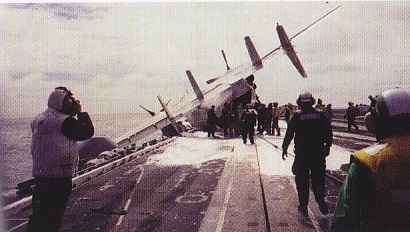
Variants:
C-2A
C-2A(R)
“Reprocured” C-2A
C-2 Greyhound
Primary Function: Transport
Engines: Two Allison T-56-A-425 turboprop, 4,600hp (3,400 kW)
Length: 56 feet, 10 in (17.30 m)
Wingspan: 80 feet, 7 in (24.60 m)
Folded span: 29 feet, 4 in
Height: 15 feet, 10.5 in (4.85 m)
Wing area: 700 sq.ft (65 sq.m)
Empty weight: 33,746 lb (15,310 kg)
Useful load: 20,608 lb (9,350 kg)
Max takeoff weight: 60,000 lb (24,655 kg)
Payload: 10,000 lb cargo or 26 passengers / 12 litter patients
Wing loading: 77.6 lb/sq.ft (378.9 kg/sq.m
Maximum speed: 343 knots (394 mph, 553 km/h) at 12,000 ft (3,660 m)
Cruise speed: 251 knots (289 mph, 465 km/h) at 28,700 ft (8,750 m)
Stall speed: 82 knots (94 mph, 152 km/h) at idle power
Range: 1,300 nm (1,496 mi, 2,400 km)
Service ceiling: 33,500 ft (10,210 m)
Rate of climb: 2,610 ft/min (13.3 m/s)
Crew: 2 pilots, 2 aircrew
C-2A / C-2(R)
Engines: 2 × Allison T56-A-425 turboprop engines; 4,800shp (3,400kW)
Propeller NP2000 eight-blade propeller
Length 56ft 10in (17.3m)
Height 17ft 2in (5.28m)
Wingspan 80ft 7in (24.56m)
Wingspan Folded 29ft 4in (8.94m)
Wing area: 65 sq.m.
Maximum Gross Take-Off Weight 57,500lb (26,082kg)
Empty Weight 35,000lb (15,875kg)
Internal Fuel 12,000lb (5,443kg)
Payload 10,000lb (4,536kg)
Carrier Landing Weight 49,000lb (22,226kg)
Field Take-Off Weight.60,000lb (27,216kg)
Field Landing Weight 52,000lb (23,587kg)
Airspeed 260kt (true cruising airspeed)
Maximum Speed 343kt
Range 1,300nm
Climb Rate 2,610ft a minute (13.3m/s)
Ceiling 30,000ft (9,144m)
T/O run: 665 m.
Ldg run: 435 m.
Fuel internal: 6905 lt.
Range/payload: 1930 km with 4500 kg.
Crew 4 (two pilots and two air-crew)
Capacity 38 (26 passengers and 12 litter patients)
Groen Hawk 6 / Revcon 6G / Cessna Skymaster
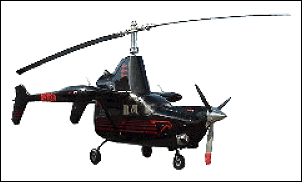
Groen Brothers Aviation, Inc. (GBA) has developed a plan that can rapidly bring the gyrodyne into the modern age. Implementing this plan would enable the design, development, production and delivery of safe, fast, vertical takeoff and landing, long range high payload rotorcraft. These aircraft will have the ability to hover and will be economical, reliable and easy to maintain. This can be accomplished using a tiny fraction of the cost and time that would normally be necessary.
Gyrodyne components and flight control systems can be incorporated into certain existing production high wing airplanes with only small modification to the airframe. The time and cost savings benefits of using an existing production airplane are possible because neither the airframe nor most of its systems will need to be designed, engineered, developed, structural loads measured, analyzed, tested, redesigned and engineered, tested again and then prepared for production. And, since the technology is simple, engineering risks are low.
Groen Brothers Aviation has also developed proprietary mission adaptive rotor blade technology. This technology allows GBA’s rotor systems to be optimized for hover flight and then during transition from hover to forward flight it can change to be optimized for high speed. Load sharing between the rotor and the aircraft’s fixed wing adds to the high speed capability of GBA’s gyrodyne aircraft designs.
Using an airplane that is already in production also means that the production plan, materials management system and massive supplier chain, quality assurance system, tooling, and production line are already in place and do not need to be designed, developed and paid for again, nor will there be a production learning curve to overcome. The only components that will need this development are the tip-jets (which have no moving parts), rotorblades, rotor head, mast and flight control system. Since the airframe is suspended from the rotor exactly from where it is suspended from its wing, in flight loads to the airframe should be virtually unchanged.
This concept was successfully tested by Groen Brothers Aviation through modifying a Cessna Skymaster airplane. It’s two piston engines were removed. The forward engine was replaced with a Rolls-Royce model 250 gas turbine engine, and the aft engine was replaced with a large clam-shell cargo door. The wings were clipped and the existing twin boom tail was inverted to give rotor clearance. The rotor system from one of GBA’s Hawk 4 Gyroplanes was directly connected to the high wing attach points that were already carrying the Skymaster’s fuselage. This conversion, using minimal assets, took less than one year from first conception to first flight. This aircraft demonstrated its exceptional stability and ease of flight, characteristic of a well designed gyroplane.
A technology demonstrator development of the Hawk 4 was announced in late 2000 as Hawk 6G with an expected first flight (prototype N9112A) in January 2001. The first flight was eventually made on 22 September 2001. Based around Cessna 337 fuselage with a single 335kW Rolls-Royce 250-B17F2 turboprop in the nose for propulsion, driving a FC9684C-6RX three-blade propeller, and a Rolls-Royce 250-C18 above the fuselage for rotation. The craft was fitted with an inverted Cessna 337 tailplanes and shortened wing with spoilers and two-blade rotor system from the Hawk 4. External fuel tanks are mounted at wingtips, and are modified Piper PA-24 Comanche wingtip units. Fuel capacity 416 litres. Estimated cruising speed was 209 to 241km/h, and a useful load of 907kg.
Price was US$950.000 in 2003.
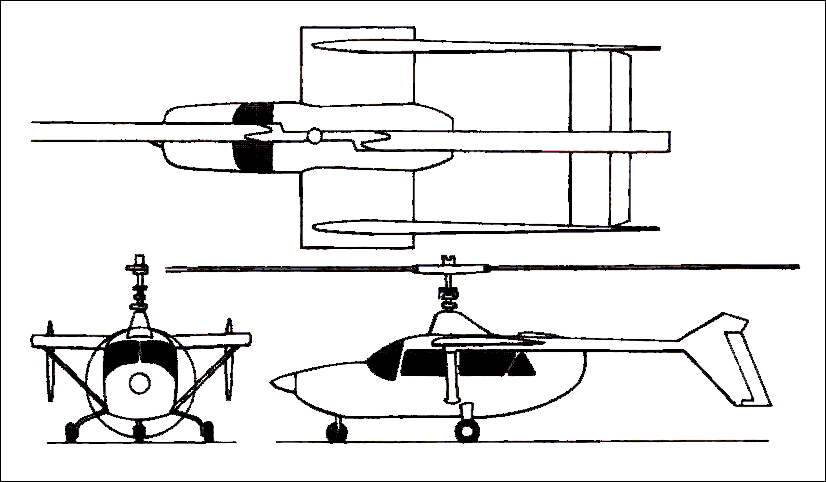
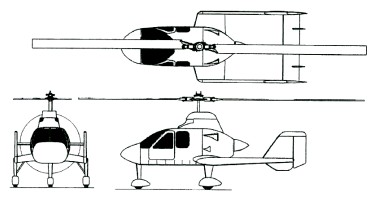
Groen Hawk 5
The Hawk 5 (five place) Gyroplane brings to aviation a unique aircraft with many utilitarian qualities. The Hawk’s performance and exceptional versatility also offer a safe and affordable alternative to helicopters and airplanes in many applications. The aircraft’s simple, robust, design translates into lower operating costs than any comparable turbine powered helicopter. The wide operating speed range, from 46 – 162 mph, of this highly maneuverable gyroplane also ensures the Hawk 5 a new niche in the aviation marketplace. The Hawk 5 design, intended for series production following certification, incorporates modifications gained from GBA’s experience with its Hawk 4 (four place) prototype. These include a weight reduction program and an extended cabin that will permit an additional passenger. Most notably are: higher capacity; vertical take-off and landing; a marked increase in useful load, range and endurance; and higher maximum and cruise speeds. Easy to fly and always in autorotation, the Hawk 5 offers uncompromising safety in the realm of flight.
Engine Rolls-Royce 250 C20S (420shp) gas turbine
Rotor Blade 42 ft. – 2 blade system
Fuselage Length 24 ft.
Height 13.5 ft.
Fuel Capacity 100 gal.
Max. Gross Weight 3,500 lbs.
Useful Load 1,525 lbs.
Rate of Climb (ft./min.) 1,500 Max.
Speed (VNE) 162 mph (140 kts)
Cruise Speed 140 mph (122 kts)
Service Ceiling 16,000 ft.
Range at Cruise 508 miles (no reserve)
Endurance 5 hours (no reserve)
Seats 5
Groen Hawk 4 / Jet Hawk 4T
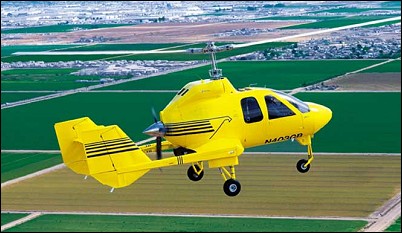
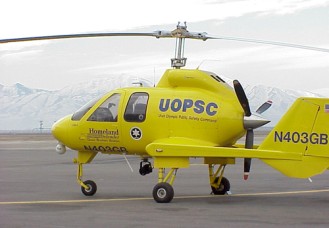
Design changes to H2X and later Hawk III in October 1998 resulted in Hawk 4. Initial aircraft (N402GB) first flew 29 September 1999, powered by a Continental piston engine, and made first vertical take-off on 9 December 1999; had flown 120 hours in 200 sorties by early April 2000. In September 2000 company switched certification effort to turbine-powered Hawk 4T (N403GB), which was renamed Hawk 4 at this time following abandonment of piston-engined version; the following October Groen changed its focus to seek government contracts for Hawk 4, slowing certification process for both piston- and turbine-powered versions until it sees market upturn.
GBA analysises and optimises gyroplane rotor blade airfoil performance resulting in a family of natural laminar-flow airfoils for the rotor blades of the Hawk 4 and successor gyroplanes. The airfoil design optimizes the lift/drag relationship for the Hawk rotor system. Initial Hawk models will use aluminum rotor blades with GBA’s proprietary airfoil design, and subsequent models are anticipated to use composite blades with an enhanced GBA proprietary airfoil design that will permit increased operating speeds.
The aircraft features twin tailbooms supported by stub-wings which also house main landing gear, and twin stabilisers and rudders with fixed horizontal tail surface mounted between the vertical tails. A two-blade, semi-rigid aluminium teetering rotor with swashplate has a rotor speed of 270rpm. The collective pitch-controlled rotor head allows vertical take-off (zero ground roll) and enhanced flight performance. Rotor brake is standard. Actuation by pushrods. Patented dual-control stack cyclic flight controls.
The structure had a steel mast and engine mounts; stressed skin aluminium semi-monocoque fuselage, tail unit, hub structure and propeller; composites nose, engine cowling and wingtips; acrylic windscreen and doors; glass fibre nosecone and engine cowling.
The undercarriage is fixed tricycle type with mainwheel tyres 6.00×6; nosewheel 5.00×5, Cleveland hydraulic brakes, and twin safety wheels at rear of tailbooms.
Hawk 4 piston-powered version has air-cooled, six-cylinder Teledyne Continental TSIO-550 rated at 261kW at 2.700rpm; prototype had four-blade MTV propeller but production models will have Hartzell three-blade constant-speed propeller. Engine provides power to rotor for prerotation to provide for short and vertical take-off capability; power to rotor system never engaged during flight.
Fuel capacity is 284 litres in a single tank at the rear of the fuselage and a refuelling point at the top of the fuselage. Oil capacity 11.4 litres.
The pilot and up to three passengers are in an enclosed cabin in two pairs of seats. The rear seats folding to provide baggage space.
The electrical system is 28V DC.
The production prototype for Hawk series was powered by a 134kW Textron Lycoming O-360-A4M flat-four.
The company has a flight test facility at Buckeye, Arizona, where, on 12 July 2000, the prototype Jet Hawk 4T / Hawk 4 made its initial flight. This turbine-engine version is powered by a Rolls-Royce Model 250 420shp turboprop engine driving a three-blade constant-speed propeller, first flown (N403GB) on 12 July 2000. Other changes include addition of underfins and taller landing gear. Two further prototypes under construction.
The Hawk 4T is sold fully assembled with a Rolls-Royce Model 250 B17C gas turbine for $749,000 in 2001. By May 2003, deposits on 148 aircraft had been taken, via 12 dealerships at around US$749.000 (2003). Fractional ownership programme announced July 2001 but later dropped.
The Hawk 4 was an integral part of security during the 2002 Winter Olympic and Paralympic Games. On 28 December 2001, Groen announced contract with Utah Olympic Public Safety Command for lease of Hawk 4, beginning 20 January 2002, for security patrols at Salt Lake International Airport, equipped with video downlink system, Spectrolab SX-5 searchlight and additional radios. The Hawk 4, during its operational period for the Utah Olympic Public Safety Command (UOPSC), was available 24-7, completed 67 missions and accumulated 75 hours of maintenance free flight time.
Hawk H4
Engine: Rolls-Royce 250, 420shp
Rotor diameter: 12.80m
Fuselage length: 7.31m
Overall height: 4.11m
Empty weight: 835kg
Max. take-off weight: 1587kg
Useful load: 960 lb
Fuel capacity: 75 USgal
Max. speed: 238km/h
Cruising speed at 75% power: 212km/h
Max. rate of climb at sea level: 457m/min
Service seiling: 4875m
Take-off run: 8m
Range with max fuel at 75% power: 584km
Grob G-500 / G-520 Egrett
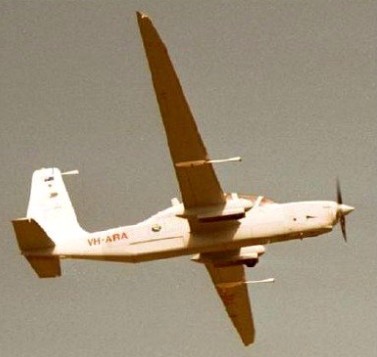
The Grob/E-Systems/AlliedSignal Egrett was a surveillance aircraft developed in Germany in the 1980s by an international partnership. It was intended to fill a joint Luftwaffe-USAF requirement for a high-altitude, long-duration surveillance platform for treaty verification and environmental monitoring.
Germany’s Grob Aircraft, teamed up with E-Systems and Garrett AiResearch, both in the United States. The name EGRETT comes from a combination of the three companies’ names.

According to the publicly available accounts, the official purpose of the program, which the U.S. Air Force reportedly nicknamed Senior Guardian, was to provide a cheaper alternative to the U-2 Dragon Lady spy plane for both treaty verification and environmental monitoring purposes. In the 1980s, the United States and the Soviet Union were negotiating the terms of what would become the Intermediate-Range Nuclear Forces Treaty (INF) and the Treaty on Conventional Armed Forces in Europe (CFE). INF entered force in 1988, while CFE did not go into effect until 1990. Both required robust verification methods.
The turboprop-powered G-520 Egrett and Strato 1 high-altitude and long-duration research platforms are capable of carrying different electronic payloads in 12 separate compartments (first flown June 1987 in G-500 Egrett form.

Grob and the rest of the team ultimately built total of five aircraft in various versions, starting with the prototype D 450 EGRETT, followed two more D 500 EGRETT II aircraft.
The contractors then modified the D 500s into the final G 520 configuration before building a third of these pre-production planes. Finally, Grob produced a two-seat G 520T trainer version.
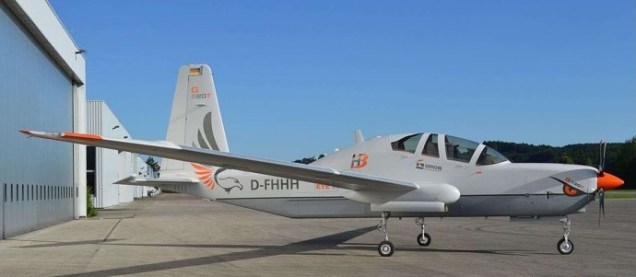
The German manufacturer claims its G 520NG variants has the “lowest operational cost in class.”
The aircraft with its composite airframe was able to carry more than 2,000 pounds of sensors and equipment in any of 12 separate, modular bays, five of which lined the bottom of the fuselage. There was enough room there for turreted day- and night-vision cameras, as well as synthetic aperture radars and other gear.
The G 520 could fly this equipment to an altitude of 50,000 feet. The aircraft has a very narrow cord wing with a span of just more than 108 feet. Depending on the exact load out and flight profile, the plane reportedly could have a range of more than 1,500 miles or loiter over a particular area for up to eight hours.

In the end, the existing prototypes filtered out onto the open market through the original partners. In 1995, Raytheon bought E-Systems, ultimately renaming it as their Intelligence, Information and Services division. The company’s flight test outfit continued flying at least one EGRETT II for some time afterward, providing support to NASA’s Airborne Science Program. According to the Federal Aviation Administration, this aircraft, N520DM, apparently passed to Bear Defense circa 2012.
The D 450 EGRETT aircraft is also still in the U.S. civil registry, listed as N520EG, and property of a company called Gentran Corporation. This Omaha, Nebraska-based “trucking company” has one employee, according to publicly available records. Spotters caught this all-white aircraft in California in 2012 and it does not appear to match the one flying in Indiana earlier in July 2017.

 All Aero