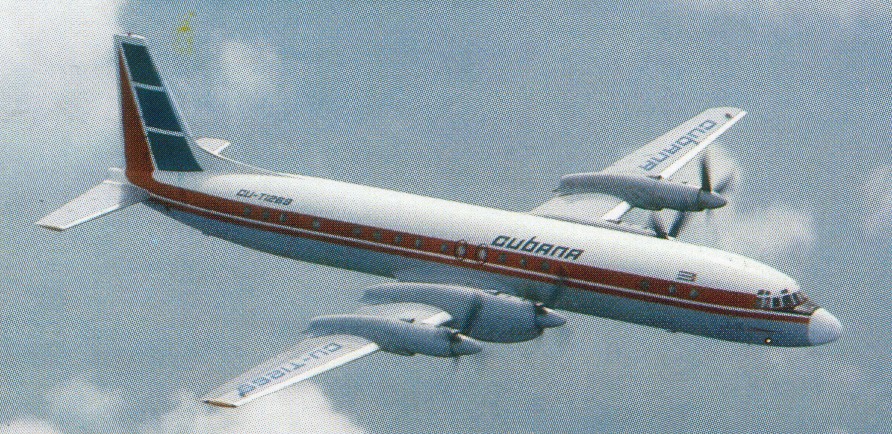
The llyushin Il-18 was developed in the mid-1950s to meet an Aeroflot requirement for a medium-range 75/100-seat transport, and the first prototype flew on 4 July 1957.
Flown for the first time on 4 July 1957, the Il-18 Moskva (Moscow) was originally powered by Kuznetsov NK-4 turboprops, but the Ivchenko AI-20 was adopted as standard at an early production stage.
Production 75-seat models, NATO reporting name ‘Coot’, entered service with Aeroflot in April 1959, and was the nation’s first turboprop airliner.
Aeroflot inaugurated use of the type on its Moscow-Adler and Moscow-Alma-Ata routes on 20 April 1959.
In 1963 Ghana returned four Il-18’s bought in a 1960 order for eight. Ghana decided it needed only four.
Further developments of the model resulted in a number of improvements and growing capacity. The last civil production version, the Il-18D long range variant built from 1965-69, utilised the 4,250 shp AE-20K engine, and could carry 110 or max 122 passengers.
The Il-18 served as s medium haul airliner until the mid to late 1970s. Some remain in Aeroflot service in 1992. Most of the survivors served as aerial laboratories or as transports for industry.
When production ended in 1969, a total of 564 Il-18 airliners of all versions were built in the GAZ-30 Znamya Truda (Banner of Labour) plant at Khodinka in Moscow in the former USSR, and about 120 were exported. Of the total built only small numbers entered military service, primarily for VIP transport.
As Il-18s have been retired from civil use some have been converted into the ECM or electronic intelligence (Elint) ll-20s, and these have the NATO reporting name ‘Coot-A’. It seems likely that the numbers of these aircraft will increase as the turboprop-powered ll-18s are retired from Aeroflot use.
Il-20 Coot-A
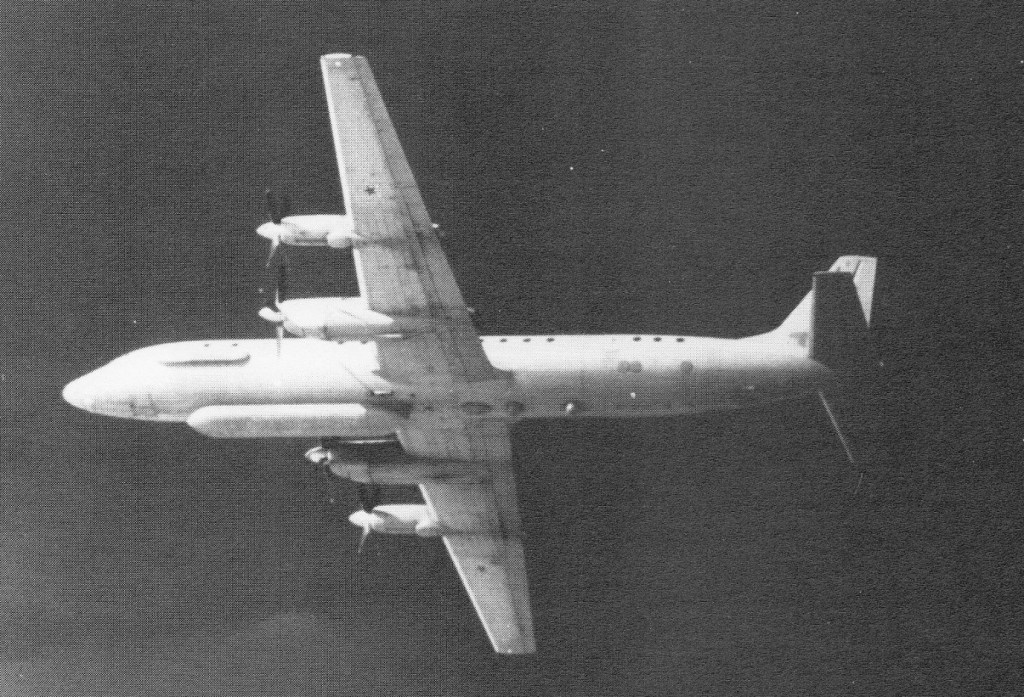
ELINT variants of the Il-18 transport have been operated by SovAir since 1978, and are distinct from the armed Il-38 May derivative. Coot-A has the same airframe as the basic Il-18, and carries SLAR in a large ventral fairing, plus other electronic equipment, camers and sensors for its specialised role. The Il-20 Coot A is a peacetime reconnaissance aircraft fitted with the side looking Igla (Needle) radar in a large underfuselage pad, plus cameras and signal intelligence units. Some twenty aircraft were built between 1969 and 1976. Some were later converted back to the passenger version.
Il-20 Coot-A with SLAR pod under the fuselage
IL- 38 anti-submarine/maritime patrol aircraft also developed from IL-18 and first flew 1961.
IL-20 reconnaissance, electronic intelligence, and communications relay aircraft also developed from IL-18, with the IL-24 civil variant.
Il-18 Engines: 4 x turbo-prop Ivchenko AI-20, 2940kW / 4,250 hp Props: ABI 4 blade 14 ft 9 in dia Max take-off weight: 61200 kg / 134924 lb Empty weight: 34500 kg / 76060 lb Wingspan: 37.4 m / 122 ft 8 in Length: 35.9 m / 117 ft 9 in Height: 10.2 m / 33 ft 6 in Wing area: 140.0 sq.m / 1506.95 sq ft Max. speed: 685 km/h / 426 mph Cruise speed: 650 km/h / 404 mph at 29,500 ft Landing speed: 118 mph Range: 5000 km / 3107 miles Range w/max.fuel: 6500 km / 4039 miles Range w/max.payload: 3700 km / 2299 miles Range at 135,584lb gross: 1550 mi Crew: 5 Passengers: 89-110
Coot-A Engines: 4 x AI-20M turboprop, 4250 shp (3169 kW).
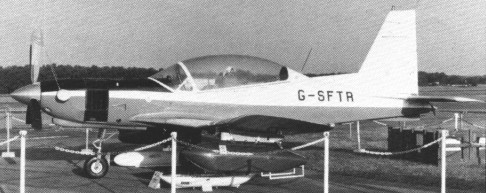
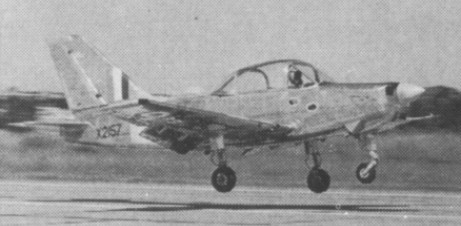
In India, on 6 January 1977, Hindustan Aeronautics flew the first of two prototype HPT 32 basic trainer (X2157). Of all metal construction, the two/three seat basic trainer was suitable for a range of ab initio training and was developed to meet an Indian air force requirement. The Indian Air Force had ordered 40, which were scheduled for delivery in 1985 6.
Known as the Deepak in Indian Air Force service, 134 were built for Indian Air Force and eight for Navy to replace HT-2s.
A private-venture development of the HPT-32, the turboprop HTT-34 side-by-side trainer first flew on June 17, 1984. The HTT-34 has an Allison 250-B17D engine in place of the original Lycoming AEIO-540 piston unit, but is virtually unchanged aft of the firewall.
HPT-32 Engine: 1 x Lycoming AEIO-540, 195 kW. Span: 9.5 m. Length: 7.7 m. Wing area: 15 sq.m. Empty wt: 890 kg. MTOW: 1250 kg. Warload: 255 kg. Max speed: 265 kph. Initial ROC: 335 m / min. Ceiling: 5500 m. T/O run (to 15m): 545 m. Ldg run (from 15m): 487 m. Fuel internal: 220 lt. Range/Endurance: 740 km / 4 hr.
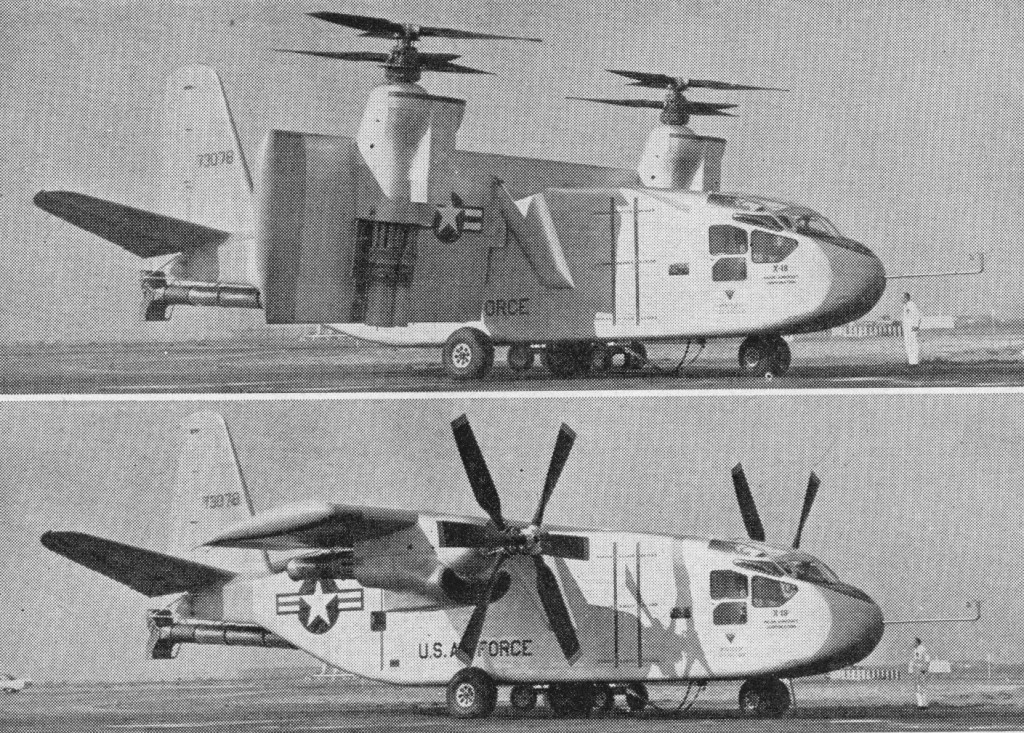
A prototype in the VTOL arena was the 33,000 lb Hiller X-18 tilt-wing convertiplane. The X-18 took to the air for the first time in November 1959, and in overall concept was configured as a transport type. Power was provided by two 5850-shp (4362-kW) Allison T40-A-14 turboshafts driving the two contra-rotating propeller/rotor units located one on each wing, and a 3400-lb (1542-kg) thrust J34 turbojet providing exhaust gases to a tail-mounted thrust diverter used for longitudinal control in vertical flight.
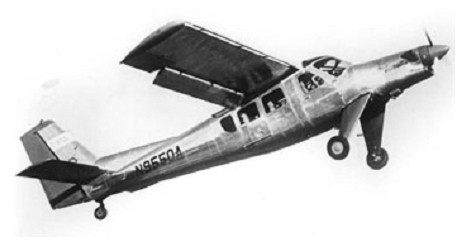
The Stallion is specifically designed for operation from unprepared fields and is equipped with a full complement of STOL devices. Design of the Stallion began in 1963, and the first models were produced in 1966. The Stallion is powered by a single 680-ehp turboprop engine driving a three blade reversible-pitch prop and fed by wing tanks with a capacity of 120 gallons. Its all-metal cantilevered wings are equipped with high lift slotted all-metal flaps, fabric-covered balanced ailerons, and full-span automatic leading-edge slats. The tail unit features a one-piece horizontal surface with combined trim and antibalance tab. The cabin is protected by a crash-resistant tubular frame. The Stallion’s accommodations provide for a pilot and copilot up front with either eight passengers on bench seats or six passengers seated individually. Access is made through a door on the port side near the pilot, an optional starboard door, and a double cargo door on the port side. The double door is in two sections—the forward half hinges and the rear half slides. The rear half can be opened during flight for cargo drops or parachutists.
THE Credible Chase programme, an off shoot of Pave Coin, in which a number of aircraft were evaluated by the USAAF at Eglin AFB in order to come up with a new light-strike attack aircraft for the South Vietnamese Air Force, resulted in a 15 each order for the Helio Stallion and Fairchild Peacemaker. These aircraft, carrying the designations AU 24 and AU 23 respectively, are militarised versions of their commercial counterparts, but have increased gross weights, underwing and fuselage hardpoints and Gatling guns firing from the cabin doors. In the case of the Helio AU 24 the prototype was modified and tested by Kaman Aerospace under contract from Helio, although Helio supplied the test pilot. Kaman has stressed the aircraft to a new gross weight of 6,300lb, 2,860kg as well as adding two hardpoints under each wing and one fuselage centreline point. The AU 24 can carry 300lb, 135kg on the outboard pylons and 600lb, 270kg inboard, plus 500lb, 225kg on the fuselage centreline. Ordnance can include single bombs, cluster bombs, FFAR launchers and machine gun pods. The AU 24 is powered by a UAC PT6A 27 of 680 shp, 508kW. The AU 24 has a speed range of from 42 mph, 68km/hr to over 200 mph, 320km/hr. The Stallion is basically the same aircraft as the Courier the wing planform is identical but span is increased from 39ft, 11.9m to 41ft, 12.5m.
H-550A Stallion Engine: P&WAC PT6A-27, 680 hp. Seats: 10. Wing loading: 21.1 lb/sq.ft. Pwr loading: 7.5 lb/hp. Gross wt: 5100 lb. Empty wt: 2860 lb. Equipped useful load: 2090 lb. Payload max fuel: 1280 lb. Range max fuel/cruise: 360 nm/1.9 hr. Range max fuel / range: 483 nm/ 3.5 hr. Service ceiling: 25,000 ft. Max cruise: 179 kt. Max range cruise: 140 kt. Stall: 36-41 kt. 1.3 Vso: 47 kt. ROC: 2200 fpm. Min field length: 750 ft. Takeoff distance (50′) 660 ft Landing distance (50′) 750 ft Fuel cap: 810 lb. Ceiling 25,000 ft
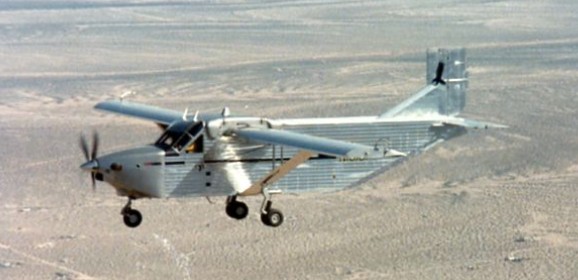
The Hawk GafHawk (“General Aviation Freighter”) was a small, turboprop-powered freighter aircraft developed in the United States in the 1980s but which only flew in prototype form. The first flight was on 19 August 1982.
The GAF-125 was developed by Hawk Industries Inc. from Yucca Valley, CA. This company specialised in equipment and tools for the off-shore oil industry, and was looking for a more efficient way to transport their products all over the country. Road transport was too slow most of the time, and loading their large and unusually-shaped products onto conventional aircraft often posed many expensive and time-consuming problems.
And so in July 1977, the president of the company, Ernest “Ernie” Hauk (not Hawk!), together with designer Larry Stewart, initiated the development of a freighter aircraft that was to overcome these problems. The design was named the GAF-125 GAFHawk, with GAF meaning General Aviation Freighter. The name later changed to GAFHawk 125. The design would have to meet many demands: rear loading door for easy on/off loading, STOL capability for remote airstrips, square-section fuselage for maximum loading efficiency, single engine to lower maintenance time and cost, single-pilot operation etc.
It was designed to be simple, rugged, and have good STOL and rough-field performance. The resulting design was a boxy aircraft with a rectangular-section fuselage with a high-set tail and rear loading ramp. The high aspect-ratio wings were high-set and braced with stuts. The landing gear was fixed and of tricycle configuration, with the main units having dual wheels.
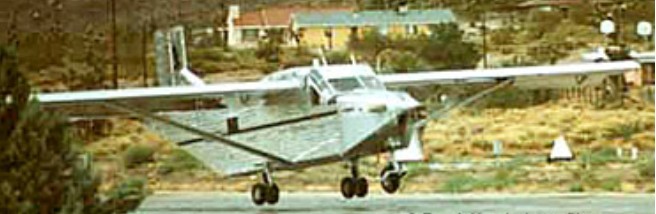
The company obtained 1956-built Piper PA-22-150 Tri-Pacer N6911B (msn 22-4186), which was almost completely disassembled in the workshops of Hawk Industries’ Aircraft Division on Aviation Drive, at the small airport in Yucca Valley, California. The little aircraft was then rebuilt, but in an extensively modified form. It was made to look like a miniature version of the GAFHawk design, to serve as a small scale flying testbed for the GAFHawk’s development. The aircraft was appropriately named the MiniHawk, and first flew in 1978.
Looking like a miniature version of the actual GAFHawk, this little aircraft served as a flying testbed for the GAFHawk’s development. It is now preserved at Roy Williams Airport in Joshua Tree, CA. Photo taken by AirNikon in May 2004.
Based on the lessons learned from the Minihawk, an actual GAF-125 prototype was built, and registered as N101GH on 9 December 1981. This much larger aircraft made a successful first flight on 19 August 1982, powered by a Pratt & Whitney PT6A-45R turboprop engine.
The aircraft division of Hawk Industries was later renamed to Hawk International. Initially they were fairly successful in selling the GAFHawk, but by 1983 the certification process had become exceedingly difficult. Some suggest foul play by certain parties. By 1989 the prototype still hadn’t been fully certificated, although by then 20 firm orders had already been received, as well as options for another 93 aircraft once certification would have been obtained. And despite grave competition from the Cessna 208, there were even plans to develop larger as well as smaller versions of the aircraft. But in 1990 Hawk Industries gave up. Full certification was never obtained, and production was never started. Prototype N101GH remained the only GAFHawk 125 in existence.
Development of the GAFHawk prototype initially stalled by late 1983. Flight testing had been completed, but Hawk Industries continued to have serious problems with certification by the FAA. The deal was that the FAA started requiring testing far beyond what would have been considered normal.
Finally Ernie Hauk started to work with PZL in Poland to build the aircraft there, for the eastern European market. PZL was interested, but negotiations fell apart after they had developed the mount to put their ASz-62IR radial engine on the airframe. PZL did produce one such mount, which was shipped to Yucca Valley, but eventually Ernie Hauk never used it. Negotiations stalled and PZL lost interest. In 1990 the cost estimate to complete certification and preproduction exceeded 20 million dollars, and Ernie gave up completely on certifying and producing the GAFHawk. The PT6 turbine engine was sold and the aircraft was parked engineless at Yucca Valley.
In 1991 Bill Michel lost a DHC-3 Otter (N338D msn 338) in a forced landing, following an engine failure. When he was looking for a replacement aircraft he found the GAFHawk. Bill immediately saw its cargo- and short-field capabilities as a really good answer to the type of flying he did, and in January 1992 he struck a deal with Ernie Hauk to buy the plane, reportedly for “the price of an Otter” without an engine. The deal included that Bill would buy a new PZL engine, complete the install, and he would own the aircraft. Hawk maintained the manufacturing rights. Bill worked the aircraft for about four years with the legality of commercial operation being questionable. Work was started at Yucca Valley to get it ready for flight, and Wild Bill personally installed a brand new PZL radial engine, using the mount that PZL had built for Hawk Industries years earlier and that had not seen any use yet. The first engine Bill used was a factory-new 1,000 hp PZL power plant, bought from MELEX in the USA.
The GAFHawk was originally powered by the 893kW (1,198shp) PT6A-45R turboprop, but in 1992 this was replaced by a Polish-built 853 kW (1,145hp) PZL-Kalisz ASz-62IR-M18/K9-BB radial engine, fitted with a big four-bladed prop.
With most of the work done, Ernie and Bill signed the bill of sale on 5 June 1992. N101GH however remained registered to Hawk Industries Inc. for practical reasons.
A few weeks later, on 28 June 1992, Bill was due to depart Yucca Valley for Sterling, Alaska, which was his home base at the time. The GAFHawk was parked out in front of the hangar, all ready and loaded heavy for the long flight to Alaska, when early that morning, at 04:57 local time, the very powerful 1992 Landers Earthquake struck almost exactly below Yucca Valley. The quake was a hefty 7.3 on the Richter scale, and its epicenter was only 14 km (8.5 miles) due east of Yucca Valley airport. Seismic waves rippled the ground vertically for several long seconds, as if the ground were water, causing the heavy GAFHawk’s left main gear to collapse. The damage took three days to repair, and Bill finally left Yucca Valley for home on 2 July 1992.
During Bill’s operations in Alaska, his original PZL engine was giving him some problems. To solve this he went to the PZL-Kalisz factory in Poland in 1993, and bought a brand-new 1,145 hp PZL ASz-62IR-M18 engine. He had it crated and shipped to Alaska, where it replaced the less powerful radial he had bought from MELEX the year before.
Bill flew the GAFHawk for only a few years. By 1996 he had run into difficulties with the FAA and the aircraft was grounded and placed in storage at Sterling, with less than 270 hours total time on the airframe, and only about 90 hours on its new engine. Bill incorporated his company All West Freight Inc. in August 1997 (but the GAFHawk remained his personal property), and he eventually moved his business from Sterling to his new All West Airport near Delta Junction. He received a permit for his GAFHawk for one ferry flight only, and on 6 October 2002 he flew his rare aircraft out of Sterling to Delta Junction, where it was again placed in storage.
In 2006, N101GH was still registered to Hawk Industries Inc., Yucca Valley, CA, despite having been owned by Bill Michel for 14 years already. However, its registry status was “Undel Tri” (Undeliverable Triennial), which at that time meant that an Aircraft Registration Report, sent by the FAA once every three years, was returned by the Post Office as undeliverable.
The FAA finally grounded the airplane in a unique fashion. The airplane is ok to fly, but Bill can not fly it himself, nor direct its operation by court order. The penalty for noncompliance is forfiture. That is why, in 2007, it was sitting.
Bill ground-ran it in 2004 and 2008, but other than that the aircraft saw no activity at all during these years.
By late 2009 Bill Michel hadn’t been able to make use of his airworthy GAFHawk in any way for about 13 years. It was then that he finally decided to part from it. He agreed to sell it to Jon Anderson, and the purchase agreement was signed on 9 December 2009. The aircraft hadn’t flown since its ferry flight in 2002, and needed quite a bit of work to get it back in the air again. Jon reported:
I serviced the engine, cleaned the spark plugs and magnetos, greased everything, changed out all the windows, did some sheet metal work on some storage damage, rebuilt the brakes, cleaned many components. Had to buy tires, rebuild the landing gear, address prop issues, and buy a new oil cooler. Some of the control cables had stretched and their tension was gone. Still have some work to do, the fiberglass fuel tank needs attention, there are little squawks here and there, as well as the extensive avionics need a massage.
And then, on 27 March 2010, the unique GAFHawk took to the air again, for the aircraft’s first flight in almost 8 years. It was a single short test flight, with “Wild” Bill Michel at the helm and Jon in the right seat as an observer.
On 30 December 2010 the GAFHawk 125 N101GH was officially registered to Jon’s name.
Variants: GafHawk 125 – prototype and intended production version (1 built) GafHawk 950 – enlarged version (not built) TurboHawk 85 – twin-engine version (not built)
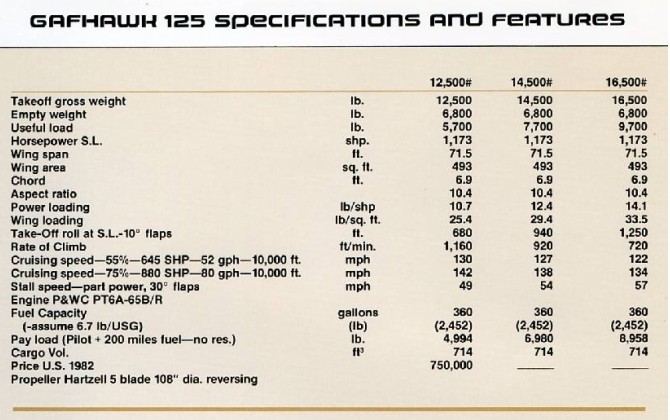
Specifications Powerplant: 1 × Pratt & Whitney Canada PT6A-65B/R, 1,173 hp (875 kW) continuous Prop: Hartzell 5 blade w/reverse Length: 46 ft 11 in (14.30 m) Wingspan: 71 ft 6 in (21.79 m) Height: 18 ft 0 in (5.49 m) Wing area: 493 sq.ft (45.8 m2) Empty weight: 6,800 lb (3,085 kg) Gross weight: 14,500 lb (6,577 kg) Fuel capacity: 360 USG Cruise speed: 138 mph (222 km/h) Range: 824 miles (1,326 km) Service ceiling: 18,000 ft (5,500 m) Rate of climb: 920 ft/min (4.7 m/s) Crew: Two pilots Direct flight controls Flaps: electric
In July 1982 it was reported that the Harbin Aircraft Works had developed a turbine-powered version of the Y-11, with PT6A-110 turboprops. A prototype was reputed to have flown. With a gross weight of 12,125 lb / 5500 kg, the maximum payload is 3748 lb / 1700 kg, and the Y-11T is estimated to have a max speed of 175 mph / 282 kph and a max range of 876 miles / 1410 km.
Developed from the earlier piston-engined Y-11, the twin-PT-6A-powered Y-12 has an enlarged cabin to accommodate up to 17 passengers. A first production batch of 18 aircraft was scheduled for completion by the end of 1986.
The Y-12 prototype first flew in 1982, and there have been three series production versions
Y12 (I) Initial version with 500 shp PT6A-11 engines, 93” diameter propellers, leading edge slats, seating for 17 passengers and a MTOW of 5000 kg.
Y12 (II) Later production version with higher-rated 600 shp PT6A-27 engines, plain leading edge, 98” diameter propellers and MTOW increased to 5300 kg. The UK CAA issued Type Certificate FA49 for this variant in 1990 and examples are in operation in Malaysia and Fiji.
Y12 (IV) Improved model with sweptback wingtips, redesigned seating for 18-19 passengers and max. weight increased to 5700 kg. The Canadian Aerospace Corporation markets a version of the aircraft under the Twin Panda name as a DHC-6 replacement.
The Sri Lankan Air Force ordered six Y-12 turboprop utility transports from China in 1986, and at least two have been delivered to the Chinese Air Force for aerial survey work.
The Y12 was originally produced by Harbin Aircraft Manufacturing Corporation (HAMC), and under Chinese commercial arrangements is marketed by the China Aviation Technology Import and Export Company (CATIC). HAMC has subsequently been reorganised in 1999 as Hafei Aviation Industry Co. Ltd (HAI), responsible for the Y12 and other sub-contract work.
Federal Aviation Administration Type Certificate: A00006WI applies to the Hafei Aviation Industry Company Limited Y12 IV.
Harbin Y 12 II Turbo Panda Engines: 2 x PT 6 A 27, 500 shp Length: 48.885 ft / 14.9 m Height: 18.373 ft / 5.6 m Wingspan: 56.43 ft / 17.2 m Wing area: 369.205 sq.ft / 34.3 sq.m Max take off weight: 11686.5 lb / 5300.0 kg Weight empty: 6262.2 lb / 2840.0 kg Max weight carried: 5424.3 lb / 2460.0 kg Max speed: 158 kt / 292 km/h Cruising speed: 135 kt / 250 km/h Initial climb rate: 1653.54 ft/min / 8.4 m/s Service ceiling: 22966 ft / 7000 m Wing loading: 31.78 lb/sq.ft / 155.0 kg/sq.m Range: 724 nm / 1340 km Crew: 2 Payload: 17pax
Y-12-II Engine: 2 x P&WAC PT6A. Installed pwr: 925 kW. Span: 17.2 m. Length: 14.9 m. Wing area: 34.3 sq.m. Empty wt: 2840 kg. MTOW: 5000 kg. Payload: 1700 kg. Cruise speed: 330 kph. Initial ROC: 528 m / min. Ceiling: 7000 m. T/O run: 180 m. Ldg run: 208 m. Fuel internal: 1600 lt. Range/payload: 1440 km with 800 kg. Capacity: 17 pax.
Y12 IV Engines: 2x Pratt & Whitney Canada PT6A-27 Propellers: 2x Hartzell HC-B3TN-3B/T10173(N)B-3 MCTOW 12,500 lb (5670 kg)
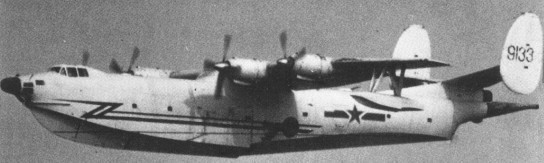
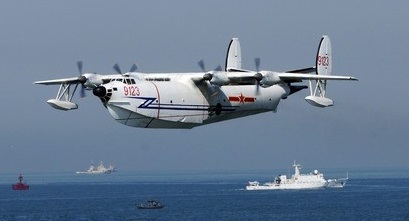
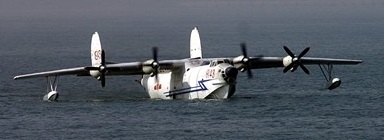
The SH-5 is an indigenous seaplane designed to replace the domestically produced Beriev Be-6s then in PLANAF service. Design work began in 1970, with the new aircraft aimed at performing maritime patrol and search and rescue duties. An entirely new in design, static testing didn’t begin until 1974. The Harbin Shuishang Hongzhaji 5 / PS-5 first flew April 1976, with series production commencing 1984 and 8-9 built to 1987 at Harbin.
The four-turboprop amphibian PS-5 appears to have the wing and powerplant of the Y-8 (An-12) transport and the tailplane and twin fins of the Beriev Be-6, combined with a new fuselage.
Powered by four 3,150 hp WJ¬-5A-1 (AI-24A) turboprops, PS-5S has 22,045-lb (10-tonne) max payload, includ¬ing four torpedoes or AShMs on underwing racks, or up to 13,227 lb (six tonnes) of depth bombs.
The SH-5 saw active use, and several of the aircraft were upgraded with EW systems. One example was converted for use as an aerial firefighter. In 2009, production of a new variant was announced with deliveries planned for 2014.
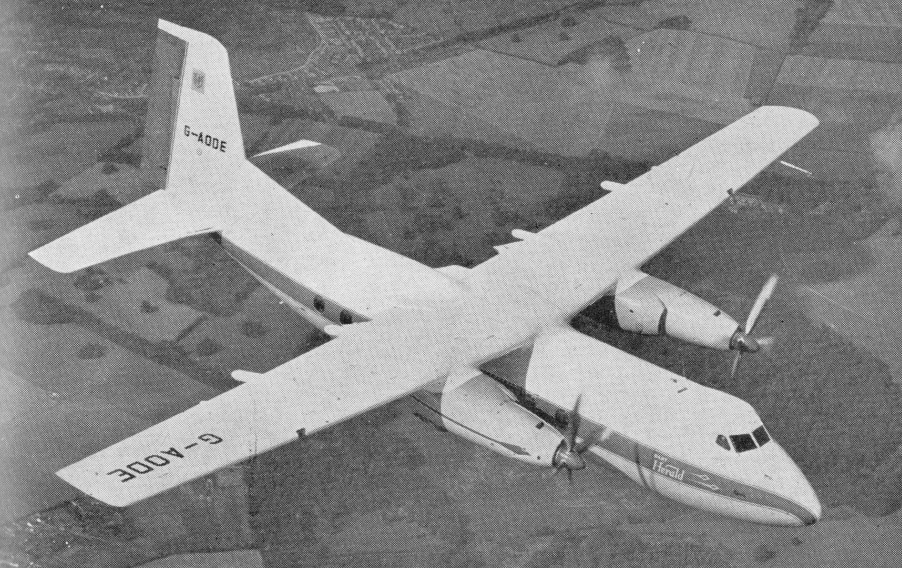
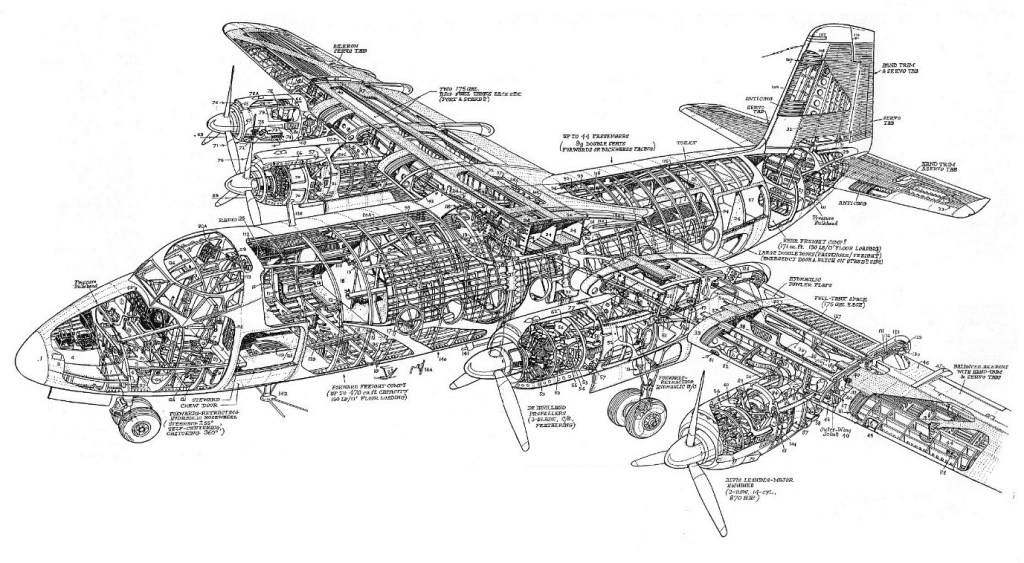
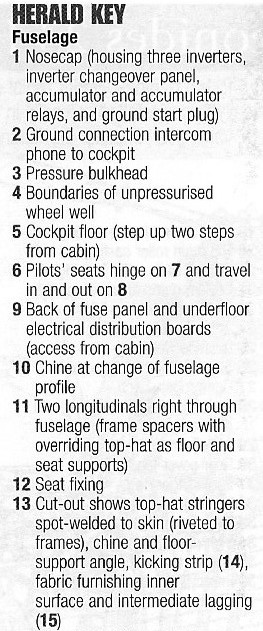
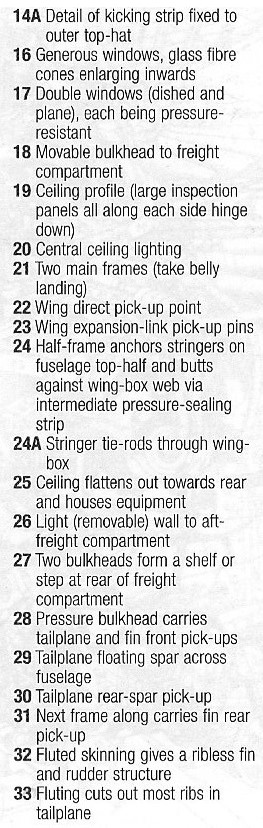
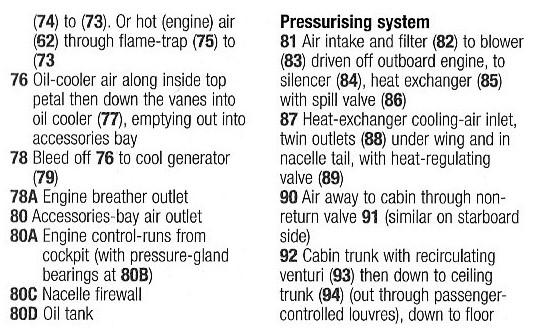
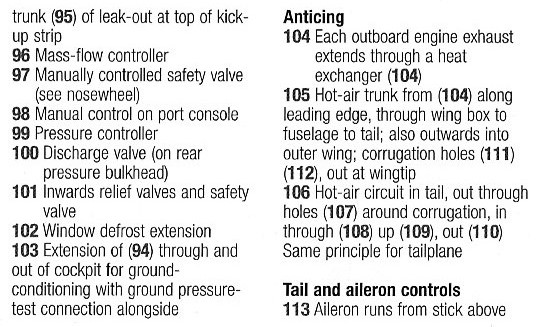
A medium sized transport designed to take the place of the DC 3, the Handley Page HPR 3 Herald design shows an essentially straight forward approach ¬with four piston engines, a high wing layout and a fuselage designed to carry 44 passengers, freight, or mixed loads. It is to be pressurized to a relatively low differential, and will carry a full payload of 10,705 lb. for a no reserve range of 350 st. miles, or 4,650 lb. for a full tank range of 2,050 miles.
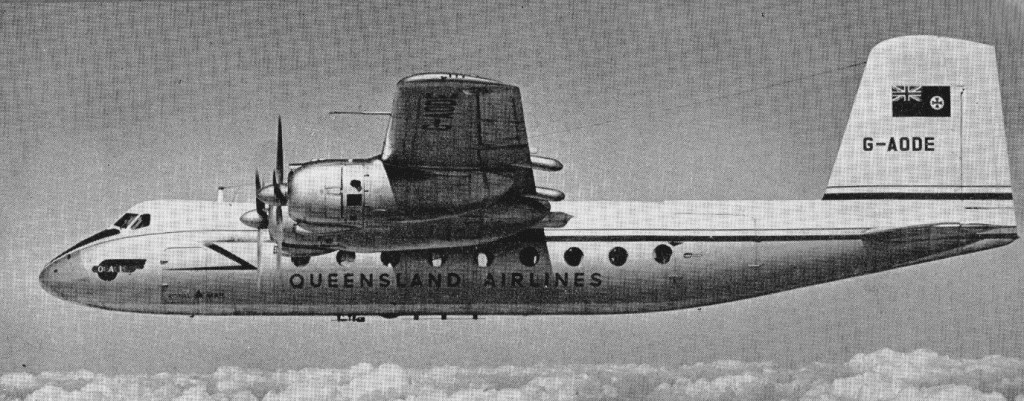
The first Herald, G-AODE, flew on 25 August 1955 from Radlett, powered by four Alvis Leonides piston engines. Airborne for 30 minutes, the pilot was H.G.Hazelden. It appeared at that years SBAC Display.
Handley Page HPR.3 Herald
The first Handley Page Herald completed 125 hours flying in a year and received a Special Category of C of A in 1956.
By 1956 the Herald had been ordered by Queensland Airlines, Australian National Airways, Lloyd Aereo Colombiano and Air Kruise.
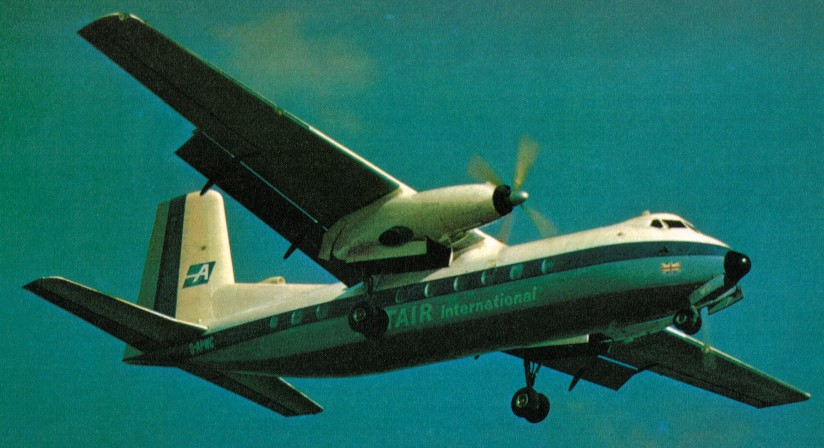
The prototype Dart-engined Herald made its first flight on 11 March 1958 and the first production Herald Series 100 flew on 30 October 1959. The Series 100 accommodated between 38 and 47 passengers. The Series 200 was the main production version with a forward fuselage 1.07m longer than that of the Series 100. Accommodation was provided for 50-56 passengers. Powered by two Rolls-Royce Dart 527 turboprops of 2,150 shaft hp, its maximum cruise speed is 274 mph.
In 1960 Handley Page were offering both the Leonides Major and Dart powered versions.
The Series 300 (a modified Series 200 developed to meet US airworthiness requirements) was followed by the Series 400 military transport with a side loading door and accommodation for 50 troops, paratroops, 24 stretchers or freight, eight of which went to the Royal Malaysian Air Force. The projected Series 500 was followed by the Dart 532/9 turboprop-engined Series 600.
The final two versions were the Series 700 long-range version of the Series 600, accommodating up to 60 passengers or 52 passengers and baggage over 1,980km stages, and the Series 800 military version of the 700. By 1958, when they offered an alternative version powered by Rolls-Royce Dart turboprops, the Fokker F 27 had cornered the market. Only 48 aircraft were produced.
HP(R) HP.3 Herald Engines: 4 x Alvis Leonides Major, 850 bhp Wingspan: 95 ft Length: 70 ft 3 in Mauw: 34,000 lb Max speed: 263 mph
HP Herald Srs 200 Powerplant: two Rolls-Royce Dart RDa.7 M1k. 527 turboprops, 1570kW / 2105 ehp Propellers: Rotol four-blade, fully feathering 12 ft 6 in diameter Wingspan, 94 ft 9 in / 28.88 m Length, 75 ft 6 in / 23.01 m Height, 24 ft 1 in / 7.34 m Gross wing area, 82.31 sq.m / 886 sq.ft Max. usable floor area, 283 sq.ft Max. usable volume, 1802 cu.ft Max. cabin length, 54 ft 0 in Max. width, 8 ft 8.25 in Max. height, 6 ft 3.75 in Accommodation: 50 passengers at 30.5 in pitch; 56 at 30 in pitch. Basic operational 25,758 lb Total fuel, 8640 1b Max. take-off with 5 deg flap, 41000 lb Max. landing, 39,500 lb Max. payload, 11,242 lb Max. zero fuel, 37,500 lb Power loading (max. take-off weight), 10.2 lb/ehp Wing loading (max. take-off weight), 48.5 lb/sq.ft Wing loading (max. landing weight), 44.5 lb/sq.ft Max level speed: 275 mph / 443 kph High-speed cruise, 237 kt. at 15,000 ft Long-range cruise, 230 kt. at 23,000 ft Approach speed, 89 kt Ceiling: 8500 m / 27900 ft Take-off field length, ISA at sea level, 5000 ft Landing field length, ISA at sea level, 3575 ft Range, no reserves, ISA with max fuel, 8602 lb payload, 1 500 nm Range w/max.payload: 1786 km / 1110 miles Crew: 2 Passengers: 50-56
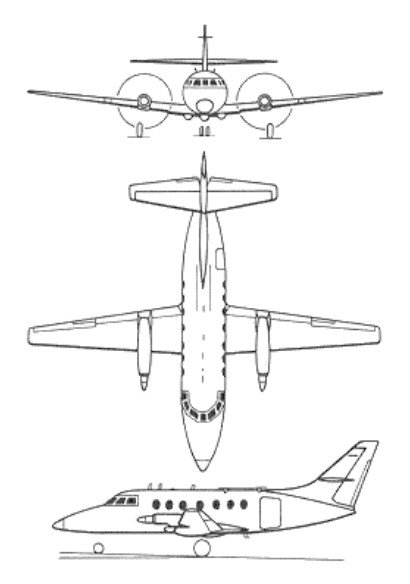
In 1966 feasibility and market studies revealed a definite market for a medium-sized turboprop mini-airliner for commuter and executive use. The H.P.137 Jetstrearn was launched, attracting nearly 200 orders and options in the first year. It even won the United States Air Force contest for the C- 10A transport. But it was a difficult aircraft for a firm used to large and expensive military designs, and development was prolonged. Its airworthiness category imposed a nominal limit in all-up weight which severely affected range/load performance. This was improved with the advent of higher-power engines and a change in category, which allowed take-off weight to rise to the level for which the Jetstream was designed.
The Jetstream had accommodations for a crew of two plus flight attendant and 4-18 passengers. With a diameter of 6 feet, a length of 24 feet, and 613 cu. ft. of usable cabin space, the Jetstream has the largest interior in its class. There is stand-up headroom, ample walkaround space, and 14 windows.
The HP.137 Jetstream was a pressurized 12/18 seat low-wing monoplane with a retractable undercarriage, powered by a pair of 840 hp Turbomeca Astazou XIV turboprops. Before the drawings were complete, Riley placed an order for 20 for the United States feeder liner market.
The prototype H.P.137 (G-ATXH c/n 198) flew first on 18 August 1967 powered by the Astazou XII. The first four aircraft were powered by the French Astazou, the fifth aircraft was fitted with the US-built Garrett AiResearch TPE-331 instead to improve sales prospects in the US. This re-engining lead to an order by the US Air Force for 11 Jetstream 3M or C-10A as a mission support transport aircraft. Early 1969 however this order was cancelled on the grounds of late delivery.
The Jetstream 1 had entered production by this time; with the first production model Jetstream 1 flying on 6 December 1968. Over the next year 36 would be delivered. The Astazou XIV engines however proved to be generally underpowered for the design. Due to these engine problems the Jetstream 1 was re-designed as the Jetstream 2 with more powerful 1073 hp Astazou XIVCs, starting deliveries in late 1969. By this point the late delivery and engine problems had driven costs to £13 million and Handley Page ran into serious financial difficulties. Only three Jetstream 2’s would be completed before Handley Page went bankrupt, and the production line eventually shut down in 1970. Only 39 aircraft had been completed by the time of Handley Page’s collapse in 1970. Although Handley Page was wound up as a company, the Jetstream lived on. Ten further aircraft were completed, five by Jetstream Aircraft and five by Scottish Aviation. In 1971 Scottish Jetstream Ltd was the name of a new company formed by Scottish Aviation and Jetstream Aircraft for the manufacture of the Jetstream twin turboprop transport. Scottish Aviation continued production of the Jetstream 2 although they referred to it as the Jetstream 200.
The Royal Air Force ordered twenty-six Jetstream 200’s as navigation and multi-engine trainers known as the Jetstream T.1. The Royal Navy later subsequently took over some of these as T.2’s. In 1977, Scottish Aviation was nationalized along with the British Aircraft Corp. and Hawker Siddeley Aviation to form British Aerospace.
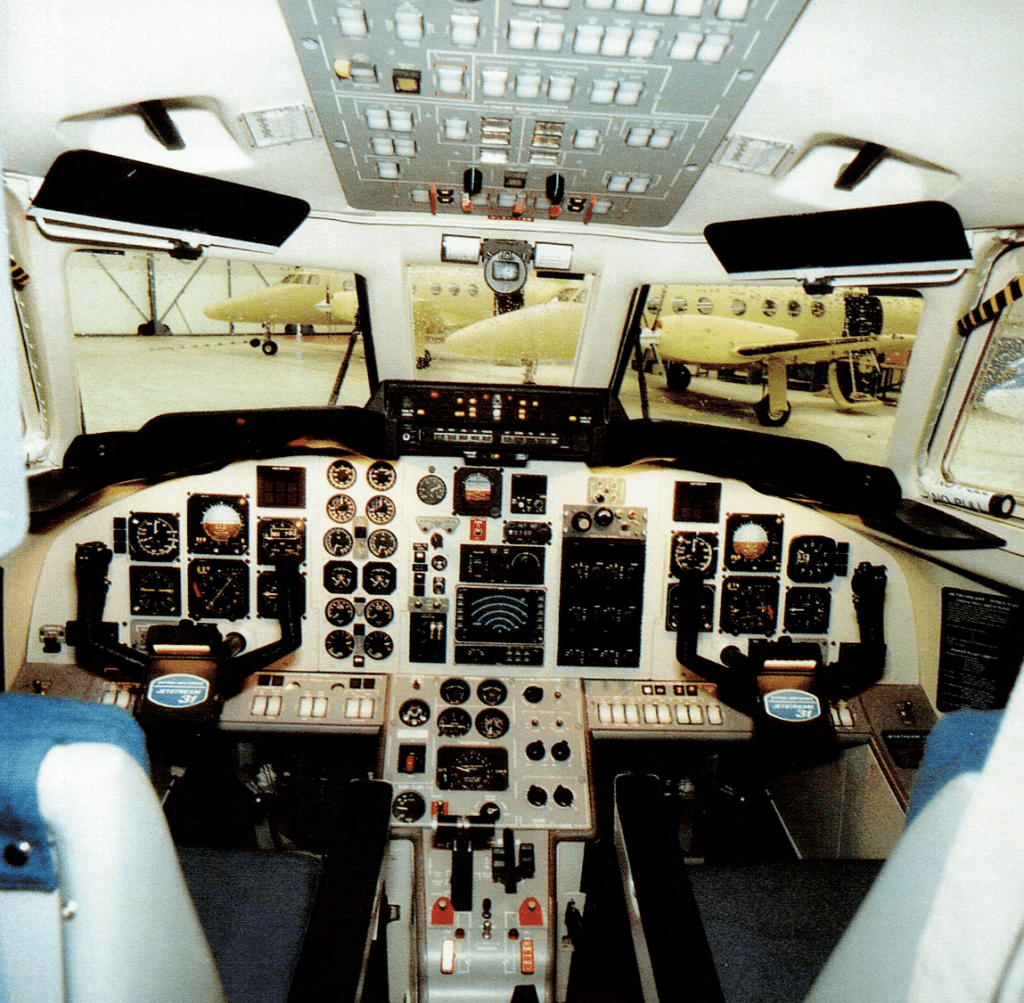
Jetstream 31
BAe decided the design was worth further development, and started work on a “Mark 3” Jetstream. The new version was re-engined with two 1020 hp Garrett TPE331-12UAR turboprops that offered significant advantages over the Turbomeca units. This allowed the aircraft the ability to operate at maximum load from a much greater range of airfields. The prototype of the BAe Jetstream 31, converted from an original HP137 airframe to suit revised FAR requirements for 19-seat commuter aircraft, made its maiden flight on 28 March 1980 (G JSSD) from Prestwick Airport, Scotland and was airborne for 1hr 22min. Aboard on the flight were BAe test pilots Angus McVittie and J. L. S. ‘Len’ Houston, J. R. ‘Bob’ Baker from Garrett-AiResearch and BAe flight test engineer Andrew Eldred.
The new British Aerospace Jetstream 31 entered production 28 March 1980 and is powered by two Garrett AiResearch TPE331 IOU engines and also features advanced technology propellers and new electrical, air conditioning and cockpit systems. By 1994 some 380 had been delivered, 320 of those to the USA. The Royal Navy received four Jetstream 31 twin turboprops, designated T.3, which are used for observer training. These aircraft join 16 Astazou-powered T.2s which are used in similar roles. The T.3s differ not only in having Garrett TPE331 engines, but also in having an underfuselage Racal ASR360 search radar in place of the nose-mounted MEL E90 unit of the T.2. The RAF also used 11 Astazou powered Jetstream T.ls for multi-engine pilot training. Saudi Arabia has bought two Jetstream 31s for tornado crew training.
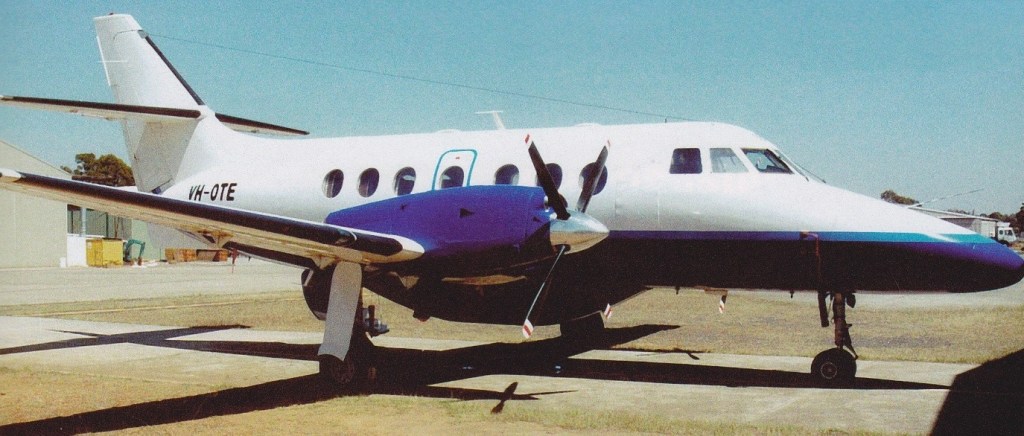
In 1985, development of a further upgrade started resulting in the Jetstream Super 31, also known as the Jetstream 32, with more powerful engines that flew in 1988. The Jetstream 32EP (also known as Jetstream Super 31) was designed to increase the payload and range of the Jetstream 32 in extreme climatic conditions. It provides significant improvements in performance, derived from the use of two upgraded Garrett TPE331-12 turboprop engines flat-rated at 1,020 shp (760 k)XD and driving four-bladed advanced technology propellers.
Jetstream 32EP VH-OTE December 2007, Bankstown, Australia
More than 310 Jetstream 31s and Super 31s had been ordered by 1987. In 1991, the 29-seat Jetstream 41 was introduced. Production of the Jetstream 31/32 ended in 1993, while the production of the Jetstream 41 ended in 1997.
The Handley Page Jetstream came back for another round, as the newly certi¬ficated Century Jetstream III, with 904 shp Garrett AiResearch TPE 331 turboprops in place of the French Astazous. Century Aircraft Corp. of Amarillo, Texas, Jetstream III is air-conditioned and pressurized at 6.5 psi. The conversion to Garrett engines allows a range of 1,920 miles out of a 426-gallon fuel capacity. The engine conversions were performed by Volpar, Inc. in Van Nuys, California.
Jetstreams built since the early start in 1965 until the production ended in 1997 are: 38 H.P.137 Jetstream by Handley Page Ltd; 5 H.P.137 Jetstream by Jetstream Aircraft Ltd; 5 H.P.137 Jetstream by Scottish Aviation Ltd; 26 Jetstream T.1 by Scottish Aviation; 220 Jetstream 31 by British Aerospace; 161 Jetstream Super 31 by British Aerospace; 100 Jetstream 41 by British Aerospace.
HP 137 Jetstream Powerplant: two Turbomeca Astazou XIV, 850 shp / 625kW Propellers: Hamilton Standard three-bladed 8 ft 3 in diameter Wingspan: 15.9 m / 52 ft 2 in Length: 14.7 m / 48 ft 3 in Height: 5.1 m / 16 ft 9 in Wing area: 25.1 sq.m / 270.17 sq ft Max. usable floor area, 85.5 sq.ft Max. usable cabin volume, 564 cu.ft Max. cabin length, 24 ft 3 in Max. width, 6 ft 1 in Max. height, 5 ft 11 in Accommodation: max. high density 18 passengers at 30 in pitch. Basic operational (gross less usable fuel and payload), 8200 lb or 8530 lb / 3869 kg Total fuel, 3120 lb / 456 USG Max take-off weight: 5657 kg / 12472 lb Max. landing, 12,250 lb Max. payload (volume limited), 4000 lb Power loading, 7.76 lb/shp Wing loading (max. take-off weight), 45.4 lb/sq.ft Wing loading (max. landing weight), 45.4 lb/sq.ft Top speed 345 mph. High-speed cruise, 265 kt at 15,000 ft Long-range cruise, 217 kt. at 30,000 ft Stall 84 mph. Take-off field length to 50 ft, ISA at sea level, 2550 ft Landing field length, ISA at sea level, 2130 ft Range with allowances, max. fuel, 1000 lb payload at 217 kt. at 30,000 ft, 1910 nm Range with allowances, max. payload 18 passengers, at 265 kt. at 15,000 ft, 220 nm Initial climb rate 2,100 fpm. Ceiling 30,000 ft.
Jetstream III Engines two 902 shp Garrett AiResearch turboprops Gross wt. 12,500 lb Empty wt. 8,200 lb Fuel capacity 426 USG Cruise mph 300+ Range 1,920 miles Takeoff distance (50′) 2,500 ft Landing distance (50′) 1,000 ft Seats 4-18.
British Aerospace Jetstream 31 Engine : 2 x Garrett TPE 331-10UG, 691 shp Length : 47.146 ft / 14.37 m Height: 17.388 ft / 5.3 m Wingspan : 52.001 ft / 15.85 m Wing area : 271.253 sq.ft / 25.2 sq.m Max take off weight : 15324.8 lb / 6950.0 kg Weight empty : 9613.8 lb / 4360.0 kg Max. weight carried : 5711.0 lb / 2590.0 kg Max. speed : 264 kts / 488 km/h Landing speed : 86 kts / 159 km/h Cruising speed : 230 kts / 426 km/h Initial climb rate : 2066.93 ft/min / 10.50 m/s Service ceiling : 25000 ft / 7620 m Wing load : 56.58 lb/sq.ft / 276.0 kg/sq.m Range : 675 nm / 1250 km Crew : 2 Payload : 19PAX / 1805kg
BAe Jetstream 3100 First built: 1982. Engines: 2 x Garrett TPE 331-10V-501H, 940 shp. Props: Dowty-Rotol 4-blade, 106-in. Seats: 9/18. Length: 47.1 ft. Height: 17.5 ft. Wingspan: 52 ft. Wing area: 271.3 sq.ft. Wing aspect ratio: 10. Maximum ramp weight: 14,660 lbs. Maximum takeoff weight: 14,550 lbs. Standard empty weight: 9046 lbs. Maximum useful load: 5614 lbs. Maximum landing weight: 14,550 lbs. Wing loading: 53.6 lbs/sq.ft. Power loading: 8.1 lbs/hp. Maximum usable fuel: 3079 lbs. Best rate of climb: 2200 fpm. Service ceiling: 25,000 ft. Max pressurisation differential: 5.5 psi. 8000 ft cabin alt @: 25,000 ft. Maximum single-engine rate of climb: 520 fpm @ 109 kts. Single-engine climb gradient: 286 ft/nm. Single-engine ceiling: 15300 ft. Maximum speed: 267 kts. Normal cruise @ 25,000ft: 230 kts. Fuel flow @ normal cruise: 460 pph. Endurance at normal cruise: 6.1 hrs: Stalling speed clean: 98 kts. Stalling speed gear/flaps down: 86 kts. Turbulent-air penetration speed: 180 kts.
HP Jetstream Mk.1 / Century Jetstream III Engines: 2 x Garrett TPE 331-3U-303, 904 hp. Seats: 10/20. Wing loading: 47 lb/sq.ft. Pwr loading: 6.9 lb/shp. Max TO wt: 12,500 lb. Empty wt: 8,600 lb. Equipped useful load: 3600 lb. Payload max fuel: 528 lb. Max cruise: 489 kt. ROC: 2000 fpm. Min field length: 2310 ft. Cabin press: 6.5 psi. Fuel cap: 3072 lb.












 All Aero