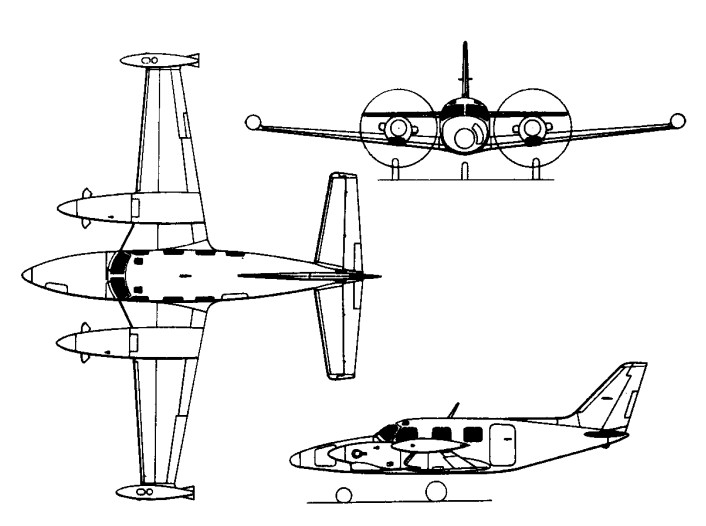
Piper designed this Cheyenne model in the early 1980s to compete with the pro¬posed King Air 350, but ran out of money for development and certified it to lower weight and speed than its ultimate capability. Only 45 were made between 1984 and 1991, although a handful more came out of the Piper factory for Lufthansa trainers.
The PA-41 differs from other, Chieftain-based, Cheyennes with a new airframe and pair of 1000 shp Garrett TPE 331-14-801 big block engines. Counter-rotating Dowty Rotol composite propellers of 106 in diameter transfer the power to the air, giving the 400LS more speed and range than some small jets, with those capabilities being given more weight than large numbers of passengers.
First flown on 20 August 1969, four production PA-31T aircraft were completed and eight ordered by the spring of 1974.
198 PA-31T Cheyenne I were built
Cheyenne I
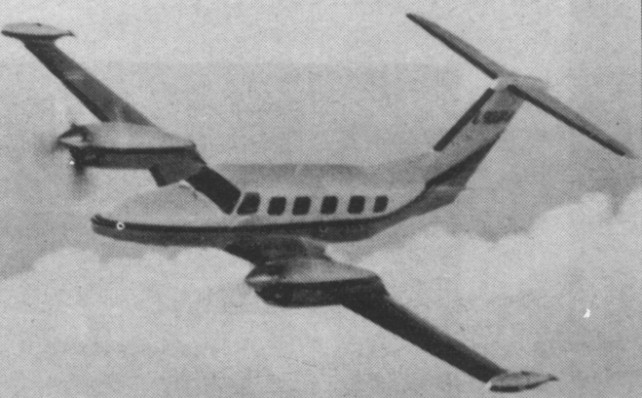
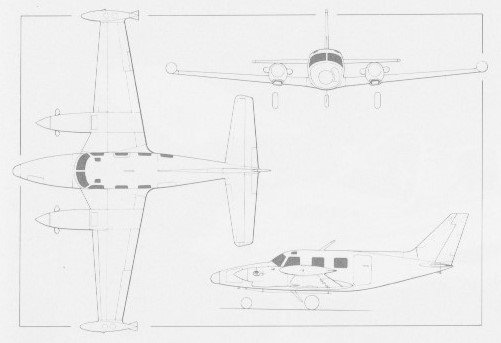
The T-1040 (PA-31-T3) is a turbine powered hybrid combining the fuselage of the Navajo Chieftain with the wing, tail and engines of the Cheyenne 1 A to create a new commuter airliner. Dual controlled and not pressurized, it can carry nine to 11 passengers, the T-1040 was introduced on 25 May 1980.
T-1040 / PA-31-T3
The first production type flew on 17 July 1981, FAA certification was received on 25 February 1981, and deliveries into service during May 1982. The use of wing tip fuel tanks was approved during November 1982. A rear utility door is fitted as standard and an optional 30 cu.ft belly cargo pod was available.
The prototype T-1020 flew for the first time on 25 September 1981, the type was delivered into service during December 1981. Twenty-one T-1020 airliner versions were built.
T-1020
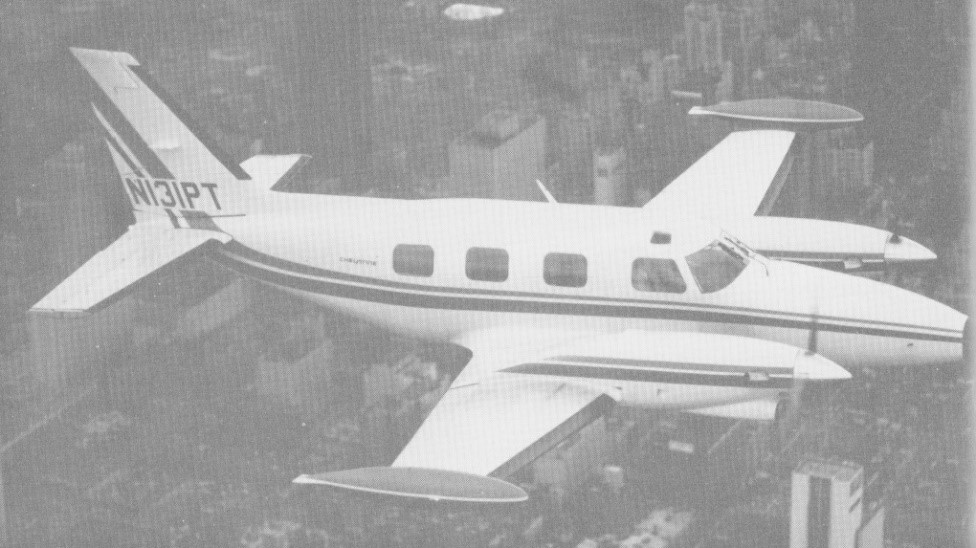
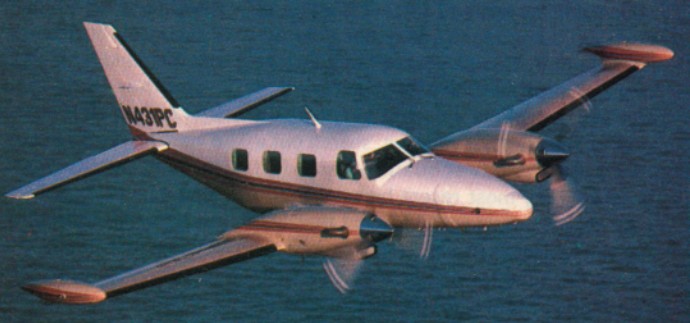
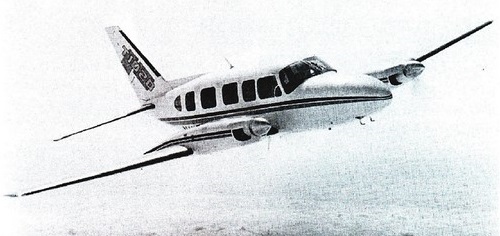
A significant advance in the Navajo family came on 22 October 1973 when Piper flew the first production example of the PA-31T Cheyenne, which combined an airframe generally similar to that of the Pressurized Navajo with two 462kW Pratt & Whitney Aircraft of Canada PT6A-28 turboprop engines. The Piper Cheyenne was certificated in 1974, just as the new surge in turboprops started, the Cheyenne is a product of proven airframe and powerplant technology that dates back to the mid 1960s.
A piston-engined version of the turbine Cheyenne I known as the Mojave was introduced but production ceased that same year after only 50 had been completed.
The first of these models to be marketed was the Cheyenne in 1974 (renamed the Cheyenne II in 1978) when a simplified version known as the Cheyenne I was introduced. Seventeen of the 1983 Cheyenne IA were built.
Production of the PA-31P Pressurized Navajo ended during 1977, at which time a total of 248 had been built, but at the same time the company introduced a new version of the Cheyenne, the PA-31T-1 Cheyenne I, the original Cheyenne then becoming redesignated PA-31T Cheyenne II. Deliveries of the new Cheyenne I, which differed primarily from its predecessor by having 373kW Pratt & Whitney Aircraft of Canada PT6A-11 turboprop engines, began towards the end of April 1978.
When Piper mated the 680 hp Pratt & Whitney PT6A 28 with the airframe of their pressurized Navajo, they produced a turboprop that had an instant heritage. The PT6A 28, which is derated to 620 hp in the Cheyenne II so that takeoff power can be maintained up to 4,800 feet, also powers three models of the King Air. Because of its long and reputable service record, the PT6A 28 is authorized to operate 3,500 hours between overhauls in the Cheyenne. That figure was stipulated principally because Pratt & Whitney felt that the 6,500 hour TBO authorized for commuter aircraft, such as the Beech 99 and the Twin Otter, would allow too long a calendar time between internal inspections, considering that typical business aircraft in the Cheyenne class fly about 600 hours per year.
Since the Cheyenne uses the fuselage design of the pressurized Navajo, the reliability of the pressure vessel and its environmental units (35,000 BTU heater, 23,000 BTU vapor cycle air conditioning system and dehumidifier) has been established, and that should mean reduced maintenance worries for the Cheyenne owner. Furthermore, pressurizing a turboprop is less complicated than is pressurizing a turbosupercharged aircraft, because high pressure bleed air from the engine’s compressor can be mixed with the cool outside air to produce the desired pressure differential, which for the Cheyenne is 5.5 psi.
The thirsty turbine powerplants of the Cheyenne necessitated a redesign of the fuel system, and the result was more than just an increased capacity. The Cheyenne’s 382 USG of usable fuel are contained in two multi celled wing tanks one per side. Although each fuel tank consists of four separate but interconnected tanks, the pilot’s fuel control options are reduced to a simple on/ off/cross-feed arrangement. The three fuel cells located within each wing are filled through an opening in each engine nacelle; they must be serviced before the tip tank, which constitutes the fourth fuel cell for each wing. Gravity causes fuel from the 22 USG tip tank to flow into the wing fuel cells. Therefore, opening a nacelle filler cap when the tip tanks are full will result in some spilling, usually on the offending preflighter. However, checking that the tip tanks are full assures that all the cells are topped, and fuel in the neck of the nacelle filler indicates that the corresponding three wing cells are full to their combined capacity of 173 USG.
Installing 1,240 total horsepower in the Pressurized Navajo’s airframe, which was originally designed to accept 850 hp, necessitated either a larger horizontal stabilizer or an innovative redesign of the flight control system if the required stability criteria were to be met. Piper chose the latter course and installed a relatively simple stability augmentation system that varies the tension in the Cheyenne’s elevator downspring as a function of the aircraft’s angle of attack. Although the Cheyenne’s SAS initially caused some consternation among Piper’s salespeople, who were forced to explain why their machine required an operative stability augmentation system to be airworthy while the competition’s aircraft didn’t, the Cheyenne’s SAS has proved to be a successful and cost effective way of engineering a solution to the classic problem of maintaining stability while increasing the horsepower of an existing design. Price 1976: $623,805.
The T-1040 is a turbine powered hybrid combining the fuselage of the Navajo Chieftain with the wing, tail and engines of the Cheyenne 1 A to create a new commuter airliner. Not pressurized, it can carry nine to 11 passengers.
632 of the Cheyenne II were built, including 24 T-1040 airliner versions.
The Cheyenne range was extended for 1981 by introduction of the PA-31T-2 Cheyenne IIXL, with the fuselage lengthened by 0.61m and 559kW Pratt & Whitney Aircraft of Canada PT6A-135 engines flat-rated to 462kW.
Schafer Aircraft Modifications Inc was founded 1977, and from 1979 developed modifications for other aircraft. Included was installing higher rated turboprops to Piper Cheyenne II as the Schafer Comanchero 750.
Certification: FAA A8EA PA-31T & PA-31T3 31T-740002 to 31T-7620057 31T-7720001 to 31T-7920094 31T-8275001 and up
PA-31T Engines: 2 x PW PT5A-28, 620 shp Wingspan over tip tanks: 42 ft 8.75 in / 13.02 m Length: 34 ft 8 in / 13.02 m Empty weight: 4870 lb / 2209 kg MTOW: 9000 lb / 4082 kg Max cruise at 11000 ft / 3350m at 7600lb/3447kg: 283 kt / 326 mph / 525 kph Econ cruise at 25000 ft / 7620m at 7600lb/3447kg: 184 kt / 212 mph / 341 kph Max ROC SL: 2800 fpm / 853 m/min Service ceiling: 29,000 ft / 8840 m Range max fuel 45min res: 1350 nm / 1555 mi / 2500 km Seats: 8 Cabin length: 16 ft 1 in / 4.90 m Cabin width: 4 ft 3 in / 1.30 m Cabin height: 4 ft 4 in / 1.31 m Cabin volume: 244 cu ft / 6.91 cu.m Front baggage compartment: 20 ft ft / .057 cu.m / 200 lb / 90.7 kg Rear baggage compartment: 22 cu.ft / 0.62 cu.m / 200 lb / 90.7 kg
PA-31T-500T1 Cheyenne I First built: 1978 Engines: 2 x P&W PT6A-11, 500 shp Props: Hartzell 3-blade, 93-in Seats: 7 Length: 34.7 ft Height: 12.8 ft Wingspan: 40.7 ft Wing area: 229 sq.ft Wing aspect ratio: 7.2 Maximum ramp weight: 8750 lb Maximum takeoff weight: 8700 lb Standard empty weight: 4904 lb Maximum useful load: 3843 lb Zero-fuel weight: 7200 lb Maximum landing weight: 8700 lb Wing loading: 38 lbs/sq.ft Power loading: 8.7 lbs/hp Maximum usable fuel: 2559 lb Best rate of climb: 1750 fpm Service ceiling: 28,200 ft Max pressurisation differential: 5.5 psi 8000 ft cabin alt @: 25,000 ft Maximum single-engine rate of climb: 413 fpm @ 110 kt Single-engine climb gradient: 225 ft/nm Single-engine ceiling: 12,500 ft Maximum speed: 243 kt Normal cruise @ 24,000ft: 234 kt Fuel flow @ normal cruise: 412 pph. Endurance at normal cruise: 5.5 hr Stalling speed clean: 84 kt Stalling speed gear/flaps down: 72 kt Turbulent-air penetration speed: 180 kt
PA-31T-620 Cheyenne II First built: 1974 Engines: 2 x P&W PT6A-28, 620 shp TBO: 3,500 hr Props: Hartzell 3-blade, constant speed reversing and full feathering, 93-in Seats: 8 Length: 34 ft. 8 in Height: 12 ft. 9 in Wingspan: 42 ft. 8 in / 13.01 m Wing area: 229 sq.ft / 21.3 sq.m Airfoil: NACA 632-415 at root, 63A212 at tip Aspect ratio: 7.96 Maximum ramp weight: 9050 lb Maximum takeoff weight: 9000 lb Empty weight: 5,331 lb Useful load: 3,719 lb Payload with full fuel: 1,427 lb Ramp weight: 9,050 lb Zero-fuel weight: 7200 lb Maximum landing weight: 9000 lb Wing loading: 39.3 lbs/sq.ft Power loading: 7.26 lb/hp Usable fuel capacity: 382 USG/2,292 lb Baggage capacity: 400 lb Baggage area: 42 cu.ft Best rate of climb: 2710 fpm Certificated ceiling: 31,600 ft Service ceiling: 29,000 ft Single engine service ceiling: 14,600 ft Max pressurisation differential: 5.5 psi 8000 ft cabin alt @: 25,000 ft Maximum single-engine rate of climb: 660 fpm @ 113 kt Single-engine climb gradient: 350 ft/nm Maximum speed: 283 kt Maximum cruise (@ 11,000 ft.): 279 kt Economy cruise (@ 25,000 ft.): 212 kt Range @ maximum cruise (45 min res). 883 nm Range @ economy cruise (45 min res): 1,350 nm Normal cruise @ 24,000ft: 248 kt Fuel flow @ normal cruise: 454 pph Endurance at normal cruise: 5.1 hr Stall speed (clean): 89 kt Stall speed (gear, flaps down): 77 kt Turbulent-air penetration speed: 180 kt Minimum runway requirement: 2,480 ft.
PA-31T-2XL620 Cheyenne IIXL First built: 1981 Engines: 2 x P&W PT6A-135, 620 shp Props: Hartzell 3-blade, 93-in Seats: 6/8 Length: 36.7 ft Height: 12.8 ft Wingspan: 42.7 ft Wing area: 222 sq.ft Wing aspect ratio: 8 Maximum ramp weight: 9540 lb Maximum takeoff weight: 9474 lb Standard empty weight: 5112 lb Maximum useful load: 4428 lb Zero-fuel weight: 7600 lb Maximum landing weight: 9000 lb Wing loading: 41.4 lbs/sq.ft Power loading: 7.6 lbs/hp Maximum usable fuel: 2292 lb Best rate of climb: 1750 fpm Service ceiling: 30,000 ft Max pressurisation differential: 5.5 psi 8000 ft cabin alt @: 25,000 ft Maximum single-engine rate of climb: 470 fpm @ 122 kt Single-engine climb gradient: 231 ft/nm Single-engine ceiling: 14,900 ft Maximum speed: 276 kt Vmca: 91 kt Normal cruise @ 29,000ft: 246 kt Fuel flow @ normal cruise: 394 pph Endurance at normal cruise: 5.3 hr Stalling speed clean: 89 kt Stalling speed gear/flaps down: 80 kt Turbulent-air penetration speed: 187 kt
PA31 T-1020 Commuter First built: 1981 Engine: 2 x Lycoming TIO-540, 350 hp TBO: 1800 hr Prop: Hartzell 3 blade, constant speed 80 in Seats: 11 Length: 34.6 ft. Height: 13 ft Wingspan: 40.7 ft Wing area: 229 sq.ft Wing aspect ratio: 7.2 Max ramp wt: 7045 lb Max take off wt: 7000 lb Standard empty wt: 4450 lb Max useful load: 2550 lb Max landing wt: 7000 lb Wing loading: 30.6 lbs/sq.ft Power loading: 10 lbs/hp Max useable fuel: 636 lb Climb rate: 1120 fpm @ 101 kt Climb gradient: 665 ft/nm Rate of climb @ 8000 ft: 950 fpm Certificated ceiling; 24,000 ft SE rate of climb: 230 fpm @ 106 kt SE climb gradient: 128 ft/nm SE ceiling: 13,700 ft Max speed: 231 kt Cruise @ 65% power @ 8,000ft: 181 kt Fuel flow @ 65% power @ 8,000ft: 185 pph Endurance @ 65% power @ 8,000ft: 3.2 hr Stalling speed clean: 77 kt Stall speed gear/flaps down: 74 kt Turbulent air penetration speed: 160 kt Retractable undercarriage Cabin length: 12 ft 7 in Cabin width: 50 in Cabin height: 51.5 in Cabin floor area: 45.4 sq.ft Cabin volume: 203 cu.ft Cabin door: 46 in x 27.5 in Opt. utility door: 38 in x 17.5 in Nose baggage: 17 cu.ft Nacelle lockers: 13.25 cu.ft each No built: 21
T-1020 Max speed: 272 mph Cruise 10,000ft: 231 mph Cruise 10,000ft eco: 196 mph Stall: 85 mph Climb rate: 1120 fpm Climb rate SE: 230 fpm Service ceiling: 24,000 ft SE service ceiling: 12,100 ft Takeoff run: 1850 ft Takeoff run to 50 ft: 2400 ft Landing run 50ft: 1680 ft Range loaded: 558 mi Fuel capacity: 108 USG Fuel capacity opt: 182 USG Wingspan: 40 ft 8 in Length: 34 ft 7.5 in Height: 13 ft 0in Wing area: 229 sq.ft Empty weight: 4450 lb Loaded weight: 7000 lb Max baggage weight: 700 lb
T-1040 / PA-31-T3 Engine: 2 x Pratt & Whitney PT6A-11, 500 shp Props: Hartzell CS, fully feathering 7 ft 9 in Wingspan: 41 ft 1 in Wing area: 229 sq.ft Wing aspect ratio: 7.4 Length: 36 ft 8 in Height: 13 ft 0in Maximum ramp weight: 9050 lb Maximum takeoff weight: 9000 lb Standard empty weight: 4624 lb Maximum useful load: 2976 lb Zero-fuel weight: 7600 lb Maximum landing weight: 9000 lb Wing loading: 39.3 lbs/sq.ft Power loading: 9 lbs/hp Fuel capacity: 300 USG Fuel capacity opt: 66 USG Tip tank capacity; 336 USG Maximum usable fuel: 2010 lb Max baggage weight: 700 lb Max speed: 280 mph / 243 kt Cruise 11,000ft: 272 mph / 236 kt Fuel flow @ normal cruise: 580 pph Endurance at normal cruise: 3.7 hr Cruise 11,000ft eco: 230 mph Stall clean: 90 mph / 88 kt Stalling speed gear/flaps down: 78 kt Turbulent-air penetration speed: 183 kt Climb rate: 1610 fpm Climb rate SE: 325 fpm @ 115 kt Single-engine climb gradient: 169 ft/nm Service ceiling: 27,900 ft Single-engine ceiling: 12,100 ft Takeoff run to 50 ft: 2650 ft Landing run 50ft: 2100 ft Range loaded: 680 mi Range opt: 1150 mi Nose baggage: 25.0 cu.ft Nacelle lockers: 9.0 cu.ft each Seats: 11
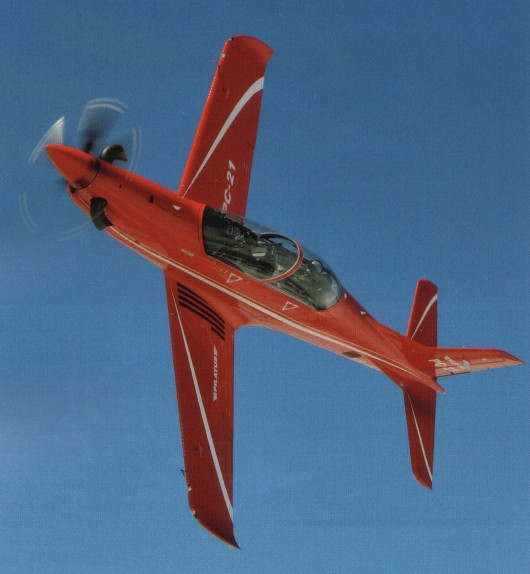
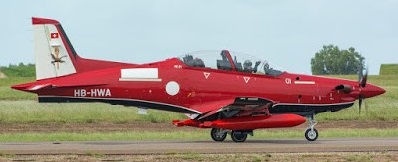
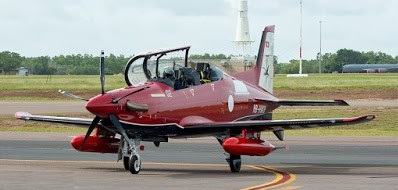
In January 1999 Pilatus launched the development of a completely new training system, the PC-21. The objective was to meet the expectations of modern air forces over the next 30 years both in terms of capability and life-cycle cost.
With this in mind, the PC-21 development specification focused on three core objectives: A superior aerodynamic performance when compared with any other turboprop trainer on the market, a more powerful, flexible and cost effective integrated training system than any other jet or turboprop trainer in the world, and a life-cycle support cost not to exceed current turboprop benchmarks.
The wingspan is 1.1m shorter than the PC-9 wing. The fowler are big enough to allow a stall speed of 81 kts when configured. The small ailerons are hydraulically boosted and are suppoorted by spoilers which begin to deploy at greater than 5 degrees of aileron deflection. The load limit is +8 to –4 G.
The aircraft has been designed to be fast for a turboprop with a maximum speed of 370 kts. The canopy is birdstrike resistant. The wing leading edge is designed to prevent a birdstrike from penetrating deeply into the wing structure by dissipating the energy span-wise. The zero-zero ejection seats are Martin Baker Mk 16s with selectable command ejection options. Oxygen is supplied from an onboard oxygen generation system. The air conditioning system is automatic.
The Pratt & Whitney Canada PT6A-68B 1600 shp / 1195 kW engine power is limited to 900 shp / 670 kW on the ground or below 90 kts. Above 90 kts the power is increased until the full 1600 shp / 1195 kW is reached at 200 kts and above. This is controlled automatically by the power management system.
PC-21 Engine: Pratt & Whitney Canada PT6A-68B 1600 shp / 1195 kW Wing span: 9.11 m Length: 11.23 m Height: 3.91 m Wing area: 15.2 sq.m Basic empty weight: 2280 kg Max take off weight (Aero): 3100 kg Max take off weight (Utility): 4250 kg Max external load: 1150 kg Max loading: +8 / -4 G Max operating speed: 370 KEAS Max operating Mach: 0.72 Max level speed (FL 100 ISA): 337 kt Useable cruise speed: 300 kt Stall: 81 kts
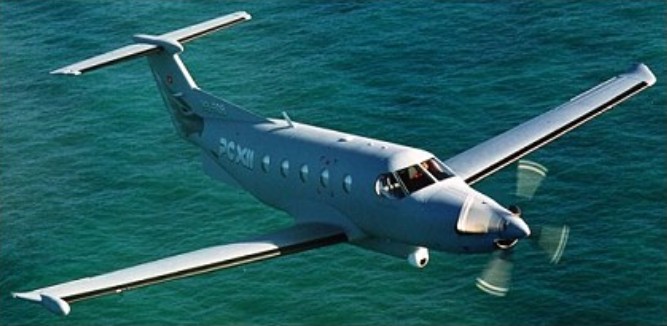
Announced in October 1989, the PC-12’s design has come about after analysis of various missions. Pilatus built two prototypes, the first flying on May 31, 1991, and it took just over 600 flight hours over three years to obtain Swiss certification. US FAA certification was awarded five months after this and the aircraft made its first sale to a US customer the very same day.
The PC- 12 has various internal configurations: a six-seat executive aircraft, a nine-seat corporate commuter, a “combi” carrying four passengers and 210 cu.ft of freight, an all-cargo version with its 330 cu.ft cabin area and the special mission aircraft. With a cabin over 5 metres in length, and a pressurisation differential of 5.75 psi giving a cabin altitude of 9,000 ft at 30,000 ft, the PC-12’s maximum operating certified altitude.
The PC-12’s Pratt & Whitney Canada PT6A-67B turboprop engine is de-rated to 1,200 shp for take-off and 1000 shp in the cruise. Pilatus has improved the engine governor system on the PC- 12 to the point where you simply push the power lever forward for take-off and confirm that the engine is indeed making full power. There is no propeller lever as the four-bladed, aluminium, fully reversible Hartzell propeller is governed to a constant speed of 1,700 rpm. With a diameter of 2.67 m, the propeller clears the ground by only 32 cm at minimum extension.
The digital engine in¬strument system panel, the EIS (engine instrument system), displays all the indicators for the engine, while the overhead panel contains the electrical power management controls and indicators.
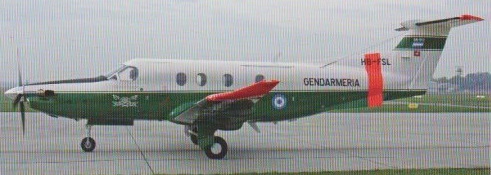
PC-12 HB-FSL
The flight controls are conventional, using push-pull rods and carbon steel cables connected to the pilot’s and copilot’s control wheels and rudder pedals. Electric triple-trim systems assist the pilot in controlling the aircraft around pitch, roll and yaw axes and the aircraft has Fowler flaps that have four operating positions: 0 degrees (up), 15 degrees (take-off), 30 degrees (also take-off) and 40 degrees (landing), with intermediate positions able to be selected. The flaps will stop automatically if an asymmetric condition of more than 5 degrees is detected and the rudder has a yaw damper and an auto-trim system. The PC-12’s landing gear is a conventional tricycle arrangement and has been designed for both grass and rough field operations. The PC- 12 has a very simple fuel system with no fuel management required and the air¬craft has an automatic fuel balance feature. The 1,522 litres of total useable fuel, stored in four integral wing tanks, gives the pilot around eight hours of IFR endurance.
The PC-12 is the first single-engine aircraft to qualify for a stalling speed above 61 knots at a maximum take-off weight of 4,500 kg. The PC- 12 has a stick pusher, which applies 50 lbs of forward pressure, so the aircraft is highly unlikely to be unintentionally stalled. In the landing configuration with gear down and flaps extended, the shaker begins at 65 knots and the pusher at 59 knots. When the aircraft is “clean” the shaker comes in at 90 knots and the pusher at 85 knots. Before the pusher takes effect the two aircraft computers calculate how much the nose must be lowered to avert at stall. When the PC-12 is stalled, it is fairly typical in its behaviour.
Because the PC-12 is considerably electrically dependent it has two generators, which are able to back each other up, and a 43-amp battery. The battery can take the load of one nav/com unit and the GPS for at least an hour after lose of engine electrical power.
In 2000 PC-12 sales increased 25.5% with a total of 69 aircraft delivered.
The PC-12/47 variant has increased maximum weight, modified winglets and other upgrades.
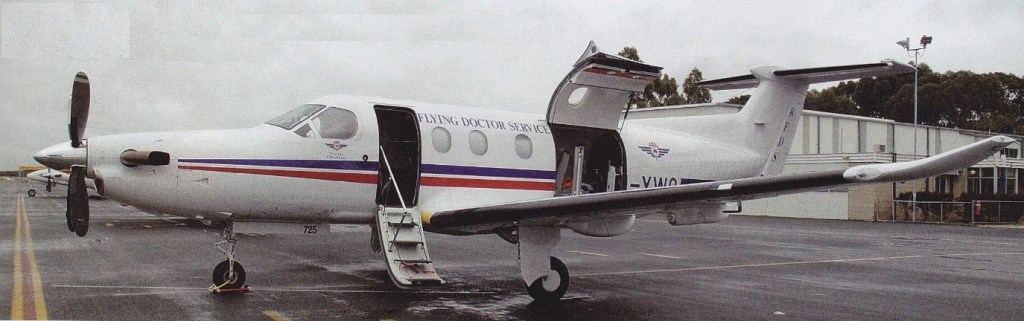
PC-12/47 VH-YWO Jandakot, Australia, November 2006
PC-12 Engine: Pratt & Whitney Canada PT6A-67B turboprop, (max) 1200 shp / 1327kW, (continuous) 1000 shp Wingspan: 53 ft 3 in / 16.23m Length: 47 ft 3 in / 14.4m Height: 14 ft / 4.26m Max ramp weight: 9965 lb Max take-off weight: 4000 kg / 8819 lb Empty weight: 2386 kg / 5260 lb Usable fuel: 1,522 lt / 402 USG Payload: 1150kg / 2535 lb Wing loading: 35.7 lbs./sq. ft Power loading: 8.2 lbs./shp ROC SL: 2000 fpm ROC FL200: 1500 fpm Service ceiling: 7620 m / 25000 ft Max certified alt: 30,000 ft Max operating speed: 240 kts Cruise speed: 497 km/h / 309 mph Max range: 2172 nm Range with 640 kg: 1600 nm Range with 1430 kg: 400 nm Takeoff distance: 1475 ft Landing distance: 945 ft Cabin volume: 330 cu.ft Crew: 1-2 Passengers: 9 Base price: $2,700,000
2009 Pilatus PC-12 NG Base Price: $3.8 million Engine: Pratt & Whitney PT6A-67P, 1200 shp Max Takeoff Weight: 10,450 lb Max Payload: 2866 lb Seats: 6–9 Rate Of Climb: 26.5 min to FL300 Max Certified Altitude: 30,000 ft Max Cruise Speed: 280 kt Fuel Flow @ Max Cruise: 491 lb/hr (73 gph) Takeoff Distance Over 50 Ft. Obstacle: 2650 ft
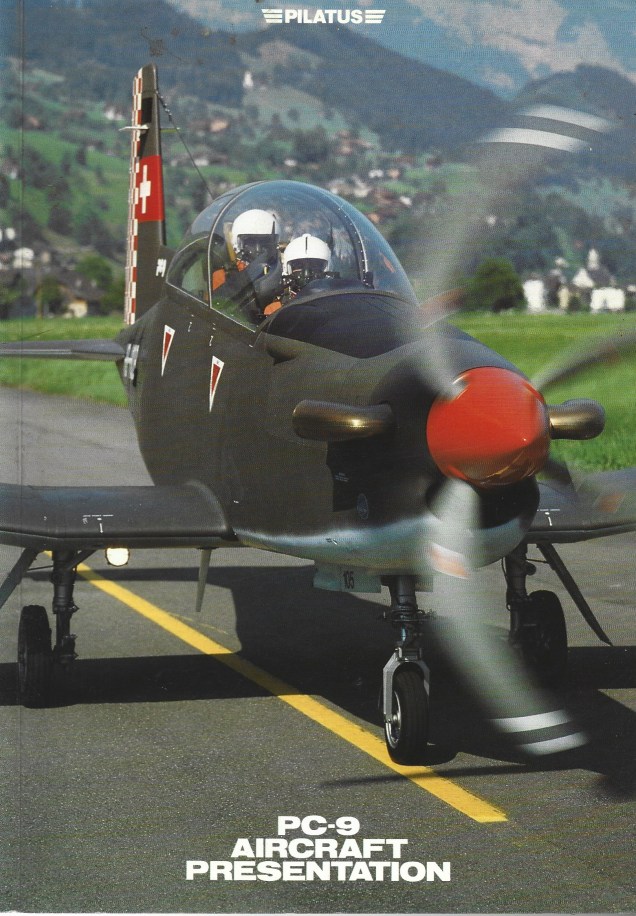
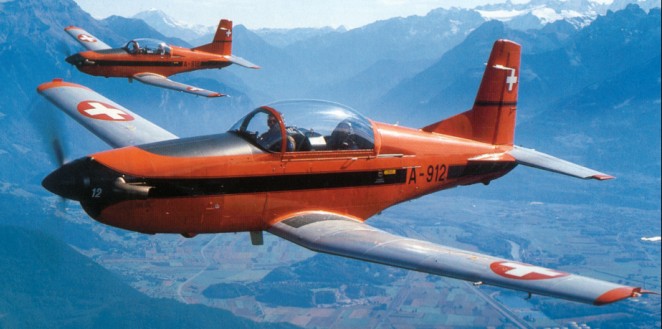
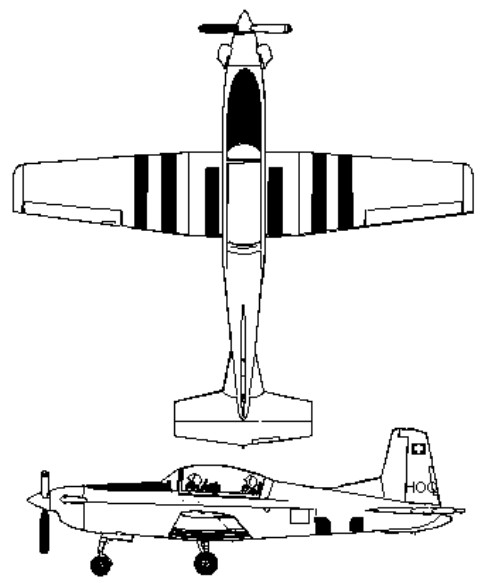
The prototype PC-9 flew on May 7, 1984, and was followed by a second aircraft, to production standard, on July 20, 1984. Although it bears a strong external resemblance to the PC-7, the PC-9 has only ten per cent commonality with the former. Major differences include a ventral airbrake, a reduced span wing with enlarged ailerons, a longer dorsal fin, and undercarriage doors. Compared with the PC-7, the PC-9 has an 857kW PT-6A-62 turboprop engine driving a four-blade propeller which, together with the structural changes, gives a significantly improved performance, including a maximum low-level speed of 496km/hr (268kt), an initial climb rate of 1,247m/min (4,000ft/min), and a time to 4,575m (15,00ft) of 4mm 30sec. Stepped tandem seating is fitted under a revised canopy, with Martin-Baker zero-zero ejection seats. Cleared for erect and inverted spinning.
Pilatus had completed the first PC-9 for Australia by June 1987. Two aircraft will be supplied complete, followed by six in kit form and components for 11 more. Hawker de Havilland and the GAF division of Aerospace Technologies of Australia assembled their first PC-9/A, of 67 PC-9/As for the RAAF, which first flew on 14 November 1987.
By late 1986 126 PC-9s had been sold to five customers.
Orders for more than 150 have been placed by 1990 by a number of air arms including those of Burma and Saudi Arabia. The PC-9 is fully acrobatic and has provision for underwing pylons for light stores.
Pilatus has continually upgraded the PC-9M to improve its operation, while maintaining low life-cycle and acquisition costs. Optimised power mapping and a trim aid device result in outstanding airborne handling. The introduction of large primary and secondary AMLCD flight displays has transformed the PC-9M into a true “glass cockpit” aircraft. The aircraft can also be equipped with a Head Up Display and Video Recording System, which enable the operator to expose students to today’s fighter technology at a very early stage of their training.
By 1993 a total of 140 aircraft were built.
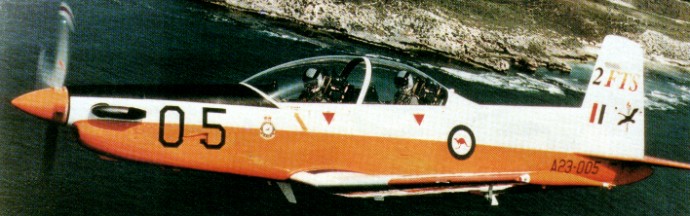
The Royal Australian Air Force’s Pilatus PC-9/A is the major basic training aircraft of the Australian Defence Force (ADF), introduced to the Air Force in 1987. Pilot training in the aircraft commenced in 1989. It was flown by the Central Flying School at RAAF Base East Sale, Victoria, where ADF fixed-wing flying instructors are trained, No 2 Flying Training School at RAAF Base Pearce, Western Australia, where ADF pilots are trained to ‘wings’ stage, and Forward Air Control Development Unit at RAAF Base Williamtown, near Newcastle, to train Joint Terminal Attack Controllers.
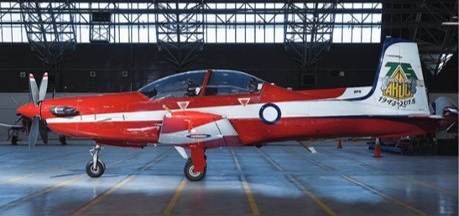
The PC-9/A is flown by the RAAF Roulettes in aerobatic displays at major events throughout Australia. Central Flying School pilots fly six aircraft that comprise the team as a secondary role to their instructional tasks. Central Flying School trains Navy and Air Force pilots to become flying instructors.
At RAAF Base Pearce, trainee ADF pilots, having successfully completed the Basic Flying Course at the ADF Basic Flying Training School at Tamworth, undertake the Advanced Flying Training Course with No 2 Flying Training School, during which they fly 130 hours in the PC-9/A. Upon successful completion, graduates are awarded their wings and posted to a flying squadron.
There are also four modified PC-9/A(F) aircraft in grey paintwork fitted with smoke grenade dispensers for target marking. These aircraft are based at RAAF Base Williamtown, near Newcastle, and are used to train ADF Joint Terminal Attack Controllers (JTACs, formerly forward air controllers), who coordinate air support to troops on the ground.
In 2020 eighteen retired RAAF PC-9A were placed up for auction at Avalon Airport, Victoria, Australia, with bids starting at $1 and no reserve.
PC-9 Crew: 2 Engine: 1 x Pratt & Whitney Canada PT6A-62 turboprop, 950 shp (708 kW) Wingspan: 10.12 m / 33 ft 2 in Length: 10.18 m / 33 ft 3 in Height: 3.26 m / 11 ft 8 in Wing area: 175.453 sq.ft / 16.3 sq.m Max take-off weight: 3200 kg / 7055 lb Empty weight: 1620 kg / 3572 lb Fuel internal: 508 lt Max. speed: 556 km/h / 345 mph Landing speed: 79 kt / 147 km/h Cruising speed: 270 kt / 500 km/h Max operating speed: 320kts IAS Initial climb rate: 3937.01 ft/min / 20.0 m/s Ceiling: 11580 m / 38000 ft Range w/max.fuel: 1642 km / 1020 miles T/O run: 240 m Ldg run: 260 m Endurance: 2 hr Crew: 2
Pilatus PC-9/A Engine: Pratt and Whitney PT6A-62 turboprop, 950 shp / 710kW Length: 10.18m / 33 ft 4 in Height: 3.28m / 10 ft 8 in Wingspan: 10.24m / 33 ft 2in Wing area: 175.3 sq.ft Basic weight: 2250kg MTOW: 2710kg Max speed: 320 kts Cruise speed: 270 kts ROC: 4100 fpm Range (with two underwing tanks): 1,850km Combat radius: 650km Ceiling: 25,000 ft Hardpoints: 2 Crew: 2
Pilatus PC-9/A (F) Engine: Pratt and Whitney PT6A-62 turboprop, 950 shp / 710kW Length: 10.18m / 33 ft 4 in Height: 3.28m / 10 ft 8 in Wingspan: 10.24m / 33 ft 2in Wing area: 175.3 sq.ft Basic weight: 2250kg MTOW: 3210kg Max speed: 320 kts Cruise speed: 270 kts ROC: 4100 fpm Range (with two underwing tanks): 1,850km Combat radius: 650km Ceiling: 25,000 ft Hardpoints: 2 Crew: 2
PC-9M Basic empty weight (typical) 1,725 kg (3,803 lbs) Maximum take-off weight 2,350 kg (5,181 lbs) Maximum external load 1,040 kg (2,292 lbs) Take-off ground roll 247m (810ft) Landing ground roll 352m (1.155ft) Rate of climb 3,880 ft/min Maximum operating speed 320 KCAS Maximum cruise speed 271 KTAS Maximum cruise speed at 10,000 ft 298 KTAS Stall speed – flaps and gear down 69 KCAS Maximum positive g-load +7.0 g Maximum negative g-load -3.5 g Sustained g-load +3.7 g Maximum range (clean) 860 nm Underwing stores 6
Based on PC-3 model, the first prototype flew on April 12, 1966, entering production in 1978. The PT-6A-powered tandem-seat trainer suitable for basic, transition and acrobatic training and, when fitted with suitable equipment, for IFR and tactical training, the first production PC-7 flew on August 18, 1978. PC 7 Turbo Trainers may be armed with four 7,62¬mm machine guns with 500 rpg, two 551 lb (250 kg) bombs.
Late in 1978, an initial contract was placed with Pilatus for eight PC 7 Turbo Trainers for the Colegio del Aire, these arriving in Mexico mid 1979, with a total of 55 aircraft ordered.
Surinam became the 14th military operator of the PC-7 when it took delivery of two aircraft in October 1986. Lightweight Martin-Baker Mk.15 ejection seats are optional on new aircraft, and are also available for retrofit to older aircraft.
More than 380 had been sold by late 1986 and by 1990 more than 400 were in service.
The PC-7 Mk.II began operation in 1994 and was designed to reflect the handling qualities of a PC-9 but with a less powerful engine. The PC-7 Mk.II is designed for all aspects of ab initio and basic training, and covers a limited number of tasks required in advanced flying training.
PC-7 Turbo-Trainer Engine: 1 x P&WAC PT6A-25A turboprop, 550 shp (410 kW). Span: 10.4 m Length: 9.8 m. Wing area: 16.6 sq.m Empty wt: 1330 kg. MTOW: 2700 kg Warload: 1040 kg. Max speed: 500 kph Initial ROC: 630 m / min. Ceiling: 9800 m T/O run: 250 m. Ldg run: 335 m Fuel internal: 480 lt. Range/Endurance: 1350 km / 3 hr 20 min Combat radius lo-lo-lo: 535 km.
PC-7 Mk.II Take-off ground roll: 259m (850ft) Landing ground roll: 335m (1,100ft) Rate of climb: 2,840 ft/min Maximum operating speed: 300 KCAS (556 km/h) Maximum cruise speed: 242 KTAS (448 km/h) Maximum cruise speed at 10,000 ft: 251 KTAS (465 km/h) Stall speed – flaps and gear down: 68 KCAS (126 km/h) Maximum positive g-load: +7.0 g Maximum negative g-load: -3.5 g Sustained g-load: +3.2 g Maximum range (clean): 810 NM Underwing stores: 6 Basic empty weight (typical): 1,670kg (3,682 lbs) Max take-off weight: 2,250kg (4,960 lbs) Maximum external load: 1,040kg (2,292 lbs)
PC-7/CH Engine: 1 x Pratt & Whitney Canada PT6A-25A, 485kW Max take-off weight: 2700 kg / 5953 lb Loaded weight: 1330 kg / 2932 lb Wingspan: 10.4 m / 34 ft 1 in Length: 9.78 m / 32 ft 1 in Height: 3.21 m / 11 ft 6 in Cruise speed: 412 km/h / 256 mph Ceiling: 9755 m / 32000 ft Range w/max.fuel: 2260 km / 1404 miles Crew: 1-2
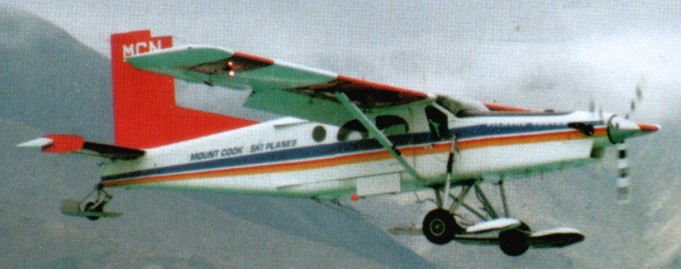
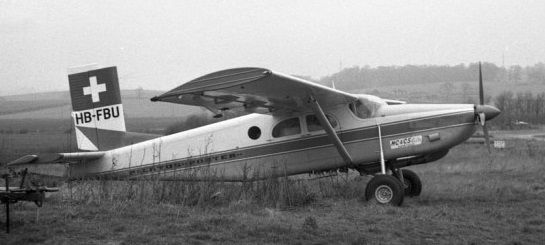
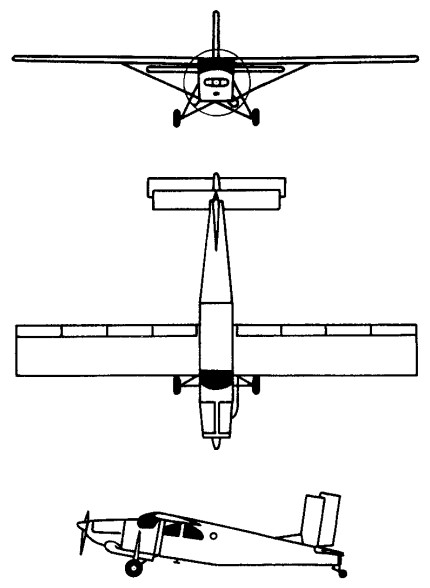
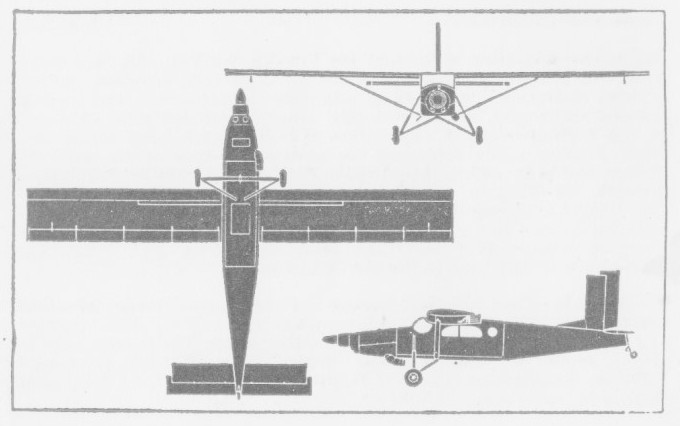
The Pilatus Porter PC 6 first flew on 4 May 1959 and remained in production in 2005. Once marketed as the “Heli Porter” by Fairchild in the US, this name more accurately describes the type’s abilities, although its true success came only after the turboprop engine was introduced to the design from May 1961 onward.
After the first of five prototypes flew on 4 May 1959, a pre-series of twenty aircraft was completed by mid-1961. A second series of twenty had been delivered by mid-1963. One was delivered to the Colombian Air Force.
The PC-6 was available with the 340 hp geared and super-charged GSO-480-B1A6 or the 350 hp geared TGO-540-B1A engines.
The Turbo-Porter development first flew on 2 May 1961, powered by a Astazou IIE turbo-prop.
Entering production in 1961, the Turbo-Porter light STOL utility transport, derived from the piston-engined Porter, has been built in substantial numbers for both civil and military applications. Identical to the earlier PC-6, except the engine, the PC-6A Turbo-Porter is equipped with a Turbomeca Astazou II 530 shp engine in place of the Lycoming GSO-480 of 340 hp. Cruise is 170 mph carrying eight passengers or an 1160 lb payload. Take-off distance is 425 ft and it can be equipped low-pressure tires for grass fields, skies or floats.
Production later changed to the improved Astazou IIG engine.
Fairchild possessed a US manufacturing licence for the Turbo-Porter, and in early 1964 was offering the type, re-engined with a Pratt & Whitney PT6A-6 turboprop. Two Astarzou-powered Turbo Porters were evaluated by the US Army during February-March 1964.
Operated by the US Army as the UV-20A Chiricahua.
In production since 1985, the 1987 production version of the Turbo-Porter was the PC-6/B2-H4, which has an increased payload. This was achieved by improving the aerodynamic efficiency of the aircraft by fitting new wing-tip fairings and an enlarged dorsal fin for increased weights, and is normally fitted with six quickly-removable seats in the main cabin. All PC-6s built since mid-1985 are of the H4 variant. Earlier PC-6/B1-H2s and /B2-H2s can be retrofitted to H4 standard if equipped with an electrical longitudinal trimming system. By mid-1986 456 PC-6s of all models had been delivered to civil and military operators, including those built under licence by Fairchild, as the AU-24 Peacemaker, in the USA.
The Credible Chase programme, an off shoot of Pave Coin, in which a number of aircraft were evaluated by the USAAF at Eglin AFB in order to come up with a new light-strike attack aircraft for the South Vietnamese Air Force, resulted in a 15 each order for the Helio Stallion and Fairchild Peacemaker. These aircraft, carrying the designa¬tions AU 24 and AU 23 respectively, are militarised versions of their commercial counterparts, but have increased gross weights, underwing and fuselage hardpoints and Gatling guns firing from the cabin doors.
Fairchild production of Pilatus Turbo-Porters begun June 1966; 15 of COIN version delivered to USAF as AU-23A Peacemaker, transferred to Royal Thai Air Force.
The PC-6/B1-H2 and B2-H4 were certified under Switzerland Federal Office for Civil Aviation FOCA F 56-10.
More than 480 PC-6s had been delivered by 1990.
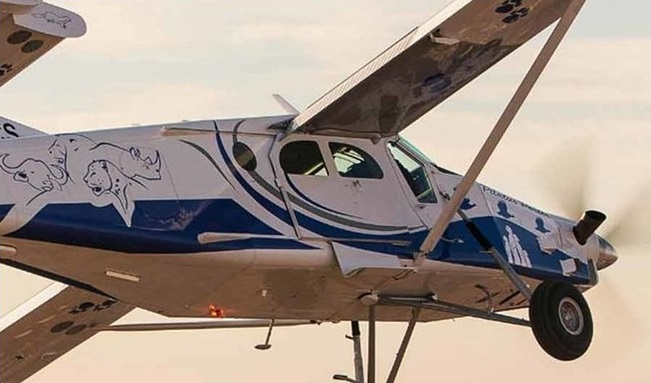
As the certification of the PC-24 Super Versatile Jet got closer, in July 2017 Pilatus announced it was discontinuing the PC-6 Porter. The Porter has seen one of the longest continuous production runs of any airplane model since it first rolled off the line in Switzerland in 1959.
While the production line has been running for nearly six decades, the number of airplanes produced is nowhere near mass-produced. The Swiss manufacturer has delivered a little more than 500 of the multi-mission high-wing airplane and approximately another 100 Porters were produced in the United States under license.
Pilatus said orders have dropped in recent years. Pilatus will continue to take orders for the airplane until mid 2018 and will cease production in early 2019. Pilatus has also committed to supporting the existing fleet for at least the next 20 years. There will be no layoffs of employees as a result of the production termination. Instead, workers from the PC-6 product line will transfer to the PC-24.
PC-6 Porter Engine: Lycoming GSO 480, 340 hp Wingspan: 49 ft 10.5 in Length: 33 ft 5.5 in Height: 10 ft 6 in Wing area: 306.8 sq.ft Empty wight: 2360 lb Loaded weight: 4320 lb Max speed: 143 mph Max cruise: 135 mph Econ cruise: 125 mph ROC: 1025 fpm Service ceiling: 23,950 ft Max range: 750 mi
PC-6 Turbo-Porter Engine: 1 x P&WAC PT6A, 410 kW. Wing span: 15.87 m / 52.07 ft Wing area: 30.15 sq.m / 324.54 sq.ft Overall length: 10.90 m / 35.76 ft Height: 3.20 m / 10.50 ft Track: 3.00 m Empty wt: 1270 kg. MTOW: 2880 kg Payload: 960 kg. Fuel internal: 645 (+490) lt Capacity: 10 pax. Design diving speed (VD): 167 kt Never exceed speed (VNE): 151 kt Design cruising speed (VC): 119 kt Max. flap extended speed (VFE): 95 kt Stall speed (idle power) flaps up (VS): 58 kt Stall (idle power) flaps dn (VSO): 52 kt Max. operating altitude: 25,000 ft Service ceiling (at max. weight): 20,500 ft Max. rate of climb at sea level: 1,010 ft/min Max. rate of climb at 5,000 ft: 935 ft/min Take-off ground roll at sea level: 197 m / 646 ft Take-off dist to 15 m (50 ft): 475 m / 1,558 ft Landing ground roll at sea level: 127 m / 417 ft Landing distance from 15 m (50 ft): 315 m / 1,033 ft Take-off ground roll at sea level: 197 m / 646 ft Take-off distance to 15 m (50 ft): 440 m / 1,443 ft Max. Range at opt. speed, no reserves, at 10,000 ft: 500 nm Endurance at opt. speed, no reserves: 4 h 20 min Max range with underwing tanks: 870 nm Endurance with underwing tanks: 7 h 35 min Average fuel consumption: 148 litres/h (39 US gal/h)
PC-6A H2 Engine: Turbomeca Astazou IIE turboprop, 523 shp. Max speed: 170 mph Normal cruise 80%: 155 mph at 9800 ft ROC: 1700 fpm Service ceiling: 28,000 ft Max range: 620 mi Endurance: 4 hr 20 min Empty weight: 2248 lb MTOW: 4320 lb Wingspan: 49 ft 10.5 in Length: 36 ft 1 in Height: 10 ft 6 in Wing area: 306.8 sq.ft
PC-6-B1-H2 Engine: P&W PT6A-20, 550 shp.
PC 6 B2 Turbo Porter Engine : Pratt & Whittney PT A-27 Length: 36.089 ft / 11.0 m Height : 10.499 ft / 3.2 m Wingspan : 49.869 ft / 15.2 m Wing area : 310.003 sq.ft / 28.8 sq.m Max take off weight : 6107.9 lb / 2770.0 kg Weight empty : 2932.7 lb / 1330.0 kg Max. weight carried : 3175.2 lb / 1440.0 kg Max. speed : 132 kt / 244 km/h Initial climb rate : 1968.5 ft/min / 10.0 m/s Service ceiling : 32808 ft / 10000 m Wing load : 19.68 lb/sq.ft / 96.0 kg/sq.m Range : 721 nm / 1336 km Endurance : 6 h Crew : 1+7
PC-6/B2-H2 Engine: P&WAC PT6A-27, 550 hp / 507kW Wingspan: 15.87 m / 52 ft 1 in Length: 10.9 m / 36 ft 9 in Height: 3.2 m / 11 ft 6 in Wing area: 30.15 sq.m / 324.53 sq ft Wing loading: 15.57 lb/sq.ft Pwr loading: 8.8 lb/hp. Gross wt: 4850 lb Empty wt: 2680 lb. Equipped useful load: 1973 lb Payload max fuel: 851 lb. Range max fuel/cruise: 388 nm/2.9 hr Range max fuel / range: 461 nm/ 3.6 hr. Service ceiling: 30,000 ft Max cruise: 135 kt. Max range cruise: 130 kt Stall: 44-50 kt. 1.3 Vso: 57 kt ROC: 1270 fpm. Min field length: 770 ft Fuel cap: 1122 lb. Seats: 11.
PC-6-B2-H4 Engine: PT6A-27, 680 shp (508 kW) flat-rated at 550 shp (410 kW). Wing area: 29sq.m. MTOW Std: 4850 lb MTOW Special cat: 6000 lb Cruise: 120-135 kt Stall: 44-50 kt. TO run: 370 ft TO 50 ft: 780 ft Range (@4850 lb): 450 nm Payload: 2000 lb. Pax cap: 11
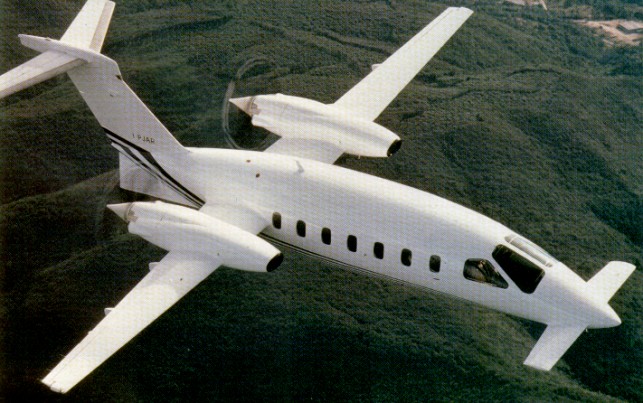
At the 1983 NBAA convention in Dallas, Texas, Piaggio announced a new twin turbo-powered business aircraft. Design work on the P.180 Avanti had begun at Piaggio’s Genoa headquarters in 1979. Seating six to 10 passengers it was a radical departure from anything the company had previously produced. The major design feature of the aircraft is its use of three lifting surfaces. The main wing is fitted above the mid-set position in the fuselage, with the main spar running behind the passenger cabin. Its straight leading edge is broken only by the engine nacelle inlets and the wing has a slight dihedral of 2 degrees. The T-tail and elevator act as the second lifting surface, in addition to being orthodox control surfaces. The foreplane is not a simple canard, but provides a positive lift component in addition to that produced by the wing. This in turn allows the wing to be reduced in size, thus decreasing overall weight and drag.
The engines were originally specified as Pratt & Whitney Canada PT6A-66A turboprops, but these were later changed in favour of more powerful PT6A-61s. Each drives a five-bladed Hartzell fully-feathering reversible-pitch propeller with spinner. The engines are mounted in composite-material nacelles. The Avanti makes considerable use of composites. Carbonfibre and a Graphite/ Epoxy mix represent about 10% of the aircraft’s weight, and all of these components are built by Sikorsky arid Edo. Wings and tail sections are produced by Piaggio at Genoa, while the forward fuselage is the responsibility of Piaggio Aviation in Wichita. Final assembly is completed in Italy. Aircraft intended for the American market are flown ‘green’ to the US to a specialist outfitters and there are plans to eventually assemble all aircraft in the United States. The cockpit is fitted with a Collins EFIS system, comprising three CRTs and Col-lins navigation and weather radar systems are standard. The aircraft is certified for single pilot operations. The main cabin is pressurised and air conditioned, is fitted with a galley and folda-way tables. An emergency exit is situated at the front on the starboard side with the airstairs on the port side.
In 1983 Gates Learjet became a partner in the project, but withdrew for economic reasons in January 1986. All the tooling and the forward fuselages of the three pre-production Avantis which were on the line at Wichita, were then transferred to Italy.
Assembly of the first P.180 began on Piaggio’s Finale Ligne plant in 1986 and the first flight was made on 23 September 1986 (I-PJAV). This was followed by the second aircraft (I-PJAR) on 14 May 1987. The Avanti was certified by the Italian authorities in March 1990, and in May of that year the first production aircraft was rolled out. The final hurdle of US certification was passed in October 1990 and the first customer delivery took place the following September.
Engines: two Pratt & Whitney PT6A-66, 850-shp / 1107kW TBO: 3000 hrs Props: 5 blade 85in counter-rotating Hartzell Wingspan: 14.03 m / 46 ft 0 in Wing area: 172.2 sq.ft / 16.0 sqm Length: 14.41 m / 47 ft 3 in Height: 3.94 m / 13 ft 11 in Max ramp weight: 5262 kg Max take-off weight: 5080 kg / 11200 lb Empty weight: 3384 kg / 7460 lb Max ldg wt: 4965 kg Max zero fuel: 4310 kg Max fuel: 1170 kg Max wing loading: 67.1 lbs/sq.ft Max pwr loading: 6.79 lbs/hp Service ceiling: 12500 m / 41000 ft Vmo: 260 kt Mmo: .67 Mach Max speed: 395 kts Stall (MLW): 93 kt ROC: 2950 fpm SE ROC: 2950 fpm TO dist (50 ft): 2850 ft Ldg dist (50 ft): 2860 ft Max range with res: 1400 nm Seats: 7-11 Cabin ht: 5 ft 9 in Cabin width: 6 ft 1 in Cabin length: 14 ft 7 in
Piaggio Aero P.180 Avanti II Price: $6.8 million 2009 Engine: 2 Pratt & Whitney PT6A-66B: 850 shp (derated from 1630) Max Takeoff Weight: 12,050 lb Useful Load: 4300 lb Max Payload: 2000 lb Empty Weight, Std: 7800 lb Wing Span: 46.03 ft Cabin Height: 5.74 ft Cabin Width: 6.07 ft Cabin Length: 14.93 ft Rate Of Climb: 2950 fpm Max Certified Altitude: 41,000 ft Max IFR Range: 1507 nm Max Cruise Speed: 402 KTAS Takeoff Distance: 2850 ft Landing Distance: 2860 ft
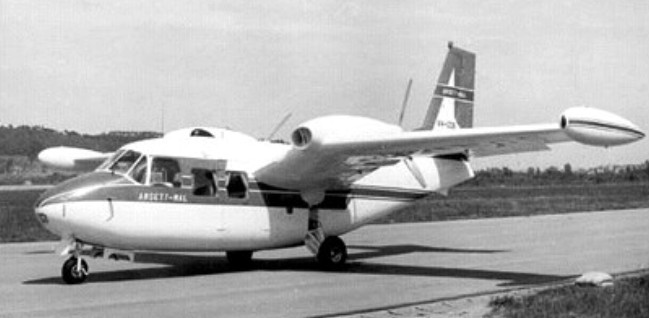
Thirty-two examples of the P.166 twin-engined light transport were produced together with 51 P.166M general-purpose military counterparts (for the Italian Air Force); five P.166B Portofinos; two P.166Cs; 20 P.166S radar-equipped search, surveillance and coastal-patrol aircraft (for the South African Air Force as the Albatross).
P166B ZK-DAI
Production of the Piaggio P.166 in its several piston-engined variants ended in 1973.
The last version was the ten-seat P.166-DL3. A first flight was recorded by the Piaggio P.166 DL3 prototype (I-PJAG) on 3 July 1976. It differed from earlier versions by introducing 438kW Avco Lycoming LTP 101-600 turboprop engines, but these were still mounted in pusher configuration, and was produced for service in the transport role with the Somali Air Force. Four P.166DL-3SFMs were delivered to the Italian Ministry of Merchant Marine to serve as maritime and ecological research aircraft, carrying radar in a 360-deg scan installation under the nose, plus other sensors. The 1987 production version of the P.166, the DL3 can be configured for light tactical transport, medevac, multi engine training, armed counterinsurgency with four underwing pylons, SAR, and maritime reconnaissance with an integrated search/detection / identification / plotting / reporting system.
Kearney and Trecker Royal Gull
The Royal Gull, a twin engine pusher amphib (nee Piaggio P.166) was assembled and distributed by Kearney and Trecker during the late 1950s and early 1960s. Two models offered a choice of a 270 hp or a supercharged 340 hp Lycoming.
Brian Heath 28 Jul 13 Kearney & Trecker Milling Machine Company was — probably still is — located in Milwaukee, Wisconsin. In the 1950’s and 60’s they leased 2 hangers on the west side of General Billy Mitchell Field in Milwaukee next to the Air National Guard with it’s F-86’s. The north hanger housed the business aviation division of the milling machine company. They had a DC-3, a Cessna 182, a Piaggio Royal Gull, and an aero-coupe. Hope I got the names right.
I was 10 years old in 1958 and my dad was the mechanic for the operation, co-pilot on the DC-3, and pilot on the others. They flew milling machine sales people and maintenance people around the eastern U.S. And they often flew the company owners and brass on vacations and fishing trips.
The south hanger housed Kearney & Trecker’s other business investment — a contract with Piaggio in Italy to assemble and sell Royal Gulls. Later the P-166 executive plane was added. My recollection is that the first P-166 at Mitchell Field was a prototype. It was the only one I ever saw, but I did ride in it several times. While the two businesses were legally separate, the mechanics/pilots often consulted with each other.
I recall being there one day when a lively discussion was held between 4 or 5 people about the length of the main forward hull that floats. Mid ship there was a step, and the rear part of the fuselage was not in the water. Some of them, including dad, thought the plane would take off and land better if the floating part of the hull extended back a foot or so. Not everyone agreed, but there was a consensus to try the idea by building a block (out of wood, I think) that would extend the floating hull back. They did that and tried it out. It worked and I think that Piaggio accepted the idea and modified the design.
I went to the airport with dad when there was a vague hope of getting a plane ride. Perhaps he was going to do a short test flight after doing some work. Or perhaps he was flying a low level company person that he knew would not mind a kid on the trip. Sometimes he had to deliver a milling machine part to a customer in, say, New York. On some of those trips I got the right hand seat — several times on the Gull.
I believe it was in the early 60’s that Kearney & Trecker sold a dozen or so of the Royal Gulls to Peru’s air force. They were looking for pilots to deliver the planes and for someone to teach Peru’s pilots and mechanics how to fly and maintain them. Dad volunteered and was selected to fly one plane from Milwaukee to Peru, and then spend a month or so teaching before returning. No, I was not invited. But I thought that what he did was cool. They bought the supercharged engines for going over mountain passes and landing on mountain lakes at over 12,000 feet. Neat planes. Sounds like Kearney & Trecker got out of the airplane business shortly after dad left.
P.166-DL3 Engines: 2 x Lycoming LTP 101-600, 600 shp / 447kW. Props: Hartzell 3-blade, 95-in. Seats: 6/12 Length: 39 ft 4 in Height: 16 ft 5 in / 5 m Wingspan: 48 ft 2 in / 14.69 m Wing area: 285.9 sq.ft / 26.56 sq.m Wing aspect ratio: 7.3 Maximum ramp weight: 9480 lb Maximum takeoff weight: 9480 lb Standard empty weight: 4960 lb Maximum useful load: 4520 lb Zero-fuel weight: 8377 lb Maximum landing weight: 8377 lb Wing loading: 33.2 lbs/sq.ft Power loading: 7.9 lbs/hp Maximum usable fuel: 1698 lb Best rate of climb: 2100 fpm Certificated ceiling: 20,000 ft Maximum single-engine rate of climb: 650 fpm @ 95 kt Single-engine climb gradient: 411 ft/nm Single-engine ceiling: 12,500 ft Maximum speed: 225 kt Normal cruise @ 10,000ft: 212 kt Fuel flow @ normal cruise: 530 pph Endurance at normal cruise: 2.7 hr Stalling speed clean: 79 kt Stalling speed gear/flaps down: 66 kt Turbulent-air penetration speed: 157 kt
The AHRLAC (Advanced High Performance Reconnaissance Light Aircraft) is a South African light reconnaissance and counter-insurgency aircraft developed by AHRLAC Holdings, a joint venture between the Paramount Group and Aerosud. It is designed to perform as an inexpensive, more versatile substitute for unmanned aerial vehicles (UAVs) and modern light attack aircraft.
In 2009, Paramount Group began working on a new light turboprop-powered counter-insurgency aircraft. The design study examined a fixed-wing aircraft as an affordable platform for both civilian and military applications as an alternative to unmanned aerial vehicles (UAVs). The design of the proposed aircraft drew on the company’s prior experience producing helicopters, and several design elements, such as the steep tandem canopy adopted, have been attributed to this source of inspiration; the aircraft is intended to act as a viable alternative for helicopters. It had been conceived as an affordable intelligence, surveillance, and reconnaissance (ISR) and light-strike platform with a strong emphasis on low-cost operations was established early on.
In September 2011, design work on the AHRLAC project was formally initiated. In 2011, the manufacturer stated that the price of the aircraft was projected at being under US$10 million per aircraft.
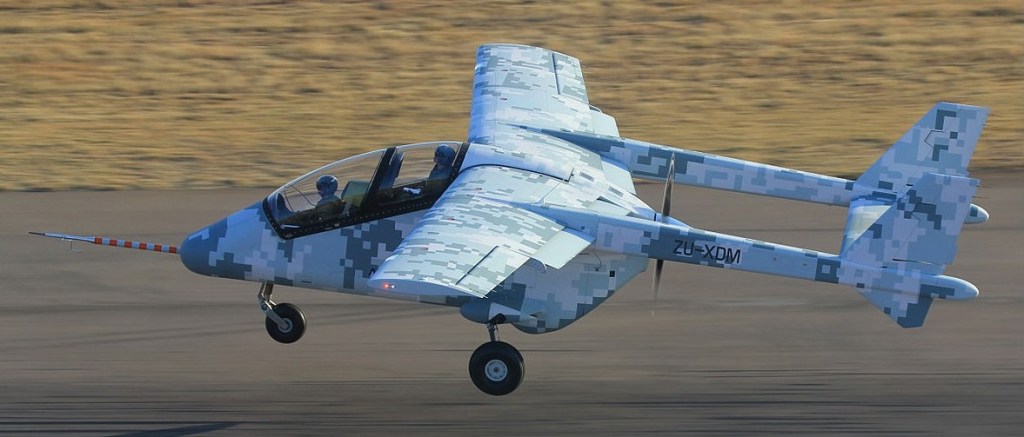
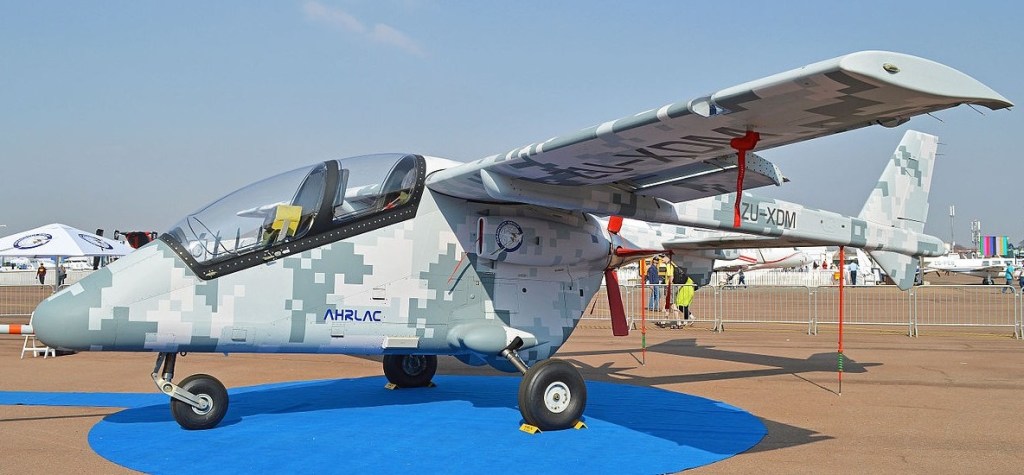
In 2011, a full-scale mockup of the AHRLAC was constructed, alongside a quarter-scale flight-capable model that was later used for a total of 80 test flights. The first full-scale prototype, designated as the Experimental Demonstrator (XDM), was completed using design for manufacture technology, which allowed for jigless construction to be performed, thus producing both time and cost savings. Of the aircraft’s 6,000 components, 98 per cent had been designed using CATIA software and were domestically manufactured.
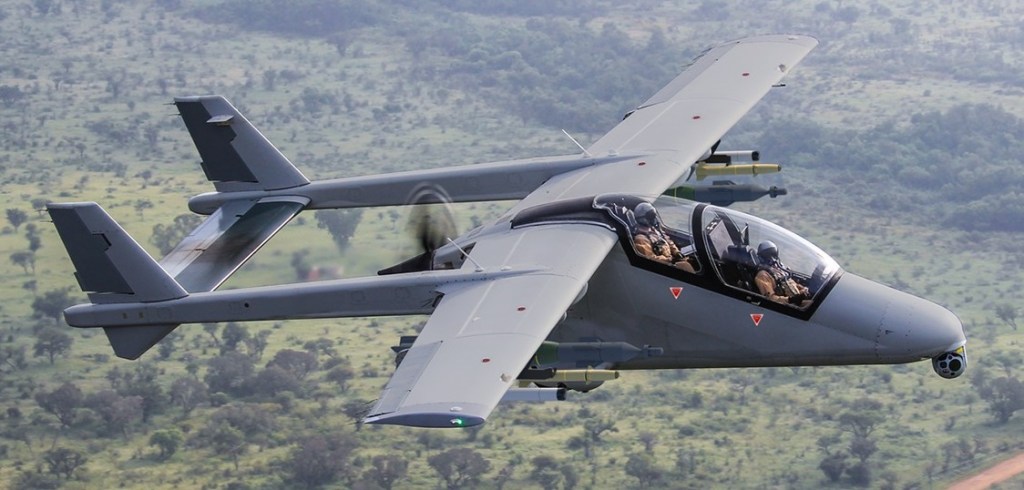
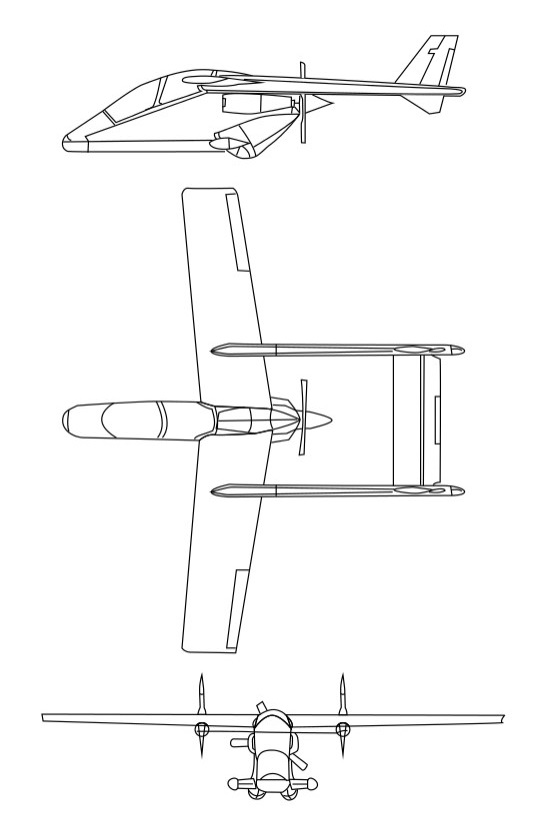
The AHRLAC features a twin-boom, single-pusher-engine, high-mounted forward-swept wing configuration providing for excellent external visibility. It is powered by a single Pratt & Whitney Canada PT6A turboprop engine; it has a top speed of 310 mph along with a flight endurance of seven hours. It is flown by a crew of two, seated in tandem configuration, both being provided with Martin-Baker ejection seats and HOTAS (hands on stick-and-throttle) control functionality. The narrow airframe is composed of a combination of metal and composite construction and is designed to provide maximum crew visibility. The AHRLAC has been designed to be capable of operating from austere runways and rough fields; it also possesses STOL (Short Take Off/Landing) and rapid deployment capabilities.
It features a reconfigurable nose, a large mission bay for avionics beneath the two-person cockpit, and the lower fuselage consists of a variety of interchangeable conformal modular units. These modules allow the aircraft to be outfitted with a variety of sensor systems such as infrared and optical cameras, synthetic aperture radar, electronic intelligence gathering and various electronic warfare packages. Additionally, electro-optical turrets can be installed both on the nose and belly of the aircraft.
first prototype
On 26 July 2014, the first AHRLAC prototype conducted its maiden flight from Wonderboom. It was initially deployed on a 20-hour flight test program to contrast computer simulations against data from the prototype’s real-world flight performance; during each of these flights, telemetry data was gathered inflight by a specially-equipped Pilatus PC-12 chase plane. The initial prototype is to be used to prove the flight characteristics and performance of the aircraft, while the second prototype, designated as the Advanced Demonstrator (ADM), shall be for testing armaments and mission systems.
On 13 August 2014, the aircraft performed its first public flight display at Wonderboom Airport.
Waterkloof AFB during 2014 African Aerospace & Defence airshow
By February 2015, the first prototype had completed 65 hours of incident-free flying; as a result, the test program proceeded to the next phase, under which the flight envelope was progressively expanded to explore and evaluate its handling, center of gravity, flight performance, airframe qualities, and rough field capabilities. According to Paramount, several prospective customers had shown interest in the aircraft, particularly from the Middle East; the construction of the second prototype was also underway.
In March 2016 Boeing announced a partnership with Paramount Group to cooperate on an advanced mission system for the armed variant of the AHRLAC known as “MWARI”.
In May 2014, the flight test program commenced at Wonderboom Airport near Pretoria, the first prototype having been moved there from Aerosud’s facility in Centurion, Gauteng. In July 2014, the ground test phase was reportedly completed.
Mwari is a two-crew C4ISR, F3EAD and precision strike aircraft, capable of carrying a wide range of weapons, sensors and systems in extended airborne mission operations. It uses a pusher propeller and has an open system architecture allowing for the rapid incorporation of current and emerging systems, setting a new standard for mission flexibility and adaptability. The aircraft features open architecture, plug and play systems and carries an interchangeable multi-mission pod system, allowing a single platform to perform multiple missions.
Mwari
The armed Mwari version is designed to carry a single 20 mm or 30 mm cannon, which is internally mounted into the portside nose section. Additionally, it is fitted with either four or six hardpoints for carrying weapons mounted under the wings. Armour for the aircraft is also modular and can be added or removed entirely dependent on the mission requirements. It has an interchangeable pod that allows reconnaissance and other equipment to be swapped out within two hours so that the aircraft can be used for different purposes.
Conformal fuel tanks carried underneath the tail booms have also been offered as an option for the type; when equipped with external fuel tanks, the AHRLAC is capable of a 2,000 nm ferry range.
By September 2016, the prototype had accumulated 250 flying hours during tests, as well as a total of four deployments to the South African border and to neighbouring Botswana for the purpose of operationally representative trials. An improvised trial flight had also been conducted during an outbreak of civil unrest in South Africa.
By September 2016, the developers were in the process of building a new assembly line at Wonderboom, this facility is expected to produce the initial two production aircraft in 2017. The Wonderboom factory is to be capable of producing up to two aircraft per month; it is reportedly readily expandable to double its current size, dependent on customer demand.
In 2014, the developers revealed that, in addition to the previously-announced crewed model of the AHRLAC, they were also in the process of developing an unmanned variant as well. According to Janes, the unmanned model of the AHRLAC had its origins in the quarter-scale model that had been produced for flight testing purposes, which had revealed favourable tendencies towards such use. By September 2014, a pair of prototype unmanned vehicles, which had received the name “Mwari”, had been produced. The Mwari UAV is considerably smaller than the manned AHRLAC counterpart, possessing a reduced flight endurance of only 4 hours along with a sensor turret in the nose. The UAV was renamed “Mwewe”, as the Mwari name is used for an armed version of the full scale manned AHRLAC.
In March 2016, American aerospace firm Boeing announced that it had entered into a development partnership with Paramount with the aim of producing a militarized version of the Ahrlac. Under this agreement, Boeing shall develop an integrated mission system that will provide the Ahrlac with intelligence, surveillance and reconnaissance (ISR) and weapons system capabilities; this equipment is presented as being optional, and some customers may prefer to opt for simpler systems instead. The militarized version of the Ahrlac shall be marketed under the name “Mwari”.
In February 2018, an announcement was made that the improved AHRLAC design will be marketed in the USA under the name “Bronco II”. In May 2020, BRONCO II, Paramount Group’s Americanized variant of the AHRLAC, in partnership with Leidos and Vertex Aerospace, offered the light attack and surveillance aircraft to U.S. Special Operations Command, or SOCOM, for its Armed Overwatch program.
Paramount announced that it had sold a total of 9 aircraft to two unnamed countries and that the first would be delivered immediately, the announcement was made at Africa Aerospace and Defence show on 21 September 2022. This marks the first sale of the aircraft and South Africa’s first sale of a fixed-wing aircraft in 20 years.
As of 28 February 2019, the AHRLAC program has been placed into business rescue with the Wonderboom factory being shut down and all 140 employees sent home. In August 2019, a business rescue plan was announced for AHRLAC, with Paramount taking full control of the Aerospace Development Corporation (ADC) and its subsidiaries, according to the proposition. In September 2020, ADC stated that production of the Ahrlac had restarted.
The company claims to have made multiple sales of 9 aircraft to two unnamed air forces. The first example was delivered on 23 September to an unnamed air force. A total of 9 Mwari aircraft were on order. Paramount Aerospace Industries claims that they can build three a year or five if demand requires more aircraft.
The Bronco II is designed for ultimate mission flexibility. The aircraft’s unique internal Interchangeable Multi-Mission System Bay (IMSB) allows for a single airframe to be easily and rapidly re-configured to perform multiple roles (e.g. ISR, SCAR, CAS, FACA) incorporating high-performance targeting sensors, network communication systems, precision weapons, an electronic self-protection suite, and mission planning systems.
The Bronco II is designed to “roll-on, roll-off” standards, it can be rapidly disassembled, transported and reassembled in the field by a small crew. Its modular mission systems enable rapid system changes, updates, additions, integration and removal. The Bronco II aircraft was to be manufactured in Crestview, Florida.
AHRLAC Powerplant: 1 × Pratt & Whitney Canada PT6A-66, 710 kW (950 shp) Wingspan: 11.9 m (39 ft 0 in) Length: 10.3 m (34 ft 0 in) Height: 4.0 m (13 ft 0 in) Empty weight: 2,000 kg (4,400 lb) Max takeoff weight: 3,800 kg (8,400 lb) Maximum speed: 504 km/h (313 mph, 272 kn) Range: 2,130 km (1,325 mi, 1,150 nmi) Endurance: 7–10 hrs Service ceiling: 9,450 m (31,000 ft) Take-off distance: 550 metres (1,800 ft) with full payload Guns: GI-2 20 mm cannon Hardpoints: 6
Mwari Wing span: 39.4 ft / 12.00 m Length: 34.4 ft / 10.50 m Height: 13.1 ft / 4.00 m MTOW: 8378 lb / 3800 kg Max speed: 311 mph / 500 kph / 270 kt Ceiling: 31,004 ft / 9450 m Max range: 1268 mi / 2040 km / 3778 nm Range: 960 km / 596 mi Endurance: 6.5 hr Armament: opt. 20 or 30mm cannon Hardpoints: 4 Bombload: 1700 lb Crew: two (pilot, copilot/observer)







 All Aero