The Apollo Lunar Module (LM /ˈLEM), originally designated the Lunar Excursion Module (LEM), was the lunar lander spacecraft that was flown between lunar orbit and the Moon’s surface during the United States’ Apollo program. It was the first crewed spacecraft to operate exclusively in the airless vacuum of space, and remains the only crewed vehicle to land anywhere beyond Earth.
Everyone called the vehicle the ‘LEM’ throughout most of its development life until May 1966 when a memo from the NASA Project Designation Committee officiously changed the name simply to ‘LM’.
Structurally and aerodynamically incapable of flight through Earth’s atmosphere, the two-stage Lunar Module was ferried to lunar orbit attached to the Apollo command and service module (CSM), about twice its mass. Its crew of two flew the Lunar Module from lunar orbit to the Moon’s surface. During takeoff, the spent descent stage was used as a launch pad for the ascent stage which then flew back to the command module, after which it was also discarded.
In November 1962 Grumman won the contract for the Lunar Module. Overseen by Grumman, the LM’s development was plagued with problems that delayed its first uncrewed flight by about ten months and its first crewed flight by about three months. Regardless, the LM became the most reliable component of the Apollo–Saturn space vehicle. The total cost of the LM for development and the units produced was $21.65 billion in 2016 dollars, adjusting from a nominal total of $2.29 billion using the NASA New Start Inflation Indices. Ten lunar modules were launched into space. Of these, six were landed by humans on the Moon from 1969 to 1972. The first two flown were tests in low Earth orbit: Apollo 5, without a crew; and Apollo 9 with a crew. A third test flight in low lunar orbit was Apollo 10, a dress rehearsal for the first landing, conducted on Apollo 11. The Apollo 13 lunar module functioned as a lifeboat to provide life support and propulsion to keep the crew alive for the trip home, when their CSM was disabled by an oxygen tank explosion en route to the Moon.
The six landed descent stages remain at their landing sites; their corresponding ascent stages crashed into the Moon following use. One ascent stage (Apollo 10’s Snoopy) was discarded in a heliocentric orbit after its descent stage was discarded in lunar orbit. The other three LMs were destroyed during controlled re-entry in the Earth’s atmosphere: the four stages of Apollo 5 and Apollo 9 each re-entered separately, while Apollo 13’s Aquarius re-entered as a unit.
Height: 9 ft 3.5 in (2.832 m) Width: 14 ft 1 in (4.29 m) Depth: 13 ft 3 in (4.04 m) Mass, dry: 4,740 lb (2,150 kg) Mass, gross: 10,300 lb (4,700 kg) Crew cabin volume: 235 cu ft (6.7 m3) Habitable volume: 160 cu ft (4.5 m3) Crew compartment height: 7 ft 8 in (2.34 m) Crew compartment depth: 3 ft 6 in (1.07 m) Atmosphere: 100% oxygen at 4.8 psi (33 kPa) Water: two 42.5 lb (19.3 kg) storage tanks Coolant: 25 pounds (11 kg) of ethylene glycol / water solution Thermal Control: one active water-ice sublimator RCS propellant mass: 633 lb (287 kg) RCS thrusters: Sixteen × 100 lbf (440 N) in four quads RCS propellants: Aerozine 50 fuel / Dinitrogen tetroxide (N2O4) oxidizer RCS specific impulse: 290 s (2.8 km/s) APS propellant mass: 5,187 lb (2,353 kg) stored in two 36-cubic-foot (1.02 m3) propellant tanks APS engine: Bell Aerospace LM Ascent Engine (LMAE) and Rocketdyne LMAE Injectors APS thrust: 3,500 lbf (16,000 N) APS propellants: Aerozine 50 fuel / Dinitrogen Tetroxide oxidizer APS pressurant: Two 6.4 lb (2.9 kg) helium tanks at 3,000 pounds per square inch (21 MPa) APS specific impulse: 311 s (3.05 km/s) APS delta-V: 7,280 ft/s (2,220 m/s) Thrust-to-weight ratio at liftoff: 2.124 (in lunar gravity) Batteries: Two 28–32 volt, 296 ampere hour Silver-zinc batteries; 125 lb (57 kg) each Power: 28 V DC, 115 V 400 Hz AC Crew: 2
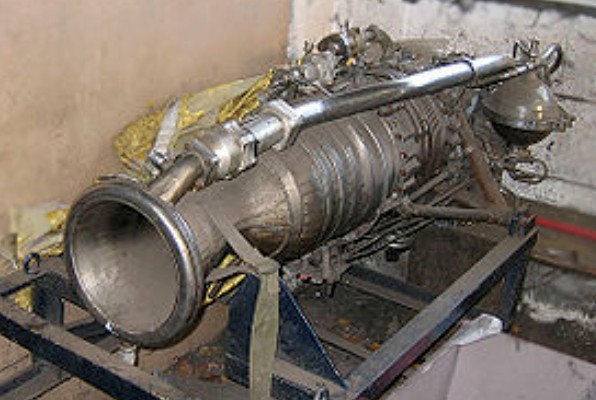
By 1944 Dushkin, who was working on the NII-1 of the NKAP, created a new version of the RD-2MZV reactive engine. This new power plant used a fuel pumping system, consisting of kerosene and nitric acid. Its main feature was the presence of two chambers, a large 1,100 kg thrust and a small 300 kg.
This allowed taking off and reaching the maximum height with the two chambers and then using the force of the small one in horizontal flight. This was able to save fuel and achieve a considerable increase in engine operating time.
Initially it decided to install this engine in the interceptor “Malyutka” of NN Polikarpov, which was projected in 1944, but his sudden death did not allow the builder to finish the job.
During state tests of the RD-2MZV, developed in May 1945, a joint thrust force of 1500 kg was achieved at take-off, 1250 kg as normal thrust and 500 kg as minimum thrust. Working only the small chamber, a thrust of 300 kg was achieved and the minimum thrust was 100 kg. The weight of the engine with all its aggregates reached 224 kg. The production of 30 power sets was approved with the delivery of the first on March 10 and the last on August 10, 1946.
Factory No. 165 was selected as the engine manufacturer, which was to work closely with other plants. Assembly and control tests were entrusted to the NII-1.
At that time, the experimental aircraft with a liquid reactive engine designed by IF Florov was already being built in the NII-1. This aircraft had begun to be projected two years ago, when by GOKO resolution No. 5201 issued on February 18, 1944, the Reactive Technique Institute (NII-1), transferred to the NKAP, was given the task of dedicating itself to the development of reactive engines. The leadership of the NII-1 was assigned to the head of the NII VVS PI Fiodorov and as his replacement was appointed VF Boljovitinov.
The new managers of the NII-1 enjoyed aeronautical construction. For this reason, in parallel to the main tasks of the institute, linked to the creation of reactive engines by the Isayev and Dushkin collectives and turbojets by AM Lyulka, it was decided to build an experimental aircraft from a project developed by Boljovitinov and Florov. This task was approved by the 18 Principal Directorate of NKAP, responsible for the reactive technique.
It was proposed to build two variants of the aircraft: one with an Isayev powerplant, which was named “4302” and another with the Dushkin engine, which was named 4303.
According to the project, the “4302” should have a flying weight of 2320 kg. The maximum speed at sea level had to reach 1010 km / h (M = 0.82), 1015 km / h (М = 0.88) at 5000 meters and 1050 km / h (М = 0.99) at 15000 meters. The ascent time at 15,000 meters was calculated at 2 minutes 22 seconds and the practical ceiling at 18,850 meters. The expected flight time was 46 minutes.
Both projects were conceived to test the powerplant itself, as well as the aerodynamic characteristics of flying at high speeds. Another primary objective was the study of the pressure distribution laws by the wing profile and the calculation of overloads in flight, especially in turbulence generation areas.
It was planned to build a total of six copies of which the first two would be used for the preparation of the flight personnel and the rest for the development of the experiments.
The institute’s productive capacities were scarce, so the construction was contracted to Factory No.21 named in honor of Sergo Ordzhonikidze and located in Gorky city.
Working drawings were ready on 1 January 1946 and once delivered the factory started production. The first two were ready for delivery in March.
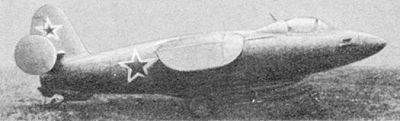
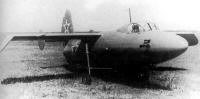
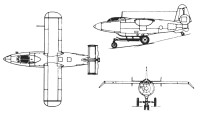
The “4302” was designed as an experimental all-metal monoplane. The wing design was straight, with a constant section throughout the span. In order to improve directional stability and reduce the effect of turbulence at high speeds, the wingtips were angled 45º downwards. The wing profile used was the TsAGI 13145 with laminar flow and thickness of 13%.
The fuselage, also metallic, had a cigar shape with a circular cross section, with a diameter of 1,150 mm at its widest part. At the bottom of the nose was the towing hook.
The tail unit was cantilever type and terminated in vertical washer-like surfaces. The empennage was constructively integrated into the fuselage. All the coating, including the rudders and ailerons, was metallic.
The landing gear was one of the most complex elements. For the first flights a fixed gear with three wheels obtained from a Lavochkin La-5 was used. Later, the “4302” was equipped with a retractable ski for landing and took off using an ejectable forklift. The landing ski was constructed of stainless steel and featured a hydraulic release system. In the middle portion of the ski profile were two grooves to fix the trolley, which was constructed of steel tubes.
The main 650x200mm wheels featured disc brakes. The 400x150mm double wheel front unit had a hydraulic damper. To reduce the lift of the truck once it was separated from the plane, the braking system was activated automatically after release. When the truck was detached, the ski was retracted.
By this time the leadership of NKAP had changed (instead of AI Shajurin, MV Jrunichev had been appointed) and this structure became the Ministry of Aviation Industry (MAP). The new MAP managers had a negative reception towards the plane, considering that the NII-1 had “meddled” in a task that was not within its competence. For this reason, as of February 1946, all financing for this project was withdrawn.
The new director Ya. L. Bibikov and VF Boljovitinov wrote directly to Stalin, explaining that at 1 April of 1941 the first issue of flight he was at 70% completion and continue the work the prototype would be ready for state tests for the month of July.
The vice-president of the Council of Ministers of the USSR, NA Bosniecienski, who after Malenkov’s departure, attended the aviation, ordered Khrunichev and Vershinin to seek a solution to the dilemma. Reluctantly, Khrunichev was forced to give in.
The new VVS chief, Marshal Vershinin reacted differently. On the one hand, he appreciated scientific work, especially in the field of military aviation, but on the other hand he was offended, since the experimental production plan was approved by the NKAP during the period of his taking office, he decided to support the NII-1.
Together with the new VVS chief engineer, IV Markov issued a communication in which he recognized the great value that an interceptor with these features would have for the VVS and requested that state tests be carried out in 1946.
In response, Khrunichev replied that the data presented by the NII-1 should be subject to a review and created a ministerial commission to do so.
The commission was chaired by Professor IV Ostoslavski and included the main builder of OKB-155, AI Mikoyan, the head of department of TsAGI VN Matvieyev, the group head of the 7th MAP Directorate, IV Loktiev and the head of the (Directorate of the MAP, VV Yakolievsky The result of the commission, presented in June 1946, yielded the following results:
“… the maximum speed of the plane will be between 900 and 950 km / h instead of 1000 – 1100 km / h and the ceiling will be limited to 12000 – 13000 meters instead of 20 000 m, due to the absence in the airplane from a sealed cabin. The duration of the flight presented in the letter is 46 minutes. The commission considers that the maximum flight autonomy will be 5 minutes. “
The commission’s results were based on the results obtained with the straight-wing Bisnovat 5, which had been unable to obtain the proposed speed. Florov replied that his aircraft had been designed with the latest strength requirements in mind and with the correct wing selection recommended by TsAGI.
Despite the commission’s report the MAP was instructed to finish and test the experimental specimen “4302”.
In response to the MAP meeting in September 1946, Khrunichev severely criticized the NII-1 leadership and demanded to reorganize the institute’s activity on a purely scientific and not practical profile. The minister ordered to separate the group of builders from the institute and give them a constructive base to continue their activity.
As the new director of the NII-1, MV Keldysh was appointed and in its new structure were three collectives: OKB-1 from LS Dushkin, OKB-2 from AM Isayev and OKB-3 from MM Bondaryuk and a department of gunpowder accelerators.
Jrunichev decision of the bureau of buildings Florov was renovated. The personnel and the productive base were placed under the direction of Bisnovat. Under these conditions, NII-1 survived one more year, until in 1948 it was absorbed by TsIAM. The Dushkin and Bondaryuk groups passed to this institute. Isayev’s group would go to NII-8 of the Ministry of Armaments, dedicating itself to the construction of reactive rocket engines.
By the fall of 1946 one in glider configuration without an engine) was ready for testing and was sent to the LII. Another Isayev-powered example was in the completion phase. Under pressure from the military, the MAP was forced to continue the construction of this copy to deliver it to the LII. With so much pressure, the works on the “4302” could not be carried out to the expected magnitude. It is stated that three examples were completed.
The flights were started in 1947. In total, 20 flights were executed, of which 19 were carried out in the version without an engine. The Isayev jet engine flight was executed by test pilot AK Pajomov in August. This flight started smoothly, but towards the end of the engine work pieces were damaged and nitric acid fumes filled the cabin.
Pajomov managed to land the plane. After this flight, the jet engine aircraft development program was closed. By then, significant progress had been made in the development of turbojet engines capable of high thrust.
After this Ilya Florov went on to dedicate himself to scientific activity, defended his candidacy thesis and later his doctorate, going on to direct a scientific group. He would never design airplanes again.
4302 Powerplant: A 1,100 kg thrust AM Isayev liquid reactive engine Wingspan: 6,932 m Wing area: 2 m² Length: 7.152 m Height: 3.06 m Maximum takeoff weight: 2398 kg Maximum speed achieved: 520 km / h Calculated top speed: 950 km / h Accommodation: 1
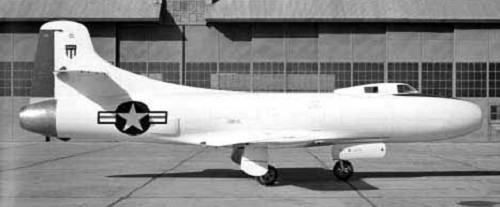
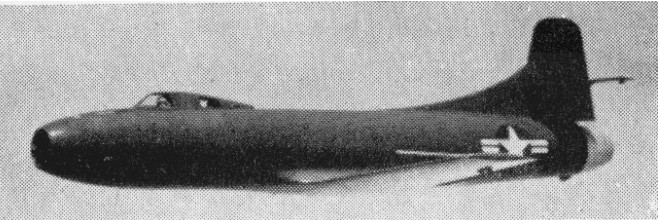
The Douglas company’s initial essay into high-speed research aircraft was the D-558-1 Skystreak which first flew on 14 April 1947 at the beginning of a programme to investigate free-flight air load measurements of the type that were then unobtainable in wing tunnel tests. The D-558-1 was fitted with a pressure-recording system connected to 400 points on the aeroplane’s surface, and powered by a 4,000-lb (1814-kg) Allison J35-A-23 turbojet yielded invaluable research data. The type was later re-engined with the 5000-lb (2 268-kg) thrust J35-A-11, and secured two world air speed records during 1947. The Skystreak set two speed records in 1947. Pilot on the second attempt was Major Marion Carl USMC who averaged 650.92 mph in two runs over a 3 km course.
The three D-558-I Skystreaks were turbojet-powered aircraft that took off from the ground under their own power. The D-558-1 Skystreak broke sound barrier in 1948. Of the three built, the first aircraft is on display at the Naval Aviation Museum in Pensacola, Florida. The second D-558-I crashed on3 May 1948, killing NACA pilot Howard C. Lilly. The third Skystreak is owned by the Carolinas Historical Aviation Museum located at the Charlotte International Airport in North Carolina.
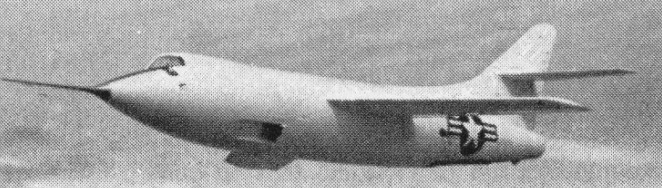
Developed from D-558-1 the Skystreak, the D-558-II Skyrocket (first flown 4 February 1948) was built primarily to investigate the properties of swept wings for high-speed flight. The D-558-2 Skyrocket was in essence a swept-wing version of the straight-winged D-558-1 powered by a 3000-lb (1361-kg) thrust Westinghouse J34-WE-22 turbojet supplemented by a 6000-lb (2722-kg) thrust Reaction Motors XLR-8 rocket motor. The type first flew in February 1948 and the rocket engine enabled the Skyrocket to exceed Mach 1 in October 1947 and later, on 20 November 1953, piloted by NACA test pilot A. Scott Crossfield with the turbojet removed and the rocket fuel capacity doubled, it reached Mach 2.01 (1327 mph) at a height of 65,000ft after being released from a Superfortress mother-plane. Three months earlier it had reached 83,235 ft after a similar launch. The D-558-II last flew on 12 December 1956.
D-558-2
The rocket-powered air-launched D-558-II Skyrocket became the first aircraft to exceed Mach 2. The first D-558-II is on display at the Planes of Fame Museum in Chino, California. The number two Skyrocket, the aircraft used by Scott Crossfield to first break Mach 2, is on display at the National Air and Space Museum in Washington DC. The last D-558-II is displayed on a pedestal at Antelope Valley College, Lancaster, California.
The Sprite was a British rocket engine built by de Havilland for use in RATO applications. For RATO use only a short burn time is required, with simplicity and light weight as major virtues. The intended market was for assisting take-off of de Havilland Comet 1 airliners (as hot and high operations in the British Empire were considered important) and also for V bombers carrying heavy nuclear weapons. 30 successful test flights were carried out by Comets, from May 1951, but gas turbine performance improved rapidly, and so RATO was not required in service.
A hydrogen peroxide monopropellant was used, decomposed into oxygen and steam over a metallic calcium catalyst. The maximum thrust was 5,000 lbf (22 kN), varying over the 16 second burn time for a total impulse of 55,000 lbf (240 kN) seconds. Propellant capacity was 39 gallons. The dry weight was 350 lbs.
The DSpr.2 used a silver-plated nickel-gauze catalyst, tested in Comets during April 1952. A technology update then took place with the proving of silver plated nickel gauze packs as catalysts with the establishment of optimum loadings and flows. This practice was replicated in all future applications with the catalyst no longer consumed. In April 1952 the DSpr.2 proved this modification impressively in Comet demonstration with clean exhaust. The next stage was pursued with the Super Sprite (DSpr.4) following the ATO development precedent with ‘hot’ operation but now enhanced in simplicity by ability to inject kerosene fuel once chamber pressure was established by the catalysed peroxide flow. The units, flight approved in August 1953, reverted to the practice of being parachuted after firing for routine re-use in service operations with the Vickers Valiant V bomber.
The Super Sprite DSpr.4 was a re-development of the Sprite application, using a significantly different ‘hot’ propellant technology, that of hydrogen peroxide / kerosene. Although the peak thrust was actually reduced (4,200 lbf / 18.7kN), burn time was 2.5 times longer (40 seconds), with a proportionate increase in total impulse (120,000 lbf seconds). Propellant capacity was 60 gallons (approx.).
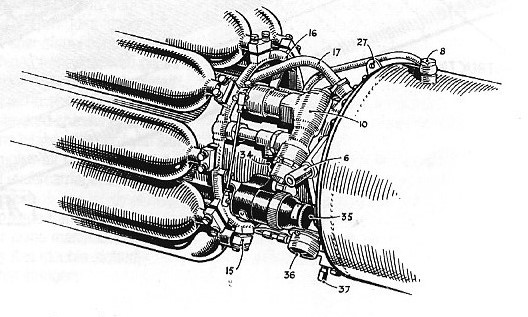
For simplicity, there were no fuel pumps and the tanks were pressurised by nitrogen from nine cylinders wrapped around the combustion chamber.
The Super Sprite was packaged as a self-contained engine in its own nacelle, jettisoned after take-off and retrieved by parachute. Inflatable air bags cushioned its impact with the ground. To obtain a clean separation from the carrier aircraft, the production engines fitted to the Vickers Valiant had a small canard vane at the nose, pitching the nacelle downwards on separation.
De Havilland regarded the 166 units manufactured as a standard production item, supported by their Service Department alongside piston and turbojet engines. It was the first rocket engine to gain formal type approval.
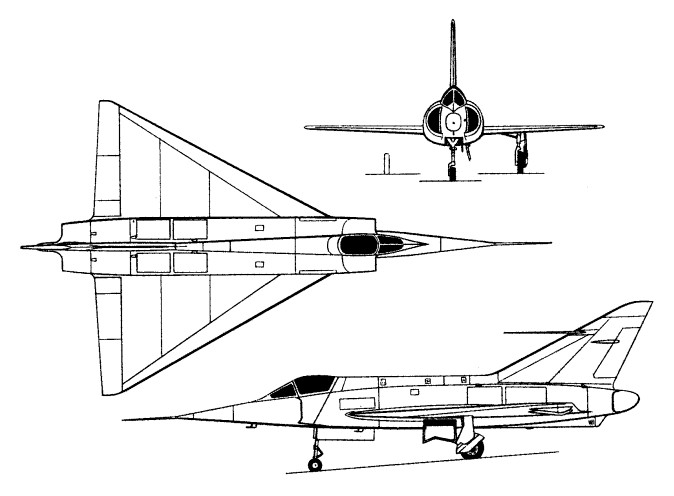
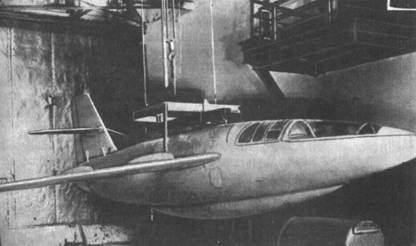
The MD 550 was designed to meet the requirements of a 1954 specification calling for a small all-weather interceptor fighter capable of attaining an altitude of 18,000m within six minutes and sustaining a speed in excess of M=1.0 in level flight. Initially known as the Mystere-Delta, it was competing with the SE.212 Durandal and the SO.9000 Trident. To attend the Armée de L’Air requirements, the Marcel Dassault company presented the project MD.550, a delta wing configuration, with a 5% chord (ratio of airfoil thickness to length) and 60 degree sweep. A tailless delta layout, the MD 550 was powered by two MD 30R (Armstrong Siddeley) Viper turbojets each rated at 980kg with afterburning, and first flew on 25 June 1955.
With the original delta vertical tail replaced by swept back surfaces and a 1500kg thrust SEPR 66 bi-fuel auxiliary rocket motor installed, the MD 550 was renamed Mirage I, and, on 17 December 1956, attained M=1.3 in level flight without rocket power and M=1.6 with the rocket lit.
Intended armament was a single Matra or Nord AAM carried externally. However, it was concluded that the Mirage I was too small to carry an effective military load, and a slightly enlarged version, the Mirage II with a pair of Turbomeca Gabizo turbojets, was proposed. This proposal was eventually discarded in favour of the Mirage III.
Engine: 2 x M.D. 30R (Armstrong Siddeley) Viper turbojets, 980kg and 1 x 1500kg thrust SEPR 66 rocket motor Max take-off weight: 5070 kg / 11177 lb Empty weight: 3330 kg / 7341 lb Wingspan: 7.30 m / 23 ft 11 in Length: 11.10 m / 36 ft 5 in Wing area: 27.10 sq.m / 291.70 sq ft Max. speed: 1700 km/h / 1056 mph
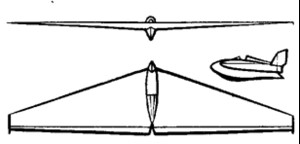
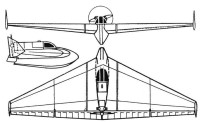
The BICh-11 appeared in 1932 as a continuation of the trapezoidal wing design started with the BICh-8 glider. Its construction was developed in the TsAGI workshops. The Cheranovski BICh-11 (RP-1) (Russian: Черановский БИЧ-11 (РП-1)), conceived in 1931, became the world’s first experimental aircraft in a flying wing configuration designed to use a reactive power plant. Problems with the development of the reactor made it necessary to equip the BICh-11 with a low-power engine in pusher configuration.
In practice, the BICh-11 had been conceived to test in flight the OR-2 liquid propellant rocket engine developed by FA Tsander, which weighed only 18 kg and was capable of developing a thrust of 0.62 kN. The funds for the modification of the model and the installation of the reactive power plant were approved by OSOVIAJIM on February 25, 1932. The installation of this engine was just behind the cabin. The fuel and oxidizing agent tanks were designed in fairings located on the wings, on both sides of the central fuselage.
The BICh-11 was conceived as a single-seater experimental glider, built entirely of wood. The cantilever and high-set wing had a trapezoidal shape and a three-spar structure. This wing was conceived in three sections: a central one forming an integral part of the fuselage and the long wing consoles with the rudders at the ends. The union of the consoles to the centroplane was made by means of some steel pieces. In the centroplane, they conceived some fairings that contained the chemical components necessary to make the OR-2 liquid reactive engine functional.
The entire leading edge was covered with a 1mm thick plywood sheet. The straight trailing edge featured control surfaces along the entire span, located on a bar on the soffit of the wing, just below the trailing edge. In the external part the ailerons were located, also used as elevator rudders. On the inside were the adjustable stabilizers on the ground and a little further inside the elevator. Adjustable stabilizers on the ground were located on the inside.
The fuselage was covered with plywood. The landing gear was composed of two independent wheels and a tail skid.
The pilot was located in a closed cockpit at the nose.
In mid-February 1932 the BICh-11 was transported to the GIRD and on February 22 it was flown in the form of a glider by Sergei Koroliov. Also in glider form, the BICh-11, piloted by Koroliov, flew in the IX National Sailing Competitions held in 1933.
The first tests work jet engine OR-2 began the 18 of March of 1933, but only 10 days after FA Tsander died and with him the work of building the rocket plane – 1 (RP-1), assigned name to the project.
Given the lack of a power plant, the BICh-11 was modified to use a 27 hp ABC Scorpion piston engine driving a propeller, with which the tests were continued. In this configuration the BICh-11 flew satisfactorily, becoming one of the first airplanes in a flying wing configuration with a trapezoidal ground plan to do so.
In the version with a piston engine, some modifications were made to the wing plan and its control surfaces. The ABC Scorpion power plant was located at the end of the fuselage fairing as an extension of the cabin and powered a two-bladed wooden propeller.
BICh-11 Engine: 27 hp ABC Scorpion Wingspan: 12.10 m Wing area: 20.00 m² Length: 3.25 m Empty weight: 200 kg Accommodation: 1
Cheranovski BICh-11 glider
Cheranovski RP-1 with wing fairings for liquid reactive engine fuel
The de Havilland Spectre was a bipropellant engine burning kerosene and hydrogen peroxide, built by de Havilland in the 1950s. The power could be controlled from 10-100% delivering 8,000 lbf (35.7 kN) of thrust at full power. In the SR.53 it used the same fuel tanks as the turbojet engine and if run at full power was expected to consume the full load in about seven minutes.
In 1952 static testing commenced with the Spectre DSpe.l. The aircraft industry had no precedent for an engine which would gain in thrust with altitude and the required maximum thrust was estimated at between 2,000 lbf (8.9 kN) and 15,000 lbf (67 kN) thrust. The design was based on a variable thrust which could be throttled from 8,000 lbf (36 kN) to 2,000 lbf (8.9 kN). Design philosophy was matched to the mixed power concept of an aircraft having both a turbojet and rocket engine for maximum operational flexibility.
Technological innovation embraced the Barske high-speed open-impeller centrifugal pumps, as formerly researched in the Walter organisation, regenerative cooling with pump stages both upstream and downstream, gauze catalyst packs, low-loss internal-flow turbine and the use of straight kerosene fuel. The aircraft tanks were to be pressurised to suppress pump cavitation problems.
It went through rig tests commencing in 1953, bench tests from mid-1954, and testing in two Canberras. From flight approval in Autumn 1956, flight experience again posed altitude starvation problems. Clearance was given for flight in the SR.53 prototype from May 1957.
In October 1957 a contract was announced for a more advanced version of the aircraft as the SR.177 to utilise a revised design Spectre DSpe.5 engine together with a reheated supersonic capability 14,000 lbf (62 kN) thrust Gyron Junior turbojet engine, thus meeting a full mixed power aircraft concept. In conjunction with the new engine, development had been undertaken with two major ancillaries, a peroxide starter for the gas turbine and a peroxide auxiliary power unit. Virtually on the heels of the announcement of the contract came the notorious 1957 Defence White Paper declaring that all future combat would be undertaken by computer controlled missiles, and that manned interceptors were now considered obsolete.
Development flying of the SR.53 continued through 39 flights operating to Mach 1.33, and to altitudes at 55,000 ft (17,000 m), as research and construction proceeded on the SR.177, until its cancellation in 1958.
After merging of interests in 1959, it was manufactured by Bristol Siddeley.
The Spectre project was cancelled in October 1960, at a reported total cost of £ 5.75 million.
Variants included: Dspe.1 Initial version Dspe.2 Constant thrust version, simpler design Dspe.3 Development of Dspe.1 with variable thrust Dspe.4 Development of Dspe.2 Dspe.5 Further development of Dspe.1 DSpe.D.1 Double Spectre A doubled version of this engine was used for early flight-testing of Blue Steel nuclear stand off bomb, with two chambers arranged vertically.
The conventional Spectre DSpe.5 had been developed alongside a DSpe.4 RATO variant, the latter for the Avro Vulcan and Handley-Page Victor V bombers, another programme subsequently cancelled after a single trial take-off of a Victor from the de Havilland aerodrome at Hatfield. These two engines were then used in combination to power the development rounds of the Blue Steel missile stand-off bomb, together with the peroxide APU, from its first flight in October 1959.
Bisnovat “5” in the TsAGI before the modifications.
The Bisnovat 5 experimental aircraft was developed in 1948 with the aim of testing the influence of the 45º swept wing on the range of supersonic flight speeds. Two prototypes were built and tested in a glider configuration due to difficulties in setting up the selected power plant.
Based on the concept of the DFS 346, the Bisnovat “5” featured an overall configuration similar to that of the Bell X-1, which would be the first manned aircraft to break the sonic barrier.
The effectiveness of wing sweep in achieving high flight speeds was demonstrated at the end of the 1940s. The 35º swept wing did not allow to overcome the sonic barrier, as it generated too much resistance. The calculations showed the need to test a new wing with 45º sweep and increase the engine power.
In the TsAGI they developed a wing with these characteristics, but the T-106 wind tunnel did not allow it to be tested at speeds above Mach 0.9. This required the construction of experimental aircraft.
This happened at the end of 1946, when in the former premises of the main constructor Boljovitinov, in the Factory No. 293 of the MAP a new OKB was created at the head of which was MR Bisnovat located. This new OKB was tasked with developing a supersonic experimental aircraft in order to test characteristics in flight and piloting conditions at speeds of Mach 1.1.
The aircraft received the designation “5” and had to be built according to an aerodynamic composition based on the 45º swept wing and TsAGI 12045bis and P2 (2M) profiles. Its development was carried out in parallel with the tests by OKB-2 of the captured German DFS 346 aircraft. The powerplant selected was the Dushkin RD-2MZVF liquid reactive engine capable of developing 2000 kg of thrust and was conditional on the fact that a higher power engine did not exist in the USSR.
Due to the low capacity of the engine, the ascent to a height of 10,000 meters had to be done by a mother plane. Once this height was reached, the plane released and the rocket engine was started. The calculations showed that, in addition to a speed of Mach 1.1, the “5” would reach 15,000 meters (from 10,000 m) in just 68 seconds. The duration of the flight with full power would be only 2.5 minutes.
The development task was officially approved in a new experimental construction plan that was signed on March 11, 1947.
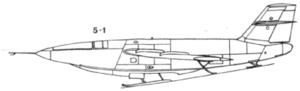
The “5” was conceived as an all-metal monoplane with a double spar mid-set wing and 45º taper along the 25% chord line. The wing profiles were suggested by TsAGI : TsAGI 12045bis in the wing root and P2 (2M) in the extremities. The wingspan reached 6.4 m. Two aerodynamic fins were installed on each console on the upper wing surface to break the flow. In order to study the pressure distribution throughout the wing at high speeds, drains were made in three sections in the right wing.
The monocoque-type fuselage had an oval section and a length of 9.92 meters. The front part consisted of a sealed cabin. Flying in an airplane at high speed implied a high risk, so the cabin was designed in such a way that in emergencies it was separated from the rest of the plane. The transparent cover was aerodynamically inserted into the fuselage. Behind the wing, on both sides of the fuselage, aerodynamic brakes were added.
In the tail section was located a reactive double chamber RD-2M-3F engine, designed by LS Dushkin with a power of 2000 kg at 8000 meters and 1610 kg of thrust at sea level. The chemicals (kerosene and nitric acid) and hydrogen peroxide (for turbocharger feed) were calculated for a flight time of about two minutes at full power.
As the “5” aircraft was designed to be launched from a mother plane, the landing gear consisted of a ski located in the lower part of the fuselage, two stabilization supports on the wings and a small skid on the tail section.
The high tail had sweep. The stabilizer had a span of 2.4 meters. The aircraft could be controlled using the stabilizers, which were connected to the flight stick. Boosters could be connected to reduce the pressure on the stick.
In order to guarantee the necessary safety, it was decided to first carry out the tests using a scale model that was called “6” and designed with full flight capacity. The “6” was built in factory 293, in conjunction with the OEZ TsAGI led by Kuznietsov. This model was built at 1: 2.75 scale, and equipped with a liquid reactive U-400-10 engine with 400 kg of thrust manufactured by Isayev and had an AP-14 autopilot system.
The “6” model had to be towed by a Tupolev Tu-2 bomber up to a height of 9000 meters and after detaching it had to connect the reactive engine to reach a supersonic speed of Mach 1,225 in straight flight. To record the flight data the “6” was included in the model a data recording system.
The recovery of the “6” was carried out by means of parachutes operated in sequence. Initially, the braking parachutes located on the wings were opened, with an area of 1 sq.m. Later the main braking parachute located in the tail area and with an area of 100 sq.m was opened.
In total, 4 examples of the Model “6” were built and tested in September – November 1947, at Gumpak airfield, near Stalingrad.
The first model (No.61) after the detachment quickly moved away from the Túpolev Tu-2, reaching great speed. The following La-7 soon lost sight of the model and it was never found.
The second model (No.62) after detaching began to present large oscillations around the axles and this resulted in the engine turning off with only 8 seconds of work. The model opened its parachutes and could be recovered without problems. The recorded speed was only 230 – 240 meters per second.
The third model (No.63) worked without problems, but after 44 – 45 seconds of flight, it plummeted and the brake parachutes were pulled away. The model was launched towards the ground, burying itself at a depth greater than 3 meters. During the impact the search equipment was badly damaged and some could not even be found in the metal mass. According to the measurements obtained from an MS-7 team and assuming that they were taken during the flight in a straight line at 8,300 meters, a speed of 1405 km / h (Mach 1.28) could be calculated.
The fourth model (No.64) flew without problems for 51 – 52 seconds, presenting only some oscillations in relation to the transverse axis. After the engine finished working, the main parachute did not open, so that only with braking the model began to descend, burying itself about 80 centimeters into the ground. In this case it was possible to recover the result of the measurements of the recording equipment, which yielded a model speed of 1230 km / h (Mach 1.11)
The figures obtained allowed the MAP to consider that the speed of the models corresponded to that calculated and to consider the tests as successful, but the direction of the VVS disagreed. Bershinin wrote in January 1948 to the Minister of the Armed Forces NA Bulganin:
“ In relation to the tests with the help of the Bisnovat manufacturer’s models, we can deduce that as a result of their lack of completion as aerodynamic models and the lack of objectivity of the flight data, objective conclusions cannot be made and they can only be considered as a first step in the use of flying models in the investigation of high flight speeds. “
The need to develop a dozen “6” models and repeat the tests ensuring the preservation of the recordings of the measuring instruments was strongly discussed. This never took place because very soon the first prototype of the plane “5 ” was ready which was known as “5-1”.
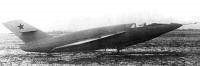
The first prototype “5-1” during testing.
The first prototype with full flight capacity was named ” 5-1 “. The towing system was replaced by the under-wing attachment of a mother aircraft, in this case a Petlyakov Pe-8 (No. 4291) with Ash-82FN engines, which was specially prepared for this task. Under the right wing, between the fuselage and the inner engine console and installed a special bracket from which the ” 5 ” was hung. The launch was carried out at heights of 7000 – 7500 meters. The weight of the plane in glider configuration reached 1565 kg.
The delivery of the engine suffered delays, reason why the first ” 5-1 ” sample began to be tested in July 1948 in a glider configuration, in order to check the behavior of the aircraft at low speeds. The “5” plane was flown by Colonel Pajomov and the Pe-8 mother plane by test pilot MA Samusiev and Ziemskov.
The flight plan included a dive after detachment, with departure to horizontal flight with an overload of 2 -3g, increase in speed until the plane reached 1500 – 2000 meters in height, when the tasks stopped and the plane was preparing for landing. During the landing, the behaviour of the plane at low speeds was studied.
In the first flight the 14 of July of 1948, there was a rending of the alar coating at the time of the release of the mother aircraft, affecting directional stability. The pilot managed to control and land the plane, but off the runway. The ” 5-1 ” was damaged and was sent to the factory for repair.
During this process some modifications were made. To prevent the plane from hitting the mother plane again at the time of detachment, the fixation system was modified. The flight control system was modified.
Rear view of the Bisnovat “5-1”.
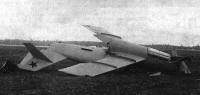
The second flight on September 3 was quite positive, but it showed a lack of transverse stability and the lack of effectiveness of the ailerons to correct it. It was decided to study this phenomenon in depth on the third flight on September 5, but another accident occurred during the landing. Upon landing the plane hit the ground with one wing, then the other. The pilot was unable to control the landing and ended up burying his nose, which caused the destruction of the plane. The pilot was unhurt but the plane could not be rebuilt.
Prototype “5-1” destroyed after its third flight.
The commission created to analyze the accident was headed by the replacement of the head of the TsAGI laboratory, VN Matvieyev. It was found that the cause of the accident was the lack of lateral stability of the plane at low speeds after extending the landing pad and the increase in resistance in the aileron control system; as well as the incorrect ground connection and the deterioration of visibility due to the condensation of water vapor that appeared on the cabin cover. It was recommended to build a second specimen taking into account the recommendations recorded and to modify and test the landing system at TsAGI.
These accidents delayed the obtaining of the expected results in “5”. In 1947 at the request of the VVS and with the support of the Moscow committee of the CPSU, the MAP was directed to carry out the necessary actions to equip the TsAGI with wind tunnels capable of testing the new speed environments. In the second half of that year, the new T-112 tunnel began to operate at TsAGI .
Drawing of the prototype “5-1”
The dimensions of the work area of this tunnel was not large, measuring only 0.7×0.6 meters, but the flow velocity reached Mach 2. This tunnel still lacked the necessary instrumentation to carry out the measurements, but it was considered that it was enough to determine the effectiveness of the wing at 45º.
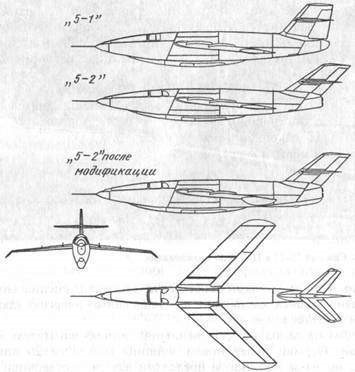
A second ” 5-2 ” prototype was built and ready by January 1949. It was practically no different from the first prototype, but to improve directional stability it was lengthened and increased the sweep of the vertical fin, which led to an increase in the length of the aircraft to 11.2 meters. The stabilization wing supports for landing were replaced by amortized skids capable of absorbing energy during impact with the ground.
Drawing of the prototype “5-2”
It was first decided to continue the tests in a glider configuration. The LII test pilot G. M. Shiyanov was selected as the pilot. The Pe-8 mothership was piloted by Gintsie and Chistyakov.
Between 26 January and 9 of June of 1949 the ” 5-2 ” carried out a total of nine glider flights, in October-November four, none with engine, even though it had been installed on the model and tested on the ground.
During the tests the weight of the aircraft reached 1710 kg, the maximum speed obtained in the dive flights reached Mach 0.775. The plane showed good behaviour and the flight control with the help of hydraulic boosters was practically no different from the conventional one.
Despite the promising results, everyone understood that the ” 5 ” had lost its “moment”. Reactive engines, characterized by their dangerousness, short working time and capricious behavior, now gave way to the increasingly capable turbojets, which had already demonstrated their ability to reach sonic speeds. The MAP leadership, in this situation, decided to turn its back on the project and, without much explanation, stopped financing it.
During the tests of the “5” for the first time in the USSR , the launching test system for rocket aircraft from the wing of a mother aircraft was tested and the accumulated experience was of great use for the development of new types of aircraft and missiles.
On the basis of the aircraft “5” Bisnovat and Isayev developed the air-surface missile R-1.
Drawing of the Bisnovat “5”
“5” Powerplant: 1 RD-2M-3VF liquid reactive, 1610 kg thrust Wingspan: 6.40 m Length: 9.92 m Wing area: 11.18 m² Empty weight: 883 kg Maximum takeoff weight: 3184 kg Wing loading: 95.6 kg / m² Maximum speed: 1200 km / h Accommodation: 1
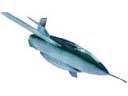
Views of the different variants of the Bisnovat “5”.
The “302” reactive interceptor fighter was designed in 1940. It was the world’s first fighter with combined reactive powerplant.
This fighter appears interchangeably in the specialized literature as a product of MK Tijonrarov (head of the project design brigade and specialist of aerodynamic calculations during the construction of the prototype), AG Kostikov (main engineer of the RNII (NII-3) during the design of the project and main constructor of the OKB-55 during the construction process or MR Bisnovat (head of the OKB-55 designated for the development and construction of the model. In some literature it has also been called Kostikov KB-3 and Tijonrarov I-302.
Between 1939 and 1940 in the USSR began to develop a design process for aircraft powered by reactive engines. Due to the short working time of these engines, their use was conceived in the form of interceptors of very high speed and short radius of action. The three most prominent developments in this line were the Tijonrarov “302”, the “Malyutka” and the Bereznyak / Isayev BI. The three projects were conceived to use liquid reactive engines using kerosene as fuel and nitric acid as oxidizing agent, with powers between 1,100 and 1,200 kg. Of these three projects, only the BI was further developed. The projects “302” and Malyutka were kept as Secret for many years and information about them is scarce and little known.
The “302” appeared in 1940 as a project for the world’s first fighter with a combined reactive powerplant. The project was developed by a group of specialists led by MK Tijonrarov under the general direction of AG Kostikov, who at that time was serving as the chief engineer of the RNII (NII-3). In the spring of 1941 the project was presented to the technical council of the institute, being approved. After the defense of the project before the commission of the VVS, AG Kostikov directed the request for approval to the NKAP, where between June 17 and 18, 1942 it was approved by a commission made up of SA Jristianovich, AV Chesalov, SN Shishkin, VI Polikovski.
In the second half of 1942 the project was presented to Kliment Efremovich Voroshilov and that same day, during a reception with Stalin, the “302” was approved and Kostikov was appointed principal constructor of the OKB-55 and director of the experimental factory of the same name. As head of the OKB was appointed MR Bisnovat and as his replacement AA Andreyev. VD Yarovitsky was selected for the resistance calculations and the aerodynamic calculations were carried out by MK Tijonrarov.
Structurally the “302” was conceived as a low-wing cantilever monoplane. The construction was of wood. The wing had a RAF-34 profile with 15% at the root and NACA-230 with 8% at the wingtips. The tail was made of wood with a plywood coating. The fuselage was designed with a monocoque structure.
Structure of the “302”
The landing gear was designed as a traditional type with single wheels on all units. The retraction system was hydraulic.
The “302” was conceived as a fighter with a liquid reactive engine (ZhRD) RD-1400 produced by LS Dushkin and with 1400 kg of thrust located under the tail and two ramjets (PVRD according to its acronym in Russian and also known as Ramjets in English) designed by V.S. Zuyev, located under the wings.
The interceptor was armed with two ShVAK 20mm cannons located in the nose and two similar ones below the cockpit, all with 400 rounds. Under the wing were detachable mounts for unguided rockets (RS-82 and RS-132) or two FAB-125 bombs.
The “302P” during testing.
By the summer of 1943 it was found that the development schedule for Zuyev’s ramjet was seriously overdue. Only a 1: 2 scale model had been completed and the tests could not be executed. Dushkin’s 1100kg D-1 Liquid Reactive Engine, with an additional 450kg chamber, was not yet ready as testing had just begun. For this reason it was decided to equip the “302” with a RD-2M double chamber liquid reactive motor, which also presented problems.
Given the lack of availability of the engines, it was decided to finish the cell and test it in the form of a glider, which received the name ” 302P “. All the weapons and some of the equipment were removed from the plane in order to lighten it. In the tail section a model of a reactive single chamber engine was located, which was exposed, without the fairing.
Glider “302P”, rear view showing the reactive engine model
At the end of August 1943 in this configuration the ” 302P ” was delivered to the LII. The tests showed excellent stability characteristics and the “302P” was sent to the TsAGI, where it was tested in the wind tunnel. During the “blows” in the T-104 tunnel of the TsAGI, it was possible to obtain an aerodynamic quality K = 15, which promised excellent results. Several dozen flights were carried out towed by a Tupolev Tu-2 and a North American B-25 Mitchell. The evaluation given by the USSR honorary test pilot S. N. Anojin on the “302P” was highly positive. Positive evaluations were also received from other experienced test pilots such as ML Galai, BN Kudrin and VN Yelagin. In the tests it was possible to calculate a landing speed of 115 – 120 km / h. The powered flights were not carried out due to the lack of completion of the reactive engines.
The first motorization variant with one ZhRD and two PVRDs yielded a possible speed of 900 km / h, a ceiling of 9000 meters and a time to reach this ceiling of 2 minutes.
The calculations obtained with the “302P” yielded a speed of 800 km / h, a ceiling of 18000 m and a reach time of a height of 5000 meters of 2.1 minutes and 2.8 minutes for the 9000 meters. The calculated range was 100 km. The only real data obtained were the take-off with a run of 16 – 18 seconds and a speed of 200 km / h. The empty weight of the plane was 1502 kg and with a military load of projectiles for the 4 guns, 505 kg of fuel and 1230 kg of oxidant, the takeoff weight reached 3358 kg.
In 1944 a government commission led by AS Yakovlev made the decision to stop all work related to “302”. The results obtained during development were not lost and many of the constructive decisions employed during the construction of the “302P” were later employed by SM Alexeyev during the construction of the I-211 and I-215 fighters.
Model 302 Powerplant: 1 x ZHRD RD-1400 with 1,400 kg thrust + 2 x PVRD Wingspan: 11.4 m Length: 8.708 m Wing area: 17.8 m² Takeoff weight: 3800 kg Empty weight: 1856 kg Maximum speed at height: 900 km / h Time at 9000 m: 2 min. Service ceiling: 9000 m Armament: 4 x ShVAK 20 mm cannons Bombload: unguided rockets (RS-82 and RS-132) or two FAB-125 bombs Seats: 1
Model 302P Wingspan: 9.55 m Length: 8.708 m Wing area: 14.8 m² Takeoff weight: 3358 kg Empty weight: 1856 kg Total load weight: 1502 kg Weight of fuel and oil: 1735 kg Wing loading: 227 kg / m² Reactive fuel weight: 505 kg Oxidizer weight: 1230 kg Speed at sea level: 800 km / h Speed at altitude: 900 km / h Take-off speed: 200 km / h Time to 5000 m: 2.1 min Time at 9000 m: 2.8 min Service ceiling: 18,000 m Range: 100 km Armament: 4 x ShVAK 20 mm cannons Bombload: unguided rockets (RS-82 and RS-132) or two FAB-125 bombs Seats: 1
302 with dotted lines the initial version with combined reactive plant.
In the spring of 1940 the TsAGI held a conference for aeronautical designers related to the use of reactive rockets and ramjets. The main engineer of the OKB-293 Victor Fiodorovich Boljovitinov was invited to this conference, who attended accompanied by two of his collaborators A. Ya. Bereznyak and AM Isayev. Bereznyak was the head of the mechanics brigade and Isayev was the chief of the engine brigade. The cause of this hasty conference was based on the confirmation that an intercept fighter with reactive power plant had begun to be developed in Germany which appeared in the last period of the War as the Messerschmitt Me-163.
In July the Council of People’s Commissars (SNK) launched the request for the development of high-speed stratospheric aircraft powered by jet engines. Bereznyak and Isayev were excited about the prospect of designing a jet-powered aircraft and, after receiving Bolkhovitinov’s approval, in the fall of 1940 they went to work on a project that was originally known as ” G “.
In 1940 they visited the Reactive Research Institute, where they learned about the work carried out by the engineer Leonid Estepanovich Dushkin on a reactive liquid fuel engine for the “302” fighter project that was then being developed at this institute.
The design of the ” G ” was designed primarily in plywood and duralumin, had a takeoff weight of only 1500 kg capable of reaching 800 km / h.
The Bereznyak and Isayev aircraft was initially designed to use a 1,400 kgf thrust engine with a fuel injection system into the ignition chamber. In order to simplify the process and decrease the creation time of the apparatus, on June 21, 1941 Isayev proposed to replace the pump injection system with a simpler injection system based on compressed air at 145-148 atmospheres from 115-liter cylinders. This made it possible to reduce the dimensions of the engine and improve its characteristics. This new engine was renamed D-1A (A corresponds to Azot (Nitrogen in Russian) and responds to the type of oxidant used in the combustion process). As a counterpart, the need to include large volume and weight oxygen cylinders in the engine resulted in the necessary decrease in the amount of fuel, so that the engine’s working time decreased to about two minutes.
The beginning of the Great Patriotic War led to a reassessment of the need. Bereznyak and Isayev worked tirelessly and in three weeks they had the preliminary project completed. A group of specialists asked Boljovitinov to issue a letter to motivate attention to the model. On 9 July of 1941 a letter signed by seven specialists were found among those who sent Bereznyak, Isayev, Dushkin, the factory director Boljovitinov and the principal engineer Kostikov. And a short time later a notification was received for them to appear at the Kremlin. The proposal was approved and AI Shaxurin together with AS Yakovlev presented a draft decree that was approved in August.
Bolkhovitinov was ordered in the short period of 35 days (instead of the three months requested by Bereznyak and Isayev ) to have a reactive powerplant interceptor fighter ready and the Research Institute 3 (NII-3) led by AG Kostikov to create the RDA-1-1100 reactive engine for this aircraft. On this basis the order of the National Committee (Narkomat) of the Aviation Industry (NKAP) was created.
The creation of the fuel tanks and the reactive engine power system based on the system developed by the NII-3 was introduced in the task of the KB of Bolkhovitinov and the task of KB Dushkin (as a member of the NII-3) was to guarantee constant engine operating speed between 400 and 1100 kg thrust in multi-launch regime.
The task was assigned on August 1, but the work started from the end of July. The OKB was declared “quartered” and worked without leaving the factory for a month and 10 days. On the first of September the first copy of the new aircraft was ready to be directed to tests at NKAP. The aircraft was built with virtually no finished detail plans, building many parts by eye. This was made easier by the small size of the aircraft. The new design was named BI, short for Blizhny Istrebitel or Short Range Hunting, but many, even at that time, interpreted the initials as the initials of its creators.
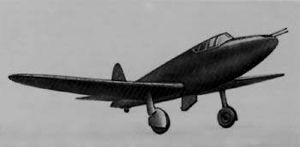
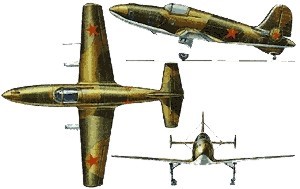
The BI was designed as a single-seater monoplane with short wingspan (6.5 meters). The entire oval-shaped fuselage and monocoque structure, was constructed of wood and covered with 2 mm plywood covered with fabric.
The wing was integrally built and covered with plywood. The selected profile was TsAGI B-1-10 with a relative thickness of 12% and a trapezoidal plant. The ailerons, rudders and rudders were constructed of wood with textile coating, but the flaps were constructed of duralumin (on the BI-5 and BI-6 versions all control surfaces were made of duralumin).
The tail assembly incorporating a ventral fin and circular drifts at the ends of the outriggers. On the BI-1 the stabilizer was raised, but on later models it was released. The rudders were covered with fabric.
The project envisioned an armament of two 12.7mm Berezin machine guns and two 7.62mm ShKAS machine guns. These original plans were replaced by the installation of two ShVAK 20 mm cannons, providing for the possibility of their replacement in the series copies by two 23 mm cannons.
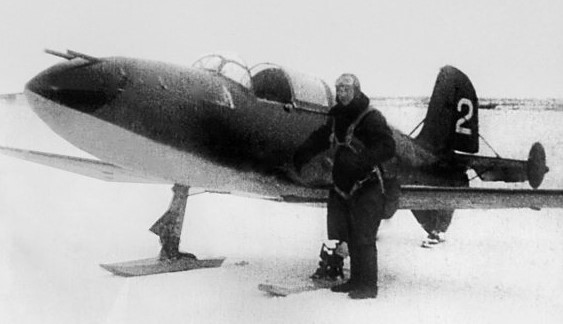
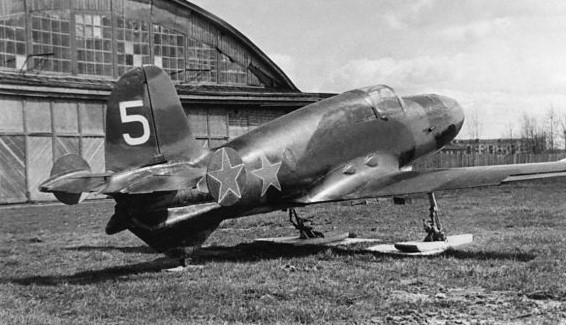
The retractable landing gear was fitted with wheels or skis. The main wheels had dimensions of 400 x 500 mm, while the skis were 1440 x 300 mm and featured a spring-loaded system. The main units were retracted towards the center line of the aircraft. The tail unit was located at the end of the ventral fin, being fixed but adjustable with dimensions 90x42mm. The retraction system was pneumatic.
The BI was powered by a 1,100 kg thrust Dushkin D-1A-1100 rocket engine. In the tail section there were five compressed air tanks and three tanks with nitric acid. These tanks, pressurized to 60 atmospheres, were constructed of a high resistance steel known as “Jromansil” consisting of an alloy of chromium, manganese and silicon with steel. Its fuel mixture of kerosene and nitric acid being not only dangerous to handle, but also causing corrosion of tanks and fuel lines. Despite its high hardness, this material was quite prone to corrosion, so the acid tanks had to be replaced periodically.
The compressed air from the tanks was also used to guarantee the retraction and deployment of the landing gear and for the firing of the cannons.
The pilot was located forward, in a cockpit with a transparent cover.
At the request of AS Yakovlev the glider of the BI fighter was tested in the wind tunnel of the TsAGI. This request considerably alarmed Bolkhovitinov’s team, aware of the harsh relations between their boss and Yakovlev. Despite this, the tests were carried out under the direction of GS Biushgens and AL Raij and after the results were completed, they were studied by Yakovlev himself and the aeronautical designer Ilya Florov, who suggested enlarging the rudder and adding two vertical fins in stabilizers to improve stability.
The first prototype, named BI-1, was only used as a glider without a motor towed by a Petlyakov Pe-2 to test the operating characteristics during landing. The first flight took place on 10 September 1941 piloted by Boris Nikolaevich Kudrin. During 15 flights it was possible to define all the main flight characteristics at low speeds. The tests showed that the behavior and the aerodynamic data corresponded with calculations.
The engine was not yet ready, mainly due to the complexities associated with technological innovation and the use of nitric acid. All safety measures needed to be observed to avoid toxicity, not only from the acid, but also from the vapors. There were even some cases of fire. Time constraints forced the autonomous testing of the engine to be skipped and went straight to testing it in the OKB test bed. The tests began in September 1941.
Before the evacuation, not much more could be done. On 16 October 1941 it was decided to evacuate the bureau and factory buildings of Boljovitinov to the Urals. The next day the engine test bed was dismantled and all documentation and materials were sent to the new location in Bilimbay, near Sverdlovsk (present-day Yekaterinburg). Also towards Sverdlovsk, about 60 km from the Bolkhovitinov location, on the 20th of the month the NII-3 with Dushkin was evacuated. The new test bed for the BI was installed on the shore of the frozen Lake Bilimbay.
Work continued at the new location. The pilot Kudrin fell ill and his position was taken by Gregory Yakovlev Bajchivandzhi. Dushkin at that time was immersed in the development of the powerplant for the new fighter developed under the direction of Kostikov himself and known as “302”, for which the engineer Arvid V. Pallo was appointed to supervise the engine works in the BI.
Nitric acid generated constant problems, corroding parts, causing skin burns and respiratory problems for mechanics. On 20 February 1942 during ignition of the engine in the test bed an explosion occurred. A jet of nitric acid was thrown at high pressure, hitting Engineer Pallo. The nozzle was thrown into the lake. The engine cover detached and flew off until it hit the pilot seat guard, loosening the mounting bolts. Bajchivandzhi was thrown forward, head banging on the instrument board. Only the quick action of the mechanics, who immediately put Pallo’s head in a container with soda and the use of glasses, prevented the accident from having further consequences. As a result of experience, a 5.5mm steel plate was installed at the rear of the pilot’s seat.
In March the test bed was repaired, and changes were made to the engine power system. Various hydraulic tests and 14 ignition tests were carried out on the engine destined to be located in the aircraft. On 25 April 1942 the aircraft was moved from Bilimbay to Koltsovo (to the Research Institute of the VVS ( NII VVS )) and 30 two starts were made to the engine and work began to prepare the BI for flight.
For the first flight of the BI a Government Commission was created with VS Pychnov. Included in the commission were Bolkhovitinov, the head of the NII VVS PI Fiodorov, the chief engineer of the BI project at the NII VVS, MI Tarakanovsky, the chief engine engineer AV Pallo. As chief pilot of the tests, G. Ya was appointed. Bajchivandzhi.
On May 2, the pilot, during a test run, lifted the BI slightly, to a height of about one meter, descending again due to low power.
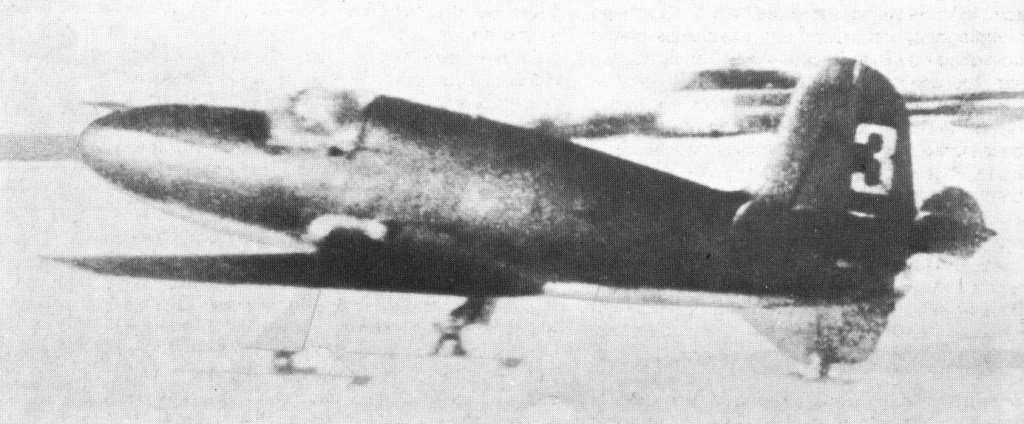
The BI-1, with the 1,100 kg Dushkin D-1A rocket engine, took off for the first time on 15 May 1942 at 19:02 local time, with a flight of 3 minutes 9 seconds, the first in the world that was done with a interceptor rocket propulsion. For this flight, the takeoff weight was set at 1,300 kg and the engine was set to 800 kgf thrust. As a result, an altitude of 840 km / h was reached and a speed of 400 km / h. The ascent speed was 23 m / second. The pilot Bajchivandzhi would later write that unlike conventional airplanes the flying of the BI was extremely pleasant, highlighting the absence of the propeller and the noise and gases from its engine and highlighting the excellent view from the cockpit. A minor landing gear failure at the end of the historic flight hampered the development program, with the tail being damaged.
Accident on May 15, 1942, at the end of the first flight.
The results of the first tests were so promising that the commission decided to order the construction of a pre-series of 50 BI-VS for military tests at the AS Moscaliov construction facilities at Factory No. 499 located in the city of Zavodoukovsk. As a basis for development, the four BI-4 prototypes were taken, having as the main difference with the prototypes in addition to the two cannons in the fuselage, a closed bay with a cassette for bombs was installed in front of the pilot’s cabin. In this bay could be located 10 small 2.5 kg bombs designed to be dropped on bomber formations in the air.
Boljovitinov, very happy with the test results, asked to film the BI development process. With the recordings made, a documentary film was created that was named “Flight to the Future” (in Russian: “Полет в будущее”). This film was shown not only to personalities, but to KB and factory personnel. This led to a very tense situation with the NKVD and was on the verge of provoking the indictment of Bolkhovitinov for revealing military secrets.
BI-1 at the Koltsovo airfield, Svierdlovsk in May 1942
Together with the decision to start serial production, the projects for the creation of training facilities in Sverdlovsk and Moscow were prepared, with the aim of preparing the pilots on the new aircraft. In 1943 it was expected to be able to create several units with the new fighter specialized in the interception of bombers.
The flight of the BI was fundamentally difficult due to the constant problems with nitric acid. On more than one occasion the acid leaked through the pipes or the walls of the tanks and the toxic gases also meant major problems that had to be constantly corrected, so the tests lasted throughout the winter of 1942 – 1943.
Due to the damage to BI-1 due to the corrosive action of nitric acid gases, the continuity of the program was carried out in the second, BI-2, and third, BI-3. These were built in the Factory No.293 in the winter of 1942 – 1943 and characterized by having a retractable landing gear with skis.
G. Baxchibandzhi with BI-2.
The second flight was performed with the BI-2, reaching an altitude of 1100 meters, but adjusted to not exceed 400 km / h. In this aircraft and in a short time, 4 flights were made, three by Bajchivandzhi (March 11, 14 and 21 1942) and another by KA Gruzdiev (January 12 1943). These flights reached a speed of 675 km / h (the calculated one was 1020 km / h at 10,000 meters), ascent speed of 82 m / s, flight ceiling of 4000 meters and flight time of 6 minutes and 2 seconds with 84 seconds engine working time. The flight of March 21 was carried out with the full load of ammunition. So far none of the prototypes had carried real weapons. There is evidence that the BI-4 was the prototype used to test the armament installation, although no firing tests were ever carried out with any of the prototypes.
The third prototype BI was fitted with retractable skis which could be interchanged with wheels depending on the ground conditions.
BI-3
On a Gruzdiev flight, when lowering the gear before landing, one of the skis fell off, but the BI was nevertheless able to land without complications.
The sixth and seventh flights were executed by Bajchivandzhi on the third BI-3 prototype. In the seventh flight, on 27 March of 1943, the planned tasks included a top speed of 750 or 800 km / h at 2000 meters. As observed from the ground, the flight remained normal until the completion of the engine work in 78 second of. After finishing the engine operation, the plane lowered its nose and plunged at a 50-degree angle until it hit the ground. Pilot Gregory Yakovlev Bajchivandzhi died in the accident.
The commission studied the catastrophe but could not determine its causes. As a result, the report included that the causes were motivated by phenomena not studied at speeds between 800 and 1000 km / h. In the opinion of the commission, at these speeds, new factors appeared that influenced the direction, stability and load on the controls.
By 1943 a new T-106-TsAGI aerodynamic facility for high speeds was installed at the TsAGI. In it, tests of aircraft models and their elements began to be carried out to analyze their behavior at high speeds. Among them, the BI model was tested to find the causes of the catastrophe. From the results obtained, it was clear that the BI was destroyed because the peculiarities of the straight wing and tail at speeds close to those of sound that led the aircraft to dive, were not taken into account. It was estimated that at the time of the accident the aircraft piloted by Bajchivandzhi reached 900 – 990 km / h. In 1973 Gregory Yakovlev Bajchivandzhi was posthumously awarded the title of Hero of the Soviet Union.
As a result of the accident, the entire production of 30 pre-series BI-VS in different stages of development was destroyed. Despite this, the flight test program was continued with a number of modifications, it was hoped, would ease the difficulties.
In May 1943 OKB-293 returned from evacuation to Moscow, being relocated to the Khimki area, Moscow District. By the following year, another 5 of the BI had been built, called BI-5 to BI-9.
The endurance of the BI was in adequate for operational use, but a two-chamber engine developed by Dushkin to overcome this deficiency with low (cruising) and high (combat) thrust settings was almost double the weight and considered unsuitable.
In order to study the possibilities of increasing the endurance of the aircraft beyond two minutes of rocket motor work, in 1943 – 1944 modification was planned using ramjets or ramjets at the wingtips. In spring 1944 the sixth BI-6 was fitted with two DM-4 ramjets designed by I. Merkulov and tested in the TsAGI-101 wind tunnel, but was never flown. This ramjet was also tested on the Yak-7B fighter.
Breznyak – Isayev BI-6 with ramjets during wind tunnel tests.
There was also an attempt at some point to seal the cabin by covering all the joints with resin bands, but this idea was scrapped.
After the loss of the Dushkin D-1-A-1100 engine, Isayev began to design his own engine, taking into consideration the advice received from Glushko and the experience accumulated during the tests of the BI. The new RD-1 engine was completed and tested in October 1944. In general, its dimensions were similar to those of the previous one, but it presented a large number of improvements and it was built with 12J13 steel with greater resistance to corrosion. The head had 85 injectors located in a honeycomb conformation that highly improved efficiency and featured an electric start system.
In January 1945, on Isayev’s BI-7 with ski landing gear and RD-1 powerplant, pilot BN Kudrin made two flights. In the first, on January 24, the plane was seriously damaged in an emergency landing due to a problem in the landing gear of the skid. On March 9, properly repaired and with some modifications, with a takeoff weight of 1800 kg and speed of 587 km / h, a climb speed of 87 m / s (4980 m / 16,340 fpm) was reached. The BI-7 revealed dangerous vibrations (flutter) in the tail section. To study the problem, on 29 March 1945, MK Baykalov conducted tests in the BI-7 in configuration as a glider. At that time, the BI had great damage caused by corrosion, so it was withdrawn.
The BI-5 and BI-6 specimens were modified to the same configuration as the BI-7 and flown as gliders towed by a North American B-25J. The BI-5 was tested with a ski undercarriage, being flown by BN Kudrin between March 10 and 25.
The BI-5 prototype on skis during testing in the spring of 1945.
Cockpit of the sixth BI prototype.
The BI-6 flew with conventional wheels, being piloted by MK Baykalov between April 25 and 29. During these tests no vibrations or other problems were observed, but by then it had already been decided to leave the program.
The Bereznyak – Isayev BI was flown with a reactive engine 9 times, 7 times with the Dushkin D-1-A-1100, and twice with the Isayev RD-1. It is argued that three more flights were made in the spring of 1944 with the DM-4 ramjets designed by I. Merkulov, but the truth of this claim has not been proven. These proposed flights were carried out by Kudrin to test ramjets, which were activated already in the air, after towing the BI-6 with another plane.
Flights with BI engine
Date
Model
Pilot
Power (kg)
Working time (s)
Height (m)
Speed km / h
A. Ascent (m / s)
May 2, 1942
BI-1
Bakhchivandzhi
500
13
1
—
—
May 15, 1942
BI-1
Bakhchivandzhi
600
66
840
400
23
January 10, 1943
BI-2
Bakhchivandzhi
800
63
1100
400
—
January 12, 1943
BI-2
Gruzdiev
1100
58
2190
675
—
March 11, 1943
BI-2
Backchivandzhi
1100
80
4000
600
82
March 14, 1943
BI-2
Backchivandzhi
1100
84
3000
+/- 650
—
March 21, 1943
BI-2
Backchivandzhi
1100
30
3000
– 160
—
March 27, 1943
BI-3
Backchivandzhi
1100
89
2000
+800
—
January 24, 1945
BI-7
Kudrin
1100
72.3
1250
587
87
March 9, 1945
BI-7
Baykalov
1100
73
3500
550
—
Note: This table does include the first “take-off” of May 2, 1942, although this was never considered an IB flight.
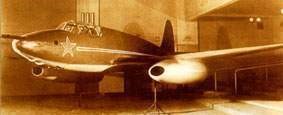
The Bereznyak – Isayev BI-1 exhibited at the Air Force Museum in Mónino.
Berez-Isa BI Engine: one 1100-kg (2,425-1b) thrust Dushkin D-IA-1100 rocket Wing span: 6.48 m (21 ft 3 in) Wing area: 7. 00 sq.m (75.35 sq ft) Length: 6.40 m (21 ft 0 in) Height: 2.06 m Empty weight: 958 kg (2,112 lb) Maximum take-off weight: 1683 kg (3,7 10 lb) Fuel and reagent weight: 600 kg Max speed (estimated): 1000 km/h (621 mph) at 5000 m (16,405 ft) Climb to 10000 m (32,810 ft): 59 seconds ROC: 4920 m / min Endurance: 2 minutes powered Armament: two nose-mounted 20-mm ShVAK cannon Accommodation: 1





















 All Aero