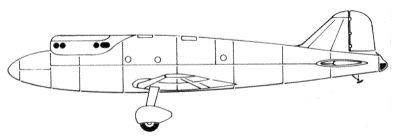
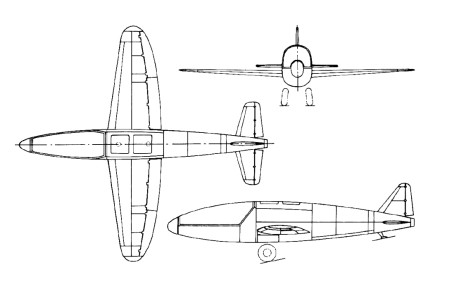
Created to meet a 1945 requirement for a rocket-propelled target defence fighter, the I-270(Zh) was based broadly on the Junkers Ju 248, but was of more conventional configuration. The I-270 featured a straight, near-laminar flow wing, a conventional horizontal tail, and an ejection seat (the first in a Soviet fighter).
The first of two prototypes was initially flown in December 1946 without the rocket motor installed, being towed into the air by a Tu-2.
Only the second prototype was to be fitted with the rocket motor. This, the RD-2M-3V modified version of the 4430 lb / 2010 kgp Walter HWK 509C, developed by L Dushkin and V Glushko, was a bi-propellant dual-chamber unit with a total thrust of 3,196 lb / 1450kg of which the cruise chamber contributed 400kg. The cabin was pressurised and proposed armament comprised two 23mm cannon and eight RS-82 rockets. Calculated endurance was 4 min at maximum thrust and 85 min on the power of the cruise chamber alone.
The first powered flight was carried out with the second prototype early in 1947, and speeds of the order of 620 mph (1000 km/h) were allegedly attained in level flight. The second prototype was written off as a result of a landing crash while being flown by an NII VVS pilot.
Shortly afterwards, the first prototype was damaged in a belly landing and was not repaired, further development was discontinued.
Max take-off weight: 4120 kg / 9083 lb Empty weight: 1546 kg / 3408 lb Wingspan: 7.75 m / 25 ft 5 in Length: 8.91 m / 29 ft 3 in Height: 3.08 m / 10 ft 1 in Wing area: 12.00 sq.m / 129.17 sq ft Max. speed: 1000 km/h / 621 mph Time to 32,810 ft (10 000 m): 2.37 min Time to to 49,210 ft (15 000 m): 3.03 min
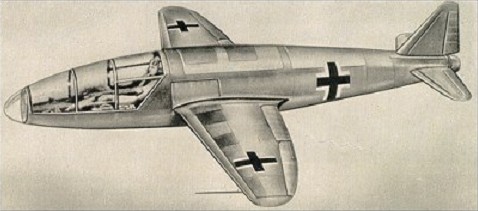
The Me 163D was developed with retractable tricycle undercarriage, then moved to Junkers as the Ju 248, and then renamed again Me 263. Compared with the Me 163, the Me 263 had a larger, longer fuselage, retractable wheeled landing gear, a larger fuel tank, and a new rocket engine with a ‘cruise chamber’.
The V1 prototype built by Junkers was tested as a glider (after aero-towed) before being returned to Messerschmitt for powered flight trials. The aircraft flew for the first time on 31 December 1944.
Construction of two more prototypes was started but they were captured by Russian forces.
There is no evidence that the Me 263 ever made a powered flight.
Power: Walter 109-509C rocket Fuel: T-Stoff and C-Stoff Armament: 2 x 30mm MK.103 cannon / 150 rds Max speed at 9840 ft: 590 mph Climb rate: 13,800 fpm Service ceiling: 52,500 ft approx Endurance max pwr: 15 min Range: 100 miles Wingspan: 31 ft 2 in Length: 25 ft 10.25 in Wing area: 193 sq.ft Empty weight: 4410 lb Max weight: 11,687 lb
The Messerschmitt Me 163 Komet (comet) rocket interceptor stemmed from prolonged research by Dr Alex¬ander Lippisch over 15 years before the war. The heart of Projekt X was a rocket engine developed by Hellmuth Walter. Lippisch’s task was to design a tailless aircraft to go with it. Even he was not allowed to have blueprints of the power¬plant for the airframe he was designing. The result of this clandestine effort was a tailless rocket research craft designated the DFS 194 which began flight trials with a 400 kg (882 lb) thrust liquid fuel Walter rocket motor at the Baltic coast test site of Peenernfinde in August 1940. While test pilot Heini Dittmar flew this test bed, reaching 550 kph (341.8 mph) in level flight, Lippisch and his team pressed on with the next stage of Projekt X at the Messerschmitt Werke in Augsburg. The ultimate aim was to produce a rocket powered interceptor fighter.
In the mid 1930s the German Air Ministry were supporting the work of rocket engine designer Hellmuth Walter, issuing him a contract to develop a 400 kg / 882 lb thrust motor. In the mean time, Alexanderander Lippisch had been working at the German Institute for the Study of Sailplane Flight (DFS) and was given the order to produce a second prototype of his DFS 39 tail-less aircraft to test the potential of a rocket powered airframe. The work would see DFS build the wings and Heinkel build the fuselage.
Lippisch discovered the wing mounted rudders would likely cause unacceptable flutter, so he redesigned the airframe to include a large conventional central fin and rudder. Redesignated DFS 194 it was fitted with a small propeller engine and a landing skid. A takeoff dolly was mounted under the landing skid, it being jettisoned shortly after takeoff.
Dr Lippisch and his staff were transferred to Messerschmitt’s works at Augsburg in January 1939, with the partially completed DFS 194. The decision was also made to by-pass the prop driven version and move directly to rocket power.
The completed airframe was shipped to Peenemünde West in early 1940.
The Comet’s wooden, plywood-covered wings are of special swept-back design with a marked wash-out of incidence towards the tip. The fuselage is of metal construction. “Elevons” which serve both as elevators and ailerons are located outboard in the wings; there are no horizontal tail surfaces.
Three development prototypes of the DFS 194 were ordered by the RLM and the first two were completed by the spring of 1941, when unpowered gliding flights began from the factory airfield. The engineless Messerschmitt Me 163 attained a top speed of 850 kph (528 mph) in a dive test.
In early 1940 the DFS 194 was equipped with a rocket motor at Peenemünde. After test flights by Heini Dittmar had confirmed speeds of up to 550km/h on the power of a single 2.94kN Walter motor, there was sufficient interest to initiate development. In 1941 the first Me 163 prototype was being tested in gliding flight and shortly after was fitted with a 7.35kN Walter RII-203 rocket motor. On 2 October 1941 Heini Dittmar cast off from a Messerschmitt Bf 110 tow-plane at 4000 m (13,125 ft), fired the Me 163V-1’s rocket motor and accelerated rapidly reached 1004.5 kph (623.8mph); two months later the Me163B Komet was ordered into production.
Speeds of up to 915km/h were achieved (limited by the volume of liquid propellants carried) and to gain some idea of the speed potential, this aircraft was towed to a high altitude before being released. Flown under power, a speed of over 1,000km/h was attained before the engine had to be throttled back because the aircraft was becoming uncontrollable.
This success saw the development of the first production prototype, now designated Me 163. Flight testing began in the Spring of 1941. These were a series of unpowered flights before the Me 163 V1 was shipped to Peenemünde for installation of the improved Walter RII-203 engine.
On 2 October 1941, the Me 163 V1 piloted by Heini Dittmar set a new world speed record of 1004.5 kph / 623.8 mph. After this performance, the RLM instructed Lippisch to design an improved version around a more powerful motor under development. The resulted in the Me 163B. The first prototype, the Me 163 V3, was completed in April 1942, but it was not until early autumn that the first Walter 109-509A motors were ready for installation.
Plans proceeded during 1943 to equip the first operational units with the Me 163B-1a. Production Me 163Bs were po¬wered by Walter 109 509A2 rocket motors using T Stoff (hydrogen peroxide) and C Stoff (hydrazine hydrate, methyl alcohol and water) to give a thrust of 1700 kg (3,748 lb).
The new motor employed a ‘hot’ system in which the oxygen was ignited for additional thrust and better fuel efficiency. Flight testing of the first series of Me 163B-0 pre-production aircraft proceeded throughout 1942.
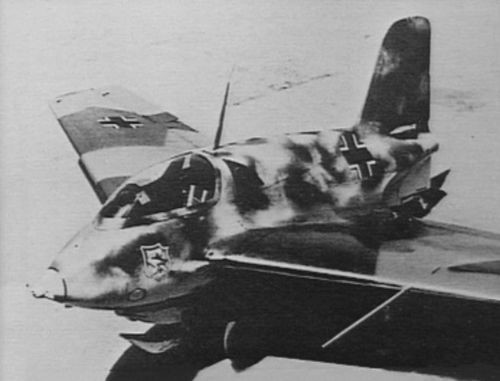
The fuselage of the Komet was made of metal but its wing was of wooden construction. The leading edge of the wing featured long slats in front of the elevons. Early Me 163B 0 aircraft were armed with a pair of 20 mm guns, but Me 163B 1 fighters carried two 30 mm weapons. The aircraft possessed no conventional landing gear, but took off from a trolley, which was jettisoned immediately after take off and at the end of the flight the Komet was landed on the skid. The small propeller on the nose served to drive a generator which supplied electrical power for the radio and instruments. Armour includes a nose cone constructed of 15-mm plate.
Laminated bullet-resisting glass gives the pilot added protection from frontal attack. Two triangular plates comprise the side cockpit armor. No provision is made for defense against attack from the rear except the plane’s high speed.
The production Me 163B’s 1500 kg (3307 1b) thrust Walter HWK 109-509 rocket motor was fuelled with a highly volatile mixture of C stoff (methyl alcohol, hydrazine hydrate and water) and T stoff (hydrogen peroxide with additional hydrocarbon stabilizers) which would explode at the least provocation. The Komet carried more than 2000 kg (4409 lb) of fuel and climbed to 12,000 m (39,370 ft) in 3 minutes 30 seconds. The Walter HWK 109-509A rocket motor made use of a steam generator that used calcium permanganate as a catalyst to produce steam when a small amount of T-Stoff was added via an electric starter motor, the resulting steam starting the turbine to begin pumping the two fuels to the rocket motor. The starter motor was switched off, and the rocket motor was throttled through its five positions until it reached maximum thrust.
Messerschmitt Me 163 B-1 Komet
After rocket¬ing high, the Komet pilots would use their remaining fuel to dive at high speed through the ranks of bombers firing on them with the Me 163B’s two 20mm MG 151/120 or 30 mm MK 108 cannon, or with the SG 500 Yagdfaust (hunter’s fist) 50 mm (1.97 in) weapon system, which fired shells vertically upwards from the top surface of the Komet’s wing when a bomber’s shadow triggered its photo electric cell firing circuit.
Series production began at dispersed facilities by Klemm, but was later transferred to Junkers, as a result of quality control problems. An operational training unit, Erprobungskommando 16 (EK 16) was formed during July 1943 at Peenemünde West, but moved to Bad Zwischenahn before the first group of pilot trainees arrived. The unit received its first group of 36 pilot trainees in the summer of 1943 and by May 1944 the first operational Me 163 wing, Jagdgeschwader 400 (JG 400) was created under the command of Hauptmann Wolfgang Späte. The unit was ordered to defend the synthetic oil refineries at Leuna from its base at Brandis, near Merseburg. The same day several Me 163s over Wesermude attacked a formation of B-17s of the 3rd Air Division and shot down one. P-38 escorts of 479th FG tried in vain to intercept the fighters.
Two additional units fighter groups, II and III/JG 400 were formed before the end of the war, but only saw limited combat against single aircraft.
On 28 July 1944 the Luftwaffe deployed for the first time the Me 163B fighter. Seven Comets were flown by JG400, which had been formed in Wittmundhafen out of the 16th Test Unit.. JG400 was assigned to protect the synthetic fuel plants. That day the US 359th Mustang Fighter Group saw five Me 163s over Merseburg. “They cooly carried out a number of attacks on our unit”.
The same day several Me 163s over Wesermüde attacked a formation of B-17s of the 3rd Air Division and shot down one. P-38 escorts of 479th FG tried in vain to intercept the fighters.
JG 400 made interceptions of Allied bombers on 7th and 28th of July 1944, without success, but on 16 August Fw Siegfried Schubert scored the types first success. He scored three victories before his death in that October. The only other major USAAF interceptions were on 24 August (4 B-17s shot down by 1 Gruppe), 11th September, and 2nd November.
Although the aircraft’s two 30mm MK 108 cannons were capable of downing a four engined bomber with only a few hits, the Komet’s high speed, and the cannons’ slow rate of fire and short range, made effective gunnery nearly impossible. As a result, the Me 163 pilots recorded a total of only nine confirmed kills. (Schubert 3 kills, Kelb, Schiebeler, Ryll, Strasnicky, Glogner, & Bott one each). After completing an attack, the pilot had to glide back to base as the fighter only carried enough fuel for eight minutes of powered flight.
In response to combat reports, alternative weapons were including the SG 500 recoilless ‘Jägerfaust’. Five were mounted in either wing and fired by photocell trigger as the aircraft passed below.
Further combat sorties were curtailed by order by the end of 1944 due to pilot losses as high as 30%. On 14 April 1945, the remaining aircraft at Brandis were destroyed and the remaining personnel ordered to join the army. The official order to disband 1./ and II./JG 400 was issued on 20 April 1945.
An improved variant with greater endurance and a tricycle undercarriage, the Me 163 C was also produced in small numbers, but was not flown operationally. A few examples of a two seat trainer, the Me 163 S were also completed. The slightly larger Me 163C development – with aerodynamic refinements, pressurised cockpit and blister-type canopy, and more powerful Walter 109-509C rocket motor and auxiliary cruising jet – was built only in prototype and pre-production form. It did not enter service, although it was almost ready for delivery to Luftwaffe squadrons at the time of the German surrender. With this version, endurance was increased from eight-ten minutes to twelve minutes of powered flight. It was faster by 40 mph, weighing 11,280 pounds.
The Me 163D was developed in to the Me 263. The aircraft was briefly known as the Junkers Ju 248 V1.
Produced in only small numbers, about 360 examples were completed.
Official top speed of the Comet, contrary to Messerschmitt’s statement, is 550 mph at 20,000 feet and above. Armament consists of two 30-mm cannon, one in each wing root, firing a total of 120 rounds. Normal flying weight of the 163 is 9,500 pounds; wing span is just over 30 feet, length, slightly under 20.
The fuels in the Komet were highly corrosive and would dissolve organic material (such as the pilot). To avoid this, the pilots would wear special asbestos fibre suits. A bumpy landing sometimes caused unburned fuels to mix and ignite.
Me 163B Komet Wing span: 30 ft 7 in (9.32 m) Length: 18 ft 8 in (5.69 m) Engines: 1 x Walter, 3300 lb Max TO wt: 9042 lb (4110 kg) Max level speed: 596 mph ( 960 kph)
Me 163B-la Powerplant; 1 Walter HWK 509A-1 (or A-2), 3,748lb (1700kg) thrust Fuel; C-stoff: 57% methyl alcohol, 30% hydrazine hydrate, 13% water – T-stoff: 80% hydrogen peroxide, 20% stabilisers Max. speed: 559mph sea level to 39,400ft (12,000m) Service Ceiling; 39,400ft (12,000m) Climb: 1.48 minutes to 6,600ft (2,000m) Climb: 2.02 minutes to 13,100ft (4,000m) Climb: 2.27 minutes to 19,700ft (6,000m) Climb: 3.45 minutes to 39,400ft (1 2,000m) Endurance; 7min 30sec Range; Approx 80 miles (130km) Empty weight: 4,1901b (1900kg) Max takeoff weight: 9,0521b (4310kg) Wing span: 30ft 7in (9.40m) Length: 19ft 2in (5.85m) Height: 9ft (2.75m) on takeoff dolly Wing area: 199.1 square feet (18.5sq.m) Armament Two 30mm Rheinmetall – Borsig MK 108 cannon / 60 rpg
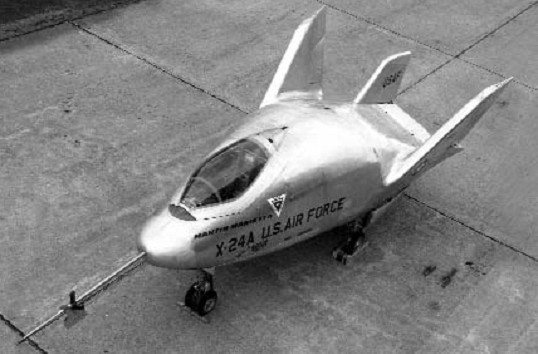
The X 24A and X-24B were the forbears of the Orbiter because they were conceived, designed, built, and flown as part of the Air Force NASA effort to develop a vehicle which could re enter the earth’s atmosphere from space and be flown without power to a selected landing site.
Both vehicles were lifting bodies. They do not use wings to achieve lift, but rely entirely on body shapes to produce lift with as little drag as necessary. What was needed was a type of aerodynamic shaping to cope with the high heat of re entry, while still producing a flying machine that could be control¬led by the pilot. The X 24 flight test programmes proved that the designs were correct.
In the form of the Martin Marietta Corporation, Martin returned to piloted aircraft production in 1965 with SV-5 piloted lifting body research vehicle, built as SV-5J with J-85 or J-60 jet engine and as SV-5P or X-24A with XLR-11 rocket engine. The X 24A and B, designed to be carried aloft by a Boeing B 52 and launched at about 45,000ft, made a ¬total of 64 successful flights and landings, sometimes using rocket power to go up to 60,000 or 70,000ft and increase their speed to simulate re entry conditions before starting their approach to a powerless landing.
The X 24A had medium lift to drag ratio (4.5 at subsonic speeds and 1.3 at hypersonic speeds), and could land anywhere within an area 8,000 nm long and 4,000nm wide from the point of re entry.
The flights of the two aircraft pro¬vided research data in the lower end of the re entry flight corridor, from low supersonic speeds through tran¬sonic and subsonic, speeds to landing. This data simplified the task of de¬signing and building the Space Shuttle Orbiter.
The X-24A/SV-5P represented the low-speed end of the test spectrum for the START program that had also tested the X-23A. The X-24A was used in project PILOT (piloted low-speed tests). The rocket-powered X-24A was specifically designed to explore the low-speed flight characteristics of a maneuverable lifting-body design. The design was essentially identical to the SV-5D used in project PRIME as the X-23A, allowing both ends of the flight spectrum to be tested on the same shape. The X-24A decisively demonstrated that lifting-bodies could consistently make precision landings onto a hard runway, proving the concept for the future Space Shuttle.
The X 24A project began in 1966, while the Air Force and Nasa were already testing two earlier lifting bodies, the M 2 and the HL-10, de¬signed by Nasa and built by Northrop. The X 24A was built for the Air Force by the Martin Marietta Cor¬poration under the management of the Flight Dynamics Laboratory. The design called for a bulbous fuselage, no wings, and a triple tail. The aircraft was 24.5ft (7.47m) long, with a single cockpit well for¬ ward, and had a span of 111.5ft (3.51m).
It was designed to, use the Thiokol XLR-11 RM 13 rocket motor, the same type as that used on the first rocket powered aircraft, the Bell X 1, and which produced 8,600 lb of thrust, burning a mixture of water, alcohol and liquid oxygen. The X 24A car¬ried enough fuel for a maximum burn of 137sec, but this was in-creased to almost 160sec later in the programme. The rocket and fuel brought the maximum launch weight of the X 24A to 11,450 lb, but the rocket was not used in the early flights.
Although it was delivered to Edwards AFB in August 1967, the X 24A did not make its first manned captive flight until April 4, 1969. The first free flight, with Maj Gerry Gentry of the Air Force in the cock-pit, was made on April 17, when it was launched at 45,000ft and an air speed of 174kt with a launch weight of 6,344 lb. The flight lasted 3min 37.4sec, did not go above the launch altitude, and achieved a maximum speed of Mach .718 (411 kt true air speed).
The X 24A made seven more free flights between May and November without using the rocket motor. Gentry was in control for all but one, which was flown by John Manke of Nasa. In January 1970, the engine was run in the aircraft for the first time, but it was flown without the rocket once more before the first powered flight was made by Gentry on March 19.
On that flight, the launch was made at 40,000ft and 175kt at a launch weight of 11,320 lb. The aircraft went up to 44,384ft and achieved a maxi¬mum speed of Mach 0.865 (469 kt) in a flight which lasted 4min 4.25sec.
The X 24A achieved supersonic speed f or the first time on the eighteenth flight, on October 14, with Manke at the controls. It was launched at 42,000ft and 185kt, and went up to 67,900ft and Mach 1.186 (681 kt) before landing after a flight of 6min 51.1sec. On March 29, 1971, it achieved the highest speed of the entire programme, Mach 1.6 (900kt), during the 25th flight, again with Manke at the controls.
The highest altitude the X 24A ever attained was 70,947ft, which it reached during the 26th flight, on May 12. Maj Cecil Powell of the Air Force was the pilot, making his second free flight in the aircraft, and the flight lasted 7min 2.7sec.
The longest flight of the pro¬gramme, lasting 8min 37.2sec, was the 28th and final flight on June 4, 1971, with Manke in the cockpit. When the flight test programme ended after almost two years, the X 24A had flown a total of 2hr 53min.
Only a single X-24A was manufactured, but two extremely similar jet-powered SV-5Js were also built. The SV-5Js were to be powered by a single J60 turbojet engine and used as trainers to introduce pilots to the low-speed handling characteristics of lifting-bodies, but in the end neither aircraft ever flew. One of the SV-5Js is on display at the Air Force Academy near Colorado Springs, Colorado, while the other has been superficially modified into an X-24A and is on display at the Air Force Museum. The X-24A itself was heavily modified to become the X-24B.
X-24B
Although the X-24A program successfully met all of its objectives, engineers and scientists at the Air Force Flight Dynamics Laboratory (FDL) wanted to conduct similar tests on an even more advanced lifting-body shape called the FDL-7/FDL-8. The original plan was to convert one of the jet-powered SV-5Js into the advanced testbed, but since this would have entailed extensive modifications to fit a rocket engine in place of the turbojet, these plans were shelved. As the rocket-powered X-24A was nearing the end of its test program, it was finally decided to utilize it instead since the modifications were expected to be less extensive.
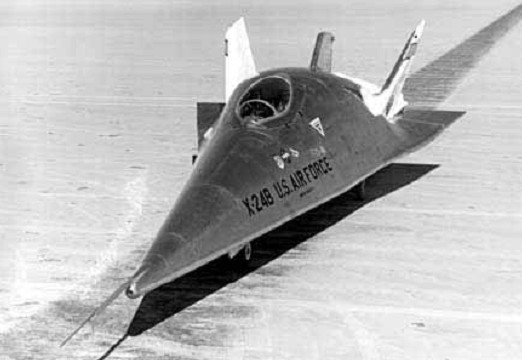
The X 24A was returned to the Martin Marietta plant late in 1971, and the lumpy looking fuselage was literally engulfed by a sleek, needle ¬nosed, wedge like structure. All sub¬systems of the X 24A, with one excep¬tion, were retained in the new vehicle, including the rocket motor. The exception was the nose gear, which had to be beefed up to take the increased weight; it was replaced with the nose gear from a Navy F11F. Strakes just large enough to accommodate ailerons were added outboard of the triple tail.
Underneath the sleek shell of the X-24B lived the original X-24A. The new skin was essentially “gloved on” to the original aircraft designed by the Air Force Flight Dynamics Laboratory as the FDL-7/FDL-8. Most systems were retained intact. Although the X-24B was intended to evaluate the flight characteristics of the FDL-7 shape, in reality it spent most of its 36 flights demonstrating precision landing techniques that would be used on the forthcoming Space Shuttle.
The X 24B had a high lift drag ratio (4.8 at subsonic speeds and 2.5 at hypersonic speeds), and had a landing footprint about double that of the X 24A.
The X 24B which rolled out of the plant on October 11, 1972, was 37.5ft (11.4m) long, with the cockpit almost half way back in the fuselage, and had a span of 19.1ft (5.82m). It had a maximum launch weight of 13,800 lb and a landing weight of 8,5001b.
The X 24B flight test programme began in July 1973 with John Manke of Nasa (who had flown 12 of the X 24A flights) and Lt Col Mike Love of the Air Force as primary test pilots, but four other pilots flew the aircraft before the programme ended two years later.
Before Manke made the first free flight on August 1 the craft was taken aloft on two captive flights. The free flight launch was made from 40,000ft at 175kt, and the air¬craft achieved a maximum speed of Mach 0.652 (400kt) and gained no additional altitude before landing in 4min 11.5sec. The first flight to use rocket power was the sixth, on November 15, which was launched at 40,000ft and 185kt and went up to 52,7164ft and Mach 0.917 (519kt) dur¬ing a flight which lasted 6min 44.7sec. Manke was at the controls on that flight and also on the first supersonic flight, the 9th, on March 5, 1974, when Mach 1.086 (615kt) and an altitude of 60,334ft were achieved after a launch from 45,000ft at 184kt.
The highest speed attained by the X 24B was Mach 1.76 (1,164kt) on its 16th flight, on October 25, with Love at the controls. Launched at 45,000ft and 200kt, the aircraft went up to 72,440ft during the 7min 47.6sec flight. The highest altitude reached was 74,130ft on the 23rd flight, on May 22, 1975, with Manke in the cockpit. The launch was at 45,000ft and 195kt and the maximum speed during the flight was Mach 1.63 (942kt). The flight lasted 7min 40. 9sec.
The basic research programme ended on September 23, 1975, with William Dana of Nasa making his second flight as pilot and the air¬craft making its 30th flight, Three other pilots then flew the X 24B for two unpowered flights apiece before it was finally grounded on Novem¬ber 26, 1,975. It had flown 36 flights, the longest of which was 8min 1.9sec, accumulating a total of four flying hours.
The X-24B is currently on display at the Air Force Museum, alongside one the the SV-5Js configured as the X-24A.
X-24A Power: Thiokol XLR-11 RM 13 rocket, 8,600 lb thrust Fuel: water, alcohol and liquid oxygen Maximum burn: 137-160sec Length: 24.5ft (7.47m) Span: 11.5ft (3.51m) Maximum launch weight: 11,450 lb First Flight: 17 April 1969 Last Flight: 4 June 1971 Fastest Flight: Mach 1.60 (1,036 mph) Total Flights: 28 Highest Flight: 71,400 feet
X-24B Length: 37.5ft (11.4m) Span: 19.1ft (5.82m) Maximum launch weight: 13,800 lb Landing weight: 8,5001b First Flight: 1 August 1973 Last Flight: 9 September 1975 Total Flights: 36 Fastest Flight: Mach 1.76 (1,164 mph) Highest Flight: 74,140 feet
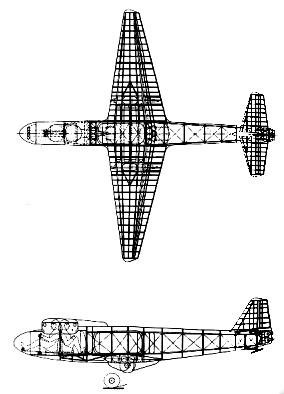
The RP-318 or RP-318-1 was Russia’s first rocket-powered aircraft or Rocket Glider (Rocketny Planer or Raketoplan) which “RP” stands for in Russian language. Beginning in early 1936 it was firstly known as RP-218-1 or “Objekt 218” before it was changed to RP-318-1 in 1938 due to inner reforms of Rocket Science And Research Institute.
According to the proposal of Marshall Tukhachevsky the Revolutionary Military Board established on 21 September 1933 a brand new institution – RNII. The activities of the new institute began on October 31 by merging of GDL and GIRD. In the beginning the works on a rocket-glider were not a part of RNII activities and also the development of rocket engines using a liquid propellant was also not in the focus of activities – the main activities were focused on military rockets, using solid fuel.
He understood well, that the idea of creation of the rocket plane simply by putting a rocket engine into usual airframe was wrong. He stressed, that there are differences in flight characteristics, trajectories and weights. The development of necessary airframes could be possible on condition, that there was a reliable and powerful rocket engine. These conclusions he pointed at the conference about utilizing of rocket-powered aircraft for use in the atmosphere, which was held on 2-3 March 1935 in Moscow.
The chief designer was S.P.Korolev and his deputy was E.S.Schetinkov. The original design was a single-seater and a pressurised cabin was not in consideration, instead the pilot was provided with a space suit. The empty aircraft was to be very light: 240kg airframe, 200kg fuel system, 200kg compressed air system (used for life support and to displace fuel components toward the engine), 50kg for engine. The rocket engine should have thrust of 19.6kN and the take-off should be assisted by solid fuel boosters. After a steep climb (at angle of 60°) to an altitude 32km, and the aircraft would glide at the speed of up to 2500km/h, covering 220km in 18min.
Some changes were introduced in the design. Now it was a two seater, high-altitude experimental aircraft with pressurized cockpit, equipped by a rocket engine (developed by the 1st department of liquid rocket engines, managed by V.P.Glushko). It was obvious that such a complicated aircraft can not be successfully built without simpler manned technology demonstrator. S.P.Korolev was ready for this: he already built a strengthened glider SK-9, specially intended to fly with a rocket engine. On June 16 1936 the board of RNII decided to proceed with a “supplement” to the Object 218. It would be an experimental aircraft equipped by a low-output rocket engine, named RP-318, essentially a SK-9 fitted with ORM-65 engine and fuel system. The engine selected, Glushko’s ORM-65, a nitric acid/kerosene engine capable of generating between 50 and 175 kg of thrust, was already under development for the 212 winged missile.
RP-318-1
Built in 1936 by Sergei Korolev as an adaptation of his SK-9 glider, it was originally designed as a flying laboratory to test rocket engines and ORM-65 (RDA-1-150) designed by Valentin Glushko was the one selected to be used. Arvid Pallo took the work on installation into the SK-9 rear fuselage, and the tanks for nitric acid and kerosene occupied the former rear cockpit. The whole powerplant weighed 136.8 kg, the fuel 75 kg. The engine could run for 112 seconds. Ground fire tests began at February 1939, until October more than 100 firings were done.
In late 1938, when both Korolev and Glushko were arrested in suspicion of Anti-Soviet activity, new RNII Director B.M.Slonimer transferred the “Rocket-Glider” project with remains of the team to the new department (head – L.S.Dushkin). A.V.Pallo was put in charge for the RP-318. Development of the RP-318-1 was continued by Alexei Scherbakov (Щербаков, Алексей Яковлевич) and Arvid Pallo (Палло, Арвид Владимирович), culminating in the first powered flight on Feb. 28, 1940 by test pilot Vladimir Fedorov. The rocketplane took off towed by a Polikarpov R-5; at 2800 m altitude it released, Fedorov set up 80 km/h speed and then fired the engine. After 5-6 seconds the speed increased to 140 km/h; Fedorov established climbing flight with 120 km/h speed and held it during all time the engine worked (110 seconds); he climbed 300 m during this time. The speed increase after engine start was smooth, vibrations didn’t appear. On March 10 and March 19, 1940 two more successful rocket flights were performed.
As it already occur several times in Soviet pre-WWII history, purges and re-organizations added new problems. RNII lost its Flight-Trials Grounds. There were no more experienced test-pilots (S.P.Korolev was in prison). It was necessary to find an organization within Aviation-Industrial complex capable to carry out flight trials of the aircraft. Help came from the OSK Factory N°1 NKAP. A.Ya.Scherbakov, head of the OSK was involved with “Project 218” as a designer of pressurized cabin. Glider-pilot V.P.Fedorov was invited as a test-pilot. The aircraft was carefully evaluated. Tail section (damaged by acid) was rebuilt. New landing ski was installed. Rigid tail skid got a shock absorber. New cowling for fuel tanks was developed.
Flight trials of RP-318-1 (designation of rebuilt RP-318) took place in November-December 1938 towed by R-5 biplane (pilot Fikson). The engine was replaced by its weight equivalent. First three flights were dedicated to the center of gravity studies: with empty tanks, 50% of fuel, 100% of fuel drained gradually to imitate its consumption by the engine.
After those flights RP-318-1 was installed in the L.S.Dushkin laboratory for engine installation and trials. Soon several problems with the ORM-65 engine were revealed. First of all, there were only three ORM-65s built, and two of them were allocated to the “Project 212” winged rocket (cruise missile). This brought some limitations on use of the engine for a RP-318: no provision for multiple start, overheating of the engine head, few unreliable sealings. Acceptable for a missile, ORM-65 needed to undergo serious modifications before it could be used on the manned aircraft.
Modified engine was designated RDA-1-150. It was 2kg lighter than the ORM-65, had improved cooling system. Number and design of injectors was changed. Intermediate ‘starter’ engine regime (fuel flow at 8…10% of normal) was introduced for the first time. Monitoring of the engine operation was improved. Though still very basic, it was a step forward from couple of ORM-65’s wires burned by flames and disrupting the electric current to lights on the pilot’s instrument panel.
Experiments with multiple ignition (additional air-hydrogen burner with electric start) were successful, but tight design limitations of the RP-318-1 created problems for its installation. Total number of engine firings was more than 100, including 16 after installation on the RP-318 (July 21, 1939). On October 3 A.Ya.Scherbakov sent to People’s Commissar of Aviation Industry a request for permit to fly RP-318-1 with the rocket engine fired.
KB-29 NKAP airfield at Podlipki (Moscow Region) was chosen for trials. In November 1939 the aircraft was installed on the edge of the field, partly covered by birch and fir trees. The team had to perform systems tune-up and to work with kerosene and concentrated acid under deep freeze conditions, with very basic fuelling equipment and rudimentary accommodations: wooden package box used to transport the aircraft served as a “field laboratory and workshop”.
More on-ground firings were performed and all were successful, but on January 3, 1940 supervising commission ordered more unpowered flights and demanded to perform more study of the airframe shape (the wooden SK-9 glider had been built in 1935). No damage or degradation of wooden parts were revealed, but speed was restricted by 150km/h.
Test pilot V. P. Fedorov (Владимир Павлович Фёдоров) was towed to 2,600 m and cast off at 80 km/h before firing the rocket engine and accelerating the aircraft to 140 km/h and an altitude of 2,900 m. In all, the RP-318 flew nine times before World War II ended development.
First flight with rocket engine fired at full power took place on February 28, 1940. It took since early morning until 5 p.m. to prepare the snow-covered airstrip, fuel the RP-318-1 (40kg of acid and 10kg kerosene), fill the nitrogen bottle to 130kg/m2, and check the fuel system for leakage absence. Flight crews were in cockpits: N.D.Fikson as a pilot of the R-5, A.V.Pallo as an observer and A.Ya.Scherbakov as a tag winch operator – in the rear cockpit of the R-5. V.P.Fedorov – pilot of the RP-318-1.
At 5:28 p.m. both aircraft took off, and 31 minutes later at altitude 2800m RP-318-1 was released. It took some time for N.D.Fikson to bring the R-5 into an optimal position for observation, and at altitude 2600m V.P.Fedorov fired the engine. First, grey smoke indicated ignition of the powder charge. Shortly its place was taken by blurred flame with brown smoke showing that the engine is running in the ‘start’ regime. And, finally – spear-shaped bright flame near 1.5m long with little smoke.
After gradual acceleration of the RP-318-1 left the observers far behind, and all efforts of the R-5 pilot to keep up with the experimental machine failed. Once it was out of sight, N.D.Fikson, A.V.Pallo and A.Ya.Scherbakov turned back to the airfield to meet the rocket-plane during its landing.
From V.P.Fedorov report: Start of the ZhRD was normal, the glider speed was 80km/h. In 5…6sec speed was increased to 140km/h. During following climb speed was reduced to 120km/h. Engine was working during 110sec. During the climb altitude increased from 2600m to 2900m. Climb rate was 3m/sec. Handling and stability of the rocket-plane with fired engine are good. Start of the ZhRD does not deteriorate handling of the aircraft. Acceleration is smooth. Noise in the cockpit from the ZhRD is not irritating is is more muffled than during ground trials. The feel of acceleration and flight with the ZhRD fired is more appealing than on a prop-driven aircraft with the engine boosted to maximum power.
On March 10 and 19 two more flights were performed without an accident. During those flights the engine start was filmed from the R-5 observer’s cockpit.
Than the Spring came. Melting snow made the airfield unusable and delivery of the acid to the plane virtually impossible. No more flights were performed. In the Fall of 1940 the RP-318-1 was transported back to the RNII and disassembled.
It was planned to continue trials with modified RDA-1-300 engine. Plans included rocket-powered takeoff using jettisonable wheel cart. But this project was pushed aside by RAS and RDD rockets. In 1941 priority was given to RDA-1-1100 engine for Bolkhovitinov’s BI rocket fighter.
In August 1941 RP-318 was burned. The Rocket Institute was preparing for evacuation, and old wooden airframe was worthless.
RP.218 1935 Powerplant: 1 × RDA-1-150 rocket, 0.98 kN (220 lbf) thrust 100 kgf Wingspan: 17.0 m (55 ft 9 in) Wing area: 22.0 sq.m (237 sq ft) Length: 7.44 m (24 ft 5 in) Empty weight: 570 kg (1,257 lb) Gross weight: 700 kg (1,543 lb) Maximum speed: 140 km/h (87 mph; 76 kn) Range: 220 km Endurance: 18min Ceiling: 32,000 m Crew: 1
RP.218 1938 Engine: 4900 to 9800kN Loaded weight: 1600 kg Endurance: 15 to 20min Ceiling: 50,000 m Crew: 2
RP318-1 Powerplant: 1x Dushkin RDA-1-150 rocket engine, 1500 N maximum thrust Wing span – 17.0 m Length: 7.44 m Wing area: 22 sq.m Normal takeoff weight: 637 kg MTOW: 700 kg Vne: 160 km/h (limited by strength reasons)
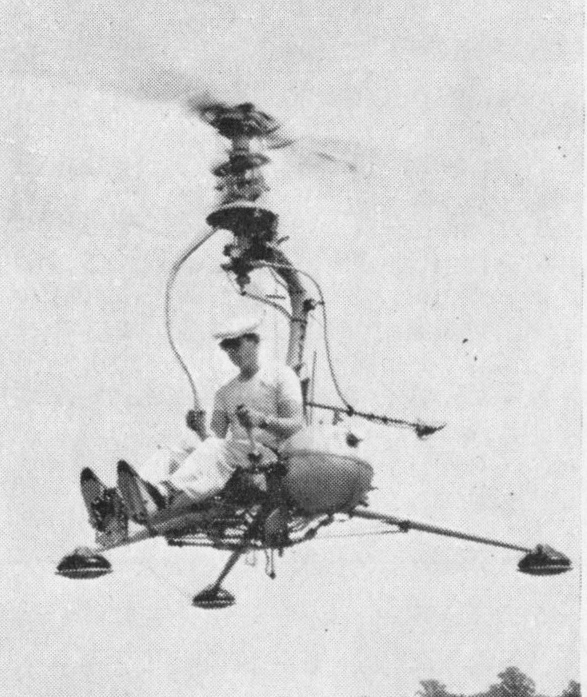
In 1954 the first helicopters with rocket-driven rotors were flown; the Kellett KH-15 and Rotor-craft RH-1.
Nicknamed ‘Stable Mable’, the KH-15 has been built for the U.S. Navy to test a new system oft gyro-abilisng cotrols. It flew after only 8 minutes of tethered tests. Power units are tip-mounted hydrogen peroxide rocket motors.
Power: 2 Reaction Motors XLR32 rockets Rotors: 2-blade tip-powered main rotor and tail rotor Rotor diameter: 18 ft Loaded weight: 644 lb Seats: 1
Ernst Heinkel initiated as a private venture the He 176, which was designed by Siegfried and Walter Gunter specifically for rocket propulsion. The span and area apply to the open cockpit, fixed undercarriage first prototype as originally designed; larger wings were fitted before the first flight. The speed and endurance of approx 171 mph (275 kph) and 50 sec. are those achieved on the first flight on 20 June 1939 powered by a 5.89kN Walter HWK-R1 203 liquid fuel rocket motor, although much better performances were achieved later. The He 176 was demonstrated before senior German officials early in July 1939. They remained unconvinced of the potential of rockets for aircraft propulsion. The more advanced second prototype, with enclosed cockpit and retractable landing gear was never built.
Engine: One Walter HWK R 1 203 rocket, 1,323 lb (600 kg) thrust. Wing span: 16 ft 4.75 in (5.00 m) Length: 17 ft 0.75 in (5.20 m). Height: 1.4 m / 4 ft 7 in Wing area: 58.12 sq.ft (5.40 sq.m) Gross weight: approx 3,530 lb (1600 kg). Empty weight: 900 kg / 1984 lb Max. speed: 750 km/h / 466 mph Cruise speed: 700 km/h / 435 mph Ceiling: 9000 m / 29550 ft Range: 95 km / 59 miles Crew: 1.
While work was proceeding with the P 1052 and the P1081, Hawker tried out the Snarler rocket on the P1040 which, with this addition, became the P1072. The Snarler was an Armstrong Siddeley rocket installation fitted to the tail of the aircraft, but powered by a Rolls-Royce Nene turbojet exhausting via bifurcated ducts in the wing roots, the idea being to get the rocket airborne for experimental engine development. After a conventional first flight in November 1950, the rocket was successfully used four days later. Six flights were made with the Snarler, taking off normally on the jet engine, and lighting the rocket at a fairly low altitude, putting the aircraft into a climb. With the Nene jet engine working at full power, together with the thrust of the rocket, the aircraft went up not beyond 40,000 feet the, aircraft had no pressurized cabin.
Engines: Rolls-Royce Nene turbojet, 5000 lb (2268 kg) and Armstrong Siddeley Snarler rocket, 2000 lb (907 kg) thrust.










 All Aero