Paraglider power unit
Empty weight: 25kg
Engine: NS/Hirth, 34 hp
Reduction: 1:3
Prop diameter: 150 cm
Price (1998): 6800 DM
Paraglider power unit
Empty weight: 25kg
Engine: NS/Hirth, 34 hp
Reduction: 1:3
Prop diameter: 150 cm
Price (1998): 6800 DM
The West German built NST Minimum design is basically a hang glider with an 18 hp Solo engine hung underneath. However, the engine mount position is designed to be at the aircraft’s centre of gravity in normal flight.
Minimum
Empty weight: 22 kg
Engine: Solo, 15 / 20 hp
Certification: vz
Reduction: 1:3
Prop diameter: 150 cm
Fuel capacity: 10 lt
Price (1998): 5380 DM
Cycle: 4 stroke
No cylinders: V 2
Compression: 8.9
Displacement: 580 cc
Cooling: Air
Ignition: Electronic
Reduction: Poly V 3/1
Dimension: 400 x 500 x 250 mm
Weight: 28 kg
Max pwr: 30 hp at 4200 rpm
Price 1998: 3500 DM
1998:
Theenhausener Str. 26
D-33824 Werthr
Germany
Norbet Schwarze first built his power machines circa 1983. Worldwide sales amounted to about 500 by 1998.

Price per Unit (piece) 2009: $11,000.00
Instinct High Line NS 200
Engine: Simonini MINI 2 Plus, NIRVANA Tunning
Power: 27 HP (@ 6,800 rpm)
Ignition: NIRVANA CIR (electronic with pre-ignition and battery charging regulation, microprocessor controlled start/stop button, moto-hour recorder and rpm meter output)
Carburetor: Diaphragm WALBRO WG8
Reduction: Belting 1:2.4 NIRVANA
Exhaust: Tuned NIRVANA
Propeller: Carbon, two-blade foldable 130 cm, with central bolt
Starting Gear: Manual and electrical
Fuel Tank: 14 litres, integrated
Body: Self-supporting laminated shell – carbon/Kevlar sandwich
Frame: Aluminium, five-parts reinforced NAP frame, aerodynamic carbon laminated struts, easy and fully dismantle
Harness: Anatomic construction absorbing remaining vibrations, straps AustiAlpin Cobra, underneath container – foldaway and easy to remove
Accessories: Maintenance-free NiCd battery, charged during the flight, socket 16.8 VDC, fuel gauge
Equipment: Padded bag for engine complete with wheels, propeller packs
Weight: 23 kg (empty unit without harness)
Recommended Pilot Weight: 80–160 kg (single or tandem)
Minimum Static Thrust: 70 kP
Average Fuel Consumption: 3–3.5 litres per hour
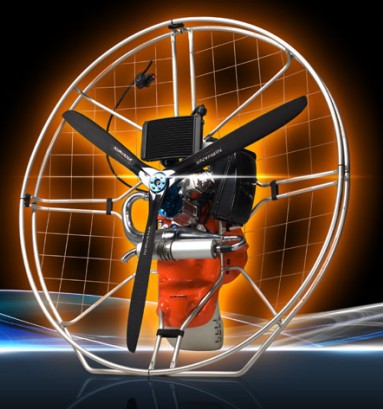
The Easy Paramotor body carries the engine unit including battery in a four-parts folding frame. The Easy features a Pulse composite two-blade propeller and AustriAlpine Powerfly carbines.
Price per Unit (piece) 2009: $6,980.00
Engine: Sky 100, single-cylinder with liquid cooling
Power: 18 PS (@ 10,200 rpm)
Ignition: Contactless
Carburettor: Diaphragm WALBRO WG8
Reduction: Mechanical reduction gear 1:4
Propeller: Carbon two-blade or tree-blade foldable
Starting Gear: Manual
Fuel Tank: 10 litres, integrated
Body • Frame: Self-supporting, laminated shell, orange colour • Aluminium, four-parts, foldable
Harness: Anatomic construction, silencing of the remaining vibrations, straps AustriAlpin Cobra, front reserve container – removable
Accessories: Fuel gauge, speed system
Equipment: Padded bag for engine complete with wheels, frame and propeller packs
Weight: 22 kg
Recommended Pilot Weight: 60–110 kg
Minimum Static Thrust: 58/54 kP (according to the propeller size 125/115 cm)

This light paramotor is suitable for pilots weighing between 45 and 80 kg. The paramotor is equipped with very light drive rocket unit. The centrifugal clutch and electrical starter enable maximum ease of manipulation on the ground and take off. The tuned exhaust together with wooden or composite propeller ensures sufficient performance for fast take off and safe climb. The paramotor features a four-parts folding frame and AustriAlpine Powerfly carbines.
Price per Unit (piece) 2009: $6,316.00
Engine: Raket 120
Power: 13.5 PS (9,000 rpm)
Ignition: Contactless
Carburettor: Diaphragm WALBRO
Reduction: Belting 1:3
Exhaust: Radne
Propeller: Wooden, two blade (115, 125 cm)
Starting Gear: Electrical
Fuel Tank: 10 litres, integrated
Body • Frame: Self-supporting, laminated shell, orange colour • Aluminium, four-parts, foldable
Harness: Anatomic construction, silencing of the remaining vibrations, straps AustriAlpin Cobra, front reserve container – removable
Accessories: Maintenance free battery NiCd charged during the flight, socket 16.8 VDC, fuel gauge
Equipment: Padded bag for engine complete with wheels, frame and propeller packs
Weight: 18 kg
Recommended Pilot Weight: 40–70 kg
Minimum Static Thrust: 52/50 kP (according to the propeller size 125/115 cm)
Average fuel consumption: 3 litres per hour

The Rodeo paramotor received DULV certification in 2005
The Simonini tuning engine has a tuned exhaust and is fitted with the PULSE composite two-blade propeller. AustriAlpine Powerfly carbines are used throughout.
Price 2009: $7,845.00
Also marketed by Parajet 4 Fun at US$3,845 in 2010.
Engine: Simonini MINI 2 Plus, NIRVANA Tunning
Power: 27 PS (6,800 rpm)
Ignition: NIRVANA CIR (electronic with pre-ignition and battery charging regulation)
Carburettor: Diaphragm WALBRO WB37
Reduction: Belting 1:2.4 NIRVANA
Exhaust: Tuned NIRVANA
Propeller: Carbon two-blade foldable PULSE 2R2 (115, 125 cm)
Starting Gear: Manual and electrical
Fuel Tank: 10 litres, integrated
Body • Frame: Self-supporting, laminated shell, orange colour • Aluminium, four-parts, foldable
Harness: Anatomic construction, silencing of the remaining vibrations, straps AustriAlpin Cobra, front reserve container – removable, foldaway spacers
Accessories: Maintenance free battery NiCd charged during the flight, socket 16.8 VDC, fuel gauge
Equipment: Padded bag for engine complete with wheels, frame and propeller packs
Weight: 25 kg
Recommended Pilot Weight: 80–160 kg (single or tandem)
Minimum Static Thrust: 70/65 kP (according to the propeller size 125/115 cm)
Average fuel consumption: 3–3.5 litres per hour
2000 brought the serial production of the Nirvana Electric model. First racing season – Czech Republic Championship.
Nirvana Systems sro is a producer of motor paragliding equipment.
The first flights on the modified Parafoil began in 1987; take off using the tow rope behind the car. 1988 saw the beginning of parachute production – BIG type, and the discovery that flying from the hills is possible.
The first paramotor production began in 1989– the paramotor was not finished.
Sale and service of Edel parachutes began in 1992, later also the Wings.
In 1993 the Trike was completed with a Jawa 350 engine and later the Trabant. This was first flown in 1994. In 1995 the first own paramotor was completed with a Konig triple cylinder engine.
A light paramotor with a Hirth engine was completed in 1996.
1999 saw the foundation of the company – Nirvana paragliding – for the production of paramotors.
2000 brought the serial production of the Nirvana Electric model. First racing season – Czech Republic Championship.
Nirvana introduced the new PPG wings, Alix and Desire in 2005 and the Rodeo paramotor received DULV certification.
The new Flystyle collection was introduced in 2006.
Official entered the USA PPG market in 2009, WAG qualification, and official introduction of the Instinct to the domestic, German and UAE market.
 All Aero