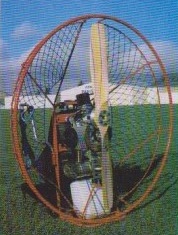
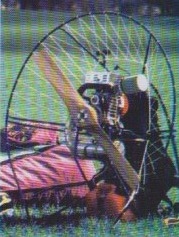
Sky Paragliders PPX F200

With a chassis designed to work in extreme conditions and on professional jobs, there are 2 sizes: 1450 and 1400. Both have 200 cc power with Carbon Tripal propellers (recommended 130cm).

The engine can fly 4-5 hours and then carry out two seater flights.

PXP Paramotor Frame

The chassis can be dismantled into 4 stainless steel parts, or on request at 2, 3, or 5 parts. They are TIG welded, using stainless steel pipes, 304 & 316 grade in 6, 8, 10, 12 and 16 mm in the central part of the chassis frame. The 16 mm tube offers a double impact resistance.

There were more than 15 models of chassis, to mount any engine or incorporate the Evolution & Fly 100 EVO range of light engines,

Price 2009: US$1,650

F 200 1400
Engine: F 200, 200 cc
Carburettor: Walbro 37
Power: 27 hp
Belt reduction: 1 / 3
Cooling: Air
Clutch: No
Thrust: 78 kg
Fuel: 98 Green
Fuel tank: 14 lt
Consumption: 3 lt/hr
Frame dimensions: 130 x 130 x 27 cm
Prop: BA014 – Wood 125 or BA015 – 3 parts, Carbon 120 cm
Weight: 30 kg
Max pilot weight: 120 kg
Recomended pilot weight: 100 kg
Harness: Freedom
Parachute container: Down System
Parachutes sling: Serial

F 200 1450
Engine: F 200, 200 cc
Carburettor: Walbro 37
Power: 27 hp
Belt reduction: 1 / 3
Cooling: Air
Clutch: No
Thrust: 82 kg
Fuel: 98 Green
Fuel tank: 14 lt
Consumption: 3 lt/hr
Frame dimensions: 140 x 140 x 27 cm
Prop: BA016 – 3 parts, Carbon 130 cm
Weight: 31.5 kg
Max pilot weight: 200 kg+ Tandem
Recomended pilot weight: 125+ kg
Harness: Freedom
Parachute container: Down System
Parachutes sling: Serial
Rotron

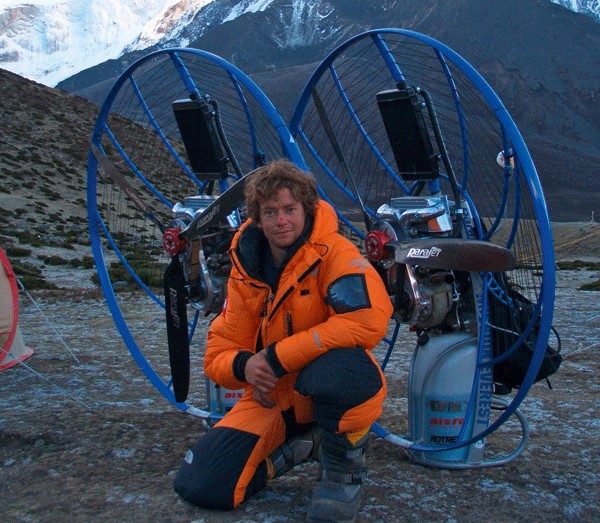
In early 2007 Rotron founder and chief technology officer, Gilo Cardozo, pursued a childhood dream: to fly a paramotor 30,000ft over the summit of Everest.

Having teamed up with friend and TV personality Bear Grylls, Cardozo had just seven months to build two paramotors. The most powerful paramotor engine available was barely producing 30hp and was far too heavy to launch at the desired altitude. So, he also set about building a four-stroke rotary engine that was more compact and 50 per cent lighter than a piston engine equivalent.

The basis of the Everest engine was a 294cc single rotor engine producing 40hp as a standard normally aspirated engine.

The engine included a miniature centrifugal supercharger fitted with a miniature intercooler to ensure the air was as cold and dense as possible when entering the combustion chamber. The supercharger was modified to be spun at up to 200,000rpm in order to simulate sea level atmospheric pressure of 1 bar at 30,000ft.

To eliminate the problem of icing, the supercharger was placed before the fuel delivery system. The heated and supercharged air was then sent through an intercooler before passing the injector at an average of 25 degrees Celsius.

After four months of design, development, testing and manufacturing, the engine was finally ready. With just two days before departure, the second engine was completed.

On 14 May 2007 the two pilots took off and in a flight that lasted four hours they achieved a paramotoring world record of 29,494 feet.

On completion of the expedition and building on its success, Cardozo continued to develop his rotary engine and looked for a commercial platform for the technology. Rotron Power was born.

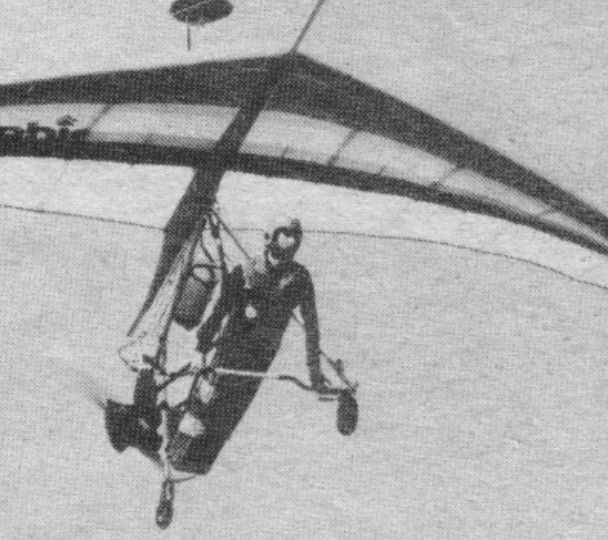
Reflex Reflex

The Reflex is equipped with electric start and epoxy paint as standard. Reflex backpacks could alsp be had with a small trike.

Reflex 115 EL
Empty weight: 25 kg
Engine: Solo, 14 hp
Reduction: 1:2.5
Prop diameter: 115 cm
Fuel capacity: 7 lt
Price (1998): 23 000 F

Reflex 115 JPX
Empty weight: 29 kg
Engine: JPX, 20 hp
Reduction: 1:2.38
Prop diameter: 115 cm
Fuel capacity: 7/10 lt
Price (1998): 27 000 F

Reflex 123 EL
Empty weight: 29 kg
Engine: Zanzttera, 25 hp
Reduction: 1:1.8
Prop diameter: 123 cm
Fuel capacity: 8.5 lt
Price (1998): 26 000 F

Reflex 84 EL
Empty weight: 20 kg
Engine: Solo, 12 hp
Prop diameter: 84 cm
Fuel capacity: 7 lt
Price (1998): 20 000 F

Reflex 98 EL
Empty weight: 25 kg
Engine: Solo, 14 hp
Reduction: 1:2
Prop diameter: 98 cm
Fuel capacity: 7 lt
Price (1998): 23 000 F