1998: Röserheide 1, D-31683 Obernkirchen, Germany
Paramotor builder
1998: Röserheide 1, D-31683 Obernkirchen, Germany
Paramotor builder

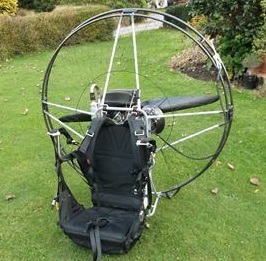
Ready to fly foot launched powered parachute, is portable and folds into a bag. Direct drive 3500 rpm engine.
Engine: Konig 3 cyl, 24 hp.
Speed max: 25 mph.
Cruise: 25 mph.
Range: 125 sm.
Stall: 12 mph.
ROC: 400 fpm.
Take-off dist: 50 ft.
Landing dist: 10 ft.
Service ceiling: 12,000 ft.
Fuel cap: 4 USG.
Weight empty: 48 lbs.
Height: 3.67 ft.
Length: 1 ft.
Wing span: 30 ft.
Wing area: 300 sq.ft.
Seats: 1.
Landing gear: foot launch.
Endurance: 5 hr.
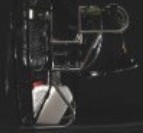
A paramotor with a Kobra Tuned 28hp Simonini MINI 2 Plus engine in a 145cm Stainless Steel, 4 section frame.
Engine: Kobra Tuned Simonini Mini2 Plus
Propeller: 130cm 3 Blade Helix Carbon
Frame: 145cm Stainless Steel, 4 section
Fuel Tank: 14 Litre
Max endurance: 4 hr
Dry Weight: 32.5 kg
Thrust: 85 kg
Pilot weight range: 80-150 kg pilot or tandem
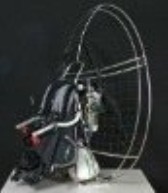
A paramotor with a Kobra Tuned 28hp Simonini MINI 2 engine in a 140cm Stainless Steel, 4 section frame.
Engine: 28hp Simonini MINI 2
Fuel capacity: 14 Lt
Max endurance: 4.5 hr
Propeller: Carbon
Dry Weight: 28.5 kg
Thrust: 75 kg
Pilot weight: 80-150 kg
Bogor, Propinsi Jawa Barat, Indonesia
Power pack builder
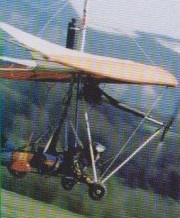
Circa 1998, the Hagel system provided a tractor power system for hang gliders.
The system was certified in Austria and Germany using the Wills Wing Supersport and Ultrasport wings, but could be adapted for other wings.
Engine: Solo 210, 15 hp
Reduction ratio: 1.4-1
Prop diameter: 200 cm
Fuel capacity: 9 lt
Empty weight: 25 kg
Certification: vz (A)
Price (1998): ATS 65,000
1998: Weiherburggasse 5, A-6020 Innsbruck / Tirol, Austria
Power pack builder
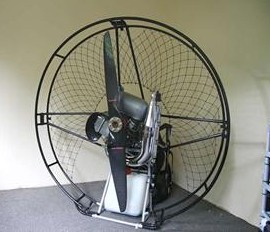
Built by New Zealand’s paramotoring school ParaPro.
Extremely smooth running, 5 point engine mount, quite, carbon prop, suitable for pilot up to 90kg
Engine: M19Y
Cycle: 2 strokes
Total displacement: 119,38 c.c.
Bore: 57,5 mm.
Stroke: 46 mm.
Weight: 10 kg without exhaust
Peak: RPM 9200
Cooling: by air
Piston: of light alloy with 2 piston ring of cast iron S10 crominium-plated
Cylinder: of silicon light alloy with surfacing of Cermetal
Head: special aluminium alloy
Crankcase: molten in alloy G-Al Si 9 UNI 3051
Carburettor: membrane
Feeding: reed valve on the crankcase
Electronic ignition: type TCI
Spark Plug: NGK B9ES
Starter: manual
Clutch: centrifugal
Reductor: with Poly V belt
Reduction: 1:3,12
Continuous normal tempertaure: not
over 250 C
Exhaust pipe: tuned
Fuel: mixture of unleaded petrol 98 octane and oil at 25% normally
Oil: synthetic top quality oil for 2-stroke engines
Fixing to the frame: 5 rubber antivibration mounts
Carbon fibre prop
14 litre fuel tank
Cruise control
4 part cage

The Bell ‘Pogo’ rocket belt two man platform.

Bell Aerosystems Rocket Belts. These strap on devices had a pair of vectorable nozzles controlled by handlebars and enabled the wearer to be thrust over 15 m (50 ft). The only practical application of the Rocket Belt has been as a gimmick in a James Bond movie. Developed versions of the device have been used by NASA astronauts for spacewalking.
Neat and potentially useful, the rocket belt has proved difficult to control with the finesse necessary for everyday use by non experts.
 All Aero