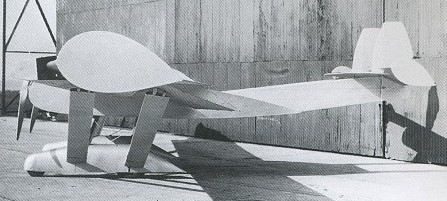
Built for Guggenheim competition.
Built for Guggenheim competition.
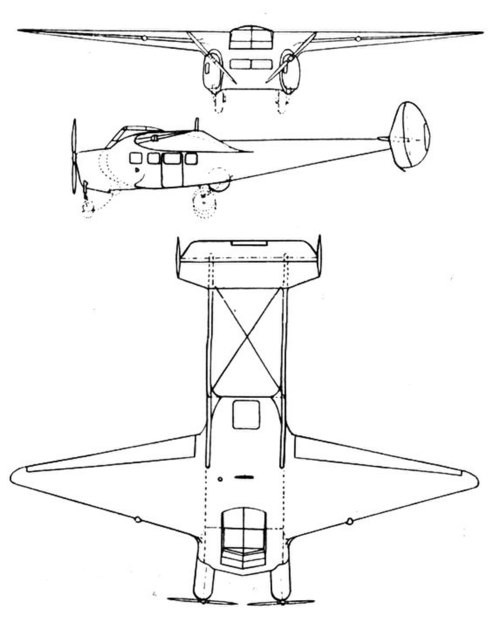
The CB-16 monoplane was built as an executive transport for banker Paul W. Chapman and was designed by Vincent Burnelli. The design of Burnelli’s first monoplane embodied his ‘lifting body’ techniques, which involved a more extensive blending of the fuselage with the wing to provide greater lift – and accident survival. The high-wing, open-cockpit CB-16 is also notable for being the first multi-engined aircraft capable of single-engined operation, and possesses a retractable landing gear and an all-stressed metal design. Despite its promising nature and Burnelli’s ideas, the CB-16 was lost due to a maintenance error.
Engine: 2 x 371kW Curtiss Conqueror
Crew: 2
Passengers: 20
Wingspan: 27.40 m / 89 ft 11 in
Length: 14.00 m / 45 ft 11 in
Cruise speed: 185 km/h / 115 mph
Range: 1287 km / 800 miles
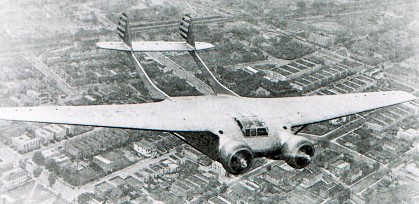
The Burnelli UB-14 and a developed variant named OA-1 Clyde Clipper were 1930s American prototype lifting-fuselage airliners designed by Vincent Burnelli, who was responsible for constructing the first two examples.
Following on from his earlier designs Vincent Burnelli designed a commercial transport version using the lifting-fuselage concept. Burnelli’s designs were based on the idea that an airfoil-section fuselage could contribute to the lift generated. The Burnelli UB-14 first flew in 1934, and had an airfoil-section fuselage that formed the centre-section of the wing. The aircraft had twin tailbooms and a widespan tailplane and elevator fitted with twin fins and rudders. The UB-14 had retractable landing gear and was powered by two Pratt & Whitney radial engines. An enclosed cockpit for the crew of two was located on the centre wing’s upper surface. The cabin could hold 14 to 18 passengers.
The first prototype, UB-14, was destroyed in a 1935 accident attributed to faulty maintenance on the aileron control system. Burnelli then designed and built an improved version, the UB-14B. An extensively modified version of the UB-14B design was built under licence in the United Kingdom by Cunliffe-Owen Aircraft, powered by two Bristol Perseus XIVC radials as the Cunliffe-Owen OA-1 Clyde Clipper. The UB-14B was to have been built by Scottish Aviation, but with more streamlined inline engines.
Burnelli applied to the CAA for approval to fly a transatlantic flight with Clyde Edward Pangborn as the pilot in September 1936, however it failed its airworthiness certification due to an excessively long takeoff run and poor quality control. Its performance was later tested at A&AEE Boscombe Down in 1939.
After appropriate work, in June 1941 Jim Mollison and an Air Transport Auxiliary crew delivered the Cunliffe-Owen OA-1, now registered as G-AFMB to Fort Lamy, Chad. It was then fitted out as a personal transport for General De Gaulle. At one time it landed in Vichy France while en route to Fort Lamy. It was later abandoned at RAF Kabrit in Egypt, and burned during VJ-Day celebrations.
Variants
UB-14
Prototype, powered by Pratt & Whitney engines, registered as NX14740. Built by Burnelli Company. Destroyed 13 January 1935, without injury.
UB-14B
Second prototype with modifications, registered as NC15320. Built by Burnelli Company. Exported to Nicaragua in 1943 as AN-ABH.
OA-1
Third prototype, registered as G-AFMB, built by Cunliffe-Owen Aircraft under licence with further modifications, in the United Kingdom.
UB-14B
Crew: two
Capacity: 14–18 passengers
Length: 44 ft 0 in (13.41 m)
Wingspan: 71 ft 0 in (21.64 m)
Height: 10 ft 0 in (3.05 m)
Wing area: 686 sq ft (63.7 m2)
Airfoil:
Fuselage: NACA 4323
Outer wing root: NACA 2412
Outer wing tip: NACA 2409
Empty weight: 9,200 lb (4,173 kg)
Gross weight: 17,500 lb (7,938 kg)
Powerplant: 2 × Pratt & Whitney Hornet, 750 hp (560 kW) each
Maximum speed: 210 mph (340 km/h, 180 kn)
Cruise speed: 205 mph (330 km/h, 178 kn)
Range: 1,240 mi (2,000 km, 1,080 nmi)
Service ceiling: 22,000 ft (6,700 m)
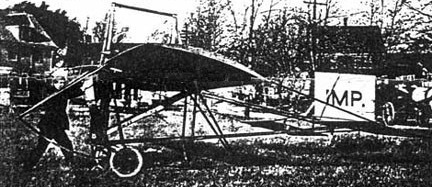
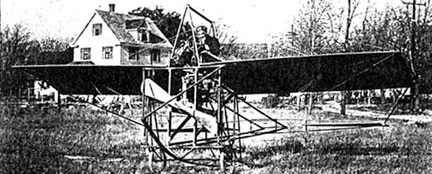
The 1909 Monoplane designed and built by Elmer A.Burlingame in the USA was one of the first monoplanes.
The Burgoyne-Stirling Dicer was a low-wing monoplane built in 1948, probably at Knowle, UK.
The Dicer flew with the officially un-sanctioned registration G-AECN, which had previously been allocated to an unfinished Pou de Ciel c/n DCB.1 of D.C. Burgoyne pre-war.
It was last hard of at Wymeswold, UK.
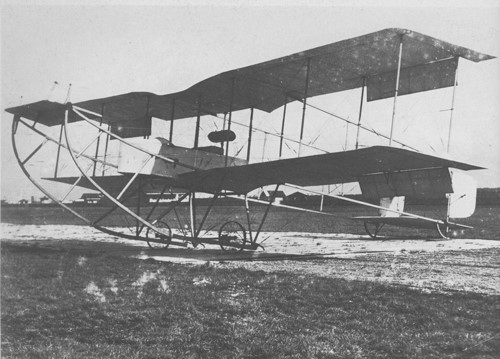
A biplane pusher with a closed nacelle and ailerons at upper and lower wings, built in München, Germany, during 1911-1912. A big rounded tube construction holds the elevator in front. Double rudder at the back.
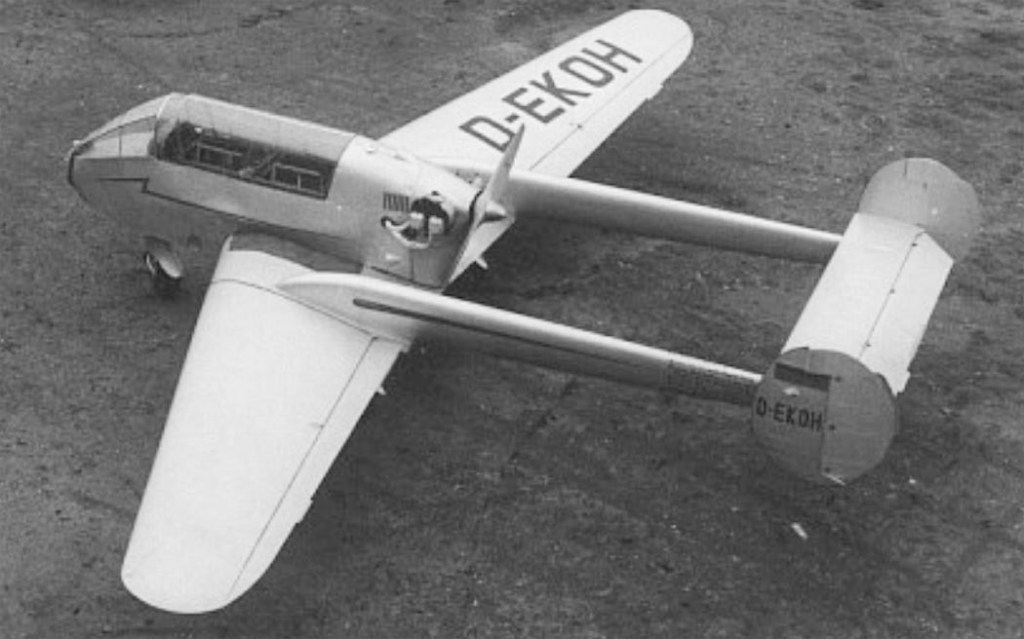
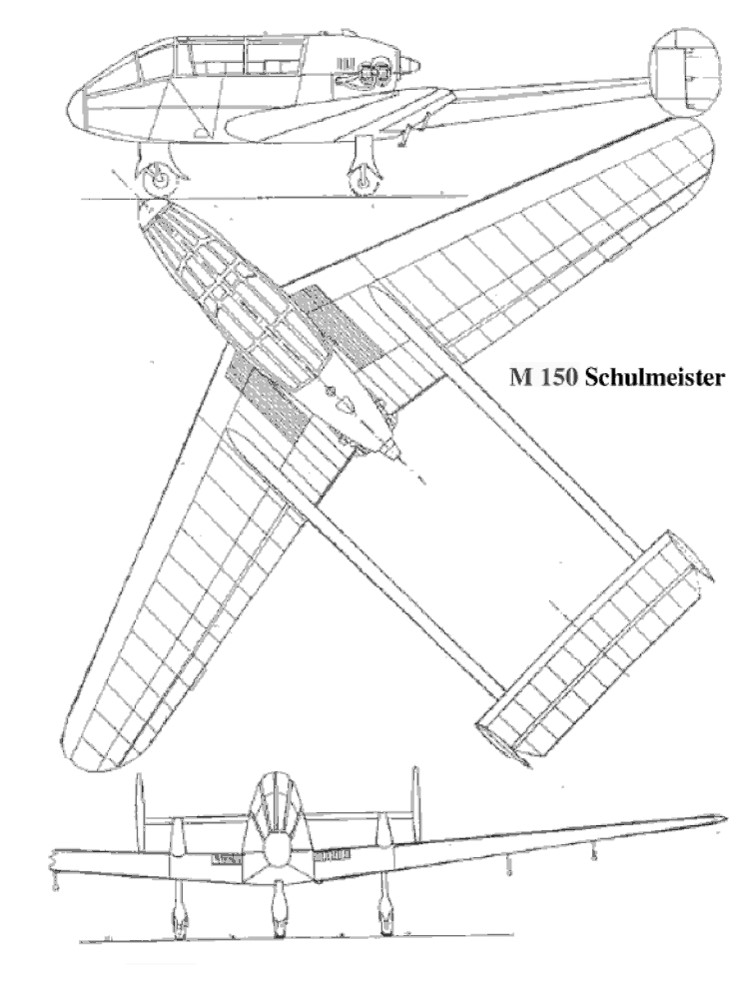
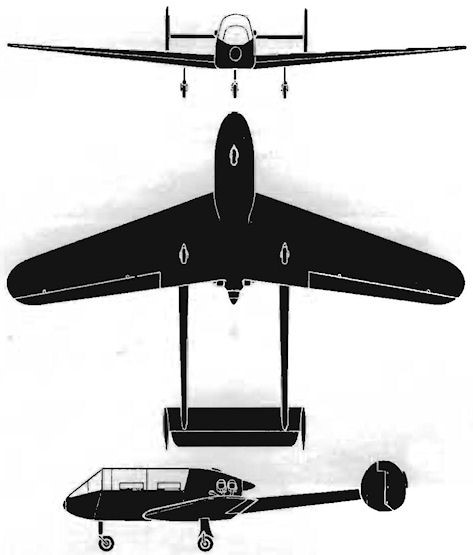
Developed from the A-15 (WN-16) aircraft, designed by the former Wiener-Neustadt company, the M-150 Schulmeister (Schoolmaster) is a two-seat, low-wing type, powered by a 65 hp Continental C90 incorporating a pusher propeller.
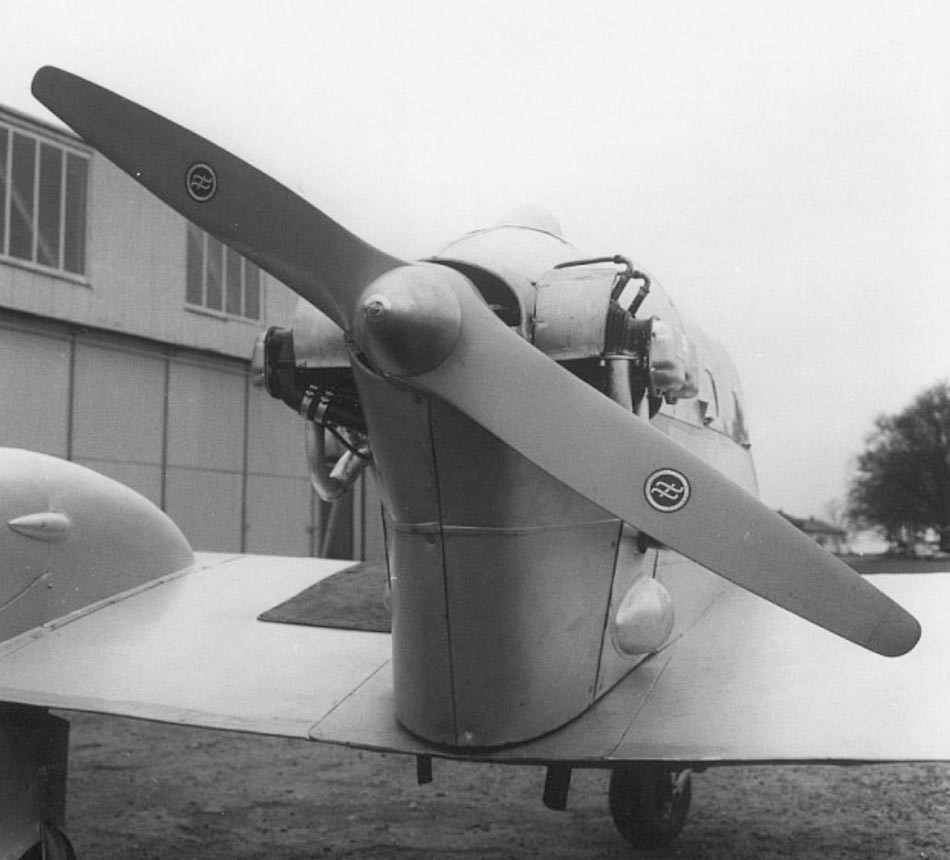
In the early 1950s, the German company Burgfalke Segelflugzeugbau became interested in the aircraft. Maidl modernized the project to meet new requirements resulting in 1956, with the M-150 Schulmeister.
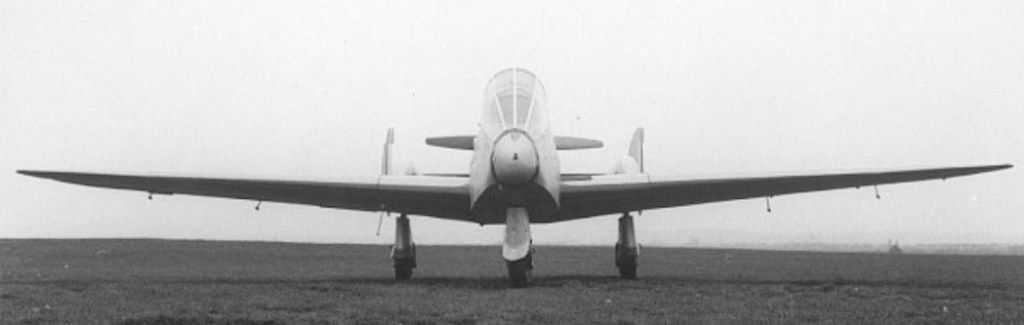
The M-150 is capable of simple aerobatics, and the makers claim that it is almost impossible to spin even under extreme flight conditions. Construction is of mixed wood and steel, the main structural members being of steel. The wing and tail units are mostly of wood, with the leading edge and undersides ply covered, and the upper surfaces fabric covered. Fuselage is of a tubular structure and fabric covered.
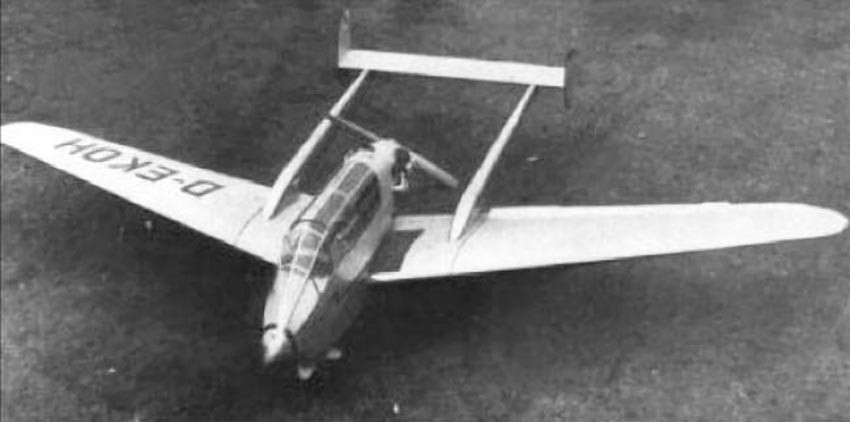
The prototype aircraft first flew on September 14, 1957. Having received the civil registration D-EKOH in the same year, the aircraft was tested, but could not interest potential customers.
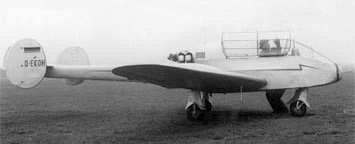
M-150
Engine: Continental C90, 90 hp
Wingspan: 9.84 m
Wing area: 13.50 sq.m
Length: 7.27 m
Height: 1.80 m
Empty weight: 350 kg
Maximum takeoff weight: 590 kg
Maximum speed: 165 km/h
Cruise speed: 145 km/h
Practical range: 500 km
Practical ceiling: 4200 m
Crew: 2
In 1913 as Burgess-White, R White designed the X-16 aero engine. It was a 500hp air-cooled 16 cylinder, X-configuration. With two V-8 motors united, it was possibly never completed.

A hybrid of Farman and Wright machines, it was completed after the Harvard-Boston Aero Meet in 1910, first tried at the end of 1910, and flown into 1911. Passenger flights were undertaken until it crashed in April 1911. Its power plant was a 60 hp Hendee V-8, while a proposed 50 hp Gnôme was never fitted.

