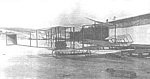
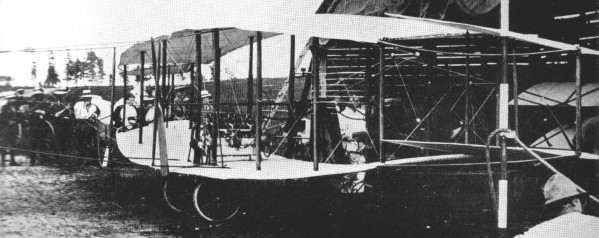
The 1909 Baddeck II was designed and built by McCurdy and Baldwin with the Canadian Aerodrome Company.
Baddeck No. 2 Engine: 1 × Kirkham air-cooled piston engine, 40 hp (30 kW) Wingspan: 33 ft 11 in (10.34 m) Wing area: 220 sq ft (20 sq.m) Length: 32 ft (9.8 m) Height: 7 ft 6 in (2.29 m) Max takeoff weight: 1,000 lb (454 kg) Crew: one
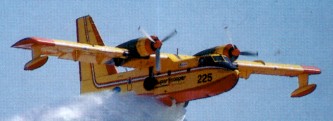
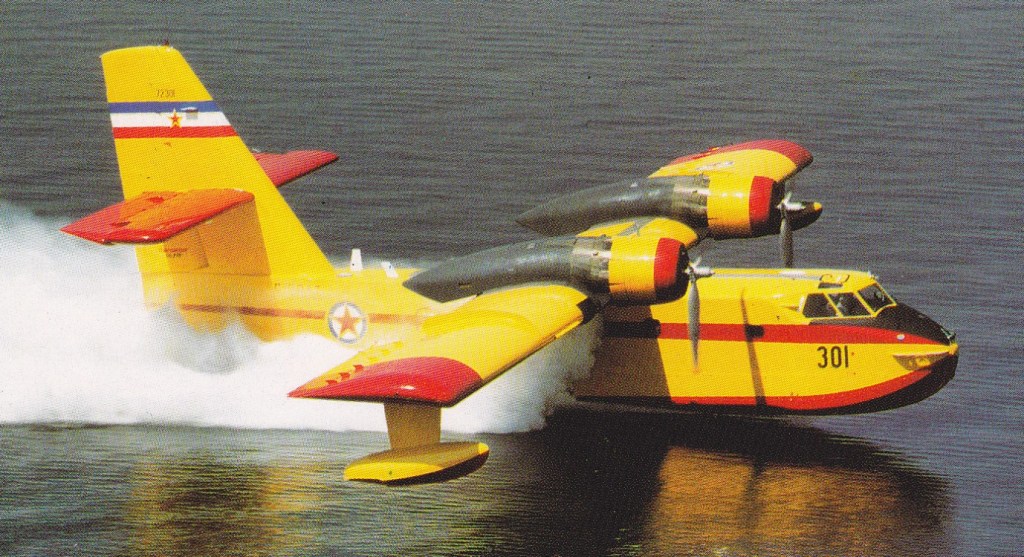
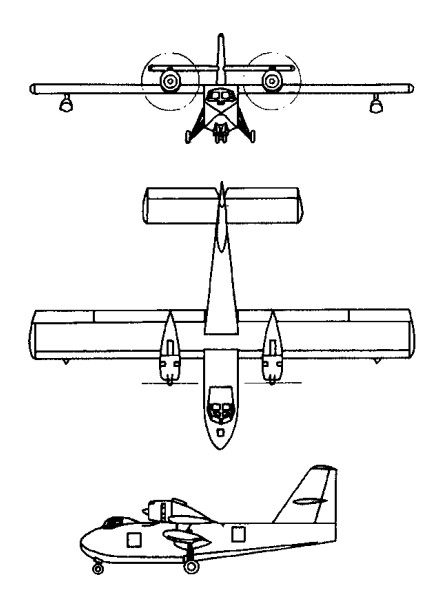
Designed principally for firefighting duties, the CL-215 twin-engined general-purpose amphibian also has military applications, including search and rescue and coastal patrol, Spain and Thailand use their CL-215s in both of these roles. The first prototype flew on October 23, 1967.
The CL-215’s two fuselage tanks hold 1412 USG / 5345 lt of water which can be scooped up in 10 seconds from a lake or sea surface, and can be dumped in one second.
Canadair offers a number of special military configurations, including flight inspection, maritime surveillance using an ALL AN/APS-128 search radar, electronic warfare support and training, cargo transport, and airborne early warning (AEW).
Production of the basic CL-215 was completed with delivery in 1990 of the 126th airframe, having been exported to France, Greece, Spain, Italy, Yugoslavia, Thailand and Venezuela.
CL-415T
In September 1986 Canadair announced the CL-215T turboprop development. Designed as a retrofit package for existing operators of the piston-engined aircraft and – if sufficient new orders were received – for full production, the CL-215T has two 2,380 shp (1 175 kW) PW123AF engines driving four-bladed propellers. As a water-bomber (its primary mission) the CL-215T will carry 6,132 litres (1,620 US gal).
The first CL-215T flew on 8 June 1989 powered by two 2380 shp / 1775 kW Pratt & Whitney Canada PW123AF turboprops, and could carry 1620 USG / 6132 lt of water.
CL-215 Engines: 2 x Pratt & Whitney R-2800-CA3, 1566kW, 2100hp Wingspan: 28.6 m / 93 ft 10 in Wing area: 100.33 sq.m / 1079.94 sq ft Length: 19.82 m / 65 ft 0 in Height: 8.92 m / 29 ft 3 in Max Take-off weight: 17100-19731 kg / 37699 – 43500 lb Empty weight: 12161 kg / 26811 lb Max level speed: 172 mph (293 kph) at 10,000ft/3050m Cruise speed: 291 km/h / 181 mph Initial ROC: 1000 fpm / 305 mpm Range: 2095 km / 1302 miles Payload: 5453kg 12,000 lb of water, 3864 kg / 8518 lb freight, or 26 passengers
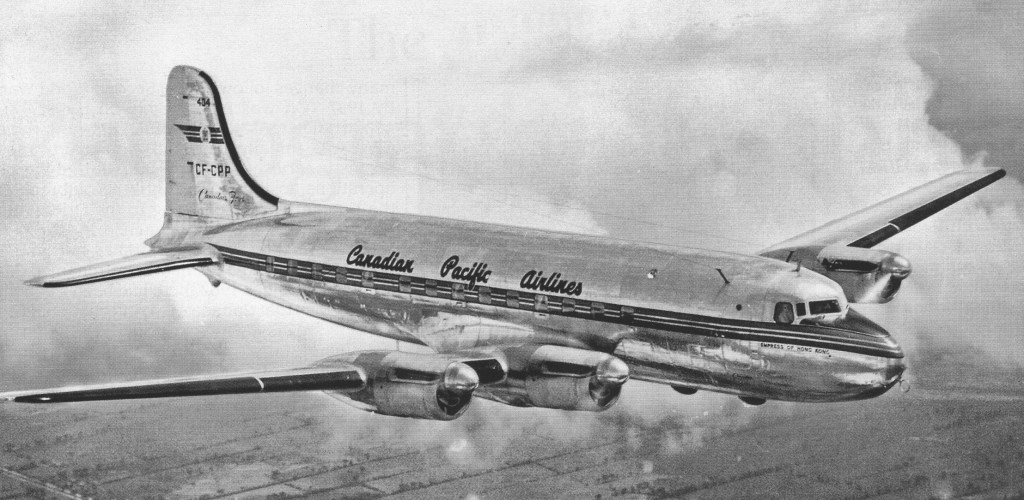
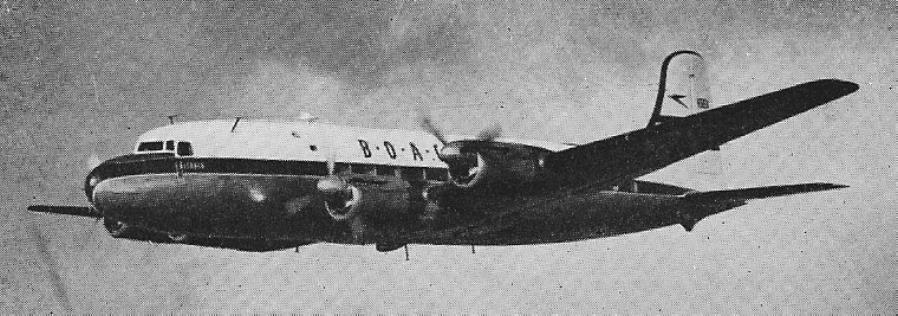
The Canadair Four is a progressive development of the DC-4M-2 which embodies features if both Douglas DC-4 and DC-6, and was adapted to take four 1730 hp Merlin 620 engines.
The DC-4M-2 is externally similar to the Canadair Four and was employed by the RCAF and Trans-Canada Air Lines. The Canadair Four has been delivered to Canadian Pacific Airlines and British Overseas Airways Corporation, the latter designating the type Argonaut.
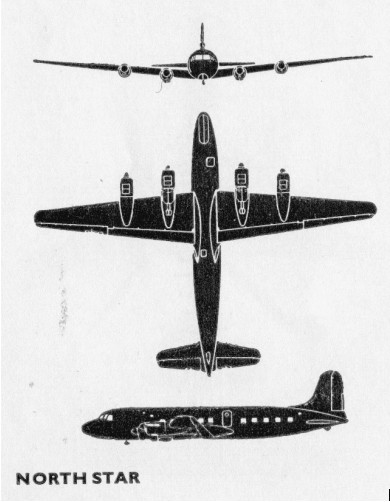
The R.C.A.F. uses a Canadian-built version of the Douglas C-54 known as the C-54G-M North Star, with Rolls-Royce Merlin 620 engines.
A total of seventy-four DC-4Ms and Canadair Fours were built by Canadair Ltd.
The single Canadair C-5 used by the R.C.A.F. is basically a North Star with 2,100 h.p. R2800 radials.
Canadair Four Engine: Rolls-Royce Merlin 626, 1760 hp Wing span: 117 ft 6 in Length: 93 ft 7.5 in Height: 27 ft 6.5 in Empty weight: 46,832 lb Loaded weight: 82,300 lb Max cruise: 325 mph at 25,200 ft Max cruise: 280 mph 12,800 ft Service ceiling: 29,500 ft Passenger capacity: 40
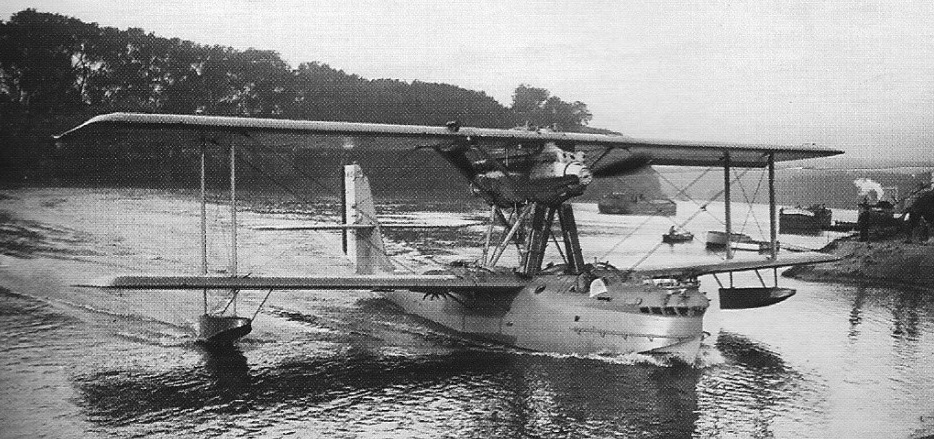
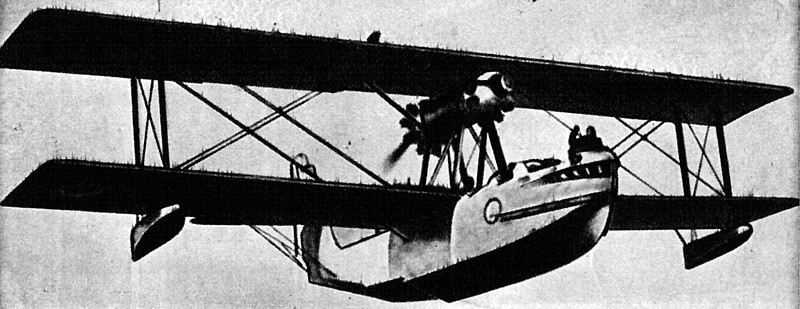
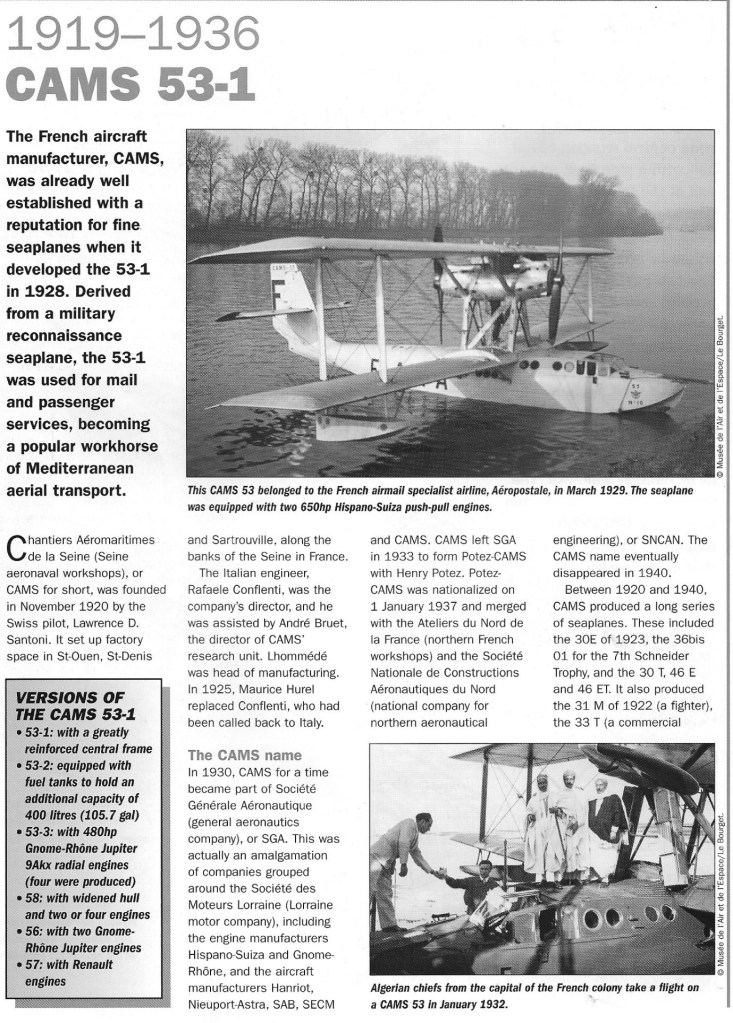
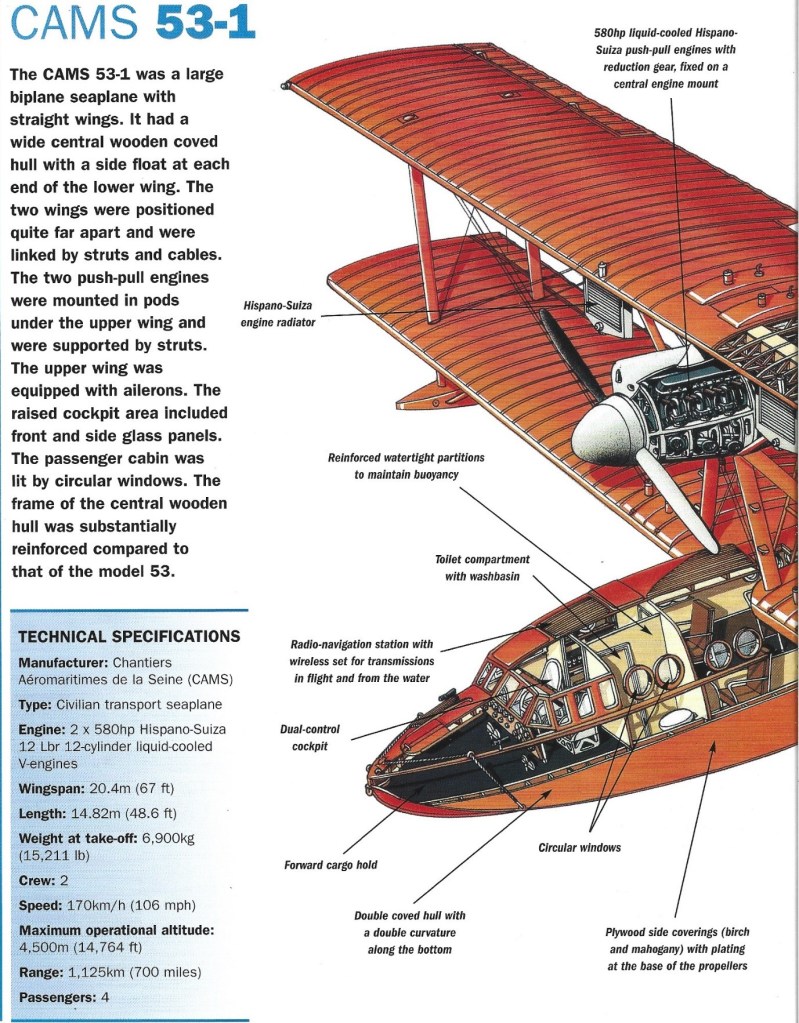
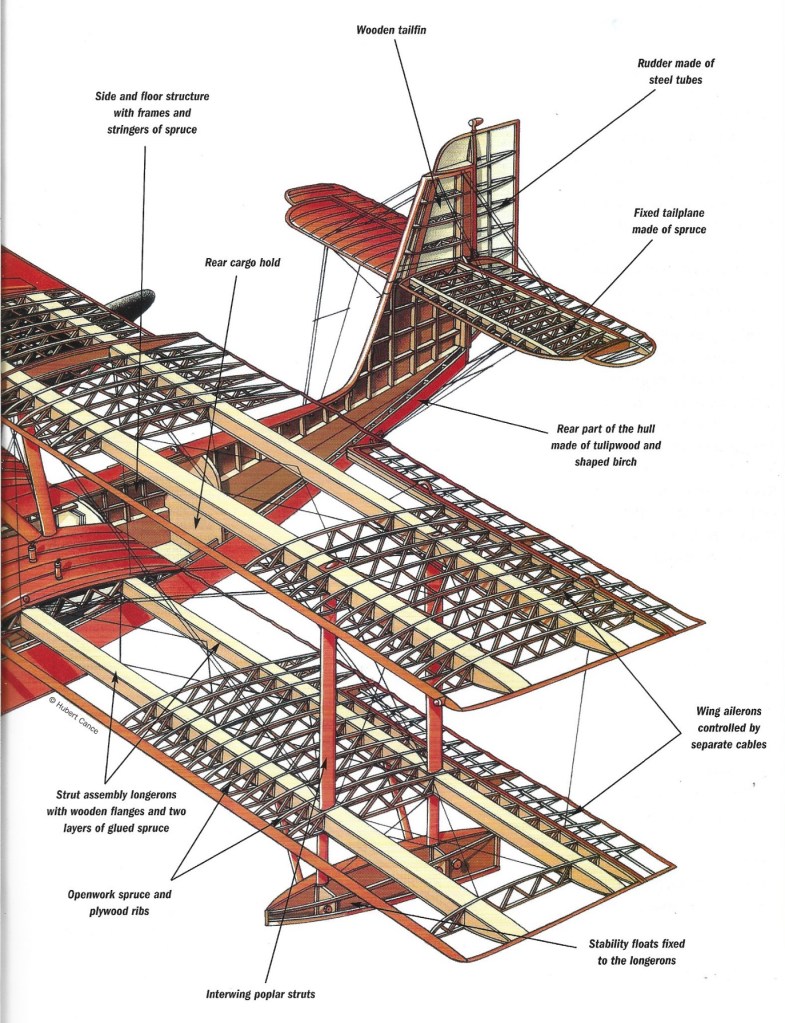
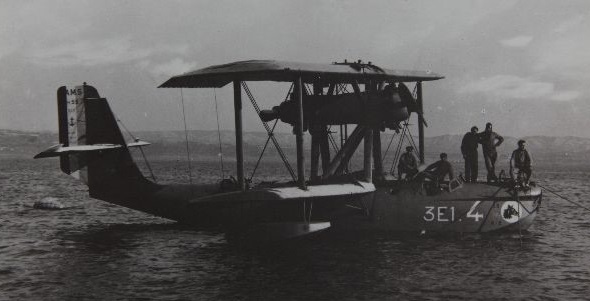
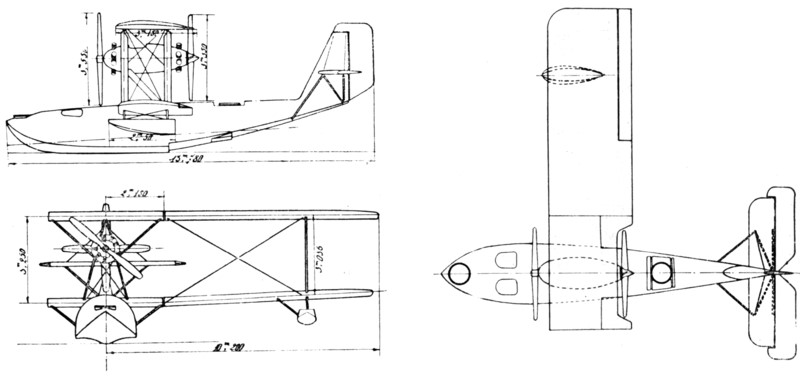
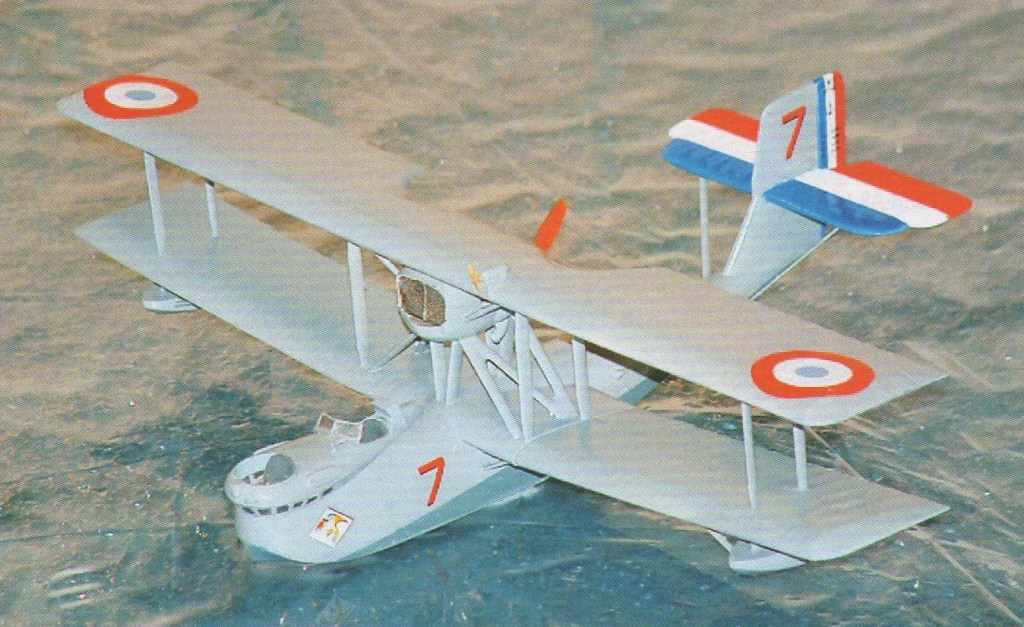
The CAMS 55 design was derived from the unsuccessful CAMS 51 and followed the familiar Chantiers Aéro-Maritimes de la Seine (CAMS) formula of a conventional biplane flying boat configuration with tandem tractor-pusher engines mounted in the interplane gap. The cockpit was open, and there were open gun positions in the bow and amidships. The bow also incorporated an observation balcony with windows sloped to afford a good downward view.
A single prototype was followed by two aircraft to compare different engine installations, one with air-cooled radials and the other a liquid-cooled V engine; in the end, the French Navy ordered some of each. Eventually, 15 escadrilles were equipped with CAMS 55s of various subtypes, replacing the Latham 47 in some units, and in turn being relegated to secondary duties when the Breguet Bizerte became available in 1936. Twenty-nine remained in service at the outbreak of World War II, with the last examples serving with Escadrille 20S in Tahiti until January 1941.
Variants:
55.001 – prototype with Hispano-Suiza 12Lbr engines (one built).
55J – engine test version with Gnome et Rhône licence-built Bristol Jupiter engines (two built).
55H – engine test version with Hispano-Suiza 12Lbr engines (two built).
55/1 – production version with Hispano-Suiza 12Lbr engines (43 built).
55/2 – production version with Gnome et Rhône licence-built Bristol Jupiter engines (29 built).
55/3 – version with all-metal hull for French Navy requirement for long-range flying boat. Prototype destroyed early in test programme (one built).
55/6 – version with all-metal hull and floats, saving 400 kg (882 lb) of structural weight; deemed too expensive to produce (one built).
55/10 – version with geared Gnome et Rhône Jupiter engines and increased fuel tankage (32 built, including four tropicalised machines). Powerplant: 2 × Gnome et Rhône 9Kbr, 370 kW (500 hp) each Propeller: 4-bladed fixed pitch Wingspan: 20.4 m (66 ft 11 in) Wing area: 113.45 m2 (1,221.2 sq ft) Length: 15.03 m (49 ft 4 in) Height: 5.41 m (17 ft 9 in) Empty weight: 4,590 kg (10,119 lb) Gross weight: 6,900 kg (15,212 lb) Maximum speed: 195 km/h (121 mph, 105 kn) Cruise speed: 150 km/h (93 mph, 81 kn) Range: 1,280 km (800 mi, 690 nmi) Service ceiling: 3,400 m (11,200 ft) Rate of climb: 2.2 m/s (430 ft/min) Crew: 4 Armament: 4 × trainable 7.5 mm (0.295 in) machine-guns Bombload: 2 × 75 kg (165 lb) carried under lower wing
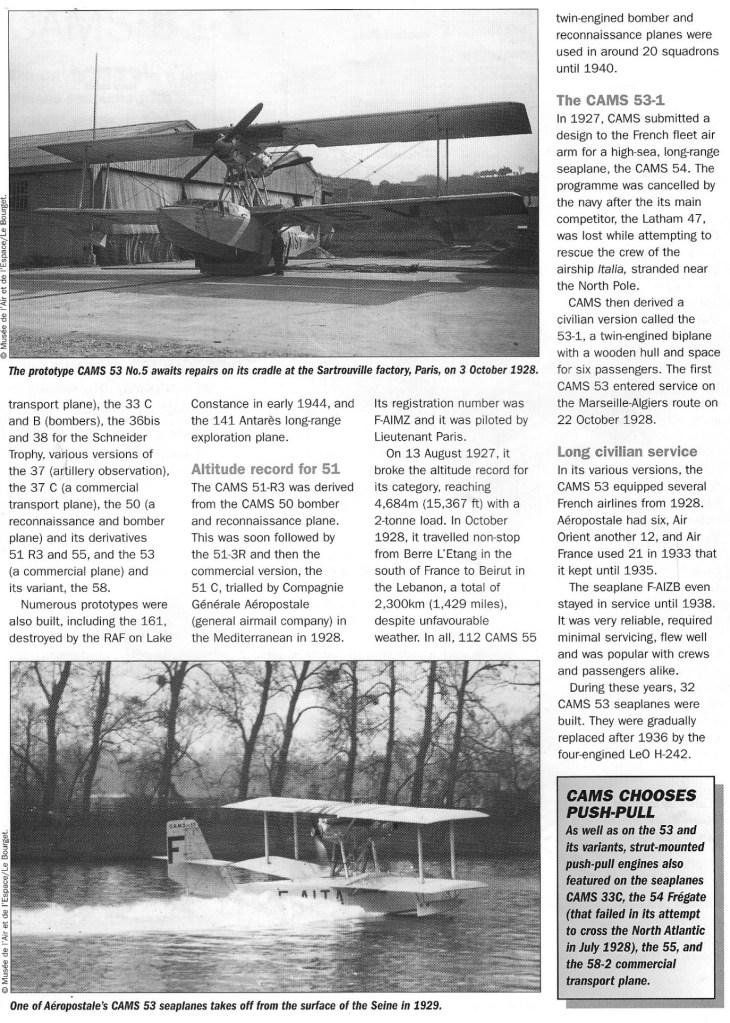
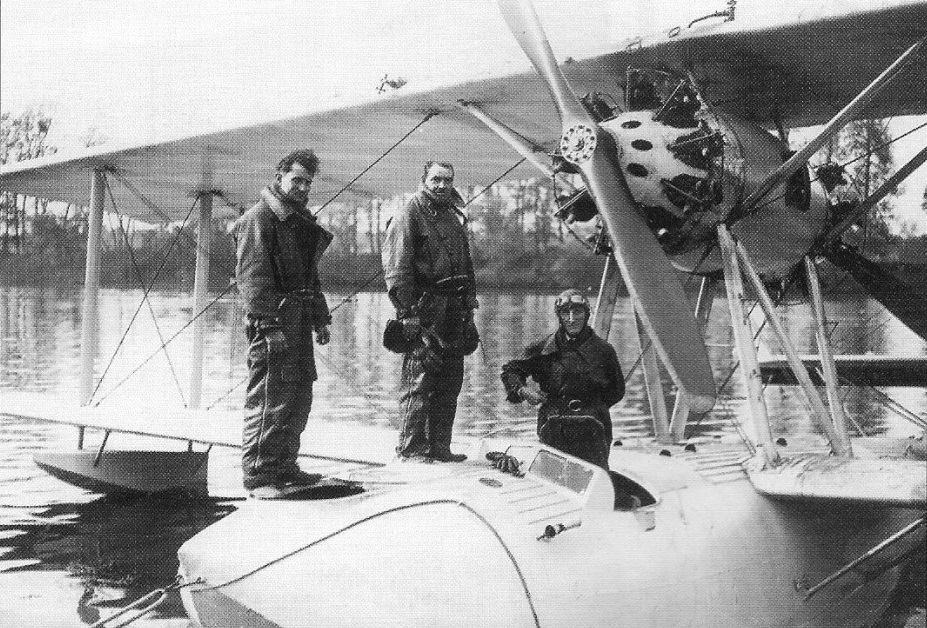
The CAMS 51 was a transport flying boat built in France in the mid-1920s. Designed by Maurice Hurel as a private venture by Chantiers Aéro-Maritimes de la Seine (CAMS), it was a conventional biplane with two radial engines mounted in a tractor-pusher installation in the interplane gap. The first flew in 1926.
One example (the 51C) was sold to Aéropostale, which used it for tests in preparation for transatlantic services.
CAMS also built a militarised version as the 51R3 in the hopes of interesting the French Navy in it as a reconnaissance aircraft, but no order was forthcoming.
A final aircraft was built as a record-breaking machine originally designated 51-3 R that broke the world payload-to-altitude record on 18 August 1927 by lifting 2,000 kg to 4,684 m (15,368 ft). This aircraft was later used as a pathfinder for French airmail routes to South America.
CAMS 51C Powerplant: 2 × Gnome et Rhône 9Aa, 283 kW (380 hp) each Wingspan: 20.40 m (66 ft 11 in) Wing area: 115.0 m2 (1,237 sq ft) Length: 13.78 m (45 ft 2 in) Height: 5.00 m (16 ft 5 in) Empty weight: 3,150 kg (6,945 lb) Gross weight: 5,150 kg (11,354 lb) Maximum speed: 200 km/h (125 mph, 109 kn) Range: 100 km (620 mi, 540 nmi) Service ceiling: 4,600 m (15,100 ft) Crew: two Capacity: four passengers
For shipborne observation/patrol, CAMS’ bay-windowed 37A first flew in 1926. About 150 were produced in the inter-war years. With its Lorraine 450hp broad arrow V12 and coarse pitch and small diameter pusher propeller it lasted longer than most with one example being operated by the Free-French from Tahiti. It could be operated from land strips when a wheeled main gear was attached, but was not capable of amphibious use since it could neither take off nor land on water in this configuration.