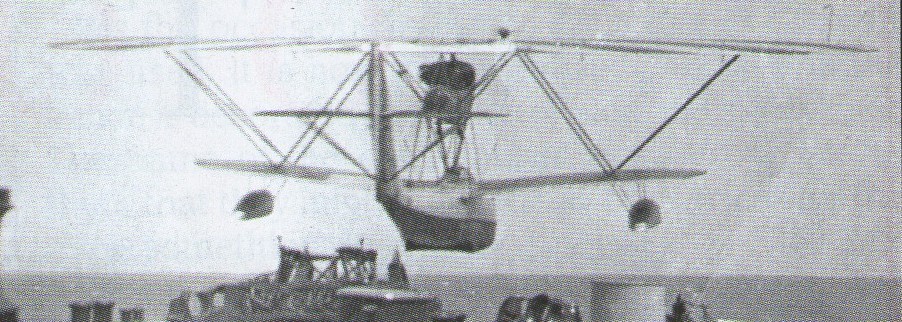
Single-seat flying-boat fighter. Appearing in 1921, this first 25M version of the fighter had distinctive Warren bracing and a 410 h.p. Fiat A.20 engine.
Single-seat flying-boat fighter. Appearing in 1921, this first 25M version of the fighter had distinctive Warren bracing and a 410 h.p. Fiat A.20 engine.
three-engined eight/ten-seat commercial transport
five/six-seat single-engined light transport biplanes
Cant 7, 7 bis and 7 ter
single-engined trainer biplanes
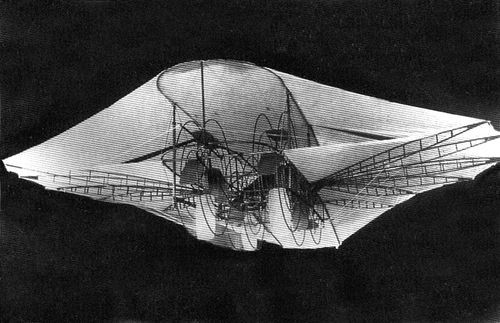
The airship of the Baptist Reverend Burrell Canon from Pittsburg, TX was named “Ezekiel” because Canon get the idea to build it while he read in the book of Ezekiel. The ship had large fabric-covered wings powered by an engine that turned four sets of paddles. It was built in a nearby machine shop and was reported as briefly airborne in 1902. En route to the St.Louis world’s fair in 1904, the airship was destroyed by a storm. In 1913 a second model crashed, and the Rev. Cannon gave up the project. A replica is currently housed in the Northeast Texas Rural Heritage Museum in Pittsburg, Texas.
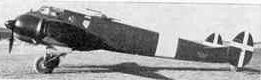
In 1941 C.A.N.S.A. produced the F.C.20 reconnaissance bomber powered by two 840-h.p. Fiat A.74 R.C.38 radials, and the F.C.20bis, which was intended for ground attack and carried a 37-mm. cannon in the nose. The final development of the design was the F.C.20quater of 1943, which was similar to its predecessor apart from the engines, which were two 1,150-h.p. Daimler-Benz DB 6O1s. These increased maximum speed from 261 m.p.h. to 311 m.p.h.
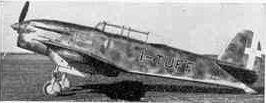
In 1940, C.A.N.S.A. produced two prototypes of the F.C.12 (first flown 1940), which was intended as a trainer for dive-bomber pilots but was also projected as a light attack bomber. The F.C.12 was a tandem two-seat monoplane powered by a 600-h.p. Fiat A.30 R.A. in-line engine. Armament comprised two 12.7-mm. guns in the fuselage and two 12.7-mm. guns in the wings, and a manually-operated 12.7-mm. gun in the rear cockpit.
A less successful development of the C.5 produced in 1942.
single-engined one/two-seat training biplane (Fiat or Alfa Romeo engine), built in some numbers in late 1930s for civil market.
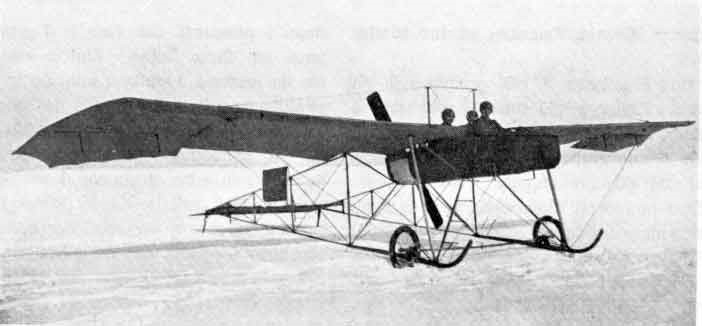
Italian pusher monoplane designed by Italian engineer Canova. Characteristic and beautiful looking machine accommodating three people in the short central fuselage. Ailerons on the wing. Single rudder on the tail-boom construction.

