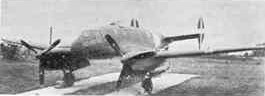
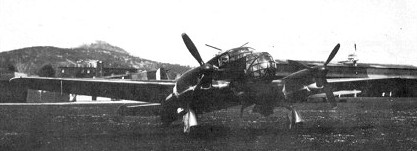
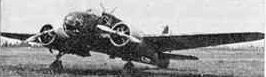
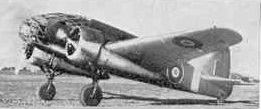
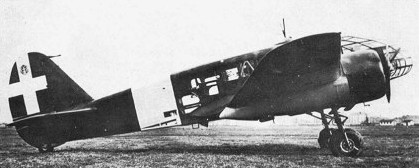
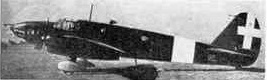
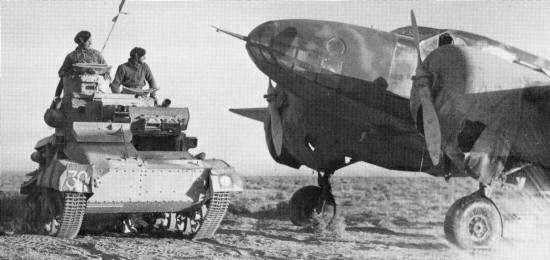
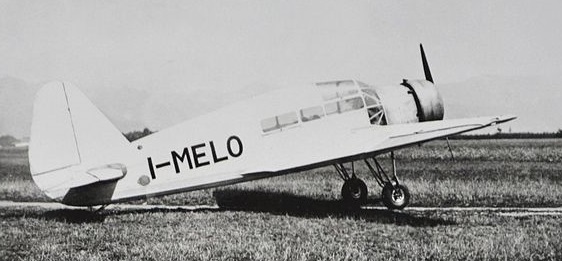
The Ca 380 Corsaro was a twin- fuselage two-seat fighter with the crew seated in tandem in a cockpit carried by the port boom (a similar arrangement to that adopted for the S.M.92). The Corsaro was powered by two 1,550-h.p. Daimler- Benz DB 603 engines and carried an armament of eight 2O-mm. Mauser cannon and a bomb load under the wing section between the two fuselages. A prototype of the Corsaro was flight tested but eventually destroyed by the retreating German forces.
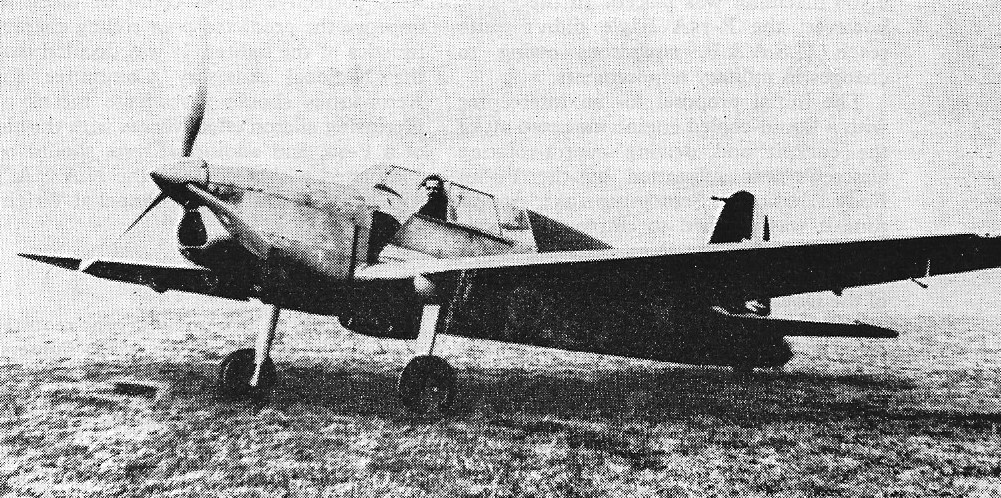
The Caproni Ca 355 Tuffo was flown for the first time in January 1941. Powered by an 850 hp Issotta-Fraschini Delta IV engine and possessing an undercarriage based on that of the Curtiss P-40, The Tuffo carried its 1100 lb bomb on an articulated rack. Flight testing was successful but no production orders were placed and only the sole prototype was built.
The Ca 331 was a light twin-engined bomber reconnaissance aircraft. Of all-metal construction, the Ca 331 was projected in two versions, the Ca 331A reconnaissance bomber and the Ca 331B night fighter, prototypes of both versions being built and flown. The latter version was to have been built in large numbers and carried an armament of four 20-mm. cannon and four 12.7-mm. machine guns. Power was provided by two 825-h.p. Isotta-Fraschini Delta 4 in-line engines and construction was all metal.
The Ca.316 was a twin-float reconnaissance seaplane powered by two 450-h.p. Piaggio P.VII C.16 radials and intended for catapult launching from warships of the Italian Navy. The Ca 316 was designed to replace the obsolescent I.M.A.M. Ro 43 float biplane, but only prototypes had flown before the armistice stopped further development.
A modified Ca.310 with two Isotta-Fraschini Asso 120 IRCC 40 engines served as the Ca.313 prototype, first flown on 22 December 1939, but France had already confirmed an order for 200 Ca313 RPB1 on 1 October, followed closely by British and Swedish orders for 300 and 64 respectively.
The Caproni Ca313 and Ca314 were comparatively small and light aircraft powered by two Isotta-Fraschini Delta RC35 twelve-cylinder in-line engines of 700hp each. Both aircraft were constructed of a mixture of wood, metal and fabric and were developed versions of the Ca311 and 312M for multi-role use.
Caproni Ca.313
The Ca313 and Ca314 fulfilled a specification for a lightweight general-purpose combat aircraft capable of being used for reconnaissance, light bombing, ground attack, training and torpedo-attack. Both types had similar speed performance, in the 250-270mph category.
The torpedo installation was carried by the Ca313 RPB 1 SIL and Ca314 SIL (silurante =torpedo, in Italian). These aircraft were also used by the Luftwaffe and some were used after capture by the Allies as communications aircraft in North Africa.
Italy’s entry into the war prevented delivery of any of the British machines and France received only five Ca.313F models, the remainder being diverted to the Regia Aeronautica.
Eighty Ca 313 were exported to Sweden in 1940. According to Swedish sources, the Ca 313 was generally unsatisfactory and had to be rebuilt and extensively strengthened after delivery. Forty-one Swedish airmen lost their lives in accidents involving the Ca 313 and, after the war. The Swedish Government took legal action against the Caproni concern but, in the meantime, the Societa Italiana Caproni had gone into liquidation.
Most extensively built version was the Ca.314.
Caproni Ca.314
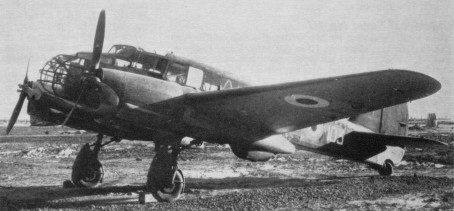
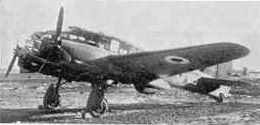
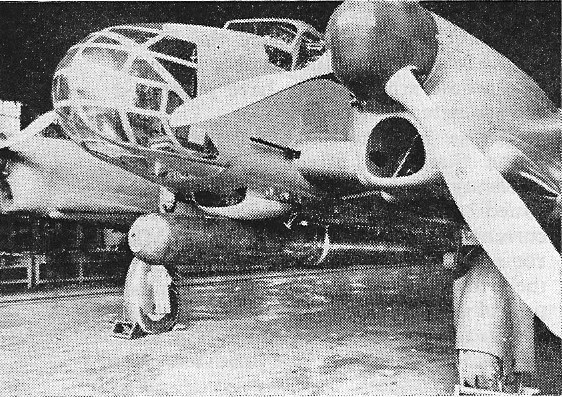
The Ca 314, an improved version of the Ca 313, was the last of the Bergamaschi-designed light twin-engined reconnaissance bombers to be produced in quantity. It was also used in small numbers by the Luftwaffe and was to have been built under license in Germany as the Ca 315 (featuring a modified nose similar to that of the Ca 316).
Ca.314
Variants included the Ca.314A or Ca.314-SC (Scorta), a convoy escort/maritime patrol aircraft, the Ca.314B or Ca314-RA (Ricognizione Aerosiluranti) torpedo-bomber and the ground-attack Ca.314C. The extra under-fuselage gun packs were carried by the Ca314C. These additional items were not normally carried by the reconnaissance-bomber versions.
Ca313 RA
Ca313 RPB 1 Type: reconnaissance-bomber.
Ca313 RPB 1 SIL Type: torpedo bomber.
Ca313 RTB 2 Type: reconnaissance-bomber.
Ca 314 A Libeccio Engine: 2 x Isotta-Fraschini Delta RC.35, 720 hp Length: 38.714 ft / 11.8 m Height: 12.139 ft / 3.7 m Wingspan: 54.626 ft / 16.65 m Wing area: 421.949 sq.ft / 39.2 sq.m Max take off weight: 14597.1 lb / 6620.0 kg Weight empty: 10054.8 lb / 4560.0 kg Max. speed: 213 kts / 395 km/h Cruising speed: 173 kts / 320 km/h Service ceiling: 20997 ft / 6400 m Cruising altitude: 13780 ft / 4200 m Wing load: 34.65 lb/sq.ft / 169.0 kg/sq.m Range: 913 nm / 1690 km Armament: 2x MG 12,7mm, 1x MG 7,7mm, 500kg Bomb.
The Ca 311 differed from its predecessor in having the “stepped” windscreen replaced by a more extensively glazed Blenheim I-style dose section (although the second production series, the Ca 311M (Modificato) reverted to a stepped canopy rather like that later adopted for the Ca 314), and the Ca 312 was a version with 630-h.p. Piaggio P.XVI R.C.35 radials.
Caproni Ca.311M
Defensive armament was a Caproni Lanciani turret with a single 7.7mm machine-gun, and one machine-gun in the port wing root and another firing aft through a ventral hatch.
Caproni Ca.311
The Ca 312M possessed a similar nose to that of the Ca 311, the Ca 312bis was a twin-float seaplane variant, and the Ca 312-1S was an experimental torpedo floatplane. The Ca 313 was a further development of the Ca 311 with two 650-h.p. Isotta-Fraschini Delta R.C.35 engines which was used in limited numbers on the Russian Front.
(SABCA) made a marketing agreement with the Italian company Caproni, with SABCA selling some of Caproni’s military aircraft in certain markets, including the Caproni Ca.135, Ca.310 and the Ca.312, which were to be designated SABCA S.45bis, S.46 and S.48 respectively.
Developed in parallel with the Ca.309 Ghibli, the Ca.310 Libeccio (south west wind) reconnaissance / transport aircraft was structurally similar, but had retractable landing gear and was powered by two 460hp/350kW Piaggio P.VII C.35 radial engines. Export deliveries went to Norway, Peru and Yugoslavia. Yugoslavia also acquired 12 more under the designation Ca.310bis; this variant differed primarily by having an unstepped extensively glazed nose. The Caproni C.310 World War 2 to be retired by the Italians in 1948. The prototype of the Ca.310bis served as a development aircraft for the following Ca.311.
(SABCA) made a marketing agreement with the Italian company Caproni, with SABCA selling some of Caproni’s military aircraft in certain markets, including the Caproni Ca.135, Ca.310 and the Ca.312, which were to be designated SABCA S.45bis, S.46 and S.48 respectively.
Caproni Ca.310 (Libeccio) Engines: 2 x Piaggio P.VIII C.35, 470 hp Length: 40.03ft (12.2m) Width: 53.15ft (16.20m) Height: 11.55ft (3.52m) Maximum Speed: 227mph (365kmh; 197kts) Maximum Range: 1,050miles (1,690km) Service Ceiling: 22,966ft (7,000m; 4.3miles) Armament: 1 x 7.7mm Breda SAFAT machine gun in dorsal turret. 2 x 7.7mm Breda SAFAT machine guns in fixed-firing forward wingroot locations. Up to 992lbs of internal ordnance. Accommodation: 3 Hardpoints: 0 Empty Weight: 6,724lbs (3,050kg) Maximum Take-Off Weight: 10,251lbs (4,650kg)
The prototype of the six-passenger low-wing transport Caproni Bergamaschi Ca.306 Borea (north wind) appeared at the 1935 Milan Exhibition. The Borea was first of a range of light twin-engine aircraft manufactured for a variety of roles.
The first of these was the mixed wood and metal construction Ca.309 Ghibli (desert wind) of 1936, 78 of which were built for use in Libya. The military versions were used as light transports or reconnaissance bombers with a lengthened glazed nose, bomb racks, cameras, and with armament comprising three 7.7mm machine-guns. Powered by two Alfa Romeo 115 in-line engines, of 185hp each and having a fixed, spatted undercarriage, the Ghibli had a maximum speed of about 150mph.
Caproni Ca.309 Ghibli
Seven squadrons equipped with Ghiblis were operational when Italy entered the war in 1940. The Ghibli was used for police duties by the Aviazione Presidio Coloniale and the Aviozione Sahariana as a light reconnaissance-bomber and transport (carrying two crew members and six passengers).
Several production series were produced, the final versions of the Ghibli to Ibe produced in quantity being the Series V and VI, the latter having a forward-firing 20-mm. cannon mounted in the nose.
Caproni Bergamaschi Ca 309 Ghibli Engine: 2 x 200hp Alfa Romeo 115-II Max take-off weight: 2695 kg / 5941 lb Empty weight: 1745 kg / 3847 lb Wing load: 14.35 lb/sq.ft / 70.00 kg/sq.m Wingspan: 16.20 m / 53 ft 2 in Length: 13.30 m / 43 ft 8 in Height: 3.25 m / 10 ft 8 in Wing area: 38.70 sq.m / 416.56 sq ft Max. speed: 250 km/h / 155 mph Cruise speed: 210 km/h / 130 mph Service ceiling: 14764 ft / 4500 m Range: 670 km / 416 miles Armament: 3x MG 7,7mm, 335kg Bomb. Undercarriage: fixed.
The Caproni PS.1, also known as the Pallavicino PS-1 and Caproni Ca.303, was an Italian four-seater sportsplane, designed and built specifically to compete in Challenge 1934, the European touring plane championships.