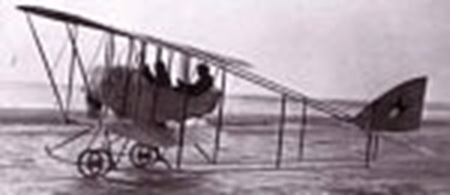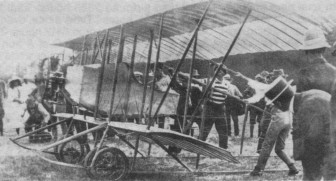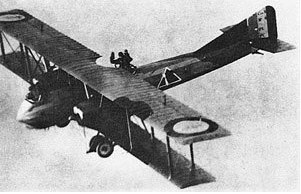
Caudron R.11 / R.12 / R.14

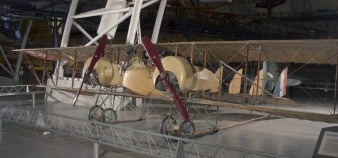
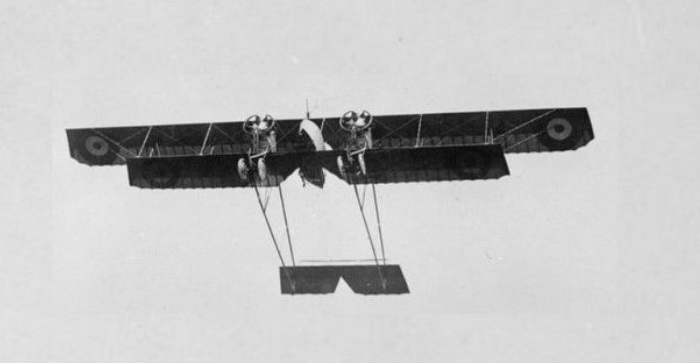
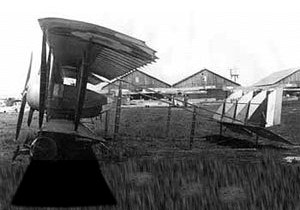
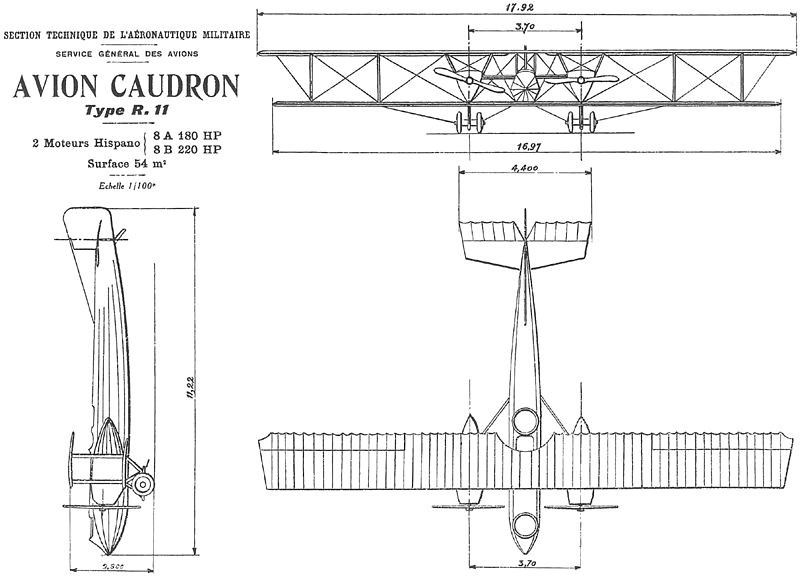
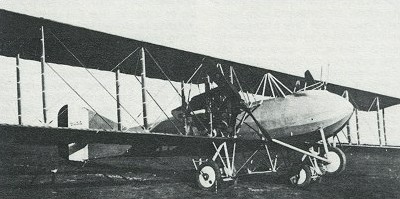
Designed by Paul Deville, the Caudron R.11 (mis-identified in Jane’s 1919 as the Caudron R.II) was initially intended as a reconnaissance aircraft for the French Air Force, but went on to serve the role of fighter escort instead. Its design was similar to the Caudron R.4, but with a more pointed nose, two bracing bays outboard the engines rather than three, no nose-wheel, and a much larger tail. The engines were housed in streamlined nacelles just above the lower wing. The wings were of equal span with three bays and parallel struts. The wing spars had a steel tube and ribs of timber and plywood. The ailerons were only on the upper wing. The rudder horn was fitted with a weight compensation. Cable control from the steering column and pedals were fitted. The R.11 was powered by two 220 horsepower Hispano-Suiza engines housed in streamlined nacelles, and featured a large-area tail structure and two large fixed landing gear. In the first ten series machines Hispano-Suiza engines were installed 8Bda (210 hp). In the production process R.11 used different versions of the engine Hispano-Suiza, and the aircraft structure, and systems were constantly amended.

The fuel system allowed both motors to use any fuel tank. Fuel tanks placed at the rear of the engine nacelles, could be dropped in flight if on a fire.
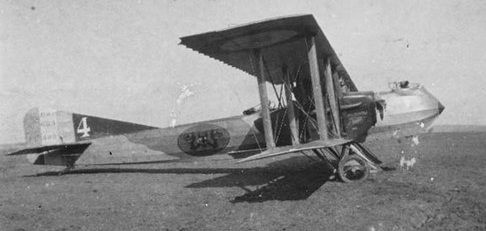
Armament was 5 x 7.7mm Lewis type machine guns in various positions and the bombload was just 265 pounds of external stores. The crew of three were all positioned in the fuselage with the pilot between the top and bottom wing assemblies in three individual open-air cockpits, a rear gunner behind him and a bow gunner in the extreme forward of the aircraft. Installed in the rear gunner cab were redundant aircraft controls.
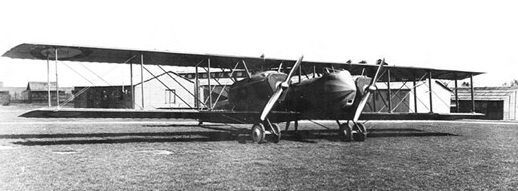
First flying in May 1917, the French army ordered 1000 R.11s. Production began in 1917, however, due to lack of engines, which mainly went to fighters, the production of unfolded very slowly, and the first aircraft were completed late in that year. Two were handed over to the RFC for trials. In February 1918 the first Escadrille (squadron) R.26 was equipped. By April 1918 a total of 20 had been completed.

By early July 1918, eight French bomber squadrons were equipped. The last escadrille to form before the Armistice (and abrupt end of production) was R.246, at which point 370 planes had been completed.

The R.11 served with the R.46, R.239, R.240, R.241, R.242 and R.246 French Escadrilles. It holds the distinction of becoming the last French production aircraft of World War 1, also forming the final French squadron (R.246) of the war, and served until July 1922.
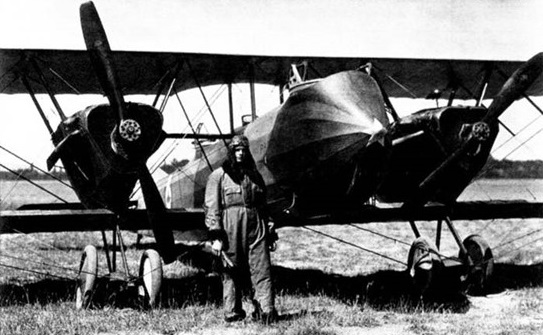
The most famous at the front were the R.11 A3 – plane escort bombers, with mostly Breguet 14 weapons which could be up to 5 machine guns. These aircraft usually had the best school graduate gunners, and one of them, Sergeant Vitalis, shot down eight German aircraft.
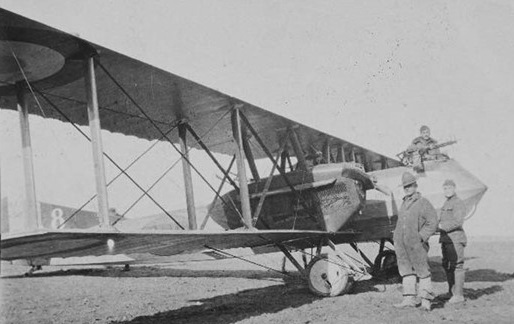
Some were operated by the American Expeditionary Force.

The Caudron R.12 was an experimental version of the R.11, with larger Hispano-Suiza 8Fb 300 hp engines. Development ended when the Caudron R.14 variant appeared in August 1918. The R.14 had great speed and powerful armament installed: 37-mm “Hochkiss” gun and a Lewis machine gun, but it was heavy and clumsy and unsuccessful arrangement of the cockpit gave a bad review.

Gallery

Caudron R.11
Engines: 2 x Hispano-Suiza 8Ba, 160 kW (210 hp)
Propellers: 2-bladed wooden fixed pitch
Upper wingspan: 17.92 m (58 ft 10 in)
Lower wingspan: 16.9 m (55 ft 5 in)
Wing area: 54.25 sq.m (583.9 sq ft)
Length: 36 ft 11 in / 11.25 m
Height: Height: 2.7 m (8 ft 10 in)
Empty Weight: 3,135lbs (1,422kg)
Maximum Take-Off Weight: 4,773lbs (2,165kg)
Fuel capacity: 220 l (48 imp gal; 58 US gal)
Maximum Speed SL: 114mph (183kmh; 99kts)
Maximum speed 5,000 m (16,000 ft): 167.3 km/h (90.3 kn; 104.0 mph)
Service Ceiling: 19,521 ft (5,950m)
Time to 2,000 m / 6,600 ft: 8 min 6 sec
Time to 3,000 m / 9,800 ft: 14 min 18 sec
Time to 5,000 m / 16,000 ft: 39 min
Endurance: 3 hours
Armament: 5 x 7.7mm / 0.30 in Lewis machine guns
Accommodation: 3
Hardpoints: 4
Bombload: 265lb external

Caudron R.11
Engines: 2 x Hispano-Suiza 8Bba, 215 hp
Wingspan: 17.92 m
Wing area: 54.25 sq.m
Length: 16.97 m
Height: 2.80 m
Empty weight: 1422 kg
Normal takeoff weight: 2167 kg
Maximum speed: 183 km / h
Cruising speed: 165 km / h
Endurance: 3 hr
Maximum rate of climb: 250 m / min
Practical ceiling: 5950 m

Caudron R.11A3
Long-range reconnaissance, differed from the base model, the lack of bomb armament, built in series.

Caudron R.11BN 3
Night bomber, with the same engines as a small series.

Caudron R.11B3
Bomber, serial machine. By the end of the war was to be built 145 copies of R.11, but the front has got only 49, two more cars were handed over to the American Expeditionary Corps. The machine was built after the war.

Caudron R.12
Version R.11 of 1918 installed engines Hispano-Suiza 8Fb 300 hp

Caudron R.14
R.11 enlarged version of the model. The prototype was presented in August 1918. The aircraft was equipped with engines Hispano-Suiza 8Fb, which originally was supposed to be installed on R.12 model. The armed 37-mm gun Hotchkiss machine guns supplemented Lewis.
Caudron R.IV

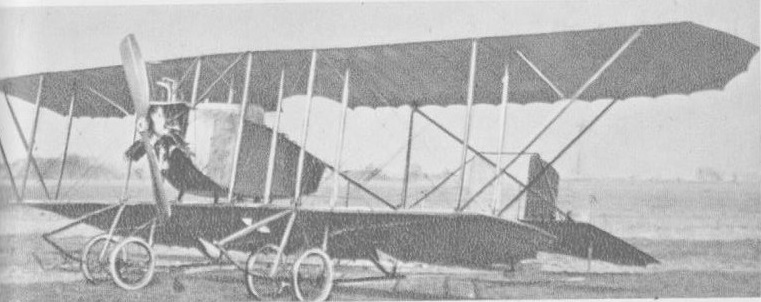
While the G.3 and G.4 had been credited largely to Gaston Caudron, the R.4 was mostly the work of Rene Caudron. Appearing in prototype form in June 1915, the R.4 had a full-length fuselage and single fin and rudder. The unequal-span wings had three bays on each side, with ailerons on the upper wing only. As well as the twin-wheel main landing gear units and tailskid, there was a single nose-wheel intended to protect the propellers. Power was from twin 97kW Renault i2Db engines. The three-man crew included nose and midships gunners each provided with twin Lewis machine-guns.
Intended originally as a bomber, it served mainly as an A.3 category three-seat reconnaissance aircraft, frequently engaged in photographic work. Its climb rate was not impressive, and a few aircraft were built with more-powerful 112kW Hispano-Suiza 8Aa engines in an attempt at improvement.
The production aircraft began to reveal a structural weakness. Among the crashes that happened, on 12 December 1915, a series aircraft under test was destroyed and Gaston Caudron, who was piloting the aircraft, was killed.
In early use Escadrille C.46 had claimed 34 German aircraft brought down with its R.4s in an eight-week period, but it was soon clear that in addition to structural redesign, improved ceiling and greater manoeuvrability were highly desirable. The new Caudron chief designer, Paul Deville, designed a new improved development which was to emerge as the R.11.
Production of the R.4 was terminated after 249 had been built. In the reconnaissance escadrilles it was replaced by the more-powerful Letord 1 during 1917.

Engine: 2 x 97kW Renault 12Db inline piston engines
Take-off weight: 2330 kg / 5137 lb
Empty weight: 1710 kg / 3770 lb
Wingspan: 21.1 m / 69 ft 3 in
Length: 11.8 m / 38 ft 9 in
Wing area: 70 sq.m / 753.47 sq ft
Max. Speed: 136 km/h / 85 mph
Ceiling: 4600 m / 15100 ft
Armament: 4 x 7.7mm machine guns, 100kg of bombs

Caudron G.IV

The limitations of the G.3 and its inability to lift a worthwhile bomb load led to the development of the twin-engined Caudron G.IV as a dedicated bomber, which first appeared in March 1915. Structurally similar to the G.3, the G.4 had increased wing span, a tail-plane with four rudders instead of two, and twin engines mounted on struts between the wings. Power was provided by either 80 hp / 60kW Le Rhone rotary engines with circular cowlings, or by uncowled 75kW Anzani radials. The short crew nacelle had an observer/gunner’s cockpit in the nose, though the field of fire was limited by the proximity of the engines, and a bomb load carried underwing. Defensive armament was limited to usually the one 7.7mm machine gun and the bombload capacity varied between 220lbs and 250lbs. As well as a 7.7mm Lewis or Vickers machine-gun on a ring mounting in the front cockpit, some G.4s had a second Lewis gun mounted over the upper wing centre section for rear defence. This second gun could only be operated by the gunner standing at full stretch in his cockpit.

The G.4 was ordered into large-scale production and two versions were built, the Cau 4 B.2 day bomber and the Cau 4 A.2 artillery observation and reconnaissance aircraft. A number of the G.4 A.2 version had wireless installed.
The appearance of the G.4 was delayed by production problems and first appeared in service with the French Aviation Militaire in November 1915 as the Cau 4B.2. This particular model, however, suffered from a high loss rate and would be phased from service by November of 1916. The Cau 4A.2 followed and was put to more successful use in the reconnaissance and artillery spotting role.
The British Royal Naval Air Service purchased 55 of the type, 43 imported and 12 were built by the British Caudron Company. Flown by Nos 4 and 5 Wings, they were used in 1916 and early 1917 in attacks on German seaplane and airship bases in Belgium. The RNAS G.4s were replaced by Handley-Page O/100s in the autumn of 1917.
The Italian Aeronautica Militare received imported G.4s and was also supplied with 51 examples built by the A.E.R. company at its factory near Turin. In May 1917 the 48a Squadriglia was the first unit to re-equip with the G.4, to be followed by the 49a and 50a Squadriglie. Italian G.4s operated in the mountainous Alpine areas, demonstrating their good climb qualities and suitability for flying at altitude.
During the war the type established several Italian altitude records. A number of Caudron G.4s were also supplied to the Imperial Russian Air Service, with which they flew in the reconnaissance role with onboard radio.

Towards the end of World War I G.4s were relegated to training duties, and 10 of the type were bought for that purpose by the United States Air Service in France in early 1918. The G.4 was used for a number of notable post-war flights and some hundreds were sold to private owners and flying clubs in France and Italy post-war.
In France 1,358 of the G.4 were produced of the 1,421 G.IV built in all.

Caudron G.4A.2
Engines: 2 x Le Rhone 9C rotary, 80hp
Length: 23 ft 8 in (7.16m)
Wingspan: 56 ft 5 in (17.20m)
Wing area: 36.8 sq.m / 396.11 sq ft
Height: 8 ft 6 in (2.60m)
Maximum Speed: 82mph (132kmh; 71kts)
Service Ceiling: 14,108ft (4,300m; 2.7miles)
Armament: 1 or 2 x 7.7mm machine guns, 220lbs of external ordnance
Accommodation: 2
Hardpoints: 2
Empty weight: 733 kg (1,616 lb)
Maximum Take-Off Weight: 1,232 kg (2,716 lb)

Caudron G.4A.2
Engines: 2 x Anzani 10-cylinder radial, 100hp
Length: 23 ft 8 in (7.16m)
Wingspan: 56 ft 5 in (17.20m)
Wing area: 36.8 sq.m / 396.11 sq ft
Height: 8 ft 6 in (2.60m)
Maximum Speed: 82mph (132kmh; 71kts)
Service Ceiling: 14,108ft (4,300m; 2.7miles)
Armament: 1 or 2 x 7.7mm machine guns, 249lbs of external ordnance
Accommodation: 2
Hardpoints: 2
Maximum Take-Off Weight: 2,932lbs (1,330kg)

Caudron G.III

G.III

Developed from the G.II, the G.III was a two-seat sesquiplane powered by a 59.6kW Le Rhone, Gnome or Anzani engine mounted in the nose of the short crew nacelle. First flown in France in 1912, over 100 were operated by the Royal Naval Air Service and Royal Flying Corps for training. A few had initially been used prior to 1914 as seaplanes.

The G.III was a two-bay biplane with strut-braced extensions to the upper wing. The wings were of wooden construction with fabric covering. There was a small nacelle for the crew. The tail surfaces, with twin fins and rudders, were carried on open wire-braced wooden booms, the lower members continuing forward to form skids. Wing warping was used instead of ailerons. Two twin-wheel main undercarriage units were fitted.

The G.III remained in service with the French Air Force for artillery spotting duties on the Western Front and in the Balkans until mid-1916.

Others, built in Italy, were used operationally until March 1917.

Most of the G.IIIs flown by the American, Belgian and Russian air forces were used as trainers.

G.IIIAs were built for military use in 1914 and used extensively by France, U.K., Belgium, Russia, and Italy as two-seat reconnaissance/ artillery observation aircraft. Several hundred were built, mostly in France, but also by British Caudron and in Italy.

The Canterbury (NZ) Aviation Co. Ltd of New Zealand had six imported Caudron GIII one and two-seat trainers. They built up three locally made copies – #3 #5 and #9.

3 – Caudron-type single seater

‘White Wings’
First flown 21 Jul 1917
Local copy built by J G Mackie at Sockburn. Single-seater, 45hp Anzani.
Badly damaged on takeoff Sockburn 7 Oct 1917. Pilot H Morse.

5 – Caudron-type 2-seater

Local copy built by J G Mackie at Sockburn. Dual control, fitted with 60hp Motor ex-#2
First flown Oct 1917
Withdrawn from use Sockburn 1920

9 – Caudron-type single-seater

Local copy built by J G Mackie at Sockburn. Single-seater, 45hp Anzani.
First flown May 1918.
Withdrawn from use Sockburn 1920

Caudron G.III CFS-9 which was used as a trainer at AFC CFS, Point Cook, Australia, in 1916

Some 3000 G-3s were constructed 1913-18 being used as observation aircraft until 1916 and as trainers throughout WW1. The first G-3s were without ailerons. The elevator cables are attached to exterior control stick extension. With no pressure on the stick the elevators drag on the ground.

In 1913, a shipment of 20 (some says 12) Caudron G.3s arrived from France, accompanied by Gaston Caudron.

The Caudrons were used to train Chinese pilots at the Pukou Flight School, 185 miles west of Shanghai. By the end of World War I, the Chinese had added a number of other aircraft. The Caudrons continued as training craft until at least 1920.

Records include first flights at Peking and Peking to Tien-Tsin by Rene Caudron and passenger in July 1913; first biplane to loop (by Chanteloup on 17 September 1913); World Endurance Record by Poulet (16 hr 28 min) in May 1914.

Gallery

Engine: 80 hp Gnome, Le Rhone, Clerget or 100 hp Anzani
Props: 2 blade
Wingspan: 43 ft 11 in
Length: 21 ft
Height: 8 ft 6 in

Engine: 80 hp Gnome
Props: 2 blade
Wingspan: 43 ft 11 in
Length: 21 ft
Height: 8 ft 6 in
Take-off weight: 734 kg / 1618 lb
Empty weight: 445 kg / 981 lb
MTOW: 1612 lb
Max speed: 69 mph at SL
Service ceiling: 10,000 ft
Endurance: 4 hr
Armament: 1 x mg
Bombload: 20 lb

Engine: 1 x Le Rhone, 80 hp / 59kW
Take-off weight: 734 kg / 1618 lb
Empty weight: 445 kg / 981 lb
Wingspan: 13.4 m / 42 ft 8 in
Length: 6.4 m / 22 ft 9 in
Height: 2.6 m / 8 ft 6 in
Wing area: 27.0 sq.m / 290.63 sq ft
Max. speed: 106 km/h / 66 mph
Ceiling: 3000 m / 9850 ft
Range w/max.fuel: 300 km / 186 miles
Crew: 2

G-3
Engine: Walter NZ 120
Prop: Merville, 8 ft dia.
Weight: 1650 lb
Fuel capacity: 24 USG
Oil capacity: 5.67 USG
Speed: 56 mph
Endurance: 2 hr 30 min
Tires: 3.00×19 Dunlop
Aileron span: 9 ft 7 in
Aileron chord: 21 in
Elevator span: 6 ft 7 in
Stabiliser span: 13 ft 2 in

Caudron Frères / Type M / Type N 

Although almost all the aircraft designed by the Caudron brothers were biplanes, they did in 1911-2 produce three monoplane types. These were the single seat racing Types M and N and the related but somewhat larger Type M2 military version.

The Types M and N were very similar and, though the designations were reported together with some details in contemporary accounts, it has proved difficult for modern historians to distinguish them. They shared the same fuselage and both used a variety of engines but a comparison of data from different contemporary sources suggests that the Type M had a larger wing than the Type N. Though there is some scatter, the span of the Type M was close to 8.7 m (28 ft 7 in) and of the Type N to 8.0 m (26 ft 3 in). In contrast, wing area varied within types.

Around this time, various French manufacturers like Voisin and Farman were hoping to improve the stability of aircraft against gusts by using wings that were partly flexible like those of birds and the Caudron Types M and N also included this feature. Each wing had two steel tube, wood filled spars, one at the leading edge and the other 500 mm (19.7 in) aft, a little behind one third chord, with ash ribs and wire bracing. The number of ribs varied between 10, 11 and 12 and they were conventionally rigid between the spars. Behind the rear spar the upper part of each rib was also rigid, ending at about 70% chord; the lower part was completed by a thin, flexible extension strip for about 60% of the chord. The wing was then fabric covered, though the flexible portion was only covered on the upper side. The wings were supported from above by landing wires from a four-legged pylon above the fuselage and by lifting wires from another below, shorter on the Type N than on the Type M. On the latter the tip of the lower pylon was braced by a horizontal, longitudinal strut to the centre of the undercarriage frame. Lateral control was by wing warping.

The structural fuselage of the Types M and N was a rectangular section, ash framed lattice girder with wire cross bracing. Poplar formers and stringers produced a more rounded, fabric covered section. The pilot sat well down in an open cockpit over the wing and behind the upper pylon. A wide range of engines were fitted, including the 35 hp (26 kW) Anzani three-cylinder inverted Y radial engine, the 45 hp (34 kW) Anzani 6-cylinder two row radial and the 50 hp (37 kW) Gnome. The last, a rotary engine, was usually covered over the upper part to screen the pilot from oil spray; the Anzanis were mounted uncowled. They all drove large, rather broad chord propellers. The very broad chord, low aspect ratio tailplane was constructed like the wing with a flexible rear surface acting both to improve stability and, by warping, act like conventional elevators, its trailing edge extending well beyond the end of the fuselage. A small, near rectangular, one piece, rigid fin was pivoted near its leading edge from the extreme tail.

The Types M and N had a tailskid undercarriage. A transverse steel bar was fixed at each end to an ash V-strut from the lower fuselage and further braced with a steel V-strut from its centre. A pair of axles, hinged at the centre of the bar, passed through the vertices of the ash struts via rubber shock absorbers with the mainwheels, slightly toed out and 1.4 m (4 ft 7 in) apart, beyond them. Early versions of the undercarriage used a single axle rather than a split one. There was an unusually long, curved, tall tailskid at the rear to keep the long tailplane clear of the ground.

Apart from basic specification (dimensions, weights and speed) in Laérophile 1912 and Jane’s All the World’s Aircraft 1913, no records of the Type M2 are currently known.

The first flight dates are not currently known, nor which type flew first, but there are reports of a Type N, piloted by Renée Caudron, flying on 23 December 1911. Fitted with the 35 hp (26 kW) Anzani engine, it flew an out and return flight from Caudron’s Le Crotoy base to Pointe-Saint-Quentin at 100 km/h (62 mph). Two days later it was on display at the 1911 Paris Salon. It was re-engined with a 45 hp (34 kW) Anzani for an English owner, E.W. Ewen, who flew it home across the English Channel on 2 May 1912. Flown by Maurice Guillaux it took part in a circuit of London race in June 1912, starting from Hendon, but retired from lack of fuel just before the end when it looked a likely winner. After many modifications it was on display at the Olympia show in February 1913. In September 1913 F. Goodden demonstrated it the Aerial Derby at Hendon, powered by a 35 hp (26 kW) Anzani; it had been entered for the race with the 45 hp (34 kW) engine but did not compete. The 8.4 m2 (90 sq ft) wing area of this aircraft, possibly the only Type N, was much smaller than that usually quoted (10 m2 (108 sq ft)). Though its span was 230 mm (9.1 in) less than the 8 m (26 ft 3 in) said to indicate a Type N and shown on the three-view in L’Aérophile, the main cause was a narrow chord (1.2 m (4 ft 0 in)) compared with the 1.4–1.5 m (4 ft 7 in – 4 ft 11 in) found in the French references.

Emile Obre flew many demonstration flights in early 1912 with a Type M, powered by a 50 hp (37 kW) Gnome engine. He flew across mainland France and in Corsica, Sardinia and French colonies in North Africa, visiting Tunis and Carthage, where the aircraft was damaged in an accident. At least three Type Ms were built.

Type N

Variants:

Type M
Span 8.7 m (28 ft 7 in) and long lower pylon braced to the undercarriage cross-member.

Type M2
Military machine
span 9.4 m (30 ft 10 in)
wing area 14 sq.m (151 sq ft)
length 6.1 m (20 ft 0 in)
weight 235 kg (518 lb)
maximum speed about 115 km/h (71 mph).

Type N
Span 8.0 m (26 ft 3 in) and short lower pylon.

Type N
Engine: 1 × Anzani or Gnome, 26–37 kW (35–50 hp)
Propeller: 2-bladed Caudron, 2.03 m (6 ft 8 in) diameter
Wingspan: 8.0 m (26 ft 3 in)
Wing area: 10.0 m2 (108 sq ft)
Length: 6.0 m (19 ft 8 in)
Height: 2.0 m (6 ft 7 in)
Empty weight: 175 kg (386 lb)
Gross weight: 300 kg (661 lb)
Maximum speed: 125 km/h (78 mph, 67 kn)
Crew: One