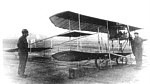
The 1910 Caudron tractor biplane Type A2-6 was designed and built by Rene Caudron in France.
The 1910 Caudron tractor biplane Type A2-6 was designed and built by Rene Caudron in France.
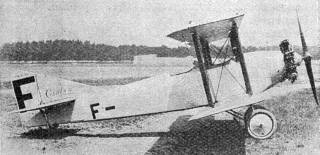
The Caudron C.161 was a lightweight French two-seat biplane designed by Caudron for sport or flight training use. A conventional biplane with a square fuselage powered by a 65 hp Salmson radial engine. It had two cockpits in tandem with dual controls in both, when not used as a trainer the controls could be removed from the rear cockpit.
A variant, the C.168, with a more powerful 70 hp Anzani radial engine was also available.
C.168
Engine: 1 × Anzani 6-cyl, 52 kW 70 hp
Wingspan: 9 m / 29 ft 6 in
Wing area: 20 sq.m / 220 sq ft
Length: 6.13 m / 20 ft 1 in
Height: 2.42 m / 7 ft 11 in
Empty weight: 342 kg / 754 lb
Gross weight: 572 kg / 1.261 lb
Power / mass: 0.0912 kW / kg / 0.0555 hp / lb
Wing loading: 28.6 kg / sq.m / 5.9 lb / sq ft
Maximum speed: 150 km / h / 93 mph / 81 kn
Crew: 2
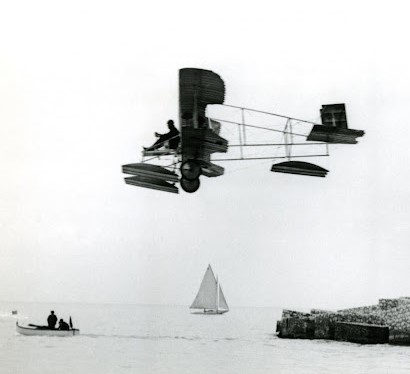
The Caudron pusher seaplane entered in the 1912 Monaco seaplane meeting featured three, big, flat-bottomed Fabre floats fitted in front of the wheels and one under the tail, a 60 hp six-cylinder Anzani engine. The pilot sat on a forward outrigger. In France it was referred to as a true “aero-amphibian” by virtue of its combined wheel-and-float undercarriage, because it could take off from and land on both land and water.
Span: 34’9″
Wing area: 35 sq.m
Length: 23’9″
Weight: 380 kg
Speed: 52 mph

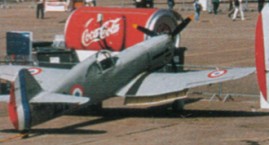
The Caudron 760 was a fighter, first flown in 1939 but in 1940 the entire production line was deliberately set on fire to prevent the type falling into German hands.

Marcel Riffard, who joined the French company Societe Anonyme des Avions Caudron as chief designer in 1932, developed his racing aircraft design into a lightweight fighter aircraft as the Caudron C.710. The prototype flew for the first time on 18 July 1936.
The C.713 Cyclone, first flown in December 1937, which was generally similar in overall design and 336kW Renault 12Ro1 powerplant, but introduced retractable tailwheel type landing gear and redesigned vertical tail surfaces. Final evolution of Riffard’s design was the C.714.01 prototype, first flown in the summer of 1938, which differed by having some structural strengthening and a wing of improved profile.
The factory testing of this prototype confirmed Riffard’s performance estimates, and it was handed over to the CEMA for trials in September 1938.
In November 1938 100 C.714 production aircraft were ordered which were required to have four 7.5mm wing-mounted machine-guns. Of low-wing cantilever monoplane configuration, the C.714 was an all-wood construction, except that all control surfaces had light alloy framework and fabric covering. The wing section was so shallow that it was not possible to mount machine-guns conventionally, within the wing structure, and special streamlined pods were designed, these carrying a pair of guns beneath each wing.
Production began in the summer of 1939, and 50 of the aircraft which had been intended to serve with the Armee de I’Air were diverted to the assistance of Finland, but only six had been received by 12 March 1940, the balance being presumed to have been lost en route. It is believed that about 40 C.714s were delivered to the French air force, which, after some 90 had been built, cancelled production because of dissatisfaction with the type’s rate of climb. They were used to equip an all-Polish squadron which became known as the ‘Warsaw Group’ (GC 1/145), this unit seeing action against the Germans between 2-13 June 1940. Following the collapse of France, a small number were used by the Vichy French air force, and about 20 were confiscated by the Germans for use by the Luftwaffe.
Derived from the C-714, the C-714-R was built specially for racing and fitted with a 900 hp Renault 12 R Special. This version was designed by Marcel Riffard and was to be piloted by Raymond Delmotte for an attempt at the world speed record. World War II stopped all that.

Caudron C 714 Cyclone
Engine: Renault 12Ro1, 444 hp
Wingspan: 29 ft 5 in / 8.97 m
Wing area: 134.550 sqft / 12.5 sq.m
Length: 27.986 ft / 8.53 m
Height: 9 ft 5 in / 2.87 m
Max take off weight: 3858.8 lb / 1750.0 kg
Weight empty: 3087.0 lb / 1400.0 kg
Max. speed: 262 kts / 485 km/h / 301 mph
Cruising speed: 173 kts / 320 km/h / 199 mph
Service ceiling: 29856 ft / 9100 m
Wing load: 28.70 lb/sq.ft / 140.00 kg/sq.m
Range: 486 nm / 900 km
Crew: 1
Armament: 4x MG 7,5mm
C-714-R
Engine: Renault 12 R Special, 900 hp
Wingspan: 22.14 ft
Length: 28.57 ft
Design speed: 412 mph


Competing with the ANF-Mureaux 190 to meet a Service Technique de l’Aeronautique specification for a lightweight fighter, the C 710 Cyclone, designed by Marcel Riffard, was developed from the Coupe Deutsch de la Meurthe racing monoplanes. It was of wooden stressed-skin construction with a 500hp Renault 12R 01 12-cylinder inverted-Vee air-cooled engine.
First flown on 18 July 1936, the C 710-01 was subsequently fitted with two drum-fed 20mm HS-9 cannon in the wings, and was tested at Guyancourt and Villacoublay throughout 1937. On 1 February 1938 it crashed in the Verrieres forest.
Two additional airframes had been built, the second of these being completed as the C 710-02 which differed from the first prototype in having redesigned vertical tail surfaces, taller and more angular. Further development of the basic design concentrated on derivatives embodying retractable undercarriages (C 713, C 714) but were brought to a halt by the German occupation of France in 1940
Engine: 500hp Renault 12R 01 12-cylinder inverted-Vee air-cooled
Take-off weight: 1 645 kg
Empty weight: 1243 kg / 2740 lb
Wingspan: 8.97 m / 29 ft 5 in
Length: 8.53 m / 27 ft 12 in
Height: 2.47 m / 8 ft 1 in
Wing area: 12.50 sq.m / 134.55 sq ft
Max. speed: 455 km/h / 283 mph
Range: 825 km / 513 miles
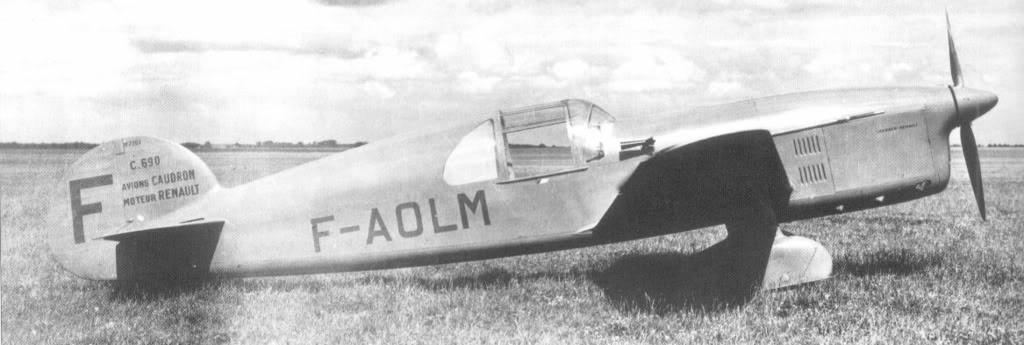
A fighter trainer based on the Coupe Deutsche de la Meurthe racers of 1933 35, the C.690 was the first of a series of little Caudron fighters which were among the most successful light fighters of the period between the World Wars. Powered by a six-cylinder in line air cooled Renault of 240 hp, the C.690 had fixed spatted landing gear and length greater than the span. One machine¬gun could be fitted. Subsequent developments in the series, which included the C.710, C.713 Cyclone, C.714 and Caudron-Renault C.760, were brought to a halt by the German occupation of France in 1940.
Fifteen C 690Ms were built as advanced trainers for the Armee de I’Air.
Engine: Renault, 240 hp
Span: 7.75 m (25 ft 5 in)
Length: 7.85 m (25 ft 9 in)
Gross weight: 990 kg (2185 1b)
Maximum speed: 370 km/h (229 mph)
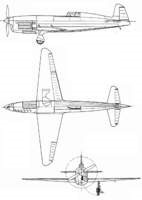
A fighter trainer derived from the C.640 Typhon, the C.670 was a streamlined tandem seat monoplane powered by two 220 hp Renault in line engines. Two machine guns, or 20 mm (0.79 in) cannon or a light bombload could be carried, but none entered service.
Engines: two 220 hp Renault in line
Span: 14.8 m (48 ft 6 in)
Length: 10.7 m (35 ft 2 in)
Gross weight: 3200 kg (7055 lb)
Maximum speed: 400 km/h (248 mph)
Armament: Two machine guns, or 20 mm (0.79 in) cannon or a light bombload

The prototype C.365 tourer/mailplane made its first public appearance at the1934 Paris Air Show, and about 210 were subsequently built, 70 for the civil market and 140 for the French military.
The first production model, the C.635, seated two pairs in the cabin. Aft of the cabin is a large baggage compartment, and the rear seats can be removed.

C.635
Engine: Renault 453-01 or 5Q-09, 220 hp
Wingspan: 34 ft 1 in
Length: 28 ft 6 in
Height: 7 ft
Wing area: 172.16 sq.ft
Empty weight: 1760 lb
Loaded weight: 2706 lb
Max speed: 186 mph
Cruise: 168 mph
Service ceiling: 19,680 ft
Range: 560 mi


