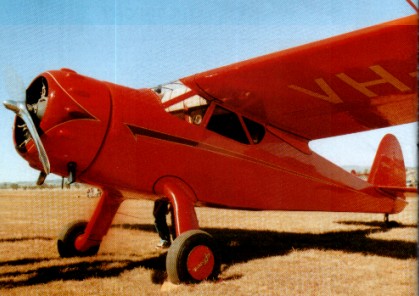
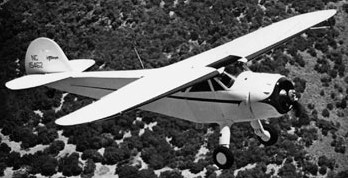
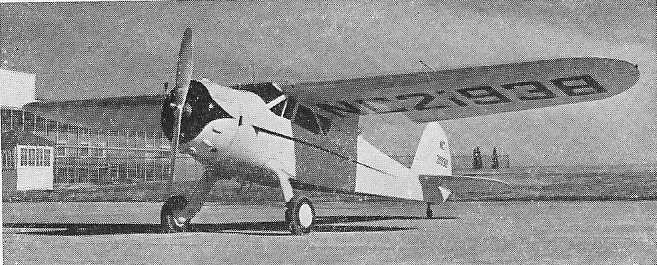
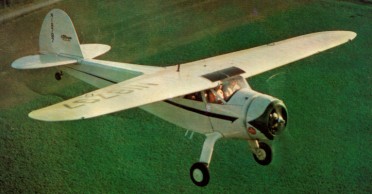
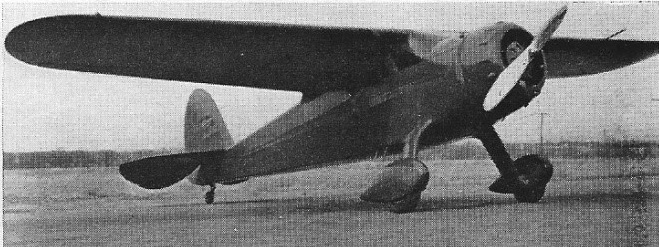
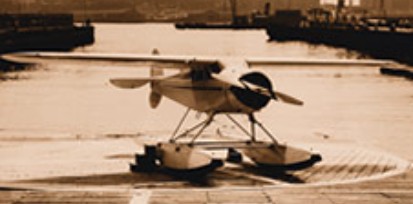
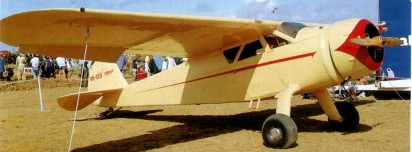
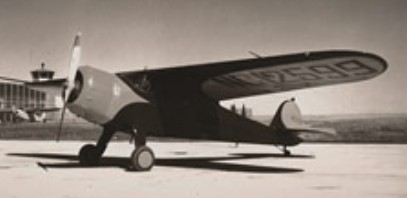
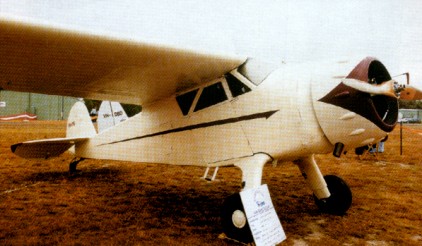
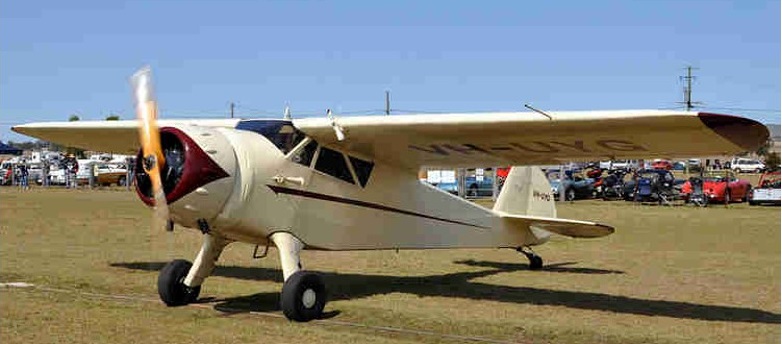
Dwane Wallace and his company perceived the untapped twin engine market as being for a relatively inexpensive and uncomplicated airplane. The prototype T 50 was a simple airplane. It had fixed ¬pitch props and small (225 hp) Jacobs en¬gines, but constant speed propellers and 20 more horsepower per side were later fitted. The props were not full feathering, and could only be pulled into full coarse pitch in the event of an engine failure.
The design used al¬most no aluminum (only the nose cap, tail stinger, engine cowlings and nacelles) at a time when aluminum was far too valuable to waste on trainers. The T 50’s fuselage was welded steel tubing with fabric over wood longerons and formers, and the wing was all wood spruce, mahogany and birch under fabric. The flaps were wood also, and they and the gear were both driven through bicycle -chain loops by a pair of electric motors in the belly. The screw jack actuator for the gear was non-reversible, so no down locks or up¬latches were needed. The landing gear retracts upward into the nacelles and remains partly exposed so that belly landings can be made with little or no damage if the flaps are up. An unusual feature of the Jacobs engine is that it operates on only one magneto, plus battery ignition. It is started on the battery, then switched to the mag. Both engines turn generators, and they run smoothly on ignition if a mag fails.
The T-50 prototype makes its first flight with Dwane Wallace at the controls on March 26, 1939. The plane was certified in December 1939.
By 1940, it was in production and ready for buyers. Cessna only had time to make a few commercial T 50s before rumors of war reached American ears. The Army showed a polite interest in the T 50 as a trainer for bomber pilots, and ordered 33 specially equipped T-50’s – at the time, the largest order in Cessna’s history. The Army’s new planes are designated AT-8’s. The Army Air Corps’ first Bobcats were AT 8s, and they were, in fact, the service’s first multi-engine trainers of any sort. The AT¬8 had 290 hp nine cylinder Lycomings in place of the civilian airplane’s seven cylinder 220kW / 245 hp Jacobs R-680-9 engines, plus the eyebrow windows and transparent cockpit roof that henceforth all military T 50s would have. Service trials showed that these were unnecessarily powerful for use in a two-seat trainer, and when in 1941 the first real production contracts were placed, less powerful engines by the same manufacturer were specified.
The British decided to ship their students to Canada for flight instruc¬tion, so it fell to Canada to come up with the necessary training planes. Prior to that, they’d sold four to the CAA [as airways fa¬cility check planes] and 33 to the Air Corps, but the big sale was the first 180 airplanes to the Canadians dubbing them “Cranes”.
The Canadians called the T¬50s Cranes and eventually got 830 airplanes. One extra thing the Canadians wanted was a third fuel tank, installed in the fuselage be¬neath the rear seat; the two 60 gallon wing tanks were only good for about three hours, and 40 gallons in the fuselage gave the Crane an extra hour or so. The Crane wasn’t certified for civilian use with the third tank, and the filler cap opening was covered over in surplus Canadi¬an T 50s (and later U.S. versions that also got the mod) after the war. The Canadians soon reverted to wooden fixed pitch props, because of a lack of metal for blades and perhaps because they figured the airplane was going nowhere but down anyway if an engine stopped. For the Commonwealth Joint Air Training Plan, eventually 550 aircraft were supplied under Lend-Lease.
The original use of Cessna’s T-50s had been in a light transport role, and in 1942 the USAAF decided that these aircraft would be valuable for liaison/communication purposes and as light personnel transports. The aircraft were named Bobcat and given the designation C-78, later changed to UC-78. In addition, a small number of commercial T-50s were impressed for service with the USAAF under the designation UC-78A.
The USAAF’s requirement for the two-seat conversion trainers had been difficult to predict, and when it was discovered in late 1942 that procurement contracts very considerably exceeded the training requirement, Cessna was requested to fulfil the outstanding balance of the AT-17B and AT-17D models as UC-78B and UC-78C Bobcats respectively. Both were virtually identical, but differed from the original UC-78s by having two-blade fixed-pitch wooden-propellers and some minor changes of installed equipment. Production of these two versions amounted to 1,806 UC-78Bs and 327 UC-78Cs. (3,370 UC-78 Bobcats for the USAAF in total)
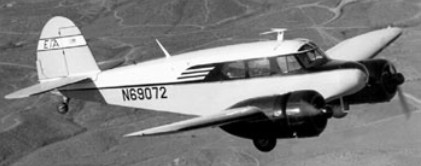
The initial production version, designated AT-17, was equipped with Jacobs R-755-9 engines driving wooden propellers. A total of 450 was built, and these aircraft were followed into production by 223 of the generally similar AT-17A, which differed by having Hamilton-Standard constant-speed metal propellers and a lighter maximum weight. The later AT-17B (466 built) had some equipment changes, and the AT-17C (60 built) was provided with different radio for communications. Of these 1,199 aircraft, 550 were delivered to Canada with the name Crane Mk 1A.
They came in two gross weights, de¬pending on the wing construction used¬ – 5,100 and 5,700 pounds and their crew capacity was either two or five, depending on whether they had the fuselage aux tank.
In the period 1942-3, the US Navy had a requirement for a lightweight transport aircraft to carry ferry pilots between delivery points and their home bases, as well as for the movement of US Navy flight crews. This led to the procurement of 67 aircraft, generally similar to the UC-78, which entered service under the designation JRC-1. Many examples of USAAF Bobcats remained in service for two or three years after the end of World War II.
Originally built with 245 hp Jacobs radial engines, some Bobcats later got 295 hp Lycomings, and others were re-engined with 300 hp Jacobs powerplants. With the addition of an exit-hatch window to meet safety requirements, some also have been converted to six-seaters, though normal seating is two pilots and three passengers on a single bench-type rear seat.
Bobcats have a large rudder, but the vertical stabilizer is small and minimum single-engine control speed is 90 mph. At 10,000 feet, full throttle gives 20″ of manifold pressure, and 1,900 rpm on the Hamilton Standard constant-speed props will yield 143 mph indicated.

There are four different single engine ceilings listed for the heavier of the two versions of the airplane, based on gross weights of 5,400 and 5,700 pounds, each calculated with fixed pitch and constant speed props. The best is 1,500 feet above sea level; the worst is sea level, with a minimum rate of descent of 50 feet per minute.
There were several little ¬known Bobcat variants and derivatives, though none of them ever progressed much beyond the prototype stage. The first was the Cessna P 7, a Bobcat with plywood covered wings and tail surfaces and 330 hp Jacobs engines. The second was the P 10, a Wichita mini-version of the de Havilland Mosquito, it was a two place P 7, with the big Jacobs en¬gines and a plywood covered fuselage, a little snub nose and a pair of side by side seats un¬der a bubble windscreen and roll back cano¬py. Finally, there was the P 260, which had the Bobcat’s wing planform, fabric covered fuselage arrangement and formation of boil¬ers nacelles; but it was a 14,000 pound car¬go hauler with R 1340 Pratt & Whitneys. It almost made it into production the Govern¬ment was about to buy 500 of them as C¬106As except the C-47 turned out to be more useful than any¬body had expected.
In early 1944, Cessna suspends production of the Bobcat and begins manufacturing components for the Douglas A-26 and Boeing B-29 bomber. More than 5400 T-50s were constructed for the RCAF and the US military.
Cessna T-50 1A
Engine: 2 x Jacobs L-4MB, 225 hp
Wingspan: 41ft 11in (12.8m)
Length: 32ft 9in (10m)
Height: 9ft 4in (2.8m)
Range: 750 miles (1,207km)
Speed: 191 mph (307 km/h)
Cessna UC 78 Bobcat
Engine: 2 x Jacobs R 755-9, 242 hp
Length: 32 ft 9 in / 9.98 m
Height: 9 ft 11 in / 3.02 m
Wingspan: 41 ft 11 in / 12.78 m
Wing area: 295.041 sqft / 27.410 sq.m
Max take off weight: 5699.9 lb / 2585.0 kg
Weight empty: 3501.5 lb / 1588.0 kg
Max. speed: 170 kts / 314 km/h / 195 mph
Cruising speed: 152 kts / 282 km/h
Service ceiling: 22,000 ft / 6705 m
Wing load: 19.27 lbs/sq.ft / 94.00 kg/sq.m
Range: 652 nm / 1207 km / 750 miles
Crew: 2
Passenger: 3
UC-78 Bobcat
Engine: 2 x Lycoming R-680-9 radial, 220-kW (295-hp).
JRC-1
Engine: 2 x Lycoming R-680-9 radial, 220-kW (295-hp).
Crane Mk I
Engine: 2 x Lycoming R-680-9 radial, 220-kW (295-hp).
Crane Mk 1A
AT-8
Engine: 2 x Lycoming R-680-9 radial, 220-kW (295-hp).
AT-17
Engines: 2 x Jacobs 8-775-9, 183kW (245 hp).
Wingspan: 12.80m (41 ft 11 in).
Length: 10m (32ft 9in).
Max TO weight: 2258 kg (5,700 lb).
Gross weight: 5,700 lb.
Empty weight: 4,050 lb.
Fuel capacity: 120-160 USG.
Max speed: 195 mph at sea level.
Cruise: 165 mph.
Landing speed: 65 mph.
Initial climb rate: 1,525 fpm.
Ceiling: 15,000 ft.
Operational range: 750 miles.
Seats: 4-6.
AT-17A
AT-17B
AT-17C