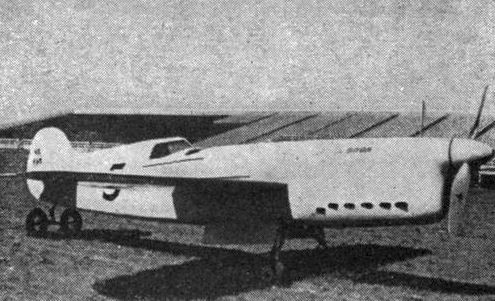
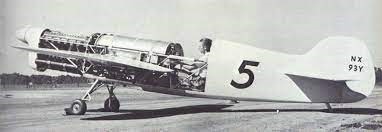
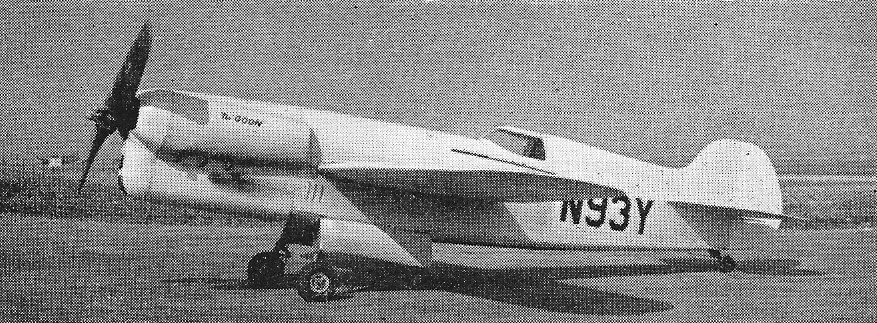
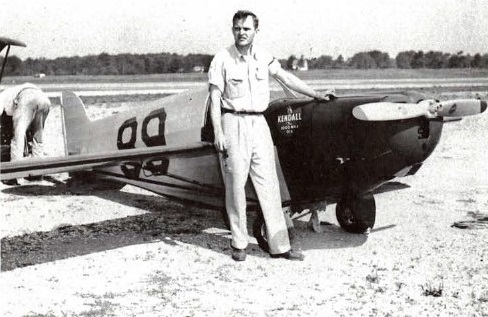
Art Chester followed on his successful air racer the “Jeep”” with the Goon. “Goon”, like “Jeep” was named after characters in Popeye cartoons and comic strips.
The Goon was built with a conventional welded steel tube frame and fabric covering. The wings used spruce spars and plywood covering. The mid-wing taildragger aircraft featured short-legged retractable landing gear. The engine was prepared to turn clockwise (as normal for some British inlines of the era) in anticipation of mounting a custom French propeller, but the propeller was also customized for American engines, and the engine needed to be modified again to rotate normally.
The Chester Goon aka The Chester Special #2 was built for the 1938 National Air Races.
Placed second in the Greve Trophy Races of the 1938 National Air Races with a speed of 250.42 mph (403 km/h). 1938 Thompson Trophy – Has to drop out after failure of prop. 1939 National Air Races – First place at 263.39 mph (424 km/h), winning $9000. 1939 Thompson Trophy – Dropped out with engine trouble.
In 1939 20th Century Fox featured the Goon in the movie series Tailspin Tommy. By 1956, the Goon was purchased in unflyable condition. During the 1956 rebuild, a 190 hp Lycoming O-435-1 engine was installed in place of the Menasco, including a cut down Beech-Roby propeller and wheel brakes.
Lycoming powered
On December 23, 1957, the rebuilt Goon was test flown by Harvey Mace at Sacramento, California.
The Goon was purchased in 1991 by the Crawford Auto-Aviation Museum and was awaiting restoration in Macedonia, Ohio.
Powerplant: 1 × Menasco C-6-S Buccaneer, 450 hp (340 kW) Propeller: 2-bladed French Ratier Controllable Wingspan: 18 ft 6 in (5.64 m) Length: 20 ft 6 in (6.25 m) Crew: One
Arthur Chester designed and built the Chester Special in his garage in the early 1930s. The racer was completed in 1932, but was not fully tested by the time of the 1932 National Air Races.
The Special N12930, later called the “Jeep,” was tested on August 14, 1932. Flight tests proved the aircraft was unsatisfactory for competition and major changes were made before entry in the 1933 races. The 1932 version had a semi-open cockpit with a rather flat windscreen. The airframe was stripped for extensive modifications, including shortening the wings by two feet and chopping the length by 23 inches. The bay behind the cockpit was eliminated and 18 pounds of lead were required to correct the balance. A hatch was installed over the cockpit and the cowling was changed.
The fuselage was constructed of welded steel tubing with plywood fairing aft of the cockpit and covered in fabric. The wings were made of birch spars and plywood ribs with spruce cap strips. The leading edges were plywood covered and the rest of the wing was covered with fabric. The Chester Special was powered by a 185 hp Menasco C4S engine.
Art first competed with his Special in the 1933 National Air Races, where he won one first and four fourths, with his best speed reaching 155 miles per hour. At the 1936 National Air Races the Chester Special appeared under the new name “Jeep,” taken from a character in the famous Popeye comic strip. Chester raced his Special until 1937, reaching an overall best speed of 235 miles per hour and always taking home at least a little prize money.
The Jeep was later sold to Tom Stauch, who intended to fly it at the 1939 National Air Races, but failed to file the paperwork on time. The Special didn’t reappear until 1947 when it participated in the Goodyear Races after a complete rebuild. The engine was switched to an 85 hp engine and the airplane was so revamped that it could hardly be called a Chester racer, only the license number and tail section remained unchanged.
William T. Flack – 1947 Goodyear
Bill Flack of Warwick, New York, rebuilt the ‘Jeep’ for the 1947 Goodyear races and was the winner of the consolation race.
Art Kilps acquired the Jeep, which he donated to the EAA AirVenture Museum in 1977. Before the racer was put on display, EAA Member Henry Proescher took on the project of restoring the Chester Special to its 1936-37 racing configuration. The restoration took over six years to complete, after which, the historically accurate racer was put on display in the AirVenture Museum.
Engine: 185 hp Menasco C4S Wing Span: 16 ft. 8 in. Length: 15 ft. 1 in. Height: 4 ft. 10 in. Wing Area: 48 sq. ft. Empty Weight: 765 lbs. Gross Weight: 1150 lbs. Fuel Capacity: 30 USgal. Maximum Speed: 255 mph Cruise Speed: 219 mph Range: 325 mi.
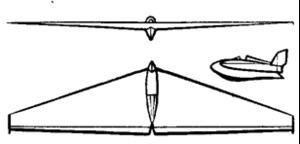
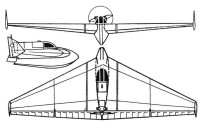
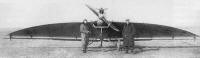
The BICh-11 appeared in 1932 as a continuation of the trapezoidal wing design started with the BICh-8 glider. Its construction was developed in the TsAGI workshops. The Cheranovski BICh-11 (RP-1) (Russian: Черановский БИЧ-11 (РП-1)), conceived in 1931, became the world’s first experimental aircraft in a flying wing configuration designed to use a reactive power plant. Problems with the development of the reactor made it necessary to equip the BICh-11 with a low-power engine in pusher configuration.
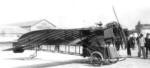
In practice, the BICh-11 had been conceived to test in flight the OR-2 liquid propellant rocket engine developed by FA Tsander, which weighed only 18 kg and was capable of developing a thrust of 0.62 kN. The funds for the modification of the model and the installation of the reactive power plant were approved by OSOVIAJIM on February 25, 1932. The installation of this engine was just behind the cabin. The fuel and oxidizing agent tanks were designed in fairings located on the wings, on both sides of the central fuselage.
The BICh-11 was conceived as a single-seater experimental glider, built entirely of wood. The cantilever and high-set wing had a trapezoidal shape and a three-spar structure. This wing was conceived in three sections: a central one forming an integral part of the fuselage and the long wing consoles with the rudders at the ends. The union of the consoles to the centroplane was made by means of some steel pieces. In the centroplane, they conceived some fairings that contained the chemical components necessary to make the OR-2 liquid reactive engine functional.
The entire leading edge was covered with a 1mm thick plywood sheet. The straight trailing edge featured control surfaces along the entire span, located on a bar on the soffit of the wing, just below the trailing edge. In the external part the ailerons were located, also used as elevator rudders. On the inside were the adjustable stabilizers on the ground and a little further inside the elevator. Adjustable stabilizers on the ground were located on the inside.
The fuselage was covered with plywood. The landing gear was composed of two independent wheels and a tail skid.
The pilot was located in a closed cockpit at the nose.
In mid-February 1932 the BICh-11 was transported to the GIRD and on February 22 it was flown in the form of a glider by Sergei Koroliov. Also in glider form, the BICh-11, piloted by Koroliov, flew in the IX National Sailing Competitions held in 1933.
The first tests work jet engine OR-2 began the 18 of March of 1933, but only 10 days after FA Tsander died and with him the work of building the rocket plane – 1 (RP-1), assigned name to the project.
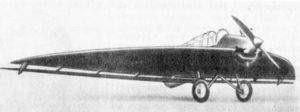
Given the lack of a power plant, the BICh-11 was modified to use a 27 hp ABC Scorpion piston engine driving a propeller, with which the tests were continued. In this configuration the BICh-11 flew satisfactorily, becoming one of the first airplanes in a flying wing configuration with a trapezoidal ground plan to do so.
In the version with a piston engine, some modifications were made to the wing plan and its control surfaces. The ABC Scorpion power plant was located at the end of the fuselage fairing as an extension of the cabin and powered a two-bladed wooden propeller.
BICh-11 Engine: 27 hp ABC Scorpion Wingspan: 12.10 m Wing area: 20.00 m² Length: 3.25 m Empty weight: 200 kg Accommodation: 1
Cheranovski BICh-11 glider
Cheranovski RP-1 with wing fairings for liquid reactive engine fuel
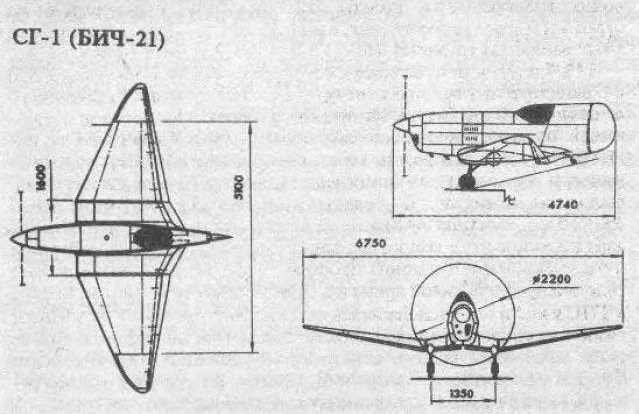
During the design of the new SG-1 racing aircraft (SCR-21), designer Boris Ivanovich Cheranovsky applied a trapezoidal wing shape but with a broken leading edge. The center-wing was straight and the outer had a swept 25º. By the front view, the wing was a “reverse gull”, and tailless.
The very short fuselage had a length with a rudder of no more than 4,74 m. The drop-shape of the pilot’s cabin, along with the fuselage with a hexagonal cross section in the cockpit area, was continued back to the wedge-shaped vertical tail.
The take-off weight of the SG-1 was 643 kg with empty 526 weight. The take-off and landing characteristics turned out to be outstanding. The “screen” effect reduced the landing speed to 80 km / h, and the take-off and landing respectively 110 and 100 m. It was calculated with the forced motor MB-6А (240 hp) to reach 424 km / h.
Such unusually large numbers caused a critical attitude to the project of some aerodynamics and designers. The plane was predicted of a fiasco, but some experts gave positive feedback, among them – Brig. VS. Pyshnov Mr. I rank engineer A.S. Yakovlev.
Due to the complexity of the engine supercharging system, its power, like that of the serial MB-6, was only 220l.s., and on flight tests it was possible to achieve 417 km / h. But this is only 7 less than the estimated speed. SG-1 tests were completed by the summer of 1941.
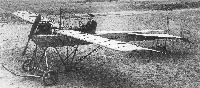
The BICh-7 (Russian: Черановский БИЧ-7) appeared as an enlarged BICh-3 development with a more powerful 100 hp Bristol Lucifer engine and the fuselage featured two open cockpits in tandem.
At the wingtips, on the upper surface, rudders were located with a curved leading edge.
The landing gear featured a single center wheel with skids on the tail section and near the wingtips. This landing gear proved ineffective, as did the dolphin-fin rudder.
Designed by Boris Ivanovich Cheranovski the BICh-7 was built at the Air Fleet Academy in 1929.
As a result, the plane did not take off. After several unsuccessful attempts, the model would be modified to give rise to the BICh-7A.
Based on the unsuccessful BICh-7, Cheranovski modified the cell to become a two-seater with a closed cabin. The rear cockpit fairing made a smooth transition to a rudder, which was very effective in this version. The BICh-7A (Russian: Черановский БИЧ-7A) signified the continuation of the development of the original Cheranovski parabolic scheme.
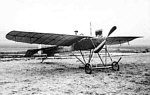
Cheranovski BICh-7A
Like most of Cheranovski’s designs, the BICh-7A was built entirely of wood with a fabric covering.
The cabin on this model appears closed and ends at the rudder. The wing, with a thick profile, presented an area increased to 30 m².
Another notable feature was the modification of the landing gear to a conventional two-wheel configuration with independent landing gear and tail skid.
The wing profile was also slightly modified and the system of ailerons and elevons installed on a bar located near the trailing edge of the wing intrados was introduced. This configuration had been successfully tested on the BICh-5 during the experiments carried out in the TsAGI wind tunnel and resulted in an increase in the effectiveness of these surfaces and in the maneuverability of the aircraft.
Cheranovski BICh-7A.
The BICh-7A was completed by 1932. The tests carried out in 1932 confirmed the expectations of its builder. The flights carried out by the pilot NP Blagin showed that the new airplane responded positively to the controls and presented good stability both longitudinally and during turns. These flights reached a maximum speed of 165 km / h with a ceiling of 5000 meters. Landing speed remained in the range of 70 – 75 km / h.
The main problem with the BICh-7A was its engine. Attempts to install a more powerful 140 hp three-cylinder Bristol Lucifer unit brought no improvement. During the flights the pilot was forced to adjust the power to 100 hp due to the appearance of strong vibrations. Low engine power and the use of an imported engine limited the model’s production possibilities. The M-11 domestic engine was never tested in the BICh-7A.
The excellent results of the BICh-7 would lead Chizhevski to develop in the Bureau of Special Constructions (BOK) a model of a flying wing that was known as BOK-5.
BICh-7 Engine: 1 Bristol Lucifer 100 hp Wingspan: 12.20 m Wing área: 30.00 m² Length: 4.74 m Empty weight: 612 kg Maximum takeoff weight: 865 kg Wing loading: 29.0 kg / m² Power load: 8.7kg / hp Fuel capacity: 93 kg Payload capacity: 253 kg Maximum speed: 165 km / h Landing speed: 70 km / h Seats: 2
BICh-7A Engine: 1 Bristol Lucifer 100 hp Wingspan: 12.20 m Length: 4.74 m Height: 2.40 m Wing area: 30.00 m² Empty weight: 627 kg Maximum takeoff weight: 880 kg Wing loading: 29.3 kg / m² Power load: 8.8kg / hp Fuel capacity: 93 kg Payload capacity: 253 kg Maximum speed: 165 km / h Cruising speed: 138 km / h Landing speed: 70 km / h Practical range: 200 km Practical ceiling: 5000 m Seats: 2
The 1911 ChUR-1t was built by Russian aviator Nikolaj Vasilievich Rebikov and inventor Grigory Gerasimovich Chechet with financial support of M.K.Ushkov of Moscow.
It was demonstrated on the Second Moscow Aviation Exposition (Mar 25 – April 8, 1912), later – flown on Comendant Airfield near St.Petersburg.
It was a ‘inverted’ biplane (upper wing was much smaller than the lower one) with biplane tail planes. Ailerons were only on the upper wing, during tests – added to the lower one too. Wings were equipped with anti-slide surfaces.
The first aircraft in Russia to have steel wielded frame in front fuselage. Additional control surface was added to the tail in order to compensate load on the control stick.
On July 5 1912 the aircraft (flown by N.V.Rebikov) was crashed and not restored.