
Circa Reproductions Nieuport 24
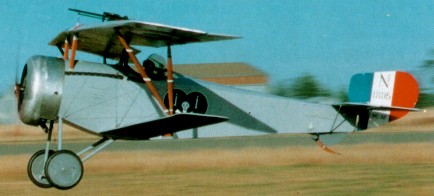
Plans from Canadian Graham Lee who had re drawn the original drawings down to the 7/8 scale. The Nieuport 17 is all aluminium construction, covered with a polysynthetic fabric and painted with aircraft finishes. Powered by an 1835cc VW engine that has been fitted with a starter motor, it cruises at a leisurely 65 70 mph.
A CIRCA Reproduction Nieuport 11/17 features 6061 tube, pop rivet construction. Average cost in 2008 was $6,000.00.
Engine: 1835cc VW 60HP
Span: 21’5″
Length: 16’5″
Empty Weight: 300 LBS
Useful Load: 300 LBS
Wing Area: 114 SQ. FT.
Seats: 1
Take Off Distance: 250 FT
Stall: 33 MPH
Landing Speed: very slow
Cruise: 80 MPH
Rate Of Climb: 650 FPM
Engine: VW1600.
Wing span: 22 ft.
Length: 16 ft.
Height: 6 ft 6 in.
Weight: 362 lb.
Max speed: 70 mph.
Endurance: 4 hr.
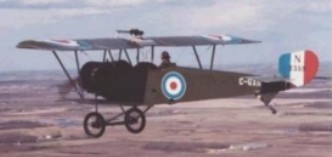
The 87% scale replica of a Nieuport 12 was designed and prototyped in 1989, at Oshkosh ‘90, it took 3rd place in the light plane category.
The 12 is constructed of the same materials as the Nieuport 11 with the exception of the main wing spars which are formed sheet. The 12 is a 2 place with a Rotax 582 recommended. Construction is fabric covered tube structure, pull riveted gussets and AN bolts. Plans are oriented to the experienced builder with little instruction needed. Videos are available of Building procedures 4 hrs as well as a flight preview video (2 hours)
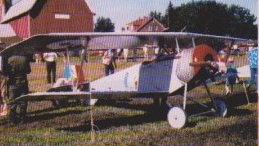
Engine: Rotec R2800 or Rotax 582, 65 hp
HP range: 65-85.
Reduction: 3.47:1
Propeller (flight): 84″ diameter
Span Main Wing: 26.5 ft
Span Sub Wing: 21.2 ft
Chord Main Wing: 4.85 ft
Chord Sub Wing: 31.5
Wing Area: 189 sq. ft.
Span Stabilizer: 9 ft
Length cowl to tail: 21.5 ft
Height: 7.5 ft
Weight empty: 575 bs
Fuel Capacity: 12 Gal US.
Gross Weight: 1070 lbs
Stall Speed: 33 MPH
Cruise: 75 MPH
Top Speed: 94 MPH
Never Exceed (Vne): 112 MPH
Take off run: 300 ft
Landing Roll: 300 ft
ROC: 550 fpm.
Range: 180 sm.
G Factor (@ 550 lbs): +5.7/ – 2.8
Tubes: 6061-T6
Gussets / fittings: 2024 – T3
Build time: 1400 hrs
Seats: 2.
Landing gear: tail wheel.
Engine: Rotax 582, 64 hp
Wing span: 8 m
Wing area: 17.56 sq.m
MAUW: 475 kg
Empty weight: 255 kg
Fuel capacity: 50 lt
Max speed: 150 kph
Cruise speed: 115 kph
Minimum speed: 53 kph
Climb rate: 2.2 m/s
Seats: 2
Plan price (1998): $200
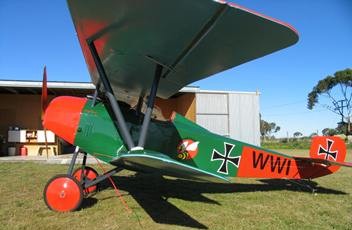
A variation of the Graham Lee designed 7/8 scale copy of the 1916 French Nieport 11 is the German copy by Seimens Schukert featuring lowered top wing and four point carbane struts. Rotax 503 powered
Gas powered Spandau MG adds to fun flying.
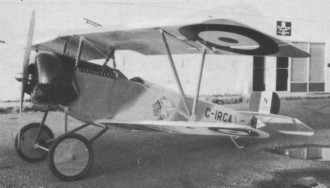
An 87% scale replica first displayed at Oshkosh in 1984 after a hurried 10 hours of serious test flying before being loaded on a trailer for the trip. Construction drawings includes more than 100 pages of dimensional drawings, assembly sketches and construction notes, in 9 x 12 format The Baby Nieuport is an outwardly accurate reproduction with handling characteristics much like the original World War I fighter. Special construc¬tion techniques make the best use of aluminum tube and sheet for a light, robust structure, capable of meeting ultralight or amateur-built criteria, powered by either a Rotax 447 or 50 hp Rotax 503. With more than 100 pages of dimensional drawings, assembly sketches and construction notes, Circa claim that the aircraft, built from alloy tube and sheet, can be put together in around 500 hours. Tubes 6061-T6 Gussets / fittings 2024 – T3
Loops, spins, Split S and a 7000ft power dive were performed on C-IRCA but aerobatics are NOT recommended.
A CIRCA Reproduction Nieuport 11/17 features 6061 tube, pop rivet construction. Average cost in 2008 was $6,000.00.
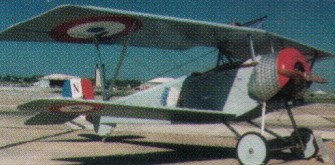
Engine: 1835cc VW 60HP
Span: 21’5″
Length: 16’5″
Empty Weight: 300 LBS
Useful Load: 300 LBS
Wing Area: 114 SQ. FT.
Seats: 1
Take Off Distance: 250 FT
Stall: 33 MPH
Cruise: 60 MPH
Rate Of Climb: 650 FPM
Nieuport 11 EXP
Engine: Rotax 503, 46 hp.
HP range: 22-50.
Reduction 258:1
Propeller (flight) 72×33
Height: 7.5 ft.
Length: 16.5 ft.
Wing span upper: 21.5 ft.
Wing span lower: 20.2 ft
Wing area: 114 sq.ft.
Chord Main Wing 3.6 ft
Chord Sub Wing 2 ft
Span Elevator 8.2 ft
Weight empty 254 to 300 lbs
Fuel Capacity 5 to 12 Gal US.
Gross: 675 lbs.
Top Speed 85 MPH
Never Exceed (Vne) 95 MPH
Cruise: 80 mph.
Range: 200 sm.
Stall: 32 mph.
ROC: 850 fpm.
Take-off dist: 125 ft.
Landing dist: 250 ft.
Service ceiling: 10,000 ft.
Seats: 1.
Landing gear: tail wheel.
Take off run 250 ft
Landing Roll 225 ft
G Factor (@ 550 lbs) +6/ – 2.8
Nieuport 11 UL
Engine: Rotax 447, 40 hp.
HP range: 22-40.
Speed max: 77 mph.
Cruise: 64 mph.
Range: 75 sm.
Stall: 27 mph.
ROC: 650 fpm.
Take-off dist: 200 ft.
Landing dist: 250 ft.
Service ceiling: 10,000 ft.
Fuel cap: 5 USG.
Weight empty: 250 lbs.
Gross: 550 lbs.
Height: 75 ft.
Length: 16 ft.
Wing span: 21.5 ft.
Wing area: 114 sq.ft.
Seats: 1.
Landing gear: tail wheel.
Engine: Rotax 503, 48 hp
Wing span: 7.16 m
Wing area: 11.6 sq.m
MAUW: 272 kg
Empty weight: 125 kg
Fuel capacity: 50 lt
Max speed: 135 kph
Cruise speed: 115 kph
Minimum speed: 48 kph
Climb rate: 3 m/s
Seats: 1
Plan price (1998): $139

Reconnaissance and liaison aircraft, Turkey, 1955
In 1959 a twin-float seaplane version was being tested. Originally a cantilever monoplane, the Hydro-Kurir features single bracing struts, the licence-built 155 hp Walter Minor 6-III engine has a redesigned cowling, and the wings raised above the upper fuselage contour. The Hydro-Kurir is actually the fifth Kurir built (50005).

Length: 32.48 ft / 9.9 m
Height: 11.483 ft / 3.5 m
Wingspan: 46.752 ft / 14.25m
Max. speed: 94 kts / 175 kph
Service ceiling: 15092 ft / 4600 m

Designed and built by E. and H. Cihak in Czechia (Austro-Hungarian Empire), the 1911 Cihak Type D had a wing span of 28’10” and length of 27’10”.

1910 Cihak Type C monoplane was designed and built by Eugen and Hugo Cihak in Czechia (Austro-Hungarian Empire).
Span: 28’10”
Length: 28’10”

Eugen Čihák, a native of Vinkovice, Croatia, was a designer of the Rapid aircraft from 1913.


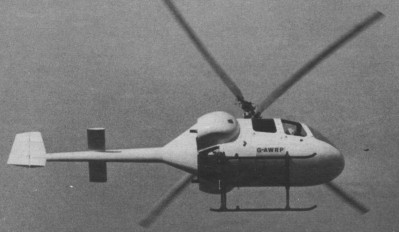
J.Weir maintained a working association with J.S.Shapiro, and in 1961 63 Servotec built a man carrying helicopter model to embody Weir’s ideas of a non stalling rotor, which emerged from many years of model tests. In the course of this collaboration, Weir became aware of the CR Twin development and in 1965 decided to give this development financial support. This combination of interests was cemented in a take over of Rotorcraft Ltd by the Cierva Autogiro Co, which was thereupon renamed the Cierva Rotorcraft Co. The largest shareholders were Weir and Shapiro.
The design for a four seat helicopter was shaping up during 1965, and in 1967 the Ministry of Technology awarded a research contract as a partial contribution to test some novel features. Also in 1967 construction of the prototype began, and the first flight took place in August 1969. In the same year Servotec Ltd was taken over by Cierva Rotor¬craft Ltd. Servotec, with its design and inspection approval, continues development work on the CR Twin helicopter and also work under contract to several organisations, including Canadair, Boeing Vertol and Bell.
The CR Twin retains the basic layout of two engines driving two contra rotating coaxial rotors, as this was con¬sidered to be the only configuration in which the aims of twin engined safety, simplicity and efficiency could be attained at a low first cost. When the aircraft was designed the only means of achieving the desired performance at a low cost was by the use of piston engines. The turbine engines then available, and indeed still available several years later, were too costly, required a further reduction stage in the main gearbox and had an excessive fuel con¬sumption in cruise.
Two prototypes were built, using Rolls Royce Continental O 300 engines of a nominal 145 bhp each. Designated CR.LTH-1 (otherwise known as the CR-Twin) and the first aircraft, G-AWRP, first flew in 1969 followed by G-AXFM (GB-2) later that year, and a third pre-production machine, G-AZAU (GB-3) in mid-1971. This latter aircraft was fitted with 210hp Continental IO-360-D engines, and the production variants were to be the CR.420 with 210hp Continental TSIO-360-A engines and the CR.640 with 320hp Continental Tiara T6-320 engines. These aircraft were used to demonstrate the practicability of the rotor and airframe, but the lower engine power actually avail¬able was inadequate to permit single engined flying. Test flights showed that the low speed handling was easier than with conventional helicopters (having a single main rotor and an anti torque rotor). No difficulties were encountered when engaging rotors in wind speeds up to 35kt. Adequate yaw control was available for normal helicopter manoeuvres, and no control difficulties were met in side¬ways flight at 25kt or in quick stops. A maximum speed of 90kt IAS was attained using less than maximum power, and full autorotation was achieved.
The first pre production CR Twin was under construc¬tion in Servotec’s workshops at Redhill in 1972. For its initial flight trials this aircraft was to be fitted with normally aspirated Rolls Royce Continental IO 360s of 210 bhp each.
An extremely simple mechanical layout was chosen for the CR Twin. The engines are mounted at about 400 to the fore and aft axis, each driving into the main gearbox through a short drive shaft and combined centrifugal clutch and free-wheel unit.
A single stage reduction main gearbox is used, comprising only two input pinions and two output crown wheels the upper of which drives the lower rotor and the lower the upper rotor. The engines, gearbox and rotors are mounted as a combined power/lift group in a separate tubular sub-frame.
The rotor is controlled manually by the pilot with no servo assistance being provided. The blades are of a symmetrical untwisted section so that the same spare rotor blade can be fitted to either the upper or the lower rotor, should a blade be damaged in service. Each main rotor blade has a hollow main spar of “compressed wood,” a plastic material reinforced with wood fibres, to the leading edge of which is bonded a stainless-steel anti-erosion strip and within which nose-balance weights are fitted. A blade
carcass of glass-fibre cloth of increased thickness towards the blade root is bonded to the main spar aft of the erosion strip, and is injected with polyurethane foam in order to stabilise the trailing-edge section.
The canopy, cowlings, Tail-cone and fairways are all constructed of glass-fibre and are mounted on a simple light-alloy platform that also provides mountings for the undercarriage, the subframe supporting the complete power-lift group, the controls, fuel system and instruments. A feature of the helicopter is the ease with which the canopy, cowlings and tail cone can all be quickly removed in order to simplify major servicing operations.
The design has followed the sealed-maintenance concept by which field unit assemblies can be exchanged quickly without exceptional skill or facilities.
Development was eventually abandoned in 1975 due to lack of further financial backing.
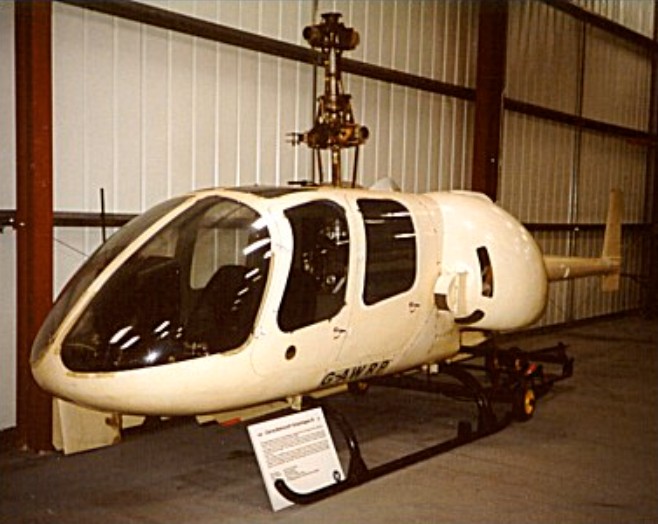
CR Twin 420
2 x Continental TSIO 360A, 210 h.p.
Rotor diameter: 10.06m
Fuselage length: 8.58m
Max take-off weight: 1564kg
Max speed: 222km/h
Cruising speed: 193km/h
Blade section Naca 00 symmetrical
Mean chord 8in tapered.
Fuel cap: 65 Imp gal (295 lt).
Baggage capacity (rear fuselage): 16 cu ft, 0.453 cu.m, (rear cabin), 47 cu.ft, (1.34cu.m).
CR Twin 640
2 x Continental Tiara T6-320, 320 h.p.
Rotor diameter: 10.06m
Fuselage length: 8.58m
Max take-off weight: 1564kg
Max speed: 222km/h
Cruising speed: 193km/h
Blade section Naca 00 symmetrical
Mean chord 8in tapered.
Fuel cap: 65 Imp gal (295 lt).
Baggage capacity (rear fuselage): 16 cu ft, 0.453 cu.m, (rear cabin), 47 cu.ft, (1.34cu.m).

