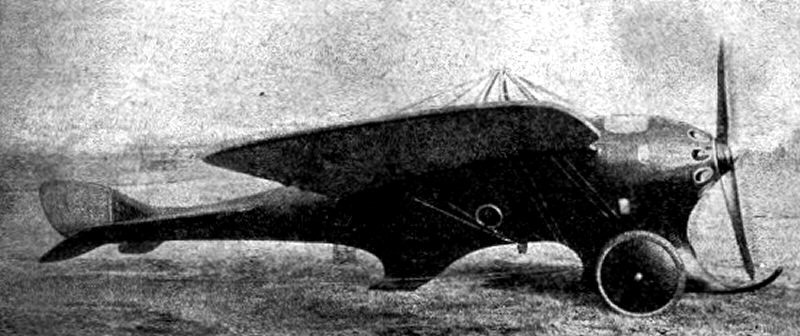
The 1913 streamlined “Dolphin” was a tractor monoplane with plywood-covered fuselage, powered by 7-cylinder 80 hp rotary Kalep engine. Both machine and motor were built at the “Motor” company in Riga, today capital of Latvia. It was designed by Russian military pilot Viktor Vladimirovich Dybovskiy, with help of his brother Vyacheslav.
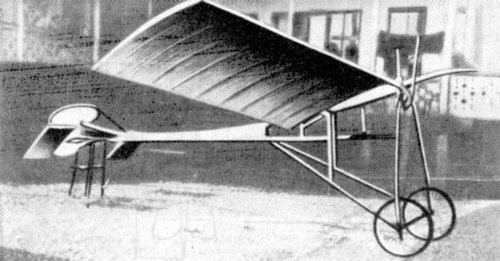
Young military officer Georgiy Antonovich Dyakov, from Kutaisi (Georgia) built this aircraft of his own design in 1912. It had strong and extremely simple construction. The pilot was seated on on the bicycle seat. He used a motorcycle engine of 7.5 HP. Tests showed that aircraft was unable to take off.
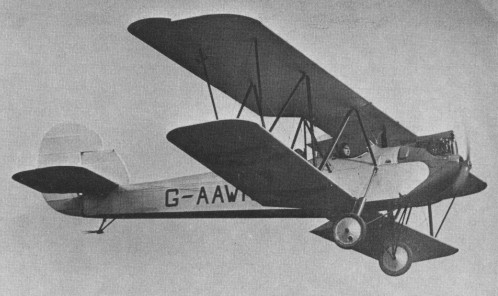
During 1929, Dudley Watt was approached by T. Neville Stack who had an idea for a slow landing, safe -flying training biplane combining the advantages of folding wings with natural stability. Watt agreed to finance the construction and formed a company, D. W. Aviation Co, at Brooklands. The aircraft was designed by Captain K. N. Pearson, M.C., AFRAeS, and dubbed the D.W.II. By the end of 1929, first wood had been cut. Drawings for the tail unit were completed by March 1930 from which time forward construction proceeded at full speed. . The work team consisted of Bill Hellon, a former Handley Page general mechanic who had worked with Savage Skywriters at Hendon, and Bill Whitaker, an aircraft craftsman who had formerly worked for both Vickers and Hawkers. The chief engineer responsible for the project was William A. Baker. The building of the D.W.II took place in the “black sheds” at Brook¬lands and on May 17, 1930, G AAWK made its public debut in the hands of Dudley Watt. The engine was a 90 h.p. ADC Cirrus III. The D.W.II was an instant success. Everything seemed set fair for this biplane with its “unusually high lift” wings which cruised at a respectable 75 m.p.h. on such comparatively low power. It was at this point that the whole enterprise left Brooklands for Ford Aerodrome, Yapton, Sussex, where larger hangars were available. Here was to be set up a production line. But things did not work out as planned and the Dudley Watt fortunes took a turn for the worse. Inspired by the success of the D.W.II, work had already begun on the mock up of a three seat version to be known as the D.W.III. This was never to be and just before Christmas, 1930, the collapse came. In spite of its success, orders did not materialise for the D.W.II and there was now no cash left to allow speculative building. Dudley Watt was forced to sack his workforce. Watt and the D.W.II turned up at aviation meetings during the following season but afterwards gradually faded from the aviation scene. The D.W.II was sold in 1934 to Brian Field who dismantled it into oblivion.
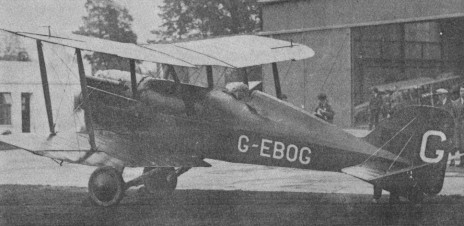
The Aircraft Disposal Co Ltd was selling off refurbished ex RAF SE.5s. Inspired by the potential of the S.E.5a just as had McCudden and others before him, Dudley Watt rebuilt his machine as a high perform-ance model. The 200 h.p. Wolseley Viper was replaced by a 300 h.p. Hispano Suiza enclosed in a stream-lined cowling and cooled by under¬slung radiators. The rear fuselage decking was redesigned to fair in with the pilot’s headrest and a smaller windscreen was fitted. Now named the D.W.l., the work on this Hisso–powered hybrid was carried out in a shed at Brooklands near the old Henderson School of Flying hangars. Dudley Watt raced it as a standard S.E.5a at Bournemouth in April 1927. In its re vamped form it should have been a race winner but records do not show it to have been a flag dropper. The D.W.1 was finally burned at Whitchurch in 1932.
A Duthiel-Chalmers six-cylinder horizontal engine of 128 mm. (5.04 in.) bore, 130 mm. (5.12 in.) stroke, and 612.84 cu. in. total displacement, was rated 72.5 h.p. at 1200 r.p.m. The dry weight was reported to be 385 lbs., or 5.3 lbs. per rated h.p.
The Duthiel-Chalmers engine rated 97 h.p. at 1000 r.p.m. had four horizontally arranged cylinders of 125 mm. (4.92 in.) bore and 300 mm. (11.81 in.) stroke. The total displacement was 898.04 cu. in., and the dry weight was stated to be 792 lbs., or 8.2 lbs. per rated h.p.
A four-cylinder horizontal type was also built with bore was 110 mm. (4.33 in.), the stroke 300 mm, (11.81 in.). This engine had a total displacement of 698.8 cu. in. and was rated 75 h.p. at 1000 r.p.m. The dry weight is reported to have been 528 lbs., or 7 lbs. per rated h.p. the same displacement and rated at 100 h.p., was built with 160 mm. (6.3 in.) bore and 140 mm. (5.51 in.) stroke. The dry weight was said to be 638 lbs., or 6.38 lbs. per rated h.p.
A three-cylinder horizontal Duthiel-Chalmers engine, of the bore was 110 mm. (4.33 in.), the stroke 300 mm, (11.81 in.) and consequently a total displacement of 524.1 cu. in., was rated 56.5 h.p. at 1000 r.p.m. This engine was stated to weigh 396 lbs., or 7 lbs. per rated h.p.
A two-cylinder horizontally opposed engine, rated 37.5 h.p. at 1000 r.p.m., was built with an unusually long stroke. The bore was 110 mm. (4.33 in.), the stroke 300 mm, (11.81 in.), and the total displacement 349.4 cu. in. The dry weight was stated to be 200 lbs., or 5.9 lbs. per rated h.p.
A two-cylinder Duthiel-Chalmers horizontal engine, rated 24 h.p. at 1200 r.p.m., had a 128 mm. (5,04 in.) bore, 130 mm. (5.12 in.) stroke, and a total displacement of 204.28 cu, in. This engine was said to weigh 132 lbs., or 5.5 lbs. per rated h.p.
Cylindrical sleeve valves in the cylinder head were operated mechanically. The cylinders were held by long studs passing through clamps over the cylinder head.
The water outlet and the spark plugs were located on top of the cylinder and the water inlet underneath. The crankshaft was fitted with a wire spoked flywheel, and the pistons were lubricated by special oil feeds run to the cylinder.