Farner HF Colibri 1 SL

Hans U. Farner was a Swiss aircraft designer whose footlaunched canard ultralight sailplane had briefly reached production in 1966. In November 1974 he filed a patent for a novel control system, particularly suitable for canards. This suggested mounting the canard on a slender tube which slid snugly within a second long forward tube that, together with a pod containing an engine, pilot and bearing mainplanes, formed the fuselage. Extension of the canard-carrying tube by means of fore and aft control column movement increased the canard’s moment arm and increased pitch. The angle of attack of the canard was automatically altered as this happened. Rotating the tube about its long axis by rudder pedal movement turned the canard away from the horizontal and caused yaw, removing the need for a vertical rudder. Wing mounted ailerons controlled roll in the usual way.

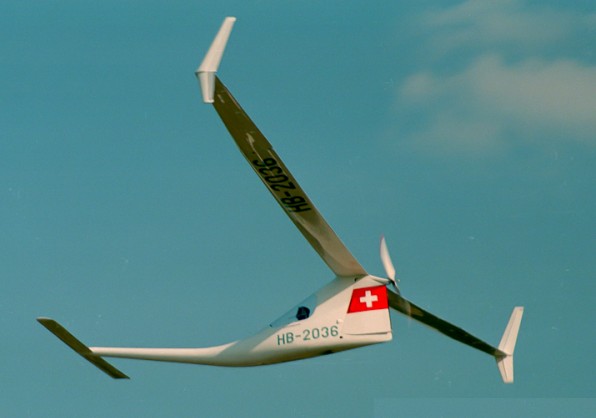
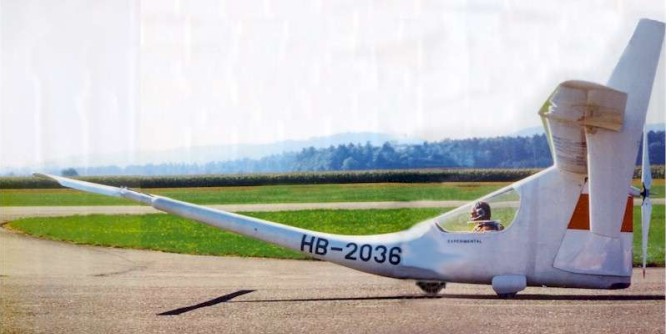
The Farner HF Colibri 1 SL motor glider, designed, built and test flown by Hans Farner in the late 1970s embodied these ideas. It had a very high aspect ratio (31.7) wing with a constant chord centre section carrying dihedral. Outer panels, with anhedral, combined with the inner section to form a cantilever gull wing. Thes outer panels had straight taper on the leading edges only, and rotated as all-moving ailerons or “tiperons” for roll control. The retractable tricycle landing gear is of narrow track limited by the fuselage width, and short wheelbase.
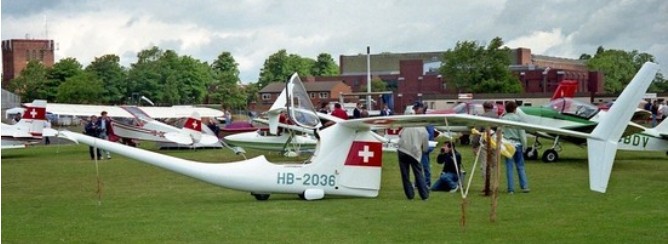
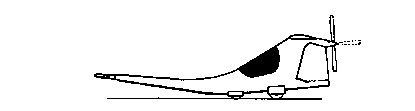
The wing was mounted on top of a narrow fuselage pod, with the pilot under a rear hinged canopy well forward of its leading edge. The Colibri was a twin engined motor glider, with two single cylinder two stroke McCulloch MC-101A, each of 10.1 kW (13.6 hp) driving a two blade pusher configuration propeller via reduction gear and a high positioned shaft, just below and a little way behind the trailing edge. The propeller blades can be folded to the rear when not in use, for soaring flight. Under the drive shaft the fuselage remained deep but tapered rearwards into two door like aerofoils with straight, vertical trailing edges that could be opened symmetrically outwards as an airbrake. Positioned well behind the centre of gravity, they closed together as the only fin. Forward of the cockpit the fuselage curved gently upwards into a tubular, straight, tapering, rising boom. The parallel chord, unswept, high aspect ratio canard, carried on its constant diameter tube in the manner described in the patent, providing lift and both yaw and pitch control. The main gull wing is of very high aspect ratio (31.7) mounted on top of the fuselage at the rear, and unbraced. It has dihedral on the constant chord and constant section (Wortmann FX-61-184) inner panels, and anhedral on the all moving outer panels which have leading edge taper and a Wortmann FX-60-1261 aerofoil section, the same as that of the canard foreplane. No flaps or ailerons are fitted.

The first flight date is uncertain but the Colibri was complete by late 1979. The written record post-1980 is sparse but photographs show it was still flying in 1990, when it appeared at a display in Belgium. It had visited the UK in 1989, coming to the PFA meeting at Cranfield. During the 1980s it had undergone considerable modification to the novel control system, with high aspect ratio, swept fins on the wings first at the outer end of the centre section, just before the start of the rotating tiperons, and then at the wing tips. These images suggest that conventional flight control surfaces were added to both fore and aft wings as well as to the fins. The extensible fuselage also seems to have been abandoned by 1989. It was still flying in 1990.
Gallery

Engine: 2 × McCulloch MC-101A, 10.1 kW (13.6 hp)
Propellers: 5-bladed pusher foldable
Wingspan: 17.50 m (57 ft 5 in)
Wing area: 9.65 sq.m (103.9 sq ft)
Aspect ratio: 31.7
Airfoil: Wortmann FX-61-184 on centre section, FX-60-126/1 on outer panels
Length: 7.201 m (23 ft 7.5 in)
Height: 1.45 m (4 ft 9 in)
Empty weight: 255 kg (562 lb)
Max takeoff weight: 362 kg (798 lb)
Fuel capacity: 21 L (4.6 Imp gal; 5.5 US gal)
Landing speed: 36 kts / 66 km/h
Initial climb rate: 649.61 ft/min / 3.30 m/s
Maximum glide ratio: 42±1:1 at 101 km/h (63 mph; 55 kn)
Rate of sink: 0.55 m/s (108 ft/min) minimum, at 77 km/h (48 mph; 42 kn)
Take-off run: 120 m (394 ft)
Crew: One
Farner WF.23

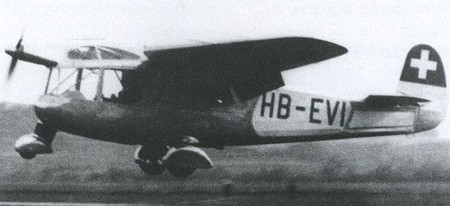
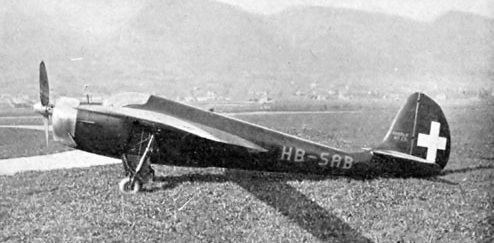
The 1938 W.F.23 motor glider/sailplane was design by Max Weber and Georg Müller, powered by a 25 hp AVA tractor engine, and featured a free-wheel hub.

The WF.23 featured a retractable main undercarriage with spring strut. Landing on a skid was possible.

The sole wood and canvas example was built by Willi Farner Flugzeugbau Grenchen as the Farner W.F.23P

Wingspan: 17.50 m
Wing area: 21.5 sq.m
Empty weight: 340 kg
Max weight: 433 kg
Wing loading: 20 kg/sq.m
Max speed: 140 km/h
ROC: 1 m/sec
Seats: 1

Farner WF.12 Tourist

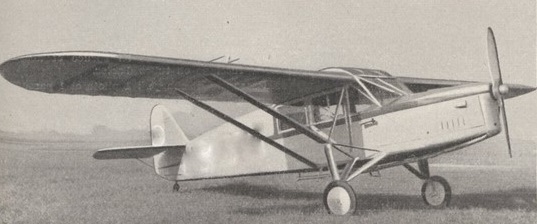
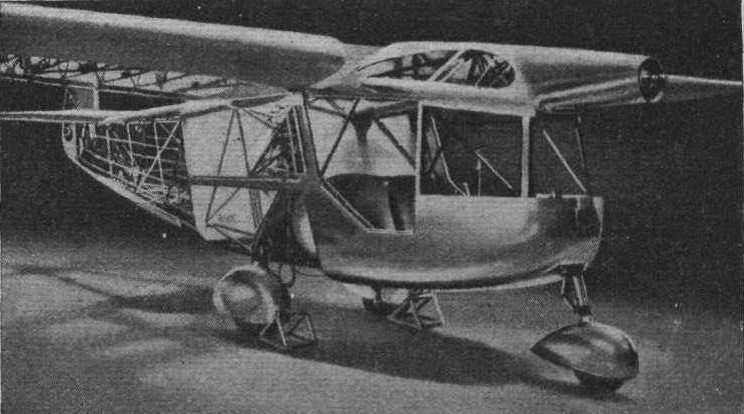
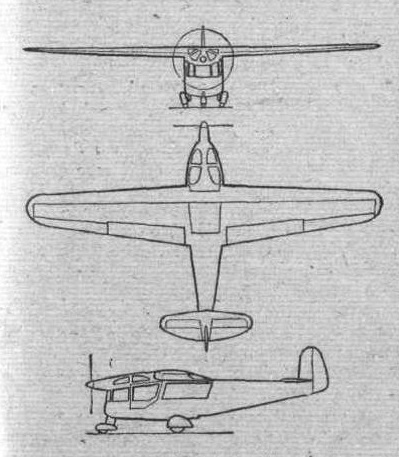
The W.F.12 two-seater trainer and touring aircraft is a high-wing monoplane with a fixed and faired undercarriage and a nose wheel landing gear. The cabin has side-by-side seating accommodation with dual controls.

In the prototype WF.12 built 1943, the Blackburn Cirrus-Minor 4-cylinder air-cooled in-line engine of 90 h.p. for take-off and of 82 h.p. cruising power at 2,300 r.p.m. is mounted in the fuselage aft of the cabin. The airscrew extension shaft comprises two parts linked together and connected with the airscrew shaft by means of universal joints; it runs over the top of the cabin and is supported forward in a structure projecting ahead of the top of the fuselage nose section. In this manner the airscrew axis lies in a plane with the wing and the view forward and downward is unimpaired.

Engine: Blackburn Cirrus-Minor, 90 hp
Span: 36.1 ft / 11.00 m
Length: 24.4 ft
Height: 8.5 ft
Wing area: 172 sq.ft
Empty weight: 1,235 lb
Gross weight: 1,765 lb
Wing loading: 10.24 lb./sq.ft
Power loading: 19.6 lb/hp
Maximum speed: 109 mph
Landing speed (with flaps): 46.6 mph

Farman HF.2/2

Henry Farman was a supporter of pusher biplanes, but he realized that his business needed to gain expertise in the field of tractor monoplanes.

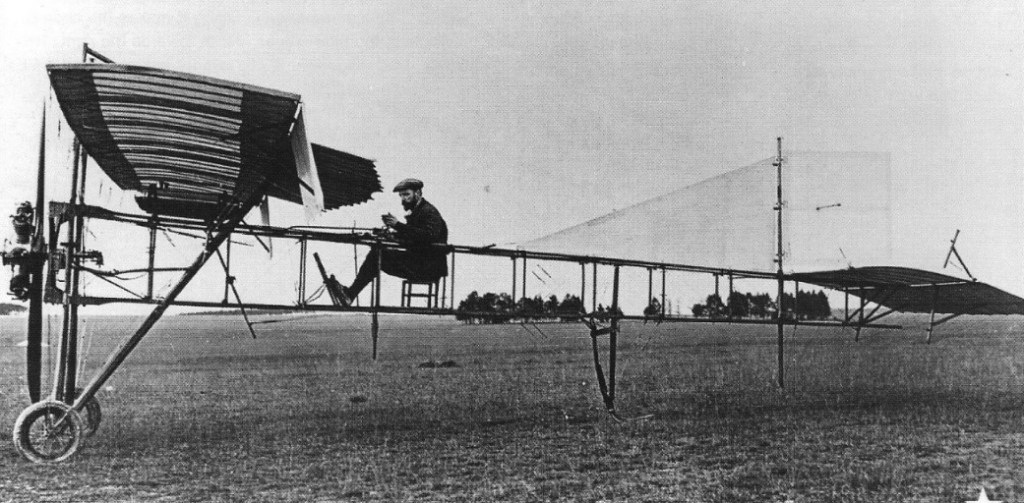
His first tractor monoplane was produced in the beginning of 1911. It was an ultra light high wing monopplane where the pilot sat in a fully open fuselage on a very basre chair. In the end this paid back in a monoplane with a total weight of 300 kg. The 50 hp developed Gnôme rotary engine gave this monoplane a top speed pf 115 km/hr,

The monoplane was tested at Bouy (Camp du Chalons)

It consisted of a rectangular wing of 23 ft span with a chord, including ailerons, of 6 ft 6 in. about 13 ft behind is a tail, composed of a small horizontal surface, and vertical and horizontal rudders. The Gnome motor, with propeller, is in front, while to pilot’s seat is located on a level with the main plane and just behind it.

It is mounted on a steel chassis with two wheels.

The monoplane carries 48.5 lb/sq.m at more than 25 mph.

This design got the factory identification HF.2/2. This development monoplane model was followed in due course by at least two other tractor monoplanes.

Farman 9E

9EA – 250hp reduction gear and dual ignition

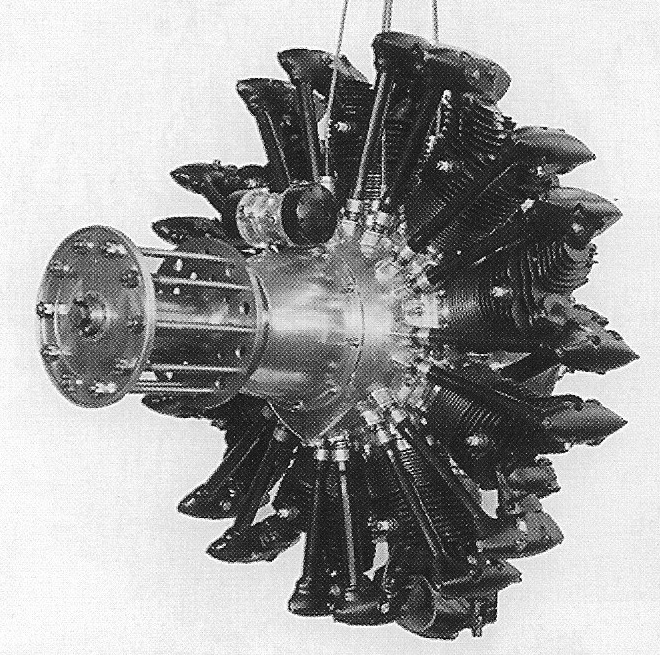
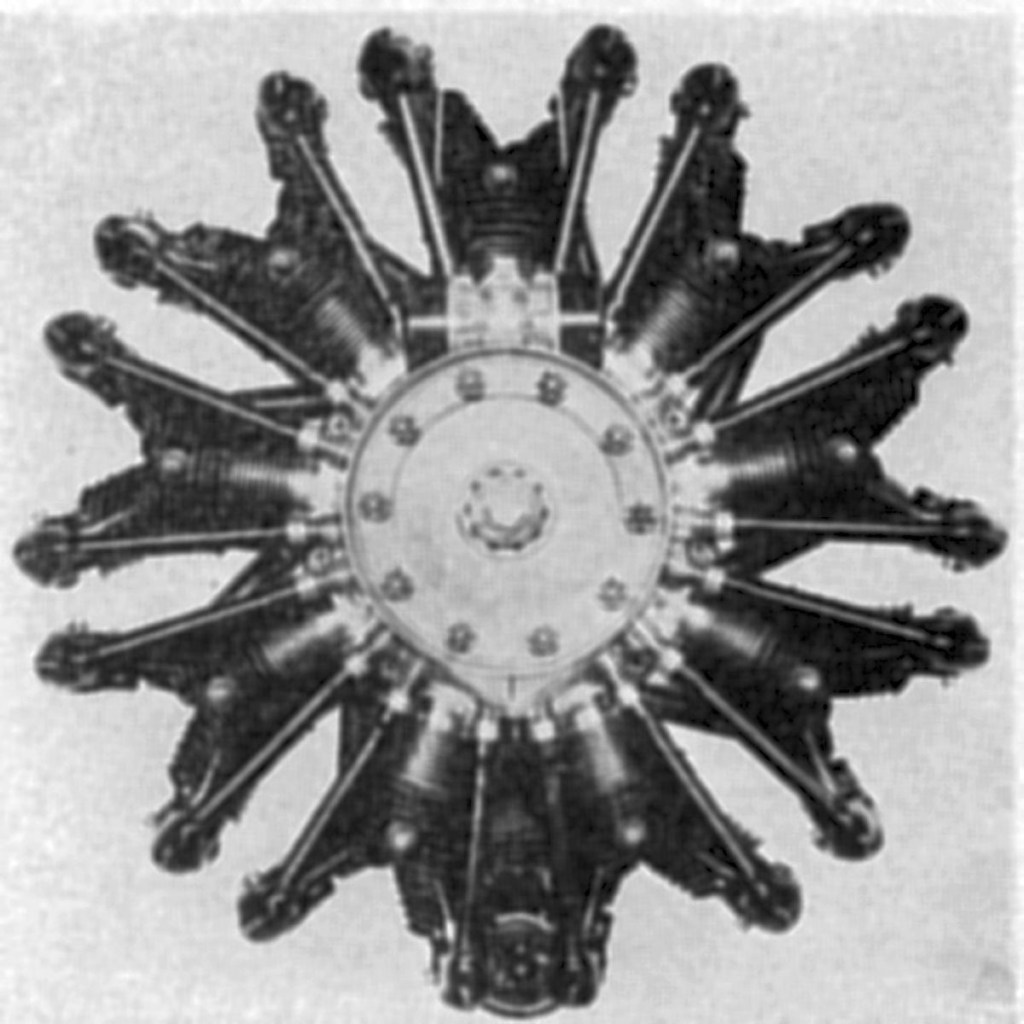
The 9Ea was an air-cooled nine-cylinder radial with a 2:1 Farman reduction gear, 115 mm (4.528″) bore, 120 mm (4.724″) stroke, 11.218 l (684.6 in³) displacement and 5.75:1 compression ratio that was rated 250 hp at 2,600 rpm and capable of 280 hp at 2,700 rpm. Dry weight was 583 lb, or 2.33 lb/hp. Fuel consumption was 0.5 lb/hp/hr and oil consumption was 0.033 lb/hp/hr. Outside diameter was 42″ and length was 46″.

9Ea

The 9Ea cylinders used steel barrels with integrally turned cooling fins that were screwed into cast aluminum alloy heads. Two inclined valves were operated by fully enclosed push rods and rocker arms driven by a cam ring at the engine front. A full-floating piston pin, two compression rings and two scraper rings were fitted to each aluminum piston. The two-piece forged steel crankshaft included a crankpin integral with the front section. The master connecting rod big end was fitted a floating bushing. The four-section crankcase inner sections were joined in the cylinder plane. The forward inner section housed the timing gears and distributors, and the rear section contained a mixture distribution fan driven at four times crankshaft speed. The nose section enclosed the propeller reduction gears, and the rear cover supported the oil pumps, generator and starter. The mixture was supplied by a Claudel carburetor, and the ignition by battery and coil. Lubrication was a force-fed dry-sump type using gear pumps; oil was scavenged from both crankcase ends.

9Ea

The 9Eb, introduced in 1929, had a 115 mm (4.528″) bore, 135 mm (5.315″) stroke, 12.62 l (770.1 in³) displacement and 5.4:1 compression ratio. It was rated 250 hp at 2,150 rpm and 270 hp at 2,200 rpm. Dry weight was 550 lb. The mixture was furnished by a Stromberg carburetor, and dual ignition by Ducellier magnetos. Fuel consumption was 0.53 lb/hp/hr and oil consumption 0.0265 lb/hp/hr. The 9Eb diameter was 41.76″ and its length was 47.28″. Farman continued to improve the 9Eb and produced other 9E models through the 1930s.