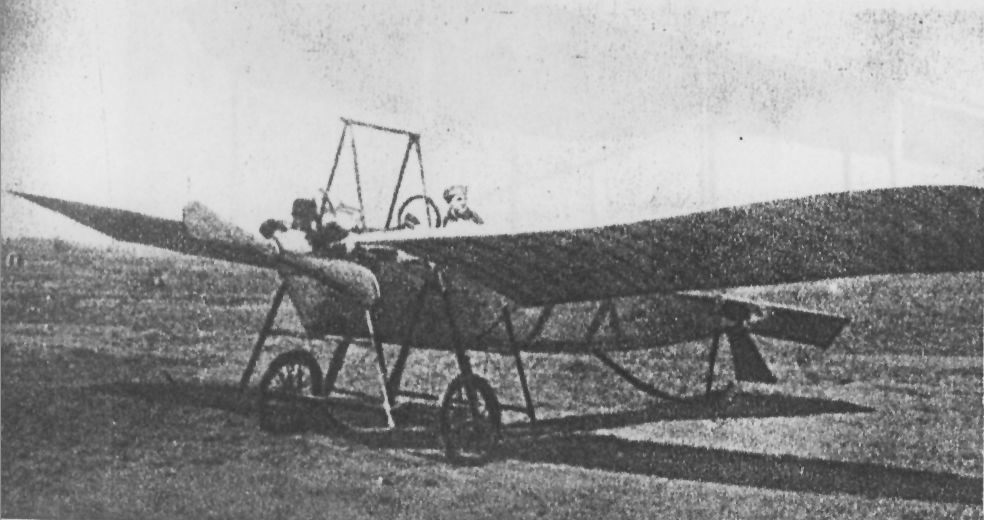
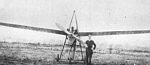
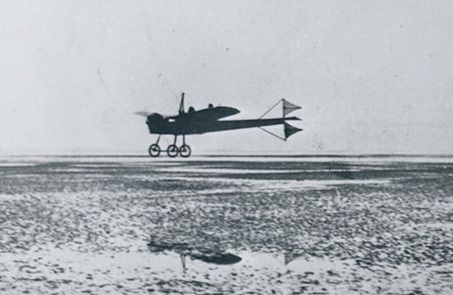
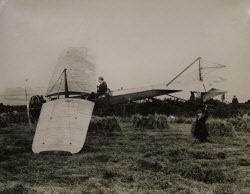
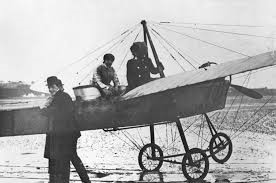
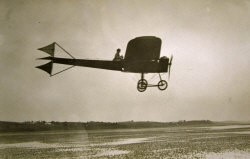
Marquis Gerolamo Balbi from Genova exhibited a monoplane of his design, named “Issione” (“Ixion” in English). It was built in the workshops of the Castagneto di Voltri company. The elevator was controlled by a steering wheel, and the rudder by two pedals. The engine was a 25 hp Anzani. It was tested in 1910 at Campo di Cameri.
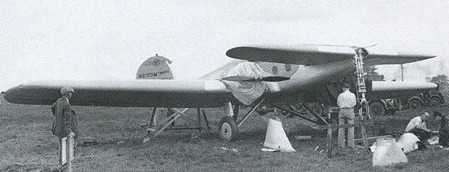
Constructed by Fernic, the T-9 made its first flight September 9, 1929. It was an 8 passenger transport powered by two Wright Whirlwind 220 hp.
Engines: two Wright Whirlwind 220 hp Wingspan: 18 m Canard span: 6.70 m. Length: 13 m. Height: 4.12 m Weight: empty: 2268 kg MTOW: 4536 kg Maximum speed: 196 km/h. Cruise: 161 km/h Landing speed: 68km/h.
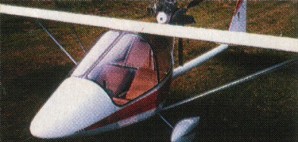
Designed by Bill Ferguson and first flown in 1991, the Fergy was developed from the Kolb Mark III and introduced to the market in 1991. The Fergie won the Grand Champion title at Sun ‘n Fun in 1991. Reviewer Andre Cliche describes it as a “clone”, whilst Noel Bertrand et al. claim it was “inspired by the Kolb Twinstar”. The aircraft differs from the Kolb design in that it has a revised cockpit pod, with centerline-hinged doors and a square-tipped rudder. The horizontal stabilizer was also raised a few inches to give better ground clearance.
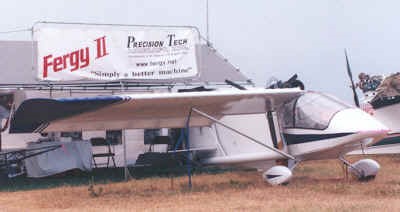
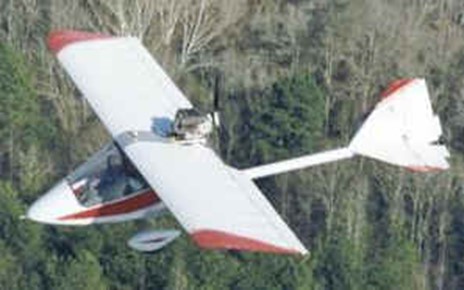
The Precision Tech Fergy F-II B is a two-seat side-by-side, conventional landing gear, strut-braced, high-wing, pusher configuration ultralight aircraft that was manufactured by Ferguson Aircraft and later Precision Tech Aircraft in kit form for amateur construction.
Ferguson Aircraft manufacturers of the Fergie, sold the design to Precision Tech Aircraft out of Cartersville Georgia.
Precision Tech has made some design changes, changing to a new airfoil, landing gear, and tail section. The airfoil change was required when the wing spar was changed to a 6 inch spar.
The aircraft is constructed from aluminium tubing, covered with aircraft fabric. The wings fold for storage or trailering. The standard engine supplied with the kit was the 50 hp (37 kW) Rotax 503, with the liquid-cooled 64 hp (48 kW) Rotax 582 optional, although the Fergie can accept engines that range in output from 50 to 80 hp (37 to 60 kW).
The average construction time from the kit was reported by the manufacturer as 350 hours and 40 had been completed by 2001. The unit cost was US$10,900 in 2001.
The aircraft was out of production circa 2002 and no longer available.
Ferguson F-II Engine: Hirth 2704, 55 hp. HP range: 46-70. Height: 5.5 ft. Length: 21.25 ft. Wing span: 30 ft. Wing area: 160 sq.ft. Fuel cap: 12 USG. Weight empty: 425 lbs. Gross: 900 lbs. Speed max: 90 mph. Cruise: 70 mph. Range: 200 sm. Stall: 32 mph. ROC: 1200 fpm. Take-off dist: 200 ft. Landing dist: 200 ft. Service ceiling: 10,000 ft. Seats: 2. Landing gear: tail wheel.
Ferguson F-II Engine: Rotax 503, 55 hp. HP range: 46-70. Height: 5.5 ft. Length: 21.25 ft. Wing span: 30 ft. Wing area: 140.2 sq.ft. Fuel cap: 12 USG. Weight empty: 425 lbs. Gross: 900 lbs. Speed max: 90 mph. Cruise: 70 mph. Range: 200 sm. Stall: 32 mph. ROC: 1200 fpm. Take-off dist: 200 ft. Landing dist: 200 ft. Service ceiling: 10,000 ft. Seats: 2. Landing gear: tail wheel.
Ferguson II-B Wingspan: 29ft. 6 in. Wing Area: 140 sq. ft Length: 22 ft. Height: 5ft. 8in with 2 blade prop Empty Weight: 400 lbs. Gross Weight (65 hp): 900 lbs. Useful Load: 500 lbs. Fuel Cap: 12.5 gal. Take-off Roll Pilot only 46 hp: 175 ft Rate of Climb 46hp: 800 ft/min Rate of Climb 65hp: 1200 ft/min Cruise: 50 – 80 mph VNE: 100 mph Landing Speed w/Flaperons: 28mph Landing Speed wo/Flaperons: 34mph Seats: 2 Storage Aft of Seats: 4 cubic feet
Precision Tech Fergy F-II B Engine: 1 × Rotax 503, 50 hp (37 kW) Propeller: 3-bladed ground adjustable Wingspan: 29 ft 6 in / 8.99 m Wing area: 140 sq ft / 13 sq.m Length: 18 ft 8 in / 5.7 m Empty weight: 400 lb / 181 kg Gross weight: 1,000 lb / 454 kg Fuel capacity: 12.5 US gallons / 47 lt Maximum speed: 90 mph / 145 km/h / 78 kn Cruise speed: 75 mph / 121 km/h / 65 kn Stall speed: 28 mph / 45 km/h / 24 kn Range: 220 mi / 191 nmi / 354 km Rate of climb: 1,000 ft/min / 5.1 m/s Wing loading: 7.14 lb/sq ft / 34.9 kg/sq.m Crew: one Capacity: one passenger
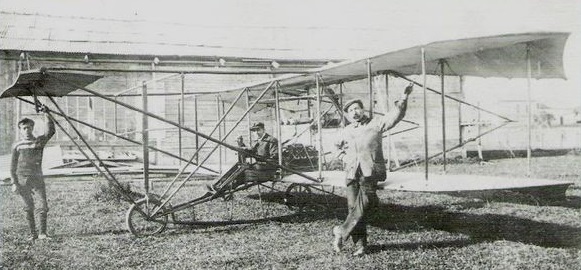
The exploits of the Wright Brothers fascinated Harry Ferguson and during subsequent years he visited many air shows and exhibitions. Two he attended were Rheims and Blackpool where he took measurements from the aircraft there. On his return to Belfast he persuaded his brother Joe that it would be good for their garage business to build and fly planes.
Throughout 1909 construction took place, with various changes and improvements being made as work progressed, one being the replacement of the original Green engine by an eight cylinder, air cooled 35hp JAP engine.
The day of the first flight attempt arrived and with wings detached and the tail resting in the back of a car the aircraft was towed through the Belfast streets up to Hillsborough Park. First efforts to get off the ground failed due to propeller trouble. It was replaced but again this and bad weather prevented attempts for nearly a week.
Finally, on the 31 December 1909 Ferguson was ready to go. A reporter from the Belfast Telegraph described the scene:
The roar of the eight cylinders was like the sound of a Gatling gun in action. The machine was set against the wind, and all force being developed the splendid pull of the new propeller swept the big aeroplane along as Mr Ferguson advanced the lever. Presently, at the movement of the pedal, the aeroplane rose into the air at a height from nine to twelve feet, amidst the heavy cheers of the onlookers. The poise of the machine was perfect and Mr Ferguson made a splendid flight of 130 yards. Although fierce gusts of wind made the machine wobble a little twice the navigator steadied her by bringing her head to wind, successful initial flight that has ever been attempted upon an aeroplane.
A few unsuccessful attempts, one of which was at Magilligan Sands, the Ferguson monoplane took to the air from Hillsborough. However, while his attempts at Hillsborough and Magilligan are well documented, it is believed that Ferguson tested his plane at the site of what is now Ards Airfield.
Harry Ferguson had thus made the first flight in Ireland and was the first Briton to build and fly his own aeroplane.
The machine was rebuilt and flown in 1911 and 1912.
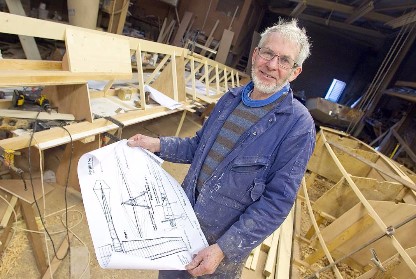
Allastair Duffin in his Belfast workshop
Allastair Duffin, a Newtownards boatbuilder and woodworker, was building a replica of the Harry Ferguson monoplane commissioned by the BBC. The BBC approached Alastair about with their idea of filming a documentary about Ferguson, which would include flying a replica of the original plane.
There are no original plans and it appears Harry Ferguson marked it out on the floor and said to the men, right, there you are, build it. Plans were drawn up using a model at a museum as its basis. Once completed it is hoped the plane will fly.
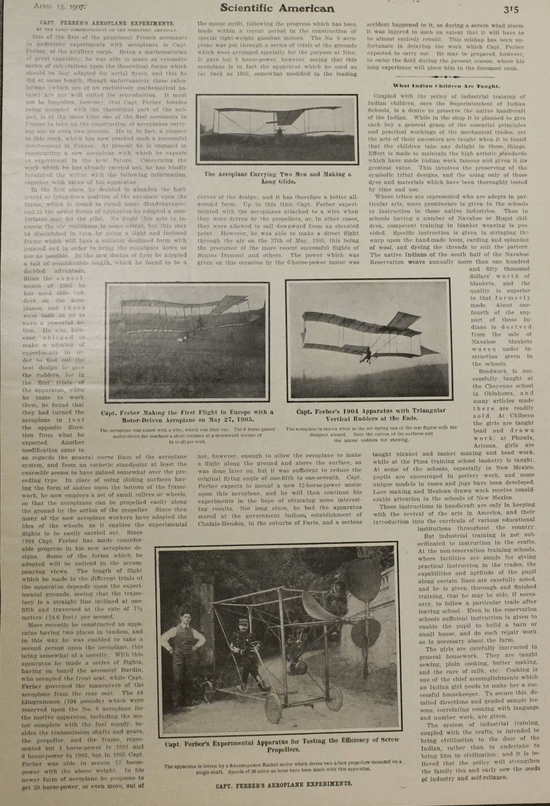
From 1904-1906, Ferber collaborated with Colonel Charles Renard at Chalais-Meudon. In 1905, he built a larger glider to which he married a 12 hp motor, and on 25 May at Chalais -Meudon he launched it from an overhead cable and made a short powered glide. Although not really a successful airplane, it seems to rank as the first rationally conceived and constructed airplane to fly in Europe.
The Felixstowe F.5 is a four-seater seaplane of British maritime reconnaissance aircraft developed at the end of the First World War. Designed to combine the same payload and the operating range of the Felixstowe F.3 with qualities of handiness and the performances of the Felixstowe F.2a. The last aircraft designed by John C. Door, the prototype, N90, first flew in May 1918, the aircraft met expectations, the hull supporting maritime conditions of the North Sea, and production was launched.
To accelerate production and for economic reasons, The F.5 adopted many elements already built for the F.3. Preserving practically only the hull of the prototype, with the aerofoil and the engines of the F.3, the craft had performances lower than the prototype, the F.2a, and even than the F.3.
F.5 entered service only after the First World War ended, and replaced in the RAF the Felixstowe F.2a, F.3 and Curtiss H-16 . It became the standard aircraft of the RAF until the commissioning of the Supermarine Southampton in 1925. Nine squadrons were in the RAF equipped with the F.5.
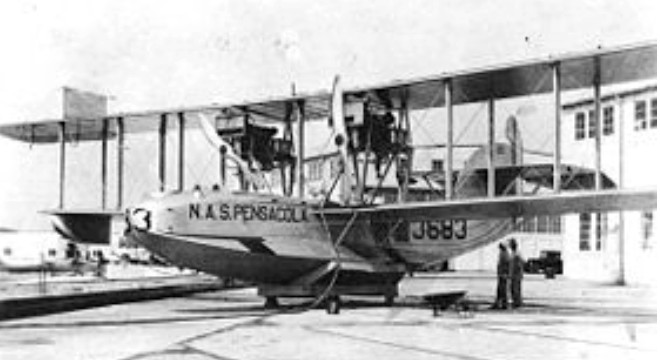
The U.S. Navy was interested in Felixstowe F.5 but wished that the craft be produced in the United States and tailored to their needs. Parts were delivered to Naval Aircraft Factory, Philadelphia, in March 1918, and work began immediately. The Rolls-Royce Eagle were replaced by Liberty. The F5L the prototype made its first flight July 15, 1918. Often wrongly called Curtiss F.5L, 227 were built:
The F.5L remained in service in the U.S. Navy until replaced in 1928 by the PN-12, used for coastal patrols or missions of coastal artillery adjustment.
Between 1920 and 1921, the Aeromarine Plane and Motor Company subsidiary Aeromarine Airways, used 8 F.5L surplus from the U.S. Navy. Equipped for the transport of 10 passengers, these were sometimes called Navy Cruiser and were used in November 1920, between Key West , Florida and Havana , Cuba . One of these seaplanes, from the 1st November 1920, flew the first international air mail service on behalf of the U.S. Post Office. Aeromarine Airways also flew the seasonal services Miami – Bimini – Nassau , New York City – Atlantic City and Cleveland – Detroit from July 14, 1922. These were named Santa Maria / Wolverine, Pinta, Niña, Columbus, Balboa, Ponce de Leon, Buckeye and Mendoza. The latter is famous for having flown over New York with 27 people on board in May 1922.
In 1920, Shorts Bros. export some F.5 to Japan, which then bought a license. The arsenal of Yokosuka to build 10, Aichi 40 and arsenal Hiro 10 before developing in 1927 from F.5 Hiro Type 15 (Hiro H1H).
In 1919, NAF built two F.5L [A4036/4037] with a significantly larger surface modified empennage. This tail will be adopted retroactively on F.5L in service.
In March 1919 Naval Aircraft Factory dispatched to New York City a F.5L specially designed for display. An aeronautical exhibition was organized by the Association of Manufacturers and the cell Aeronefs exposure would allow the public to understand how construtction device. So it was a cutaway that should not fly, but he was still a seral number [A-3882]. Transferred to the Smithsonian Institution in 1920, he became well cumbersome when it was decided ten years later to renovate the building that housed. The Smithsonian therefore proposed to return to the U.S. Navy, and this proposal was accepted, but the Smithsonian finally kept the hull, a wing float, a propeller and a bomb. The U.S. Navy had shelled the rest is all that remains today of the family seaplane designed by John C. Door , with the front part of an unidentified aircraft maintained by the Norfolk and Suffolk Aviation Museum of Flixton, in Great Britain .
Felixstowe F.5 Engines: 2 x Rolls-Royce Eagle VIII, 345 hp Wingspan: 31.6 m Length: 15.0 m Height: 5.7 m Wing area: 131 sq.m Empty weight: 4136 kg Loaded weight: 5765 kg Maximum Speed: 142 km / h Ceiling: 2070 m Range: 840 km Armament: 4 Lewis 7.7 mm Bombload: 418 kg Crew: 4
F-5-L Engines: Two 400-horsepower Liberty 12A Wingspan: 31.6 m (103 ft 9 in) Length: 15 m (49 ft 4 in) Height: 5.7 m (18 ft 9 in) Weight: Empty, 3,955 kg (8,720 lb) Gross, 6,169 kg (13,600 lb)