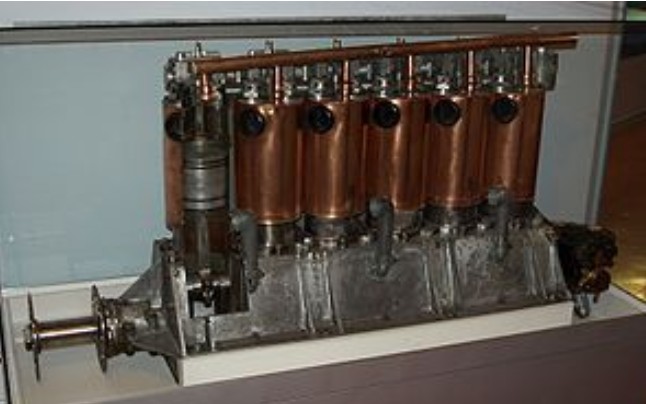
The Green E.6 was a British six-cylinder, water-cooled aero engine that first ran in December 1911, it was designed by Gustavus Green and built by the Green Engine Co and Mirlees, Bickerton & Day of Stockport between August 1914 and December 1918. A total of 42 were built.
Applications: Avro 504K Avro 523A Bass-Paterson flying boat Cody Type V Eastbourne Aviation Circuit biplane Gnosspelius Hydro Tractor Biplane Graham-White Charabancs Type 10 Royal Aircraft Factory F.E.2a Short S.68 Seaplane Sopwith Bat Boat Sopwith Three-seater Sopwith 1913 Circuit of Britain floatplane Sopwith Type TT
E.6 Type: 6-cylinder, inline, upright piston engine Bore: 5.51 in (140 mm) Stroke: 5.98 in (152 mm) Displacement: 855.54 cu in (14.03 L) Dry weight: 440 lb (200 kg) Valvetrain: Gear driven overhead camshaft, two valves per cylinder Fuel type: 40-50 octane petrol Cooling system: Water-cooled Reduction gear: Direct drive, right-hand tractor Power output: 120 hp (89.5 kW) at 1,300 rpm (maximum power) Specific power: 0.14 hp/cu in (6.4 kW/L) Power-to-weight ratio: 0.27 hp/lb (0.45 kW/kg)
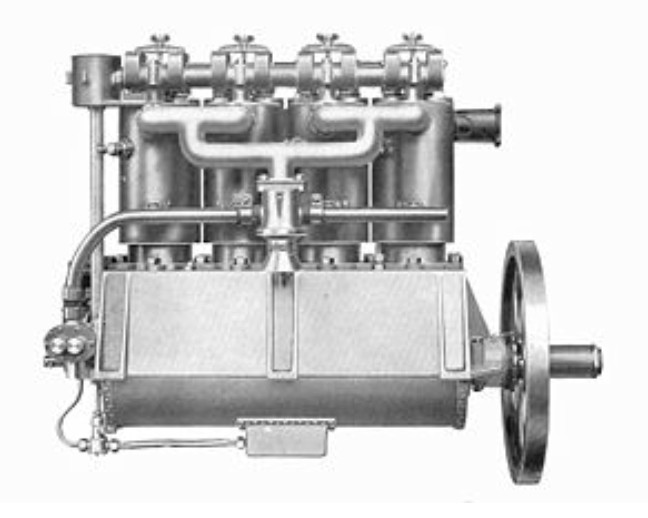
The Green D.4 was a four-cylinder watercooled inline piston engine produced by the Green Engine Co in the UK in 1909. It produced about 60 hp (45 kW) and played a role in the development of British aviation before World War I.
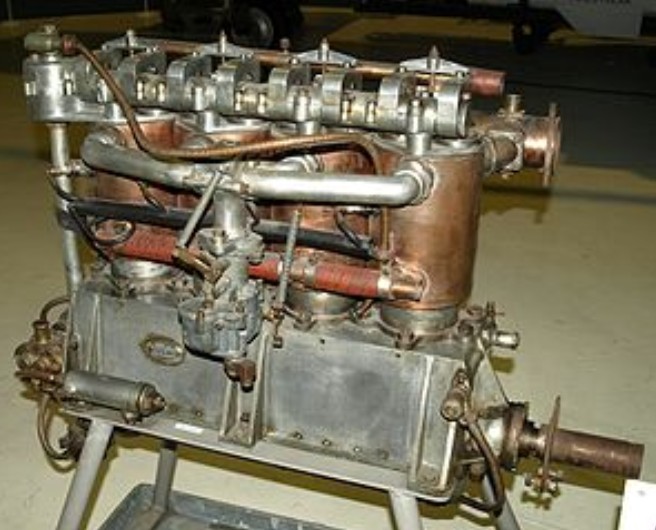
The Green D.4 was a natural development of the Green C.4. It was an inline, watercooled 4-cylinder piston engine with characteristic Green features: cast steel single piece cylinders and cylinder heads, two valves per cylinder driven by an overhead camshaft, white metal crankshaft bearings and copper water jackets, rubber sealed to allow for differential expansion.
Increases in bore and stroke more gave the D.4 more than twice the swept volume of the C.4, and roughly doubled its power. The cast steel cylinders, individually machined inside and out, were mounted separately onto a flat sided aluminium crankcase. They were fastened down by long bolts between them, which reached into the crankcase to support the four inner crankshaft bearings. The main bearings were in the crankcase ends, and the ball race was designed to allow either pusher or tractor operation. A flywheel was fitted to the output shaft. Thin cylindrical copper water jackets surrounded the cylinders almost to their base, where a rubber ring, located by a circumferential groove in the cylinder, provided a sliding water seal that allowed for the differential thermal contraction of copper and steel. Cooling water was fed to these jackets by an engine driven pump via a horizontal tube on the low right side of the engine, assuming a tractor orientation, and fed to the radiator by another tube on the top left.
A single jet Zenith carburettor with a remote float chamber fed a double branched inlet manifold on the right; the plugs, also set in the cylinder walls, were on the same side, below and angled to the inlets. The exhaust ports were on the left side, angled forwards. A crankshaft driven Bosch magneto at the rear provided the plugs’ high voltage supply. The overhead camshaft was also driven from the crankshaft, via worm gears and a vertical shaft at the rear of the engine. The camshaft operated the valves by rockers with rollers on their camshaft ends and adjusting screws at the other.
Lubricating oil was mechanically pumped through cast-in channels in the crankcase to all the crankshaft bearings. The camshaft was contained in an oil tight sleeve.
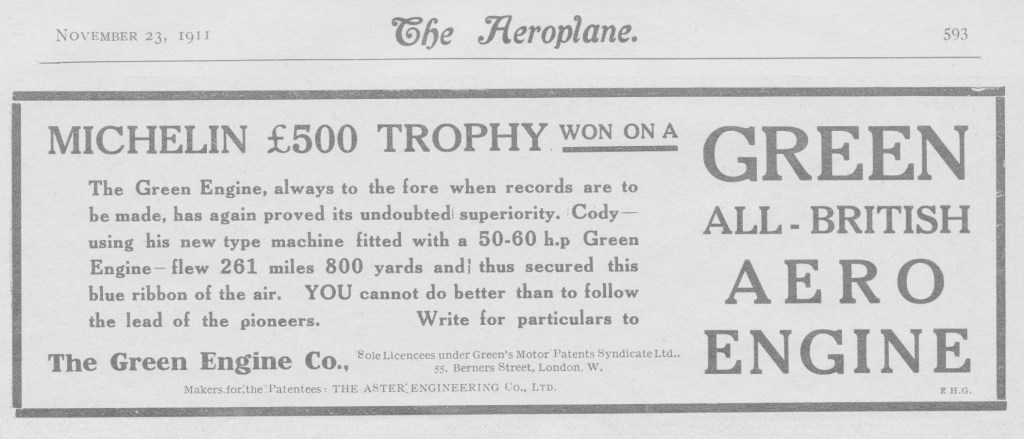
The D.4 was usually described as a 50-60 hp engine, sometimes as 60 hp, 65 hp or 60-70 hp. The type designation D.4 was rarely used at the time.
Green’s engines were noted for their reliability and he reinforced that reputation with entries into Government competitions; in 1910 the D.4 won the £1.000 prize donated to the winner by Patrick Alexander. There was a maximum power test, the D.4 achieving 67.8 hp at 1,210 rpm, but the emphasis was on endurance: the engine had to produce two non-stop 12 hr runs and average more than 58.5 hp. In the event, the D.4 averaged 61.6 hp with few signs of wear on inspection afterwards.
Up to 1912 the Green D.4 was the only all-British aircraft engine capable of producing 60 hp, so when prizes were offered for flights or races for all-British aircraft, the Green was the only choice. The best known example is that of Moore-Brabazon in his Short Biplane No. 2, winning the £1,000 Daily Mail prize in 1910 for a circular 1 mile flight by a British pilot in an all-British aeroplane.
The British Empire Michelin Trophies (no.1 for speed and no.2 for distance) between 1910 and 1913 were also all-British aircraft competitions. Six of the seven winners were powered by Green engines, showing their dominance and reliability. The winners of all four of the 1910-11 contests, three of Cody’s aircraft plus Moore Brabazon’s Short S.2, were D.4 powered.
Cody’s D.4 also powered his entry to fourth place in the 1911 Daily Mail Circuit of Britain competition, a distance of 1,010 miles. That engine, flown over 7,000 miles, was exhibited at the 1913 Olympia Aero Show. Despite its pre-war success, neither the Green D.4 nor other Green models played a part in the war, in which the lighter, air-cooled French engines of Le Rhône, Clerget and Gnome were extensively used.
Variants: A long stroke (152 mm) development gave 65 hp (48 kW) at 1250 rpm, but seems not to have flown.
Applications: ASL monoplane no.2 ASL Valkerie C Avro Type G Blackburn Type E Cody No.IIA Cody No.IIB Cody No.IIC Cody No.III Dunne D.5 Dunne D.6 Dunne D.8 Edwards Rhomboidal biplane (damaged in taxi trials, not flown) Flanders F.2 Flanders F.3 George & Jobling biplane Grahame-White XV Handley Page Type B Harper monoplane (possibly not completed) Howard Wright biplane Humphreys monoplane No.1 Humphreys monoplane No.2 Humphreys monoplane No.3 Megone biplane Northern Aircraft PB.1 Poynter monoplane (probably not flown) Short Biplane No.2 Sonoda Tractor Biplane
Specifications: Type: 4-cylinder water-cooled inline upright poppet valve piston engine Bore: 5.51 in (140 mm) Stroke: 5.75 in (146 mm) Displacement: 549 cu in (9.0 litres) Dry weight: 259 lb (117 kg) bare; 302 lb (137 kg) with accessories Valvetrain: two poppet valves per cylinder driven by overhead camshaft via rockers Fuel system: 1× single jet Zenith carburettor with separate float chamber Fuel type: petrol, 40-50 octane Oil system: fully forced, with cast-in channels to bearings and via hollow crankshaft to end bearings Cooling system: water, with rubber sealed spun copper jackets around each cylinder, engine pumped Reduction gear: none; direct right hand tractor drive Ignition: single Bosch magneto Power output: 50 hp (37 kW) at 1,050 rpm, 70 hp (52 kW) at 1,200 rpm for short periods Fuel consumption: 0.590 lb/hp/hr (0.359 kg/kW/hr) at 62 hp Oil consumption: 0.175 lb/hp/hr (0.107 kg/kW/hr) at 62 hp
The Green C.4 was a British four-cylinder, water-cooled aero engine that first ran in 1908, it was designed by Gustavus Green and built by the Green Engine Co and Aster Engineering. The engine was one of two Green designs to win a government prize.
Applications: Aeronautical Syndicate Valkyrie Type A Avro Type II Avro Type III Avro Type IV Avro Type D Avro Baby Blackburn Monoplane 1 Handley Page Type B Handley Page Type D Hornstein biplane Macfie Empress Martin-Handasyde No.3 Neale VII biplane Short S.27 (Manufacturer No.s S.26 and S.28) Sopwith Burgess-Wright Wells Reo
C.4 Type: 4-cylinder, inline, upright piston engine Bore: 4.13 in (105 mm) Stroke: 4.73 in (120 mm) Displacement: 253.44 cu in (4.158 L) Length: 39 in (991 mm) Width: 16 in (406 mm) Height: 28 in (711 mm) Dry weight: 184 lb (83 kg) Valvetrain: Gear driven overhead camshaft, two valves per cylinder Fuel type: Petrol Cooling system: Water-cooled Reduction gear: Direct drive, right-hand tractor Power output: 52.5 hp (39 kW) at 1,460 rpm (maximum power) Specific power: 0.2 hp/cu in (9.37 kw/L) Power-to-weight ratio: 0.28 hp/lb (0.46 kW/kg)
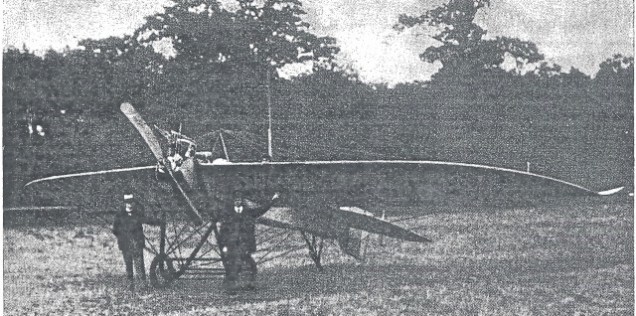
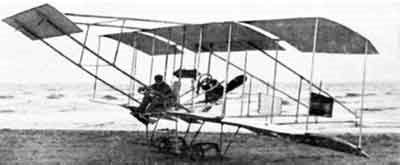
This monoplane was built in 1912 by Fritz Grebe and Albert Schäfer for the Oranier-Fliegerschule in Frankfurt am Main. With it, Albert Schäfer flew an hour on 19 September 1913 and won a Nationalflugspende reward. The engine was a 100hp Argus.
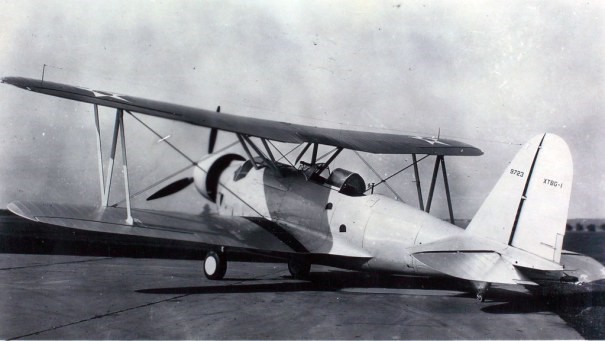
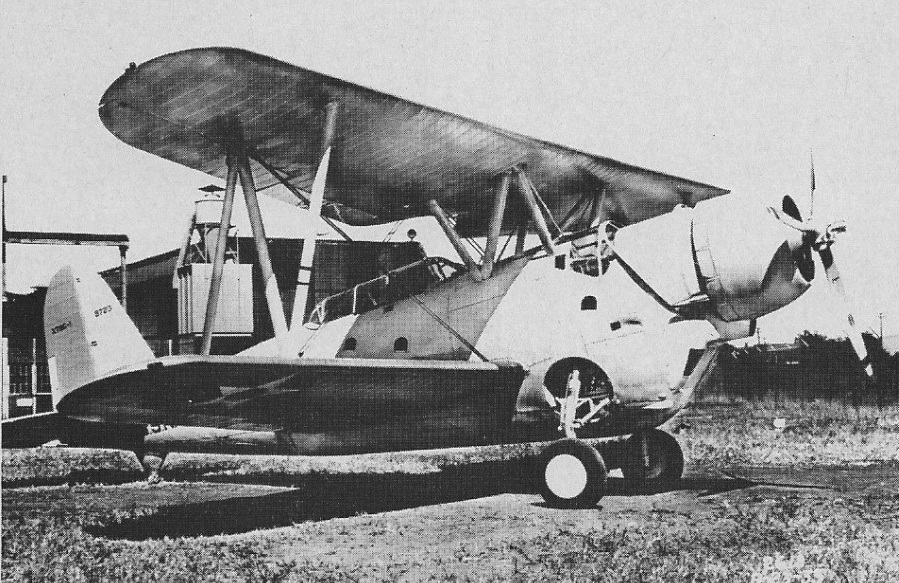
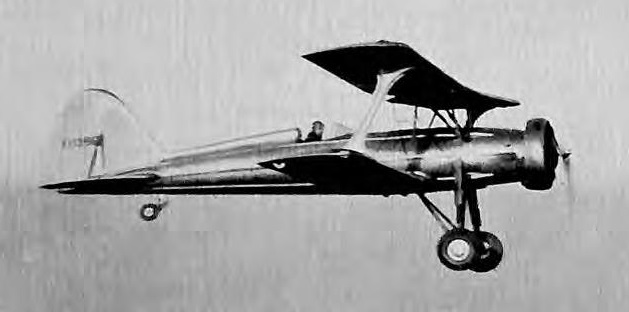
This three-seat biplane was Great Lakes entry in the torpedo bomber competition which ended with the adoption of the Devastator. It was the last biplane considered by the US. Navy for that role.
The XTBG-1 featured a small independent front cockpit placed just behind the engine which was employed by the “torpedoman.”
With its top speed of 200 mph, the Devastator bested it easily.
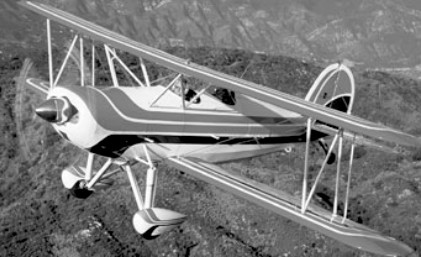
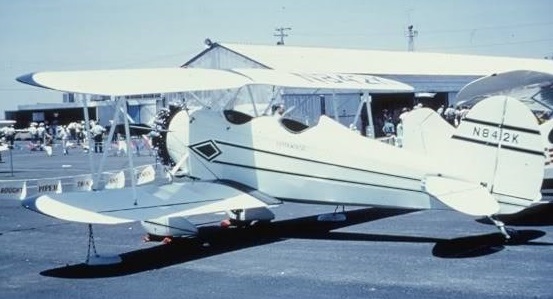
The original Great Lakes Model 2T-I Sport Trainer was built by the Great Lakes Aircraft Corp. in Cleveland, Ohio, in 1929. Between 1929 and 1932, the company built more than 200 of them, and they quickly became a great favorite of aerobatic pilots. The designer, Charles W. Meyers, raced a customized Great Lakes with considerable success during the early 1930s, and the legendary Tex Rankin flew one in airshows throughout the country before World War II setting records for both inside and outside loops. After the war, enthusiasm for the airplane continued and many airframes were converted to accept larger engines, particularly Warner radials. During the past several years, factory blueprints of the design have been available to homebuilders from the resurrected Great Lakes Aircraft Co., also of Cleveland, and several are under construction utilizing various modern engines. The 2T 1 began as a very simple, clean design with straight wings and a four cylinder 85 hp Cirrus engine. It was found to be tail heavy and accordingly difficult to recover from a flat spin. For some reason reluctant to move the engine forward, the designers hit upon the expedient of moving the center of lift aft by sweeping back the outer panels of the top wing. This decision was fortuitous; it wasn’t clearly realized at the time, but sweeping the wings of an airplane tends to improve its snap rolling ability. First shown in Detroit in 1929, the 2T 1 was an instant success, winning 500 orders from prospective dealers within a couple of weeks of its debut. Bringing in consultants from the auto industry, the Great lakes Air¬craft Company set up a Detroit style production line. The airplane was certificated in June 1929; aided by tours, publicity stunts and some surprising success as a racer, the 2T 1 promised to make the fortune of its builders but then October came, and the stock market crash, and the future changed completely. Production went on into the spring of 1931; thereafter, airplanes were built to order from parts backlogs, but series manufacture ceased. The original upright Cirrus engine eventually was replaced with an inverted, or “Hi Drive,” Cirrus of 90 hp; but none of the Cirrus engines was entirely satisfactory, and surviving airplanes were eventually reengined, many of them with radials such as the 145 hp Warner Scarab and the 185 hp. About 1964, Harvey R. Swack decided it was a shame that the city of Cleveland (home of the original Great Lakes Company) had forgotten Great Lakes. What the local museum needed was a restoration or a replica of the 2T 1. The museum agreed. Unable to afford the genuine article, Swack determined to build a replica. He obtained from the FAA a copy of the original blueprints, but then some involved legal obstacles to his building the replica arose, and he was obliged to search out the legal owners of the design and the type certificate. Then the museum decided it would not settle for a mere replica. But now Swack, who had visited the Great Lakes factory as a boy and who treasured a memory of the sporty maroon biplane on display there, set out to render the fine old machine its due first by selling copies of the blueprints to homebuilders, paying a commission to the legal owners, and eventually by buying the title to the design. The type certificate had expired, but Swack managed to extract a renewal from the FAA and began to dream of getting the airplane back into production.
Doug Champlin was an airplane collector who had run an operation re¬storing Waco UPF 7s but when the supply of Waco basket cases ran out, Champlin cast about for another approach and came upon Harvey Swack. Swack sold out to Champlin, who first equipped the airplane with a 140 hp Lycoming engine and then got an entirely new type certificate for a four aileron version with a 180 hp engine and constant speed prop, cleaning up the old certificate, which with the addition of modern engine and prop, new inverted systems and fuel tanks, wing mods and heel brakes had become an unwieldy thicket of STCs. The new Great Lakes, built in Wichita and Enid, Oklahoma, first came out in 1972. In 1973, the Model 2T-IA-1 was certified with a 140-hp Lycoming, and the Model 2T-IA-2 (with a 180-hp Lycoming) was produced for the first time in 1974. By 1977 was building airplanes at the rate of three a month. The company has drawn a lot of attention at air shows with a special display airplane powered by a 420 shp Allison turboprop. This airplane is not in-tended for production; it is more a cooperative demonstration of capability by Great Lakes and Allison. In 1980, after more than 50 years, the legendary Great Lakes biplane found a new home in Eastman, Georgia. R. Dean Franklin, a Great Lakes pilot, set up a modern production facility after acquiring production rights, type certificates, and other assets of the Great Lakes Aircraft Co. The Great Lakes is the oldest certificated airplane still in production, and its manufacture closely follows the basic specifications of the original design. The Great Lakes production ended in 1978. The manufacturer of the 1930s design, two seat sport biplane, which has delivered 126 of the airplanes since production was resumed in 1973, will continue to produce spare parts for the aircraft in service.
Engine 180-hp Lycoming Seats 2. Gross wt. 1,800 lb. Empty wt. 1,230 lb. Fuel capacity 26 USG Top 132 mph. Cruise 118 mph. Stall 54 mph. Initial climb rate 1,150 fpm. Ceiling 17,000 ft. Range 300 nm. Takeoff distance (50′) 825 ft. Landing distance (50′) 825 ft.
2T-1 Engine: AC.E. Cirrus, 95 hp.
2T-1A Engine: 140 hp.
2T-1A-2 Engine: Lycoming AEIO-360-B1G6, 180 hp. TBO: 1800 hrs. Prop: Hartzell 2-blade, 74-in. Seats: 2. Length: 21.1 ft. Height: 7.7 ft. Wingspan: 26.7 ft. Wing area: 180 sq.ft. Maximum ramp weight: 1800 lbs. Maximum takeoff weight: 1800 lbs. Standard empty weight: 1230 lbs. Maximum useful load: 570 lbs. Maximum landing weight: 1800 lbs. Wing loading: 10 lbs/sq.ft. Power loading: 10 lbs/hp. Maximum usable fuel: 150 lbs. Best rate of climb: 1150 @ 65 kts. Climb gradient: 1061 ft/nm. ROC @ 8000 ft: 683 fpm. Service ceiling: 17,000 ft. Maximum speed: 110 kts. Normal cruise @ 65% pwr @ 8000 ft: 102 kts. Fuel flow @ normal cruise: 48 pph. Endurance at normal cruise: 3 hrs: Stalling speed clean: 48 kts. Stalling speed flaps down: 46 kts. Turbulent-air penetration speed: 133 kts.
2T-1R
2T-4A 2 Engine: Lycoming IO 360 B1F6, 180hp. Length: 20 ft. 4 in. Height: 7 ft. 4 in. Wingspan: 26 ft. 8 in. Wing area: 187.6 sq. ft. Seats: 2. Gross weight: 1,800 lbs. Empty weight: 1,230 lbs. Useful load: 570 lbs. Payload with full fuel: 414 lbs. Fuel cap: 26 USG/156 lbs. Wing loading: 9.63 lbs./sq.ft. Power loading: 10 lb/hp. Minimum field length: 850 ft. Rate of climb: 1,400 fpm. Maximum cruise (75% power): 105 kts. Economy cruise (55% power): 92 kts. Range at Maximum cruise, 45 min res: 208 nm. Range at economy cruise, 45 min res: 242 nm. Stall speed: 47 kts. Service ceiling: 17,000 ft.
2000 Great Lakes Engine: Lycoming IO-360-B1F6, 180hp TBO: 2000 hrs Fuel type: 100/100LL Propeller type: Hartzell CS Landing gear type: Conventional/Fixed Max ramp weight: 1800 lb Gross weight: 1800 lb Landing weight: 1800 lb Empty weight, std. : 1230 lb Useful load, std.: 570 lb Payload, full std. fuel: 414 lb Usable fuel, std: 26 USG Wingspan: 26 ft. 8 in. Overall length: 20 ft. 4 in. Height: 7 ft. 4 in. Wing area: 188 sq. ft Wing loading: 9.6 lbs./sq. ft. Power loading: 10.0 lbs./hp Wheel track: 5 ft. 9 in. Wheel size: 6.00 x 6 in Seating capacity: 2 Baggage capacity: 30 lb Cruise speed 75% power @ 6,000 ft.: 101 kt Max range (w/ reserve) 55% power: 310 nm Estimated endurance (65%): 2.5 hr Stall speed: 47 knots Best rate of climb: 1150 fpm Service ceiling: 17,000 ft Takeoff ground roll: 575 ft Takeoff over 50-ft. obstacle: 825 ft Landing ground roll: 400 ft Landing over 50-ft. obstacle: 825 ft
Great Lakes Sport Trainer Top speed: 138 mph Cruise: 125 mph Stall: 40 mph Range: 340 sm Rate of climb: 1200 fpm Takeoff dist: 300 ft Landing dist: 400 ft Service ceiling: 14,000 ft Engine: Lycoming O-320, 150 hp HP range: 125-200 Fuel capacity: 26 USG Empty weight: 1025 lb Gross weight: 1618 lb Height: 7.3 ft Length: 20.3 ft Wing span: 26.7 ft Wing area: 187.5 sq.ft Seats: 2 Landing gear: tail
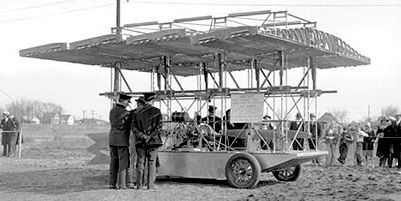
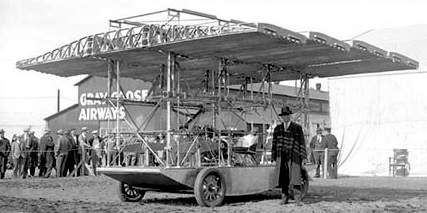
Built circa 1936, the Windmill Plane was an ornithopter type, with four tandem walking beams that opened and closed ten overhead slats, all of this mounted on a four-wheeled gondola with an unknown, but large, powerplant. No record of flight was found. The Windmill Plane appears in the video, “Golden Years of Aviation,” showing its set of rotating wings on either side of a horizontal axle. It was able to taxi only after being pushed by 10 men, but was never seen flying.