Deutscher Aero-Lloyd, the air transport company, built a high-wing training monoplane designed by Dr Ing K. Grulich in 1925. Designated S.1, it could have either 75 hp or 100 hp Siemens engine.
Piston
Grosso Aircraft Easy Eagle 1
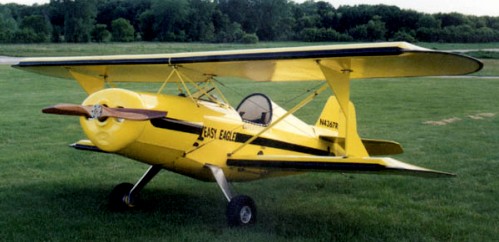
The LSA Easy Eagle I Bi -Plane is an affordable, easy to build aircraft that combines standard aircraft construction methods, steel tubing, wood and fabric covering.
The 4130 steel tube fuselage is wide enough for 44 inch waist line and a 6 foot 3 inch pilot. The 300 pound useful load allows for a 228 pound pilot and 11 gallons of fuel. The low wing loading of 6.7 pounds. per square foot gives the Easy Eagle I Bi -Plane a low stall speed and great glide ratio.
The aluminum 5/8 inch landing gear and 5 inch wheels provide for easy handling either on paved runways or grass strips. With the optional hydraulic brake upgrade, ground handling is superior.
The Easy Eagle I Bi -Plane takes off in only 300 feet and lands in about the same, thanks to 105 square feet of wing area. Climb is 900 feet per minute at sea level.
With a stall at 45 mph or less, a cruise of 100 mph, low building time and simple straight forward construction, all combine to make the Easy Eagle Bi-Plane a single place, affordable bi-plane.
The airframe is rated at plus 4 and minus 3 g-s the Easy Eagle Bi-Plane is capable of doing many sportsman aerobatic maneuvers.
Featuring a fully welded steel frame combined with an all wood wing and a one piece aluminum landing gear, make it a airplane for today. Landing and taking off is made easy with a fully controllable tail wheel.
With a 64 hp VW engine the Easy Eagle cruises at 100mph and has a stall speed of 45mph. The Easy Eagle features a fabric covered fully welded steel frame combined with an all wood wing.
In 2008 the EASY EAGLE was available from:
GREAT PLAINS AIRCRAFT
PO Box 545 Boys Town, NE, USA.
Engine: 1915cc VW 65HP
Span: 18’4″
Length: 14’4″
MTOW: 725 lb
Empty Weight: 454 LBS
Useful Load: 283 LBS
Wing Area: 105 sq.ft.
Seats: 1
Take Off Distance: 450 FT
Stall: 45 MPH
Landing Speed: 55 MPH
Cruise: 95 MPH
Rate of Climb: 700 FPM
Range: 350 sm
Fuel capacity: 12 USG
Seats: 1
Grose & Feary 1910 Monoplane / Oakington Monoplane
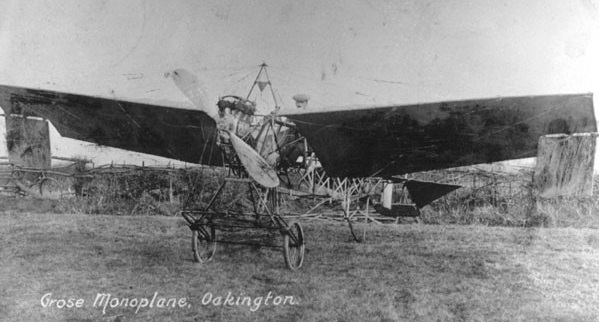
Built in the UK, construction commenced in 1909, and testing took place in April 1910, though no flights were ever reported.
Gros-Bredelet GB-01 Gerfaut
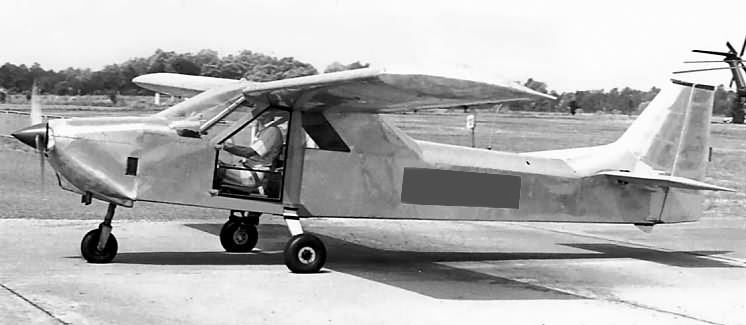
An original one-of-a-kind homebuilt aircraft, designed and built by James Bredelet and Louis Gros for two to four persons. The aircraft had a cantilever wing and was powered by one 130 hp Continental IO-240-A engine. It first flew on September 4, 1982.
Gruppo Costruzioni Aeronautiche GCA.3 Eta Beta

The Gruppo Costruzioni Aeronautiche GCA.3 Eta Beta is virtually a tandem two-seat scaled-up version of the earlier GCA.2 Dumbo, retaining the V-tail assembly. The Eta Beta appeared in 1952, and was designed for both training and touring roles.
The fuselage is an all-wood stressed-skin structure and the wing is an all-wood monospar structure with a stressed plywood skin. Cantilever spring steel main undercarriage legs are fitted, and the enclosed cabin is provided with dual controls and HF radio.
Engine: 60 hp C.N.A, D4S
Wingspan: 27 ft 10,5 in
Length: 20 ft 4 in
Empty weight: 710 lb
Loaded weight: 1151 lb
Max speed: 124 mph at SL
Cruise: 106 mpg
ROC: 984 fpm
Range: 404 mi
Gruppo Costruzioni Aeronautiche GCA.2 Dumbo
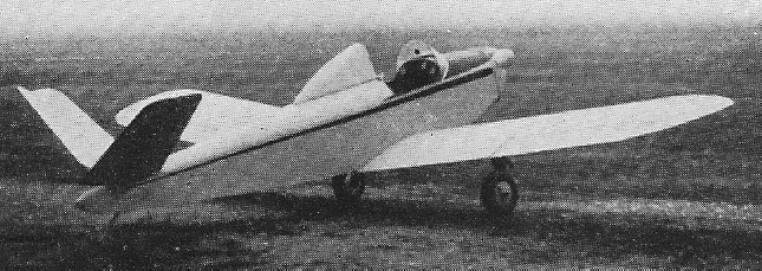
The second machine from Gruppo Costruzioni Aeronautiche of Milan, the GCA.2 Dumbo was designed by Emilio Bianchi and Giovanni.
First flown in 1951, only one prototype was built.
The Dumbo is a single-seat light monoplane with a butterfly tail assembly. All-wood construction with plywood and fabric covering. The power is a 23 hp Ambrosini P.25.
Engine: 23 hp Ambrosini P.25
Wingspan: 24 ft 3 in
Wing area: 85.249 sq.ft
Length: 16 ft 5 in
Height: 5 ft 7 in
Empty weight: 264 lb
Loaded weight: 484 lb
Max speed: 93 mph
Cruise: 75.5 mph
Time to 3280 ft: 6 min 30 sec
Ceiling: 12,120 ft
Range: 300 mi
Gruppo Costruzioni Aeronautiche GCA.1 Pedro
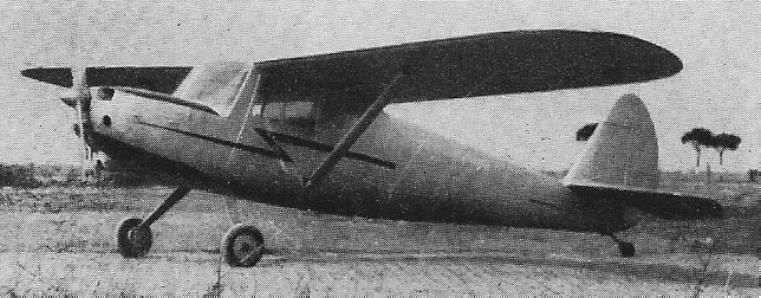
Designed by Emilio Bianchi and built in 1953 by the Gruppo Costruzioni Aeronautiche, the GCA.1 Pedro is a side-ny-side two-seat cabin monoplane powered by a 60 hp C.N.A. D4 air-cooled engine.
The Pedro is of all-wood construction with plywood covering. Dual controls are fitted.
Engine: 60 hp C.N.A. D4
Wing span: 32 ft 1.5 in
Wing area: 140 sq.ft
Height: 6 ft 2.5 in
Empty weight: 748 lb
Loaded weight: 1276 lb
Max speed: 106 mph
Cruise: 93 mph
Time to 3280 ft: 6 min 30 sec
Service ceiling: 14,100 ft
Absolute ceiling: 17,550 ft
Cruise range: 342 mi
Groppo Trail
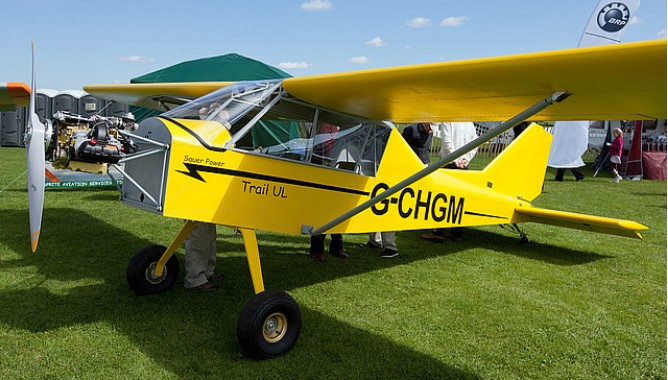
LSA
Groos Quand même
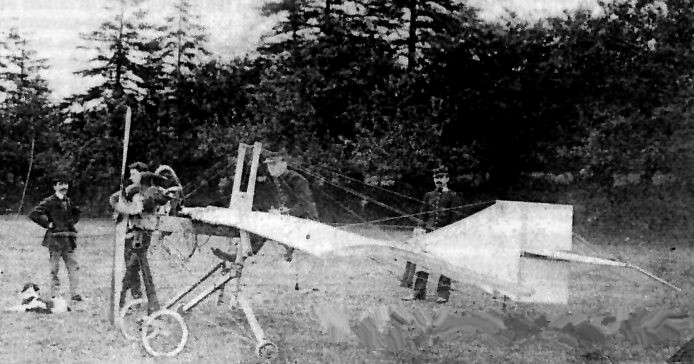
The second design of French military officer Alfred Groos. Produced in 1909, a small monoplane which was named “Quand même” [“Nevertheless”].
It was tested on 30 July 1909 as it flew about 100 meter with a speed of 55 km/hr at a height of ca. 2 meter. When it came down one part of the wing was damaged and the propeller broken. The monoplane had a four-wheel undercarriage (2 bigger in front and 2 small ones behind) and a very simple “fuselage” – about one piece of wood – and was powered by a 25 hp Anzani.
Groombridge and South 1903 multiplane
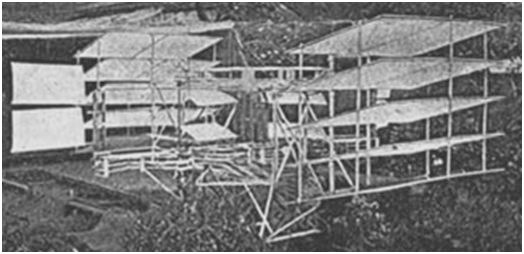
Built in the UK, this 1903 machine, which was about 80 feet in length and 60 feet in width, was to be supported on superposed planes attached to the framework both at the front and rear of the machine. It had three propellers on each side of the framework, and an extra one surmounting the whole structure. The propellers were carried on arms extending from the central driving shaft which form an axis within a rectangle, the two vertical sides of which form axes carrying the vanes of the propellers. During the driving stroke the vanes extended outside beyond the rectangle, while they returned edgewise, in a feathering position, inside it.

