The 1914 Gyro Motor Co Duplex J was a five-cylinder air-cooled rotary aero engine producing 50hp@1250rpm from 477.12ci, with a dry weight of 170lb.
Piston
Gyro Motor 1911 35hp
Designed by Fred Weinberg, the 1911 35hp was a five-cylinder air-cooled rotary aero engine.
Gyro Motor 1911 22 hp
Designed by Fred Weinberg, the 1911 22hp was a three-cylinder air-cooled rotary aero engine.
Gwinn Aircar
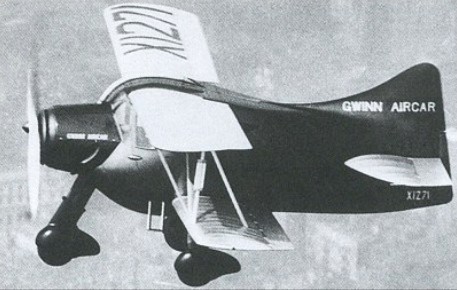
The first Aircar was completed in 1937 when it also received its Approved Type Certificate.
The test pilot for the Air Car was Richard K. Benson. During one flight he inadvertently got the Air Car into a spin and at about 10,000 feet and was able to recover at about 1000 feet. Saving the airframe got him a $10,000 reward from Gwinn.
Engine: 2 x Pobjoy Niagara II.
Seats: 2.
Top speed: 118 mph.
Cruise: 103 mph.
Landing speed: 41 mph.
Guyot et Verdier 1911 biplane
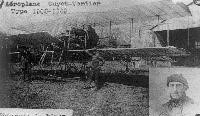
In 1911, in Juvisy in Essonne, construction of a 4th biplane started but with monocoque metal fuselage on wheels with shock absorbers, the hull joining the front cell to the aft stabilizer adjustable, a rear stabilizer in two parts to allow the development of the rudder with a crutch for ground braking. Combination of ailerons with controls on joystick, 60 hp E.N.V motor, Regy tractor propeller, foot rudder control, upper plane span of 8 meters, and lower plane 7 meters.
Louis Verdier carried out the development and flight tests in presence of an officer from the military aeronautical laboratory of Chalais-Meudon in view of the use of this two-seater by the army.
In view of the results obtained, including the solidity of the aircraft, well built, good flight behavior, possibility of landing on very short terrain due to the solidity of its landing gear, a very soft suspension and good braking at
ground, the Guyot-Verdier airplane registered before January 1, 1911 in the 1st major military aviation competition in Reims in la Marne, which began on October 1, 1911.
42 manufacturers take part in this competition, registering around 70 machines. Unfortunately, the Guyot-Verdier aircraft does not meet the qualifications, the required conditions are too stringent.
On Sunday, October 29, 1911, Louis made a demonstration flight of in front of 4000 to 6000 spectators, in the field Berthonnerie Air Force (2 km from La Souterraine), flying for 35 minutes, completing a 35 km circuit where it reaches an altitude of 500 meters. He is carried in triumph in the streets of the city and a wine of honor is offered.
Then follow other flights and aerial celebrations, in November 1911, January 12, 1912, April 28, 1912 in Azérables in Creuse.
In 1912, Louis received his pilot’s license n° 526, from the aeronautical sports commission.
In 1913, Louis Verdier wrote:
“Despite all these facts and qualities as well as many steps taken by our gentlemen, Deputies and Senators of Creuse and Haute-Vienne, the La Souterraine aviation factory has never obtained any order of a military service from the French State, nor any financial aid, all this aviation equipment has been studied, built and developed to no avail, for it was not the few parties and exhibitions that were able to cover all these study and construction costs for these aircraft prototypes. I give up building and flying these planes, I leave the provinces and return to the Paris region”
Louis entered the Sanchez-Beza Establishments as a pilot, then as a test pilot and engine developer at the Salmson aviation factories in Billancourt and, with mechanics, replaces engines on seaplanes in Saint-Raphaël (Var), Bizerte (Tunisia), Marseille (Bouches-du-Rhône), Toulon (Var).
Guyot et Verdier 1910 biplane
Henri Guyot and Louis Verdier undertake, still at La Souterraine, the construction of a third biplane, two-seater, at Chauvière, 80 horsepower engine and pusher propeller, unequal span wings.
The front cell and the rear fixed plane are joined by V-shaped ash spars and to reduce resistance in flight, the masts and metal parts are profiled. The span of the upper plane is 17.50 meters and the span of the lower plane 15 meters, bearing surfaces with beak entry into the air profiled to avoid resistance to the advancement of the aircraft, the engine mounted on a fuselage which is fixed on the lower plane of the aircraft which constitutes the cockpit. The cell is mounted on skid with 4 shock absorbers metal fixed on two wheels on each runner. The wheels are mounted on balloon tires with bead rims, brakes on wheels and brake stand on the ground.
The first official flight, piloted by Louis, took place on April 24, 1910 at Le Dorat on the flat racecourse. It was completely fenced which facilitated the control of entries because the event was paying. It’s a rectangle of 50 meters by 60 meters, the aircraft can take off in all directions.
Louis passed his A.C.F. (Aéro-Club de France) on July 1, 1911 on this Guyot-Verdier aircraft. His pilot’s license civil bears the n° 538. The license n°1 was obtained in 1909 by Louis Blériot.
Guyot-Cellier 1909 tandem biplane
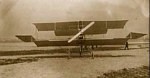
The 1909 Guyot-Cellier tandem biplane was designed and built by Guyot and Cellier in France. It is not known if it flew.
Guyard No.2 1911
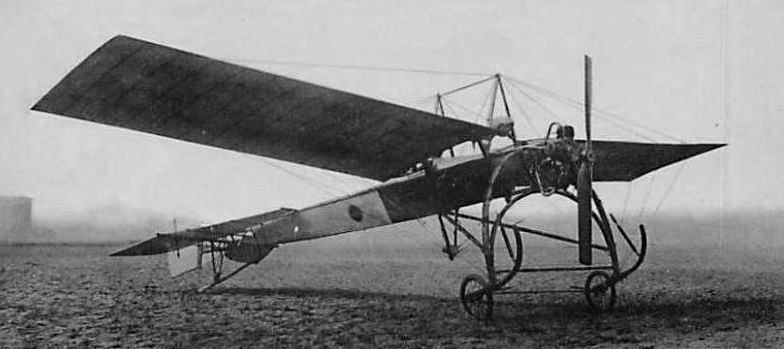
In April 1912, a second Guyard monoplane made its appearance and was tested at Issy (France). A totally different design, this monoplane was well-built. The undercarriage was built on a pair of arched wooden struct and a crossbar, plus a pair of neat short forward skids.
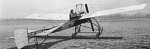
Engine: Anzani 5-cyl 50 hp
Wingspan: 11m / 35’5″
Wing area: 18 sq.m / 29’6″
Length: 8 m
Weight: 225 kg
Speed: 100 kph
Guyard No.1 1910
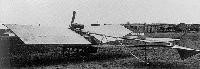
The first Guyard was a Demoiselle copy that was tested in Madagascar, 1910.
Gunton Special
The Gunton Special was a single seat aircraft built by T.F.W.Gunton in Spalding, UK, in 1939 but not finished.
c/n T.F.W.G.1 G-AFRW, it was fitted with an A.B.C. Scorpion engine.
It was sold to R.C.Bracewell and used in the building of the Pivot Monoplane G-AGOO.

