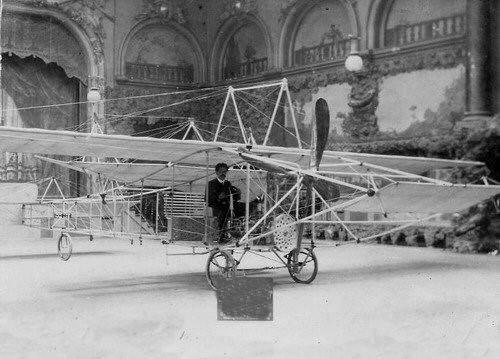
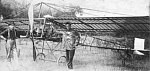
Towards the end of March 1910 the townsfolk of Wolverhampton had a chance to see a flying machine at close quarters when the Hartill mono-plane was displayed in the furniture showrooms of Robert H. Davies in Darlington Street. It drew a great deal of interest and its designer Mr Hartill, was on hand to explain all about it.
He explained to the enthralled gathering of onlookers that before starting work on the project he went over to the Rheims Flying Meeting, the worlds first, and to the Paris Aero Show of 1909. Where he made close examination of the machines present.
His machine was designed and constructed by Mr A.E.Hartill. a plumbing and gas engineer with premises at the top end of Cleveland Street, on the corner of Snow Hill, (as noted by his 1910 advert).
It was made to the order of a Doctor Hands, who is noted in Kelly’s 1905 directory as Surgeon and Medical Officer of Health.to the Wednesfield District Council and also medical officer and public vaccinator for for Wolverhampton Union Cottage Homes 138 Wednesfield Road.
On his return to Wolverhampton Mr Hartill began construction of the mono-plane for Doctor Hands and though it was the good doctor who was to foot the bills, the machine was to be known by the name of its designer and was to be flown by him or is son on its trials.
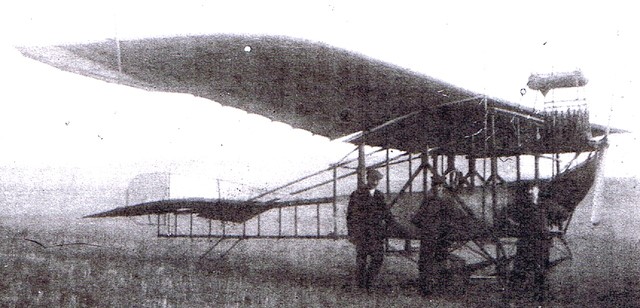
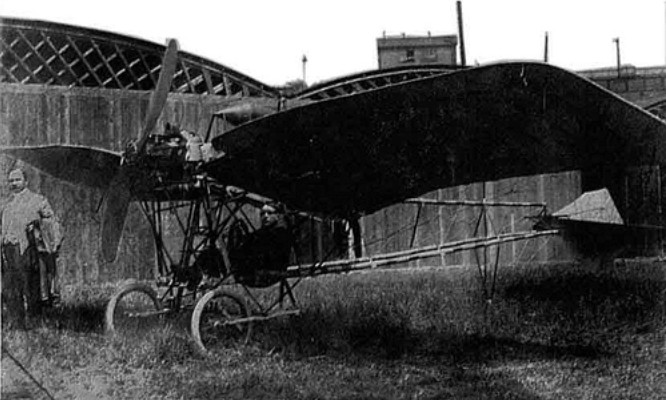
When completed the Hartill flying machine was seen to be very similar in layout to the Demoiselle, of very light construction, with pilot seated close to the ground under the wing and motor. The Wolverhampton machine was however considerably larger, having a wing span of 26ft against the Demoiselle’s 18. there was also differences in the control system, for whilst wing warping was used ( a common idea of the period), the Hartill was known for having fluted wings with tips that could be drawn up, supposedly to improve stability when landing or in difficult wind conditions.
However, since since the machine did not fly, it is not possible to say if the idea would have worked .
Construction was of steel and bamboo, wing covering was rubberized aero fabric, an Alveston horizontally opposed twin cylinder engine of 20h.p. was fitted and all weight was around 4cwt.
As would be expected, both Wolverhampton flying machines, the Hartill and the Star were entered for the Dunstall Flying Week held over the period June 27- July 2nd 1910, as this meeting was devised to encourage British Aviation.
One of the numerous bothers that beset the Hartill mono-plane was late delivery of the Alveston motor and a suitable airscrew.
The Doctor Hands/Hartill team tried manfully to get airborne and suffered a few frights, the mono-plane nosing over a couple of times when taxiing. It is not known what happened to this flying machine, but it seems certain it was destined not to fly.