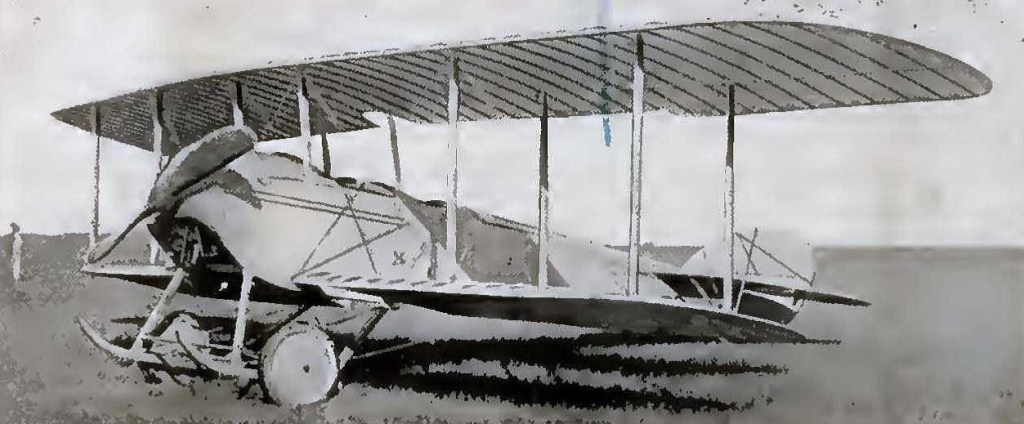
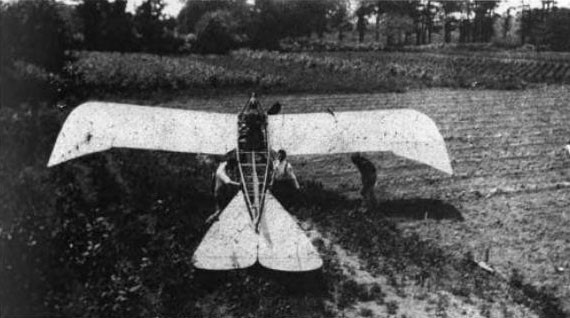
An American-designed and -built, two-seater mono-biplane, so called because it could be fitted with interchangeable wings and could be flown as either a biplane or a monoplane. It was the 1912 work of the Heinrich Brothers of Baldwin, Long Island, and was a conventional monoplane design, but had many original construction features.
The Model A was the first monoplane of the brothers Albert & Arthur Heinrich from Baldwin, New York, on which both taught themselves to fly. Its maiden flight was made in May of 1910, and was powered by a 60 hp Emerson boat engine.
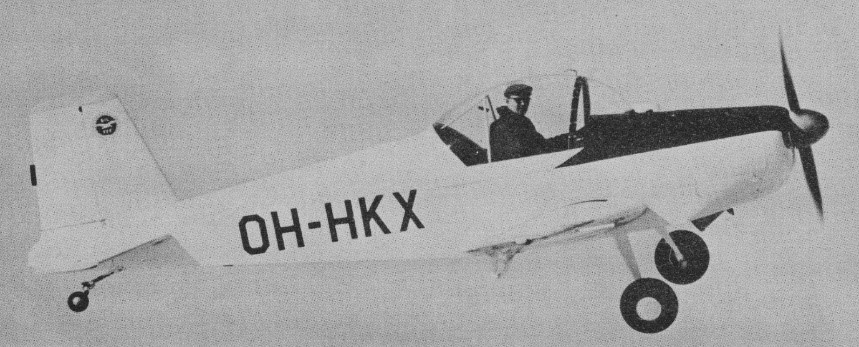
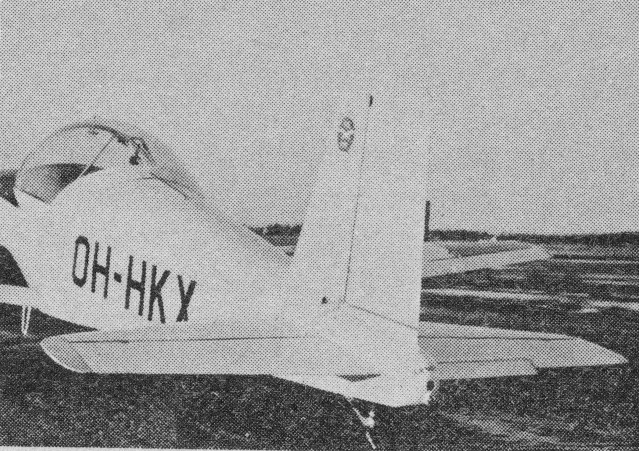
Juhani Heinonen produced the Heinonen HK-4 in 1964 for the Finnish Aeronautical Association.
Heinonen developed the two-seater with an all-wood wing, ailerons fabric covered. The all-wood fuselage has four main longerons and plywood covering. The tail is wood cantilever with fabric covered rudder and elevator. An elevator trim is adjustable from the cockpit.
The landing gear uses cantilever spring steel main legs attached to the wing, and the tail wheel is steerable.
Engine: Lycoming O-235-C1, 115 hp Wing span: 26 ft 0.5 in Lengt: 20 ft 2 in Height: 7 ft 1.5 in Empty weight: 870 lb MTOW: 1323 lb Top speed: 148 mph Cruise: 127 mph Service ceiling: 15,400 ft
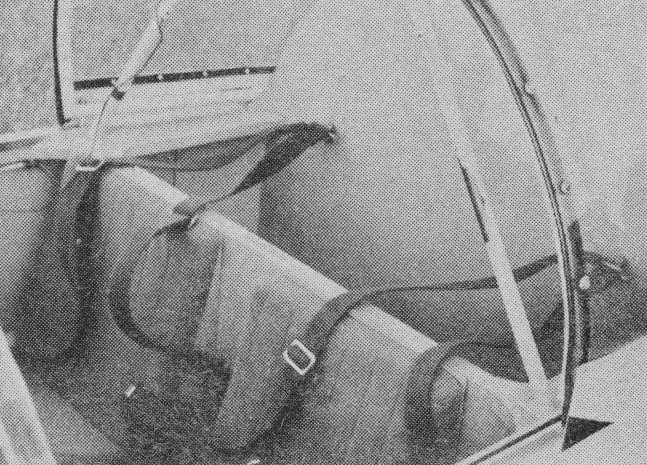
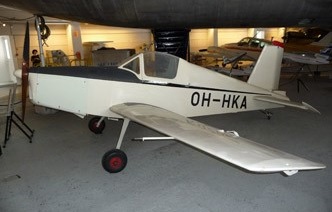
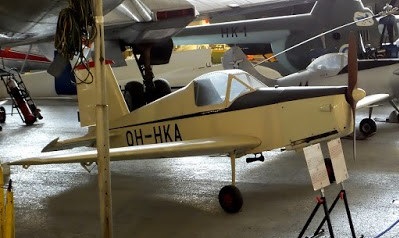
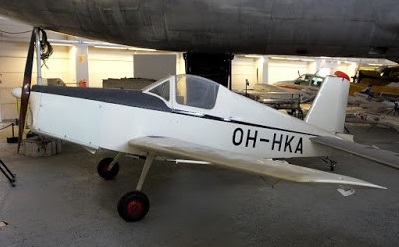
The HK-1 Keltiänen was designed and built by engineer Juhani Heinonen in 1954, registered OH-HKA.
The only Finnish aircraft which has achieved a world’s record. plane He made the record long distance flight on 10 July 1957, from Madrid to Turku nonstop, 2844 km in 17 hours 1 minute. This constituted a world’s record in category C-1.A; single-engine land planes with take-off weight max 500 kilos. The record stayed with this aircraft until 1974.
In 1943 the He 319 (project P1065 Ic) was proposed as a high-speed bomber or night fighter with a nose mounted armament of 4 x MK108 and powered by BMW801 radial engines. A mock-up was built the same year but destroyed during a RAF raid. All efforts converged immediately to a new program designated He 419. It consisted in a high-altitude fighter. The V1 (also A0 pre-series version) was actually built from a He 219 A-5 tail and fuselage with DB603G engines and a newly designed wing of 55 sq.m area.
The He 419 A1 was intended to be fitted with single fin unit for production simplification. To avoid production of newly designed pieces the A1 was overtaken by the He 419-B1/R1 version which featured the same fin unit of the He 219. The 2000 hp DB603G engines were fitted with a turbo system driven by exhaust, and an endurance of about 2 hours. The B1 had a larger wing of 59 sq.m. Armament consisted in 2xMG151 in the wing roots and 2 x MK108 in a ventral tray. Maximum speed reached was 670 km/h at 14.500 m; landing speed was 172 km/h; cruise speed was 650 km/h with a calculated range was 2.540 km.
Six finished He 419-B1/R1 were built in Marienehe utilizing He 219A 5 fuselages. The six were flown with the He 319 tail, very long-span wing of 59 square metres (635 sq ft), two 20 mm MG 151/20 in the wings and four 30 mm MK 108 in ventral housing. Speed was 422 mph (679 km/h) to 44,619 ft (13,600 m).
Construction of a prototype He 319 high-speed bomber and night fighter, developed from the He 219 was begun in 1942, but work was abandoned following an air attack on Heinkel’s Marienehe factory in November of that year.
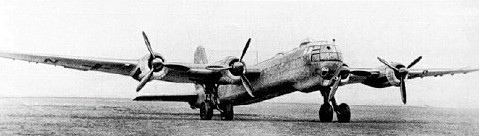
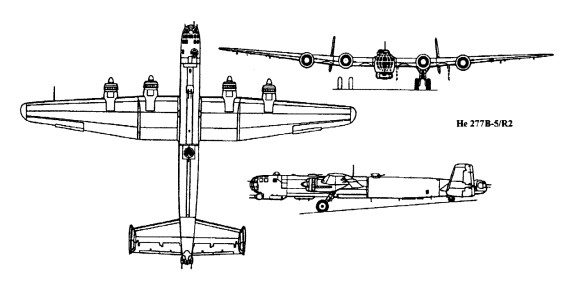
In an effort to overcome the problems being experienced with the coupled DB 606 engines of the He 177, Heinkel suggested in 1940 that four separate DB 603s should be substituted. Although the Reichsluftfahrtsinisterium rejected the plan, work continued unofficially under the designation He 177B and the design was resurrected in response to Hitler’s May 1943 demand for a heavy bomber to facilitate effective strikes on London. Converted from an He 177A-3/R2 airframe, with four DB 603A engines, the first Heinkel He 277 prototype flew at Vienna-Schwechat in the closing months of 1943, followed by the second aircraft on 28 February 1944. Directional instability resulted in the fitting of a twin fin and rudder tail unit to the third prototype. Eight 1305kW DB 603A-powered He 277B-5/R2 production models were completed before the priority given to fighter production in July 1944 brought the programme to an end.
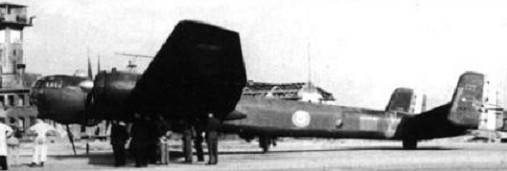
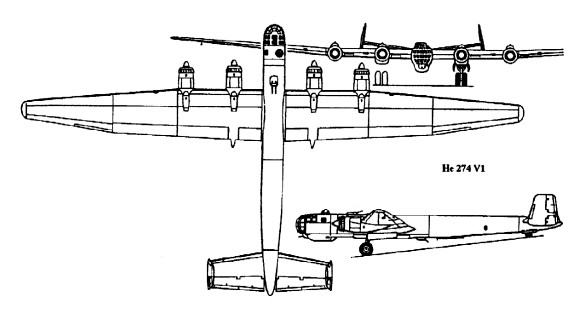
A four engine bomber, the Heinkel He 274 was the detail design responsibility of Societe Anonyme des Usines Farman’s Suresnes factory in occupied France. Fitted with a pressurised cabin in the nose, the aircraft was powered by four 1305kW Daimler-Benz DB 603A-2 engines and featured a lengthened version of the He 177A-3 fuselage, with a new high-aspect-ratio wing and twin fins and rudders.
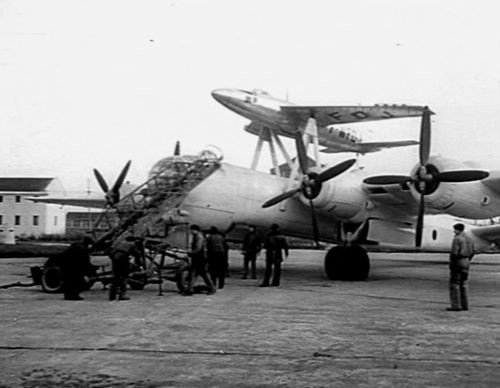
Two prototypes were ordered in May 1943, together with four He 274A-0 pre-production examples, which were to have 1417kW DB 603G engines. Despite an unsuccessful German attempt to destroy the almost-complete first prototype when they retreated from Paris in July 1944, the aircraft was finished by the French after the liberation. The first flight was from Orleans-Bricy on 30 December 1945 as the AAS 01 A.
Two prototypes were built in France by the S.N.C.A.C.
It was used later to test-fly models of such aircraft as the Aerocentre NC 270 and the Sud-Ouest SO 4000.
M.1 glider (F-WFDJ) on Heinkel He.274 V-1
He 274 Engines: 4 x Daimler-Benz DB-603A2, 1850 hp Propellers: metal three-bladed variable pitch Wingspan: 44,20 m Length: 23,80 m Height: 5,50 m Wing area: 142,00 sq.m Aspect ration: 13,2 Fuel: 10130 lt Empty weight: 21300 kg Max weight: 38000 kg Wing loading: 267,605 kg/sm.m Power loading: 5,135 kg/hp Max speed: 580 km/h Cruise speed: 180 km/h Ceiling: 14300 m Range: 4250 km Endurance: 7 hours 45 min
The He 270 was essentially a private venture improvement of the He 70, in which a 1175 hp DB 601Aa engine was installed in an He 70F airframe. It flew in the spring of 1938, but no production was under-taken.