Herringhausen Vagabund

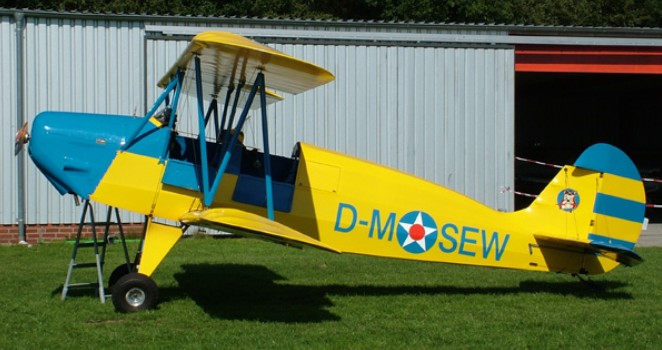
The Vagabund is a 3-axis two-seat ultralight biplane, in classic timber construction. The design of the Vagabund goes back to 1989. The open cockpit biplane is constructed using the usual materials and working procedures for wooden aircraft. The fuselage is conserved with epoxy resin and covered with polyester fabric. A high-quality lacquer finish gives it a maximum weather protection. The open cockpit biplane has a welded tubular steel chassis with one-guidable roll spur. The wooden-propeller is driven by a 80 hp, lightweight four-stroke, horizontally-opposed aircooled Jabiru 2200 engine. As power plant also the 50 hp Nissan Micra 1200 or the 80 hp Rotax 912 UL version engine can be used. The choice of the engine has its influence on the performance of the aircraft: with the Micra 1200 the cruise speed is 125km/h, with the Rotax 912 125 km/h.
Herring-Burgess Model A / Flying Fish

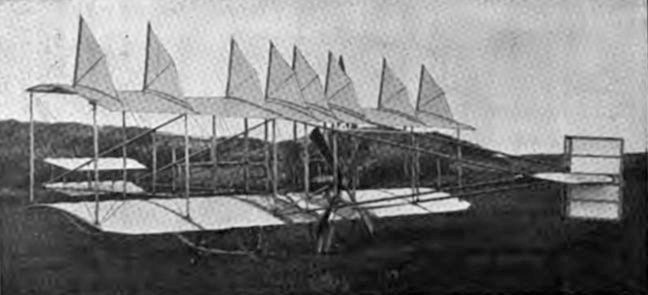
A pusher biplane with a central skid and skids under each wingtip, powered by a Curtiss 25 hp 4-cyl water-cooled engine with a four bladed propeller. Six vertical fins were arranged on the upper wing for lateral stability.

The machine was displayed at the Boston Aerial Exposition on 20-26 February, 1910.

It was first flown on 28 February 1910 by Augustus Herring on the ice at Chebacco Lake, Hamilton, MA.

It was ordered by the carousel and amusement park manufacturer Charles W. Parker of Abilene and Leavenworth Kansas. It was the first of many Burgess aeroplanes, it made the first flight in New England and was the first commercial aeroplane built and sold in New England.

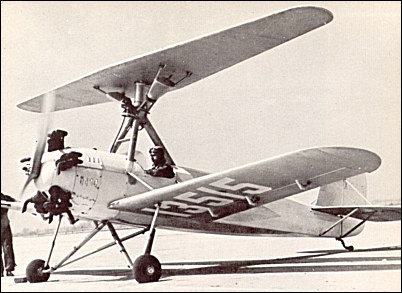
Herrick Convertoplane

The Convertoplane, cross between an airplane and a rotorplane, was developed in the United States in the 1930s by the Gerard P. Herrick, aided by Ralph H. McClarren of Philadelphia’s Franklin Institute. Basically, the design was a biplane with an upper wing that could function either as a lifting surface or as a two-bladed teetering rotor.
Flown by test pilot George Townsend in 1937, the aircraft demonstrated successful conversions in flight from a biplane to a rotorplane. Herrick was striving for an aircraft that could achieve speed as an airplane while possessing ability to convert to rotating-wing configuration for landing and take-off in tight areas.

Hergt Monoplane

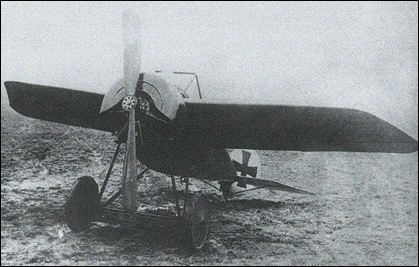
The Hergt Monoplane was designed and built at F.E.A. 1 Altenburg as a private venture by F. D. Hergt during 1918 and flown by Mario Scherff.

The prototype had room for one pilot, and ply-skinned wings and fuselage.

Engine: Gnome 80 h.p.
Wingspan: 6.0 m. (19 ft. 8 1/4 in.)
Length: 5.2 m. (17 ft. 0 3/4 in.)
Speed: 125 km.hr. (78 m.p.h.)
Armament: none

Herdler 1911 Hochdecker

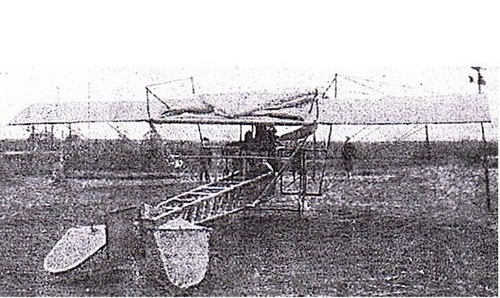
The 1911 Herdler Hochdecker high-wing eindecker designed by Carl Herdler, had an “Absturzsicherung auf dem Flügel (ein sammengefalteter Luftsack) der bei Gefahr gespreizt werden konnte” – a security device, where the idea was to blow up the bag with air, to remain longer in the air whereas to lessen the force of impact in the event of a crash on the ground. The “air bag” may have also been somewhat based on the parachute.

The machine made short hops in 1911.

Hensley 1909 biplane

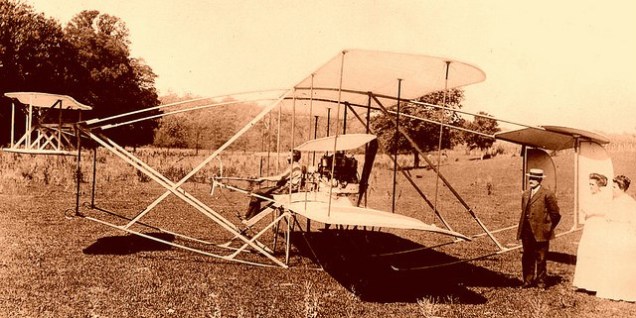
This somewhat Wright-like machine was constructed in Anderson, Indiana, USA, by Charles H. Hensley, a 40-year-old man who enjoyed building and flying box kites, and Levi Calvin Lambert, who was a 33-year-old plant manager and a member of the family that owned the Lambert Gas and Gasoline Engine Co., also of Anderson, which probably provided the engine. A grandson of Hensley stated that the plane flew around in a circle, for how long or at what height is unknown. He was told the plane was dismantled after its only flight.

Henschel Hs P.75

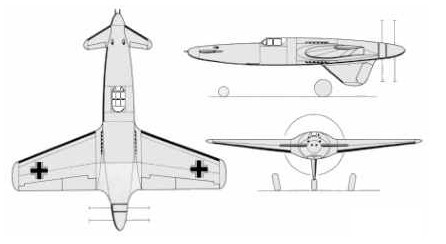
This 1941 aircraft design was to be a possible successor to the Messerschmitt Bf 110 heavy fighter. Although of a unusual configuration for that time, there were advantages (and disadvantages) to its rear wing/forward canard construction.
The Hs P.75 featured a tapered fuselage, with the slightly swept-back wings being mounted mid-fuselage and set back to the rear of the aircraft. The widened fuselage was designed to house the Daimler Benz DB 610 engine, which were two DB 605 engines joined side-by-side, just aft of the cockpit. These were the same engines that the Heinkel He 177 used, and were found to be prone to overheating and catching fire.Due to this development, they were changed in 1942 to the liquid-cooled, 24 cylinder Daimler Benz DB 613 engines (two coupled DB 603s) that produced 3500 horsepower. Both engine configurations were to drive contrarotating propellers (to offset tourque) of a 3.2m (10′ 6″) diameter via an extension shaft. There were a pair of swept-back canards located on the nose of the aircraft, that were to serve the purpose of elevators. The vertical tail unit was mounted beneath the fuselage, so that it could act as a tail bumper upon takeoff so that the propellers would not strike the ground. Since the propellers were located at the rear in a pusher configuration, a tricycle landing gear arrangement was chosen. Fuel was contained in three tanks, one in each wing and one behind the cockpit. A single pilot sat in the cockpit which was located about midway along the fuselage, and four Mk 108 30mm cannons were mounted in the nose.
The advantages of the pusher propeller/forward canard design was that it opened up the pilot’s view, plus the weapons installation was much simplified and could be concentrated. The disadvantages would be engine cooling plus an ejection system or propeller jettison would have to be designed for the pilot to safely exit the plane in case of an emergency.

Henschel Hs P.75 Data
Span: 11.3 m / 37 ft 1 in
Length: 12.2 m / 40 ft 0 in
Height: 4.3 m / 14 ft 1 in
Wing Area: 28.4 sq.m / 305.7 sq.ft
Max Weight 7500 kg / 16535 lb
Wing Loading: 264 kg/sq.m / 54 lbs/sq.ft
Ceiling: 12000 m / 39370′
Max. Speed: 790 km/h / 491 mph

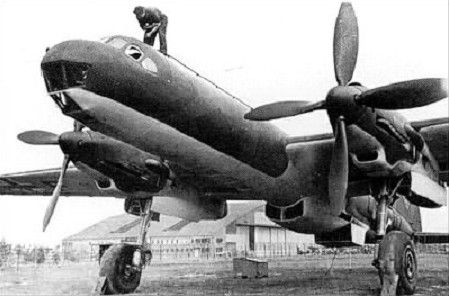
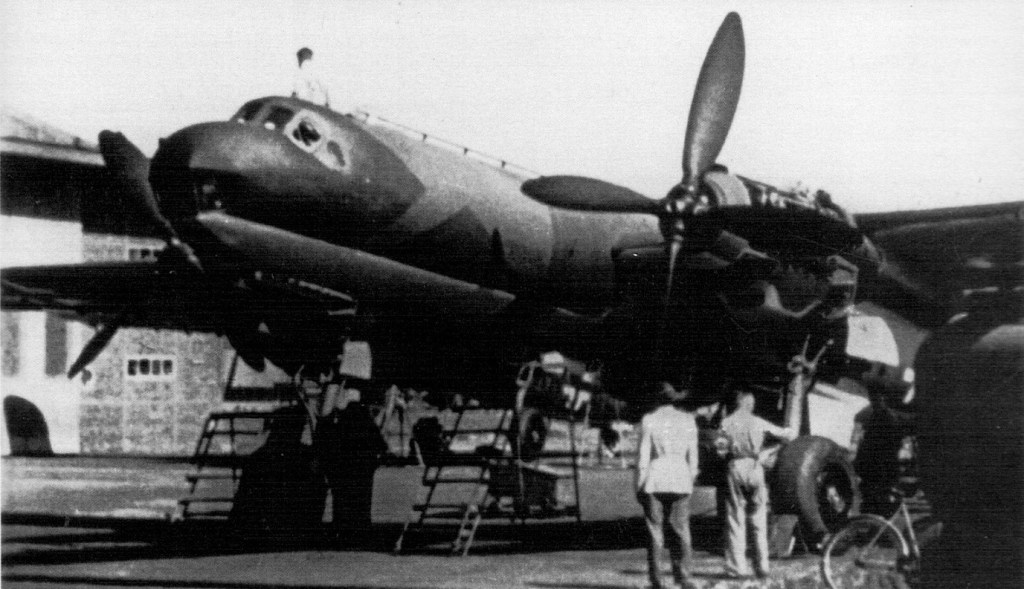
Henschel Hs 130

A high-altitude reconnaissance bomber, developed from the Hs 128, the A-06 and A-07 pre-series aircraft had a wing span of 29m, and turbosupercharged DB 605 engines. They could reach 15500m.

The Hs 130E-0 was powered by two 1750 hp Daimler-Benz DB 603A engines, which were supplied with air by a compressor, driven by a 1475 hp DB 605T. This configuration was known as ‘HZ Anlage’. This aircraft was capable of attaining 16,500 m / 54,000 ft.

Five HS 130 pre-production E-0s and probably three E-1 production aircraft were completed before 1944 when the programme was cancelled.

One E-1, W.Nr.130082 BD+KA, was tested by a crew from the Versuchsverband at the Henschel plant at Berlin-Schonefeld late in 1944, but crashed on 17 December 1944 killing all on board.