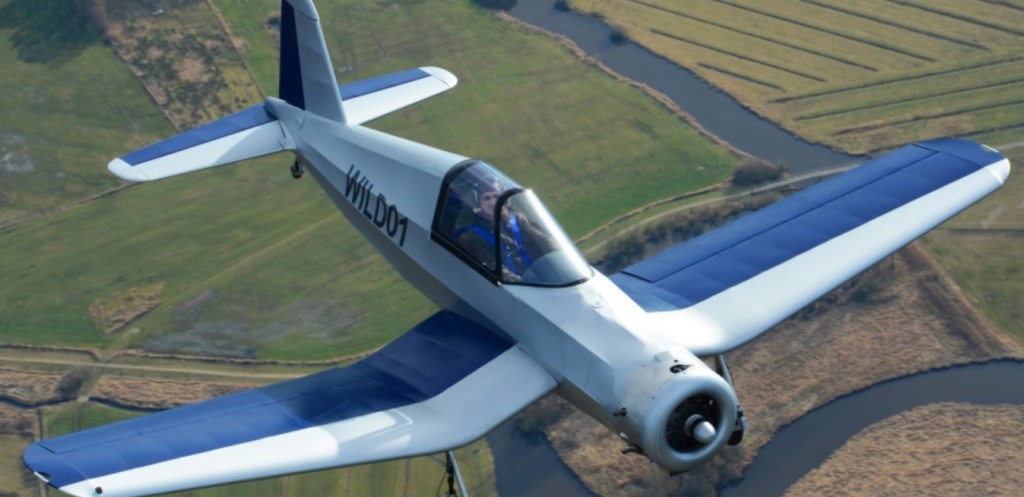
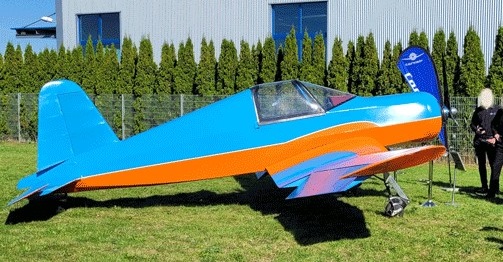
The Corsair relies on latest lightweight construction technology to combine flight performance, agility and energy efficiency. The whole primary structure is made of aerospace grade carbon fiber. Carbon fiber spaceframe technology is applied on the fuselage to achieve the greatest possible strength at the lowest possible weight.
The Carbon structure has a proven strength of +9 and -6g. Furthermore the complete cockpit area is constructed as a Kevlar reinforced safety cell.
The Corsair follows the German LTF-L regulation. As well it covers many other national regulations, e.g the British SSDR, the Italian, French, Czech, Polish and even the US American FAR part 103 regulation. For the later the empty weight, MTOW and speeds are slightly reduced.
The Verner Scarlett 3 V – a 4-stroke, 3-cylinder radial engine designed as a light aircraft engine and produces 42 bhp at 2500 rpm. The high engine torque allows the use of a rather big and efficient propeller. There are two standard options: either a ground adjustable 3-blade 1,60 m carbon prop which can produce – depending on the blade pitch – up to 100 kg of static thrust. Or the 1,75 m Helix 2- or 3-blade props which both even deliver more than 100 kg thrust.
The first version of the Corsair features a classic tailwheel configuration. The fixed main landing gears are located at the wings and due to the wing shape are rather short and quite aerodynamic. The cantilevered main wheel attachment together with hydraulic springs and dampers is great for grass strips and the occasional less than perfect landing.
The tail gear is connected with the rudder by means of a GFRP spring and allows good ground handling. Even the tail wheel is on a cantilever and has an elastomeric spring and damper.
Provisions for a retractable landing gear have been considered in the wing design and if we see sufficient customer demand a retractable version could become available in the future. Nevertheless it has to be stated, that the retractable version does not promise to be any faster – the additional weight and the resulting drag will consume the aerodynamic benefit.
Engine: Verner Scarlett 3 VW, 31 kW (42 BHP) at 2.500 RPM
Wing span: 24,6 ft
Wing area: 108 sq ft
Length: 20,7 ft
Empty weight: 265 lbs (FAR part 3 254 lbs)
Payload: 287 lbs (FAR part 3 254 lbs)
Loading: +6g / -4g
Wings folded width: 9,0 ft
Maximum speed: 55 knots / 102 km/h (EU 55 km/h)
Cruise: 54 knots / 100 km/h (EU 160 km/h)
Stall: 24 knots / 44 km/h (EU 210 km/h)
Best climb: 1000 ft/min / 5 m/s