A single engined three-seat biplane.
Piston
Johnson Aircraft Tiger Cub Sport II

The LSA Tiger Cub Sport II has a wide enough cockpit to seat 2 full grown adults in comfort.
Wide main gear and a large rudder aid ground handling and the ailerons have a 2.7 to 1 differential throw, this virtually eliminates adverse yaw. Control surfaces are large, giving good control response throughout the flight envelope.
With a 912 Rotax or an O200 Contenental the Sport II needs only 300 ft of hard surface runway to get airborne, and will climb out at 800 ft per min. at gross weight. The landing roll is under 400 ft,
It can be ordered as a Tri gear or tail dragger and there were 2 engine options available.
The airframe is built of aluminum tubing with aluminum gussets and brackets at the joints, fastened together with bolts and rivets.
Engine: Continental O-200, 100 hp
Empty weight: 840 lb
MTOW: 1320 lb
Wing span: 33′
Wing area: 165 sq. ft.
Fuselage length (nose to tail): 22′ 6″
Folded width: 6′ 6″ (width of main gear)
Stall full flap: 35 mph.
Cruise: 105 mph.
Climb: 800 fpm.
Glide Ratio: 8 to 1
Take off Roll: 300′
Landing Roll: 400′
Wing Loading: 7.6 lbs. per sq. ft
Power Loading: 12.5 lbs. per hp.
Stress Loading: 5+ 3- G’s.
Vne: 130 mph
Cockpit width: 42 in
Engine: 912 Rotax, 100 hp
Empty weight: 700 lb
MTOW: 1320 lb
Wing span: 33 ft
Wing area: 165 sq. ft.
Fuselage length (nose to tail): 22′ 6″
Folded width: 6′ 6″ (width of main gear)
Stall full flap: 35 mph.
Cruise: 105 mph.
Climb: 800 fpm.
Glide Ratio: 8 to 1
Take off Roll: 300′
Landing Roll: 400′
Wing Loading: 7.6 lbs. per sq. ft.@ gross.
Power Loading: 12.5 lbs. per hp. @ gross.
Stress Loading: 5+ 3- G’s.
Vne: 130 mph.
Cockpit width: 42 in
Johnson Aircraft Tiger Cub
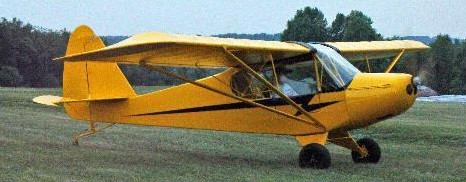
The LSA Tiger Cub UL has a wide enough cowl to keep the exhaust inside, (no unsightly two stroke exhaust hanging out) a folding wing and tail, fully enclosed cockpit (large enough to accommodate a 6’6″-250 lb. pilot in comfort) full three axis controls with flaperons and a steerable tail wheel, a wide speed range and rugged landing gear.
The first Tiger Cub first flew on 1 April 1996.
The ailerons have a 2.7 to 1 differential throw ro virtually eliminate adverse yaw.
With a 447 Rotax engine a 170 pound pilot needs about 150 ft. of hard surface runway to get airborne, and will climb out at 800 ft per min. Landing roll out is under 300 ft, even with out brakes.
The airframe is built of aluminum tubing with aluminum gussets and brackets at the joints, fastened together with bolts and rivets. A drill and pop rivet tool are all that is needed.
The plans include a complete materials and vender list .
The material list gives a list of the sizes and amounts of all the aluminum and chrome molly tube and sheet needed to build the airframe, a list of all the AN hardware sizes and quantities needed and a list of all the rest of the materials needed to complete the airplane, with descriptions and venders part numbers for hard to find or describe parts.
The gusset prints are organized by thickness from .025 to .125 the patterns can be cut out and traced onto the aluminum sheet with a fine tipped marker. No scaling from the plans is required. Directions and tips for cutting out the gussets are included in part one of the assembly manual.
Full size prints, of the chromemoly and machined parts, are included.
The panel prints have all the measurements needed to lay out the part on your work table, so you don’t have to scale your measurements from the prints, eliminating a common source of errors. ¼ scale prints (19″ by 30″ prints) of the wings, tail surfaces, fuselage and bulkhead panels.
The plans also include an assembly manual (over 200 – 11″ by 17″ ) pages of pictures and text), that gives step by step directions and tips to guide you through assembly, rigging, covering, wiring, plumbing and finishing.
Available since Jan. of 2000 over 300 sets of plans have been shipped (as of 1/2007).
Est. build time for scratch built…650 hrs.
Price for a complete set of plans was $250.00 in 2007.
The basic kit includes, a set of plans, all of the Parts Packages, listed on the previous page, and all of the additional materials needed to build a covered airframe (less engine prop instruments and paint.)
The kit will also include the main bulkhead, rear cross tube and the flaperon mixer, already assembled. These three subassembly’s are the most critical and the most difficult to build. Having them built in drill guides and assembly jigs, assures a strong and square part, and reduces building problems considerably.
The basic kit eliminates the hassle of having to order materials from six or seven different sources and tracking down all of the numerous small parts needed.
Tiger Cub UL
Engine: 447 Rotax, 40 hp
Gearbox (2.58 to 1)
Empty weight: 275 lb
MTOW: 600 lb
Wing span: 29 ‘ 4″
Wing area: 130 sq. ft.
Fuselage length: 19′ 11″
Folded length: 22′ 8″
Folded width: 6′ 6″ (width of main gear)
Stall full flap: 25 mph.
Cruise: 65 mph.
Climb: 800 fpm.
Glide Ratio: 8 to 1
Take off Roll: 150′
Landing Roll: 300′
Wing Loading: 4.6 lbs. per sq. ft.@ gross.
Power Loading: 15 lbs. per hp. @ gross.
Stress Loading: 6+ 4- G’s.
Vne: 90 mph.
Cockpit width: 27 in
Tiger Cub UL
Engine: 503 Rotax, 52 hp
Gearbox (2.58 to 1)
Empty weight: 320
MTOW: 650 lb
Wing span: 29 ‘ 4″
Wing area: 130 sq. ft.
Fuselage length: 19′ 11″
Folded length: 22′ 8″
Folded width: 6′ 6″ (width of main gear)
Stall full flap: 27 mph.
Cruise: 48 kt / 55 mph / 89 kmh
Climb: 1000 fpm.
Glide Ratio: 8 to 1
Take off Roll: 75′
Landing Roll: 300′
Wing Loading: 5.0 lbs. per sq. ft.@ gross.
Power Loading: 12.5 lbs. per hp. @ gross.
Stress Loading: 6+ 4- G’s.
Vne: 78 kt / 90 mph / 145 kmh
Johnson Rocket 185
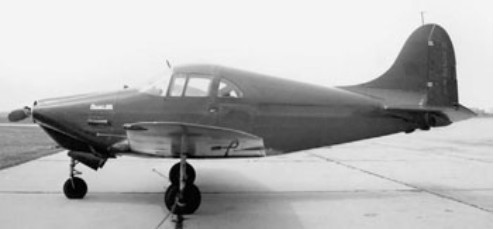
This high-performance, three-seat, cabin monoplane was first built in 1946 by Johnson Aircraft, Inc. and was ultimately manufactured in small numbers. The quick and light aircraft was built of all-metal construction with a fabric-covered fuselage. Two persons are seated side-by-side with full dual controls while the third is seated centrally just behind the front seats. In 1950, Aircraft Manufacturing Co. acquired the rights to produce a refined four-seat version of the Rocket, which it called the Texas Bullet.
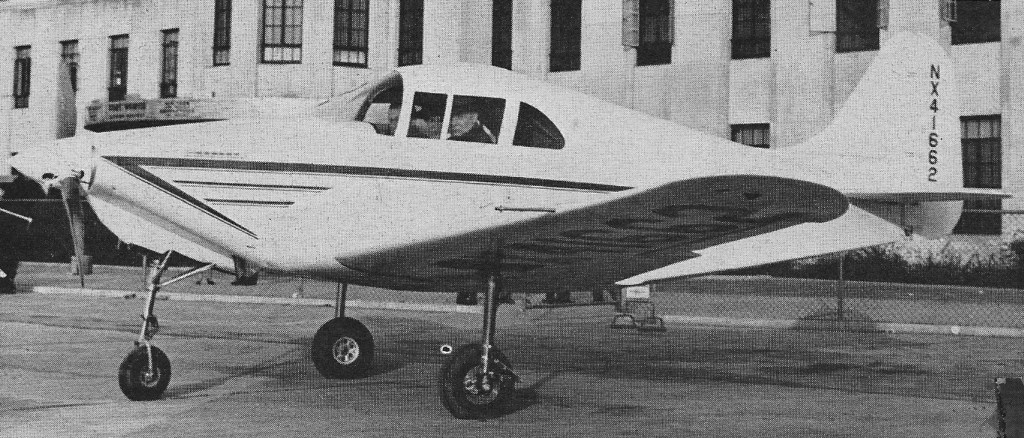
The original Rocket was powered by a 185-hp four cylinder Lycoming engine; the Texas Bullet changed over to a Continental of the same rating. Also, the fabric covering of the Rocket was traded for an all-metal, flushriveted skin, and a redesigned tail was added. Overall, the new refinements added only 100 pounds to the empty weight, and 50 pounds were added to the fully loaded weight. Exhaust gasses from the engine of the Rocket and Bullet were led into a unique “jet assist” cylinder below the fuselage. It was claimed that the device converted engine exhaust into useful thrust at speeds faster than 40 mph. Also, both aircraft made use of a Hartzell hydro-selective two-blade variable-pitch propeller.
The Rocket 185 received its Approved Type Certificate in April 1946.

Engine 185-hp Lycoming/185-hp Continental.
Gross wt. 2,250 lb
Empty wt. 1,550 lb
Fuel capacity 55 gal
Top speed 207 mph
Cruise 185 mph
Stall 50 mph
Initial climb rate 900 fpm
Ceiling 24,500 ft
Takeoff run 600 ft
Landing roll 400 ft
Seats 4.
Johns Ra-Son Warrior
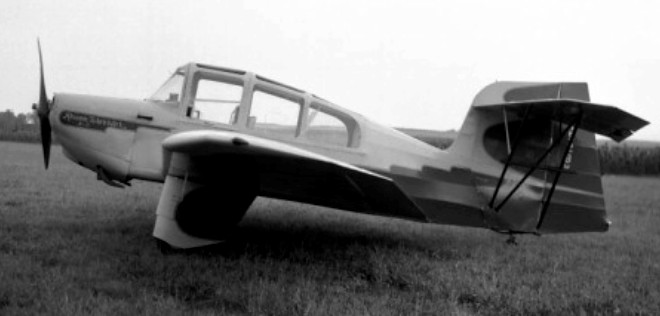
Alvis R. “Ray” Johns, of Chambersburg, Pennsylvania, USA, designed in 1947 the Rason Warrior, that was constructed in four years of part-time work, in collaboration with Paul L. Witmer, completed in 1952.
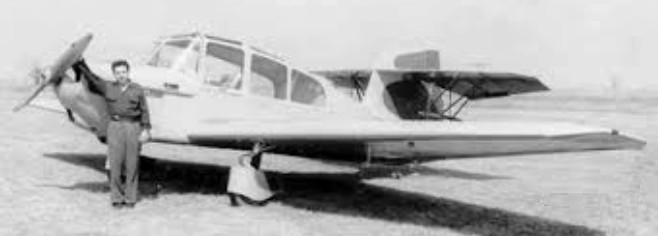
The five-seat aircraft was designed for short-field operations in remote areas and had a large wide-chord wing, fixed panted undercarriage and could easily be converted to a cargo-carrier loading through a pair of oversized gullwing cabin doors. Power came from an 185 hp Lycoming O-435-I six-cylinder horizontally-opposed air-cooled engine and can lift a 1,000 lb (454 kg) payload. The taildragger aircraft uses a large tapered low wing, with a large horizontal tail surface mounted close to the trailing edge of the wing. The fuselage is welded steel tube construction with fabric covering. The wings use wooden spars and ribs with fabric covering.
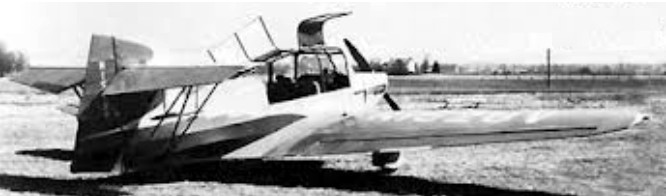
It received the EAA Award for Achievement in 1963 and was still registered in 2006 in Shippensburg, PA 17257, United States.
Construction Number (C/N): 3-1-J
Registration Number: N1528V
Engine: 1 × Lycoming O-435-1, 185 hp (138 kW)
Wingspan: 38 ft 0 in (11.60 m)
Length: 22 ft 3 in (6.78 m)
Empty weight: 1,820 lb (826 kg)
Gross weight: 3,450 lb (1,565 kg)
Fuel capacity: 45 gal (170 litres)
Maximum speed: 122 kn; 225 km/h (140 mph)
Cruise speed: 103 kn; 190 km/h (118 mph)
Stall speed: 36 kn; 68 km/h (42 mph)
Rate of climb: 1,000 ft/min (5.1 m/s)
Takeoff roll: 350 ft (107 m)
Service ceiling: 9,842 ft (3,000 m)
Capacity: 5
Joachimczyk 1911 Airplane
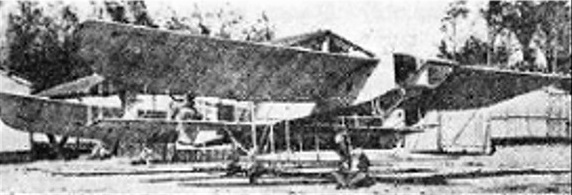
Polish engineer working in Berlin, Alfred Marceli Joachimczyk, at Deutsche Flugmaschinenbau-Gesselschaft built an experimental triplane with tandem wings but the design was apparently a complete failure.
JEOF SAX 86
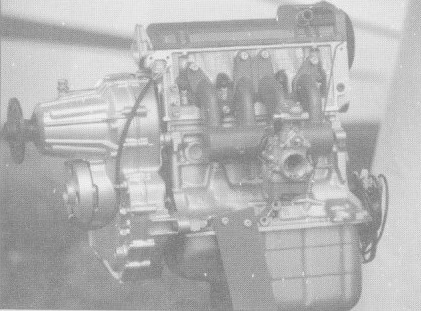
SAX86 Fiat injection
Cycle: 4 stroke
No cylinders: 4 inline
Displacement: 1242 cc
Cooling: Liquid
Ignition: Electronic
Reduction: Mechanical
Weight: 82 kg
Max pwr: 90 hp at 2400 rpm
Price 1998: 17 000 000 L
JEOF Candania GV 1
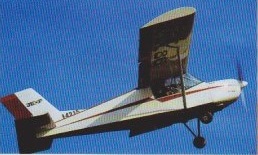
The Jeof Candiana (named for the town of its origin) is an Italian homebuilt aircraft that was designed and produced by Jeof srl of Candiana, introduced in the mid-1990s. When it was available the aircraft was supplied as a kit for amateur construction.
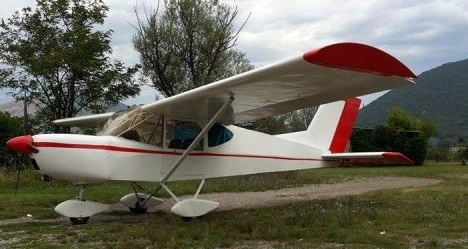
The Candiana features a strut-braced high-wing, a two-seats-in-side-by-side configuration enclosed cabin accessed via doors, fixed conventional landing gear and a single engine in tractor configuration. Tricycle landing gear is optional. It has a spaceframe fuselage and sheet dural wings. The engine is derived from a Fiat car engine.
The aircraft is made from a combination of welded steel tubing and aluminum. The aircraft was designed as a testbed for the Sax 86 engine, a derivative of the Fiat Punto 1.3 liter four-cylinder four-stroke automotive powerplant with dual electronic ignition and a 2.54 : 1 reduction drive (gears). It has a motorcycle carburetor Dell’Orto PHF 32. It gives 92 HP at 6000 rpm max continuous.
The standard day, sea level, no wind, takeoff and landing roll is 100 m (328 ft).
By 1998 the company reported that ten kits had been sold, were completed and flying.
Candania GV
Engine: Sax 86, 86 hp
Wing span: 8.65 m
Wing area: 13 sq.m
MAUW: 450 kg
Empty weight: 279 kg
Fuel capacity: 45 lt
Max speed: 260 kph
Cruise speed: 160 kph
Minimum speed: 60 kph
Fuel consumption: 9 lt/hr
Seats: 2 side by side
Price (1998): 70 000 000 lire
Engine: 1 × Sax 86, 96 hp
Propellers: 2-bladed fixed pitch
Wingspan: 9 m (28.4 ft)
Length: 7 m (21.9 ft)
Empty weight: 282 kg (622 lb)
Maximum speed: 209 km/h; 113 kn (130 mph)
Cruise speed: 171 km/h; 92 kn (106 mph)
Fuel consumption: 12 liters (3 gals)per hour at 4800 rpm at 120 km/h (75 MPH)
Stall speed: 63 km/h; 34 kn (39 mph)
Range: 901 km; 487 nmi (560 mi)
Johansen CAJO 59
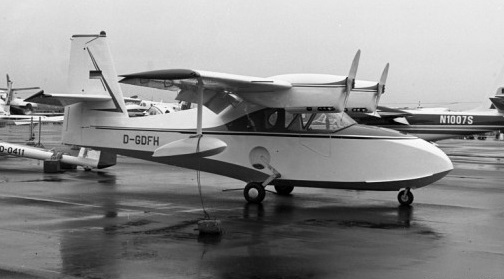
The CAJO 59 was designed by Carl Johansen (hence the name) as a general purpose 3-4 seat amphibious flying boat. It was a high-gull winged twin-engine monoplane with a wooden structure, mostly wooden skinned, apart from glass fibre/foam sandwich panels in the fuselage and fabric covered control surfaces. The wings inboard of the engines were built around two spars and had high dihedral (8.8°), which raised the engines well above the water. Outboard of the engines the wings had a single spar and were without dihedral. They carried full span slotted flaps and ailerons which were lowered when the flaps were fully extended.
The fuselage was flat sided with rounded decking, with the cabin under the wings. Its conventional flying boat V-shaped planing bottom had a change of curvature near midpoint but no discrete step. The vertical tail was straight-tapered, the rudder fitted with a trim tab. The cantilever variable incidence tailplane, with elevators, was mounted above the fuselage at about one third fin height.
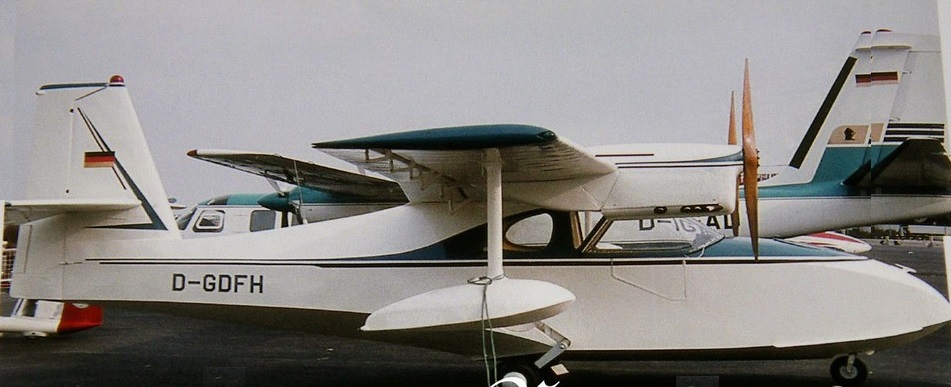
The CAJO 59 was powered by two 65 hp (49 kW) Walter Mikron III inverted inline engines. Two fixed floats, mounted well outboard on single struts, stabilised flights off water. It had a manually retractable tricycle wheeled undercarriage, with main legs mounted on the fuselage and retracting into it above the waterline.
The first flight was made from water on 25 July 1967 and the first from land on 17 April 1968. Certification facilities were lacking in Denmark, so the CAJO 59 was taken to Germany and flew as D-GDFH during 1970.
It achieved certification but did not go into production.
Engines: 2 × Walter Mikron III, 48 kW (65 hp)
Propellers: 2-bladed , wooden
Length: 6.95 m (22 ft 10 in)
Wingspan: 9.80 m (32 ft 2 in)
Height: 2.75 m (9 ft 0 in)
Wing area: 12.80 m2 (137.8 sq ft)
Empty weight: 580 kg (1,279 lb)
Max takeoff weight: 900 kg (1,984 lb)
Maximum speed: 215 km/h (134 mph; 116 kn)
Cruising speed: 200 km/h (124 mph; 108 kn)
Range: 1,000 km (621 mi; 540 nmi) with maximum fuel
Rate of climb MAUW: 4.5 m/s (890 ft/min)
Crew: one
Capacity: two-three passengers
Jodel D.160
After the D150, a D160 prototype was built. It was to become a six seater fitted with a six cylinder 235 hp Lycoming engine. The interior was fitted with two sets of individual seats and a rear bench seat. It had an electrically actuated canopy, hinged on the port side. It featured a wing span of 10,86 meters and had a length of 8,32 meters. A version with retractable gear and a constant speed prop was envisioned, but ultimately, the D160 never saw production.

