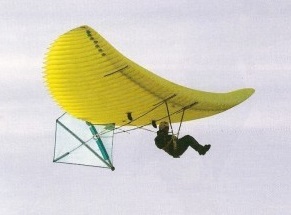
Kalbermatten Woopy

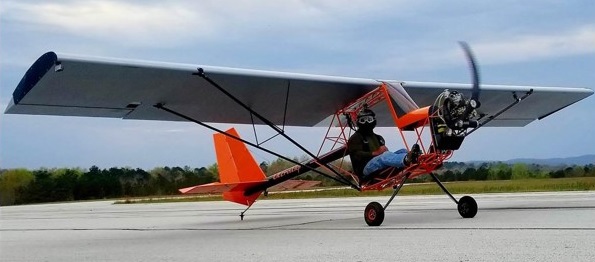
The Kalbermatten Woopy is a Swiss high-wing, single-place, hang glider that was designed by Laurent de Kalbermatten of Villars-sur-Glâne, Switzerland. The price was about 15’000CHF and ready to fly about 10 minute.

The Woopy fuselage is made from aluminum tubing, with a conventional tail, a seated pilot position and weight shift controls. The wing is inflatable and based on the same concept as an air mattress, kept inflated by two small battery-powered fans. Launch and landing is carried out on foot.

Much of the development was undertaken using scale flying models to speed construction and reduce pilot risk.
Two models were developed, the Woopy Fly and the Woopy Jump, plus a powered version of the Woopy Fly.
The Woopy Fly aircraft was developed in Siberia and can be assembled in 15 minutes, the wing is inflated by two small electric fans underneath the wing, and it is powered by small 20 hp engine.

Variants:

Woopy Fly
Initial model
Wingspan: 9.7 m (31.8 ft)
Aspect ratio: 4.58:1
Wing area: 20.5 sq.m (221 sq ft)
Empty weight: 17 kg (37 lb)
Glide ratio: 9:1

Powered Woopy Fly
Engine: HE R120 120 cc two-stroke, 20 hp
Propeller: 70 cm (28 in)
Empty weight: 123 lbs (56 kg)
MTOW: 240 lbs (109 kg)
Cruise speed: 32 kts / 37 mph / 59 kph
Stall speed: 23 kts / 26 mph / 43 kph
VNE: 40 kts / 46 mph / 74 kph
Take-off distance: 197 ft (60 m)
Landing distance: 164 ft (50 m)
Fuel consumption: 1 GPH (3.8 LPH)

Woopy Jump
More portable development model
Empty weight: 7 kg (15 lb)
Folded length: 160 cm (63 in)
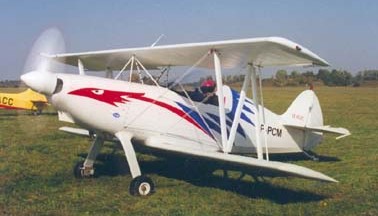
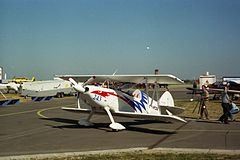
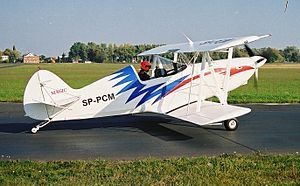
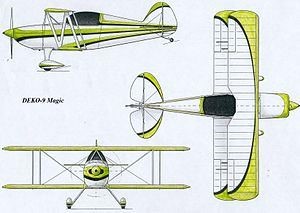
Kaiser DEKO-9 Magic / Dakomat Deko 9 Magic / Deko 9 Magic

A single-seat aerobatic sports and recreation biplane, the prototype aircraft developed on order from the German Kaiser-Flugzeugbau GmbH. The construction of the prototype, strength tests and flight tests carried out in Military Aviation Plant No. 3 Deblin (later called the Military Aviation Plant No. 1 SA branch) in Dęblinie, Poland. The design work, construction of prototypes and the necessary infrastructure took from 1996 to 1998.

The team headed by Lt.-Col. MSc. Wieslaw Pochylskiego, established a composites laboratory and strength tests, and a thermal tent enabling the study of metal-composite structures at elevated temperatures. Other members included Dr. Eng. Marek Debski and M. Sc. Christopher Kotliński. Builders and MSc. Marian Jakoniuk, MSc. Witold Wiraszka, Eng. Bruno Biernacki and Dr. Eng. Daniel Debski.

Calculations and strength tests were conducted by M.Sc. Vladimir Urbaniak – load, dr. Andrew Szot, MSc. George Mularczyk – static strength tests, Dr. Eng. Wojciech Hajec, MSc. James Kulecki – model airplane spin research, Warsaw University of Technology.

A biplane, the crew seats in tandem with a one-piece canop, and with a fixed main landing gear and tail wheel. The supporting structure of the fuselage is duralumin tube in composite nodes. The wings are double-girder construction with beams made of duralumin tubes and fixed to them duralowej pressed sheet metal ribs. The tail is welded construction made of thin-walled steel pipes. Polish made aircraft are overed with a heat-shrinkable polyester fabric, Dekonit 140 g / m².

First flight of the aircraft on 30 September 2000 and flight tests were performed by test pilot, MSc. , Maciej Aksler. The aircraft was presented at exhibitions air: ILA Berlin 1998 and 2000 and Fredrichshafen AERO 1999 and 2001.

ILA Berlin 2000

The engine of six produced by PZL Rzeszow was the 200 hp PZL Franklin 6A-350C1R , suitable for inverted flight and driving a three-bladed MT-Propeller MTV-9-DC / C188-18a propeller with hydraulically controlled pitch.

Also developed of four-cylinder Franklin 4A-235B4 92 kW (125 hp) powered version with open cockpit.

Engine: PZL Franklin 6A-350C1R, 205 hp (150 kW)
Span: 6.8 m
Length: 6.5 m
Height: 2.2 m
Wing area: 15.4 m²
Empty weight: 500 kg
Useful load: 250 kg
MAUW: 750 kg
Fuel capacity: 100 lt
Max speed: 220 km / h (119 kts IAS)
Cruising speed: 190 km / h (103 kts IAS)
Minimum speed: 90 km / h (49 kts IAS)
Vne: 350 km / h (189 kts IAS)
Rate of climb: 12 m / s (2362 ft / min)
Ceiling: 4000 m (13123 ft)
Range: 700 km (378 nm)
Take-off dist: 120 m (393 ft)
Landing dist: 120 m (393 ft)
Load factor design: + 6 / -3 g
Seats: 2

Deko-9 Magic

Kahnt Falke / Falcon

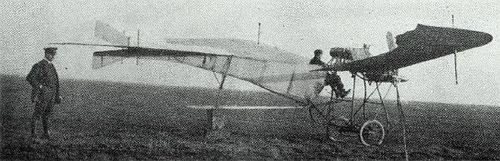
Thirteen meter span monoplane – with which two passengers could be carried beneath the pilot – built by Oswald Kahnt in Leipzig-Lindenthal. Kahnt was taught to fly by Hans Grade and opened the “1. Sächsische Fliegerschule” in Leipzig. Apart from some Grade machines, he built this monoplane during 1911. The power-plant used was initially a 45 hp Oerlikon; later a 70 hp Schröter inline engine was installed. With his “Falke”, Kahnt flew over the “Völkerschlachtdenkmal.” As head pilot at the Gothaer Waggonfabrik during the war, he was killed in a crash.

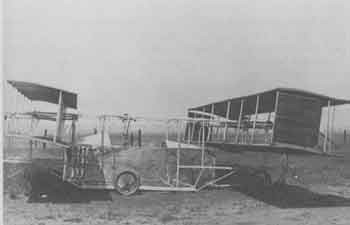
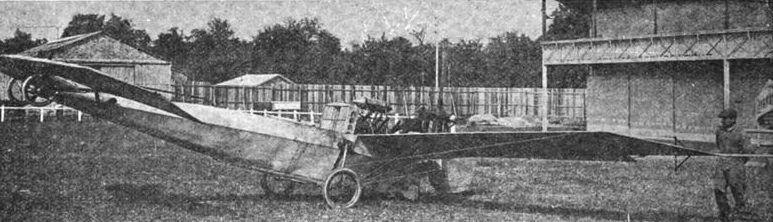
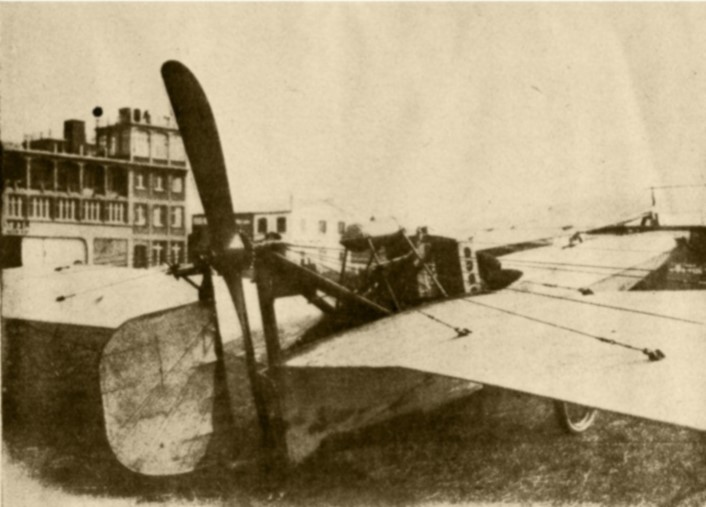
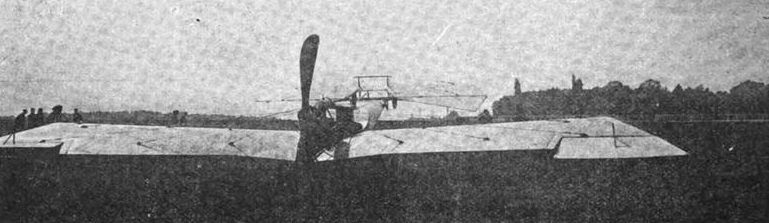
Juvigny 1914 Canard

The Canard was a design of Pierre Juvigny which was in the list of about 56 enlisted competitors of the Concours de sécurité 1914 which was published on 17 January 1914. The Concours started in June 1914, but the Juvigny Canard was not ready for competition.

It is noted that the jury nevertheless inspected the incomplete machine (unable to compete) and inspected the variable incidence mechanism of the wing. Due to the weight of the engine and ancillary equipment the machine stood with the nose high when on the ground. There is no information that it took to the air and after the outbreak of the war in begin August 1914 experiments were presumably halted.

Just Aircraft 103

Troy Woodland designed the Just 103 to conform to the FAA Part 103 requirements for ultralight aircraft, including a maximum weight of 254 pounds, a single seat, and a top speed of 63 mph. The new ultralight logged 1.5 hours before heading to the Sun ‘n Fun International Fly-In and Expo. Other than a narrow windscreen, the pilot is very much out in the open air, “which was typical with a lot of earlier Part 103 designs”.

A Polini Thor 250 engine from Italy supplies 37 horsepower at 7,500 rpm, and retails for less than $4,000. Woodland also expected to mount a Rotax 582, which would push the aircraft beyond the ultralight limits and require registration as a light sport or experimental light sport aircraft.

The company was to sell the Just 103 as a kit or ready-to-fly from the factory in Walhalla, South Carolina.

Just Aircraft SuperSTOL

The Just Aircraft SuperSTOL is a classic doped fabric/chrome moly steel frame taildragger with automatically deploying full-span two-segment leading-edge slats, 15-25-40-degree barn door flaps, Rotax 912 power and hydraulic shock-absorbing main gear struts.

The SuperSTOL is based on the Just Highlander. The base price (kit) for the SuperSTOL in 2012 was $36,650 (before engine and avionics), with S-LSA certification underway.

Just Aircraft Highlander

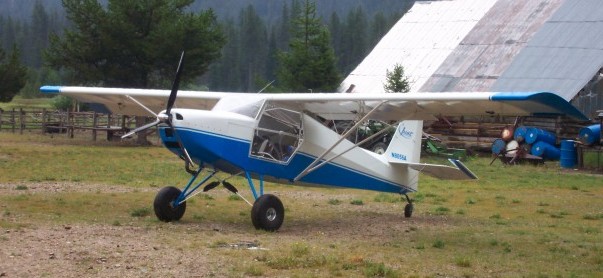
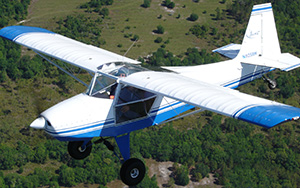
Introduced at Arlington and Oshkosh 2004, Highlander is an upgraded version of the Escapade. Just Aircraft’s new bush plane qualifications are enhanced by a larger balanced elevator and rudder, a larger trim tab, extended (and beefed up) gear legs with larger wheels and brakes, gull wing doors (can be opened in flight), an 8″ tail wheel and VG’s. And, a new three foot longer wing.
The Highlander has the same features as the Escapade, but with all the upgrades to make it a better backcountry aircraft. The Highlander is manufactured with all high quality aircraft materials. It is also manufactured with attach points for floats, lots of cabin area and extra large cargo area.
The Escapade and Highlander share considerable structural elements including the chrome-moly fuselage frame, wing airfoil construction, and engine compartment.
Using the same basic fuselage for both planes means they both have a huge luggage capacity that extends to the tail. The planes can handle a 6’7”+ frame and 300lb+ people. With sliding seats and 44” of elbow room.
Highlander LSA 2010 Kit Price: US$22,250
Both planes can be flown with the doors off or the doors and windows open, although a heater can be installed for frigid conditions.
The planes are available as complete ready to assemble kits which take about 600 – 700 hours to complete. Or you may choose various stages of assembly based upon your time demands and pocket book. Some choose to have the factory finish the wings and cover the fuselage which cuts the build time in half. There is also the option of “Build Assist” where for a monthly fee the owner may assemble the plane in the factory with company experts on hand for assistance. Those desiring a complete build ready to fly option will find this also available.
This would be SLSA certified if desired.
An extended-gear option for the Highlander provides heavy-duty axles to support bush tires: those legs raise the fuselage and widen the track by about 4 inches.
The Highlander is the bush plane model of the Escapade with longer wings, taller-heavier gear, tundra tires and larger tail feathers with balanced elevator and rudder.

The Escapade and Highlander can be installed with any power plants in the weight range of the Rotax 503 up to the Rotax 914 or Jabiru 2200 up to the Jabiru 3300.

Engine: Rotax 912 100 hp
Height: 7’10”
Length: 19′
Cabin Width: 44 in
Wing Span: 31′ 6″
Wing Area: 120.75 sq.ft
Empty Weight: 620 lbs
Gross Weight: 1320
Useable Load: 700
Fuel Capacity: 18 USgal
Flight Load Factor: +4 -2 G
Vne (never exceed speed): 130 mph
Cruise speed @ 75% power: 105 mph
Vso (full flap) at Gross Weight: 23 mph
Vs (clean) at Gross Weight: 27 mph
Take off Distance Ground Roll: 300 ft
Landing Distance Ground Roll: 250 ft

Highlander LSA
Engine: Rotax 912S, 100 hp
Wingspan: 31′ 6″
Length: 19 ft
Wing area: 116.25 sq.ft
Empty weight: 620 lb
MTOW: 1320 lb
Useful load: 700 lbs
Cruise 75%: 105 mph
Stall: 25 mph
Range: 520 sm
ROC: 1500 fpm
Takeoff dist: 100 ft
Landing distance; 75 ft
Seats: 2
Cockpit width: 44 in

Engine: Rotax 912S, 100 hp
Wing Span: 31’6”
Wing area: 120.75 sq.ft.
Mean Cord: 45”
Length: 19’
Height: 7’10”
Length Folded: 20’8”
Width Folded: 7’ 11.5”
Number of Seats: 2
Number of Doors: 2
Landing Gear: 8” Tail Wheel
Gear Width: 76”
Fuel Capacity: 18 or 26 USGallons (24 useable)
VNE: 130 mph
Cruise: 110 mph
Stall With Flaps 40 deg: 27 mph
Stall Clean: 32 mph
Take off Roll: 300 ft
Take off Distance to 50 ft: 800 ft
Ground Roll: 300 ft
Landing Distance from 50 ft: 1000 ft
Climb Rate: 880 fpm
Gross weight: 1320 Lbs
Empty weight: 615 Lbs
Useful Load: 705 Lbs
Load Limit Factors: +4 g’s –2 g’s

Just Aircraft Escapade

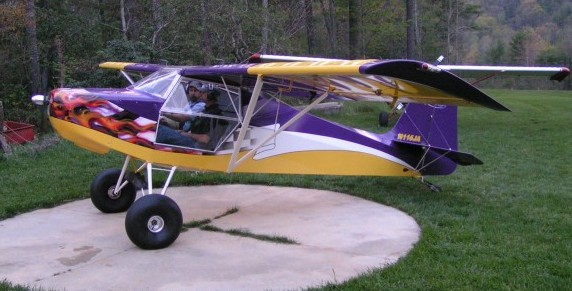
The Escapade has been developed to meet the demand for a two place side-by-side dual control (individual stick controls) aircraft that can be used for training as well as recreation.
The Fuselage, tail and landing gear are manufactured from 4130 Chrome-moly steel.
The original Escapade earned the United Kingdom’s BCAR (British Civil Aviation Requirement) Section S structural – and flight – test standards.

The wings fold in under 2 minutes with no disconnecting of any controls or control surfaces. The Escapade can be configured with tail-wheel or tri-cycle landing gear with the ability to swap from one to the other in about 1 hour.

The Escapade has been through UK Section S static testing certification requirements and flight-testing certification requirements. The Escapade can be installed with any power plants in the weight range of the Jabiru 2200 or Rotax 912/914. Jabiru Pacific can provide from the firewall forward.

The Escapade and Highlander share considerable structural elements including the chrome-moly fuselage frame, wing airfoil construction, and engine compartment.
Using the same basic fuselage for both planes means they both have a huge luggage capacity that extends to the tail. The planes can handle a 6’7”+ frame and 300lb+ people. With sliding seats and 44” of elbow room.
Both planes can be flown with the doors off or the doors and windows open, although a heater can be installed for frigid conditions.
The planes are available as complete ready to assemble kits which take about 600 – 700 hours to complete. Or you may choose various stages of assembly based upon your time demands and pocket book. Some choose to have the factory finish the wings and cover the fuselage which cuts the build time in half. There is also the option of “Build Assist” where for a monthly fee the owner may assemble the plane in the factory with company experts on hand for assistance. Those desiring a complete build ready to fly option will find this also available.
This would be SLSA certified if desired.
Escapade LSA 2010 Kit Price: US$20,250
The Escapade and Highlander can be installed with any power plants in the weight range of the Rotax 503 up to the Rotax 914 or Jabiru 2200 up to the Jabiru 3300.

Variation:
Lanitz Escapade Two

Engine: Rotax 912, 80 hp
Height: 7’2”
Length: 19′
Cabin Width: 44 in
Wing Span: 28′ 6″
Wing Area: 108 sq.ft
Empty Weight: 615 lbs
Gross Weight: 1320
Useable Load: 705
Flight Load Factor: +4 -2 G
Vne (never exceed speed): 130 mph
Cruise speed @ 75% power: 110 mph
Vso (full flap) at Gross Weight: 27 mph
Vs (clean) at Gross Weight: 32 mph
Climb Rate (sea level @ gross): 880 ft/min
Take off Distance Ground Roll: 300 ft
Landing Distance Ground Roll: 300 ft
Fuel Capacity: 18 USgal

Escapade LSA
Engine: Jabiru 2200 85 hp
Wingspan: 28′ 6″
Empty weight: 620 lb
MTOW: 1320 lb
Useful load: 700 lb
Cruise 75%: 110 mph
2010 Kit Price: US$20,250

Engine: Rotax 912S, 100 hp
Wing Span: 28’6”
Wingarea: 108 sq.ft.
Mean Cord: 45”
Length: 19’
Height: 7’2”
Length Folded: 19’2”
Width Folded: 7’ 11.5”
Number of Seats: 2
Number of Doors: 2
Landing Gear: Tricycle or Tail Wheel
Gear Width: 72”
Fuel Capacity: 18 or 26 USGallons (24 useable)
VNE: 130 mph
Cruise: 110 mph
Stall With Flaps 40 deg: 27 mph
Stall Clean: 32 mph
Take off Roll: 300 ft
Take off Distance to 50 ft: 800 ft
Ground Roll: 300 ft
Landing Distance from 50 ft: 1000 ft
Climb Rate: 880 fpm
Gross weight: 1320 lbs
Empty weight: 615 lbs
Useful Load: 705 lbs
Load Limit Factors: +4 g’s –2 g’s

Jurkštas RJ-2

In 1998 Jurkštas started the construction of the plane named JR biplane – 2, although it more often fellow aviators called it “Biukeriu” because the similarity to the German aircraft. Jurkštas does not deny the similarity, but argues that the design that the detailed drawings, were followed by five years was work.

The JR-2 is an ultra-light wooden structure biplane. The front part of the fuselage is covered with oilcloth, and the rear with canvas. The front by the engine hss duralumin coated tin. There is a technical requirement that this place is not flammable. The bonnet is formed of glass material.

Wooden structure has two wings spars. The front part of the first spar coated oilcloth. Next frame covered with canvas wings. The upper wings are connected on duraliminio pipes. The lower wings attach to the trunk connectors with 2.5 mm thick stainless steel plates. The wings are tensioned with 5.6 mm diameter steel guys.

The stabilizer and fin also has two spars. Their profile is NACA 0009. Until the first spar they are oilcloth covered, the rest is canvas. The rudder is coated with canvas. Wheels 350X135 came from a L-13 Blanik glider.

The wood was gathered in one of Silutes sawmills by R.Jurkštas. Jurkštas said that it was created by looking at a Piper Cub.

An air-cooled VW 1600 engine turns a constant pitch 1.52 m diameter propellor, which is made of laminated wood. The pitch is 0.92 m . The engine is 65 hp, maximum shaft speed of 4600 rev / min. The engine cost 250 litas.

The fuel tank is installed in the front of the fuselage. Its capacity of 23 liters. It is attached with duralumin screw bands.

The Lithuanian biplane was completed in 2003, and the first flight was on June 23, 2004, piloted by R.Jurkštas. After the first tests, it was decided that the aircraft would better suit a larger diameter and pitch propeller. That improved its flight characteristics. R.Jurkštas flew more than 60 hours.