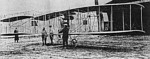
The 1909 Kluytman twin-pusher biplane was designed and built by Kluytman in France.
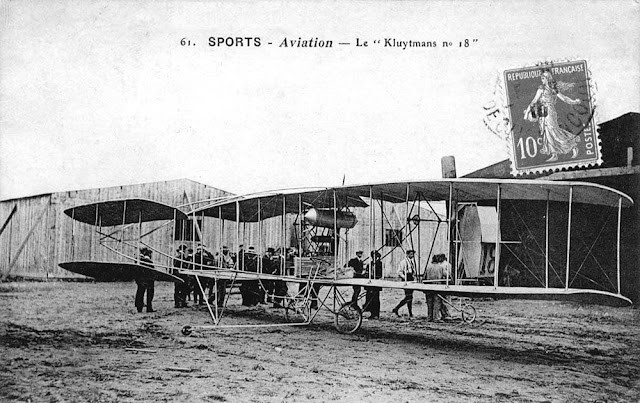
The 1909 Kluytman twin-pusher biplane was designed and built by Kluytman in France.
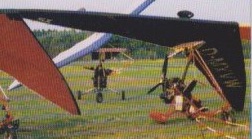
As well as the two seat Twin Racer there is also a smaller single seater.
Empty weight: 135 kg
Wing span: 10.6 m
Wing area: 16 sq.m
Fuel capacity: 50 lt
Certification: Vz
Engine: Rotax 582, 58 hp
MAUW: 400 kg
Seats: 2
Max speed: 90 kph
Cruise speed: 80 kph
Minimum speed: 45 kph
Climb rate: 2 m/s
Fuel consumption: 12 lt/hr
Price (1998): 31 088 DM
Single seat single engined flex wing aircraft with hybrid control. Rogallo wing; tail carries rudder and horizontal stabiliser. Pilot suspended below wing in trike unit, using bar to control pitch and roll by altering relative positions of trike unit and wing. Control input through pedals for yaw. Wing braced from above by kingpost and cables, from below by cables. Undercarriage has three wheels in tricycle formation. Engine mounted below wing driving pusher propeller.
Two Rogallo winged microlights are known to have been produced under the umbrella of this organisation, both of them attributed to Yevgueni Chevcheriko. As such they are hybrid control aircraft and are best described as ‘trike plus rudder on trike unit’. The trike unit is hung from the Rogallo in the normal way and the relative positions of the two can be altered to give pitch and roll control, just as in any other trike, but instead of relying on roll to initiate yaw, a separate rudder is attached to the rear of the trike unit, controlled by rudder pedals.
The Russian aircraft have a horizontal stabiliser behind the pilot. The Ptica 2, the earlier of the two Russian designs, has a large windscreen. The Ptica 2 has a 42 hp engine, 4 hp less than the SPM.
The initials SPM stand for Siniaya Ptica Modernisovanna, and it is basically an updated version of the Ptica 2.
Engine: 46 hp.
Total wing area 221 sq.ft, 20.5 sq.m.
Power per unit area 0.21 hp/sq.ft, 2.2 hp/sq.m.
Max take off weight: 401 lb, 182 kg.
Max wing loading: 1.81 1b/sq.ft, 8.9 kg/sq.m.
Max power loading 8.7 lb/hp, 4.0 kg/hp.
Take off speed 25mph, 40 kph.
Take off distance 100 130ft, 30 40m.
Landing dis¬tance 80 100 ft, 25 30 m.
Single seat single engined flex wing aircraft with hybrid control. Rogallo wing; tail carries rudder and horizontal stabiliser. Pilot suspended below wing in trike unit, using bar to control pitch and roll by altering relative positions of trike unit and wing. Control input through pedals for yaw. Wing braced from above by kingpost and cables, from below by cables. Undercarriage has three wheels in tricycle formation. Engine mounted below wing driving pusher propeller.
Two Rogallo winged microlights are known to have been produced under the umbrella of this organisation, both of them attributed to Yevgueni Chevcheriko. As such they are hybrid control aircraft and are best described as ‘trike plus rudder on trike unit’. The trike unit is hung from the Rogallo in the normal way and the relative positions of the two can be altered to give pitch and roll control, just as in any other trike, but instead of relying on roll to initiate yaw, a separate rudder is attached to the rear of the trike unit, controlled by rudder pedals.
The Russian aircraft have a horizontal stabiliser behind the pilot. The Ptica 2, the earlier of the two Russian designs, has a large windscreen. The Ptica 2 has a 42 hp engine, 4 hp less than the SPM.
Engine: 42hp.
Propeller diameter: 15in, 0.38m.
Total wing area 242 sq.ft, 22.5sq.m.
Power per unit area 0. 17 hp/sq.ft, 1.9hp/sq.m.
Take off speed 40mph, 65kph.
Cruising speed 62 mph, 100 kph.
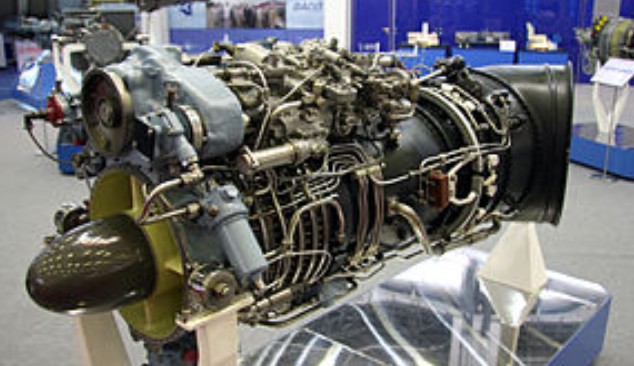
The Klimov TV3-117 is a Russian gas turbine aero engine first run in 1974. It is used in most medium lift, utility, and attack helicopters designed by the Mil and Kamov design bureaus. The TV3-117 turboshaft engine was developed in 1974 and later the TV3-117 was installed on 95% of all helicopters designed by Mil and Kamov Engineering Centre. The engine has been produced in many variants, with over 25,000 built.
Despite the similar designation, the TV7-117 engine family is new and unrelated to the TV3-117.
Variants:
TV3-117 – for Mi-24A (1972)
TV3-117M “marine”) – for Mi-14 helicopters incorporates special features to be used at sea. Mass production started in 1976
TV3-117MT “modernized, transport”) – for Mi-8MT/Mi-17 helicopters and their variants. Mass production started in 1977
TV3-117KM “Kamov, marine”) – for Ka-27 helicopters
TV3-117V (“V” stands for “high altitude”) – for Mi-24 helicopters operated in the mountains (particularly in Afghanistan). Mass production started in 1980
TV3-117VK (“high altitude, Kamov”) – a model similar to the TV3-117V engine but adapted to Ka-27, Ka-29 and Ka-32 helicopters. Mass production began in 1985. Export helicopter models were equipped with TV3-117VKR engines featuring a higher rated and cruising power (“VKR” stands for “high altitude, Kamov, power”); they were originally designed for Ka-28 machines
TV3-117VM (“VM” stands for “high altitude, modernized”) – for Mi-28 helicopters and later installed also on Mi-8MT/Mi-17 models. This engine features an automatic switch to emergency power. It was awarded type certificates by the IAC Aviation Registry, India, the Republic of China and the People’s Republic of China. Mass-produced since 1986
TV3-117VMA (“VMA” stands for “high altitude, modernized, model A”) – for Ka-50 helicopters. It is currently installed on Ka-27, Ka-29, Ka-31, Mi-24, Mi-28A/N and Ka-32 machines. This engine was awarded type certificates by the IAC Aviation Registry and by Transport Canada. Mass production started in 1986. Export models are equipped with TV3-117VMAR engines (the extra “R” stands for “power”) whose rated power and cruising power are similar to those of the TV3-117VKR engine
TV3-117VM Series 02 – a version of TV3-117VM for Mi-8MT/Mi-17 civil helicopters. Type certificates for this engine were awarded by the IAC Aviation Register, India, the Republic of China and the People’s Republic of China. Mass production started in 1993
TV3-117VMA series 02 – a version of TV3-117VMA for Ka-32 civil helicopters. Type certificates for this engine were awarded by the IAC Aviation Register, Transport Canada and Switzerland. Mass production started in 1993
TV3-117VMA-SBM1 a Turboprop version for An-140 aircraft produced by the Antonov Company
TV3-117(A) – for an unmanned reconnaissance aircraft (UAV)
VK-2500 highly modified TV3-117 also for hot and high.
Applications:
Antonov An-140
Kamov Ka-27
Kamov Ka-29
Kamov Ka-32
Kamov Ka-50
Mil Mi-8
Mil Mi-14
Mil Mi-17
Mil Mi-24
Mil Mi-28
Mil Mi-35
Specifications:
TV3-117VMA Series 2
Type: Free-turbine Turboshaft
Length: 2,055 mm (80.9 in)
Diameter: 728 mm (28.7 in) (height)
Dry weight: 294 kg (648 lb)
Maximum power output: 1,640 kW (2,200 shp) (take-off)
Overall pressure ratio: 9.4:1
Turbine inlet temperature: 920-990 C (Turbine entry temperature)
Specific fuel consumption: 0.308 kg/kW/hr (0.507 lb/shp/hr)
The Klimov M-120 was a Soviet prototype 18-cylinder liquid-cooled inline aircraft engine designed during the early years of World War II. Testing did not go well and it was cancelled in 1942.
The M-120 was developed by arranging three Klimov M-103A cylinder blocks in an inverted ‘Y’ configuration, driving a common crankshaft. It began development in 1938 and manufacture of five prototypes began in late 1939. The first prototype was completed on 30 October 1939 and began bench tests the next year. Two M-120TKs were flown in a prototype Ilyushin DB-4 bomber in November 1940. It was submitted for its State acceptance trials in August 1941, but the main connecting rod and the supercharger both broke down and the tests were not completed. The project was cancelled in 1942.
Variants:
M-120
1,600 hp (1,193 kW), weight of 850–895 kg (1,874–1,973 lb).
M-120TK
1600 hp, weight of 950 kg (2,094 lb), fitted with turbo-supercharger.
M-120UV
1,800 hp (1,342 kW). Version with a long shaft to the remote reduction gear.
M-120UV-TK
A 1940 project to combine the two variants.
Specifications:
M-120TK
Type: liquid-cooled, 18-cylinder, three-block inline engine
Bore: 148 mm (5.8 in)
Stroke: 170 mm (6.7 in)
Displacement: 54 l (3,295 cu in)
Dry weight: 950 kg (2,090 lb)
Supercharger: single stage, two-speed geared
Cooling system: liquid
Power output: 1,600 hp (1,193 kW)
Compression ratio: 6.6:1
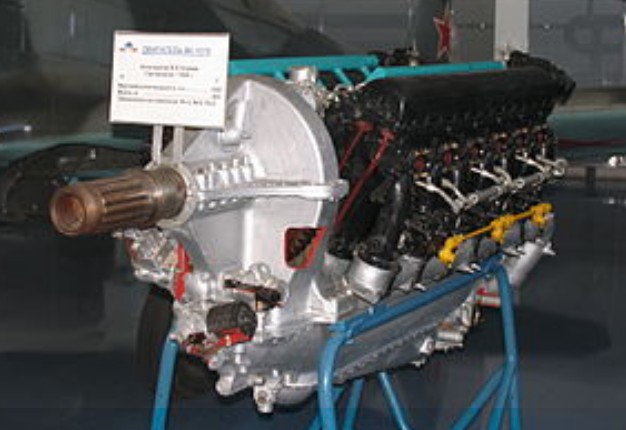
The Klimov VK-107 was a V-12 liquid-cooled piston aircraft engine used by Soviet aircraft during World War II.
The VK-107 was a brand-new design having little in common with its predecessors M-105 and VK-106. To achieve a greater power output, each cylinder now had four valves (two intake and two exhaust), crankshaft and camshafts were completely revised, and a new supercharger design was implemented. Although the engine could have been ready for production as early as 1942, Soviet factories lacked the capacity to produce a brand new design. Thus, less powerful VK-105PF and VK-105PF2 were built instead. However, the appearance of Luftwaffe Messerschmitt Bf 109G with Daimler-Benz DB 605 engine in 1943 created an urgent demand for a more powerful engine. VK-107A was put into production in 1944 and was used on Yak-9U fighters. The engine was not well liked by either pilots or mechanics — it had a life expectancy of only 25 hours and war emergency power was almost never used for fear of decreasing this even more. The engine was also difficult to service, in part because its exhaust headers were on the inside of the cylinder banks, the reverse placement of most V-type liquid-cooled engine designs.
Variants:
VK-107A – production version
VK-107R – version for hybrid piston-motorjet powered Mikoyan-Gurevich I-250 (N) and Sukhoi Su-5 fighters
VK-108 – attempt to further develop VK-107 with 1,380 kW (1,850 hp) on takeoff, used on several Yakovlev Yak-3 prototypes but did not enter production.
Applications:
Mikoyan-Gurevich MiG-7
Petlyakov Pe-2
Yakovlev Yak-3
Yakovlev Yak-9
Specifications:
VK-107A
Type: 12-cylinder supercharged liquid-cooled Vee aircraft piston engine
Bore: 148mm (5.83in)
Stroke: 170mm (6.69in)
Displacement: 35.08 liters (2,140 in³)
Dry weight: 765 kg (1,685 lb)
Valvetrain: Two intake and two exhaust valves per cylinder actuated via an overhead camshaft
Supercharger: Single stage, two-speed, gear-driven centrifugal type supercharger
Cooling system: Liquid-cooled
Power output:
1,230 kW (1,650 hp) at 3,200 rpm for takeoff
1,082 kW (1,450 hp) at 2,800 m (12,500 ft)
Specific power: 35.1 kW/L (0.77 hp/in³)
Compression ratio: 6.75:1
Power-to-weight ratio: 1.61 kW/kg (0.98 hp/lb)
The Klimov M-106 was an experimental liquid-cooled V12 piston aircraft engine intended for Soviet aircraft during World War II.
With the VK-105PF exhausting the potential of the M-105, Klimov prolonged its development into new VK-106 engine from 1941. Since air combat on the Eastern Front took place primarily at low altitudes (under 4,000 m {13,000 ft}), the new engine was built specifically for peak performance at those altitudes with a reduced compression ratio and a single-speed supercharger. Static testing was carried out from 27 October till 9 November 1942. Although reliable and easily installed in M-105-powered aircraft, VK-106 did not enter production because its cooling problems were not solved. Like M-105P, VK-106P could house an autocannon in the “vee” between the cylinder banks. Over 300 engines were built.
Applications:
Yak-1b with M-106
Specifications:
VK-106-1sk
Type: 12-cylinder supercharged liquid-cooled piston aircraft engine
Bore: 148mm (5.83 in)
Stroke: 170mm (6.69 in)
Displacement: 35.08 liters (2,140 in³)
Dry weight: 600 kg (1,320 lb)
Supercharger: Gear-driven single-stage single-speed centrifugal type supercharger
Fuel type: 95-octane rating gasoline
Cooling system: Liquid-cooled
Power output:
1,007 kW (1,350 hp) at 2,600 rpm for takeoff
1,007 kW (1,350 hp) at 2,000 m (6,560 ft)
Specific power: 28.8 kW/L (0.63 hp/in³)
Compression ratio: 6.5:1
Power-to-weight ratio: 1.68 kW/kg (1.02 hp/lb)
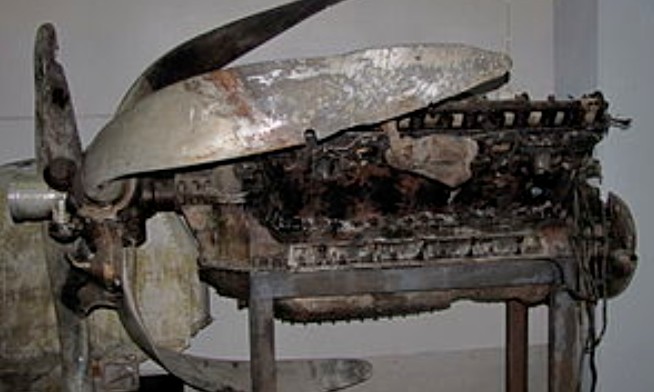
The Klimov M-103 is a V12 liquid-cooled piston aircraft engine used by Soviet aircraft during World War II.
The M-103 was a further development of the Klimov M-100 engine that was itself a licensed copy of the French Hispano-Suiza 12Ybrs. It differed from both engines in a number of aspects such as increased compression ratio, increased supercharger ratio, increased rpm’s, strengthened cylinder blocks, a new crankshaft, and flat bottomed cylinders. Developed in 1936 it was ready for testing in October 1936. The first two models failed testing due to cracked cylinder blocks and the engine was resubmitted for testing in 1937. After passing its trials it was cleared for production in 1938 and 11,681 were produced until 1942 at its factory in Rybinsk. The M-103 was followed by the M-105.
Variants:
M-103A – 148mm rather than 150mm bore cylinders.
M-103P – A ShVAK cannon fitted to fire through the engine vee.
M-103SP – A proposed version with two engines married to a common crankshaft.
M-103G – With Glycol rather than water cooling.
M-103A-TK – With an experimental Turbo-Supercharger
M-103U – Improved service life variant.
M-104 – Basically a M-103A with a two speed single stage supercharger for increased performance. 232 built.
Applications:
Bolkhovitinov S
Beriev MBR-7
Polikarpov TsKB-44
Polikarpov VIT-1 & VIT-2
Tupolev SB
Yakovlev Yak-2
Yakovlev Yak-12
Yakovlev Yak-22
Specifications:
M-103A
Type: Twelve-cylinder supercharged liquid-cooled 60° V12 engine
Bore: 148mm (5.826 in)
Stroke: 170mm (6.693 in)
Displacement: 35.101 Liters (2,142.2 cu in)
Length: 1,971 mm (77.6 in)
Width: 764 mm (30.08 in)
Height: 942 mm (37.08 in)
Dry weight: 500 kg (1,101 lb)
Valvetrain: One intake and one sodium-filled exhaust valve per cylinder actuated via a single overhead camshaft per bank.
Supercharger: Gear-driven single-speed centrifugal type compressor. Gear ratio: 11.0:1. Maximum boost for take-off: 1,100 mm Hg (43.30 MP). Maximum boost at altitude: 920 mm Hg (36.22 MP). Critical altitude: 4,000 m (13,123 ft)
Fuel system: Six K-100A Carburettors (License copy of Solex-Hispano 56S2 self-adjusted carburettor)
Fuel type: 90 (minimum grade), 95 or 100 octane.
Cooling system: Liquid-cooled
Reduction gear: 2:3
Power output:
1,000 hp (745 kW) at 2,450 RPM for take-off, boost rated at 1.44 Atm (43.30 MP)
960 hp (715 kW) at 2,400 RPM at 13,123 ft (4,000 m), boost rated at 1.21 Atm (36.22 MP)
500 hp (372 kW) at 2,450 RPM at 30,839 ft (9,400 m)
Specific power: 21.22 kW/L (0.466 hp/in³)
Compression ratio: 6.6:1
Specific fuel consumption: 328 g/(kW•h) (0.54 lb/(hp•h))
Oil consumption: 11 g/(kW•h) (0.28 oz/(hp•h))
Power-to-weight ratio: 1.50 kW/kg (0.916 hp/lb)
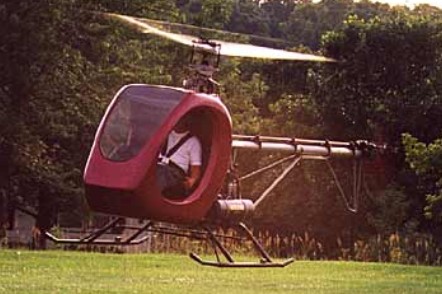
This helicopter was designed, completed, and flown in one year, one month, one week and one day.
It’s named the Kinney HRH (Hot Rod Helicopter) because of the lack of doors and hood and an air cleaner from a dual quad setup. The helicopter is small enough to fit in a home garage, and the counter-clockwise rotation of the Waitman blades is the same as standard America helicopters.
The HRH uses a 165 hp 4-cycle, 4 cylinder Subaru. It employs a computer-controlled fuel-air mixture, redundant fuel pumps, and multi-port fuel injection. It uses regular gasoline. The rotor head provides full cyclic and collective pitch, with an electronic system for maintaining rotor speed. The main blades are constructed of composite materials and the tail rotor is shaft driven.
The fully enclosed composite cabin features a fully equipped panel with both digital and analog instrumentation; a vinyl-covered seat with a “crumple-zone” support; a 4-point aircraft seat belt; and a tinted polycarbonate windshield. Addition of doors and a catalytic heater provide year-round comfort.
The powder-coated airframe is formed of aircraft-grade 4130 chromemoly steel, the primary structure both welded and bolted together with aircraft hardware. Most of the aluminum parts are black anodized.
Engine: Subaru EJ-25, 165 hp
Cruise speed: 80-90 mph
Empty weight: 1000 lbs
Useful load: 350 lbs
Gross weight: 1,350 lbs
Main rotor diameter: 25 ft
Main rotor chord: 8 in
Tail rotor diameter: 46 in
Length: 20 ft
Height: 7.25 ft
Width: 5.55 ft (175 cm)
Fuel capacity: 18.5 USgal.
Main rotor RPM: 520
Tail rotor RPM: 2,900
Endurance: 2 hours
Top speed: 103 mph
VNE: 115 mph
Blade: Waitman composite
Tail rotor chord: 4.5 in

