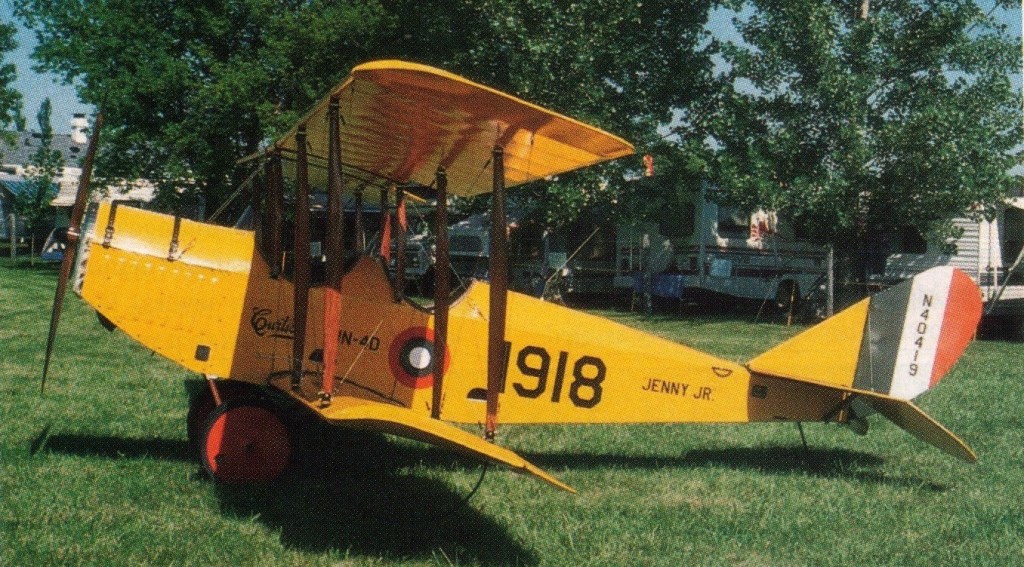
Built by Richard Kosi from Peru, Illinois, USA.
Built by Richard Kosi from Peru, Illinois, USA.
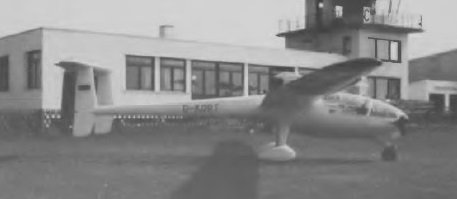
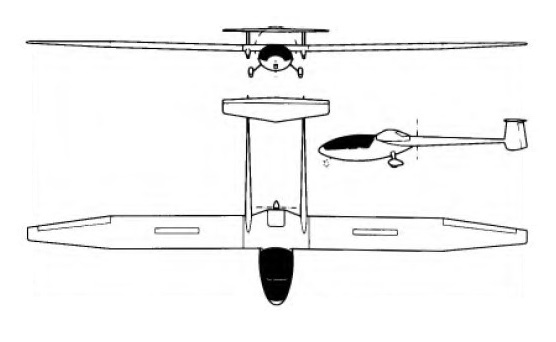
Having a twin boom pusher configuration and (on the second prototype) a conventional fixed, spatted main undercarriage, the Kora 1 is a side-by-side two seater intended primarily for training; it was designed by Messrs Schultes, Seidel and Putz, and the firm of Kortenbach & Rauh is best known for its range of furniture and other products for the garden and household.
The prototype Kora 1 made its maiden flight on 13 September 1973 and had a forwards-retracting nosewheel and the main wheels retracting backwards into the tail booms. The second prototype, which first flew on 9 April 1976, had a fixed main undercarriage to save weight and complexity, and was still undergoing flight testing at the beginning of 1978, at which time it had not yet been decided whether to start production, although orders had already been received for about a dozen Koras.
The power plant is a 65hp Limbach SL 1700EC1 air-cooled ‘flat four’ driving a Hoffman two-blade variable-pitch feathering propeller. The Kora is of all-wood construction, with cantilever high wings which have Schempp-Hirth air brakes in the upper surfaces. The pod-type fuselage nacelle has roomy side-by-side seating in a cockpit 47in wide, the canopy opening sideways to starboard. The twin tail booms end in twin fins and rudders which have the tailplane mounted on top of them. The fixed main undercarriage units on the second prototype consist of two spatted main wheels set on thin steelsprung legs cantilevered from the fuselage underside.
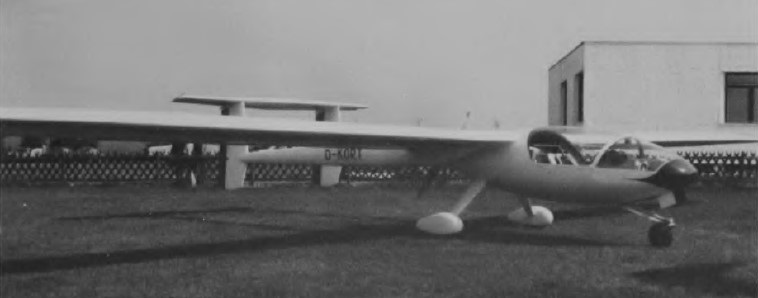
Second prototype
Engine: Limbach SL 1700 EC1, 48.5 kW / 65 hp
Span: 18.0 m / 59 ft 0.75 in
Length: 7.4 m / 24 ft 3.25 in
Height: 1.85.m / 6 ft 0.75 in
Wing area: 19.44 sq.m / 209.25 sq ft
Aspect ratio: 16.65
Wing section: Wortmann FX-66-S-1967161
Empty weight: 510 kg / 1,124 lb
Max weight: 750 kg / 1,653 lb
Water ballast: None
Max wing loading 38.58 kg/sq.m / 7.9 lb/sq ft
Max level speed at S/L: 110 kt / 205 km/h / 118 mph
Stalling speed: 35 kt / 65 km/h
Max rate of climb at S/L: 180 m/min / 590 ft/min
Min sinking speed: 0.85 m/sec / 2.79 ft/sec at 53 mph / 51 kt / 95 km/h
Best glide ratio: 30:1 at 59 mph / 54 kt / 100 km/h
The Korolyev RP-1 was a powered version of the Cheranovsky BICh-11 experimental tailless glider, designed together with Friedrich Zander (Tsander) and other Korolev’s friends from GIRD (ГИРД – Jet Propulsion Research Group).
It was planned to be a rocketplane (therefore RP index) and the Zander OR-2 rocket engine (500 N thrust) was designed especially for it. Development of the engine was very difficult, and Zander didn’t achieve success; furthermore on March 28, 1933 he died of typhus in Kislovodsk. The two RP-1 prototypes were tested in 1932-33 only as “ordinary” powered gliders, each with a 25-hp Scorpion piston engine.
The first of them was flown on June 8, 1932 – Korolyev himself was a test pilot. Totally 34 flights were made by him, but only 5 with the engine powered up.
Engine: 25-hp Scorpion
Wing span: 12.1 m
Length: 3.81 m
Wing area: 20.5 sq.m

After attending the Kiev Polytechnic Institute, Korolev went on to the Moscow Higher Technical University (MVTU). There he was involved in design and construction of an increasingly ambitious series of gliders, culminating in the powered SK-4, designed for record duration flights in the stratosphere.
The student of the graduate course of the Bauman Moscow Technical University Korolev passed the production practice at the Central Aerohydrodynamic Institute (TsAGI), at the Tupolev Design Bureau. At this time, he was already working at the aircraft factory in Fili. At the same time, in 1929, he was preparing a thesis project, deciding to design a light-engine twin aircraft SK-4 (his advisor was Andrei Tupolev).
The design of the SK-4 aircraft, designed for a record range of flight, turned out to be original, detailed and well designed. The project manager was Tupolev himself, signing it with the first presentation. This is not the case in the practice of students. The Tupolev approved single-engine two-seater SK-4 project was then built and tested.
The aircraft was designed for a 100-hp Shvetsov M-11, but it had just came to production and Korolev couldn’t obtain one. As an alternative one Walter NZ-60 engine, 5-cylinder radial, of 60 hp was used.
The SK-4 could be used as liaison and trainer aircraft, but Korolev planned to use it also for long-range air raids. He wanted to surpass the achievement of the Yakovlev AIR-3 in which pilot Filin, with journalist Koval’kov onboard, performed a non-stop flight from Minvody to Moscow on September 6, 1929 (during 10 hours 23 minutes they covered 1750 km – a world record for this category of aircraft, unregistered officially because USSR wasn’t FAI member that time).
The SK-4 was tested in late 1930 – early 1931 by Korolev’s good friend Dmitry Koshitz, and Korolev himself also participated in the tests. During one of test flights, the engine failed and the SK-4 crashed (Koshitz wasn’t seriously injured, and Korolev wasn’t onboard that time). The record flight was never attempted.
Engine: one Walter NZ-60, 60 hp
Wingspan: 12,2m
Wing area: 15.36 sq.m
Length: 7,15m
Height: 1,88m
Empty weight: 500 kg
Takeoff weight: 690 kg
Maximum speed: 160 km/h
Landing speed: 68 km/h
Service ceiling: 4000 m
Ceiling: 4000m
Seats: 2
Flight endurance: 2 hours

The Korean Air Chang-Gong 91 (English: Blue Sky 91) is a four-seat single-engined low-wing monoplane designed by the Korea Institute of Aeronautical Technology and built by the Aerospace Division of Korean Air.
Chang-gong-91 (meaning Blue Sky) was the first light plane prototype developed by Korean Air and other collaborative companies as a national policy research project led by the Ministry of Science & Technology.

Three prototypes were developed and the first flight was on 22 November 1991.
Due to low marketability forecast by Korean Air it was not put into production. It is now on static display at the Aviation Pavillion near Jeongseok Airport (RKPD).

Engine: 1 × Lycoming IO-360-A1B6, 149 kW (200 hp)
Wingspan: 10.2 m (33 ft 5 in)
Wing area: 14.86 m2 (160 ft2)
Length: 7.74 m (25 ft 5 in)
Height: 2.7 m (8 ft 10 in)
Empty weight: 839 kg (1850 lb)
Gross weight: 1225 kg (2700 lb)
Fuel Capacity: 210 ltr
Maximum speed: 339 km/h / 210 mph / 183 kts
Cruise Speed: 119 kts
Range: 1500 km / 932 miles / 600 nm
Take Off Distance: 620 m
Landing Distance: 270 m
Absolute Ceiling: 16500 ft
Service ceiling: 5025 m (16,500 ft)
Maximum Climb Rate: 740 ft/min
Seats: 4

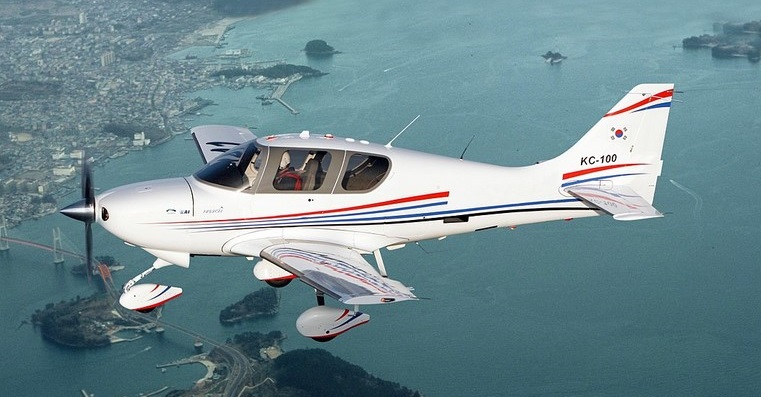
The KAI KC-100 Naraon is a four-seat, low-wing, single-engine light aircraft under development by Korea Aerospace Industries. Development began in June 2008 with a five-year development timeframe.
The KC-100 is built from carbon fibre and features gull-wing doors. The wing employs a laminar flow airfoil and winglets. The engine is a Continental TSIOF-550-K turbocharged 315 hp (235 kW) powerplant controlled by FADEC. A full-plane parachute system will be optional.
First flying on 20 July 2011, the name Naraon was chosen based on public input.
The company expected that deliveries would commence in mid-2013 at a forecast price of US$575,000.
In May 2014, the South Korean Air Force academy entered a memorandum of understanding to obtain a military trainer variant designated the KT-100, the first mass production contract for the aircraft. The KT-100 was to replace the 20 Ilyushin Il-103 aircraft at the academy to familiarize students with flying. The KT-100 first flew on 5 October 2015 and all expected to be delivered by the end of 2016.
KC-100 Naraon
Powerplant: 1 × Continental TSIOF-550-K , 315 hp (235 kW)
Wingspan: 37 ft 4 in (11.37 m)
Airfoil: laminar flow
Length: 27 ft 11 in (8.50 m)
Height: 9 ft 5 in (2.87 m)
Empty weight: 2,400 lb (1,089 kg)
Gross weight: 3,600 lb (1,633 kg)
Maximum speed: 210 kn (242 mph; 389 km/h)
Range: 1,200 nmi (1,381 mi; 2,222 km)
Crew: one
Capacity: three passengers
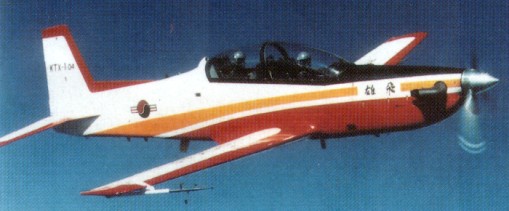
Development was initiated under the KTX program as a single-engined turboprop, basic training aircraft for the Republic of Korea Air Force in 1988 using the CATIA computer program to completely develop the aircraft, the first of its class. It was jointly developed by KAI and the Agency for Defence Development (ADD).
Nine prototypes were built on June 1991 with the first flight of the KT-1 occurring on November 1991 for static and fatigue testing. In 1995, the project was officially named ‘Woongbi’. In 1998 the final test flight was performed. The KT-1 is the first completely indigenous Korean aircraft ever developed. In 1999, a contract was signed for eighty-five aircraft with provisions for an additional twenty between Korea Aerospace Industries and the Republic of Korea. The first KT-1 Woongbi was handed over to the Republic of Korea Air Force in 2000 with the delivery of the eighty-five aircraft being completed in 2002. The Republic of Korea Air Force received 85 KT-1s and 20 KA-1s.
KT-1 can be equipped with either an analog or ‘glass’ cockpit configuration. Both types are employed by the Republic of Korea Air Force.
KAI exported seven KT-1Bs plus spare parts to Indonesia in April 2003 under a 60 million USD contract, and five more in May 2005. A KT-1B was lost during training 24-Jun-2010 .
In a press release held in Sacheon, South Korea on March 8, 2006, KAI stated that it will export more than 150 improved versions of the KT-1 to various countries in Central America and Southeast Asia. The improved export version of the KT-1 will be called KT-1C.
As of June, 2007, South Korea and Turkey have successfully negotiated for a contract of exporting 40(+15) KT-1, as well as modular armor technology of K2 Black Panther for Turkey’s future indigenous MBT, to Turkey for KRW₩500,000,000,000 (approximately US$540,000,000).
A statement published by Chungwadae, the South Korean Presidential website, on 26 January 2010, said that India and South Korea had agreed, as part of upgrading their partnership to a ‘strategic relationship’, form a joint committee in the first half of 2010. The statement added that this committee will facilitate an offer from Seoul to supply up to 60 KT-1 trainers to meet Indian Air Force requirements. However, India signed the contract with Pilatus to supply 75 PC-7.
On November 6th 2012, KAI and the Peruvian Air Force has successfully negotiated a $200 million contract for 20 KT-1Ps (10 KT-1 trainers and 10 KA-1 armed counterinsurgency variants) including some offset and technologies transfers for an approximate amount of US$208 millions. KAI will provide the first 4 airplanes by 2014 and the rest will be assembled at SEMAN (Maintenance air wing of the Peruvian Air Force).
Peru reported on 19 November 2013 having set up its KT-1 family assembly plant at Las Palmas Air Base in Lima, and plans to begin final assembly work on 16 planes beginning in March 2014. The first flight of a KT-1P for Peru took place on 19 Febuary 2014. Korean Aerospace Industries (KAI) announced on 21 May 2014 it started the production of the KT-1 Woongbi for the Peruvian Air Force.
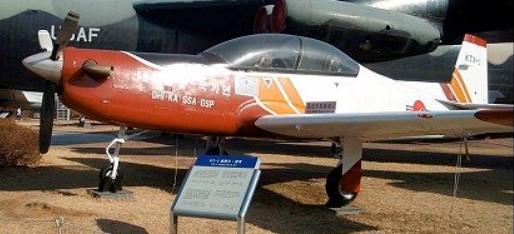
Variants:
KTX-1 Yeo-myung
Prototype primary trainer each with a different engine fitted, six built.
KA-1
An armed advanced trainer with light attack and forward air control capabilities. Several new features unique to the KA-1 are head-up-display and up-front control panel, MFD panels, and five hardpoints, two under each wing and one under the fuselage. The hardpoints may be equipped with rocket launcher, gun pods or AIM-9 Sidewinder missiles.
KT-1B
Export version for Indonesia.
KT-1C
Improved, armed export version equipped with a centreline forward looking infrared pod. The KT-1C may also be equipped with a 12.7 mm gun pod, chaffes, flares, training missiles, rockets or unguided bombs.
KT-1T
Export version for Turkey.
KT-1P
Export version for Peru.
Specifications:
KT-1
Engine: 1 × Pratt & Whitney Canada PT6A-62, 950 hp (708 kW)
Wingspan: 10.59 m (34 ft 9 in)
Wing area: 16.01 sq.m (172.3 sq ft)
Length: 10.26 m (33 ft 8 in)
Height: 3.68 m (12 ft 1 in)
Empty weight: 1,910 kg (4,210 lb)
Max. takeoff weight: 2,540 kg (5,600 lb)
Maximum speed: 574 km/h (310 knots, 357 mph) (IAS)
Range: 1,333 km (720 nmi, 828 mi) at 7,620 m (25,000 ft), max internal fuel
Service ceiling: 11,580 m (38,000 ft)
Rate of climb: 16.2 m/s (3,180 ft/min)
Endurance: 3 h
Crew: 2 in tandem


Kordin 1911 monoplane
Otto Koppen left Ford to join the faculty of MIT, and in 1938, he decided that the time was ripe for an easy to fly airplane, so while teaching at MIT, he designed and set up a company to produce the Skyfarer, a two seat, two control monoplane. Koppen felt the Skyfarer needed no rudder, since its large twin vertical stabilizers were widely spaced on the tail out of the slipstream. In the air, the ball stayed centered at all times. In fact, the Skyfarer was so easy to fly that a complete novice was once taught the basics during only 50 minutes in the airplane. Twenty five Skyfarers were built; then World War II began, the Government requisitioned aluminum and production stopped.
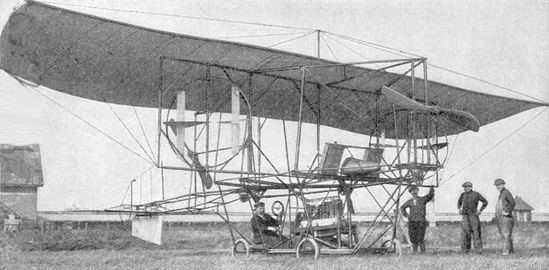
In 1913 Romanian émigré Alexander Kopcsa (often found written as Kopesa and Kopsca, his original Romanian name was Alexandru Copcea), living in Chicago, invented this large flying machine (span 50 feet and length 40 feet), intended to be used in an attempt to fly across the Atlantic Ocean. The 170 hp engine was to turn two vertical and two horizontal propellers.

