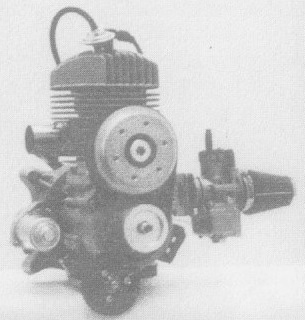
The Zanzottera MZ 34 and MZ 35 are a family of single-cylinder, two-stroke, single ignition aircraft engines designed for powered paragliders, one and two place powered parachutes, single place ultralight trikes, light single place ultralight aircraft and motor gliders.
The engine was originally designed and produced by Zanzottera Technologies of Italy, but the design was sold, along with the rest of the company’s two-stroke ultralight aircraft engine line to Compact Radial Engines of Surrey, British Columbia, Canada.
The MZ 34 and 35 both have a cylinder barrel that is Nikasil-coated. The engine features a decompression channel to allow easier recoil starting, a tuned exhaust system and a belt-type reduction drive. Starting options include a recoil or electric starter.
Earlier versions produced 26 hp (19 kW) at 6250 rpm or 38 hp (28 kW) with a tuned exhaust at 6450 rpm. The current production engine is rated at 27.5 hp (21 kW) at 6250 rpm. Reduction ratios available are 1.84, 2.05, 2.14, 2.24 and 2.34 to 1.
The unit cost for the MZ 34 in 2009 was US$2840, and the MZ 35 US$3120.
The owners manual acknowledges the limitations inherent in the design of the engine, stating:
This is not an aeronautics approved engine.
This engine has not been subjected to durability and safety tests in compliance with aeronautical standards. It is designed to be used in paramotors and ULM or aeroplanes where engine failure will not produce serious consequences. The user must assume responsibility for all risks deriving from the use of this engine and must understand that this engine is subject to sudden failure. Engine failure may result in an emergency landing. Such accidents may cause serious material damage and injuries. Never use an aircraft fitted with this engine in areas or at conditions and altitudes which may cause problems if forced to land as a result of sudden engine failure.
Variants:
MZ 34
Single cylinder, two stroke single ignition aircraft engine optimized for powered paragliders, one and two place powered parachutes, single place ultralight trikes, light single place ultralight aircraft
MZ 35
Single cylinder, two stroke single ignition aircraft engine with a narrower profile, optimized for motor-gliders
Applications:
Aviastroitel AC-5M
Belite Aircraft Superlite
The Butterfly Super Sky Cycle
Earthstar Thunder Gull
Fly Products Power
North Wing ATF
Paramotor Inc FX5
Spartan DFS Trike
Specifications:
MZ 34
Type: Single cylinder, two-stroke aircraft engine
Bore: 76 mm (2.99 in)
Stroke: 69 mm (2.72 in)
Displacement: 313 cc (19.10 cu in)
Length: 296 mm (11.65 in)
Height: 410 mm (16.14 in)
Dry weight: 17 kg (37 lb) with engine mount and silent-block mountings, starter motor, manual starter, reduction drive and muffler
Valvetrain: Reed valve induction
Oil system: 50:1 oil to fuel, premixed
Cooling system: air cooled
Ignition: Electronic
Reduction gear: Poly-V Belt drive with optional ratios of 1.84, 2.05, 2.14, 2.24 or 2.34 to 1
Power output: 27.5 hp (21 kW) at 6250 rpm
Max torque: 35 hp at 4100 rpm
Compression ratio: 9.6:1
Price 1998: 149 00 Fttc

 All Aero