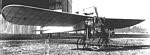
In 1909 Letord and Niepce designed and built a monoplane, in France.
Span: 31’6″
Length: 27’11”
Weight gross: 770 lb
In 1909 Letord and Niepce designed and built a monoplane, in France.
Span: 31’6″
Length: 27’11”
Weight gross: 770 lb
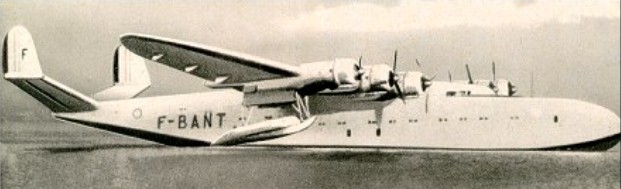
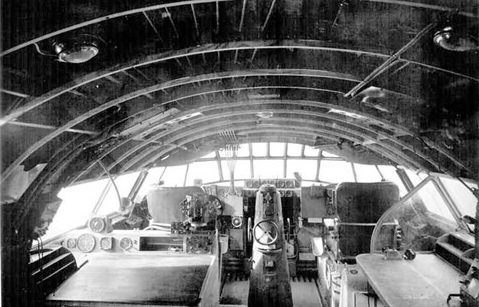
Developed in 1939, construction of the L.631 was interrupted by the war. The prototype Late 631 flew for the first time on 4 November 1942. It was a high-wing monoplane flying-boat powered by six 1,192kW radial engines. Accommodation was provided for 46 passengers in two- or four-berth cabins. However this aircraft was confiscated by the Germans during the occupation of France. It was flown it to the Bodensee (Lake Constance) on the German–Swiss–Austrian border. In 1944, it was attacked and destroyed at anchor by RAF Mosquitos.
Despite the war raging through France, Latécoère managed to complete the first production model in March 1945, now powered by Wright Cyclones instead of its original Gnome et Rhône engines.
In October of 1945 a propeller on F-BANT separated in flight with a blade slicing through the cabin and killing two passengers. Four production models were bought by Air France and inaugurated transatlantic services between their base at Biscarosse, south-west of Bordeaux, and Fort-de-France in Martinique on 26 July 1947.

Other operators were SEMAF (Société d’Exploitation du Matériel Aéronautique Français) and SFH (Société France Hydro).
The first Transatlantic Flight, Geneva, Switzerland to Fort de France, Martinique by “Latecoere 631” was on June 14, 1948. They covered the distance of nearly 5000 km in 16 hours.
A special mail flight arrived at Fort de France on June 16th, 1947. The plane disappeared on its return flight.
In February of 1948, F-BDRD crashed in the English Channel during a snowstorm killing all 19 on board. After just over one year of service, there was the total loss, with all passengers and crew, of F-BDRC on 1 August 1948. In March of 1950, F-BANU was lost off the coast of France, again with no survivors and finally in 1955, SFH’s F-BDRE had a wing failure, crashing with the loss of half of the 16 people on board.
The Societe France-Hydro operated one on cargo services in French Equatorial Africa for three years, but it crashed: after which all remaining Late 631 were broken up.

Production total: 11
F-BAHG 01 First flown 4/11/1942
F-BANF (not completed)
F-BANT 02 First flown 6/03/1945
F-BANU 3 First flown 15/06/1946
F-BDRA 4 First flown 22/05/1947
F-BDRB 5 First flown 5/09/1947
F-BDRC 6 First flown 9/11/1947
F-BDRD 7 First flown 26/01/1948
F-BDRE 8 First flown 28/11/1948
F-BDRF 9 First flown 20/11/1948
F-BDRG 10 First flown 7/10/1949
F-BDRH 11 not completed
Engines: 6 x Wright Cycl. GR 2600-A5B, 1175kW
Max take-off weight: 71350 kg / 157301 lb
Empty weight: 32332 kg / 71280 lb
Wingspan: 57.4 m / 188 ft 4 in
Length: 43.5 m / 142 ft 9 in
Wing area: 350.0 sq.m / 3767.37 sq ft
Max. speed: 405 km/h / 252 mph
Cruise speed: 320 km/h / 199 mph
Range w/max.fuel: 6000 km / 3728 miles
Crew: 6
Passengers: 70
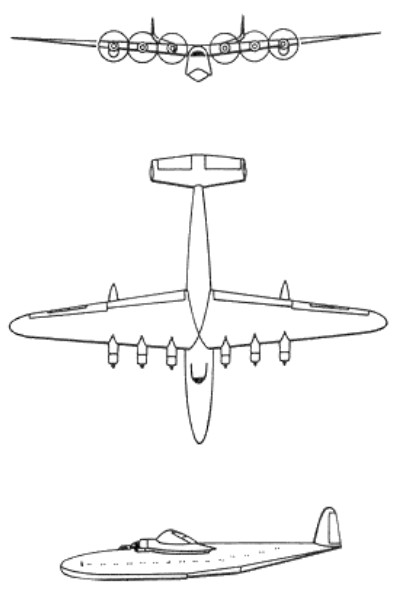
The Latécoère Laté 610 Series were 1935 4-engined long-range flying boats
Laté 610: [Project] May 1935 recce flying boat for Aéronavale
Laté 610 as designed, single fin, span 38 m, length 24.5 m
Laté 611: enlarged recce flying boat to mod. Dec 1935 spec.
Laté 611 as planned, 4 x 1000 hp HS.79.02 radials
Laté 611-01: 1939, conv. under const. to 4 x 10¹⁰ hp G-R 14N4/5
Laté 611-01, G-R 14N30/31 engines substituted after trials
Laté 612 diff. in having 4 x powered turrets (incl. tail turret)
he Latécoère Laté 580 Series were 3-engined parasol monoplane flying boat, 1 built
Laté 580: [Project] 1934 flying boat [based on Laté 570 bomber ?
Laté 581: [Project] developed Laté 580, becomes Laté 582
Laté 582: 1935 prototype recce flying boat, 3 x 890 hp G-R 14Kjrs

The Late 521 was a flying-boat with strut-braced high wings and short stub sponsons. Named Lieutenant de Vaisseau Paris, it was powered by six 641kW Hispano-Suiza 12Ycrs engines (inboard engines mounted as tandem pairs) and flew for the first time on 17 January 1935. A total of 76 passengers could be accommodated on the two decks of the two-step hull. The craft sank in a storm on its inaugural flight to the USA, but was salvaged and rebuilt with 484.4kW Hispano-Suiza 12Nbr engines. It subsequently established seaplane load-over-distance and load-to-height records in 1937.
The Late 522 (powered by six 671kW Hispano-Suiza 12Y37 engines) appeared in April 1937 but World War II prevented a regular transatlantic service. Both the Late 521 and 522 were impressed into French Navy service on 1 September 1939, three naval Late 523 having already been delivered between January and October 1938. These were armed with five 7.5mm Darne machine-guns and carried up to 1,200kg of bombs. Maximum endurance was 33 hours.
The Late 522 returned to passenger service in March 1940. The remaining aircraft of the series performed Atlantic patrols with Escadrilles E6 and E12. One Late 523 had been lost in September 1939, a second was scuttled in June 1940; and the Late 521 was demobilised in August of that year. The surviving Late 523 was grounded in August 1942, having flown with Escadrille 4E out of Dakar since June 1941. The Late 521 and 522 were destroyed at Berre by retreating Germans in August 1944.
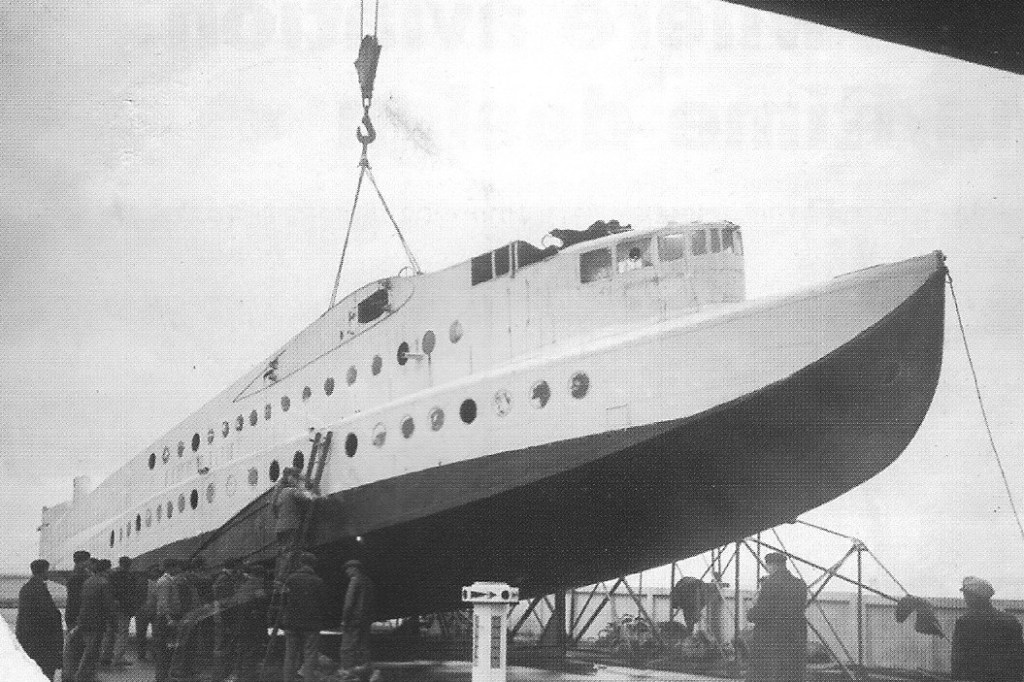
Variants:
Laté 520: [Project] 1930-33, 4 x 1000 hp HS.18 Sbr, engine abandoned
Laté 521: 1935, 6 x 860 hp HS.12Ybrs (2 x tandem pairs, 2 x tractors)
Laté 521 sunk at Pensacola in hurricane, to France for rebuilding
Laté 521: 1937, rebuilt with 6 x 650 hp HS.12Nbr (later to mil.)
Laté 521: 1939, Aéronavale serv., 970 hp HS.12Y-37 then 900 hp ’27
Laté 522: 1939, Air France transatlantic serv., 970 hp HS.12Y-37
Laté 522: 1939, Aéronavale, 900 hp HS.12Y-27, then back to ’37
Laté 523: 1938, Aéronavale recce vers., 900 hp HS.12Y-27, 3 built
Engines: 6 x HS 12 Ybrs, 630kW
Max take-off weight: 37400 kg / 82453 lb
Empty weight: 21480 kg / 47356 lb
Wingspan: 49.3 m / 161 ft 9 in
Length: 31.6 m / 103 ft 8 in
Wing area: 330.0 sq.m / 3552.09 sq ft
Max. speed: 250 km/h / 155 mph
Cruise speed: 213 km/h / 132 mph
Ceiling: 6300 m / 20650 ft
Range w/max.fuel: 5800 km / 3604 miles
Crew: 6
Passengers: 70

The Laté 36-0 was a 3 engined transport, high wing, 1930 — aka Laté 360
The Laté 35-0 was a 1931 high-winged 10 pax transport, 3 x 400 hp HS.12Jb, 1 built
The Laté 34-0 was a 1930 flying boat, 3 x 400 hp HS.12Jb (2 tractor/1 pusher), 1 built
aka Laté 340, F-AKDI
The Laté 32 was a transport flying boat, 2 x tandem 500 hp Farman 12We, 28 m span
Variants:
Laté 32-1: 1929, similiar to Laté 21bis but with a double-stepped hull
Laté 32-2: 1930, 2 x 500 hp Farman 12We, 8 built
Laté 32-2 – 3 lost: c/n 80/F-AISN, 81/ F-AISO, and 82/F-AIRU
Laté 32-3: 1927, 2 x 500 hp HS.12Hbr, 5 x Laté 32-2 conversions
Laté 32-3 conv.: c/n 77/F-AILN, 78/’LU, 79/’LT, 83/’TV, 84/’TX, 85/’BK
The Laté 31 was a single-engined biplane seaplane, aka Laté 31-0, Laté 310

