Zenair CH-100 Mono-Z

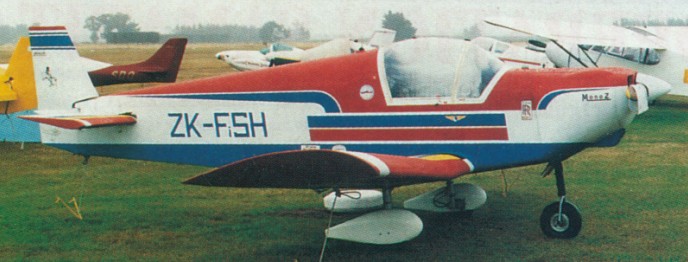
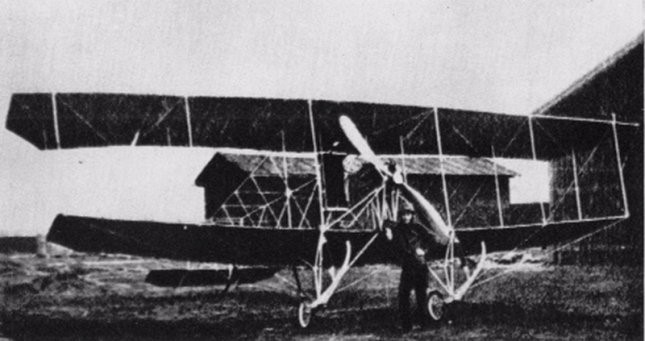
The Mono-Z is a single-place, scaled-down version of the original Zenith first built in 1974. It offers maximum operating economy with VW power at a three gph cruise. Detachable wings leave an 8-foot-wide section for easy road towing, requiring only 20 minutes to install both wings. It is stressed for 9G’s and with 100-hp becomes a powerful aerobatic performer. Engine range from the VW 1600 to 100-hp Continental.

Zenair CH-100 Article

It was marketed as plans and kits for home-builders.

Engine: VW 1600cc
Wingspan: 22’0″
Length: 19’6″
Useful load: 330 lb
Cruise speed: 105 mph
Stall: 47 mph
Seats: 1

Engine: 100-hp Continental
Gross Weight: 960 lbs.
Empty Weight: 630 lbs
Fuel capacity: 15 USG.
Wingspan: 22 ft
Length: 19ft 6in.
Wing area: 91 sq.ft
Top speed: 125 mph.
Cruise speed: 110 mph
Stall speed: 48 mph.
Climb rate: 820 fpm
Takeoff run (to 50ft): 1000 ft
Landing run (from 50ft): 1000 ft
Range: 400sm

Zenair Zenith

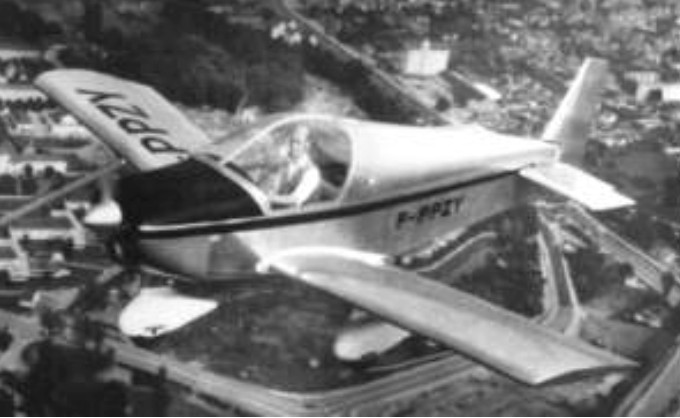
In his spare time, Heintz began to design and build his own aircraft, which he named the Zenith, anagram of Heintz. After a little more than a year’s work, the two-place low-wing Zenith was rolled out and successfully flown on 22 March 1970 as F-WPZY.

Soon after, detailed blueprints and construction manuals of the aircraft were drawn up and offered to the growing number of interested builders and flyers.

Engine: 85-160 hp
Span: 22.11 ft
Length: 20.08 ft

Zejda Skoda Fabia 1.2 TSI CBZB

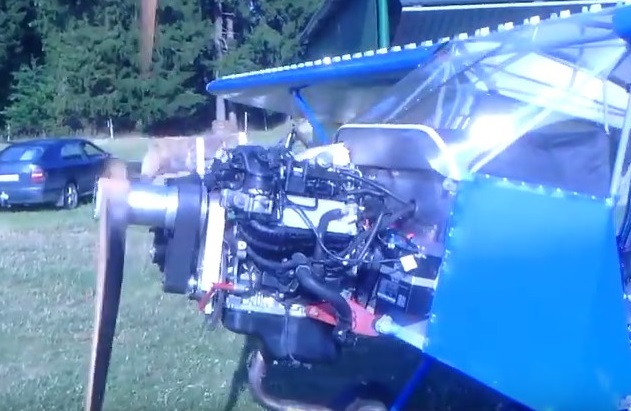
Built by Filip Zejda, it is a conversion of the Czech 1.2 TSI CBZB automotive engine suitable for ultralight and light planes. The engine produced 77kW / 105HP and 175Nm torque in 1500 to 4100 the RPM range. To maintain engine weight at Ultralight category the engine used was with an eight valve head. There is also a 16-valve version of the 1.2 TSI.

After tune the Slovak firm M. M. RACING from Bratislava, torque and speed increased up to 144 hp and 170-180Nm torque at 5500RPM. At 3000-4200 RPM torque is around 200Nm. 5500 RPM in flight, is around 2570 RPM on the propeller, with a 2.14 ratio gearbox. The reduction is Gates Polychain Timing Belts and steel pulleys with eccentric tensioning.

For the highest possible performance during a hot summer day requires cooling the compressed air inlet, that entails redesigning the cowling, or adjust the air inlet cooler designed to cool the compressed air and refrigeration division into two areas. One of them is cooling block and head, and the oil, and the other cools the compressed air inlet and a turbocharger, which are also liquid-cooled.

Test flying in a Yetti J- 03 known too as Swift J-03. During the 1.2 TSI conversion motor tests and subsequent flight tests with Yetti J-03 several propellers have been used with different diameters and different pitch. Each propeller behaved much differently, in terms of performance, climbing, vibration damping and noise produced. The final two-blade wooden propeller was designed and made to order by the Czech Republic. Rudolf Wollner company. A prop with a 2000 mm diameter, with Russian profile and pitch of 18 degree and 75 cm blade length.

Due to the construction height of the aircraft, it is not possible to use a propeller with a diameter of larger than 2000 mm. A controllable pitch propeller would take full advantage of the higher torque 210N at lower RPM for increased speed and economy. Nobody in the Czech Republic produced a useful and lightweight in-flight adjustable propeller for 130-150HP.

The weight of the engine installed in the airframe depends on all the components you need but is approximately 98 kg weight.

The engine does have direct injection, turbocharger with intercooler and a simple single ignition circuit. The engine is an easy fit into existing engine mounting points.

Zdarsky Trike

Zdarsky in Austria

Czechoslovakian engineering student Ivo Zdarsky escaped into Austria in a homemade ‘ultralight’ aircraft powered by a 2-cylinder car engine.

In 1984 the plane was confiscated by police but he bribed the police and got it back.

The student, wearing a bright yellow crash helmet, flew the craft only about 100 to 200 yards above the ground for the entire trip. He parked his homemade, 3-wheeled craft with a basket-like seat outside an Austrian Airlines hangar used for DC-9 jets and sat there until airport employees spotted him.

Police said the man took off from the town of Lozorno, about 6 miles inside Czechoslovakia, at 3 a.m. and landed at Vienna’s Schwechat airport about 4:45 a.m., a 25-mile trip. Police said the student told them he had planned his escape for a year, making secret test flights of the ultralight aircraft.

A witness said the student’s plane was powered by a 600-cubic centimeter, 2-cylinder engine and had a fuel tank taken from a Czechoslovak-made Java motorcycle. Ultralights are prohibited in Austria because of noise and environmental regulations.

The 24-year-old Ivo Zdarsky spoke fluent English and asked for political asylum and wanted to emigrate to the United States or Australia, police said.

Zdarsky was able to sell his plane to Checkpoint Charlie German museum that housed escape vehicles. Afterwards he moved to Los Angeles where he started his own company, called Ivoprop, which produced propellers of his own design.

Zbierański and Cywiński Biplane

On the initiative of the Association of Technicians at the Technical Association in Warsaw in the autumn of 1909, Czeslaw Zbierański went to Paris to get acquainted with the aviation technique of the time. On his return, he designed a wooden plane using a pulling propeller engine, while the biplanes at that time had pushing propellers. After the approval of the project by Wheeler Zbierański left for France to buy materials. Having encountered a Voisin airplane with a steel tube construction, he decided to build a hull from the tube.

Stanisław Cywiński became Stanisław Cywiński’s co-worker, who in the spring of 1910 adapted the project to steel construction and elaborated on the design. The hull of the aircraft was built in the summer of 1910, in a shed on the premises of E. Krzemiński’s lamp factory at ul. Solec 103 in Warsaw. After the construction of the hangars of the Warsaw Aircraft Association “Awia” on the Mokotowskie Field, they moved in the early autumn of 1910 to the hangar No. 1. There construction was completed. In the autumn of 1910 Cywiński bought the engine for the plane.

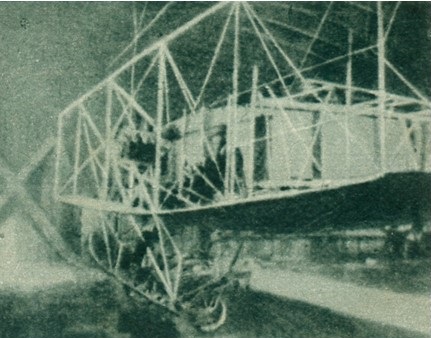
The biplane was rectangular, double-girder, wooden construction panels, supported by steel pipe posts and crossed with wires. Canvas cover. Controls were only on the upper wing. Truss lattice made of steel pipes connected by screws. Tubes stiffened by ash rods. Rear hull triangular section. Trusses framed by wires. With fabric covering

In May 1911, while attempting to fly an improper connection of the wires to the spark ignition caused gasoline to burn and burn part of the airfoil. In the summer the plane was renovated.

On September 25, 1911, the plane was flown by Michał Scipio del Campo, flying 15-20 km, at a height of 50-60 m, within 15 minutes. The engine was too heavy and too weak, so the Gnome engine from the Morane-Borel aircraft belonging to M. Scipio del Campo was mounted.

When the Russian army took over at the beginning of 1912, the plane was evacuated by Russian lieutenant Krachowiecki, fictitiously buying it. Cywinski dismantled the engine, and Zbierański donated the craft to the Union of Students of the Lviv Polytechnic. The plane was transported to Cracow in 1912, where it was exhibited in the Oleander area and then stored for over a year. There at the beginning of the war in 1914, it burned down during the fire of the exhibition buildings.

Engine: ENV type D, 29 kW (39 – 40 hp)
Wingspan: 10 m
Length: 8.5 m
Height: 3.3 m
Wing area: 31-34 sq.m
Gross weight: 240 kg
Useful weight: 100 kg
Total weight: 340 kg
Speed: 70 km / h
Flight time: 1 h 30 min

Zaschka Helicopter

In 1928 Zaschka carried out experiments with a two-rotor helicopter at Tempelhof Airport in Berlin.

“His [Engelbert Zaschka’s] plane, the first helicopter, which ever worked so successfully in miniature, not only rises and descends verticially, but is able to remain stationary at any height. Herr Zaschka is fully aware that the perfection of his invention will be the greatest forward step in aviation since the Wright brothers made their historical hop. As he pointed out, the danger of flying would immediately be decreased by at least 80 per cent, since four fifths of the accidents in flying occur either in the takeoff or in landing. […] A motor giving thirty to forty horsepower is installed in Zaschka’s present experimental machine. It is so delicately adjusted that he has been able to keep the plane at a height of several feet above the ground, with no movement either up or down.”

Source: German Plane Promises New Stunts in Air, The Bee. Danville, Virginia, USA, June 25, 1927, p. 16.

Zanzottera MZ 301

The MZ301i has electronic fuel injection, twin electronic ignition, and electric start.

MZ 301
Cycle: 2 stroke
No cylinders: 1
Bore: 76 mm
Stroke: 69 mm
Compression: 9.3
Displacement: 939 cc
Cooling: Air
Ignition: DCDI
Reduction: Mechanical Integral damper 2.18:1 to 3.66:1
Dimension: 200 x 400 x 500 mm
Weight: 39 kg
Max pwr: 85 hp at 6500 rpm

Zanzottera MZ 201 / MZ 202 / Compact Radial Engines MZ 201 / MZ 202

The Zanzottera MZ 201 and MZ 202 are a family of twin-cylinder, in-line two-stroke, dual ignition aircraft engines designed for ultralight aircraft and motor gliders. The engine was originally designed and produced by Zanzottera Technologies of Italy, but the design was sold, along with the rest of the company’s two-stroke ultralight aircraft engine line, to Compact Radial Engines of Surrey, British Columbia, Canada.

The MZ 202 was developed first as a 60 hp (45 kW) lightweight competitor to the liquid-cooled 64 hp (48 kW) Rotax 582. Later the MZ 201 was developed from the MZ 202 as a de-rated 45 hp (34 kW) version intended for motorgliders and single place ultralights that needed more power than the single-cylinder MZ 34.

The MZ 201 and 202 both have a cylinder barrels that are Nikasil-coated. The bore and stroke are the same as the single-cylinder MZ 34 engine. The MZ 201 features an optional recoil starter or electric starting, while the MZ 202 has electric starting only. The MZ 201 has a choice of a reduction drive belt or gearbox, while the MZ 202 offers just the gearbox with reduction ratios of 2.18, 2.55, 2.88, 3.11 or 3.66 to 1.

The unit cost for the MZ 201 in 2009 was US$4440, and the MZ 202 US$5560.

The owners manual acknowledges the limitations inherent in the design of the engine, stating:
This is not an aeronautic approved engine.
This engine has not been subjected to durability and safety tests in compliance with aeronautical standards and is not a certified engine. It is designed to be used in ULM or aeroplanes where engine failure will not produce serious consequences. The user must assume responsibility for all risks deriving from the use of this engine and must understand that this engine is subject to sudden failure. Engine failure may result in an emergency landing. Such accidents may cause serious material damage, injury and/or death. Never use an aircraft fitted with this engine in areas, conditions and altitudes that may cause problems if forced to land as a result of sudden engine failure.

Variants:
MZ 201
Twin-cylinder, air-cooled, two-stroke dual ignition 45 hp (34 kW) aircraft engine optimized for motorgliders and single place ultralights. Equipped with a single Tillotson carburetor.

MZ 202
Twin-cylinder, air-cooled, two-stroke dual ignition 60 hp (45 kW) aircraft engine. Equipped with dual Bing carburetors.

MZ 202i
Twin-cylinder, air-cooled, two-stroke dual ignition 67 hp (50 kW) aircraft engine. Equipped with electronic fuel injection, controlled by a computerized engine management system. No longer in production

Applications:

MZ 201
Belite Aircraft Superlite
SlipStream Scepter
Spacek SD-1 Minisport
Star Bee Light
Taggart GyroBee
Wings of Freedom Flitplane

MZ 202
ASAP Beaver Plus 2
Apex Cross 5
Mosquito Aviation XE
Sabre Wildcat
Star Bee Total Bee

Specifications:
MZ 202
Type: Twin-cylinder, two-stroke aircraft engine
Bore: 76 mm (2.99 in)
Stroke: 69 mm (2.72 in)
Displacement: 626 cc (38.20 cu in)
Length: 313.5 mm (12.34 in)
Width: 299.4 mm (11.79 in)
Height: 331.1 mm (13.04 in)
Dry weight: 38 kg (84 lb) with starter motor, two carburettors, fuel pump, cooling system and exhaust system.
Valvetrain: Reed valve induction
Fuel type: Premium auto fuel
Oil system: 50:1 oil to fuel, premixed
Cooling system: air-cooled
Reduction gear: RZ 2 gearbox with reduction ratios of 2.18, 2.55, 2.88, 3.11 or 3.66 to 1
Power output: 63 hp (47 kW) at 6250 rpm
Compression ratio: 9.1:1
Ignition: DCDI
Price 1998: 17530 Fttc