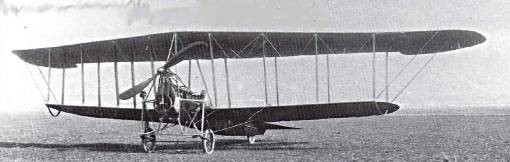
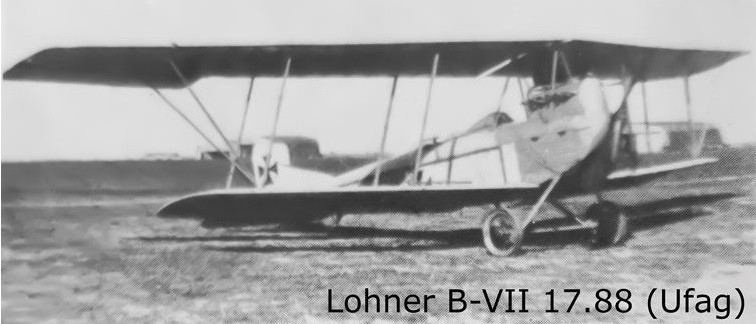
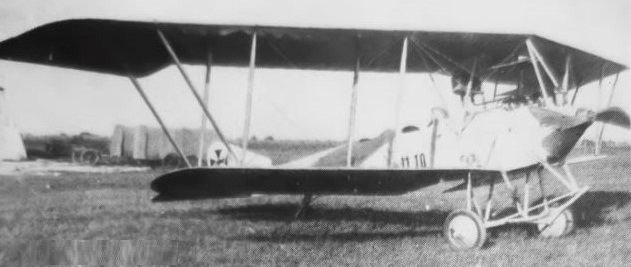
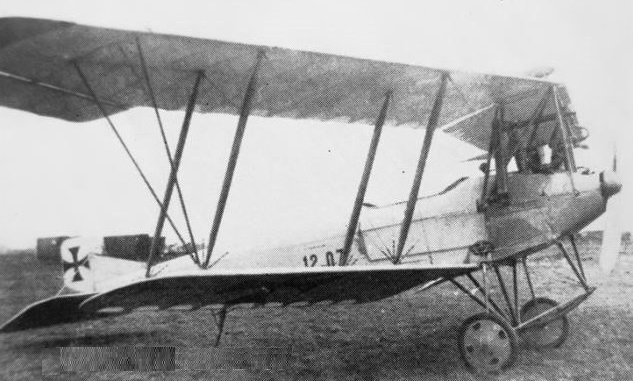
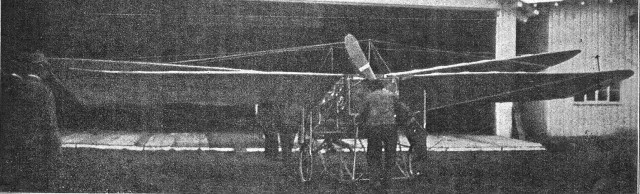
The third aeroplane of the Austrian navy, a “Pfeilflieger” biplane with a 120 hp Daimler Engine. Lohner was asked to develop a biplane for the Austro-hungarian navy in 1911 which was finished in March 1912 with a temporary undercarriage to be able to test on the land. Typical of the design was the high mounted propeller – driven by a chain – and the big wings (unequal span, 4 struts at a side).
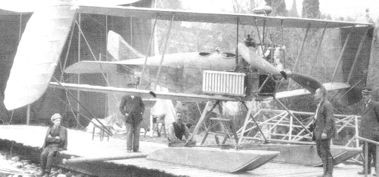
Two copies were built of the 1912 Pfeilflieger Sporttype light arrow-biplane with 85 hp Hiero engine. One for the k.u.k. Luftfahrtruppe got the name “Cyklon”. A second model was sold to Herman Hold. It could be fitted with wheels or floats. This photo was taken when Hold flew the aircraft at the Adriatic See at Portorož (today Slovenia) in 1913.
The 1910 Lohner-Daimler “Pfeilflieger I” biplane was designed by Karl Paulal Built by J. Lohner & Co. Vienna, Austria.
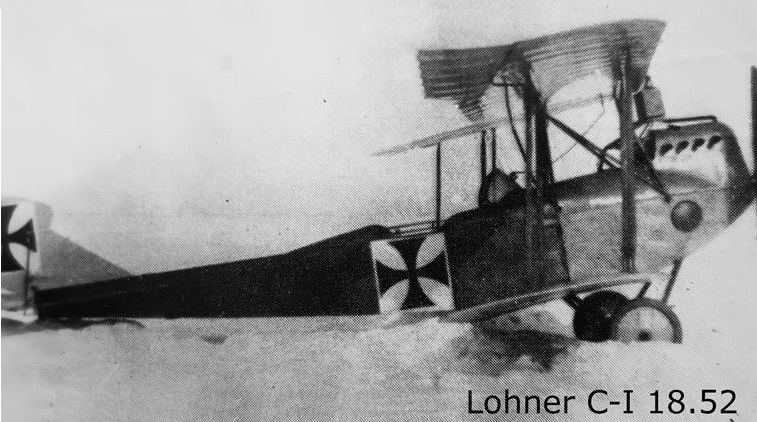
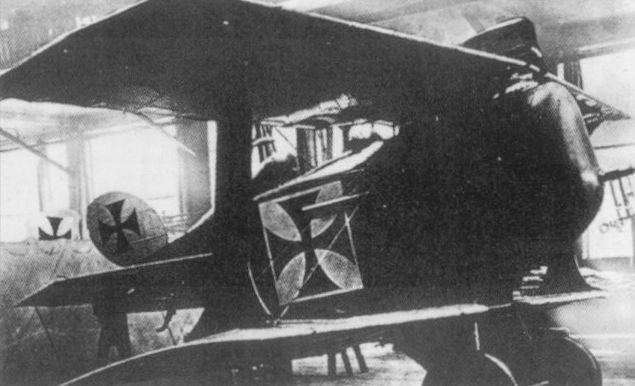
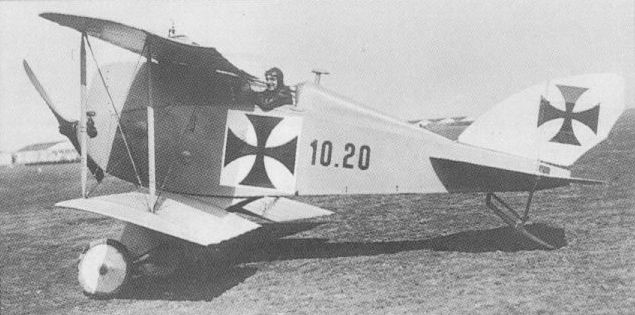
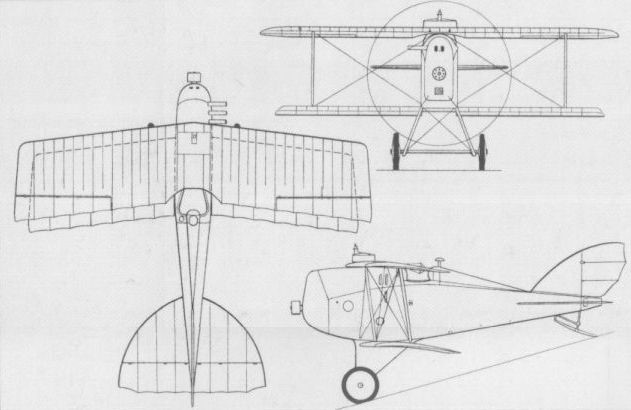
During 1916, the Lohnerwerke of Vienna received a contract from the K.u.K.Luftfahrttruppen (Imperial and Royal Air Service of the Austro-Hungarian Army) for four single-seat fighter prototypes powered by the 185 hp Austro-Daimler six-cylinder inline engine. The first of these, the Lohner 10.20, or Typ AA, appeared at Aspern on 5 September 1916. A single-bay biplane with an armament of twin synchronised Schwarzlose machine guns, the Lohner 10.20 was characterised by a singularly abbreviated and deep, slab-sided fuselage. This was suspended between the wings by a short, inverted-Vee cabane and the faired struts supported the undercarriage. The wing cellule had broad, aerofoil-section I-type struts, and the vertical tail possessed no fixed surface. Taxying trials revealed insufficient control. The rudder area was increased several times and the fuselage lengthened before the aircraft flew on 29 December 1916. The fighter demonstrated poor stability, and, after suffering severe damage in February 1917, was returned to the Lohnerwerke for repair and extensive modification. The aircraft re-emerged in the following month as the Lohner 10.20A, the lower wing having been raised to the base of the fuselage, the cabane being eliminated, a twin-strutted wing cellule being adopted, the fuselage being lengthened and the redesigned tail surfaces embodying a fixed fin. The Lohner 10.20A was destroyed in a crash on 6 June 1917.
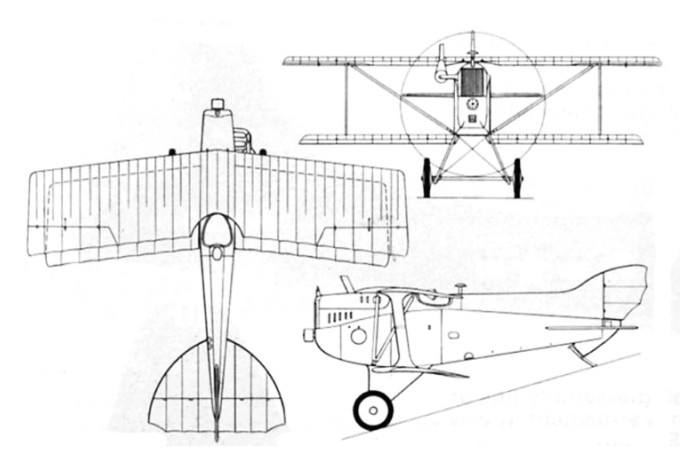
The second fighter prototype from the Lohnerwerke, the 10.20B (later redesignated 111.02), possessed essentially similar wing and tail surfaces to those of the 10.20A. It had a “wireless” wing cabane, however, which reverted to aerofoil-section I-struts supplemented by inclined Vee-struts. It also introduced a deep dorsal fin. Powered by a similar 185 hp Austro-Daimler engine to that of its predecessor and carrying a twin-Schwarzlose gun armament, the Lohner 10.20B made its initial flight at Aspern on 2 June 1917. The prototype was taken over by the K.u.K.Luftfahrttruppen in August 1917, and official trials continued through October when further development was halted. No data relating to this type are available.
Extensive revision of the Lohner 10.20 resulted in a single 10.20A prototype.
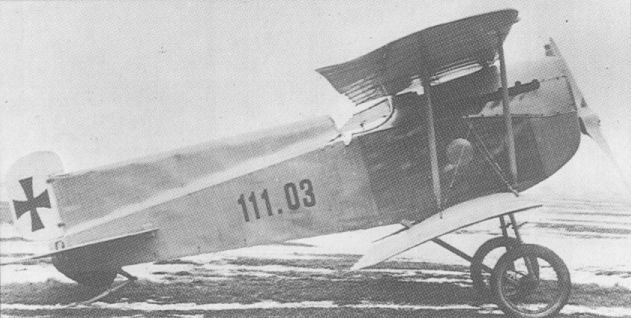
The third Typ AA series prototype produced by the Lohnerwerke, the 111.03 differed from its immediate predecessor, the 10.20B alias 111.02, in having a conventional wire-braced wing cellule, a redesigned rudder and unfaired undercarriage strutting. Retaining the 185 hp Austro-Daimler engine, the Lohner 111.03 was flown for the first time on 28 June 1917, and flight testing continued through October. At this stage, the Lohnerwerke was assigned a manufacturing licence for the Aviatik D I, and further development of the Typ AA series was ended.
The third Type AA series fighter, the Lohner 111.03 was abandoned in favour of the Aviatik D I.
Max speed, 120 mph (193 km/h). Time to 3,280 ft (1 000 m), 2.66 min Range, 240 mis (386 km). Empty weight, 1,373 lb (623 kg). Loaded weight, 2,085 lb (946 kg). Span, 24 ft 11 1/4 in (7.60 m). Length, 20 ft 10 in (6,35m). Height, 9 ft 10 1/8 in (3.00 m). Wing area, 215.28 sq ft (20.00 sq.m)
Lohner 10.20B Engine: 1 x Austro-Daimler AD 6 series 18000, 136 kW / 185 hp Wingspan: 7.30 m / 23 feet 11,39in Length: 6.00 m / 19 feet 8,21in Height: 2.95 m / 9 ft 8,14in Wing area: 17.98 sq.m / 193.54 sq.ft Crew: 1
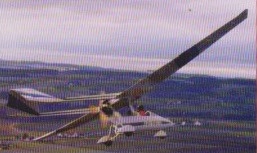
A tandem two-seat very light aircraft, with smaller LO-120 Bausatz I version. The LO 120 S can operate as a motorglider or microlight by changing the outer portions of the wings. Comstruction is wood and fabric.
LO 120 S Engine: Hirth 2704, 40 hp Wing span: 15.80 m Wing area: 16 sq.m MAUW: 400 kg Empty weight: 235 kg Fuel capacity: 32 lt Max speed: 150 kph Cruise speed: 120 kph Minimum speed: 50 kph Climb rate: 3 m/s Certification: VZ Seats: 2 Fuel consumption: 8-10 lt/hr Price (1998): 65 900 DM Kit price (1998): 26 400 DM
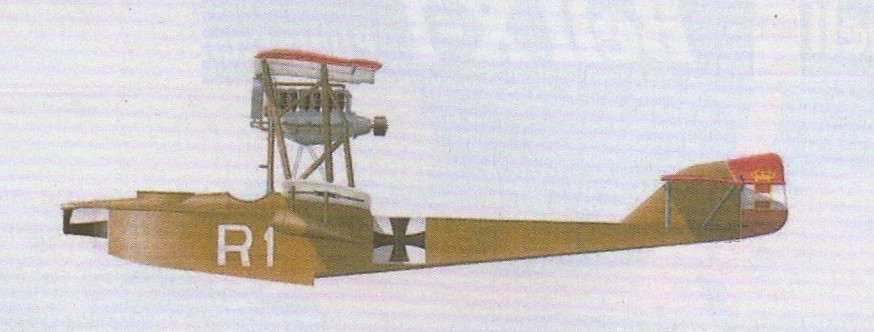
This long-lived machine went through an unusual series of modifications. It was built by the Kieler Maschinenfabik Mordhorst, Germany, in 1908 as a “Dreiflächner”, with three wings in tandem, for Otto Fritzsche, but Fritsche was killed in a car accident before a meeting in Kiel where he wanted to compete. Carl Loew took over the machine in 1909 and the Rumpler workshops removed one of the wings pairs and installed an Aeolus engine, but he still couldn’t get the craft in the air. After yet another another rebuild it looked more like a normal Taube monoplane and was equipped with a Daimler engine. In this configuration it flew in 1911, piloted by Loew. After a successful flight over the Baltic from Sonderburg in Nordschleswig (now Sønderborg, Denmark) to Kiel he donated the machine to the Kaiserliche Marine, who equipped it with floats and named it E.1. The E.1 survived until the beginning of 1914, when it was destroyed in a crash in Tsingtao, China.
The Loening S2L was one of three amphibian designs to be considered as possible replacements for conventional floatplanes aboard Navy cruisers. A design-for-purpose amphibian was viewed as potentially a better solution to the problem of periodically re-rigging floatplanes to wheeled undercarriage, then back to floats again.
Loening received a contract in 1932 to construct a single amphibian prototype as the XS2L-1. Its design followed a conventional biplane layout.
XS2L-1 Engine: 1 x Pratt & Whitney R-985-28 Wasp Junior, 400 hp Prop: 2 blade metal, ground adjustable Wingspan: 34 ft 6 in Length: 30 ft 7 in Wing area: 355 sq.ft Empty weight: 2833 lb Noral gross weight: 4053 lb MTOW: 4317 lb Max speed: 130 mph Ceiling: 12,400 ft Range: 633 mi Seats: 1 Armament: 1 x .30 mg