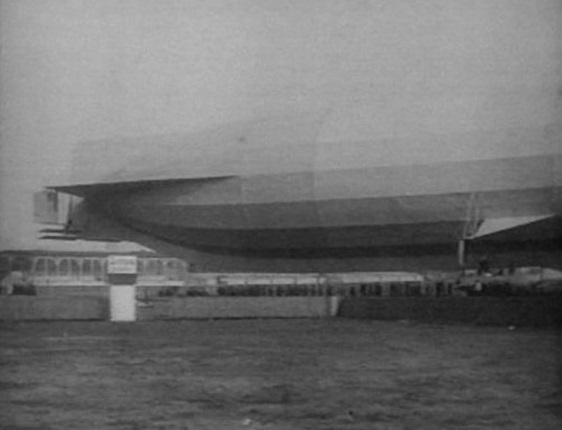
Zeppelin Type V / L55/LZ101, L56/ LZ103, L58/LZ105, L60/LZ108, L61/ LZ 106, L62/LZ 107, L63/LZ 110, L64/ LZ109, L65/LZ111

L58

Apart from the historical factors surrounding the last operation carried out by L53, this Zeppelin Type V airship was also of some technical prominence. This lay in the fact that her construction embodied an increased spacing of her main frames, which were now 15 in (49 ft 2.5 in) apart compared with the previous norm of 10 in (32 ft 9.7 in). Measures such as these served to lighten the L53, contributing to the fact that her useful lift was some 62.7 per cent of the total, so that on her maiden raid an altitude of 6300 in (20,670 ft) was attained.
Alternatively known by the works designation LZ100, this airship made its first flight on 18 August 1917 from Friedrichshafen where she had been built, and became the command of one of Peter Strasser’s most senior officers, Kapitanleutnant der Reserve Eduard Proelss. He first brought his new charge over the British Isles on the night of 24/25 September 1917 when raids were directed against targets in the Midlands and north east, 17 months after his first bombing sortie in L13, his previous command.
However, it would be wrong to give the impression that Zeppelins were entirely directed to bombing missions against land targets. L53 is an illustra¬tion of this fact since of the 23 operational sorties made by this vessel be¬tween her commissioning date on 21 August 1917 and her fiery end on 11 August of the following year, only four were bombing attacks. The remainder were scouting missions over the North Sea where the endurance of lighter-than-air craft made them superior to any conventional aeroplane of the day Small wonder therefore that L53 and her nine sister craft (L55/LZ101, L56/ LZ103, L58/LZ105, L60/LZ108, L61/ LZ 106, L62/LZ 107, L63/LZ 110, L64/ LZ109 and L65/LZ111) were regarded as a standard scout type. All after L56 were fitted with Maybach motors of the supercharged Mb IVa type.

On 21 June 1921, returning from another trial flight, Beadmore R36 suffered damage during landing. The release of emergency ballast caused a sharp pitching up, straining the ship against the mooring line. The nearest unoccupied sheds were at Howden in Yorkshire since the Pulham sheds were holding German Zeppelins handed over as war reparations. The wind increased and it was decided that the LZ 109 (L 64) would have to be sacrificed to save the R36. Within 4 hours L 64 had been cut into pieces and cleared to give enough room for R36. Even then she was damaged by a gust of wind during the manoeuvre into the shed.

L53 (Zeppelin LZ100)
Type: strategic bomber and patrol airship
Powerplant: five 179-kW (240-hp) Maybach HSLu six-cylinder water-cooled piston
Maximum speed 106 km/h (66 mph)
Service ceiling 6400 m (20997 ft)
Range 4680 km (2908 miles)
Empty weight 24500 kg (54013 lb)
Useful lift 40460 kg (89,199 lb)
Diameter 2390 m (78 ft 4.9 in)
Length 196.495 m (644 ft8 in)
Volume 55990 cu.m (1,977,271 cu ft)
Armament: two 7.92-mm (0.312-in) Maxim machine-guns on free mountings in single position above forward hull, plus bombs
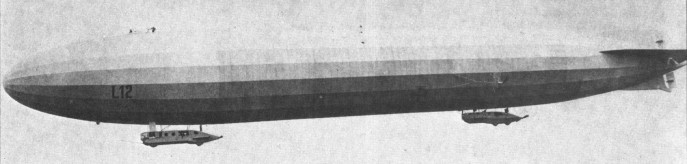
Zeppelin Type P / LZ40, LZ41, LZ43, LZ45, LZ46, LZ48, LZ50, LZS3, LZ52, LZ54

L12

January 1915 was the date set for the introduction of a new type of German bomber airship, the Zeppelin Typ P. In point of fact the first of the new vessels was four months late in making its appearance, the lead ship L10 (buil¬der’s designation LZ40) being deli¬vered in mid-May. Armament was two 7.92-mm (0.312-in) Maxim machine-guns on free mountings in single gun position above the forward hull.
The ship was sent on its attack against targets in England in the following month with a raid on London, it being believed at all levels and on both sides of the North Sea that the selection of individual targets was possible. In point of fact, the weather took a hand, and L10 was able to get only as far as Gravesend, where its bombs chanced to set light to a military hospital with a consequent reaction against such ‘frightfulness’.
Another attack was mounted 11 days later when Jarrow and South Shields were the targets, despite heavy fire from the defence batteries on the coast. Three other occasions found the new Zeppelin over the British Isles from a total of 28 military excursions from Nordholz. The German system of organization meant that the flights were usually carried out by the same crews, so that some became more ex¬perienced than others, but mindful of the dangers the men tended to live only for the day and to endure bomb¬ing trips under thousands of cubic metres of explosive gas and in numb¬ing cold as best they could.
Strangely, it was on what should have been an uneventful flight, a mari¬time reconnaisance on the afternoon of 3 September 1915, exactly a year be¬fore SL11 was destroyed, that the L10’s career ended. While the airship was making ready to land back at Nordholz near Cuxhaven, the order to valve off gas was given as a normal preliminary to making landfall. Unfortunately a thunderstorm happened to be raging and the naval airship was struck by lightning. There was a violent explo¬sion before the vessel plunged into the shallow waters below, where it burned for several hours. All aboard perished, Kapithnleutnant Hirsch the comman¬der and his crew of 18. Total produc¬tion of the Type P was 10 units, L10 to L19 (builder’s designations LZ40, LZ41, LZ43, LZ45, LZ46, LZ48, LZ50, LZS3, LZ52 and LZ54 respectively).

L10 (Zeppelin LZ40)
Type: strategic bomber airship
Powerplant: four 156.6-kW (210-hp) Maybach CX six-cylinder water-cooled piston
Maximum speed 95 kph (59 mph)
Service ceiling 3900 m (12,795 ft)
Range 2150 km (1,336 miles) Empty weight 21100 kg (46,518 lb)
Useful lift 26200 kg (57,760 lb)
Diameter 18.70 m (61 ft 4.2 in)
Length 163.50 m (536 ft 5 in)
Volume 31900 c.m (1,126,540 cu ft)
Armament: two 7.92-mm (0.312-in) Maxim machine-guns

Zeppelin L.30 Class / L.33

L.32

The 1916 L.30 Class were about 643 feet long, with a capacity of 1,907,000 cubic feet, and were powered by six 240-h.p. engines driving two blade props and used a considerably modified girder construction in the hull. Maximum speed was 60 m.p.h., carry¬ing a 22-ton load. They carried incendiary and high -explosive bombs from 110 to 660 lb. in weight.

With a volume of 55,000 cubic metres and a length of 198 metres, the L30 had a top speed of 100 kilometres per hour.

In 1916 new airship was in the process of being designed when a stroke of luck, caused the latest German airship technology to be handed to the British on a plate. On the night of 23rd/24th September 1916, the German Zeppelin L-33 was brought down at Great Wigborough, Essex. The L-33’s commander had been participating in an air raid on London when it was damaged by antiaircraft fire, and then intercepted and brought down by a night fighter who’s fire failed to ignite the hydrogen. However so much damage was done to the gasbags and fuel tanks that the ship was forced to descend. The German crew attempted to destroy the ship instead of it falling in to enemy hands but so little hydrogen was left that only the doped fabric lit when they fired signal flares in to the hull. The L-33 was virtually intact and her motors were undamaged. In one stroke the British had been handed a near perfect ship full of the latest German technology.

Immediately a crew of investigators recorded every feature of the ship in detail. This top-secret record took five months to complete. The designs for the R34 and R34 were put on hold whilst this was being undertaken. It was with this information that the British designers could adapt the plans to include what the Germans had done so successfully, and this enabled the design teams to produce near copy designs for the R 33 and R 34. The R33 was allocated to Armstrong and Whitworth at their Barlow works just some 3 miles south of Selby, Yorkshire.

Cruise: 60 mph
Load: 22 ton

Zeppelin Hansa

DELAG, the Deutsche Luftschiffahrts-Aktiengessellscaft, was funded in part by the Hamburg-Amerika Shipping Company and from money raised by those cities involved in the undertaking. Each city, in addition, provided ‘aerial harbours’; erecting airship sheds at their own expense to house the fleet of airships. Although no scheduled passenger services ensured, excursion flights of several hours’ duration at 100 Marks per head proved popular to Germans and foreigners alike over the four years of operation.

The first airship destined for service was the LZ-7 Deutschland. Following this in the years preceding the war came the airships LZ-10 Schwaben, Sachsen, Viktoria Luise and the Hansa, which between them carried over 35,000 fare-paying passengers in 1588 flights, covering 170,000 miles without serious mishap.

Zeppelin Viktoria Luise

DELAG, the Deutsche Luftschiffahrts-Aktiengessellscaft, was funded in part by the Hamburg-Amerika Shipping Company and from money raised by those cities involved in the undertaking. Each city, in addition, provided ‘aerial harbours’; erecting airship sheds at their own expense to house the fleet of airships. Although no scheduled passenger services ensured, excursion flights of several hours’ duration at 100 Marks per head proved popular to Germans and foreigners alike over the four years of operation.

The first airship destined for service was the LZ-7 Deutschland. Following this in the years preceding the war came the airships LZ-10 Schwaben, Sachsen, Viktoria Luise and the Hansa, which between them carried over 35,000 fare-paying passengers in 1588 flights, covering 170,000 miles without serious mishap.

Zeppelin Sachsen

DELAG, the Deutsche Luftschiffahrts-Aktiengessellscaft, was funded in part by the Hamburg-Amerika Shipping Company and from money raised by those cities involved in the undertaking. Each city, in addition, provided ‘aerial harbours’; erecting airship sheds at their own expense to house the fleet of airships. Although no scheduled passenger services ensured, excursion flights of several hours’ duration at 100 Marks per head proved popular to Germans and foreigners alike over the four years of operation.

The first airship destined for service was the LZ-7 Deutschland. Following this in the years preceding the war came the airships LZ-10 Schwaben, Sachsen, Viktoria Luise and the Hansa, which between them carried over 35,000 fare-paying passengers in 1588 flights, covering 170,000 miles without serious mishap.

Zeppelin LZ 10 Schwaben

Zeppelin LZ 10 Schwaben

Zeppelin LZ 10 Schwaben was built in 1911 and operated by DELAG (Deutsche Luftschiffahrts-Aktiengesellschaft) for passenger service. The first airship destined for service was the LZ-7 Deutschland. Following this in the years preceding the war came the airships LZ-10 Schwaben, Sachsen, Viktoria Luise and the Hansa, which between them carried over 35,000 fare-paying passengers in 1588 flights, covering 170,000 miles without serious mishap.

Zeppelin LZ 10 Schwaben

Zeppelin LZ-8 Ersatz Deutschland / Type E

Excursion flights of several hours’ duration at 100 Marks per head proved popular to Germans and foreigners alike over the four years of operation.

The first airship destined for service was the LZ-7 Deutschland which, following a successful deliver flight, was wrecked. A replacement for the LZ-7 Deutschland, the 1910 LZ-8, or the Ersatz Deutschland, was put in hand.

LZ-8
Capacity: 681,600 cu.ft
Length: 485 ft
Width: 45 ft
Height: 54 ft
Gross lift: 19.5 ton
Useful lift: 6 tons
Engines: 3 x Daimler 4 cyl, 120 hp
Max speed: 37 mph
Range ay cruise: 950 miles
Ceiling: 2000 ft
Crew: 8
Passengers: 20

Zeppelin LZ.7 Deutschland

Despite those promising army orders Colsman, as director of the Zeppelin Airship Company, saw the need to commercialise the basis of airship production in order to fund further development. His proposal was to form a passenger airline service linking the main cities of Germany, and in November 1909 the company with a capitol of 3 million Marks was founded in Frankfurt and Main.

DELAG, the Deutsche Luftschiffahrts-Aktiengessellscaft, was funded in part by the Hamburg-Amerika Shipping Company and from money raised by those cities involved in the undertaking. Each city, in addition, provided ‘aerial harbours’; erecting airship sheds at their own expense to house the fleet of airships. Although no scheduled passenger services ensured, excursion flights of several hours’ duration at 100 Marks per head proved popular to Germans and foreigners alike over the next four years of operation.

The first airship destined for service was the LZ-7 Deutschland, with a capacity of 681,000 cu.ft and able to carry passengers in comfortable Pullman-style accommodation in a cabin amidships. LZ7, named Deutschland, first flew on 19 October 1910, and was placed in service by Delag.

Unfortunately, following a successful deliver flight the airship was wrecked after crashing in the Teutoburger Wald in unfavourable weather conditions and was replaced by LZ8.

Zeppelin LZ-5 / Z.2

Within hours of the news of the loss of the LZ-4 appearing in the papers a spontaneous outpouring of popular support in what he was trying to achieve was demonstrated by the German people. From all over the nation money and promises of donations came flooding in to Friedrichshafen, and within a short time more than 6 million Marks (£5 million) had been subscribed.

With the loss of the LZ-4 the army demanded an immediate replacement, for this purpose the old LZ-3 was taken in hand and enlarged and equipped with more powerful engines. At the same time work began on the new LZ-5, which was of similar size but again with more power than its predecessor, with a capacity of 530,000 cu.ft and combined propulsive output increased to 220 hp.

The Kaiser, watchful of the count’s growing popularity with the German people, proposed a board of trustees to manage the money Zeppelin had accumulated. The count countered this suggestion by forming the Zeppelin Foundation as a charitable body to continue research into dirigible flight, whilst separately in September 1908 establishing the Luftschiffbau Zeppelin GmbH.

Carl Berg’s son-in-law, Alfred Colsman, was installed as managing director, which allowed the count to continue his development work with the minimum of interference from the government and army sources.

LZ-5 was completed in May 1909 and undertook a proving flight of thirty-seven hours covering 603 miles during the course of which, whilst on the way to Berlin, it encountered adverse weather conditions causing it to make a forced landing at the village of Göppinggen near Ulm.

During this manoeuvre the LZ-5 hit a tree, severely damaging the bow section and deflating the forward gas cell. Despite this serious damage, temporary repairs were effected by removing the damaged ffirward section and after jury rigging the outer cover over the damaged area the crippled airship was flown 95 miles back to Friedrichshafen.

In due course the LZ-5 was fully repaired and subsequently delivered to the army as the Z-2, where it served successfully until the outbreak of the war, being further modified and lengthened while in service.