Martin’s first design was a side by side two-seat low wing monoplane with a Cirrus Hermes engine. The drawings for the M.1 were prepared during late 1929. Engine runs and other ground tests were made on a completed fuselage which vindicated the chosen arrangement; however, the project was not completed due to lack of funds.
Piston
Martin Aircraft JetPack
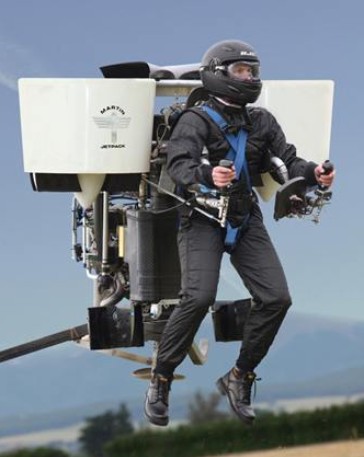
Oshkosh, Wisconsin, 2008, was the launch pad for a world first in personal flight today when Martin Aircraft Company unveiled the ultimate personal flying machine – the Martin Jetpack. Glenn Martin, Inventor of the Martin Jetpack and Managing Director of Martin Aircraft Company, showed the world that sustainable personal flight is now possible.
Glenn has devoted almost 30 years to the research and development of the Martin Jetpack. Glenn and a group of avionic, technical, design and production experts at Martin Aircraft Company have created a jetpack that flies 100 times longer than its predecessor the Bell Rocket Belt.
The Martin Jetpack has a patented fan jet technology, uses regular gasoline, complies with Ultralight regulations and is easy to fly after completion of a unique training program.
In 2005, Prototype 9 achieved sustained flight times, laying the foundation for a viable and successful pre-production prototype to be developed. In 2008 the Martin Jetpack was launched.
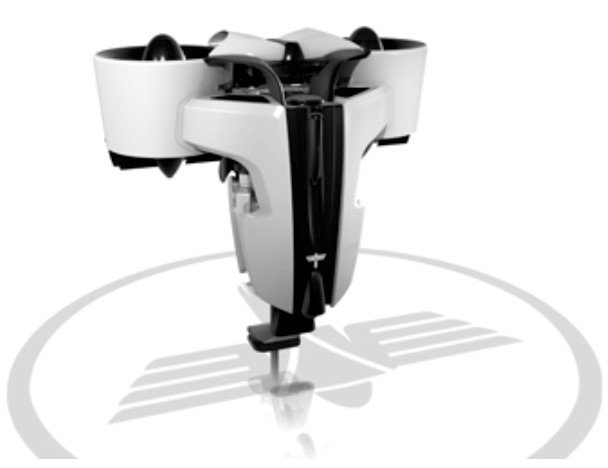
The core of this machine is the fan, its duct and the flow straighteners. These have cost the team countless hours as they pushed the boundaries of the science of ducted fans in a low speed environment. Mr Martin found that while many of the ‘facts’ older designs were based on were as solid as the day they were first committed to the text book, others were due either to the originators trying to simplify the calculations because of a lack of modem processing power, or had a fudge factor to cover steps in the process that didn’t become clear until high quality CFD systems were available.
A long series of experiments with Solidworks 3D CAD-drawn concepts run through CFD (a computer based simulation of a wind tunnel) brought about a series of promising steps forward in efficiency that were checked out on the workshop test rig. The team now have a fan blade that is not only light at roughly 100gm per blade, it also runs at 92 percent efficiency. The best Mr Martin can find elsewhere is the lift fans on the JSF which are published at 87 percent. The team have also worked hard to get the whole ducted fan package efficient across a broad speed range. The 2011 setup has a relatively flat efficiency curve with a small peak at around 60 km/h forward speed. Each fan unit is considered to be torque neutral which means the airflow from the duct is so close to straight that the twist is almost immeasurable, giving gains in thrust.
The fans needed a light, unobtrusive and reliable drive method which led the team to the modem synchronous belt. The latest designs have carbon fibre tensile cord inside the polyurethane belt with nylon facing on the teeth. The power transfer for width is better than for chain and challenges many gear-driven alternatives especially on weight. The major requirement for belts is to keep an alignment of better than half a degree and constant tension. Most belt drives use aluminium housings which shrink and grow with ambient temperatures let alone engine temperatures, so the decision was taken to go to a carbon fibre structure to all but eliminate temperature related dimension changes. The carbon structure also greatly assisted in keeping the alignment within spec.. The final touch was to make sure the drive and driven pulleys were fully supported by bearings on either side: no poor quality over hung shafts would be allowed in this design.
Once the horsepower requirements of the fans were known, a search of all known production engines was made. Power density, brake specific fuel consumption, package size and reliability were recorded, then checked against the requirements. No production engine had the power to weightt ratio needed allied with the high reliability the team demanded. Martin Aircraft sought advice from various companies and found that marine applications, such as outboards, shared many of the operational needs of the aviation world. Both users tend to run at three settings: idle; around 75% continuous; and 100% for extended periods. With this in mind, questions were asked of one specialist, Mercury Marine, to ascertain the level of stress an engine could be placed under and still achieve high reliability. The end result was four gentlemen For reliability and packaging reasons a water cooled V4 two-stroke was chosen. This gives a power pulse every 90 degrees which brings the peak and mean torque at the crankshaft nice and close together, resulting in a smooth output to the fans. To further smooth the power delivery, there is a ‘centre flex’ type rubber coupling before the drive enters the c!rive pulley. The cylinders are from Honda (CR 500 motor crosser), modified by replacing the steel sleeves with aluminium coated with nikasil. The change gives better heat transfer and reduces the engine weight by over 3kg. New heads have been made which have a carbon fibre top cover to keep the water in and the weight down.
The exhaust system is a simple yet brilliant piece of work which through its various interconnections and pipe lengths gives a lesser improvement at peak rpm compared to a full expansion chamber system, but functions well over a very wide band. The torque curve is one of the flattest I’ve seen, which means the horsepower line has no real humps or hollows as the rpm rise. Reliability is vital in a machine that has no wings (just a BRS ‘chute fitted) so the engine team have incorporated all the hallmarks of a reliable engine such as mean piston speeds below 15m/s, bore and stroke ratio kept below 1.15 / 1, and porting size and shape designed to protect the rings as they pass. All based on hard-won data from the marine industry where after tens of thousands of engines they have learnt a thing or two.
The cooling system has a neat (and patented) method of pumping air through the radiator. To understand it, think about blowing air across the top of a milk bottle. The airflow from your breath across the top creates a draw on the air in the milk bottle. The horizontally mounted radiator on thej etpack has ducts that sit on the side of the entry to the ducted fans so that the rush of air going into the fans pulls air through the radiator. The more horsepower applied the more airflow through the fans and therefore more flow through the cooling system. Another simple yet brilliant design.
The first prototype Jetpacks were manually controlled and apparently not hard to fly, but the team have their eye on a market where a high level of automation seems preferable. The fully fly-by-wire system uses the same unit as the Predator UAV for its air speed, gyro, magnometer, GPS and other critical inputs, but the processing and control is done by a dual redundant Martin Aircraft system. When creating it the team were helped immensely by a professor from Bremen University who joined for six months to apply his experience in control systems. He also helped with the creation of a proper flight simulator suitable for training and checking out software changes to the real thing. The fly-by-wire approach allows the operator to simply command the machine to rise or fall, turn left or right, leaving the control units to move the duct vanes and the cruciform, surfaces in the jetstrearn to create directional change while changing the engine output to control height and speed.
Release the controls at any time and the system will maintain height and gradually bring you back to stable hover.
Martin Aircraft has created a concept, not just a one-off machine. The current version suits US Part 103 rules, so it is limited in overall weight, speed and fuel capacity. Accepting these limitations opens up a large private market for the Jetpack. A slightly bigger ‘unregulated ‘ version on the same basic configuration can lift 200kg-plus payloads versus the current 115 kg and stay aloft for over 90 minutes. Still bigger versions exist on paper.
The 12th prototype featured a 200 hp V-4 engine driving two ducted fans. It had been flown to more than 3000 ft and 74 kph. The planned price at that stage was US$150,000 to US$250,000.
Standard Equipment:
Flight and Engine displays
Harness
Ballistic Parachute
Retractable undercarriage
Energy absorbing undercarriage.
Height: 5 ft
Width: 5.5 ft
Length: 5 ft
Structure: Carbon fibre composite
Empty weight: 250 lbs (excluding safety equipment)
Gross weight: 535 lbs
Useful (Pilot) Load: 280 lbs+
Maximum thrust: 600 lbs+
Fuel Capacity: 5 US gallons (as required by FAA Part 103,Ultralight Regulations)
Fuel burn: 10.0 gph
Engine: Martin Aircraft 2.0 L V4 2 stroke, rated at 200 hp (150 kw). Max 6000 rpm.
Electrical system: 12 V DC Battery, starter, 360 w alternator.
Rotor: Carbon / Kevlar composite diameter 1.7 ft
Max: 7058 rpm
Range: 31.5 miles (at max speed of 63 mph as required by FAA part 103).
Hover in ground effect: 8000 ft (estimated)
Hover above ground effect: 8000 ft (estimated)
Martin Aircraft Co
In 1998 the Martin Aircraft company was founded with the specific goal to research and develop a jetpack that could fly 100 times longer than the Bell Rocket Belt (26 seconds). In 2005, Prototype 9 achieved sustained flight times, laying the foundation for a viable and successful pre-production prototype to be developed.
The founder of Martin Aircraft Company and the inventor of the Martin Jetpack is Glenn Martin. Richard Lauder is the company’s Chief Executive.

Based in Christchurch, New Zealand, Martin Aircraft Company is developing the world’s first practical jetpack, the Martin Jetpack. Launched to global acclaim at the 2008 Experimental Aviation Association AirVenture air show in the USA, Martin Aircraft Company planned to fulfil its first customer orders in 2010.
Martin Slug
With the experience gained from the conversion of Motor Cadet PFA.1385, P.J.Martin began building a definitive motor glider which he call the Martin Slug.
It was given the PFA number 1388 and was to be powered by a VW engine.
Martin 162A Tadpole Clipper
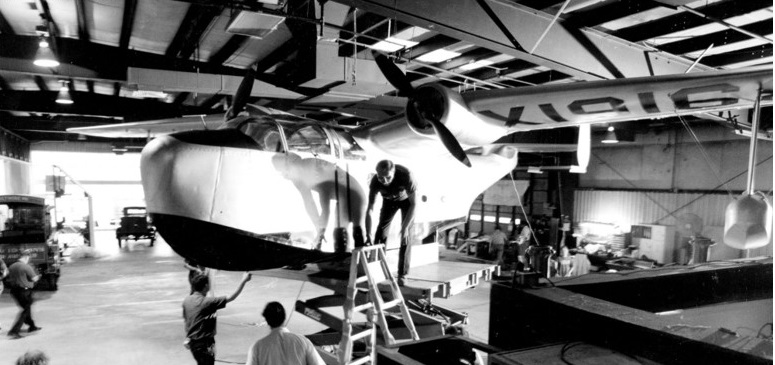
A piloted, three-eighths scale model of PBM flying boat; single-seat test aircraft built to generate aerodynamic data to design and build full-scale Martin PBM flying boat.
The construction was fabric-covered spruce plywood and aluminum.
In 1987, a dedicated and enthusiastic team of volunteers, many of whom were former Martin employees, began an exhaustive restoration of the 162A. After more than 10,000 man-hours of labor, the 162 was ready for display while on loan to the Museum of Industry in Baltimore, not far from where the “Tadpole Clipper” had been built and flown. Portions of the rear fuselage under-surface were left uncovered to illustrate some of the modifications made in the 162A’s hull during the course of its testing.
Wingspan: 43ft 5 5/8in / 13.25m
Length: 28ft 6 1/8in / 8.69m
Height: 12ft 1/8in / 3.66m
Weight: 2819.7 lb / 1279 kg
Martin 1913 Tractor / Scout / Special
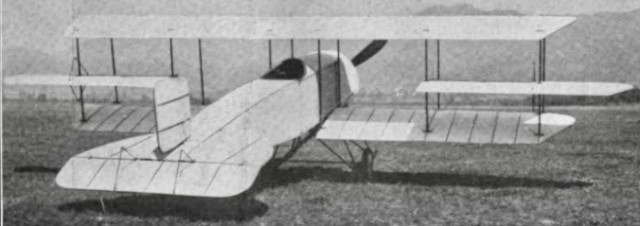
A single-seat biplane with a 90 hp Gnôme rotary engine. It was built for daredevil pilot Lincoln Beachey, but he rejected it on the grounds that it lacked necessary performance.
Martin 1910 Biplane
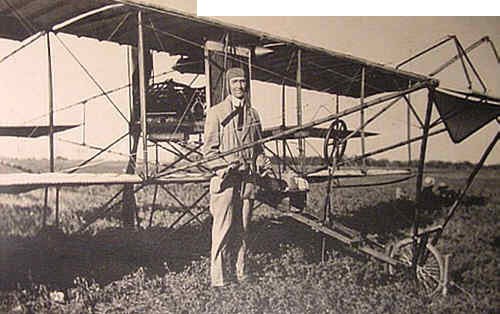
In 1910 Glenn L. Martin built another biplane machine with a slightly larger upper wing, interplane ailerons, a triangular stabilizer at the front rudder and a 50 hp Hall-Scott engine with which he set a few flight records of distance, duration and altitude in 1910 with flights from Newport-Beach to Catalina Island.
Martin 4-0-4

The prototype of an improved Martin 3-0-3 had been flown on 20 June 1947, but with it was decided instead to develop a new Martin 4-0-4. This incorporated the wing structural revisions and introduced a pressurised and slightly lengthened fuselage, accommodating as standard a crew of three or four and 40 passengers.
The airliner was unveiled in 1949 and immediately ordered by a variety of air carriers, gaining 101 orders from TWA and Eastern. The subsequent 4-0-4 was introduced in 1950 with a fuselage 39 inches longer, slightly more powerful engines than the 202, and pressurization.
The onset of the Korean War suddenly made airplane materials significantly more expensive, and Martin found itself filling orders at a loss and stopped production.
Two or these 40-passenger transports were in service with the U.S. Coast Guard in 1955 as the RM-1, similar to the civil Martin 4-0-4 airliner.

A total of 148 of the 2-0-2, 3-0-3, and 4-0-4 types were built until 1952. Examples served well into the 1980s with commuter airlines.
RM-1
Engines: two 2,400 h.p. Pratt & Whitney R2800-34W
Span: 93 ft. 3 in.
Weight: 44,900 lb.
Max. Speed: 312 m.p.h.
4-0-4
Engines: 2 x 2400hp Pratt Whitney R-2800 CB-16
Max take-off weight: 20366 kg / 44900 lb
Empty weight: 13211 kg / 29125 lb
Wingspan: 28.42 m / 93 ft 3 in
Length: 22.73 m / 74 ft 7 in
Height: 8.66 m / 28 ft 5 in
Wing area: 80.27 sq.m / 864.02 sq ft
Cruise speed: 502 km/h / 312 mph
Ceiling: 8840 m / 29000 ft
Range: 3058 km / 1900 miles
Seats: 52

Martin 303

Along with the unpressurized Model 202, Martin offered a companion pressurized model, known as the Model 303. United Air Lines was the primary sponsor of the 303, having invested one million dollars of its own money in the development. In addition to the 50 slated for delivery to United, Martin also had orders from Northwest Airlines, Braniff Airways, and Pan American-Grace Airways (PANAGRA) for 59 more.
Apart from cabin pressurization, the 303 differed from the 202 in that the wing span was shortened by about 4ft (1.2m) in an attempt to gain cruise performance at the expense of takeoff and climb performance. The 303 made its first flight on July 3, 1947; however, United canceled its large order a short time later.
Because of prevailing market conditions and serious stability problems encountered with the 202 and a need to redesign the wing structure, Martin dropped the 303 program the following December with a reported loss of more than $15 million. The prototype and almost all records were then scrapped for tax purposes.
A total of 148 of the 2-0-2, 3-0-3, and 4-0-4 types were built until 1952.
Martin 2-0-2 / RM-1 / VC-3A
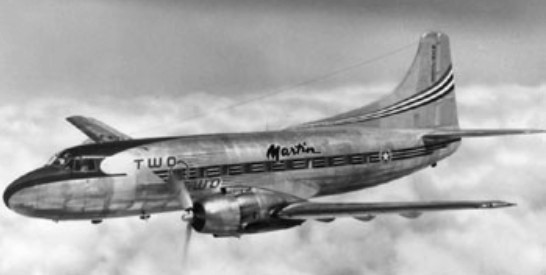
Attempting to gain a share of the post-World War II demand for civil airliners, the Glenn L. Martin Company flew on 22 November 1946 the prototype of a twin-engine 36/40-seat unpressurised transport designated Martin 2-0-2.
Power was provided by twin Pratt & Whitney 18-cylinder air cooled radial engines capable of developing a normal output of 1,800 hp, 2,100 hp for takeoff or 2,400 hp with water injection. The engines turned Hamilton Standard three-blade reversible-pitch airscrews.
The “Two- O-Two” was the first twin-engine airliner of postwar design to receive certification for airline use. Accommodations provided for a crew of three or four plus 36 to 40 passengers. A version of the 202 was outfitted with larger fuel tanks to increase its range to 2,365.
The first of these entered service in October 1947, but the loss of a 2-0-2 in 1948 as a result of wing structural failure led to modification of other in-service aircraft and production of this version was brought to an end.
When production ended in early 1953 a total of 103 had been built, this number including two supplied to the Coast Guard as staff transports under the designation RM-1G (later RM-1Z and finally VC-3A); they were subsequently transferred to the US Navy.
A total of 148 of the 2-0-2, 3-0-3, and 4-0-4 types were built until 1952.
Martin 202
Engines two 2,100-hp Pratt & Whitney R-2800 CB-16.
Wingspan: 28.42 m / 93 ft 3 in
Length: 21.74 m / 71 ft 4 in
Height: 8.66 m / 28 ft 5 in
Wing area: 80.27 sq.m / 864.02 sq ft
MTOW 19504 kg / 42999 lb
Empty wt. 26,930 lb
Top speed 311 mph.
Cruise 286 mph.
Stall 76 mph.
Initial climb rate 2,200 fpm
Range 3220 km / 2001 miles
Ceiling 33,000 ft
Takeoff distance (50′) 1,565 ft
Landing distance (50′) 1,720 ft
Seats 40.


