Built by Edward Zielenski in 1930, three place monoplane N10400 was powered by a 120hp Quick engine.
Piston
Ziegler Pfeil-Eindecker
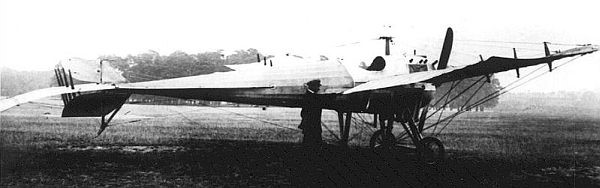
In 1912 Albert Ziegler acquired a used 50-55 hp Argus engine and a shed at the Bornstedter Feld near Potsdam from the Siemens-Schuckert company, where at least a year was needed to realise his “Pfeil-Eindecker”. Flown during the summer of 1913, it was said to have been very stable and well steerable.
Zhongyuan Shanzai
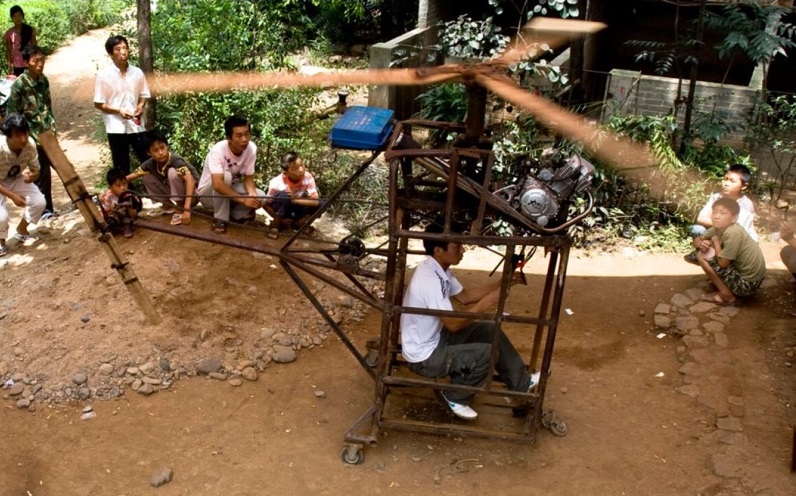
20-year-old Wu Zhongyuan, a farmer from Henan province. He has since childhood dreamed of flying and spent three months and $1,600 building a shanzai helicopter. The airframe is fabricated from a steel scaffold. Power comes from an old 150cc motorcycle engine driving Elm wood blades. Zhongyuan claims the chopper will fly to 800 meters (2,600 feet), but so far hasn’t been able to prove it.

Provincial authorities have forbidden him from flying on safety grounds.
Zerbe Sextuplane
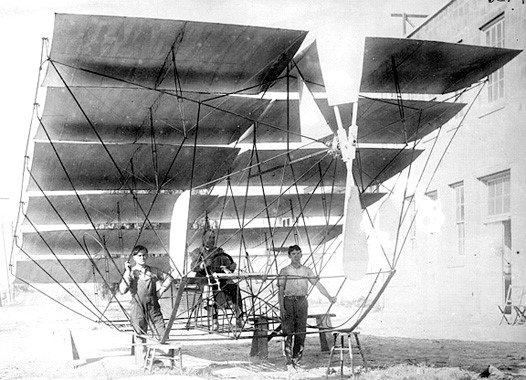
Californian Professor Jerome S. Zerbe produced a sextuplane with six 15′ wings forward-staggered over a framework bearing two tractor props, but there are no records of its success, if any.
Zerbe Air Sedan

In 1909 Californian Professor Jerome S. Zerbe built the four place cabin quadruplane Air Sedan. There were four short-span, double-cambered, forward-staggered wings, apparently with a ganged variable angle of attack. The cabin was plywood-clad.
Powered by a 100hp Gnôme or 90hp LeRhône rotary, it was flown by Tom Flannery from a field on the Washington County fairgrounds for a distance of about 1,000′ before being damaged on landing. No other flights were recorded.
Zerbe Multiplane / Quintaplane
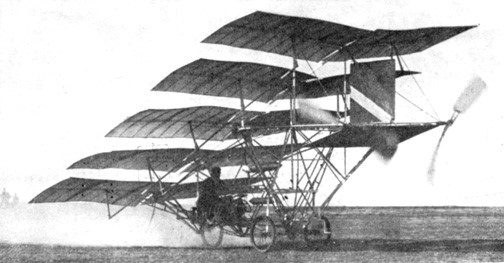
James Slough Zerbe, known as Professor Jerome S. Zerbe built three multiplanes circa 1910. The Quintaplane of 1910 had five wings attached to what appears to be a flying motorcycle.
Whether or not it ever flew is unknown, but the second five-wing multiplane built by Californian Professor Jerome S. Zerbe, came to grief on January 11, 1910 during the 1910 Los Angeles International Air Meet at Dominguez Mesa. It was reported as being “a casualty before becoming airborne.”

James Slough Zerbe, known as Professor Jerome S. Zerbe built three multiplanes circa 1910.
Multiplane of 1910.
The second five-wing multiplane built by Californian Professor Jerome S. Zerbe, came to grief on January 11, 1910 during the 1910 Los Angeles International Air Meet at Dominguez Mesa.
Zeppelin-Staaken E.4/20

Designed in 1917 by Adolf Rohrbach, the Staaken E-4 was a stressed metal monocoque fuselage canatlevered monoplane four-engined passenger aircraft with galley, w.c., baggage stowage and full communications. The most advanced aircraft of its time, the E.4/20 flew successfully in 1920. Completed after the armisitice and extensively tested by the Allies who ordered it destroyed because of its potential as a bomber – it was faster than any Allied fighter of the day. It was dismantled in 1922.
E-4/20
Engines: 4 x Maybach IVa, 190kW
Max take-off weight: 8500 kg / 18739 lb
Wingspan: 31.0 m / 102 ft 8 in
Length: 16.6 m / 54 ft 6 in
Wing area: 106.0 sq.m / 1140.97 sq ft
Max. speed: 230 km/h / 143 mph
Cruise speed: 211 km/h / 131 mph
Range w/max.fuel: 1200 km / 746 miles
Crew: 3
Passengers: 12-18

Zeppelin-Staaken R.XV
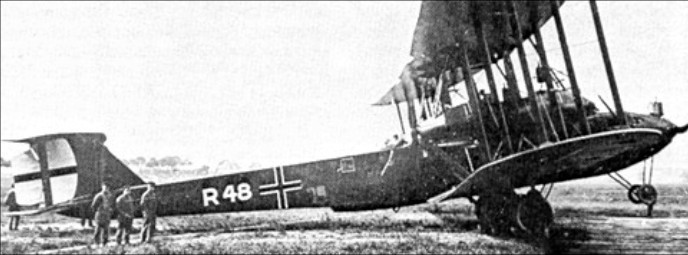
The first prototype flew in 1918. Three built.
R.XV
Engines: 5 x Maybach Mb.IV
Max take-off weight: 14450 kg / 31857 lb
Wingspan: 42.2 m / 138 ft 5 in
Max. speed: 130 km/h / 81 mph
Armament: 6 machine-guns
Zeppelin-Staaken 8301

The first prototype flew in 1918. Three built.
Zeppelin 8301
Engines: 4 x Mercedes D-IVa
Max take-off weight: 12500 kg / 27558 lb
Empty weight: 9000 kg / 19842 lb
Wingspan: 42.4 m / 139 ft 1 in
Length: 21.0 m / 69 ft 11 in
Height: 6.8 m / 22 ft 4 in
Wing area: 340.5 sq.m / 3665.11 sq ft
Max. speed: 130 km/h / 81 mph
Range w/max.fuel: 1000 km / 621 miles
Crew: 5
Armament: 5 machine-guns
Bombload: 1800kg
Zeppelin-Staaken R.VI / Staaken L

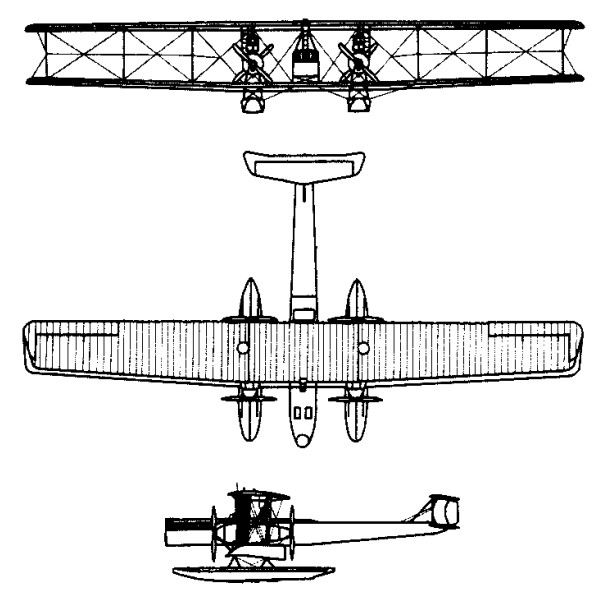
First flown in mid-1917, the Zeppelin-Staaken R VI, with 18 examples built, was to be by far the most numerous of the giant, long ranged R-planes. Powered either by four 245hp Maybach Mb IVs, or four 260hp Mercedes D IVa engines, mounted back to back in twin nacelles to drive two pusher and two tractor propellers, the R VI’s top level speed was 135km/h, while its normal range with a 1000kg bomb load was around 880km. Delivered to Rf Abt 501, by now transferred to the Western Front, the RVIs sometimes operated alongside their smaller G type bretheren in raids against the English mainland and more distant French ports and cities.
The Navy operated a sole, float-equipped example of this bomber under the designation Zeppelin-Staaken Type L, serialled 1432. It was wrecked during trials in 1918.
R.VI
Engine: 4 x Maybach Mb.IV, 183kW
Max take-off weight: 11848 kg / 26121 lb
Empty weight: 7921 kg / 17463 lb
Wingspan: 42.2 m / 138 ft 5 in
Length: 22.1 m / 73 ft 6 in
Height: 6.3 m / 21 ft 8 in
Wing area: 332 sq.m / 3573.61 sq ft
Max. speed: 135 km/h / 84 mph
Ceiling: 4320 m / 14150 ft
Range: 800 km / 497 miles
Crew: 7
Armament: 4 x 7.92mm machine-guns
Bombload: 2000kg
 All Aero